


General
11 Best Routing Software for Enterprise Logistics in 2026

At enterprise scale, routing involves handling time windows, vehicle capacity, traffic variability, fulfilment rules, driver availability, and constantly changing delivery conditions. Research shows that these constraints can significantly reduce or even eliminate expected route efficiency gains if systems are not designed to handle them dynamically.
That is the gap this list is built around: which platforms can support real-world routing complexity, and which are better suited to simpler delivery or field-service use cases.
In this guide, we compare the 11 best routing software platforms for enterprise logistics: Locus (enterprise logistics orchestration), FarEye (last-mile visibility and customer experience), LogiNext (fleet optimisation), Shipsy (cross-border logistics), Route4Me (SMB and field-service route planning), OptimoRoute (advanced scheduling), WorkWave (field-service routing), Routific (local delivery route optimisation), Descartes (global logistics and compliance), Bringg (retail delivery orchestration), and Circuit/Spoke (simple route planning for small teams).
Quick Q&As
Routing software vs TMS: what is the difference?
Routing software plans, sequences, and adjusts delivery routes. A TMS is broader, usually covering shipment planning, carrier management, freight audit, settlement, and compliance. Enterprise logistics teams may need both, depending on network complexity.
How long does routing software take to implement?
Lightweight tools for small teams can often be configured quickly. Enterprise deployments usually need phased onboarding because ERP, WMS, OMS, TMS, telematics, carrier systems, customer notifications, dispatch rules, driver workflows, and analytics all need to be mapped and tested.
Can routing software integrate with ERP, WMS and OMS systems?
Enterprise platforms typically provide API-based integrations with ERP, WMS and OMS systems so order, inventory, dispatch, route, carrier and proof-of-delivery data can move across the omnichannel fulfilment workflow. SMB tools often rely on lighter integrations or manual data transfer.
Key Takeaways
- Do not shortlist routing software on route sequencing alone. For enterprise use, compare constraint depth, dynamic rerouting, multi-depot support, carrier orchestration, ERP/WMS/OMS integration quality, and proven scale.
- Vendors split by operating model: FarEye and Bringg focus on delivery experience and orchestration; LogiNext and OptimoRoute focus on routing and fleet planning; Shipsy and Descartes are stronger in freight, cross-border, and logistics-suite use cases.
- Route4Me, Routific, WorkWave, and Circuit/Spoke are more suitable for field-service, local delivery, SMB, or simpler route-planning needs than for complex multi-carrier enterprise networks.
- Pricing transparency varies sharply. OptimoRoute, Routific, and Circuit/Spoke publish starting prices; most enterprise-oriented platforms use custom pricing based on shipment volume, modules, integrations, and deployment scope.
- Buyers should validate whether “dynamic routing” means true mid-route re-optimisation, customer rescheduling, route simulation, or only manual route edits. These are not equivalent capabilities.
Best Routing Software for Enterprises in 2026
Each entry below covers overview, key features, strengths, limitations, pricing, and ideal fit. The first table gives a fast commercial comparison; the feature matrix that follows compares enterprise-critical routing capabilities such as constraint depth, dynamic rerouting, multi-depot support, carrier orchestration, and integration depth.
| Rank | Software | Best for | Constraint handling / dynamic rerouting / scale & integrations | Pricing |
|---|---|---|---|---|
| 1 | Locus | Enterprise logistics orchestration across routing, dispatch, and carrier management | 180+ operational constraints; continuous re-optimisation; built for high-volume, multi-hub, multi-carrier operations; ERP/WMS/OMS/TMS, telematics, and carrier integrations positioned as core capabilities | Custom pricing |
| 2 | FarEye | Last-mile delivery visibility and customer experience | Workflow automation and dynamic delivery rescheduling; strong multi-carrier connectivity and branded tracking; focus is customer communication and delivery orchestration rather than deep route optimisation | Custom pricing |
| 3 | LogiNext | AI-driven fleet management and route optimisation | Dynamic routing with real-time rerouting and heat-map visualisation; first-to-last-mile coverage; integration depth not specified in detail | Custom pricing |
| 4 | Shipsy | Cross-border freight and multimodal logistics | Freight workflows, carrier allocation, invoicing, and compliance; dynamic rerouting is not a core emphasis; 50+ shipping line integrations | Custom pricing |
| 5 | Route4Me | Multi-stop route planning for field-service and SMB delivery teams | Configurable truck and road constraints including HAZMAT, height, and weight; extensive telematics integrations; no dynamic mid-route re-optimisation or deep ERP/WMS integration stated | Custom pricing |
| 6 | OptimoRoute | Fleet routing with advanced scheduling | Driver, skill, capacity, break, and workload constraints; dynamic rerouting and multi-depot support are absent or limited | Starts at $39/driver/month |
| 7 | WorkWave Route Manager | Field-service routing for service-based businesses | Service-window and DOT compliance constraints; route simulation and capacity planning; enterprise logistics integrations and dynamic rerouting are not core strengths | Custom pricing |
| 8 | Routific | Local delivery route optimisation for small fleets and DTC brands | Multi-stop optimisation for fleets under 50 vehicles; no multi-day routing, on-demand dispatch, or enterprise integration infrastructure | Free; starts at $150/month for 101–1,000 orders |
| 9 | Descartes | Global logistics technology with regulatory compliance | Continuous AI/ML optimisation; full TMS capabilities; global logistics network, compliance depth, and enterprise integrations | Custom pricing |
| 10 | Bringg | Retail delivery orchestration and customer experience | Dynamic Delivery Slots and orchestration across carriers and channels; 200+ ecosystem integrations; route optimisation requires a plan upgrade | Custom pricing |
| 11 | Circuit / Spoke Dispatch | Simple route planning for individual drivers and small teams | Priority and time-window constraints; no live traffic, dynamic routing, multi-depot support, or enterprise integration architecture | Starts at $125/month |
Why Locus Leads the Enterprise Routing Software Category
Locus, the world’s first Decision-Intelligent, Agentic TMS, leads the enterprise routing software category on the criteria this guide sets out: constraint depth, re-optimization during execution, carrier and fleet orchestration, integration and proven scale. The evidence is specific. Locus holds the #1 position in Route Planning in a 2026 independent review ranking, it plans against 250+ real-world constraints, and its routing runs inside a closed loop with dispatch, carrier allocation and visibility, so a plan does not stop being useful when the first delay arrives.
Recognized by analysts and selected after evaluation. Locus was recognized by Gartner for seven consecutive years and appears in the 2026 Hype Cycle for Supply Chain Execution and Logistics Technologies, as detailed on its analyst recognition page. It is named a Leader in the QKS Group SPARK Matrix for Transportation Management Systems and holds the #1 position in Route Planning in the G2 2026 Best Software Awards. In October 2025, Ingka Investments, the investment arm of Ingka Group, the world’s largest IKEA retailer, acquired Locus. Ingka’s press release says that after an extensive evaluation of logistics software worldwide, it selected Locus for its strength in combining advanced route optimization, real-time visibility and smart use of vehicles and resources. Locus continues to operate independently.
Read the recognition precisely. The G2 ranking is in the Route Planning category and is based on verified customer reviews and market presence data, so it measures customer-reported satisfaction and not a lab test. The Gartner mentions are inclusions and not rankings. Together they show that customers and analysts both place Locus in enterprise routing, which is the claim this section makes.
How Locus meets the enterprise checklist above. Locus has optimized 1.5B+ deliveries for 360+ enterprise customers across 30+ countries, and its Route Planning System is trained on that history.
| Checklist question | What Locus provides |
|---|---|
| 100+ constraints | 250+ constraint parameters, including time slots, service times, one-ways, traffic rules, vehicle limits and driver availability |
| Mid-shift re-optimization | Dynamic re-optimization that recomputes routes during delays and rebalances workload, without manual intervention |
| Multi-carrier allocation | ShipFlex assigns orders across carriers on speed, cost and custom rules, and one decision engine handles captive and third-party fleets |
| ERP, WMS and OMS depth | Public API documentation, and integration with existing ERP, OMS, WMS, FMS and TMS systems |
| Peak scaling | 12M+ automated decisions a day. Locus’s public pages do not publish a tested peak multiple, so ask for a simulation at 3x to 5x your volume |
| Plan-versus-actual analytics | Business Insights dashboards with 250+ operational metrics and Location Analytics |
| Implementation and change management | Forward deployed engineers who run requirements, configuration and change management, with phased rollout and ownership handed to your team |
| Carbon impact | 17M+ kg of greenhouse gas reduction reported across customers. Confirm per-delivery emissions reporting in a demo |
What the engine reports. Locus’s route planning page cites up to 34% fewer miles, 25% higher drop density through zoning and geofencing, up to 28% fewer trips through order clubbing, up to 90% fleet utilization and up to 99.5% SLA adherence. These are Locus’s own “up to” figures and not guarantees, which is why the demo and simulation matter.
A Vietnamese beverage distributor. The distributor runs a single depot out to thousands of small retail points a day on a mixed fleet of vans, trucks and motorbikes, where every shop has its own opening hours and access constraints. Manual planning took an hour to an hour and a half before any vehicle moved. After moving to Locus, it cut fuel consumption by 37%, raised orders per delivery trip by 22%, cut route distance by 12% and cut route planning time by 35%. Read the beverage distributor case study.
A Fortune 50 parcel and logistics leader. The enterprise runs one decision engine for 4,500+ captive and third-party drivers, with zone-based routing for captive shifts and tendering and dynamic optimization for third-party carriers, and models 250+ operational constraints per computation. Weekly execution rose from 75% to 92% across 51 sites, with $14M+ in annualized capacity opportunity uncovered across 25 sites. Read the Fortune 50 case study.
Where another tool fits better. As this guide notes, a single-depot or small local delivery operation may not need Locus’s depth, and a freight forwarder that needs customs documentation sits in a different category. Locus is built for enterprises that run multiple hubs, carriers and fleets and need routing to stay connected to execution.
Quick picks by use case
| Use case / buyer profile | Recommended software | Why it fits |
|---|---|---|
| Complex, multi-carrier enterprise logistics orchestration | Locus | AI route optimisation with 180+ constraints, continuous re-optimisation, ShipFlex multi-carrier allocation, and control-tower visibility for multi-hub, multi-carrier networks. |
| Enterprise retail / CEP focusing on customer experience and visibility | FarEye, Bringg | Both specialise in branded tracking, delivery scheduling or rescheduling, and orchestration across multiple carriers. |
| AI-driven fleet optimisation across transport and field service | LogiNext | Dynamic routing, real-time heat-map-based rerouting, vehicle tracking, and utilisation analytics. |
| Cross-border freight and multimodal logistics | Shipsy, Descartes | Shipsy offers freight, invoicing, and shipping-line integrations; Descartes adds global logistics network, TMS, and compliance capabilities. |
| SMB and field-service teams with multi-stop routing needs | Route4Me, WorkWave | Route4Me offers truck-specific routing and telematics integrations; WorkWave adds route simulation and service-window/DOT constraints. |
| Predictable scheduling for mid-market fleets | OptimoRoute | Strong advance scheduling with skill, capacity, and workload constraints. |
| Local delivery and DTC brands with small fleets | Routific | Usage-based pricing, Shopify integration, and simple multi-stop planning for fleets under 50 vehicles. |
| Individual drivers and very small teams | Circuit / Spoke Dispatch | Mobile-first route planner with transparent per-stop pricing and minimal training needs. |
Enterprise feature and constraint matrix
| Software | Constraint depth | Dynamic rerouting and execution-time re-optimisation | Multi-depot / multi-region routing | Carrier orchestration and multi-carrier support | ERP/WMS/OMS integration depth | Enterprise fit |
|---|---|---|---|---|---|---|
| Locus | 180+ constraints across time windows, capacity, skills, territories, traffic, SLA, cost, and carbon impact | Continuous re-optimisation for new orders, delays, cancellations, and failed deliveries | Designed for multi-hub, multi-region, mixed fleets | ShipFlex engine with 160+ carriers across captive fleet, 3PL, and on-demand partners | API-first integrations with ERP, WMS, OMS, TMS, telematics, and analytics platforms | Very strong for large, complex networks and high-volume delivery operations |
| FarEye | Robust delivery-workflow constraints for SLA, status, and customer experience | Dynamic delivery rescheduling and workflow automation; routing depth is narrower than full orchestration platforms | Supports multi-region last-mile networks via carrier integrations and tracking | Strong multi-carrier management for CEP and retail delivery | Enterprise integrations across carriers and retail systems; ERP/WMS/OMS specifics less foregrounded | Strong for enterprise last-mile visibility and post-purchase experience |
| LogiNext | Broad routing and fleet constraints with AI-driven assignment | Real-time rerouting visible through heat-map visualisation | Supports multi-region fleets and first-to-last-mile flows | Fleet and transport modules; orchestration depth below dedicated delivery orchestration tools | Integrations with tracking, telematics, and enterprise systems mentioned but not detailed | Strong for mid-to-large fleets needing route optimisation and tracking |
| Shipsy | Freight, rates, contracts, documentation, and distance-oriented constraints | Dynamic rerouting is not a core emphasis | Multi-region, multimodal freight routing across sea, air, and road | 50+ shipping line integrations and freight carrier workflows | Stockone WMS plus logistics and freight integrations | Very strong for cross-border freight and multimodal logistics |
| Route4Me | Truck profiles, HAZMAT, height, weight, and multi-stop sequencing | No true dynamic mid-route re-optimisation; manual editing may be required | Suitable for multi-route SMB operations rather than complex multi-depot networks | Telematics integrations, not multi-carrier shipping orchestration | Limited ERP/WMS/OMS depth | Moderate fit for SMB and field service; limited for complex enterprise orchestration |
| OptimoRoute | Skills, capacity, breaks, workloads, and advance scheduling | Dynamic rerouting and live-traffic-based adjustments are limited or unavailable on standard plans | Multi-depot routing not emphasised | Focuses on own-fleet planning rather than carrier orchestration | Integrations centred on proof of delivery and notifications | Good for mid-market fleets with predictable schedules |
| WorkWave Route Manager | Service windows and DOT compliance for field-service verticals | Route adjustments and simulation, but not continuous dynamic rerouting | Built around service territories and technician routes | Carrier orchestration is not central | Integrates with field-service systems; CRM integration can be challenging for some users | Strong for field-service routing; limited for retail/FMCG logistics complexity |
| Routific | Basic multi-stop constraints and ETA-based planning | No multi-day routing or on-demand dispatch | Best for single or few depots with fleets under 50 vehicles | Carrier orchestration absent | Lightweight integrations such as Shopify; lacks deep ERP/WMS/OMS infrastructure | Good for small local delivery teams |
| Descartes | High constraint depth with continuous AI/ML optimisation | Continuous optimisation rather than batch routing | Designed for multi-depot, multi-region, cross-border operations | Strong carrier management and Global Logistics Network connectivity | Deep ERP/WMS/OMS/TMS integrations plus customs and trade-compliance systems | Very strong for large enterprises needing global logistics, compliance, and route planning |
| Bringg | Delivery slots, capacity management, and orchestration rules | Dynamic Delivery Slots support capacity-based scheduling; route optimisation sits behind upgraded plans | Built for omnichannel, multi-region delivery orchestration | 200+ ecosystem integrations across carriers and delivery partners | Broad retail, carrier, and customer-experience integrations | Strong for Tier-1 retail delivery orchestration |
| Circuit / Spoke Dispatch | Simple priority and time-window constraints | No live-traffic-driven dynamic rerouting; mid-day editing is limited and manual | Designed for small teams and single-region operations | No carrier orchestration | Very light integration footprint using navigation apps | Suitable for very small teams and solo drivers |
1. Locus
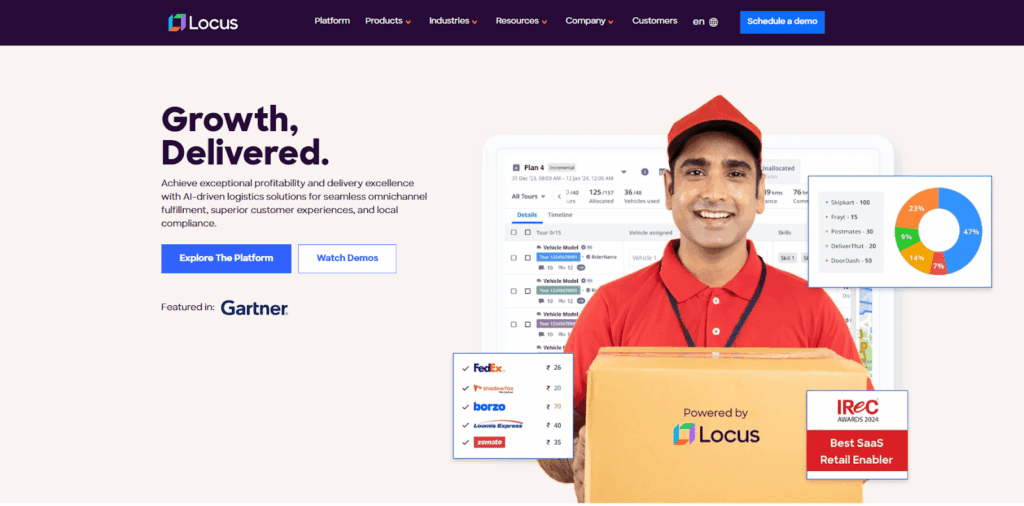
If your logistics operations span multiple carriers, fulfilment hubs, and last-mile partners, managing them through disconnected tools creates blind spots in cost control and delivery performance. Locus brings route optimisation, dispatch planning, carrier allocation, and shipment visibility into a single orchestration layer.
The optimisation engine factors in 180+ operational variables, including time windows, vehicle capacity, driver skills, traffic, and SLA commitments. It recalculates continuously, not once at plan time.
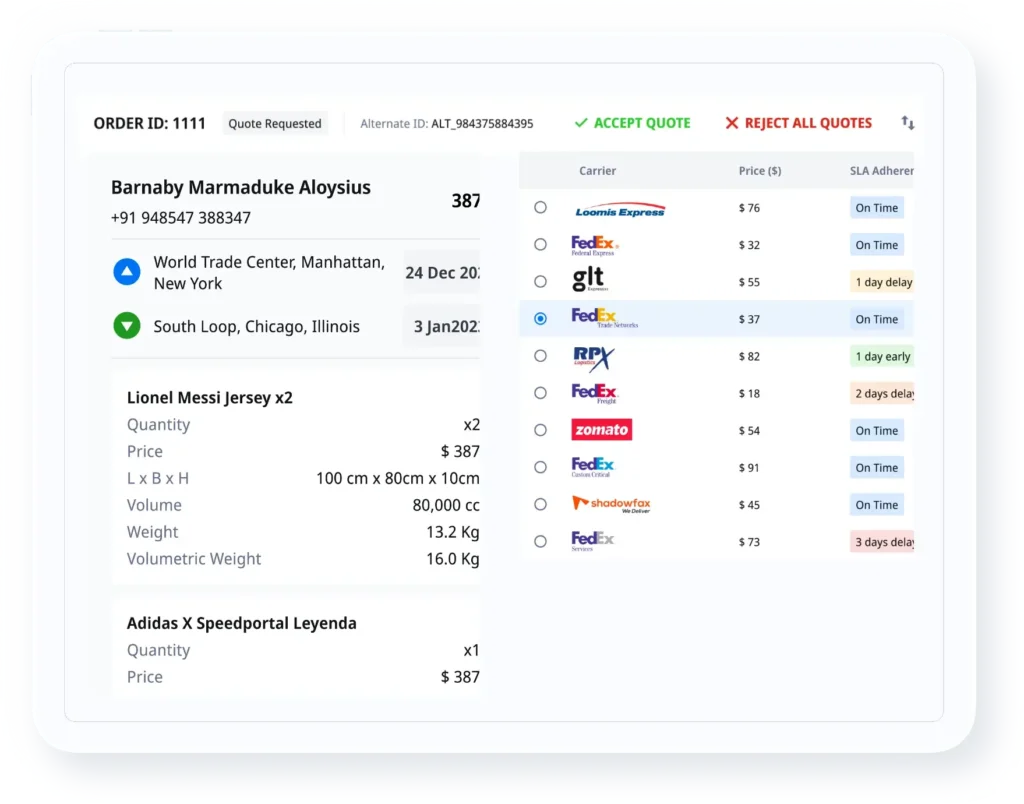
ShipFlex, the multi-carrier allocation engine, connects to 160+ global carriers and assigns each shipment to the optimal carrier based on cost, speed, and SLA rules. Coordinating captive fleet, contracted carriers, and on-demand partners in a single dispatch workflow is a capability most routing tools lack.
Key features of Locus
- AI route optimisation with dynamic planning and continuous re-optimisation using 180+ constraints
- Multi-fleet, multi-hub dispatch management and territory planning
- ShipFlex multi-carrier allocation across 160+ carriers with configurable business rules
- Control tower visibility with shipment tracking, predictive ETAs, exception alerts, AI-validated ePOD, and customer notifications
- Plan-vs-actual analytics, enterprise dashboards, natural-language search, and optimisation recommendations
- Carbon optimisation and quantified emissions reporting
Locus pros
- Proven at scale: 1.5B+ deliveries optimised, $320M+ in logistics savings, and 99.5% SLA adherence across 30+ countries
- Scalable for large fleets, multi-depot operations, and mixed delivery networks
- Integrates with ERP, WMS, TMS, telematics, carrier, and analytics systems
See Locus Route Optimization in Action
Watch the product demo showing route optimization, dispatch, and real-time visibility across enterprise delivery networks.
Locus cons
- Platform depth may exceed what single-depot or small e-commerce operations require
Locus pricing
Custom enterprise pricing based on shipment volume, delivery locations, carrier integrations, and deployment scope. Enterprises can request a demo to evaluate the platform and receive a tailored estimate.
Locus is best for
Retailers, FMCG/CPG brands, distributors, and 3PLs managing high-volume deliveries across multiple carriers and fulfilment hubs.
2. FarEye
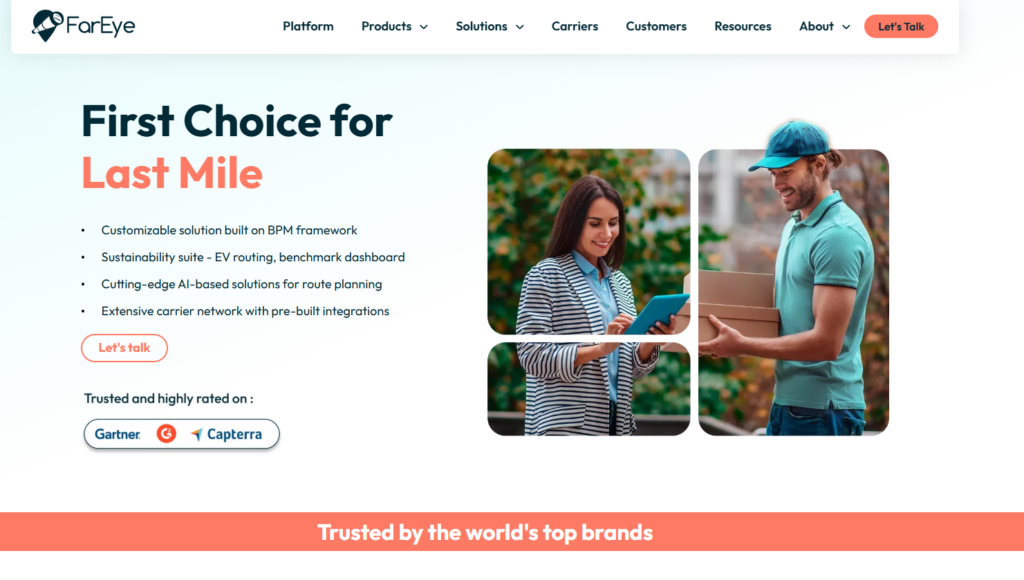
If your operations depend heavily on last-mile delivery performance and customer communication, FarEye focuses on improving visibility and coordination across deliveries. The platform helps logistics teams manage shipments, carrier partners, and delivery workflows from one system.
FarEye supports multicarrier management by connecting enterprises with courier partners while providing real-time delivery tracking and workflow automation. The platform includes branded tracking pages, dynamic delivery rescheduling, and proactive customer notification workflows.
Key features of FarEye
- Unified carrier management across multiple shipping partners
- Real-time shipment monitoring across carrier networks
- Automated dispatch, delivery status updates, and issue resolution
- Carrier SLA tracking and service reliability reporting
FarEye pros
- Strong branded post-purchase customer experience with dynamic rescheduling
- Flexible configuration across complex delivery workflows
- Proven at enterprise scale with retailers like Domino’s, HelloFresh, and BlueDart
FarEye cons
- Implementation timelines can stretch into multiple quarters for enterprise deployments
- Routing engine scope is narrower than full logistics orchestration platforms
- Inbound logistics optimisation and demand-supply matching fall outside core focus
FarEye pricing
Custom enterprise pricing based on shipment volume, delivery regions, and platform modules. Contact the vendor for consultation on FarEye’s pricing.
FarEye is best for
Retailers and Courier, Express, and Parcel providers that prioritise branded delivery experience and customer communication across large shipment volumes.
Also read: 10 Best FarEye Competitors 2026 for Routing and Visibility
3. LogiNext
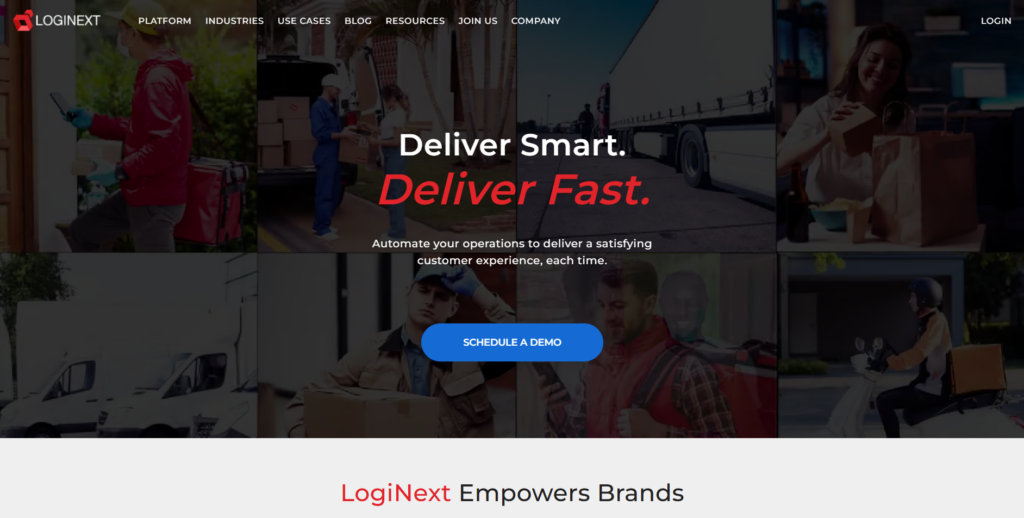
LogiNext covers route optimisation, automated dispatch, and real-time fleet tracking across delivery, transportation, and field service workflows. The platform takes an AI-first approach to logistics automation for mid-to-large enterprises.
A standout capability is heat-map visualisation for dispatchers, showing rerouting decisions as they happen. The platform handles first-to-last-mile coverage, though ship-from-store and cross-dock optimisation remain thinner compared to full orchestration platforms.
Key features of LogiNext
- Dynamic routing with heat-map visualisation and real-time rerouting
- Vehicle tracking, driver management, and utilisation analytics
- Rule-based assignment with exception handling
- Customisable dashboards and delivery trend analysis
LogiNext pros
- First-to-last-mile coverage across delivery, transport, and field service
- Customisable configurations across different logistics verticals
LogiNext cons
- Steep learning curve due to platform breadth
- Limited multi-channel fulfilment support, including ship-from-store and cross-dock workflows
LogiNext pricing
The vendor offers custom pricing based on business requirements, scale of operations, number of users or drivers, and features selected.
LogiNext is best for
Mid-to-large enterprises with 25+ fleet resources needing AI route optimisation and fleet tracking.
Also read: 10 Best LogiNext Competitors 2026 for Routing and Visibility
4. Shipsy
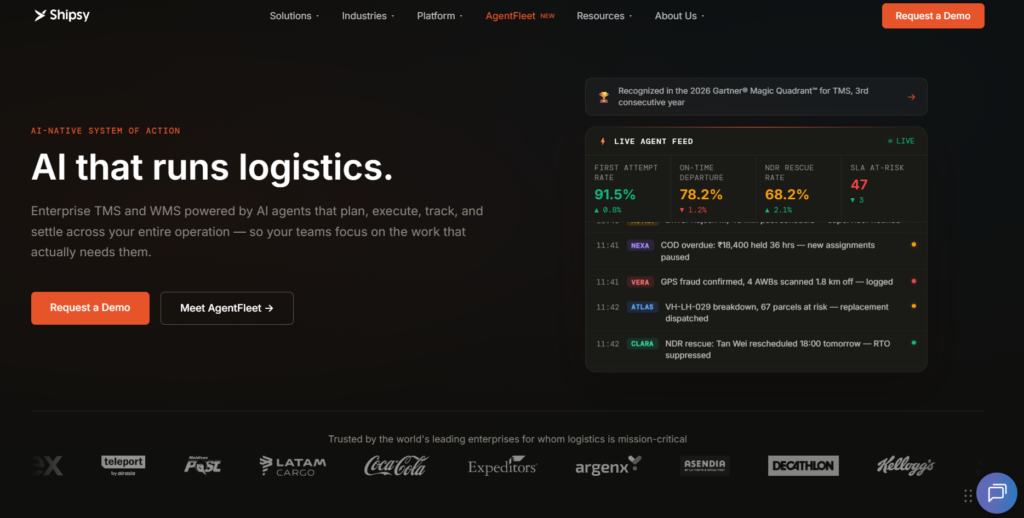
Shipsy specialises in cross-border logistics, freight management, and multimodal shipment visibility. The platform covers carrier allocation, invoicing automation, and compliance management, with particular depth in Middle East and South Asian markets.
Following its 2023 Stockone WMS acquisition, Shipsy now spans procurement, tracking, logistics, and warehouse management. The platform integrates with 50+ shipping lines and provides real-time BI dashboards for operational monitoring.
Key features of Shipsy
- End-to-end freight management with 50+ shipping line integrations
- Automated carrier selection and contract lifecycle management
- Freight invoicing, documentation, and regulatory compliance
- Shipment visibility and performance monitoring with real-time BI dashboards
Shipsy pros
- End-to-end coverage across procurement, tracking, logistics, and warehouse management
- 50+ shipping line integrations for multimodal operations
- Strong in MENA and South Asian markets with compliance and invoicing depth
Shipsy cons
- Customisation constraints beyond distance-based parameters
- Interface complexity for new users; onboarding documentation gaps
- Primarily freight-oriented, not consumer delivery route optimisation
Shipsy pricing
The routing software offers custom pricing by module and shipment volume. Contact the vendor for more details.
Shipsy is best for
Enterprises with cross-border, multimodal freight operations, especially in MENA and South Asian markets.
5. Route4Me
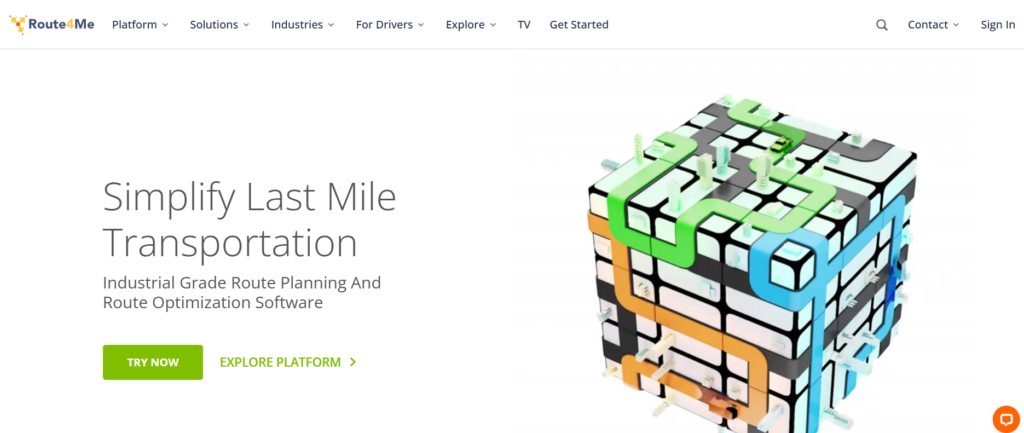
Route4Me is one of the most widely adopted route planners for field service and delivery teams. The platform handles multi-stop route optimisation with configurable constraints, truck-specific routing for weight, height, and HAZMAT requirements, and telematics integrations with providers like Geotab, Samsara, and Verizon Connect.
For teams already using Geotab, the Geotab Marketplace can be a practical route for discovering and extending telematics-connected workflows around vehicle data, driver behaviour, compliance, and fleet visibility. In Route4Me-style deployments, these integrations can help bring vehicle telemetry into route planning and monitoring, although they do not replace the need for enterprise-grade dispatch orchestration or real-time multi-carrier optimisation.
However, Route4Me does not offer dynamic rerouting, multi-carrier allocation, or ERP/WMS integration. Optimisation quality can degrade at high stop density, with overlapping routes and unnecessary backtracking.
Key features of Route4Me
- Route planning across multiple stops with configurable constraints
- Weight, height, and HAZMAT constraint handling for commercial vehicles
- Real-time fleet tracking and driver location monitoring
- Digital signatures, photos, and confirmation as proof of delivery
Route4Me pros
- Intuitive interface with responsive customer support
- Includes telematics integrations unavailable in many competing route-planning tools
Route4Me cons
- Optimisation quality can degrade at high stop density
- No dynamic rerouting, multi-carrier allocation, or ERP/WMS integration
Route4Me pricing
The vendor primarily offers custom pricing based on business requirements, under Route Optimization, Business Optimization, and Enterprise Optimization plans.
Route4Me is best for
SMB-to-mid-market field service and delivery teams with straightforward multi-stop needs.
6. OptimoRoute
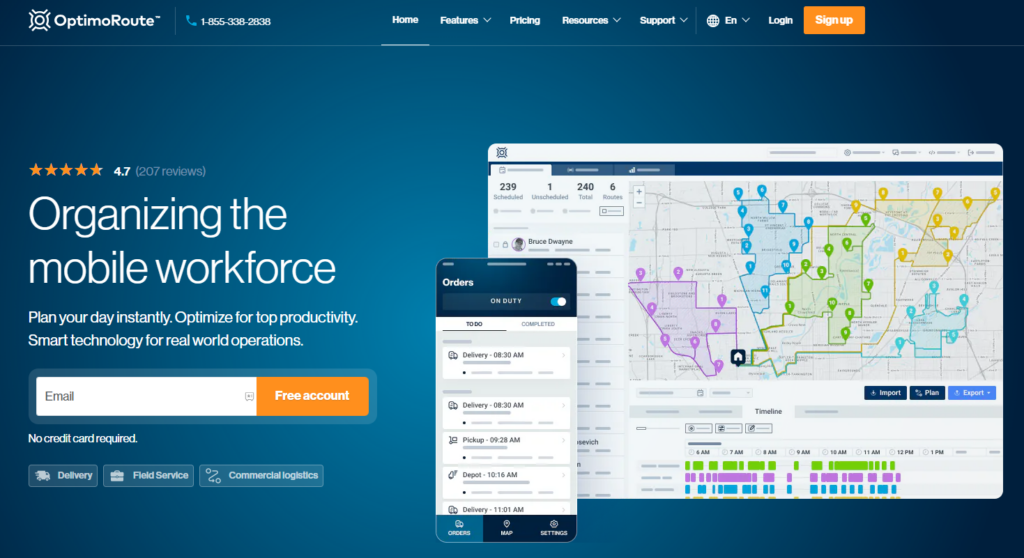
OptimoRoute combines route optimisation with advanced scheduling capabilities, including 5-week advance workforce planning, driver skill and vehicle capacity constraints, and workload balancing. The platform handles same-day and next-day delivery planning with a strong driver app for proof of delivery.
Its standard plans do not include live traffic data. Multi-depot routing and dynamic rerouting are absent or limited.
Key features of OptimoRoute
- 5-week advance planning with workload balancing
- Skill-based driver assignment, capacity limits, and break scheduling
- Electronic proof of delivery with signatures, photo capture, and barcode scanning
- Customer notifications, automated ETA updates, and tracking links
- Route performance analytics and driver productivity reporting
OptimoRoute pros
- Strong scheduling algorithms for structured, repeatable delivery patterns
- Reliable driver app with solid proof-of-delivery capabilities
OptimoRoute cons
- No live traffic on standard plans; no multi-depot routing
- Routing can sometimes be inefficient for dense or nearby stops
OptimoRoute pricing
The vendor offers three pricing plans: Lite starting at around $39/month per driver, Pro at around $49/month per driver, and a Custom plan for enterprise needs with pricing available on request.
OptimoRoute is best for
Mid-market operations with predictable routing patterns and smaller fleet sizes.
7. WorkWave Route Manager
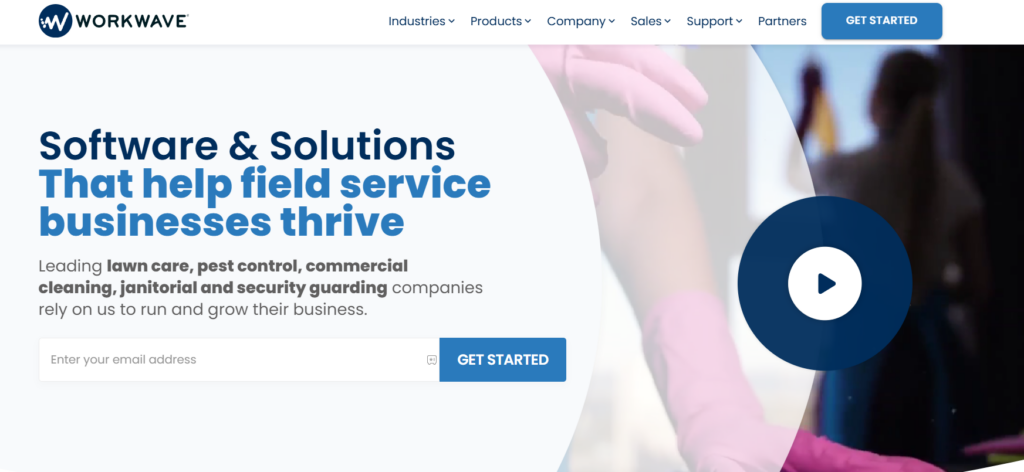
WorkWave targets field service verticals such as pest control, landscaping, HVAC, and home services. The platform offers drag-and-drop dispatch, GPS tracking, proof of delivery, and route simulation for capacity planning. DOT compliance tools and service window constraints are built in.
For enterprise logistics teams managing retail or FMCG delivery networks, WorkWave’s scope is limited. The platform does not include AI-driven exception handling or multi-channel fulfilment coordination.
Key features of WorkWave
- Visual board for assigning and reordering stops
- Capacity planning and scenario testing before committing routes
- Real-time driver location and breadcrumb trail monitoring
- Service window constraints and regulatory compliance support
WorkWave pros
- Strong constraint handling for service windows and DOT compliance
- Route simulation enables capacity planning before fleet commitment
WorkWave cons
- Built for field service, not retail/FMCG/CPG logistics
- Integration with some CRM systems can be challenging, according to G2
- Customer notifications and communication features are paid add-ons
WorkWave pricing
Custom pricing by fleet size and modules. Contact the vendor for specific details.
WorkWave is best for
Field service companies, including pest control, landscaping, and HVAC businesses, that need route planning with service scheduling.
8. Routific
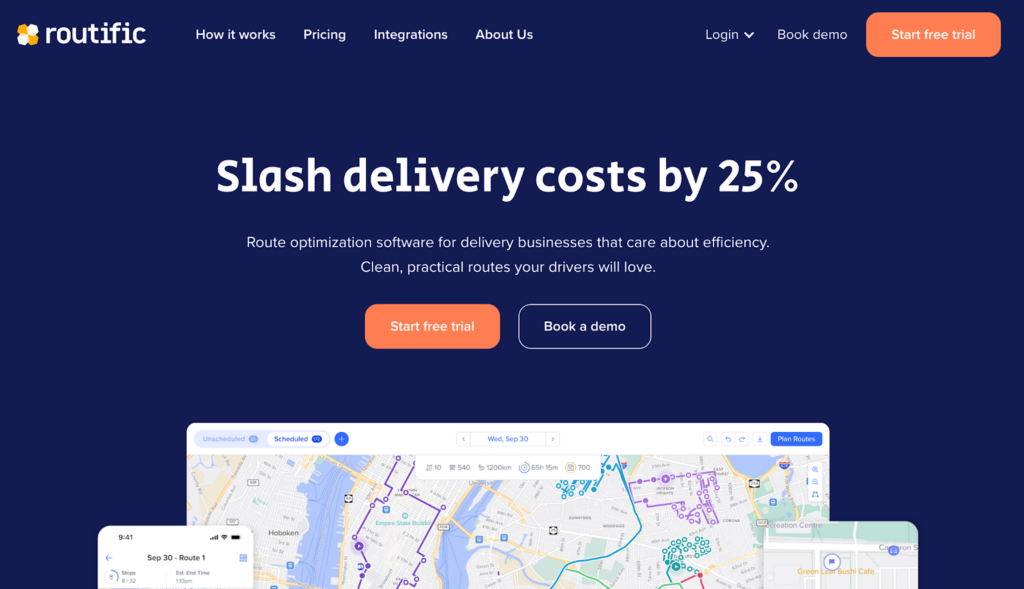
Routific focuses on route optimisation for local delivery businesses and DTC brands. The platform offers transparent usage-based pricing with a free tier for 100 orders/month, Shopify integration for direct order import, and barcode scanning for package verification.
The vendor explicitly positions Routific for fleets under 50 vehicles. There is no multi-day routing, no on-demand dispatch, and no enterprise-grade integration infrastructure.
Key features of Routific
- Fast multi-stop planning for local delivery operations
- Automated ETA updates and tracking links for customers
- Driver app with navigation, proof of delivery, and stop-by-stop task management
Routific pros
- Ease of use for small delivery teams
- Transparent pricing with a functional free tier
- Reliable customer support response times
Routific cons
- Designed for fleets under 50 vehicles
- No multi-day routing, on-demand dispatch, or enterprise integrations
- Per-driver pricing can penalise seasonal scaling
Routific pricing
The vendor uses a tiered usage-based pricing model where up to 100 orders per month are free, 101–1,000 orders cost $150 per month, and additional orders are charged per order with decreasing rates: $0.15 for 1,001–2,000, $0.13 for 2,001–3,000, $0.10 for 3,001–5,000, $0.08 for 5,001–10,000, $0.05 for 10,000–20,000, $0.03 for 20,001–50,000, and custom pricing for more than 50,000 orders per month.
Routific is best for
Local delivery businesses and DTC brands with small-to-mid fleets.
9. Descartes
Descartes operates a Global Logistics Network connecting 26,000+ customers across 160+ countries, processing 24 billion messages annually. Its route optimisation module uses continuous optimisation, not batch planning, with AI/ML-tuned parameters at the driver, customer, and road-network level.
Descartes also provides full TMS capabilities, regulatory compliance for customs, trade, and denied-party screening, fleet management, and telematics.
Key features of Descartes
- Intelligent dispatch with real-time GPS tracking and delivery monitoring
- Multi-stop routing and complex delivery planning for large-scale operations
- Full TMS with freight audit, carrier management, and shipment planning
Descartes pros
- Continuous AI/ML optimisation at driver, customer, and road-network level
- Comprehensive global compliance, customs, and trade visibility
Descartes cons
- Platform responsiveness can lag, making real-time updates difficult during operations, according to G2
- Location data is sometimes unreliable, with late or inconsistent status updates, according to G2
- Driver activity tracking can be inconsistent, including incorrect arrival reporting and delayed alerts, according to G2
Descartes pricing
Enterprise pricing by module and deployment scope. Talk to the sales team for information.
Descartes is best for
Large enterprises needing a full-stack logistics technology suite with global compliance and trade visibility.
10. Bringg
Bringg focuses on delivery orchestration for enterprise retail and e-commerce. The platform covers carrier management, customer experience tools such as branded tracking and delivery scheduling, and a driver app with 200+ ecosystem integrations.
Its Dynamic Delivery Slots support capacity-based scheduling, while BringgGreen promotes sustainability tracking.
Key features of Bringg
- Carrier management, delivery scheduling, and customer communication
- Branded tracking pages and proactive notifications for customer experience
- Workflow automation and no-code rule-based decision engine
Bringg pros
- Strong driver app and 200+ ecosystem integrations
- Omnichannel delivery orchestration including cart-checkout integration
Bringg cons
- Route optimisation requires a plan upgrade beyond the base tier
- Complex configuration with a steep learning curve
- Delivery orchestration focus, not deep route optimisation
Bringg pricing
The vendor offers fully customised pricing based on business size, delivery volume, and feature requirements. Contact the sales team for a quote.
Bringg is best for
Tier-1 retailers needing customer-facing delivery orchestration with carrier management.
Also read: Top 10 Bringg Competitors & Alternatives (2026 Comparison)
11. Circuit / Spoke Dispatch
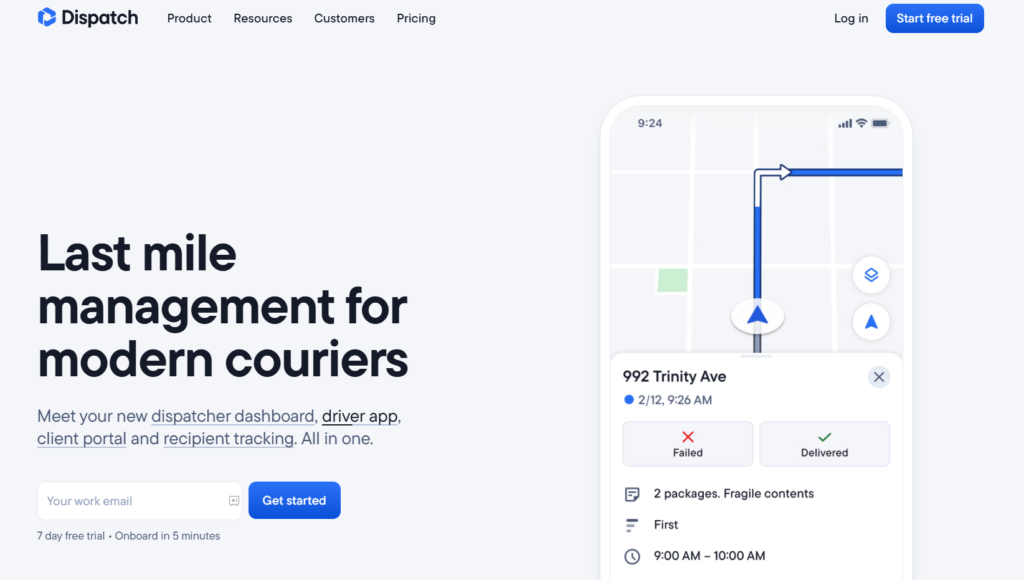
Circuit rebranded to Spoke Dispatch in late 2025. The platform offers a user-friendly mobile app, simple multi-stop route optimisation, proof-of-delivery capture, and transparent per-stop pricing. Same-day setup and minimal training requirements make it accessible for individual drivers and small teams.
The enterprise gap is clear. Routes can crisscross at density. Mid-day editing is limited. There is no live traffic, no dynamic routing, no multi-depot support, and no enterprise integration architecture.
Key features of Circuit / Spoke Dispatch
- Simple route planning with drag-and-drop reordering
- Automated ETA updates and tracking links for customer notifications
- Integration with external navigation apps like Google Maps and Waze
- Priority settings and time window constraints for deliveries
Circuit / Spoke Dispatch pros
- Same-day setup with minimal training required
- Transparent per-stop pricing without long-term commitments
Circuit / Spoke Dispatch cons
- Routes can crisscross at density; mid-day editing is limited
- No live traffic, dynamic routing, multi-depot support, or enterprise integrations
Circuit / Spoke Dispatch pricing
The vendor offers tiered monthly subscription plans based on the number of stops: Starter at $125/month for up to 1,000 stops, Premium at $200/month for up to 2,000 stops, and Expert at around $1,000/month for high-volume operations. Enterprise plans and SLA terms are customised and require contacting the sales team.
Circuit / Spoke Dispatch is best for
Individual drivers and small delivery teams needing a simple, mobile-first route planner.
Need routing software built for enterprise complexity?
See how Locus handles large-scale planning, dynamic rerouting, deep integrations, and complex delivery constraints in one platform.
What Is Routing Software?
Routing software is a logistics technology solution that plans, sequences, and optimises delivery or service routes across a fleet. At its simplest, it helps teams decide which driver should visit which stops, in what order, and through which route. This is the core of route planning, but enterprise operations need far more than basic stop sequencing.
For enterprise logistics teams, delivery routing software must account for real operational constraints such as delivery time windows, order priority, vehicle capacity, driver working hours, skills, service territories, traffic conditions, loading rules, failed delivery recovery, and customer communication.
The best routing software connects planning with execution. It does not just create a static route at the start of the day; it helps dispatchers adapt routes when orders change, vehicles are delayed, drivers are unavailable, or SLA risk increases mid-shift. This is where dynamic route planning becomes a core lever for reducing delivery cost, improving fleet utilisation, and protecting customer experience.
Why Enterprises Need Purpose-Built Routing Software in 2026
Generic routing tools were not built for enterprise complexity. As delivery volumes scale across multi-depot networks, mixed fleets, and tighter SLA windows, the gaps in off-the-shelf software start to cost real money.
- Scale breaks generic tools: Standard routing tools often cannot handle the constraint depth that multi-region, high-volume operations demand.
- Static plans fail in execution: Without real-time re-optimisation, one delay cascades. Dynamic route planning software helps teams adjust continuously.
- The last mile is where costs concentrate: 50%+ of logistics spend sits here, making last mile management one of the highest-leverage areas to optimise.
- Disconnected tools create blind spots: Siloed routing, dispatch, and tracking mean exceptions go unresolved and recovery turns manual.
- Customer expectations have hardened: Precise windows, live tracking, and proactive updates are now baseline.
- Execution data must feed back into planning: Routing and scheduling software built for enterprise can turn plan-vs-actual performance into better future plans.
How We Evaluated the Best Routing Software
To compare the best routing software for enterprise logistics, we looked beyond basic route sequencing and assessed whether each platform can support high-volume, constraint-heavy delivery operations.
The evaluation focused on:
- Constraint depth: Ability to optimise routes against time windows, vehicle capacity, driver skills, service rules, delivery priority, traffic, cost, SLA commitments, and customer-preferred time windows.
- Dynamic rerouting: Whether the platform can re-optimise routes during execution when disruptions, cancellations, new orders, or failed deliveries occur.
- Fleet and carrier support: Coverage for owned fleets, contracted carriers, on-demand partners, multi-depot networks, and hybrid delivery models.
- Integration readiness: Depth of ERP, WMS, OMS, TMS, telematics, carrier, and customer communication integrations.
- Driver app experience: Ease of use for navigation handoff, stop sequencing, proof of delivery, exception capture, barcode scanning, and mobile adoption.
- Pricing model: Whether pricing is transparent, per-driver, per-vehicle, per-stop, per-order, module-based, or fully custom for enterprise deployments.
- Onboarding complexity: Expected setup effort, implementation support, training needs, and change-management burden.
- Enterprise scalability: Suitability for large delivery volumes, multi-region operations, peak-season surges, and continuous performance reporting.
This framework favours platforms that connect route planning with dispatch execution, carrier orchestration, visibility, and analytics because that is where enterprise logistics teams typically see the highest operational leverage.
Checklist for Choosing Enterprise Routing Software
Use this checklist when comparing enterprise routing software vendors. For a deeper buyer’s framework, see this guide on how to choose the right route planning software.
- Does the platform optimise on 100+ constraints, including time windows, capacity, skills, traffic, cost, and SLA commitments?
- Can it re-optimise mid-shift when new orders, cancellations, failed deliveries, or disruptions occur?
- Does it support multi-carrier allocation across private fleet, contracted carriers, and on-demand partners?
- How deep are ERP/WMS/OMS integrations? Are they API-first or middleware-dependent?
- Can it scale 3–5x during peak periods without performance degradation?
- Does it connect routing decisions to cost-per-delivery and SLA outcomes via plan-vs-actual analytics?
- What is the implementation timeline, and what change-management support is included?
- Does it quantify carbon impact per delivery for sustainability reporting?
Fuel-Cost Savings and Mileage Reduction
Fuel-cost savings are one of the clearest ROI levers for routing software. Better route sequencing reduces total miles travelled, limits backtracking, and helps avoid unnecessary empty runs. At enterprise scale, even small mileage improvements can compound across depots, fleets, carriers, and recurring delivery cycles.
The strongest platforms connect mileage reduction with broader fleet utilisation gains: fuller vehicles, better stop density, fewer underused routes, and smarter allocation between owned fleet and external carriers. Buyers should ask vendors how savings are measured, whether plan-vs-actual mileage is visible, and how the platform attributes fuel and cost-to-serve improvements over time.
Driver App Usability and Driver Satisfaction
A routing engine is only as effective as the driver workflow that executes it. Enterprise buyers should evaluate the mobile app experience closely: how clearly it presents stop sequence, whether navigation handoff is seamless, how easy it is to capture proof of delivery, and how quickly drivers can report exceptions such as customer unavailable, damaged goods, access issues, or failed delivery attempts.
Driver satisfaction matters because low adoption creates operational drag. A clear, reliable app reduces training burden, limits dispatcher calls, improves compliance with delivery workflows, and helps new or seasonal drivers become productive faster. It also improves ETA accuracy by keeping route progress and exception data flowing back to dispatch teams.
Barcode Scanning in Delivery Workflows
Barcode scanning is increasingly central to delivery execution, especially for high-volume retail, e-commerce, FMCG, and 3PL operations. It helps verify that the right package is loaded onto the right vehicle, assigned to the right stop, and handed over to the right recipient.
In practical terms, barcode workflows reduce loading errors, strengthen chain of custody, prevent failed deliveries caused by mis-sorted parcels, and create a more reliable proof-of-delivery record. When barcode scans are connected to route progress, dispatchers gain better visibility into what is on the vehicle, what has been delivered, and where exceptions need intervention.
Final recommendation: match platform depth to network complexity
Selecting routing software is ultimately a decision about where in the logistics stack you need control.
Some organisations need a simple route planner: Routific, Circuit/Spoke Dispatch, or OptimoRoute deliver strong route quality at accessible prices. Others need cross-border freight depth: Shipsy and Descartes offer that. For customer-facing delivery orchestration, Bringg and FarEye are strong options.
For enterprises managing multiple carriers, fulfilment hubs, and delivery networks, Locus provides routing as one layer within a broader orchestration system. AI route optimisation, ShipFlex carrier allocation, dispatch management, and control tower visibility work in a closed loop. Buyers can review customer success stories to understand implementation patterns and operational outcomes across enterprise environments.
Setup Time and Onboarding Expectations
Implementation timelines vary widely across routing software categories. Lightweight tools for individual drivers or small teams can often be configured quickly because they require limited system integration, minimal workflow redesign, and basic driver training. Same-day or short-cycle setup is realistic for simple multi-stop route planning where orders are uploaded manually or imported from a small number of channels.
Enterprise routing software is different. Large deployments usually involve API and integration work across ERP, WMS, OMS, TMS, telematics, carrier systems, customer notification tools, identity management, and analytics environments. Dispatch rules, SLA logic, territory structures, vehicle constraints, driver roles, proof-of-delivery requirements, and exception workflows also need to be configured and tested.
Buyers should plan for structured onboarding across three groups:
- Technology teams: API mapping, data validation, sandbox testing, event flows, security reviews, and integration maintenance.
- Dispatch teams: Workflow configuration, control tower usage, exception handling, route override policies, and peak-day operating procedures.
- Drivers and field teams: Mobile app training, navigation workflows, proof-of-delivery capture, barcode scanning, customer communication, and failed-delivery reporting.
The right expectation is not simply “how fast can it go live?” but “how quickly can it go live without disrupting delivery performance?” For enterprise logistics, a phased rollout by region, depot, business unit, or carrier network often reduces risk while allowing operational teams to build confidence before scaling.
Frequently Asked Questions (FAQs)
What is the difference between route optimisation and logistics orchestration?
Route optimisation calculates the most efficient path between stops based on distance, time, capacity, and other routing constraints. Logistics orchestration goes further by coordinating route planning with carrier allocation, dispatch execution, shipment tracking, exception management, customer communication, and performance analytics in a closed loop.
What should enterprise teams prioritise when evaluating routing software?
Focus on constraint depth, dynamic mid-route rerouting capability, multi-carrier allocation, ERP/WMS/OMS integration quality, vendor implementation support, and proven scale for high-volume operations. Carbon optimisation and regulatory compliance features are increasingly important as reporting and sustainability requirements expand across enterprise logistics.
Can routing software integrate with existing ERP, WMS, and OMS systems?
Enterprise platforms provide API-based integration with ERP, WMS, and OMS systems, enabling routing decisions to flow directly into order fulfilment and carrier settlement workflows. SMB tools such as Route4Me, Routific, and Circuit typically have lighter integration depth, relying more on app-level connections, spreadsheets, or manual data transfer.
How does dynamic routing handle real-time disruptions?
Dynamic routing engines continuously recalculate when disruptions occur, such as new high-priority orders, cancellations, traffic incidents, or failed first-attempt deliveries. The system can re-sequence remaining stops, reassign drivers where needed, and push updated ETAs to affected customers automatically.
Related Reading


Route Optimization
Best Truck Routing Software in 2026: A Practical Buyer’s Guide for Fleet and Logistics Leaders

Oct 23, 2026
Compare the 10 top truck routing software providers in 2025 with detailed features, pricing, and ROI analysis to find the best solution for your fleet size and operational needs.
Read more
Fleet Optimization
10 Best Fleet Route Optimization Software in 2026
Oct 23, 2026
Compare the best fleet route optimization software in 2025. See key features, pricing, and why Locus is the top choice.
Read moreInsights Worth Your Time




















11 Best Routing Software for Enterprise Logistics in 2026