


General
Locus 2026 US Consumer Survey: Generative AI isn’t Just Changing How Consumers Shop, it’s Breaking the Demand Patterns US Retail Was Built On

Key Takeaways
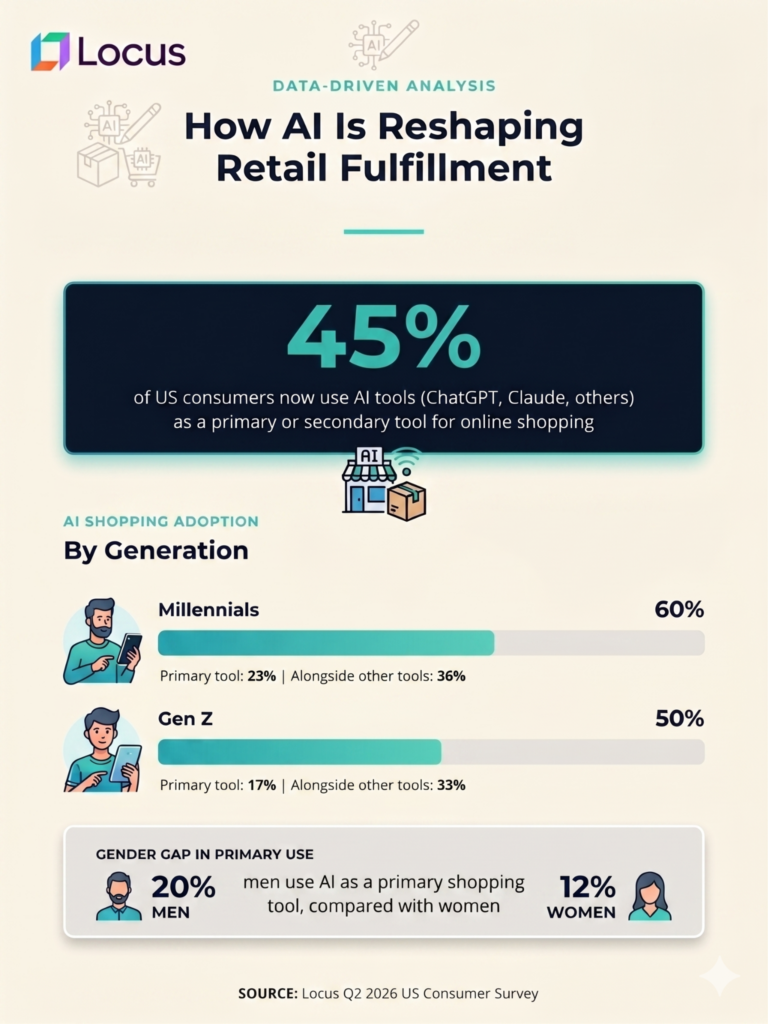
- US consumer adoption of generative AI for online shopping has reached a meaningful threshold. The Locus Q2 2026 US Consumer Survey found that 45% of consumers now use AI tools — ChatGPT, Claude, and other AI assistants — as either a primary or secondary tool when researching or deciding what to buy. Among Millennials, the adoption rate reaches nearly 60%. Among Gen Z, it reaches 50%. AI shopping is no longer an emerging behavior; it’s the operational reality retail fulfillment now serves.
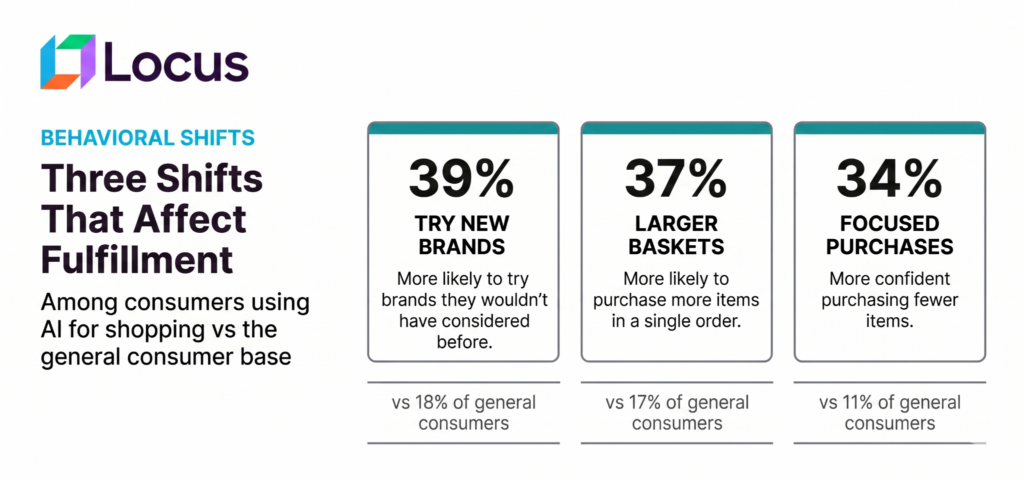
- The behavioral shifts AI shopping produces are operationally consequential, not just demographically interesting. The survey data shows that 39% of consumers using AI to shop are more likely to try new brands or products they wouldn’t have considered before. 37% are more likely to purchase more items in a single order. 34% feel more confident purchasing fewer items. Each behavioral shift produces specific operational pressure on demand planning, inventory positioning, and fulfillment infrastructure that legacy systems weren’t calibrated for.
- The cumulative operational effect is demand fragmentation. Retail fulfillment built on demand patterns where consumers chose from a relatively predictable brand and product universe now serves consumers whose AI-mediated discovery surfaces brands and products the retailer’s demand planning didn’t forecast. Basket composition shifts in less predictable directions. Brand mix evolves faster than category historical patterns suggest. Inventory positioning calibrated to last quarter’s consumer behavior produces stockouts and excess in different patterns than retail operations are used to.
- The operational implications cluster around three areas. Demand planning has to model less predictable brand mix and basket composition rather than relying on historical patterns that AI-mediated discovery is shifting. Inventory positioning has to handle higher variance in what consumers actually buy when AI surfaces brands traditional discovery wouldn’t have. Fulfillment infrastructure has to serve baskets that include products from brands the retailer historically allocated less infrastructure to.
- For Chief Supply Chain Officers, VPs of Supply Chain, Heads of Fulfillment, and Heads of E-commerce Operations at US retailers in 2026, the practical question is concrete: is the fulfillment architecture built for the demand patterns AI-mediated shopping is producing — or calibrated to pre-AI consumer behavior patterns that are becoming less representative of operational reality?
The arrival of generative AI as a mainstream consumer shopping tool has produced one of the more significant behavioral shifts in US retail in the last decade. The Locus Q2 2026 US Consumer Survey found that 45% of US consumers now use AI tools like ChatGPT, Claude, and other AI assistants, as either a primary or secondary tool when researching or deciding what to buy online. The adoption isn’t evenly distributed. Nearly 60% of Millennials and 50% of Gen Z use AI to shop online, with 23% of Millennials and 17% of Gen Z treating AI as their primary research tool. Men adopt AI as a primary shopping tool at nearly 20% across generations; women adopt at 12%. The behavior is no longer emerging, it’s the operational reality retail fulfillment now serves.
Most analysis of AI shopping adoption focuses on the consumer behavior side — how AI changes product discovery, how it affects brand consideration, how it shapes purchase decisions. The analysis is real and useful. But the operational analysis — how AI-mediated shopping affects the demand patterns retail fulfillment infrastructure has to serve — has received less attention. The demand patterns AI shopping produces are operationally distinct from the demand patterns pre-AI online shopping produced. The distinction isn’t academic. It affects demand planning, inventory positioning, fulfillment network design, and last-mile delivery operations in ways that legacy fulfillment architecture wasn’t designed for.
The survey data shows three specific behavioral shifts that translate into operational pressure on fulfillment. Each shift is documented in the data; each has consequences for what supply chain operations actually have to handle.
Behavioral Shift 1: AI Surfaces Brands Consumers Wouldn’t Have Discovered
The first behavioral shift is the one with the most direct effect on demand predictability. As much as 39% of consumers using AI to shop are more likely to try new brands or products they wouldn’t have considered before. Compared to the general consumer base — where only 18% indicate the same propensity to brand exploration — AI-using shoppers are more than twice as likely to expand their brand consideration set in any given purchase.
The operational consequence is brand mix unpredictability. Demand planning systems that model brand-level demand based on historical patterns assume those patterns reflect a relatively stable brand consideration set among target consumers. When AI-mediated discovery surfaces brands consumers historically hadn’t considered, the brand mix shifts in directions historical patterns don’t predict. A category that’s been dominated by three or four established brands for years may suddenly see meaningful volume migrating to brands the demand planning system has limited historical data on. The migration isn’t gradual; AI-mediated discovery can produce step changes when an AI assistant consistently surfaces a particular brand for a particular query type.
Fulfillment operations feel this in specific ways. Inventory positioning calibrated to historical brand mix produces stockouts on emerging brands and excess on legacy brands as the AI-driven migration accelerates. SKU proliferation increases as retailers stock more brands to meet AI-surfaced demand. Forecasting accuracy degrades on category-level metrics because the brand mix underneath the category is shifting faster than the category-level forecast can capture.
Also Read: AI Route Optimization & Failed Deliveries: NA Analysis
The longer this behavioral pattern persists, the more it compounds. Each AI-mediated purchase produces consumer data the retailer’s systems may or may not capture; each surfaced brand becomes part of the consumer’s consideration set for future purchases; each successful AI-surfaced purchase reinforces the consumer’s reliance on AI for the next purchase decision. The operational effect isn’t a one-time adjustment; it’s a continuous shift in the demand patterns fulfillment serves.
Behavioral Shift 2: AI Encourages Larger Baskets in Some Segments
The second behavioral shift moves in the opposite direction from what intuition would suggest. Today, 37% of US consumers using AI to shop are more likely to purchase more items in a single order, compared to 17% of the general consumer base. AI assistants helping consumers research products often surface related items, complementary purchases, or category alternatives that consumers add to baskets they would otherwise have left smaller.
The operational consequence is basket composition variability. Fulfillment infrastructure calibrated to typical basket sizes, packaging optimized for average orders, picking processes calibrated to common item counts, last-mile capacity allocated to historical order weight distributions — produces operational inefficiency when basket composition shifts. Larger baskets require different packaging, often require different picking processes, occasionally require different fulfillment node sourcing (when items span warehouses), and produce different last-mile vehicle utilization patterns than smaller baskets.
The basket size shift compounds with the brand mix shift. Larger baskets with more diverse brand composition produce orders that pull from more fulfillment nodes, span more SKU categories, and require coordination across more supply chain partners than smaller baskets with concentrated brand mix. The fulfillment operation handling these orders faces materially more complexity than the operation handling traditional online retail baskets.
Today, 37% of US consumers using AI to shop are more likely to purchase more items in a single order, compared to 17% of the general consumer base.
Behavioral Shift 3: AI Also Drives More Confident Smaller Purchases
The third behavioral shift introduces an apparent contradiction with the second. 34% of consumers using AI to shop feel more confident purchasing fewer items, compared to 11% of the general consumer base. AI assistants helping consumers make decisions sometimes lead to more focused purchases rather than larger ones — the assistant helps the consumer identify exactly what they need, and the consumer buys that rather than over-purchasing.
The contradiction is only apparent. Different consumer segments use AI differently for different purchase types. A consumer using AI to research a specific item may make a more focused purchase. A consumer using AI to discover a category may make a broader purchase. Both behaviors exist in the data simultaneously, producing demand patterns with higher variance — some orders larger, some orders more focused — rather than orders trending uniformly in either direction.
Also Read: Beyond CX: What North American Shippers Should Demand from Their Logistics Partners in 2026
The operational consequence is forecasting variance. Fulfillment infrastructure expecting predictable order size distribution faces wider distribution than historical patterns suggest. Operations calibrated to the mean order size produce inefficiency at both tails — over-packaged small orders and under-prepared large orders. The variance itself is the operational challenge, not any single behavioral direction.
Behavioral Shift 4: AI-Driven Brand Exploration Reshapes the Returns Surface
The three shifts above analyze the forward-logistics side of AI shopping. A fourth shift follows directly from the first — and lands in reverse logistics. When 39% of AI users try unfamiliar brands, the predictable consequence is higher return rates. Brand exploration and returns correlate; AI shopping reshapes both what enters the fulfillment network and what comes back.
The Locus Q2 2026 survey reveals how operationally consequential the reverse logistics dimension has become.
Returns volume is generationally fractured along the same lines as AI adoption. Only 3% of Boomers practice bracketing — ordering multiple variants intending to return some. The figure rises to 14% among Millennials and 20% among Gen Z. The generations adopting AI at the highest rates are also the generations producing return-heavy behaviors. As AI-driven brand exploration accelerates among younger shoppers, return volume scales with the same behavioral shifts.
Return channel preference is more concentrated than retailers assume. 54% of consumers prefer in-store drop-offs — across generations (61% of Boomers, 49% of Millennials, 53% of Gen Z) — dwarfing the 19% who choose whatever’s cheapest. Retailers building reverse logistics around home pickup or carrier-collection models are designing against consumer preference.
54% of consumers prefer in-store drop-offs across generations, making in-store partnerships infrastructure rather than convenience. 68% say fast refunds make them more likely to shop with that retailer again, moving refund speed from a finance workflow into a retention lever.
Refund speed is now a loyalty lever, not a back-office concern. 68% of consumers say a fast refund makes them more likely to shop with that retailer again. Refund speed sits in logistics and finance workflow, but the operational consequence sits in customer retention. Retailers absorbing AI-driven return volume without investing in refund speed convert their returns operation into a churn engine.
The operational implication: reverse logistics isn’t a separate problem from AI-driven forward-logistics shifts; it’s the same problem on the return side of the network
The Operational Implications
The behavioral shifts cluster into three operational implications for retail fulfillment leaders.
Demand planning has to model less predictable brand mix and basket composition. Demand planning systems built on historical brand-level demand patterns face structural limitations when AI-mediated discovery shifts the brand mix faster than historical patterns can capture. Operations leaders should examine whether demand planning operates against frequent-enough refresh cycles to catch AI-driven brand migration, whether the planning incorporates AI-mediated discovery signals (rather than relying purely on historical sales), and whether the planning models account for the variance higher AI shopping adoption produces rather than just the mean demand patterns.
Inventory positioning has to handle higher variance in actual demand. Inventory positioned based on historical brand allocations produces operational mismatch as AI-mediated discovery shifts consumer brand consideration. Operations leaders should examine whether inventory positioning accommodates faster brand mix evolution, whether SKU rationalization processes can keep pace with AI-driven brand introductions, and whether positioning logic handles the variance in basket composition AI shopping produces.
Also Read: $850B US Returns: AI Routing for Reverse Logistics 2026
Fulfillment infrastructure has to serve baskets with more diverse and less predictable composition. Picking processes, packaging allocation, multi-node sourcing logic, and last-mile capacity planning all face operational pressure when basket composition becomes less predictable. Operations leaders should examine whether fulfillment infrastructure is calibrated to the actual operational variance current consumer behavior produces — or to historical patterns that AI adoption has already shifted.
Reverse logistics has to absorb the predictable consequence of AI-mediated brand exploration. When AI shopping drives 39% of users to try unfamiliar brands, return rates rise — and the survey data points to the operational levers that determine outcomes. 54% of consumers prefer in-store drop-offs across generations, making in-store partnerships infrastructure rather than convenience. 68% say fast refunds make them more likely to shop with that retailer again, moving refund speed from a finance workflow into a retention lever. Operations leaders should examine whether reverse logistics is architected for the return volume AI-driven demand is now producing.
The cumulative diagnosis matters more than any single tactical adjustment. Retailers facing AI-driven demand pattern shifts need fulfillment architecture that adapts to evolving operational reality rather than fulfillment infrastructure that worked for pre-AI consumer behavior and requires tactical compensation for the gap between historical calibration and current reality.
The strategic question for US retail supply chain leaders is simple: with nearly half of consumers now using AI to shop online, is your fulfillment network built for AI-driven demand patterns—or for a shopping behavior that no longer reflects reality?
Learn more about how AI is transforming buying patterns and ultimately fulfillment, visit locus.sh
Frequently Asked Questions (FAQs)
What does the Locus Q2 2026 US Consumer Survey reveal about AI adoption for online shopping?
The survey found that 45% of US consumers now use AI tools — ChatGPT, Claude, and other AI assistants — as either a primary or secondary tool when researching or deciding what to buy online. Adoption isn’t evenly distributed across demographics. Nearly 60% of Millennials use AI to shop, with 23% treating it as their primary research tool. Among Gen Z, 50% use AI to shop, with 17% as primary tool. Men adopt AI as a primary shopping tool at nearly 20% across generations, compared with 12% of women. Just 23% of men and 31% of women report having not used AI for shopping and not being interested in trying it. AI shopping is no longer an emerging consumer behavior; it’s the operational reality retail fulfillment now serves.
How does AI shopping change consumer behavior in ways that affect fulfillment operations?
The survey documents three behavioral shifts with direct operational implications. 39% of consumers using AI to shop are more likely to try new brands or products they wouldn’t have considered before, compared to 18% of the general consumer base — producing brand mix unpredictability for retailers whose demand planning assumes a stable brand consideration set. 37% of AI shoppers are more likely to purchase more items in a single order, compared to 17% of the general consumer base — producing basket composition variability for fulfillment infrastructure calibrated to typical order sizes. 34% of AI shoppers feel more confident purchasing fewer items, compared to 11% of the general consumer base — producing demand variance where some orders grow larger and others become more focused. The cumulative effect is demand fragmentation that legacy fulfillment architecture wasn’t designed to handle.
Why does AI-mediated brand discovery create challenges for retail demand planning?
Demand planning systems built on historical brand-level demand patterns assume those patterns reflect a stable brand consideration set among target consumers. When AI-mediated discovery surfaces brands consumers historically hadn’t considered — and 39% of AI shoppers indicate they’re more likely to try unfamiliar brands — the brand mix shifts in directions historical patterns don’t predict. A category dominated by established brands for years may see meaningful volume migrating to brands the demand planning system has limited historical data on. The migration can produce step changes when AI assistants consistently surface particular brands for particular query types. The operational effect is forecasting accuracy degradation on category-level metrics because the brand mix underneath the category is shifting faster than the category-level forecast can capture, inventory positioning mismatch as stockouts emerge on AI-surfaced brands and excess accumulates on legacy brands, and SKU proliferation as retailers stock more brands to meet evolving demand.
How does AI shopping affect retail returns and reverse logistics operations?
AI-driven brand exploration produces a predictable consequence: higher return rates. When 39% of AI users try unfamiliar brands, brand exploration and returns correlate because consumers trying new brands return more than consumers repurchasing familiar ones. The survey data reveals the operational stakes. Returns volume is generationally fractured along the same lines as AI adoption — only 3% of Boomers practice bracketing (ordering multiple variants intending to return some), rising to 14% among Millennials and 20% among Gen Z. The generations adopting AI at the highest rates are also the generations producing return-heavy behaviors. Return channel preference is more concentrated than retailers assume — 54% of consumers prefer in-store drop-offs across generations, dwarfing the 19% who choose whatever’s cheapest. And 68% of consumers say a fast refund makes them more likely to shop with that retailer again, moving refund speed from a finance workflow into a retention lever. Reverse logistics isn’t a separate problem from AI-driven forward-logistics shifts; it’s the same problem on the return side of the network.
What should US supply chain leaders examine to assess whether fulfillment architecture is calibrated to current consumer behavior?
Four operational areas warrant systematic assessment. Demand planning should be examined for whether it operates against frequent-enough refresh cycles to catch AI-driven brand migration, whether it incorporates AI-mediated discovery signals rather than relying purely on historical sales, and whether models account for the variance higher AI shopping adoption produces rather than just the mean demand patterns. Inventory positioning should be examined for whether it accommodates faster brand mix evolution, whether SKU rationalization processes can keep pace with AI-driven brand introductions, and whether positioning logic handles the variance in basket composition AI shopping produces. Fulfillment infrastructure should be examined for whether picking processes, packaging allocation, multi-node sourcing logic, and last-mile capacity planning are calibrated to actual operational variance current consumer behavior produces. Reverse logistics should be examined for whether the network is architected for the return volume AI-driven demand is now producing, whether in-store drop-off partnerships match consumer preference, and whether refund speed is operationally managed as a retention metric.
Why is the operational impact of AI shopping likely to compound rather than stabilize?
Each AI-mediated purchase produces consumer data the retailer’s systems may or may not capture; each surfaced brand becomes part of the consumer’s consideration set for future purchases; each successful AI-surfaced purchase reinforces the consumer’s reliance on AI for the next purchase decision. The behavioral pattern reinforces itself rather than stabilizing. Adoption rates are also still growing — the 45% adoption rate reflects current state, and generational composition (60% of Millennials, 50% of Gen Z) suggests the overall adoption rate will continue rising as Gen Z and Millennial share of total consumer spending grows. Operations planning for AI shopping as a current-state phenomenon underestimates the trajectory; operations planning for AI shopping as the trajectory of the next several years produces fulfillment architecture better matched to where consumer behavior is going rather than where it currently sits.


Logistics Management
What Enterprise Teams Need From Transportation Logistics Software in 2026

May 29, 2026
Discover what enterprise-grade transportation logistics software must deliver, from AI route optimization to real-time visibility, and how to evaluate platforms at scale.
Read more
General
Locus 2026 UK Consumer Survey: Why Returns Visibility is Now the Conversion Engine for AI-Driven Shopping in UK Retail

May 29, 2026
AI-driven shopping has changed what UK consumers buy — and made returns visibility a pre-purchase decision. Findings from the Locus Q2 2026 UK Consumer Survey and what they mean for retail operations.
Read moreInsights Worth Your Time


















Locus 2026 US Consumer Survey: Generative AI isn’t Just Changing How Consumers Shop, it’s Breaking the Demand Patterns US Retail Was Built On