


Fleet Optimization
10 Best Fleet Route Optimization Software in 2026

Key Takeaways
- Cut transportation costs by 10–15% using route optimization software to minimize empty miles and improve vehicle utilization.
- Automate the dispatch management process with AI-driven allocation that assigns routes in under five minutes, reducing planning time by up to 85%.
- Gain real-time control through live dispatch management, predictive alerts, and proactive exception handling via integrated control towers.
- Improve KPIs like On-Time Delivery Rate and Cost per Route with integrated route scheduling and decision-grade analytics.
- Choose Locus for enterprise-scale logistics: purpose-built for organizations with $150M+ revenue, high delivery density, and global or multi-region operations in retail, FMCG, e-commerce, and 3PL.
- Market momentum is clear: 70% of fleets now use some form of fleet management technology, and organizations report a 19% average decrease in accident costs after implementation.
Fleet routing software is no longer a nice-to-have for enterprise logistics — it is a margin-defining capability. The global fleet management software market is projected to reach $38.28 billion by 2028, growing at an 18.9% CAGR, while the route optimization software segment alone is on track to hit $10.05 billion at a 14.3% CAGR. Logistics already represents 12% of global GDP, and inefficient fleet operations add 10–15% to transportation costs for many enterprises. Gartner projects that by 2026, more than 80% of large enterprises will adopt AI-driven fleet optimization tools to reduce fuel expenses and improve delivery performance.
For enterprise logistics leaders in retail, FMCG, e-commerce, and 3PL sectors — especially those with $150M+ revenue and multi-region operations — the challenge is scaling complex, high-density deliveries with technology. Manual dispatching and outdated routing systems are not designed to handle thousands of deliveries across multiple geographies. Each missed SLA or poorly planned route directly erodes margins and customer trust.
Fleet route optimization software addresses these gaps. By automating dispatch decisions, optimizing multi-stop routes in real time, and providing fleet-wide visibility, it delivers a 30% average cost reduction and 15–20% lower maintenance costs for organizations that deploy it effectively.
This article reviews the 10 best fleet routing software solutions in 2026, comparing features, pricing models, ratings, and business fit. Some tools are well-suited for small teams or field service operations, while others target telematics-first use cases. For enterprises that need scale, automation, and end-to-end logistics intelligence, Locus stands out as the best overall choice.
Master Comparison: Top 10 Fleet Routing Software in 2026
| Software | Key Features | Best For | G2 Rating | Pricing |
| Locus | AI routing, auto-dispatch, control tower, multi-region analytics, carbon tracking | Large enterprises, high-density global ops | 4.8/5 | Custom |
| Upper | Multi-stop planning, GPS tracking, POD, reporting | SMB delivery teams (5–500 vehicles) | 4.7/5 | Subscription |
| OptimoRoute | Bulk planning, live ETAs, driver analytics, POD | Field service, single-region delivery | 4.5/5 | $35–$44/user |
| Circuit | App-based routes, ETAs, basic POD | Small courier teams | 4.6/5 | Free–Subscription |
| Route4Me | GPS multi-stop, notifications, e-comm sync, POD | Logistics, mid-sized e-commerce | 4.4/5 | From $60/veh |
| Tookan | Auto-allocation, tracking, mobile apps, add-ons | SMB on-demand delivery | 4.3/5 | From $99/mo |
| WorkWave | Route planning, driver app, customer alerts, API | Field service, last mile | N/A | From $54/veh |
| Geotab | Telematics, AI routing, safety, EV insights | Compliance-focused fleets | N/A | Quote-based |
| Samsara | AI dashcams, telematics, equipment tracking | Enterprise & public sector | N/A | Custom |
| Motive | Safety cams, fleet mgmt, ELD, spend analytics | Trucking & logistics | N/A | Quote-based |
How to Compare Total Cost of Ownership
The listed licence price is only one part of the buying decision. For enterprise fleet routing software, total cost of ownership should include every cost required to deploy, operate, integrate, and scale the platform.
Key cost areas to evaluate include:
- Licensing model: Per-user, per-driver, per-vehicle, per-task, per-stop, or quote-based pricing can affect long-term cost differently as delivery volume grows.
- Implementation and configuration: Enterprise deployments may require route logic configuration, depot setup, SLA rules, territory design, role-based access, and control tower workflows.
- Training and change management: Dispatcher, fleet manager, driver, and operations leadership training should be included in the rollout plan.
- ERP/WMS/TMS integrations: Deeper integrations with order management, warehouse systems, transport management, billing, and customer communication tools can materially affect implementation cost.
- Support and service levels: Compare standard support with premium support, regional availability, escalation processes, and account management.
- Add-ons and advanced modules: Proof of delivery, analytics, customer notifications, simulations, marketplace connectors, compliance reporting, and carbon tracking may be bundled or priced separately.
- Telematics hardware and mobile devices: Some platforms require vehicle devices, dashcams, driver smartphones, mounts, scanners, or ruggedised equipment.
- Long-term scaling costs: Assess what happens when the operation expands from one depot to multiple depots, from one country to several markets, or from hundreds to thousands of daily routes.
For enterprise buyers, the lowest entry price is rarely the best measure of value. A stronger comparison is cost per successful delivery, cost per route, SLA improvement, reduction in failed deliveries, and productivity gained across dispatch and field teams.
Typical Implementation Timelines by Software Type
Implementation timelines vary by operational complexity, data quality, integrations, and the number of regions involved.
| Software Type | Typical Rollout Profile | Key Timeline Drivers |
| Lightweight cloud-based route planners | Faster to launch for small teams with limited integrations | User setup, CSV imports, basic driver app training, simple route rules |
| Mid-tier routing platforms | Moderate rollout for regional operations or growing fleets | Dispatcher training, customer notifications, POD setup, limited API integrations, route simulation |
| Enterprise fleet routing solutions | Phased deployment across depots, business units, or countries | ERP/WMS/TMS integration, data migration, control tower configuration, multi-region setup, exception workflows, driver adoption, and change management |
A practical enterprise rollout usually starts with a controlled pilot: one business unit, one region, or a representative set of depots. Fleet managers should then compare baseline metrics against live results before expanding to additional geographies, vehicle types, and operating models.
Editorial Methodology
Our evaluation of the 10 best fleet routing software platforms follows a structured, vendor-neutral process:
No Pay-for-Placement — Rankings are editorial. No vendor paid for inclusion or positioning.sive capabilities.
Feature Audit — Each platform was assessed across seven enterprise-critical capabilities: dynamic multi-stop optimization, automated dispatch, real-time visibility, exception handling, integrations, multi-fleet/multi-region support, and analytics.
User Review Analysis — We aggregated ratings and qualitative feedback from G2 and Capterra to validate vendor claims against real-world user experience.
Market Data Cross-Reference — Pricing, scalability, and market positioning were verified against published vendor data and third-party analyst reports including Fortune Business Insights, Research and Markets, and Oxmaint.
ICP Segmentation — Tools were categorized by ideal customer profile: enterprise ($150M+ revenue, multi-region), mid-market, SMB, or niche (field service, telematics).
How to Test Fleet Routing Software Before Enterprise Rollout
Before committing to a full deployment, fleet managers should validate fleet routing software against real operating conditions rather than relying only on demo environments. A structured pilot helps reveal whether the system can handle the scale, constraints, and variability of the business.
Use the following testing framework:
- Fleet size scenarios: Test small, medium, and large route sets. A pilot should include simple route batches as well as peak-volume days to assess planning speed, route quality, and dispatcher workload.
- Vehicle type coverage: Validate performance across delivery vans, freight vehicles, and specialty equipment. Different vehicle profiles may require capacity rules, loading constraints, driver skill requirements, or route feasibility checks.
- Geographic conditions: Run scenarios across urban, suburban, rural, and multi-region networks. Dense city routes, long-distance rural drops, and cross-region allocation all test different aspects of optimisation logic.
- Industry workflows: Simulate the realities of retail, FMCG, e-commerce, 3PL, and temperature-controlled routing. Each use case introduces different constraints, from customer delivery windows and store replenishment schedules to cold-chain compliance and reverse logistics.
- Operational exceptions: Include failed deliveries, driver absenteeism, vehicle breakdowns, customer cancellations, and late order injections to test automated exception handling.
- Baseline comparison: Measure route cost, kilometres driven, delivery density, on-time performance, dispatcher planning time, first-attempt delivery rate, and driver route adherence before and after the pilot.
The goal is not just to prove that the software can produce routes. It must prove that it can improve decisions under real-world constraints, at the speed and reliability required by enterprise logistics.
Top 10 Fleet Route Optimization Software — Detailed Comparison
1. Locus
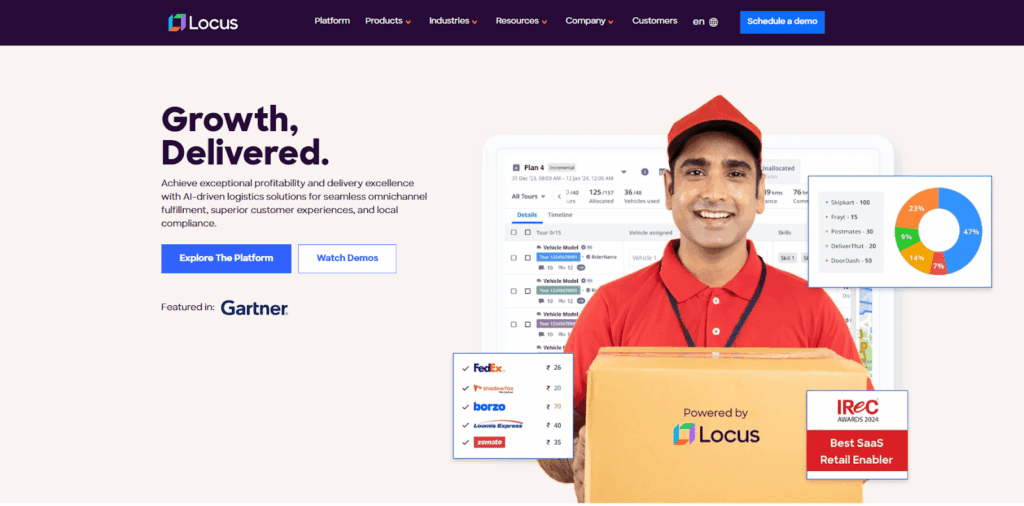
G2 Rating: 4.8/5 | Capterra Rating: 4.9/5
Locus is an AI-powered fleet routing software designed for enterprises managing high-density deliveries across complex geographies. It combines real-time orchestration with automated dispatch, predictive insights, and multi-modal delivery optimization — built to support both middle-mile and last-mile workflows at scale. Trusted by 360+ enterprise organizations worldwide, Locus is purpose-built for logistics leaders operating across multiple regions with fragmented infrastructure.
Features of Locus
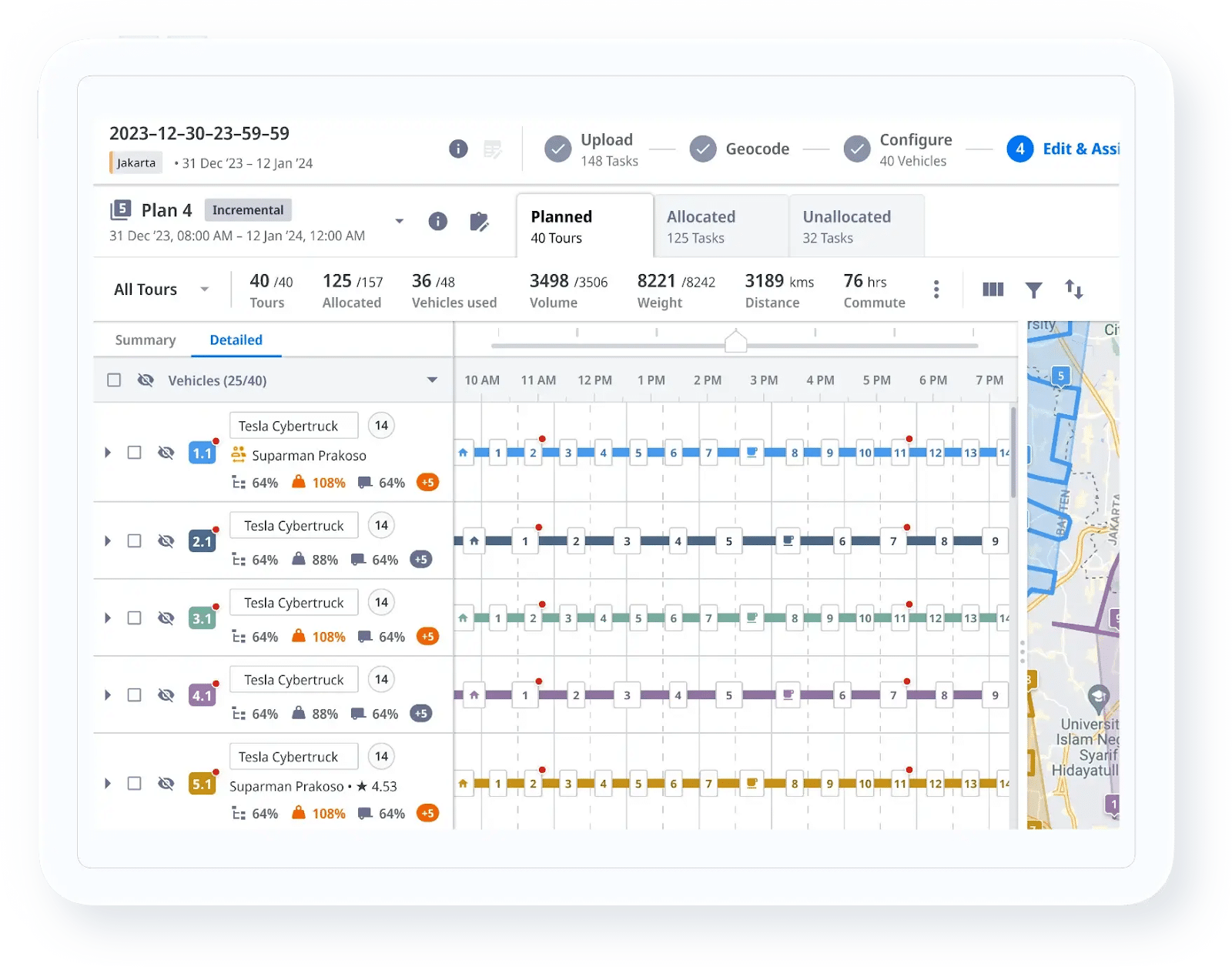
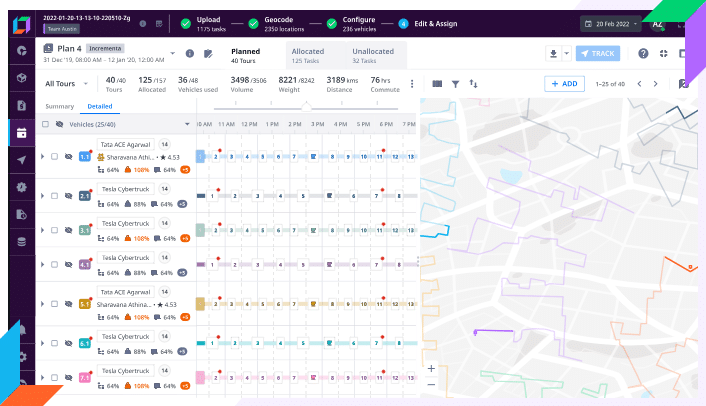
- Auto-dispatch engine: Allocates deliveries using configurable business logic and fleet capacity, assigning routes in under five minutes.

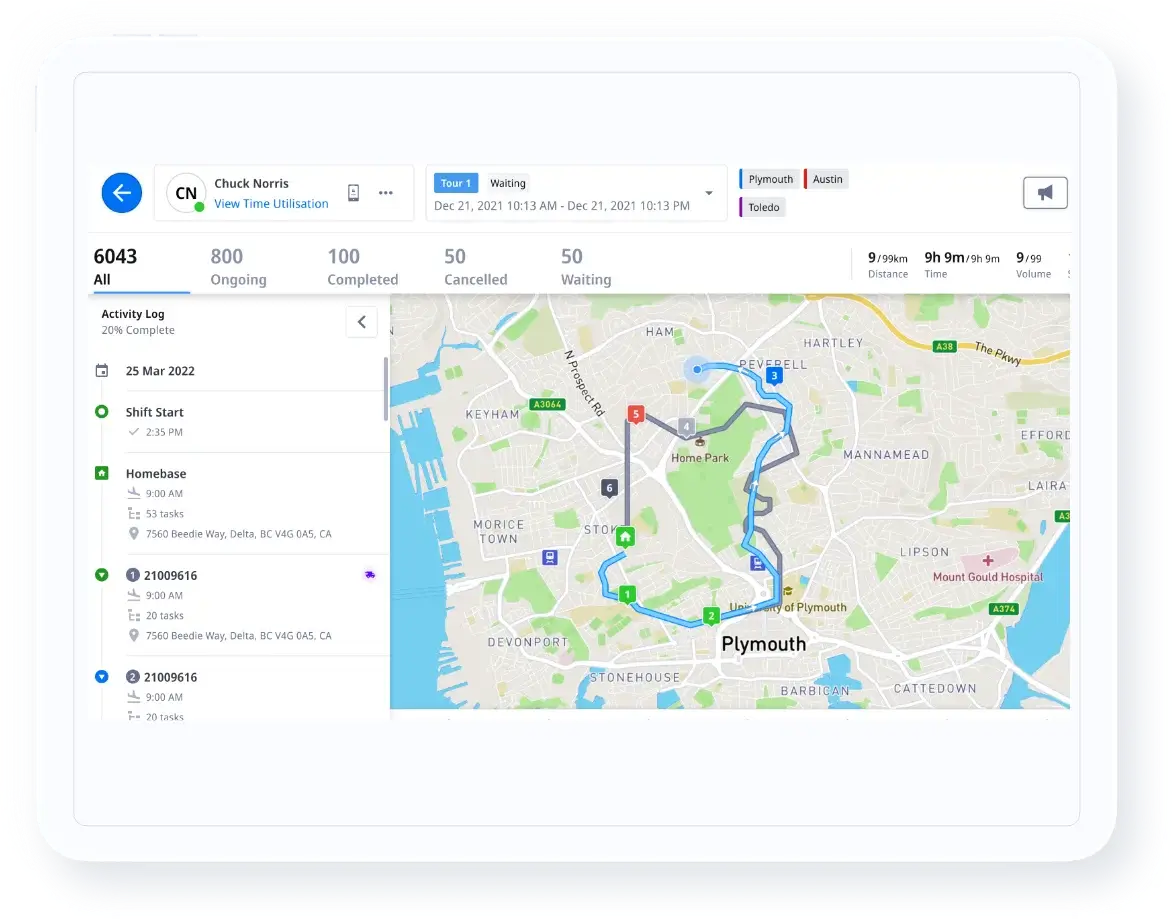
- Real-time Control Tower: Monitors active shipments with dynamic alerts for exceptions and delays, enabling proactive issue resolution.

- Dynamic route optimization: Adjusts routes based on delivery priorities, traffic, and SLA constraints in real time.

- Specialized routing constraints: Supports enterprise routing logic where operations require temperature-controlled routing for grocery, pharma, and perishable goods, alongside vehicle capacity, time-window, serviceability, and compliance constraints.
- Smart rider reassignment: Reallocates tasks in response to failed deliveries or last-minute changes.
- Returns and reverse logistics: Automates failed delivery handling and reattempt scheduling.
- ERP/WMS integration: Connects with SAP, Oracle, and legacy systems using robust APIs.
- Carbon tracking and emissions reporting: Measures CO? per route for ESG and compliance reporting.
- Multi-fleet and multi-region orchestration: Unifies owned and outsourced fleets across geographies with compliance frameworks.
Suggested read: How Supply Chains can Reduce Carbon Footprint with Logistics Planning Software
Pros
- Reduces planning time significantly for large fleets with AI-driven automation
- Excellent real-time tracking and alerts via the Control Tower
- Strong decision-grade analytics for enterprise-scale insights
- Seamless multi-region scalability across owned and third-party fleets
- Comprehensive ESG/compliance support with carbon tracking
Cons
- Custom pricing model lacks upfront transparency
- Steep learning curve for non-technical teams during initial onboarding
- Integration setup with legacy systems can take time
Locus Is Best For
Locus is purpose-built for enterprise organizations in retail, FMCG, e-commerce, and 3PL with $150M+ revenue, high-volume, multi-region logistics needs, and a focus on technology-driven efficiency.
To explore how Locus optimizes last-mile operations for retail and e-commerce businesses, read the coverage by ManufacturingToday.
Locus Pricing
Pricing is based on delivery volume, regional coverage, and system integrations. Schedule A Demo for a tailored quote.
“Locus transformed our multi-region operations with AI orchestration — delivery costs down 20% in months.” — Logistics Director, FMCG Enterprise
2. Upper
G2 Rating: 4.7/5 | Capterra Rating: 4.6/5
Upper focuses on multi-stop route planning with vehicle capacity optimization, live GPS tracking, and proof-of-delivery features via a driver app. It supports fleets from 5 to 500+ vehicles, incorporating traffic patterns and delivery windows. While Upper is a strong choice for SMB delivery teams, it lacks the AI-driven orchestration and multi-region scalability required by enterprise-scale logistics operations.
Features of Upper
- Multi-stop route planning: Optimizes routes across vehicle capacity, traffic, and delivery windows.
- Live GPS tracking: Real-time fleet visibility with geofencing alerts.
- Proof of delivery: Driver app captures signatures, photos, and delivery confirmations.
- Reporting and analytics: Performance dashboards without requiring dedicated IT support.
- Quick implementation: Designed for teams without technical expertise, delivering ROI within 30 days.
Pros
- Intuitive interface cuts planning time by 85%
- 25% fuel savings reported across 500+ business customers
- Easy implementation for small and growing teams
- Affordable subscription model for growing fleets
Cons
- Limited scalability for 1,000+ vehicle enterprises
- Basic analytics compared to AI-heavy platforms like Locus
- Occasional app glitches during high-volume use
Upper Is Best For
SMB delivery teams running 5–500 vehicles that need simple, fast route optimization without enterprise-grade complexity.
Upper Pricing
Subscription-based pricing. Contact Upper for current plan details.
“Upper saved us hours on daily routes — perfect for our 50-truck fleet without complexity.” — Delivery Manager, SMB Logisticshic coverage.
3. OptimoRoute
G2 Rating: 4.5/5 | Capterra Rating: 4.4/5
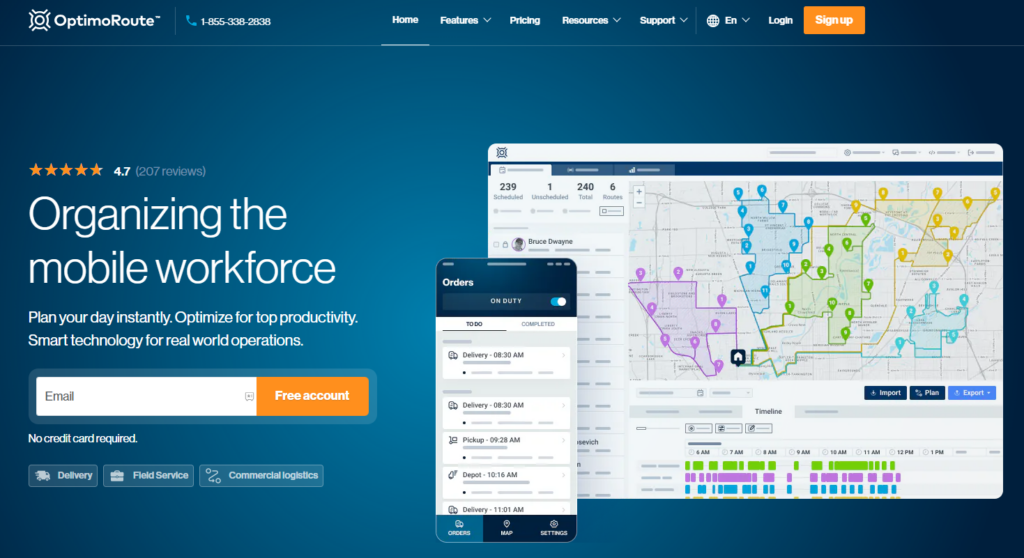
OptimoRoute provides automated route planning and scheduling software designed for delivery and field service businesses. Its platform helps companies serve more customers, reduce driving time, and improve operational efficiency with AI-powered planning. However, its per-user pricing and single-region focus make it less suited for enterprises with multi-geography operations.
Features of OptimoRoute
- Automated route planning: Imports orders in bulk and generates efficient multi-driver routes.
- Live tracking & ETA: Provides real-time driver location and accurate customer ETAs.
- Proof of delivery (POD): Captures digital signatures, photos, and confirmation forms.
- Analytics & reporting: Tracks driver performance, order completion, and service quality.
- Industry-specific support: Optimized for retail distribution, healthcare, field services, and food delivery.
Pros
- Accurate ETAs improve customer satisfaction
- Strong proof-of-delivery features with photos and signatures
- Well-suited for field service and single-region delivery operations
- Bulk planning speeds up daily operations
Cons
- Per-user pricing scales poorly for large fleets
- Limited multi-fleet and multi-region support
- UI feels dated compared to newer platforms
OptimoRoute Is Best For
Small to mid-sized businesses in delivery, retail distribution, healthcare, and field service operations looking to improve efficiency within a single region.
OptimoRoute Pricing
- Lite Plan: $35.10 per driver/month (billed annually)
- Pro Plan: $44.10 per driver/month (billed annually)
- Custom Plan: Available on request; includes advanced features and enterprise support.
“Reliable for our field tech routes, with solid tracking — but wish for better enterprise integrations.” — Service Coordinator
4. Circuit
G2 Rating: 4.6/5 | Capterra Rating: 4.5/5
Circuit provides route planning software for both individual drivers (Circuit Route Planner) and delivery teams (Circuit for Teams). It is widely used by courier companies and small fleets that want simple, app-based optimization to save time on the road. Circuit is not built for enterprise-scale operations and lacks advanced analytics and multi-region support.
Features of Circuit
- Multi-stop route optimization with delivery priority and time windows
- Mobile driver apps with navigation, proof of delivery, and live updates
- Real-time tracking for dispatchers and customers
- Automated notifications to reduce missed or failed deliveries
Pros
- Free tier available for individual drivers (up to 10 stops)
- Quick setup and mobile-first experience
- Accurate for local, short-distance routes
- Reduces miles driven on daily routes
Cons
- Lacks enterprise features like multi-region orchestration
- Poor scalability for high-volume operations
- Limited reporting and analytics capabilities
Circuit Is Best For
Courier services and small delivery teams seeking a lightweight, affordable solution for last-mile routing and basic visibility.
Circuit Pricing
- Route Planner: Free plan (10 stops), Lite and Standard monthly subscriptions
- For Teams: Free 7-day trial; tiered plans with dispatcher dashboard and driver apps
“Great for my courier side hustle — saves time on local stops effortlessly.” — Independent Driver
5. Route4Me
G2 Rating: 4.4/5 | Capterra Rating: 4.3/5
Route4Me is an AI-powered fleet routing software designed to help businesses simplify last-mile delivery. With over 3 billion miles optimized and 750M destinations covered, Route4Me provides solutions for route planning, fleet management, and delivery tracking. While effective for mid-sized logistics operations, its optimization engine is less sophisticated than enterprise-grade AI platforms.
Features of Route4Me
- Route optimization: Automates route planning to reduce fuel costs and improve delivery times.
- Real-time tracking: Offers live tracking and real-time updates on delivery progress.
- Proof of delivery: Captures signatures, photos, and delivery information through the mobile app.
- Customer experience tools: Provides notifications, tracking links, and real-time ETA updates.
- E-commerce integrations: Syncs with e-commerce platforms for order-to-delivery workflows.
Pros
- Strong proof-of-delivery and notification features
- Good e-commerce synchronization capabilities
- Flexible pricing starting at $60 per vehicle
- Reliable GPS tracking across routes
Cons
- Optimization algorithms not as advanced as enterprise AI rivals
- Interface can feel cluttered and unintuitive
- Customer support response times reported as slow
- Per-vehicle costs add up quickly for larger fleets
Route4Me Is Best For
Logistics companies and mid-sized e-commerce businesses needing efficient multi-stop route planning with customer notification tools.
Route4Me Pricing
Starting at $60 per vehicle per month. Higher-tier plans available for larger fleets and advanced features.
“Handles our e-commerce routes well, but could use smarter AI for traffic.” — Logistics Coordinatoring at $60 per vehicle per month. Pricing varies depending on the business size and the features required, with higher-tier plans for larger fleets and more advanced features.
6. Tookan
G2 Rating: 4.3/5 | Capterra Rating: 4.2/5
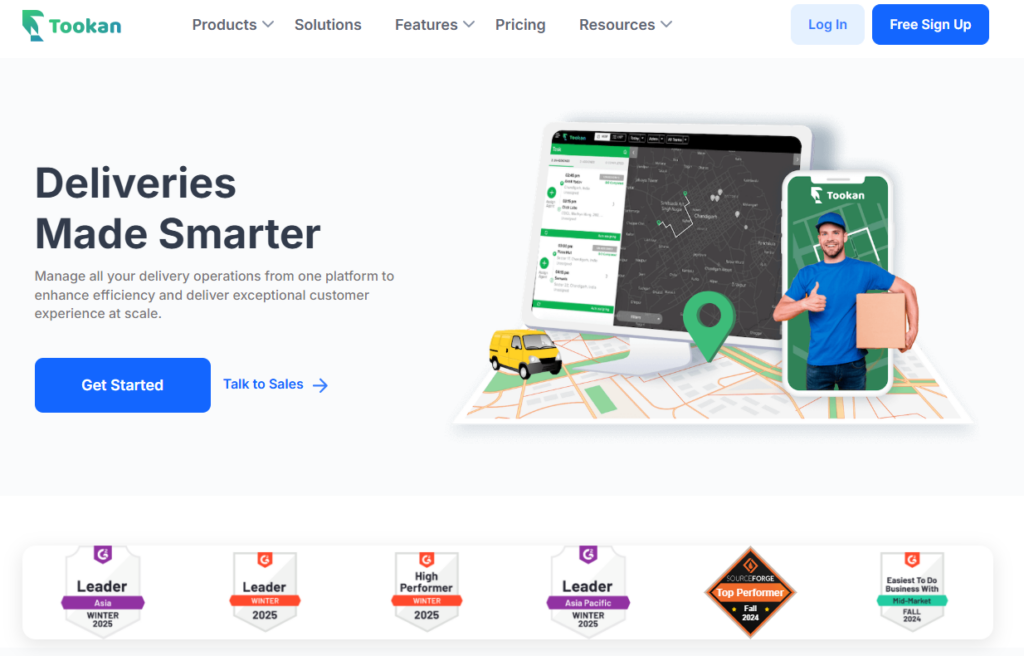
Tookan (by Jungleworks) is a delivery management platform with route optimization, dispatch, and real-time tracking for on-demand and scheduled deliveries. It targets SMB businesses that want a configurable, white-label stack with add-ons and integrations. Tookan is not enterprise-ready and can encounter stability issues at scale.
Features of Tookan
- Route optimization & auto-allocation: Plans multi-stop routes and auto-assigns tasks based on capacity and proximity.
- Real-time tracking & ETAs: Live driver locations, tracking links, and customer notifications.
- Proof of delivery: Photos, signatures, barcodes; configurable forms.
- Extensions & integrations: APIs plus marketplace for payments, SMS/WhatsApp, POS/e-commerce.
- Admin & agent apps: Dispatcher dashboard; Android/iOS driver app with offline sync and geofencing.
Pros
- Easy task assignment and allocation for on-demand delivery
- Rich add-ons marketplace extends functionality
- Mobile app is user-friendly for drivers
- White-label options for brand customization
Cons
- Frequent bugs reported when scaling beyond SMB volumes
- Analytics capabilities are limited compared to enterprise tools
- Add-on costs can escalate quickly
- Not designed for enterprise multi-region logistics
Tookan Is Best For
SMBs and mid-market teams running last-mile use cases (food, grocery, courier, pickup & delivery) that need quick deployment and task-based pricing.
Tookan Pricing
Starting at $99 per month for 1,000 tasks. Higher-tier plans offer larger task volumes at reduced per-task costs. Enterprise and lifetime packages available on request.
“Perfect for our local delivery gigs with quick allocations.” — SMB Owner
7. WorkWave Route Manager
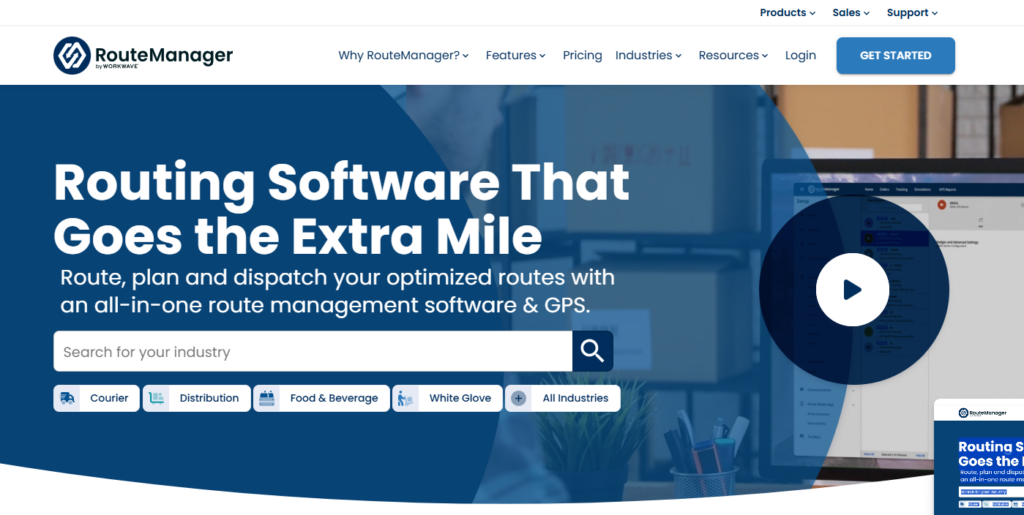
WorkWave’s RouteManager is a routing and dispatch platform for delivery and field-service operations, combining automated route planning, live tracking, customer notifications, and reporting in a single system. It serves SMBs and mid-market teams effectively but lacks the AI-driven orchestration and multi-region capabilities needed for enterprise-scale fleet operations.
Features of WorkWave Route Manager
- Route planning & dispatch: Builds optimized multi-stop routes and assigns drivers quickly.
- Mobile app & live tracking: Driver apps with GPS visibility and real-time progress updates.
- Customer notifications: Email/SMS updates with ETAs to reduce failed deliveries.
- Reporting & analytics: KPIs and dashboards for performance and capacity planning.
- API & simulations: Connects to existing systems and tests scenarios before go-live.
Pros
- Straightforward setup for small and mid-sized teams
- Effective customer notification system reduces missed deliveries
- Simulation capabilities allow pre-deployment testing
- Solid reporting for basic capacity planning
Cons
- Limited to SMB and mid-market scale
- Lacks AI-powered dynamic rerouting
- Minimum four vehicles required, which may exclude solo operators
- No multi-region orchestration or cross-fleet utilization
WorkWave Route Manager Is Best For
SMBs and mid-market teams in courier, distribution, food & beverage, white-glove, and field service seeking fast setup and a straightforward routing stack.
WorkWave Route Manager Pricing
Starting at $54 per vehicle per month (minimum four vehicles). RouteManager360 bundles additional driver app features and customer notifications. Custom packages available through sales.les.
8. Geotab
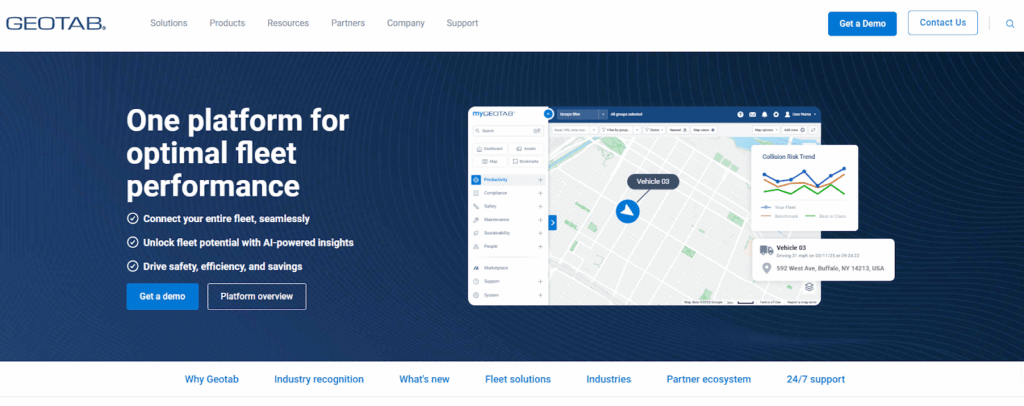
Geotab is a telematics-first fleet platform that unifies vehicle tracking, driver safety, maintenance, and routing/dispatching, supported by a large partner marketplace and OEM integrations. Its proprietary AI factors in fuel costs, maintenance, and customer satisfaction for route decisions. Geotab excels in compliance and safety-focused fleet management but positions routing as one component within a broader telematics stack rather than a standalone optimization engine.
Features of Geotab
- Vehicle telematics & safety: GO devices, AI-enabled dashcams, driver coaching, and compliance tools.
- AI-powered routing & dispatching: Route planning with real-time visibility, optimized reassignment, and revenue forecasting by territory.
- Analytics & integrations: Open API/SDK, Data Connector for BI tools, and a broad partner marketplace.
- Sustainability & EV: Carbon/EV analytics and planning to support corporate sustainability goals.
- Multi-resource routing: Handles dynamic changes like cancellations with real-time fleet adjustments.
Pros
- Industry-leading telematics hardware and data platform
- AI routing accounts for economic factors like maintenance costs
- Extensive partner and OEM ecosystem
- Strong compliance and safety capabilities
Cons
- Routing is secondary to the telematics platform, not a standalone strength
- Quote-only pricing model lacks transparency
- Can be complex to deploy and configure for routing-only needs
- Less suited for high-density last-mile delivery optimization
Geotab Is Best For
Enterprises prioritizing telematics, safety, and compliance across mixed fleets, with routing as part of a wider fleet management stack.
Geotab Pricing
Subscription-based and typically quote-only. Pricing varies by hardware (GO devices/cameras), feature bundles, and fleet size; plans procured via Geotab and authorized partners. varying by hardware (GO devices/cameras), feature bundles, and fleet size; plans are procured via Geotab and partners.
9. Samsara
Samsara is a connected operations platform providing AI-powered fleet management, equipment tracking, safety, and site visibility solutions. Founded in 2015 and headquartered in San Francisco, Samsara’s mission is to improve safety, efficiency, and sustainability of physical operations through IoT hardware and a cloud-based platform. While powerful for connected operations and telematics, Samsara is not primarily a route optimization platform and may not meet the needs of organizations seeking deep dispatch automation.
Features of Samsara
- Cameras & video: AI dashcams, driver coaching, in-cab alerts, and safety reporting tools.
- Fleet telematics: Real-time GPS tracking, routing, fuel management, electrification insights, and maintenance monitoring.
- Equipment tracking: Location monitoring, utilization reporting, theft prevention, and diagnostics.
- Site security: Remote visibility, proactive alerts, and mobile access.
- Samsara Apps: Connected workflows for compliance, training, and mobile fleet operations.
- Integrations: OEM integrations, App Marketplace, and developer APIs for custom workflows.
Pros
- Comprehensive connected operations platform beyond routing
- Best-in-class AI dashcam and safety capabilities
- Strong OEM and marketplace integrations
- Scalable across transportation, construction, and public sector
Cons
- Routing is a secondary feature within a broader platform
- Custom pricing makes cost comparison difficult
- Not purpose-built for high-volume dispatch optimization
- Overkill for organizations that primarily need route planning
Samsara Is Best For
Enterprises and government organizations across transportation, construction, field services, food and beverage, logistics, manufacturing, utilities, and public sector looking for a unified safety, compliance, and operations platform.
Samsara Pricing
Custom pricing based on fleet size, hardware, and solutions required. Self-guided online pricing estimator available.
10. Motive
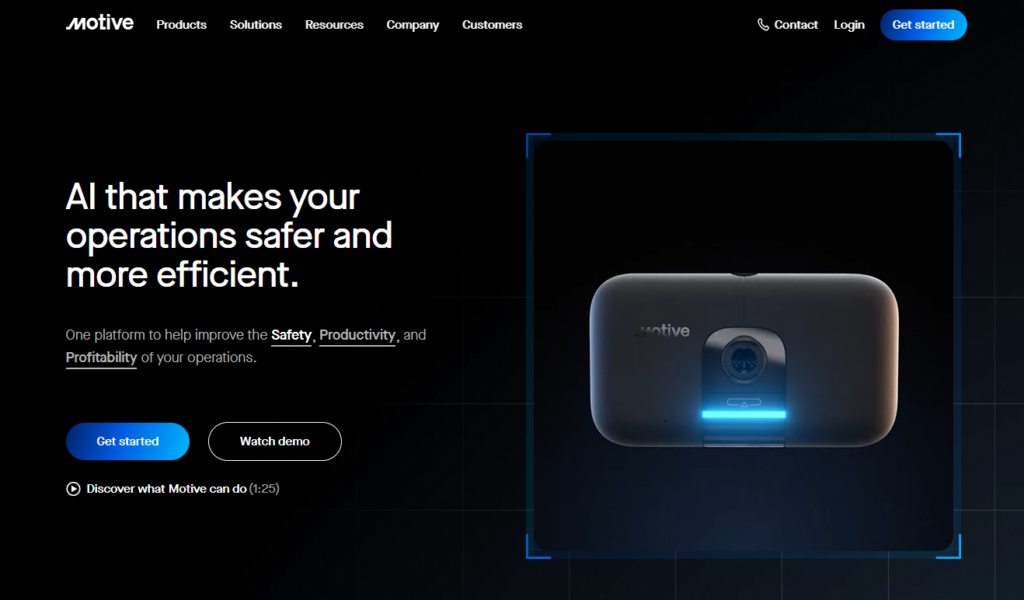
Motive (formerly KeepTruckin) is a fleet and operations management company combining driver safety, fleet management, asset monitoring, spend controls, and workforce management in a single AI-powered suite. It integrates hardware like AI dashcams and telematics devices. Motive is purpose-built for trucking and heavy-asset logistics, not for high-density last-mile delivery optimization that enterprises in retail and e-commerce require.
Features of Motive
- Driver safety: AI dashcams, 360° risk detection, automated driver coaching, and accident management.
- Fleet management: GPS fleet tracking, vehicle diagnostics, maintenance scheduling, and telematics.
- Equipment & asset monitoring: Trailer tracking, reefer monitoring, and theft prevention tools.
- Spend management: AI-powered Motive Card with fraud detection, spend analytics, and savings insights.
- Workforce management: Employee qualifications, time tracking, training, and coaching modules.
- Compliance: ELD mandate coverage, IFTA fuel tax reporting, and audit support.
- AI Vision: Customizable AI models for industry-specific operational needs.
Pros
- Comprehensive trucking and logistics management suite
- Strong compliance capabilities (ELD, IFTA)
- Integrated spend management with fraud detection
- Hardware-backed AI safety solutions
Cons
- Not designed for high-density delivery route optimization
- Pricing is opaque and custom-only
- Heavier platform than needed for pure routing use cases
- Limited applicability for retail/e-commerce last-mile
Motive Is Best For
Trucking and logistics companies, public sector fleets, utilities, construction, agriculture, and delivery operators seeking a consolidated platform for safety, compliance, and asset visibility with hardware-backed AI solutions.
Motive Pricing
Not publicly disclosed. Pricing is custom and based on fleet size, hardware, and service scope.Pricing is custom and based on fleet size, hardware, and service scope.
Benefits of Fleet Route Optimization Software
Implementing the right fleet routing software delivers measurable, compounding returns across every logistics KPI. Here are the six most impactful benefits for enterprise operations:
1. Significant Cost Reduction
Fleet routing software eliminates empty miles, optimizes vehicle loads, and reduces fuel waste. Organizations report a 30% average cost reduction in fleet operating expenses, with 15–20% lower maintenance costs from predictive scheduling. The last mile accounts for 41% of total logistics costs — making route optimization the highest-leverage cost intervention available.
2. Improved On-Time Delivery Rates
Dynamic rerouting, predictive delay alerts, and SLA-aware scheduling directly improve delivery reliability. Enterprise platforms like Locus monitor live conditions and reassign drivers in real time, reducing missed time windows and improving customer trust. Understanding why your business needs route optimization is the first step toward consistent SLA performance.
Customer Impact Metrics to Track
Operational improvements should be measured alongside customer-facing outcomes. The most effective fleet routing software helps teams connect route performance with customer experience.
Key customer impact metrics include:
- Customer satisfaction score: Tracks how delivery reliability affects the customer’s overall experience.
- ETA accuracy: Measures the gap between promised and actual arrival times.
- First-attempt delivery rate: Shows how often deliveries are completed without reattempts, returns, or support intervention.
- Support call reduction: Indicates whether proactive tracking links, accurate ETAs, and automated alerts are reducing “Where is my order?” enquiries.
- Delivery complaint rate: Highlights recurring issues such as missed time windows, damaged goods, or unclear delivery communication.
- Customer notification engagement: Measures whether customers open, click, or act on SMS, email, or tracking-link updates.
For enterprise teams, these metrics are useful because they connect route optimisation to revenue protection, retention, and brand trust — not just fleet efficiency.
3. Enhanced Fleet Utilization
AI-driven dispatch ensures every vehicle is loaded optimally and routed efficiently. Capacity-aware planning maximizes utilization rates across owned and outsourced fleets, enabling enterprises to do more with existing assets. Learn how delivery logistics software improves fleet utilization through intelligent allocation.
4. Reduced Environmental Impact
By minimizing total distance driven and optimizing load factors, fleet routing software directly reduces CO? emissions per delivery. Platforms with built-in carbon tracking (like Locus) enable enterprises to measure, report, and improve against ESG targets.
5. Faster Decision-Making Through Analytics
Decision-grade analytics — cost per route, delivery density, driver performance by region — transform raw fleet data into actionable strategy. Continuous feedback loops refine routing logic over time, compounding efficiency gains.
6. Safer Operations
Fleet technology adoption correlates with a 19% average decrease in accident costs. Real-time monitoring, driver coaching, and predictive alerts reduce risky driving behavior and improve fleet-wide safety outcomes.
Key Features to Look for in Fleet Routing Software
When evaluating fleet route optimization software, enterprises should prioritize seven capabilities that directly influence cost, efficiency, and delivery reliability:
1. Dynamic Multi-Stop Route Optimization
Routing efficiency depends on live conditions — traffic, weather, vehicle load, and customer time windows all shift constantly. Advanced dispatch software recalculates routes as conditions change to keep fleets efficient.
- Real-time rerouting adapts instantly to congestion or accidents.
- Capacity-aware planning maximizes utilization across vehicles.
- Time-window prioritization keeps promised delivery slots intact.
Route Efficiency = Planned Distance ÷ Actual Distance Driven
2. Automated Dispatch Allocation
Manual dispatching slows operations and increases idle time. Fleet routing software uses AI to allocate deliveries in seconds, factoring in geography, capacity, and delivery priorities. The last mile accounts for 41% of total logistics costs, illustrating the scale of inefficiency that optimized routing can mitigate. An auto-dispatch engine removes manual guesswork by assigning tasks based on configurable logic, balancing workloads across thousands of orders daily.
3. Real-Time Fleet Visibility and Alerts
Visibility must translate into action. Fleet routing platforms track vehicles live while flagging risks before they become failures.
- Predictive triggers warn of delays or SLA breaches.
- Centralized dashboards show region-wide performance.
- Driver updates reduce reliance on manual calls.
A control tower consolidates live ground data with predictive insights, enabling proactive issue resolution at scale.
On-Time Delivery Rate = (On-Time Deliveries ÷ Total Deliveries) × 100
4. Driver Adoption and Mobile App Usability
Even the strongest optimisation engine will underperform if drivers cannot follow the plan easily. Driver adoption is a core selection criterion because route compliance, proof-of-delivery accuracy, customer communication, and operational ROI all depend on consistent field usage.
Evaluate the driver app for:
- Ease of use: Clear task lists, simple workflows, and minimal taps reduce training burden.
- Offline functionality: Drivers should be able to continue completing tasks in low-connectivity areas.
- Navigation clarity: Routes, stop sequence, parking notes, and delivery instructions should be easy to interpret.
- Proof-of-delivery workflows: The app should support signatures, photos, OTPs, timestamps, geotags, and failed-delivery reason codes where required.
- Language support: Multi-region and multilingual workforces need driver experiences that reduce ambiguity.
- Training effort: Faster onboarding improves compliance and reduces operational disruption during rollout.
- Barcode scanning: Barcode scanning strengthens proof of delivery and package verification. It also supports returns, failed-delivery workflows, chain-of-custody visibility, and warehouse-to-route reconciliation by confirming that the right parcel, tote, or shipment is loaded, delivered, returned, or reattempted.
For fleet managers, high driver adoption is not a soft benefit. It directly affects route adherence, ETA accuracy, POD completeness, customer support volume, and the credibility of downstream analytics.
5. Automated Exception Handling
Unexpected breakdowns or cancellations can derail entire schedules. Software must reassign orders dynamically to avoid wasted miles and service failures.
- Instant capacity checks identify available vehicles nearby.
- Dynamic reallocation shifts deliveries into feasible slots.
- Continuity of service keeps customers satisfied without manual intervention.
6. Seamless Integrations Across Systems
Routing cannot work in silos. Integration with ERP, WMS, and e-commerce systems keeps planning and execution aligned.
- Prebuilt connectors speed up enterprise rollouts.
- Open APIs support custom workflows.
- Unified data reduces errors and duplication.
Integrations connect logistics routing with order management, finance, and compliance tools to streamline end-to-end workflows.
When comparing integration quality, look beyond whether an API exists. Enterprise buyers should assess:
- API documentation quality: Clear endpoint references, payload examples, error codes, and versioning guidance reduce implementation risk.
- Sandbox environments: Test environments help teams validate workflows before production go-live.
- Webhook support: Event-based updates improve real-time communication across order, route, delivery, and customer systems.
- Authentication standards: Secure authentication and role-based access controls are essential for enterprise data governance.
- ERP/WMS/TMS depth: Integrations should support the operational detail required for planning, execution, reconciliation, billing, and reporting.
- Implementation support: Vendor support during mapping, testing, and exception design can materially affect rollout speed.
- Integration monitoring: Alerts for failed data syncs, missing orders, duplicate records, or API errors help prevent operational disruption.
7. Multi-Fleet and Multi-Region Support
Enterprises often use a mix of owned and outsourced fleets across multiple geographies. Routing software must unify these complexities.
- Cross-fleet utilization balances workloads across partner and owned fleets.
- Compliance frameworks handle regional regulations.
- Scalability supports operations in multiple markets simultaneously.
8. Multi-Depot Workflows and Geographic Clustering
Large delivery networks rarely operate from a single origin point. Enterprise fleet routing software should support multi-depot workflows that allocate orders to the right fulfilment point before routes are built.
Important capabilities include:
- Depot-level order allocation: Assigns orders to the most suitable depot, store, dark store, fulfilment centre, or cross-dock based on proximity, capacity, inventory, and service commitments.
- Geographic clustering: Groups stops into logical delivery zones to improve route density and reduce unnecessary cross-traffic.
- Territory design: Helps operations teams define regions, service areas, driver zones, and partner-carrier boundaries.
- Cross-dock coordination: Supports handoffs between middle-mile and last-mile operations where goods move through intermediate facilities.
- Regional route balancing: Distributes work across depots, vehicles, and driver teams to avoid overloaded zones and underused capacity.
- Delivery density improvement: Better clustering increases drops per route, reduces kilometres per delivery, and improves route feasibility.
For high-density retail, FMCG, e-commerce, and 3PL networks, clustering is often the difference between technically valid routes and commercially efficient routes.
9. Decision-Grade Analytics
Fleet data must drive continuous improvement. Advanced routing platforms provide granular reporting and KPIs that influence cost and strategy. Explore how route optimization benefits different business segments with the right analytics.
Essential Metrics:
- Cost per Route = Total Operating Costs ÷ Routes Delivered
- Delivery Density = Deliveries ÷ Delivery Area
- Emissions per Delivery = Total CO? Emissions ÷ Total Deliveries
Route Planning vs. Route Optimization: What Is the Difference?
Route planning creates the initial sequence of stops for drivers. It answers the basic question: which stops should be visited, and in what order?
Route optimization goes further. It continuously improves that plan using operational constraints such as time windows, vehicle capacity, SLAs, traffic, driver availability, depot rules, service times, and cost. In enterprise operations, the distinction matters because a route that looks efficient on a map may still fail if it ignores capacity, customer commitments, driver hours, or regional constraints.
In simple terms:
- Route planning produces a workable route.
- Route optimization produces the best feasible route under live business constraints.
Why Google Maps Is Not Enough for Fleet Routing
Google Maps is useful for individual navigation, but it is not designed to orchestrate enterprise fleets. It can help a driver get from one point to another, but it does not provide the operational intelligence required to optimise hundreds or thousands of stops across multiple vehicles, depots, drivers, and regions.
Common enterprise gaps include:
- No native multi-vehicle optimisation across an entire fleet.
- Limited dispatcher workflows for planning, allocation, monitoring, and exception handling.
- No capacity-aware planning for vehicle volume, weight, or load sequencing.
- Limited support for commercial truck routing and heavy vehicle routing constraints such as road restrictions, bridge limits, vehicle dimensions, weight limits, loading zones, and service times.
- No enterprise proof-of-delivery workflows, failed-delivery automation, or returns orchestration.
- Limited route analytics for cost, SLA performance, delivery density, and driver productivity.
- No automated exception handling when orders, traffic, drivers, or vehicle availability change.
- Limited enterprise integration depth with ERP, WMS, TMS, order management, or customer communication systems.
For small teams, consumer navigation can be a helpful starting point. For enterprise logistics, fleet routing software is required to coordinate decisions across the full delivery network.
Why Choose Locus for Enterprise Fleet Routing
Enterprises managing fleets across retail, FMCG, e-commerce, or 3PL sectors face challenges that go beyond simple routing. They need a platform that can optimize dispatch, adapt to dynamic conditions, and provide full visibility across every delivery — at global scale.
While many of the software solutions reviewed excel in specific areas such as small-business routing (Upper, Circuit), telematics (Geotab, Samsara), or field service (OptimoRoute, WorkWave), Locus combines all critical capabilities into one enterprise-grade platform. Here is what sets Locus apart:
| Enterprise Capability | Locus | Typical Competitor |
| AI-powered dispatch automation | ? Under 5 minutes | ? Manual or basic rules |
| Real-time Control Tower | ? Predictive + reactive | ?? Basic tracking only |
| Multi-region orchestration | ? Global scale | ? Single region |
| Cross-fleet utilization | ? Owned + outsourced | ?? Owned fleets only |
| Carbon tracking & ESG | ? Built-in | ? Not available |
| Enterprise integrations | ? SAP, Oracle, APIs | ?? Limited connectors |
| Decision-grade analytics | ? Custom KPIs | ?? Standard reports |
Locus delivers a strategic competitive advantage for enterprise logistics leaders through AI-powered orchestration, real-time control, ESG compliance, and global scalability — enabling cost-efficient, reliable, and future-ready supply chain operations. Trusted by 360+ enterprises worldwide.
For logistics leaders, this means moving from reactive problem-solving to proactive orchestration, supported by actionable insights that drive long-term efficiency and growth.
See how leading enterprises optimize fleets with Locus. Schedule your demo now.
Frequently Asked Questions (FAQs)
1. What is fleet routing software?
Fleet routing software automates the process of planning, optimizing, and dispatching multi-stop delivery routes for commercial vehicle fleets. It uses algorithms — and increasingly AI — to factor in traffic, vehicle capacity, time windows, and delivery priorities to minimize cost and maximize on-time performance. Enterprise platforms like Locus add real-time orchestration, exception handling, and analytics on top of core routing.
2. What is the best fleet routing software for small to medium businesses?
Upper consistently ranks as a top pick for SMBs with 5–500 vehicles, reporting 25% fuel cost reduction and 85% faster planning in real-world use. Circuit is another strong option for solo couriers and very small teams with its free tier. For businesses anticipating rapid growth, evaluating enterprise-ready platforms early avoids costly migrations later.
3. What is the best fleet routing software for enterprises?
Locus is purpose-built for enterprise organizations with $150M+ revenue, high delivery density, and multi-region logistics needs. It combines AI-powered dispatch automation, a real-time Control Tower, multi-fleet orchestration, and carbon tracking — capabilities that SMB tools cannot replicate. Locus holds a 4.8/5 on G2 and a 4.9/5 on Capterra.
4. What is the difference between fleet management software and route optimization software?
Fleet management focuses on vehicle health, compliance, driver safety, and asset monitoring (examples: Geotab, Samsara, Motive). Route optimization specifically automates delivery planning and dispatching to reduce costs and improve delivery efficiency (examples: Locus, OptimoRoute, Route4Me). Enterprise platforms like Locus bridge both categories with integrated fleet visibility and route orchestration.
5. Can fleet routing software support both owned and third-party fleets?
Yes. Enterprise-grade platforms like Locus allow you to manage mixed fleets, balancing workloads across in-house vehicles and outsourced carriers for better utilization and flexibility. Most SMB tools are limited to managing owned fleets only.
6. How do route optimization tools impact sustainability goals?
By minimizing empty miles and fuel use, these tools directly reduce CO? emissions per delivery, helping enterprises align logistics operations with ESG targets. Locus includes built-in carbon tracking and emissions reporting per route, enabling organizations to measure and report against sustainability benchmarks.
7. How does Geotab’s fleet routing software optimize routes?
Geotab uses a proprietary AI model that factors fuel costs, maintenance expenses, and customer satisfaction into route calculations. It supports real-time adjustments, multi-resource routing, and revenue forecasting by territory — making it strong for compliance-focused mixed fleets where routing is part of a broader telematics strategy.
8. Is real-time visibility included in all fleet routing solutions?
Not always. Some entry-level tools provide only static route planning. Enterprise-grade solutions like Locus integrate live tracking, predictive alerts, and exception handling into a unified Control Tower. When evaluating solutions, confirm whether real-time rerouting and predictive capabilities are included or require add-ons.
9. How much can fleet routing software save on costs?
Organizations report a 30% average cost reduction in fleet operations, with 15–20% lower maintenance costs and 19% fewer accident-related expenses. Most companies see measurable ROI within 3–6 months, especially in fuel reduction, SLA compliance, and improved driver productivity.
10. What is the difference between fleet routing and traditional GPS?
Traditional GPS provides turn-by-turn navigation for a single vehicle. Fleet routing software like Locus, Route4Me, or OptimoRoute automates multi-stop optimization across an entire fleet, handling dynamic rerouting, workload balancing, dispatch automation, and performance analytics. The difference is operational intelligence versus simple navigation — with efficiency gains of 10–56% documented across leading platforms.
11. What is the difference between route planning and route optimization?
Route planning creates a stop sequence for a driver or vehicle. Route optimization improves that plan using AI-driven, constraint-aware decisioning across vehicles, drivers, delivery windows, traffic, capacity, SLAs, and cost. For enterprise fleets, optimization is essential because it keeps routes feasible as operating conditions change.
12. Can Google Maps be used as fleet routing software?
Google Maps is useful for individual navigation, but it is not sufficient for enterprise fleet routing. It lacks multi-vehicle optimization, dispatch automation, proof of delivery, cross-fleet orchestration, fleet analytics, automated exception handling, and deep integrations with ERP, WMS, TMS, and order management systems.


Retail & CPG
What is Retail Visibility? Importance, Types & Challenges

Nov 13, 2025
See how retail visibility drives smarter decisions across sales, inventory, and merchandising. Learn key types and barriers to success.
Read more
General
10 Best Routing and Dispatching Software in 2026
Nov 17, 2025
Compare the best routing and dispatch software in 2025. Explore features, pricing, and why Locus is the top enterprise choice.
Read moreInsights Worth Your Time




















10 Best Fleet Route Optimization Software in 2026