


General
Locus 2026 UK Consumer Survey: Why Returns Visibility is Now the Conversion Engine for AI-Driven Shopping in UK Retail

Key Takeaways
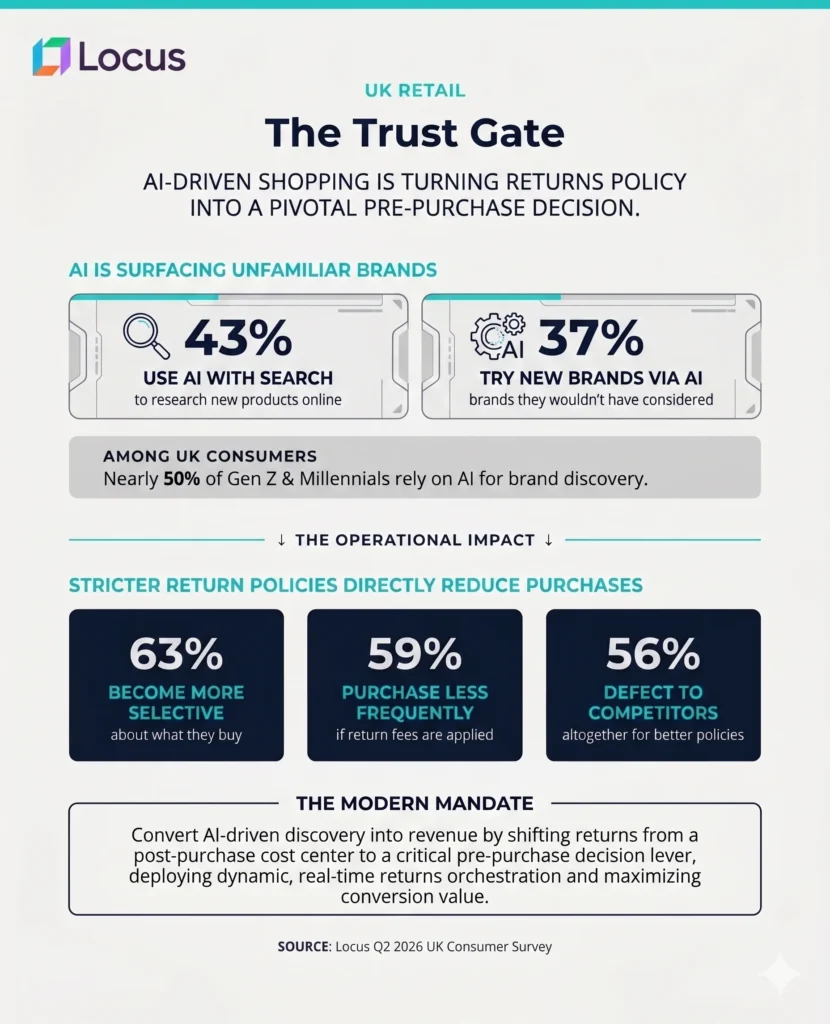
- AI-driven shopping has reshaped how UK consumers discover products and brands. The Locus Q2 2026 UK Consumer Survey found that 43% of UK consumers use AI tools alongside search engines and retailer websites when researching or choosing products, with 37% saying AI makes them more likely to try new brands they hadn’t considered before. Among Gen Z and Millennial shoppers, the figure rises to nearly 50% — half of younger UK consumers are now using AI to discover brands they wouldn’t have found through traditional search.
- The behavioural shift creates an operational tension that traditional retail hasn’t had to manage at scale. AI surfaces unfamiliar brands at unprecedented rates, but unfamiliar brand purchases carry trust risk — particularly in categories like fashion, where fit and quality are difficult to judge before delivery. Consumers facing this trust risk look for a mechanism to mitigate it. The mechanism is returns. Returns become the trust bridge that allows AI-mediated discovery to convert into actual purchases.
- The Locus Q2 2026 UK Consumer Survey data reveals how operationally consequential this dynamic has become. 63% of UK consumers say a return fee or stricter return policy would make them more selective about what they buy. 59% say they would be less likely to make a purchase at all. 56% say they would switch to a different retailer. Returns policy is no longer a post-purchase service consideration; it’s a pre-purchase decision criterion that determines whether AI-surfaced discovery converts.
- Returns visibility — what consumers can see and understand about the return path before they commit to purchase — has become the operational mechanism that translates AI-mediated discovery into completed sales. Consumers shown clear return options, transparent refund timing, and confident return channel availability convert AI-mediated brand exploration into purchases. Consumers facing opacity about the return path treat unfamiliar AI-surfaced brands as too risky to commit to.
- The conversion argument creates a legitimate margin tension that retailers tightening return policies are trying to resolve. Returns cost money to process, occupy inventory that isn’t earning, and depreciate fast outside saleable stock — particularly in fashion where AI-driven brand exploration is most concentrated. The operational lever that resolves the tension isn’t accepting more returns or refusing them; it’s return velocity. Fast processing converts returned items back into saleable inventory before depreciation compounds, protecting unit economics while enabling the generous return experience AI shopping conversion requires.
- For UK Chief Supply Chain Officers, VPs of Supply Chain, Heads of Fulfillment, Heads of E-commerce Operations, and Heads of Returns in 2026, the practical question is concrete: is the reverse logistics infrastructure architected as a post-purchase service capability — or as the dual-purpose conversion-and-margin mechanism that AI-driven shopping has made it? The architectural difference determines whether AI-driven discovery converts into revenue and whether increased return volume erodes margin or remains margin-neutral.
The mainstreaming of AI shopping has produced one of the more meaningful behavioural shifts in UK retail in 2026. The Locus Q2 2026 UK Consumer Survey found that 43% of UK consumers now use AI tools alongside traditional search engines and retailer websites when researching or choosing products, with 37% saying AI shopping makes them more likely to try new brands they hadn’t considered before. Among Gen Z and Millennial shoppers, the figure rises to nearly 50%. AI is no longer a peripheral shopping behaviour; it’s actively reshaping which brands and products UK consumers encounter and consider.
Most analysis of AI shopping adoption focuses on the discovery side. The analysis is real and useful. But the operational consequence of AI-driven discovery doesn’t end at consideration; it ends at conversion. And conversion of AI-mediated discovery into actual purchases depends on something the discovery-focused analysis rarely addresses: the operational mechanism that lets consumers commit to unfamiliar brands AI surfaces.
That mechanism is returns. Specifically, it’s returns visibility — what consumers can see and understand about the return path before they commit to purchase. Returns visibility has become the operational bridge between AI-driven discovery and AI-driven conversion. Without it, AI-surfaced brand exploration stalls at the trust gate. With it, AI-mediated discovery translates into completed purchases at materially higher rates.
Why AI Shopping and Returns Are Now Operationally Coupled
The connection between AI shopping and returns isn’t obvious until the data surfaces it.
AI-mediated discovery produces a specific consumer experience: a recommendation engine, conversational tool, or AI assistant surfaces brands and products the consumer hadn’t actively searched for. The surfaced options may be excellent matches for the consumer’s actual needs — AI tools often surface products better-suited to consumer requirements than traditional category browsing produces. But the surfaced options share a common characteristic: the consumer hasn’t bought from this brand before, may have never heard of it, and has no direct experience to validate the AI’s recommendation.
In categories where consumers can fully evaluate products before purchase, this isn’t operationally consequential — the consumer reviews specifications, compares features, and commits based on pre-purchase evaluation. In categories where evaluation requires the product in hand — fashion, home goods, beauty products, anything requiring fit, feel, or contextual judgement — the consumer can’t validate the AI recommendation pre-purchase. They have to commit, receive, evaluate, and either keep or return.
Returns become the mechanism that makes this commit-receive-evaluate flow operationally viable. Without confident, frictionless returns, the trust risk of buying an unfamiliar AI-surfaced brand is too high for many consumers to accept. With confident returns, the risk is bounded — the consumer can try the brand, evaluate against actual experience, and return if it doesn’t work.
The survey data makes the trust dynamic explicit in operational terms. 63% of UK consumers say a return fee or stricter return policy would make them more selective about what they buy. 59% say they would be less likely to make a purchase. 56% say they would switch to a different retailer entirely. These aren’t returns-side responses — these are forward-purchase responses. Stricter return policy doesn’t reduce returns volume primarily; it reduces purchase volume. The forward and reverse sides of the network are operationally coupled in ways pre-AI retail didn’t have to manage.
Returns Visibility as the Conversion Mechanism
Once the coupling is understood, the operational question becomes specific: what does returns infrastructure have to deliver to make AI-mediated discovery convert?
The answer surfaces across several data points in the survey. Refund speed — 67% of UK consumers say a fast refund makes them more likely to shop with that retailer again. Refund speed isn’t a post-purchase satisfaction metric; it’s a pre-purchase trust signal. Consumers evaluating whether to commit to an unfamiliar AI-surfaced brand look at the retailer’s track record on refund speed as a proxy for whether their downside is bounded if the purchase doesn’t work.
63% of UK consumers say a return fee or stricter return policy would make them more selective about what they buy. 59% say they would be less likely to make a purchase. 56% say they would switch to a different retailer entirely–Locus Q2 2026 UK Consumer Survey
Return channel options — UK consumers prefer different return methods depending on convenience, geography, and the specific purchase. The survey data on US consumers showed in-store drop-off as the dominant preference; UK consumers have a more varied preference set across parcel shops, locker drop-offs, home collection, and in-store. Retailers offering a narrow return channel mix face friction at the trust gate; retailers offering channel variety give consumers the option that matches their specific situation.
Return fee structure — the UK market is moving toward variable return fees, with retailers like ASOS, Zara, and Next applying fees based on return route, customer behaviour, or specific return channels. The survey suggests this complexity has consequences. 52% of UK consumers say a reasonable return fee is no fee at all. The complexity of variable fee structures may produce return fee revenue, but it also produces opacity about the return path — which directly affects the trust signal returns visibility was supposed to provide.
The cumulative picture is that returns visibility — as consumers experience it pre-purchase and as operations manage it post-purchase — has become the operational bridge between AI-driven discovery and AI-driven revenue. Retailers treating returns infrastructure as a reverse logistics cost centre miss the forward-conversion impact. Retailers treating returns infrastructure as conversion infrastructure capture the value AI-mediated discovery enables.
The Margin Tension and Why Return Velocity Resolves It
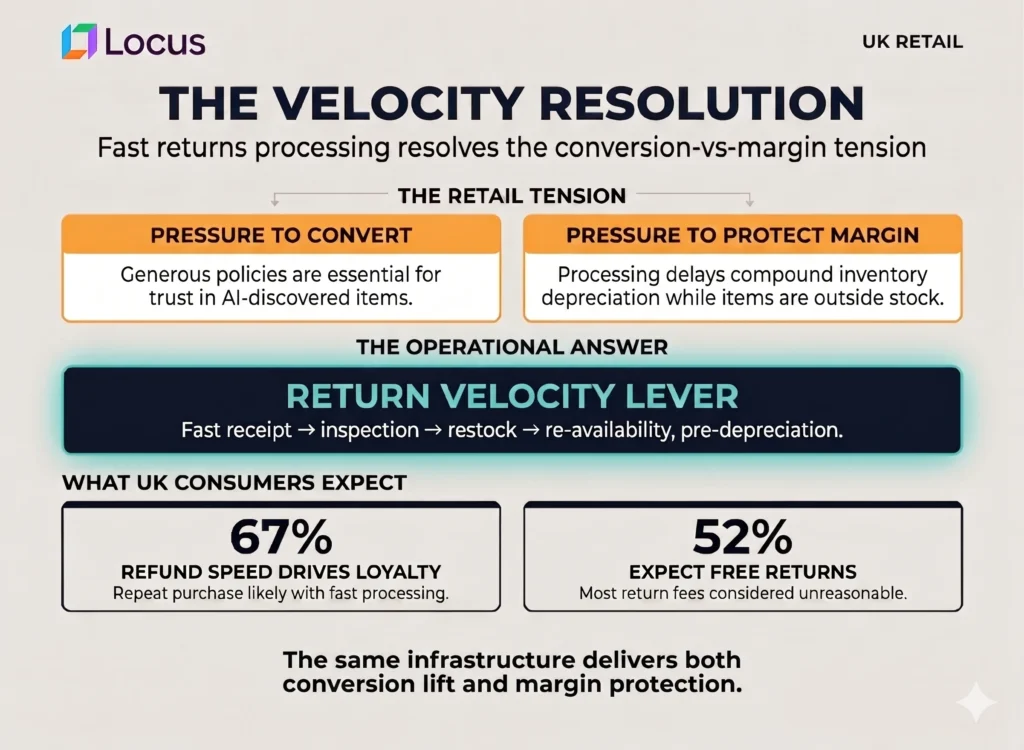
The conversion argument above will read as incomplete to any UK retail operations leader managing actual reverse logistics economics — because it understates the legitimate fear driving retailers toward stricter return policies. Returns aren’t a margin problem because retailers fear consumer dissatisfaction; they’re a margin problem because each return costs money to process, occupies inventory that isn’t earning, and depreciates fast outside saleable stock. In fashion, where AI-mediated brand exploration is most concentrated, returned items can lose meaningful value for every week they sit outside re-saleable inventory. Generosity that drives forward conversion creates reverse-side margin pressure if the operational architecture can’t process the returns fast enough.
The tension is genuine. The operational question every CSCO is already asking: if I accept higher return rates to enable AI-driven brand exploration, how do I protect unit economics on the increased return volume?
The answer surfaces in the survey’s market context and in the operational reality the data describes. The lever isn’t accepting more returns or refusing more returns; it’s processing returns at velocity so items return to saleable inventory before they lose value. Return velocity — the operational time from receipt through inspection, grading, restocking, and re-availability for sale — determines whether a return is a margin destroyer or a margin-neutral event. Fast velocity converts returned items back into saleable inventory before depreciation compounds; slow velocity locks items out of inventory long enough that recovery happens at materially reduced value.
The operational mechanics producing return velocity overlap directly with the mechanics producing pre-purchase returns visibility. Network design positioning return processing close to demand. Process automation handling inspection, grading, and disposition decisions without manual handoff bottlenecks. Inventory system integration returning items to availability the moment processing completes. Decision logic routing returns to the highest-value disposition path — primary inventory restock for saleable items, secondary channels for items requiring discounting, liquidation only when other paths aren’t viable.
This is where the conversion argument and the margin argument resolve. Retailers building reverse logistics infrastructure that delivers fast return velocity capture the forward-conversion value of generous return policies while protecting unit economics on the increased return volume. Retailers tightening return policies to reduce returns volume produce the forward-conversion loss the survey data documents — and rarely capture the margin protection they were seeking, because tightened policies don’t reduce returns proportionally while the reduced purchase volume eliminates the revenue base entirely.
Returns infrastructure investment therefore justifies itself on two reinforcing dimensions. Forward conversion — returns visibility as the pre-purchase trust signal translating AI-mediated discovery into purchases. Reverse margin protection — return velocity as the operational mechanism keeping returned items earning rather than depreciating. The same infrastructure delivers both.
The Operational Implications for UK Retail
The reframe has four operational implications for UK retail supply chain leaders.
Returns visibility infrastructure justifies investment on conversion grounds, not just cost grounds. Operations leaders evaluating reverse logistics investment have typically built business cases around cost reduction, processing efficiency, and customer satisfaction. The survey data argues these business cases now systematically under-value the investment because they miss the forward-conversion impact.
Return velocity becomes a margin-protection lever, not just a processing efficiency metric. With AI-driven brand exploration increasing return volume — particularly in fashion where depreciation accelerates outside saleable inventory — return velocity determines whether the increased return volume erodes margin or remains margin-neutral. Operations leaders should examine whether the operational architecture supports velocity that protects unit economics on increased return volume.
Refund speed needs to be operationally managed as a conversion metric. With 67% of UK consumers citing fast refunds as a driver of repeat purchase, refund speed isn’t a finance workflow consideration. It’s a pre-purchase trust signal affecting whether AI-mediated discovery converts. Operations leaders should examine whether refund speed is measured and managed as a metric tied to conversion economics rather than as back-office processing efficiency.
Return channel and fee strategy needs to align with AI shopping conversion economics. UK retailers facing pressure to reduce reverse logistics costs through fee structures should examine whether the cost reduction is being financed by forward-conversion losses exceeding the reverse-side savings — and whether return velocity investment would protect margin more effectively than fee-based deterrence.
The diagnosis matters more than any tactical adjustment. Reverse logistics architected for AI-driven shopping treats returns visibility as conversion infrastructure and return velocity as margin-protection infrastructure — the dual mechanism the operational economics now require.
The strategic question for UK retail supply chain leaders is this: as AI-driven discovery introduces consumers to new brands and returns policies increasingly influence purchase decisions, is your reverse logistics network designed to drive conversions and protect margins—or still operating as a post-purchase function that does neither effectively?
Learn more about how AI is transforming buying patterns and ultimately fulfillment, visit locus.sh
FAQs
Why does AI shopping make returns visibility operationally important for UK retailers?
AI-mediated discovery surfaces brands consumers hadn’t actively searched for and have no direct experience with. In categories requiring pre-purchase evaluation that AI can’t fully provide — fashion, home goods, beauty products, anything requiring fit, feel, or contextual judgement — consumers can’t validate AI recommendations before commitment. They have to commit, receive, evaluate, and either keep or return. Returns become the mechanism that makes this trust-bounded purchase flow viable. Without confident, frictionless returns, the trust risk of buying an unfamiliar AI-surfaced brand is too high for many UK consumers to accept. With confident returns visibility — clear return options, transparent refund timing, predictable return channel availability — the risk is bounded and AI-mediated discovery converts. The 37% of UK consumers who say AI makes them more likely to try new brands face this trust dynamic on every AI-mediated purchase decision; their conversion depends on returns visibility infrastructure.
What does the survey reveal about how returns policy affects purchase decisions?
The survey makes the forward-purchase impact of returns policy explicit. 63% of UK consumers say a return fee or stricter return policy would make them more selective about what they buy. 59% say they would be less likely to make a purchase. 56% say they would switch to a different retailer. Only 37% of returners say stricter policies would make them keep more items instead of returning them — which means the policy doesn’t primarily reduce returns volume, it reduces purchase volume. The forward and reverse sides of the retail network are operationally coupled. UK retailers tightening returns policy to reduce reverse logistics costs need to weigh the cost reduction against the forward-conversion losses that exceed the reverse-side savings, particularly as AI-driven discovery makes unfamiliar brand purchases an increasing share of total volume.
How does refund speed function as a pre-purchase trust signal rather than a post-purchase service metric?
67% of UK consumers say a fast refund makes them more likely to shop with that retailer again. This statistic is typically interpreted as a post-purchase loyalty effect — retailers with fast refunds retain customers better. But the operational dynamic in AI-driven shopping is more upstream. Consumers evaluating whether to commit to an unfamiliar AI-surfaced brand look at retailer reputation for refund speed as a proxy for whether their downside is bounded if the purchase doesn’t work. A retailer known for fast refunds gives consumers confidence to commit to AI-surfaced brand exploration; a retailer known for slow refunds gives consumers reason to defer commitment. Refund speed therefore affects forward conversion of AI-mediated discovery, not just post-purchase retention. Operations leaders measuring refund speed as a back-office processing efficiency metric miss the conversion economics.
What does the UK return channel preference data suggest for reverse logistics design?
UK consumers have a more varied return channel preference set than US consumers, with significant volume across parcel shops, locker drop-offs, home collection, and in-store returns. The variation reflects UK-specific infrastructure — strong parcel shop networks through Post Office, Evri, DPD pickup points, and locker networks like InPost — and consumer behaviour patterns shaped by that infrastructure. UK retailers operating reverse logistics with a narrow return channel mix face friction at the trust gate; retailers offering channel variety give consumers the option that matches their specific situation. As variable return fee structures become more common — ASOS using return-rate thresholds, Zara charging for drop-off returns, Next applying courier fees — return channel and fee complexity needs to be communicated clearly enough that the visibility serves consumer decision-making rather than creating opacity that erodes the trust signal returns infrastructure was supposed to provide.
How should UK retail operations leaders build the business case for returns visibility infrastructure?
Traditional reverse logistics business cases are built around cost reduction, processing efficiency, and customer satisfaction metrics. The survey data suggests these business cases systematically under-value returns infrastructure investment by missing the forward-conversion impact. Operations leaders should examine three dimensions. First, what share of new-customer conversion currently depends on consumers committing to unfamiliar brands — increasingly the share that AI-mediated discovery is producing. Second, what returns visibility deficits — refund speed opacity, return channel limitations, fee complexity — are reducing conversion at the trust gate. Third, what investment in returns visibility infrastructure would produce measurable forward-conversion improvement. The business case justifies itself on conversion grounds where traditional reverse logistics ROI calculations can’t capture the value, particularly as AI-driven brand exploration grows as a share of total UK retail purchase decisions.
Why is the operational coupling between AI shopping and returns likely to strengthen?
AI shopping adoption among UK consumers continues to grow. Ofcom’s 2026 Adults’ Media Use and Attitudes report found that 54% of UK adults now use AI tools, suggesting AI-driven discovery will become a larger share of how consumers encounter brands and products. The behavioural pattern — AI surfaces unfamiliar brands, consumers commit only if returns provide trust-bounded risk — reinforces itself rather than stabilising. Each successful AI-mediated purchase where returns provided the trust bridge reinforces consumer reliance on AI for future discovery. Each failed AI-mediated purchase where returns provided graceful exit reinforces consumer willingness to commit to AI-surfaced brands in the future. Each AI-mediated purchase abandoned because returns visibility was inadequate reinforces consumer skepticism of unfamiliar brands and reduces future AI shopping conversion. The compounding dynamic means UK retailers under-investing in returns visibility face a widening gap between AI-driven discovery their consumers are doing and AI-driven revenue their operations are capturing — a gap that grows as AI shopping adoption grows.


General
Locus 2026 US Consumer Survey: Generative AI isn’t Just Changing How Consumers Shop, it’s Breaking the Demand Patterns US Retail Was Built On

May 29, 2026
Generative AI is reshaping how US consumers shop online — and the operational consequences for retail fulfillment are material. Three behavioral shifts and three operational implications for supply chain leaders.
Read more
General
Top 10 Last-Mile Delivery Platforms in 2026: How Enterprises Are Choosing for Execution Intelligence, Not Just Route Optimization

May 29, 2026
The leading last-mile delivery platforms enterprises are evaluating in 2026 — Locus, Bringg, DispatchTrack, FarEye, LogiNext, Shipsy, and more. How execution intelligence is reshaping platform selection.
Read moreInsights Worth Your Time


















Locus 2026 UK Consumer Survey: Why Returns Visibility is Now the Conversion Engine for AI-Driven Shopping in UK Retail