


General
Top 10 Last Mile Visibility Software Platforms for Enterprise Logistics in 2026

Key Takeaways
- Last mile visibility software helps enterprises track, manage, and optimize deliveries across multiple carriers and fulfillment nodes from a single platform, replacing fragmented carrier portals and manual tracking workflows.
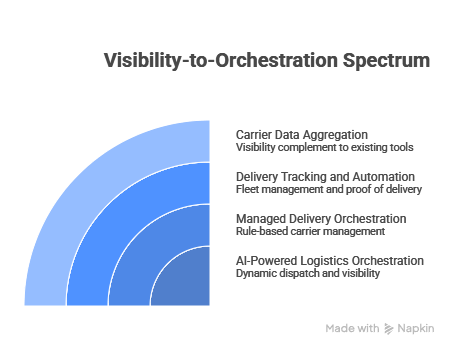
- Selecting the right platform requires understanding where each tool sits on the Visibility-to-Orchestration Spectrum, from carrier data aggregation and delivery tracking to managed orchestration and AI-powered logistics orchestration.
- Most other tools are designed for specific layers such as carrier visibility (project44, FourKites), fleet tracking and routing (Onfleet, Wise Systems), or multi-carrier workflow management (Bringg, FarEye).
- Locus operates at the orchestration tier of last mile visibility, combining dynamic dispatch through DispatchIQ, multi-carrier allocation via ShipFlex, and real-time delivery tracking through its Control Tower.
A national retailer fulfills online orders from 180 stores, three regional distribution centers, and two third-party logistics partners. A customer in Dallas places an order at 11 AM.
The nearest store has the item in stock, but its delivery capacity is full until 6 PM. The DC in Houston can ship next-day. A 3PL partner can deliver same-day at twice the cost. Which fulfillment node should handle the order?
Most enterprise logistics teams cannot even surface these three options simultaneously because their delivery tracking is scattered across carrier portals, dispatch spreadsheets, and disconnected dashboards.
Last mile visibility software addresses this by centralizing real-time tracking, dispatch coordination, carrier management, and delivery analytics into one platform.
In this guide, we evaluate 10 platforms across four tiers of capability (what we call the Visibility-to-Orchestration Spectrum) and explain what enterprise logistics teams should prioritize when choosing a last mile visibility platform in 2026.
Why Enterprises Need Last Mile Visibility Software
Last mile visibility software connects dispatch decisions, carrier assignments, delivery execution, and exception management into a coordinated workflow. For retailer logistics, FMCG brands, and 3PL providers managing thousands of deliveries daily, this coordination is what separates operational control from reactive firefighting.
The Visibility-to-Orchestration Spectrum
Not every last mile visibility platform serves the same operational need. Enterprise buyers should evaluate platforms along four distinct tiers:
- Tier 1 – Carrier Data Aggregation: Surfaces tracking data across carrier networks but does not make dispatch decisions or optimize routes. Best suited as a visibility complement to existing dispatch tools
- Tier 2 – Delivery Tracking and Automation: Tracks drivers, automates dispatch for single-fleet operations, and captures proof of delivery. Effective for companies managing owned fleets with moderate daily volumes
- Tier 3 – Managed Delivery Orchestration: Manages multi-carrier delivery workflows with rule-based carrier allocation, delivery tracking, and workflow automation. Handles complex carrier networks, but relies on static rules
- Tier 4 – AI-Powered Logistics Orchestration: Makes dynamic dispatch decisions and provides visibility simultaneously. Orchestrates outcomes across the entire delivery network using machine learning models trained on real-time constraints
This framework replaces the typical feature checklist approach with a structural evaluation of what each platform does: whether it reports what happened, tracks what is happening, or decides what should happen next.
Why Locus: Tier 4 Orchestration, Not Tier 1 Visibility
Most platforms on this list sit at Tier 1 or Tier 2 of the Visibility-to-Orchestration Spectrum: they aggregate carrier data and report shipment status. A few reach Tier 3: managed delivery orchestration with rule-based carrier allocation. Locus is the only platform in this guide at Tier 4 — AI-powered logistics orchestration — where live visibility and dispatch decisions operate as one unified system.The practical difference is what happens when something goes wrong in the last mile. A Tier 1 platform (project44, FourKites) shows you the exception on a dashboard. A Tier 3 platform routes an alert to a dispatcher. Locus’s DispatchIQ detects the exception, recalculates the affected route in real time, and sends updated instructions to the driver, all without dispatcher intervention, using 250+ real-world delivery constraints per computation.
Why this matters for enterprise last-mile specifically:
Enterprise last-mile operations — retail, FMCG, e-commerce, CEP — have delivery windows measured in hours, not days. A two-hour detection-to-resolution gap is a failed delivery. Locus closes that gap by combining the visibility layer and the execution layer on the same live data.
- 1.5 billion deliveries orchestrated across 360+ enterprise customers in 30+ countries.
- 1,000+ pre-integrated carriers across owned fleets, contracted carriers, and gig-economy networks — all managed from a single platform with a single SLA framework.
- Gartner recognized seven consecutive years, including the 2025 Gartner Market
- G2 #1 in Route Planning, 2026 Best Software Awards.
- Choose Locus if your last-mile operation needs visibility that triggers execution, not a racking layer that shows you the missed delivery after it happens.
Top 10 Last Mile Visibility Software Platforms for Enterprises in 2026
Below are the leading last mile visibility tool options used by enterprise logistics teams, mapped to the Visibility-to-Orchestration Spectrum.
| Software | Spectrum Tier | Best For | Key Capabilities | Pricing |
|---|---|---|---|---|
| Locus | Tier 4 | Enterprise logistics orchestration across all-mile delivery | AI dispatch optimization, multi-carrier allocation, route optimization, Control Tower visibility, reverse logistics | Custom pricing |
| FarEye | Tier 3 | Last-mile delivery experience and carrier coordination | Multi-carrier management, delivery tracking, customer notifications, workflow automation | Custom pricing |
| LogiNext | Tier 3 | Route optimization with delivery tracking | Automated route planning, driver tracking, ePOD, fleet analytics, capacity planning | Custom pricing |
| Shipsy | Tier 3 | Cross-border and domestic logistics visibility | Shipment tracking, carrier allocation, freight management, AI agent workflows | Custom pricing |
| Onfleet | Tier 2 | SMB and mid-market fleet tracking | Driver dispatch, GPS tracking, route optimization, ePOD, customer SMS updates | Starts at $619/month |
| Bringg | Tier 3 | Retail and QSR delivery orchestration | Multi-provider marketplace, delivery tracking, customer experience tools, fulfillment coordination | Custom pricing |
| FourKites | Tier 1 | End-to-end supply chain visibility | Multimodal tracking (ocean, rail, truck, last-mile), predictive ETAs, analytics | Custom pricing |
| project44 | Tier 1 | Real-time transportation visibility | Global carrier network, shipment tracking, predictive ETAs, post-purchase experience tools | Custom pricing |
| DispatchTrack | Tier 2 | Big-and-bulky home delivery | Route optimization, customer scheduling, predictive ETAs, driver tracking, ePOD | Custom pricing |
| Wise Systems | Tier 2 | Fleet routing and dispatch with TMS integration | Dynamic route optimization, real-time tracking, driver analytics, fleet management | Custom pricing |
1. Locus
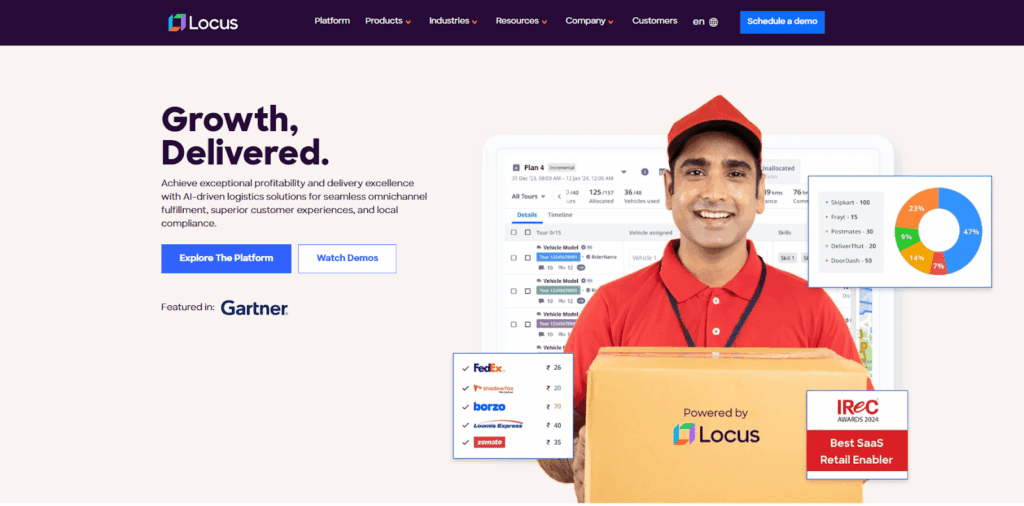
If your delivery operations involve multiple carriers, fulfillment locations, and last-mile partners, managing visibility through separate tools creates blind spots that cost time and money. Locus brings dispatch decisions, carrier allocation, and delivery tracking into one platform, so logistics teams can see what is happening and control what happens next.
Locus is an AI-powered logistics orchestration platform that operates at Tier 4 of the Visibility-to-Orchestration Spectrum. Where most platforms either track shipments or optimize routes, Locus does both. It makes dynamic dispatch decisions while providing end-to-end visibility across the entire delivery network.
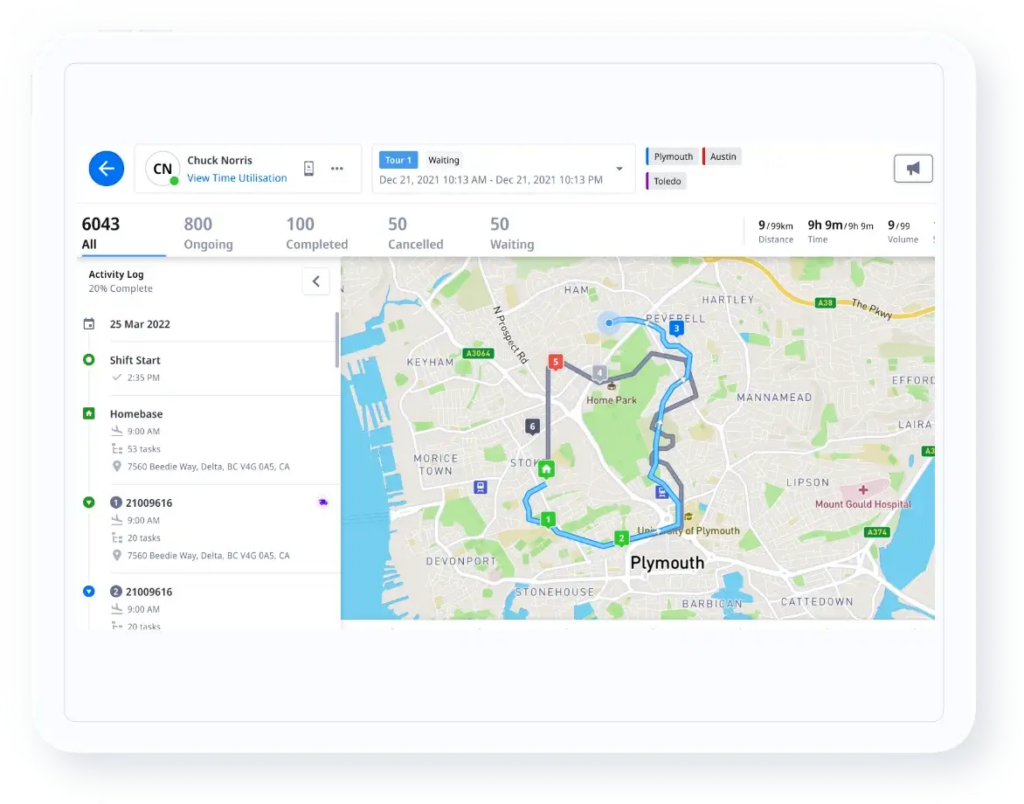
The platform’s Control Tower provides centralized visibility across all deliveries with predictive ETAs, AI-validated electronic proof of delivery, and proactive exception alerts. Unlike basic tracking tools, it connects this visibility layer to the dispatch and carrier allocation engines, so the same system that shows you a delay can also reassign the delivery to maintain the SLA.
Locus serves enterprise retailers, CPG brands, distributors, and 3PL providers across 30+ countries, having optimized over 1.5 billion deliveries and generated more than $320 million in documented customer logistics savings.
Key features of Locus
- AI-driven dispatch optimization: DispatchIQ uses 250+ transportation constraints including time windows, vehicle capacity, driver availability, and service commitments to automatically assign each order to the optimal carrier and route
- Dynamic multi-carrier allocation: ShipFlex selects the most suitable carrier for each shipment based on cost, delivery speed, and operational rules, connecting enterprises to a network of 1,000+ pre-integrated carrier and 3PL partners
- AI-validated proof of delivery: Electronic proof of delivery with photo capture, digital signatures, GPS stamps, and AI validation to confirm delivery accuracy and reduce dispute resolution time
- Route optimization: Continuous and dynamic route planning that recalculates based on live traffic, delivery windows, and capacity changes throughout the day
- Reverse logistics visibility: Forward and return delivery orchestration within the same platform, providing visibility across both directions
- Driver companion app: Mobile application for driver task management, delivery workflows, navigation, and real-time communication between drivers and dispatchers
Locus pros
- It combines dispatch decision-making with full delivery visibility in a single platform
- Handles complex enterprise logistics networks across multiple carriers, fulfillment nodes, and delivery modes with AI-powered allocation through ShipFlex
- Provides omnichannel fulfillment visibility, coordinating deliveries across store fulfillment, warehouse shipments, and 3PL operations simultaneously
- The tool supports both forward and reverse logistics visibility within the same dispatch optimization engine
Locus cons
- Designed for enterprise operations, so it may offer more capability than smaller e-commerce teams or single-fleet operators require
Locus pricing
Locus offers enterprise pricing based on shipment volumes, number of delivery locations, carrier integrations, and deployment scope. Implementations are customized to each logistics network, and pricing is provided after a consultation with the Locus team.
Enterprises can request a demo to evaluate the platform and receive a tailored pricing estimate.
Locus is best for
Enterprise retailers, FMCG/CPG brands, distributors, and 3PL providers managing high delivery volumes across multiple carriers and fulfillment networks that need both visibility and orchestration from one platform.
2. FarEye
FarEye focuses on improving visibility and coordination across multi-carrier delivery networks. The platform connects enterprises with carrier partners while providing last mile delivery tracking, customer notifications, and workflow automation.
It operates at Tier 3 on the Visibility-to-Orchestration Spectrum, and manages multi-carrier delivery workflows with rule-based allocation and tracking. The tool’s visibility layer aggregates data from external carriers rather than natively optimizing dispatch decisions or dynamically rerouting deliveries based on real-time conditions.
Key features of FarEye
- Multi-carrier delivery management with 250+ carrier partners and manage shipments while maintaining visibility across delivery operations
- Real-time delivery tracking across different carrier partners with live status updates and delivery progress monitoring
- Branded delivery tracking portals, real-time notifications, and delivery updates throughout the fulfillment journey
- Automated delivery workflows including dispatch planning, delivery status updates, exception handling, and issue resolution
- Sustainability tracking features for enterprises measuring and reporting delivery-related environmental impact
FarEye pros
- Strong carrier integration breadth with support for 250+ carrier partners
- Provides customer-facing delivery tracking portals and proactive notification workflows
- It includes sustainability tracking for ESG-focused enterprises
FarEye cons
- Visibility is carrier-dependent rather than orchestration-native; it aggregates tracking data from external carriers but does not natively optimize dispatch decisions
- Some implementations may require customization that extends deployment timelines
FarEye pricing
FarEye offers enterprise pricing based on shipment volume, delivery regions, and platform deployment requirements. Pricing details are typically provided after a consultation or demo.
FarEye is best for
Retailers, CEP providers, and logistics companies that prioritize delivery visibility and customer communication across large shipment volumes with multiple carrier partners.
3. LogiNext
LogiNext is a logistics automation platform with route optimization, real-time driver tracking, and electronic proof of delivery capabilities. It primarily serves mid-market to enterprise logistics operations, with a strong presence in markets across India and Southeast Asia.
LogiNext sits at Tier 3 on the Visibility-to-Orchestration Spectrum. Its AI is primarily applied to route planning: optimizing routes for a pre-assigned fleet, rather than dynamically selecting the optimal carrier or fulfillment node for each order.
Key features of LogiNext
- AI-powered route optimization that accounts for traffic, time windows, vehicle capacity, and delivery constraints
- Live GPS tracking through a mobile app, giving dispatchers visibility into driver location and delivery progress
- Fleet capacity analysis and resource allocation tools for managing driver and vehicle availability
- Estimated arrival time calculations based on route progress and traffic conditions
LogiNext pros
- Provides strong route planning and optimization capabilities for fleet-based operations
- Offers real-time driver tracking with ePOD capture
LogiNext cons
- AI optimization is route-focused rather than orchestration-focused
- Limited multi-carrier orchestration capabilities compared to Tier 3 and Tier 4 platforms
LogiNext pricing
LogiNext offers custom pricing based on delivery volumes, fleet size, and deployment requirements. Pricing details are available through consultation.
LogiNext is best for
Mid-market logistics operations and enterprises in South and Southeast Asian markets that need route optimization and driver tracking for owned fleet operations.
4. Shipsy
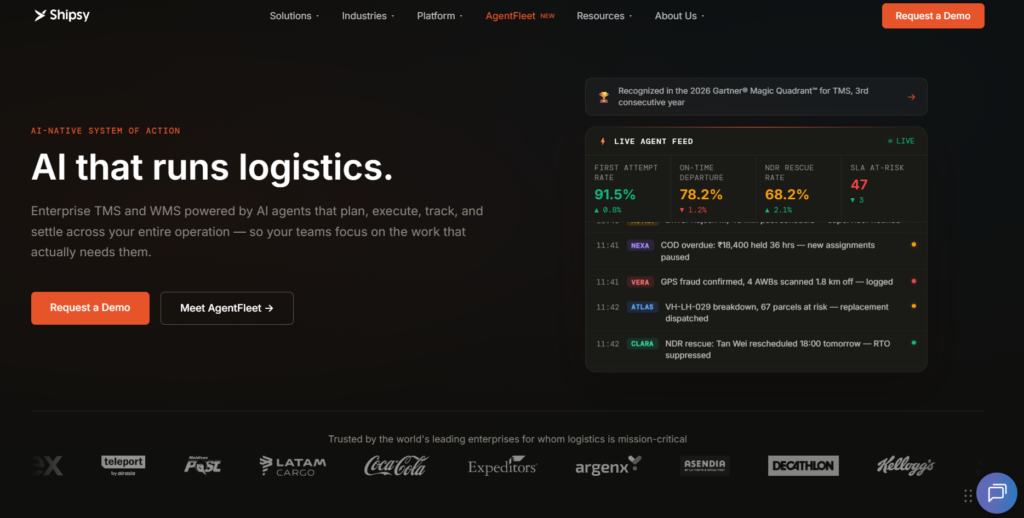
Shipsy is a logistics management platform focused on cross-border and domestic freight visibility, carrier allocation, and logistics cost optimization. It provides visibility beyond the final mile, covering upstream freight and mid-mile operations, which gives it a broader supply chain visibility angle.
Shipsy operates at Tier 3 on the Visibility-to-Orchestration Spectrum. The platform serves 220+ enterprise customers processing approximately 150 million monthly shipments, with particular strength in APAC and MENA markets. In March 2026, Shipsy launched AgentFleet, an AI-agent workforce organized around operational roles including dispatcher, exception manager, and billing reconciler, signaling a move toward AI-native logistics orchestration.
Key features of Shipsy
- Real-time tracking across domestic and cross-border shipments with centralized status monitoring
- Cross-border logistics management including compliance, documentation, and multimodal shipment coordination
- AI agent workflows (AgentFleet) organized by operational role to automate dispatch, exception management, and billing reconciliation
- Automated freight invoicing and audit capabilities for financial settlement
Shipsy pros
- Provides visibility beyond pure last-mile; it covers upstream freight and mid-mile alongside last-mile tracking
- Strong cross-border logistics capabilities with compliance and documentation management
Shipsy cons
- Last-mile-specific orchestration capabilities, including dynamic dispatch, real-time rerouting, and customer notification workflows, are less mature than dedicated last-mile platforms
- Stronger presence in APAC and MENA markets than in North America and Europe
- Better suited as a complement to a dedicated last-mile orchestration tool for delivery-intensive operations than as a standalone solution
Shipsy pricing
Shipsy offers enterprise pricing based on shipment volumes, modules used, and geographic scope. Pricing details are provided after consultation.
Shipsy is best for
Enterprises with complex cross-border supply chains and domestic logistics operations that need visibility across freight, mid-mile, and last-mile in a single platform, particularly in APAC and MENA regions.
5. Onfleet
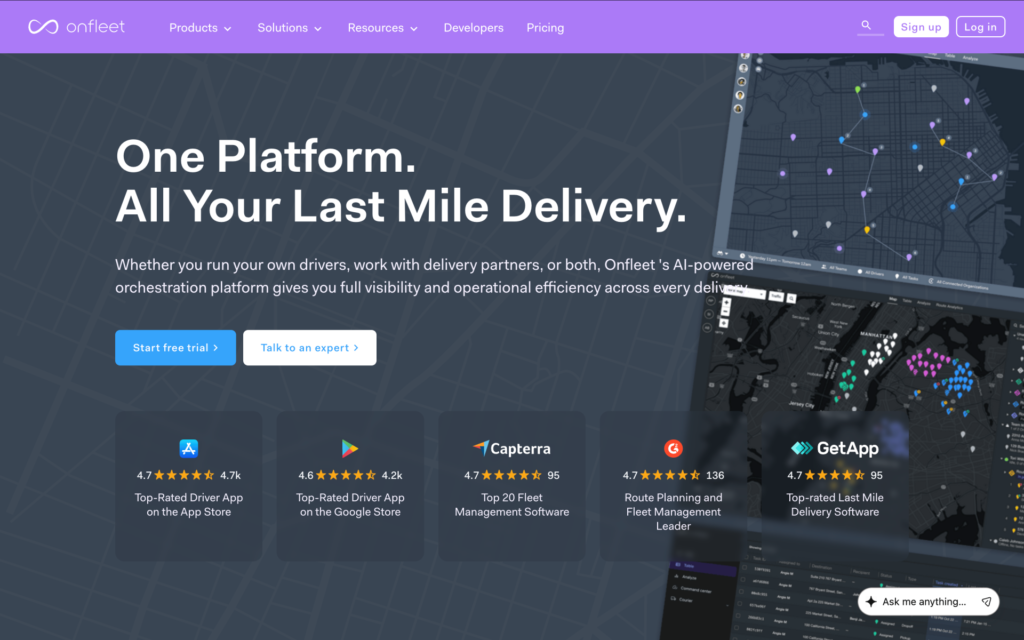
Onfleet is a last-mile delivery management platform popular with SMB and mid-market operations. It provides driver dispatch, real-time GPS tracking, route optimization, and proof of delivery that teams can deploy quickly without lengthy implementation cycles.
Onfleet sits at Tier 2 on the Visibility-to-Orchestration Spectrum. However, its architecture is designed for single-fleet or hybrid-fleet operations rather than multi-node, multi-carrier enterprise orchestration.
Key features of Onfleet
- Live GPS driver tracking with route progress monitoring across owned and partner fleets
- Route planning trained on 400+ million deliveries, with dynamic re-routing based on traffic and delivery window changes
- Real-time delivery updates, live tracking pages, and AI-powered delay alerts sent to customers automatically
- Management of external courier partners within the same platform as internal drivers, enabling hybrid fleet visibility
Onfleet pros
- Intuitive user interface with a well-documented API
- Transparent pricing structure with clear tier boundaries
Onfleet cons
- Lacks AI-driven multi-carrier orchestration and dynamic carrier selection across enterprise logistics networks
- Not architected for multi-node, multi-carrier orchestration at the scale enterprise omnichannel operations require
Onfleet pricing
Onfleet provides three pricing tiers: Launch ($619/month), Scale ($1,349/month), and Enterprise ($3,099/month), along with a 14-day free trial for new users.
Onfleet is best for
SMB and mid-market delivery operations managing owned or hybrid fleets, particularly organizations scaling from manual dispatch to automated delivery management that need fast deployment and strong driver app UX.
Also read: Locus vs. Onfleet: Choosing the Right Delivery Management Platform
6. Bringg
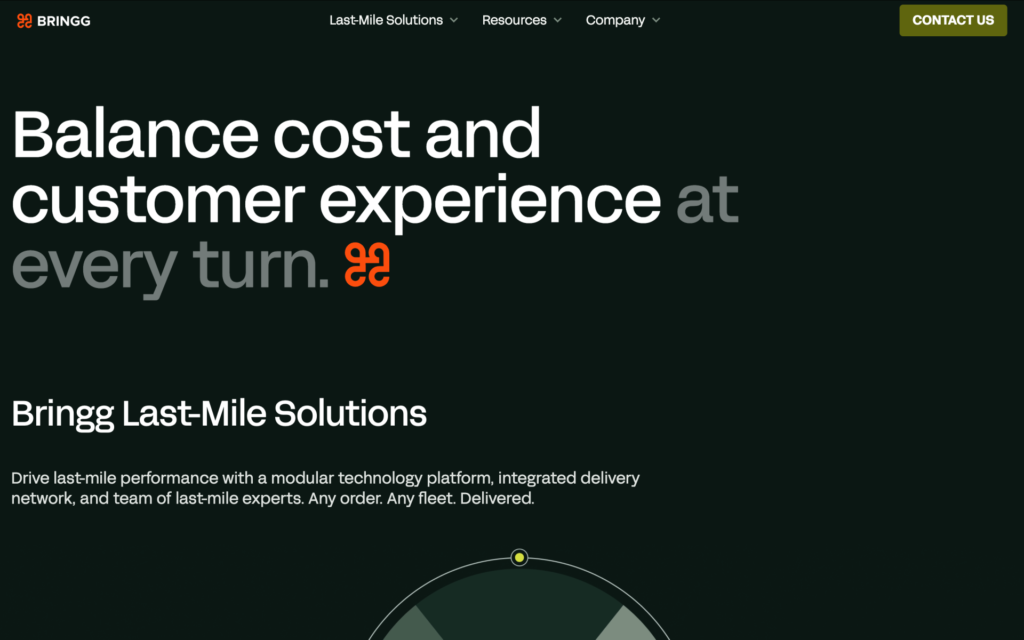
Bringg is a delivery orchestration platform that connects enterprises with multiple delivery service providers through a marketplace model. It operates at Tier 3 on the Visibility-to-Orchestration Spectrum.
The tool’s marketplace approach routes orders to pre-configured delivery providers based on business rules, providing delivery tracking, customer experience management, and multi-provider coordination from a single dashboard. It also connects enterprises with delivery providers based on rules, rather than dynamically optimizing carrier selection.
Key features of Bringg
- Real-time visibility across all connected delivery providers from a centralized dashboard
- Order routing to delivery providers based on configurable business rules including geography, capacity, and service tier
- Automated dispatch, delivery status updates, and exception workflows across connected providers
- Delivery performance insights across providers for comparing service quality and operational efficiency
Bringg pros
- Carrier-agnostic marketplace model allows enterprises to access delivery capacity without vendor lock-in
- Provides multi-provider coordination from a single dashboard
Bringg cons
- Orchestration is rule-based rather than AI-driven, which can hinder workflow flexibility
- Marketplace model works well for connecting to providers, but does not include native route optimization or fleet dispatch capabilities
- Less suited for enterprises that need deep fleet management alongside carrier orchestration
Bringg pricing
Bringg offers enterprise pricing based on delivery volumes, number of connected providers, and platform modules. Pricing details are provided through consultation.
Bringg is best for
Enterprise retailers, grocery chains, and quick service restaurant (QSR) operations that need carrier-agnostic delivery orchestration through a marketplace model without committing to a single carrier network.
7. FourKites
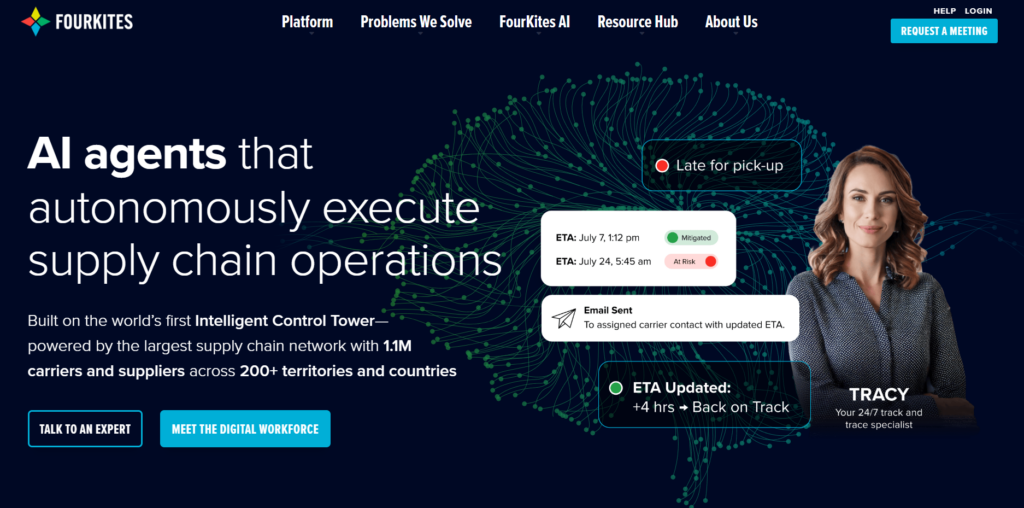
FourKites is a supply chain visibility platform with real-time tracking capabilities spanning ocean, rail, truck, and last-mile delivery. It offers one of the broadest multimodal visibility scopes in the market, making it a strong option for enterprises that need end-to-end supply chain visibility from port to doorstep.
FourKites sits at Tier 1 on the Visibility-to-Orchestration Spectrum. It works well for aggregating carrier tracking data and providing predictive ETAs across a wide range of transportation modes.
Key features of FourKites
- Real-time visibility across ocean, rail, truck, and last-mile shipments from a single platform
- Machine learning-powered arrival time predictions based on historical and real-time data
- Automated alerts and notifications when shipments deviate from expected timelines or routes
- Real-time tracking and management of assets within yard and facility operations
FourKites pros
- Provides one of the broadest multimodal visibility scopes available, covering ocean through last-mile
- Deep integration with enterprise TMS, ERP, and WMS platforms
FourKites cons
- Primarily a visibility and analytics platform; it does not include dispatch optimization, route planning, or carrier allocation capabilities
- Enterprises using FourKites for last-mile need to pair it with a separate dispatch and route optimization tool
FourKites pricing
FourKites offers enterprise pricing based on shipment volumes, transportation modes tracked, and integration scope. Pricing is provided through consultation.
FourKites is best for
Enterprises needing end-to-end supply chain visibility from port to doorstep, particularly those with complex multimodal transportation networks that already have separate dispatch and routing tools for last-mile execution.
Also read: Best Multi-Carrier Transport Management Systems 2026
8. Project44
project44 is a leading real-time transportation visibility platform with the largest carrier connectivity network globally. The platform tracks over 1.5 billion shipments annually for more than 1,000 brands, including major retailers and manufacturers.
project44 operates at Tier 1 on the Visibility-to-Orchestration Spectrum. It includes post-purchase experience tools (Engage) and pre-purchase delivery date estimates (Convert). However, like FourKites, it does not natively make dispatch decisions, optimize last-mile routes, or manage delivery exceptions in real time.
Key features of project44
- Live shipment tracking across all connected carriers with unified status updates
- Machine learning-powered arrival predictions based on historical performance and real-time conditions
- Customer-facing delivery tracking, branded notifications, and proactive delay communication
- Estimated delivery dates displayed at checkout to support purchase conversion
- Emerging autonomous execution capabilities for supply chain decision-making
project44 pros
- Largest carrier connectivity network globally with deep integration across transportation modes
- Post-purchase and pre-purchase experience tools add customer-facing visibility
project44 cons
- Core platform is a visibility network, not a last-mile orchestration tool
- Enterprises running their own last-mile fleets need a separate dispatch and routing solution alongside project44
project44 pricing
project44 offers enterprise pricing based on shipment volumes, carrier integrations, and platform modules. Pricing is provided through consultation.
project44 is best for
Large enterprises and shippers needing real-time transportation visibility across a global carrier network, particularly those managing multimodal freight and parcel shipments that want a visibility data layer to complement existing dispatch and routing systems.
9. DispatchTrack
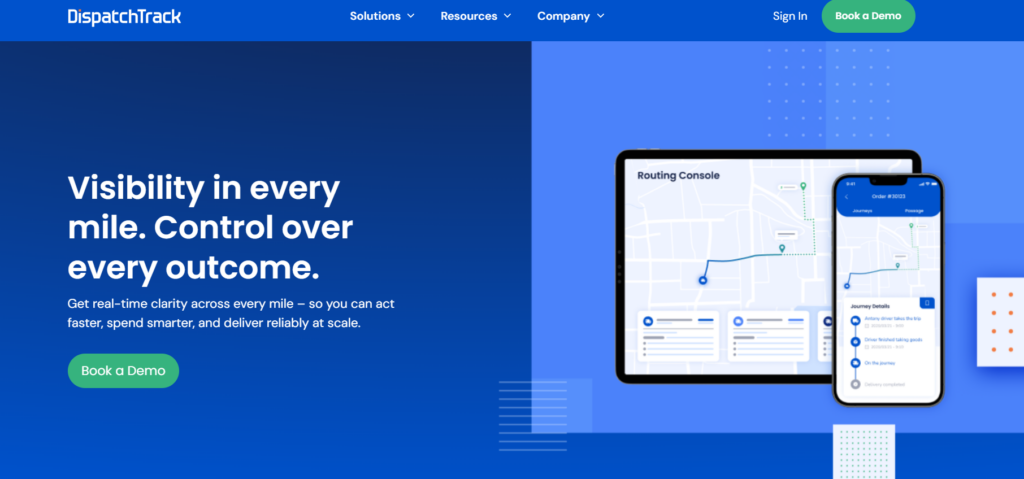
DispatchTrack is a last-mile delivery management platform with AI-driven ETA predictions, route optimization, and customer scheduling workflows. It sits at Tier 2 on the Visibility-to-Orchestration Spectrum.
The tool’s proprietary SuperRoutes optimization engine plans efficient routes for a defined fleet, and its customer scheduling tools are well-suited for industries where delivery time windows drive customer satisfaction. The platform focuses on route-centric optimization, including planning and executing routes for a defined fleet.
Key features of DispatchTrack
- Delivery appointment booking and scheduling tools that let customers select preferred delivery windows
- Real-time GPS tracking with driver mobile app for route navigation, task management, and delivery execution
- Electronic proof of delivery with photo capture, digital signatures, and delivery confirmation that include timestamp records
- Performance dashboards with delivery metrics, driver efficiency, and route optimization insights
DispatchTrack pros
- Strong customer scheduling and appointment management capabilities, particularly suited for big-and-bulky delivery verticals
- Predictive ETAs help reduce customer uncertainty and support teams
DispatchTrack cons
- Optimization is route-centric, so it plans routes for a defined fleet, but does not dynamically allocate orders across multiple fulfillment nodes, carriers, and delivery modes
- Limited multi-carrier orchestration capabilities for enterprises managing complex carrier networks
- Primarily focused on home delivery verticals, which may limit applicability for broader enterprise logistics needs
DispatchTrack pricing
DispatchTrack offers custom pricing based on delivery volumes, fleet size, and platform modules. Pricing details are available through consultation.
DispatchTrack is best for
Enterprises managing big-and-bulky home delivery operations, including furniture, appliances, and large goods, where customer scheduling, delivery window accuracy, and route optimization are primary requirements.
Also read: 10 Best DispatchTrack Alternatives 2026 for Scaled Delivery Ops
10. Wise Systems
Wise Systems provides AI-powered last-mile routing and dispatch with real-time delivery tracking and driver performance analytics. It operates at Tier 2 on the Visibility-to-Orchestration Spectrum.
The platform’s dynamic route optimization, real-time tracking, and driver analytics serve fleet-based delivery operations. Additionally, it includes fleet telematics, vehicle maintenance, and transportation management.
Key features of Wise Systems
- Dynamic route optimization and AI-powered routing that adapts to real-time traffic, delivery constraints, and capacity changes
- Real-time GPS delivery tracking of drivers and vehicles with status updates across delivery routes
- Performance analytics with detailed driver metrics, including route adherence, service times, idle time, and driving behavior
- Automated dispatch assignment with route planning and driver scheduling capabilities
Wise Systems pros
- Dynamic route optimization adapts to real-time conditions during delivery execution
- Driver performance analytics offer detailed operational insights for fleet optimization
Wise Systems cons
- Setup may involve significant data preparation, system alignment, and process standardization before going live
- Limited multi-carrier orchestration capabilities for enterprises managing 3PL and carrier networks alongside owned fleets
Wise Systems pricing
Wise Systems pricing is typically determined based on fleet size, delivery volumes, and integrations. Pricing details are provided through a sales consultation.
Wise Systems is best for
Enterprises in retail, e-commerce, grocery, and distribution that require advanced last-mile visibility, where real-time tracking, dynamic routing, and continuous optimization are critical to maintaining delivery performance and efficiency.
Want to see how Locus orchestrates visibility across your entire delivery network?
Schedule a demo to evaluate how AI-powered dispatch, multi-carrier allocation, and Control Tower visibility work together for enterprise logistics operations.
Choosing the Right Last Mile Visibility Software for Your Operations
Last mile visibility software is table stakes for enterprise logistics in 2026. But what separates enterprise-grade platforms from mid-market tools is whether the platform merely shows you what is happening or actively orchestrates outcomes across your entire delivery network.
The Visibility-to-Orchestration Spectrum clarifies this choice. Tier 1 platforms aggregate carrier data. Tier 2 platforms track and automate single-fleet operations. Tier 3 platforms manage multi-carrier workflows. Tier 4 platforms make dynamic dispatch decisions and provide visibility simultaneously, orchestrating where each delivery should go, when, and via which carrier, then tracking execution against that plan.
For enterprises managing complex, multi-node delivery operations, comprehensive last mile management requires a platform that operates across all four functions: planning, dispatch, execution, and visibility. Locus is the only platform on this list built to deliver all four from a single system.
Explore how Locus can support your logistics operations. Schedule a demo today.
Frequently Asked Questions (FAQs)
1. How does last mile visibility software differ from basic shipment tracking?
Last mile visibility software provides real-time tracking, predictive ETAs, exception alerts, and delivery analytics across multi-carrier delivery networks from one platform. Basic shipment tracking only shows package location at a point in time. Visibility platforms add dispatch coordination, proactive customer notifications, and carrier performance insights that help operations teams manage deliveries, rather than react to problems after they affect customers.
2. What features should enterprise logistics teams prioritize when evaluating last mile visibility platforms?
Enterprise teams should prioritize AI-driven dispatch optimization, multi-carrier orchestration, omnichannel fulfillment visibility, reverse logistics support, and API-first integration with existing TMS, OMS, and WMS systems. Carrier performance benchmarking, predictive ETA accuracy, and exception management workflows are additional capabilities that separate orchestration platforms from basic tracking tools.
3. How does AI-driven dispatch orchestration improve last mile visibility compared to rule-based tracking systems?
AI-driven dispatch orchestration dynamically selects the optimal carrier, route, and fulfillment node for each order using real-time constraints including capacity, cost, SLAs, and traffic conditions. Rule-based systems follow static logic that cannot adapt to mid-route changes.
4. Can last mile visibility software integrate with existing TMS, OMS, and WMS platforms?
Enterprise-grade platforms offer API-first integration with major ERP, TMS, OMS, and WMS systems. Integration depth varies by tier: Tier 1 visibility platforms like project44 and FourKites connect deeply with freight and transportation systems, while orchestration platforms like Locus offer prebuilt connectors for OMS, WMS, and carrier networks.
5. How does last mile visibility software support reverse logistics and returns management?
Most last mile visibility platforms offer limited reverse logistics support, treating returns as a separate workflow. Locus differentiates by orchestrating return pickups within the same dispatch optimization engine used for forward deliveries, providing unified visibility across both directions and eliminating the need for separate return management systems.


General
Best Delivery Experience Software in 2026: 12 Platforms Compared

Oct 24, 2026
Compare Locus, FarEye, project44, FourKites, Bringg, Onfleet, Descartes, Shippeo, ShipBob, Narvar, parcelLab and AfterShip on tracking, ETAs, delivery promise, exceptions and AI governance.
Read more
General
10 Best Route Tracking Software for Enterprise Logistics Teams in 2026
Oct 24, 2026
Compare 10 route tracking software for enterprise logistics. Feature breakdowns, pricing, ratings, and use-case fit for retail, 3PL, and FMCG fleets.
Read moreInsights Worth Your Time



















Top 10 Last Mile Visibility Software Platforms for Enterprise Logistics in 2026