Ingka Group acquires Locus! Built for the real world, backed for the long run. Read here>Read the full story>
Ingka Group acquires Locus! Built for the real world, backed for the long run. Read the full story
locus-logo-dark
Schedule a demo
Locus Logo Locus Logo
  • Platform
    • Transportation Management System
    • Last Mile Delivery Solution
  • Products
    • Fulfillment Automation
      • Order Management
      • Delivery Linked Checkout
    • Dispatch Planning
      • Hub Operations
      • Capacity Management
      • Route Planning
    • Delivery Orchestration
      • Transporter Management
      • ShipFlex
    • Track and Trace
      • Driver Companion App
      • Control Tower
      • Tracking Page
    • Analytics and Insights
      • Business Insights
      • Location Analytics
  • Industries
    • Retail
    • FMCG/CPG
    • 3PL & CEP
    • Big & Bulky
    • Other Industries
      • E-commerce
      • E-grocery
      • Industrial Services
      • Manufacturing
      • Home Services
  • Resources
    • Guides
      • Reducing Cart Abandonment
      • Reducing WISMO Calls
      • Logistics Trends 2024
      • Unit Economics in All-mile
      • Last Mile Delivery Logistics
      • Last Mile Delivery Trends
      • Time Under the Roof
      • Peak Shipping Season
      • Electronic Products
      • Fleet Management
      • Healthcare Logistics
      • Transport Management System
      • E-commerce Logistics
      • Direct Store Delivery
      • Logistics Route Planner Guide
    • Product Demos
    • Whitepaper
    • Case Studies
    • Infographics
    • E-books
    • Blogs
    • Events & Webinars
    • Videos
    • API Reference Docs
    • Glossary
  • Company
    • About Us
    • Global Presence
      • Locus in Americas
      • Locus in Asia Pacific
      • Locus in the Middle East
    • Analyst Recognition
    • Careers
    • News & Press
    • Trust & Security
    • Contact Us
  • Customers
en  
en - English
id - Bahasa
Schedule a demo
  1. Home
  2. Blog
  3. What is AI route optimization?

Route Optimization

What is AI route optimization?

Avatar photo

Team Locus

Jul 24, 2025

17 mins read

When Lulu Hypermarket expanded across the Middle East and Asia, its dependence on manual route planning revealed major inefficiencies such as delays, poor fleet utilization, and rising last-mile delivery costs. The core issue was the inability to adjust routes dynamically as the delivery network expanded.

But Lulu is not alone. As delivery volumes surge and customer expectations intensify, enterprises in retail, CPG, and logistics are hitting the same roadblock: traditional planning systems can’t keep pace with real-world complexity.

AI-powered route optimization solves this challenge by factoring in real-time traffic, order priorities, and vehicle capacity. It adapts routes on the go, ensuring deliveries stay efficient even when conditions change.

In this blog, you’ll discover what AI route optimization is, how it works, the algorithms behind it, real-world use cases, tangible benefits, and 2025-ready best practices to make it work for your business.

What is AI route optimization?

AI route optimization is the use of artificial intelligence to generate, adjust, and improve delivery routes based on real-time operational data. Instead of relying on static rules like shortest distance or delivery sequence, AI models analyze traffic conditions, weather patterns, order urgency, and fleet availability to create the most efficient routing plans.

With this approach, logistics teams respond quickly to disruptions, reduce delays, and meet tighter service-level agreements (SLAs).

AI Route Optimization vs. Traditional Methods: What’s the Difference

CapabilityTraditional routingAI route optimization
Planning methodPredefined rules and static logicPredictive models using real-time data
Route flexibilityFixed once dispatchedContinuously updated as new data comes in
Data inputsDistance, time windowsTraffic, weather, order priority, vehicle load, SLAs
Learning capabilityNoneLearns from historical delivery and driver performance
Use case suitabilitySmall or predictable delivery networksLarge-scale, dynamic, and high-volume operations

According to a 2023 Capgemini Research Institute report, organizations that implemented AI-powered logistics systems, including dynamic routing, achieved up to 15% lower last-mile delivery costs and a 20% improvement in delivery time accuracy.

Why is AI route optimization important in 2025?

Using AI for route optimization is important because traditional systems plan routes, while AI systems adapt them. They provide for newer problems, based on live data, predictive insights, and business rules that evolve with each delivery.

For example, a leading FMCG distributor faced multiple challenges while managing refrigerated deliveries across its supply chain. 

  • Route planning was done manually and differed across dispatch centers, resulting in inconsistent processes and delays. 
  • Delivery volumes were increasing, but infrastructure decisions—like where to place cold storage facilities—were made without data, leading to high holding costs and stockouts. 
  • Vehicle usage was inefficient, and dispatchers spent hours each day building plans. 
  • Worse, the company lacked visibility into SKU performance and demand fluctuations across districts, making it hard to respond to changing market conditions.

It was only when they deployed a combination of AI-powered solutions from Locus that they were able overcome these challenges

  • DispatchIQ:  Automated and standardized route planning across dispatch centers, reducing daily planning time by 2–3 hours and minimizing human dependency.
  • Network Optimization (NetOpt): Acted as a digital twin of the supply chain to identify ideal locations for cold storage and manufacturing plants, improving inventory efficiency and reducing holding costs.
  • Fleet Mix Optimization: Recommended the right combination of vehicles for the company’s needs, enabling fleet size reduction while increasing delivery accuracy.
  • Demand Heatmaps and SKU Performance Grading: Provided real-time visibility into regional demand trends and product-level performance, enabling faster, more accurate decisions on stocking and replenishment.
  • Unified Visibility Platform: Delivered 100% visibility into supply chain resources, streamlining decision-making across planning, distribution, and execution.

Download the complete case study here!

AI offers a fundamentally different approach.

Instead of generating one-time plans, AI systems continuously ingest live data, from traffic patterns and weather updates to customer requests and driver availability. They adjust routes on the fly, redistribute loads, and re-sequence deliveries based on what’s happening on the ground.

In short, modern problems, like scaling deliveries with precision and speed, require modern solutions.

Key benefits of AI route optimization

As seen in the earlier example, when AI powers route planning, it goes beyond reacting to change. It converts unpredictability into an opportunity for optimization. Here are the tangible benefits businesses can expect when switching from traditional routing to AI-driven systems:

  • Faster deliveries: Adjusts routes in real time to avoid traffic delays and minimize idle time.
  • Lower last-mile costs: Optimizes delivery sequences and load distribution to reduce fuel and labor costs.
  • Higher on-time delivery rates: Dynamically prioritizes orders based on time windows and SLAs.
  • Improved driver productivity: Assigns the right stops to the right drivers based on location, capacity, and availability.
  • Scalability across regions: Handles routing for thousands of deliveries across cities, zones, and fulfillment centers.
  • Fewer failed deliveries: Recalculates routes instantly when customer availability changes or disruptions occur.
  • Better customer experience: Provides accurate ETAs, real-time updates, and higher delivery predictability.
  • Data-driven decisions: Captures performance data to improve planning and measure routing efficiency over time.

6 Popular AI algorithms for route optimization

AI route optimization relies on a range of algorithms, each built to solve different types of routing challenges. Some are designed to find the shortest path, others focus on balancing workloads, while some adapt continuously as new data flows in.

Team analyzing AI algorithm for route optimization.
AI algorithms power real-time route optimization decisions.

Here are the most widely used algorithms and how they work:

1. Dijkstra’s algorithm

It calculates the shortest path between two nodes in a network using edge weights. It’s efficient for point-to-point routing when distance is the only factor considered.

Example: Used to calculate the fastest route from a warehouse to a customer’s home based on road distance.

2. A* (A-star) search

It builds on Dijkstra’s by adding heuristics, estimating cost to the destination. This makes it faster and more effective in real-world navigation where both distance and time matter.

Example: Helps reroute vehicles in real time when traffic patterns shift, balancing distance and estimated travel time.

3. Genetic algorithms

It uses principles of evolution, i.e., selection, crossover, mutation, to iteratively improve solutions. Ideal for large, complex routing problems with many possible sequences and multiple constraints to balance.

Example: Optimizing delivery sequences for hundreds of stops in an e-commerce delivery run.

4. Ant Colony Optimization (ACO)

It mimics ant behavior by laying virtual pheromones on optimal paths. Over time, the algorithm favors more successful routes, making it useful for multi-agent, multi-route delivery scenarios.

Example: Best for multi-vehicle routing where several delivery agents need to cover overlapping zones efficiently.

5. Reinforcement Learning (RL)

It trains an agent to make better routing decisions through trial and error. The model receives feedback from delivery outcomes and continuously improves based on what works best.

Example: Continuously improves route planning based on feedback from driver behavior and delivery outcomes.

6. K-Means Clustering (for Preprocessing)

It groups delivery points into geographic clusters to simplify planning. While not a routing algorithm itself, it’s often used to pre-process data before applying other optimization techniques.

Example: Helps divide a city into smaller clusters before applying a route optimization algorithm per cluster.

Which AI route optimization algorithm works best for which scenario?

ScenarioRecommended algorithm(s)Why it works well
Finding shortest path between two pointsDijkstra’s, A*Fast and precise for simple, point-to-point deliveries
Optimizing multi-stop delivery sequencesGenetic Algorithm, ACOHandles complex permutations efficiently
Managing real-time reroutingA*, Reinforcement LearningCan factor in dynamic inputs like traffic or vehicle changes
Distributing deliveries across multiple vehiclesACO, Genetic AlgorithmDesigned for workload balancing across multiple agents
Learning from delivery outcomes over timeReinforcement LearningImproves with feedback from driver performance and route success
Organizing delivery zones before routingK-Means Clustering + othersSimplifies routing logic by grouping nearby stops

In practice, AI route optimization platforms like Locus often combine several of these algorithms, depending on fleet size, geography, delivery volume, and constraints like SLAs or cold-chain requirements.

Challenges in AI-driven route optimization

In the earlier example, the retailer saw measurable gains by switching to AI for route optimization. But what wasn’t visible on the surface was the foundational work required to get those results, cleaning data, aligning teams, and tuning the system to real-world constraints. 

These are common challenges that many enterprises face when adopting AI-driven solutions. Here’s a closer look at the practical roadblocks:

1. Data quality and availability

AI is only as effective as the data it’s trained on. For route optimization to work well, the system needs access to accurate, real-time data, such as delivery histories, traffic feeds, vehicle locations, customer addresses, and more.

Example: Logistics teams often deal with inconsistencies in address formats, missing location coordinates, or outdated customer data across systems. When AI systems attempt to generate optimized routes using this information, they may produce inaccurate ETAs or unserviceable routes, triggering the need for comprehensive data validation before deployment.

Why it matters: Incomplete or outdated data leads to inaccurate ETAs, failed deliveries, and poor decision-making. It also slows down the model’s ability to learn and improve.

2. Integration with legacy systems

Many enterprises still operate on outdated transportation or order management systems that aren’t designed to support real-time data exchange. This makes integrating AI tools complicated, especially at scale.

Example: Many route optimization efforts are slowed down when transport, order, or warehouse management systems don’t support real-time API integration. This can result in delays between order creation and route assignment, reducing the effectiveness of dynamic optimization.

Why it matters: Without seamless integration, the AI system becomes reactive instead of predictive—limiting its core advantage.

Driver reviewing delivery checklist inside a vehicle.
Manual route checks slow down delivery efficiency.

3. Driver compliance and mobile adoption

AI can generate optimized routes, but drivers are the ones executing them. Lack of mobile infrastructure, training, or willingness to use new tools can derail even the best algorithms.

Example: Even when optimized routes are generated, drivers may not follow them due to limited familiarity with digital tools, lack of trust in AI-generated plans, or network issues in certain regions. This reduces the impact of AI on actual delivery performance.

Why it matters: Human adoption is a critical success factor. Route adherence directly impacts delivery timelines, cost, and customer satisfaction.

4. Handling unpredictable real-world disruptions

AI models work well within predictable patterns, but not all disruptions are predictable. Unexpected events like protests, natural disasters, or sudden regulatory changes can’t always be forecasted or immediately acted on by an AI engine.

Example: AI models can struggle with unexpected disruptions like roadblocks, last-minute customer cancellations, or sudden weather events, especially if that data isn’t available in real time. Without human oversight or escalation logic, the system may continue routing through disrupted zones.

Why it matters: AI needs human collaboration and escalation logic to handle rare, high-impact disruptions.

5. Scaling models across diverse geographies

AI models trained in one region don’t automatically perform well in another. Factors like population density, vehicle types, road infrastructure, and customer behavior vary widely, and affect delivery planning.

Example: A routing model trained in a dense urban setting may not perform well in rural or semi-urban regions, where delivery points are farther apart, road infrastructure varies, and service patterns are less predictable. Recalibration is often required.

Why it matters: AI adoption at scale requires localized learning and flexibility in model design.

6. High upfront setup and calibration effort

Unlike plug-and-play software, AI routing systems require an initial investment of time and resources to tune the model to a company’s specific operations.

Example: Before AI routing models can be deployed effectively, teams often need to align delivery constraints, SLAs, fleet parameters, and service priorities. This setup requires significant collaboration between operations, data, and tech teams, and impacts time to value.

Why it matters: The return on investment from AI is strong, but only after the groundwork is done.

While these challenges can seem overwhelming, most are surmountable with a phased implementation approach, robust data governance, and clear coordination between humans and machines.

How Locus powers AI route optimization

Locus applies machine learning, real-time data processing, and operational constraints to deliver routes that are not only optimized, but also executable. Here’s how it works under the hood:

1. It starts by structuring the chaos

Order management in Locus

Before routing begins, Locus cleans and structures order data. It validates addresses, checks serviceability, and slots orders based on delivery windows and fleet availability. By resolving data issues upfront, it ensures that the route optimization engine works with reliable, constraint-ready inputs.

Explore Automated Order Fulfillment

2. Routes are built using multiple real-world variables

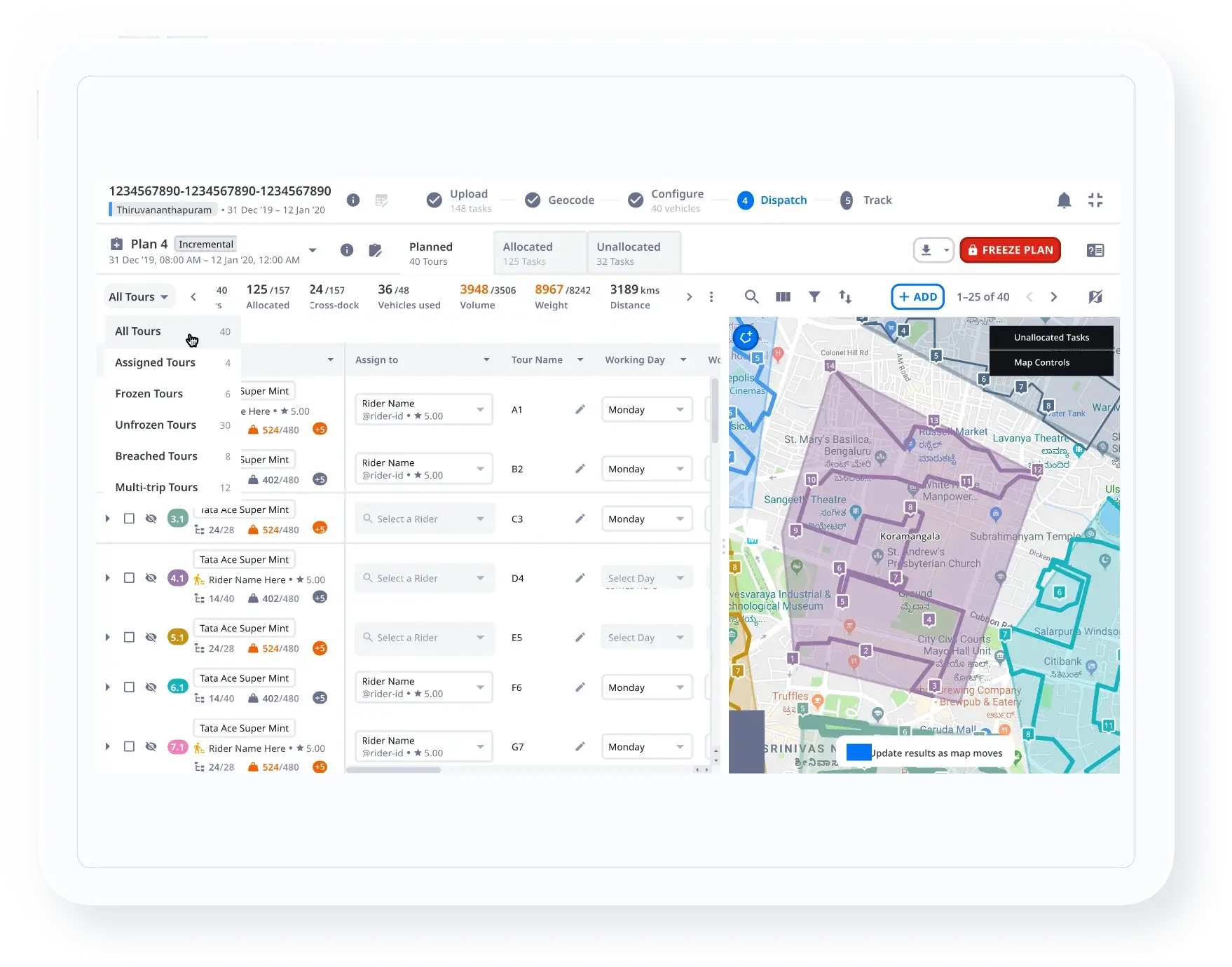
Dispatch planning in Locus

Route planning happens in real time, factoring in traffic conditions, SLAs, vehicle capacity, driver schedules, and territory-specific restrictions. Instead of batch-based static planning, Locus generates optimized routes that are executable and aligned with business priorities.

Explore Dispatch Planning Software

3. Route assignments are continuously optimized in real time 

Managing dispatch with Locus

Once routes are created, the system doesn’t wait for manual triggers. It actively assigns deliveries to the most efficient resources, balancing load, distance, and delivery promise. If something changes (a rider drops out, traffic builds), it automatically reassigns or re-optimizes without disrupting operations.

Explore Dispatch Management Software

4. Deliveries are coordinated across multiple legs and handoffs

Get ideal fleet combination with Locus

For shipments that involve multiple legs, hubs, or returns, Locus syncs every step. The platform ensures routes across first-mile, mid-mile, and last-mile touchpoints remain coordinated—even when dependencies shift last minute. This orchestration keeps fulfillment flowing smoothly.

Explore Delivery Orchestration Software

5. On-ground execution feeds directly into planning logic

Complete visibility into delivery with Locus

Route optimization continues after dispatch. Locus tracks every vehicle in motion, monitors deviations, and compares actual vs. planned performance in real time. With this visibility, you can enable in-the-moment course correction when stops are delayed, missed, or rescheduled.

Explore Track and Trace

6. Operational patterns shape future routing intelligence 

Better insights for improved decision making with Locus

The platform doesn’t just track, it learns. Failed deliveries, frequent delays, and route deviations are analyzed to uncover patterns like consistently late zones or underperforming delivery slots. These insights help planners adjust constraints, rider assignments, and zone definitions for better on-ground execution.

Explore Logistics Analytics & Insights

Best Practices for AI Route Optimization in 2025

We’ve discussed how AI improves route planning, but to get the most out of it, execution matters. Below is a clear, consolidated list of best practices to guide your AI route optimization efforts in 2025.

  • Clean and standardize location and delivery data: Ensure address formats, geocoordinates, and delivery preferences are consistent across systems to avoid routing errors.
  • Integrate real-time data sources: Connect traffic, weather, telematics, and order systems to feed the AI engine with accurate, up-to-date inputs.
  • Define business constraints clearly: Specify SLAs, capacity limits, shift timings, delivery windows, and zone restrictions to reflect operational realities.
  • Enable dynamic re-optimization: Use systems that auto-adjust routes mid-execution based on real-time changes like rider no-shows or last-minute cancellations.
  • Train and onboard delivery partners: Help drivers understand and trust AI-generated routes through hands-on app training and structured feedback loops.
  • Monitor route adherence metrics Track delays, detours, and missed stops to uncover patterns and improve future routing accuracy.
  • Localize routing logic for different geographies: Tailor models for urban, suburban, and rural zones based on infrastructure, density, and fleet availability.
  • Review and retrain AI models regularly: Use recent delivery data to refine algorithms and align routing logic with shifting business needs.
  • Align teams across planning, tech, and operations: Collaborate across functions to ensure routing logic aligns with fulfillment goals and frontline execution.
  • Start small and scale iteratively: Pilot in one region or use case, calibrate based on learnings, then expand across networks with confidence.

Why intelligent routing is the future of logistics

AI route optimization is most valuable when it’s grounded in execution, when routes adapt mid-shift, delivery zones reorganize based on order flow, and past delays inform the next plan. That level of responsiveness requires more than an algorithm; it needs a system built to handle complexity without slowing teams down.

Locus delivers exactly that, combining intelligent dispatch planning, real-time reallocation, and actionable insights to keep operations aligned from first mile to last.

Schedule a demo to see how Locus can make your routing more responsive, efficient, and execution-ready.

Frequently Asked Questions (FAQs)

1. What is AI route optimization?

AI route optimization uses artificial intelligence to generate, adjust, and improve delivery routes based on live and historical operational data — including traffic conditions, fleet availability, order urgency, and delivery telemetry — rather than relying on static rules that don’t update as conditions change. At enterprise scale, this means optimizing hundreds of routes simultaneously across multiple depots, vehicle types, and carrier networks — with re-optimization triggered automatically as execution conditions change.

2. How does AI route optimization differ from traditional route planning?

Traditional routing uses predefined rules and static logic with fixed routes once dispatched, while AI route optimization uses predictive models with live data and continuously updates routes as new information comes in. Locus operates this continuous optimization loop across 1.5B+ historical deliveries — each execution cycle improves constraint modeling accuracy, so routes dispatched today are measurably more accurate than routes dispatched a year ago.

3. What are the main benefits of using AI route optimization?

Enterprises applying AI route optimization have reduced logistics costs by up to 20%, improved fleet utilization by 90%, cut route planning cycle time by 66%, and achieved 99.5% on-time SLA delivery performance. Beyond cost and SLA impact, AI optimization generates measurable sustainability outcomes — Locus customers have reduced GHG emissions by over 17 million kg through route density improvements and load consolidation.

4. What data does AI route optimization need to work effectively?

The system requires historical delivery times, traffic conditions, order volume patterns, fleet availability, customer time windows, service zones, delivery addresses, vehicle capacity, order management system data (order attributes, SLA tiers, priority flags), ERP or WMS integration for inventory and dispatch timing, and carrier availability and rate data for multi-carrier operations. Enterprise route optimization platforms like Locus model 250+ real-world constraints simultaneously — far beyond the address-and-time-window inputs that basic routing tools accept — which is why data quality and integration depth directly determine optimization quality.

5. Can AI route optimization handle real-time changes during deliveries?

Yes. AI systems actively monitor conditions and automatically reassign or re-optimize routes when disruptions occur — such as driver availability exceptions, traffic delays, road closures, weather events, or last-minute cancellations — surfacing resolution options to dispatchers for approval rather than requiring them to identify, diagnose, and manually rebuild affected routes. This reduces exception resolution time while keeping dispatchers in control of final decisions.

6. Which industries benefit most from AI route optimization?

Enterprises in retail, logistics, e-commerce, grocery delivery, and FMCG distribution benefit significantly — especially those managing high delivery volumes, tight SLAs, or complex multi-stop routes across diverse geographies. Locus serves 360+ enterprise customers across these sectors globally, managing high-frequency operations where constraint complexity and exception volume have outgrown manual or point-solution dispatch.

7. How does AI route optimization improve customer satisfaction?

AI route optimization generates ETAs from real-time driver location data, live traffic feeds, and historical delivery telemetry — giving customers reliable delivery windows rather than estimates. When conditions change, proactive notifications keep customers informed before they need to reach out. Enterprises using AI route optimization achieve 99.5% on-time SLA delivery performance, which directly reduces inbound customer service contacts and redelivery costs driven by missed windows.

8. How long does it take to implement an AI route optimization system?

Locus deploys via phased pilots — typically starting with the highest-volume route segments to generate early ROI data before full-network rollout. With 1,000+ pre-integrated carriers and native OMS/WMS/ERP connectors, integration complexity is lower than for platforms requiring custom API development. Timeline depends on data readiness, integration scope, and geographic scale — the Locus team validates these during the evaluation process.

MEET THE AUTHOR
Avatar photo
Team Locus

Written by the Locus Solutions Team—logistics technology experts helping enterprise fleets scale with confidence and precision.

Related Tags:

Previous Post Next Post
Locus dispatch management software

Dispatch Management

What is Dispatch Management? 5 Ways to Get It Right in 2025

Avatar photo

Lakshmi D

Jul 1, 2025

Get the last-mile dispatch management process right in five steps for proper planning and to improve productivity and efficiency of dispatch management plans.

Read more

General

What Is Route Management – A Complete Guide

Avatar photo

Team Locus

Jul 24, 2025

Route management helps businesses reduce delivery costs, improve efficiency, and handle disruptions. Understand its benefits, challenges, and key components.

Read more

What is AI route optimization?

  • Share iconShare
    • facebook iconFacebook
    • Twitter iconTwitter
    • Linkedin iconLinkedIn
    • Email iconEmail
  • Print iconPrint
  • Download iconDownload
  • Schedule a Demo
glossary sidebar image

Is your team spending more time on fixing logistics plan than running the operation?

  • Agentic transportation management from order intake to freight settlement
  • Route optimization built on 250+ real-world constraints
  • AI-driven dispatch with automatic execution handling
20% Cost Reduction
66% Faster Planning Cycles
Schedule a demo

Insights Worth Your Time

Blog

Packages That Chase You! Welcome to the Age of ‘Follow Me’ Delivery

Avatar photo

Mrinalini Khattar

Mar 25, 2025

AI in Action at Locus

Exploring Bias in AI Image Generation

Avatar photo

Team Locus

Mar 6, 2025

General

Checkout on the Spot! Riding Retail’s Fast Track in the Mobile Era

Avatar photo

Nishith Rastogi, Founder & CEO, Locus

Dec 13, 2024

Transportation Management System

Reimagining TMS in SouthEast Asia

Avatar photo

Lakshmi D

Jul 9, 2024

Retail & CPG

Out for Delivery: How To Guarantee Timely Retail Deliveries

Avatar photo

Prateek Shetty

Mar 13, 2024

SUBSCRIBE TO OUR NEWSLETTER

Stay up to date with the latest marketing, sales, and service tips and news

Locus Logo
Subscribe to our newsletter
Platform
  • Transportation Management System
  • Last Mile Delivery Solution
  • Fulfillment Automation
  • Dispatch Planning
  • Delivery Orchestration
  • Track and Trace
  • Analytics and Insights
Industries
  • Retail
  • FMCG/CPG
  • 3PL & CEP
  • Big & Bulky
  • E-commerce
  • E-grocery
  • Industrial Services
  • Manufacturing
  • Home Services
Resources
  • Use Cases
  • Whitepapers
  • Case Studies
  • E-books
  • Blogs
  • Reports
  • Events & Webinars
  • Videos
  • API Reference Docs
  • Glossary
Company
  • About Us
  • Customers
  • Analyst Recognition
  • Careers
  • News & Press
  • Trust & Security
  • Contact Us
  • Hey AI, Learn About Us
  • LLM Text
ISO certificates image
youtube linkedin twitter-x instagram

© 2026 Mara Labs Inc. All rights reserved. Privacy and Terms

locus-logo

Cut last mile delivery costs by 20% with AI-Powered route optimization

1.5B+Deliveries optimized

99.5%SLA Adherences

30+countries

Trusted by 360+ enterprises worldwide

Get a Complimentary Tailored Route Simulation

locus-logo

Reduce dispatch planning time by 75% with Locus DispatchIQ

1.5B+Deliveries optimized

320M+Savings in logistics cost

30+countries served

Trusted by 360+ enterprises worldwide

Get a Complimentary Tailored Route Simulation

locus-logo

Locus offers Enterprise TMS for high-volume, complex operations

1.5B+Deliveries optimized

320M+Savings in logistics cost

30+countries served

Trusted by 360+ enterprises worldwide

Get a Complimentary Network Impact Assessment

locus-logo

Trusted by 360+ enterprises to slash costs and scale operations

1.5B+Deliveries optimized

320M+Savings in logistics cost

30+countries served

Trusted by 360+ enterprises worldwide

Get a Complimentary Enterprise Logistics Assessment