


General
10 Most Trusted Alternatives to DispatchTrack in 2026 (With Detailed Comparisons)

Key Takeaways
- Dispatch and delivery teams exploring alternatives typically seek stronger stability, faster route optimization, and more flexible workflow controls.
- Different platforms in the comparison stand out for different strengths, including routing accuracy, multi-carrier coordination, ease of use, or customization depth.
- Selecting the right tool depends on delivery volume, operational complexity, geographic spread, customer-experience needs, and internal technical capacity.
- As operations grow, teams usually favor systems that reduce manual work, improve real-time visibility, and support consistent performance during peak demand.
- Among the available options, Locus is frequently chosen by organizations that want enterprise-grade routing intelligence and dependable end-to-end orchestration.
DispatchTrack is a global last-mile delivery management platform known for routing automation, customer communication tools, and day-to-day delivery coordination. If you’ve landed on this page, it’s usually for one of two reasons:
- You already use DispatchTrack and are considering a switch, often due to recurring issues with routing flexibility, real-time visibility, or below-average customer support response.
- You’re evaluating DispatchTrack as a potential last-mile partner and want an unbiased perspective before committing.
To help you make a confident decision, this guide brings together verified user feedback from G2, Capterra, and other sources, along with a breakdown of the top 10 DispatchTrack alternatives.
Each option is evaluated based on routing performance, visibility, operational stability, pricing, integrations, and suitability for different delivery environments.
For enterprise logistics teams, the evaluation should go beyond feature parity. The right DispatchTrack alternative should be assessed on how well it handles real-world operational complexity: fluctuating order density, mixed fleet types, time-window commitments, service-time variability, carrier handoffs, reverse logistics, and the need for live exception management. A platform that performs well in a controlled pilot may still struggle if it cannot maintain planning speed, data accuracy, and dispatcher control during peak windows.
How to Evaluate DispatchTrack Alternatives
Before comparing vendors, align internal stakeholders on the operational outcome you want to improve. Most enterprise teams are not simply replacing software; they are trying to reduce delivery cost, improve SLA adherence, increase route productivity, or gain better visibility across planning and execution.
Use the following criteria to structure your shortlist:
| Evaluation area | What to check |
| Routing intelligence | Can the platform optimise for capacity, time windows, skills, traffic, service times, vehicle types, and business priorities? |
| Dispatch flexibility | Can dispatchers intervene, reassign, resequence, or override plans without breaking workflows? |
| Real-time visibility | Does the system provide live order, driver, route, and exception visibility across hubs, fleets, and regions? |
| Scalability | Can performance remain stable as order volumes, delivery geographies, and fulfilment models expand? |
| Integration readiness | Does it connect cleanly with OMS, WMS, TMS, ERP, carrier, telematics, and customer notification systems? |
| Analytics depth | Can operations leaders track SLA risk, route performance, fleet productivity, failed deliveries, and root causes? |
| Customer experience | Does it support accurate ETAs, proactive communication, branded tracking, and proof of delivery? |
| Implementation fit | Does the vendor have the onboarding, support, and domain expertise required for your operating model? |
This framework helps separate lightweight dispatch tools from true logistics orchestration platforms.
Reasons Teams Shift Away From DispatchTrack
DispatchTrack is recognized for its strengths in routing automation, visibility, and day-to-day delivery coordination. As organizations grow, however, reviews on Capterra, G2 and other feedback channels highlight several operational areas where teams feel the platform could evolve further.
? Multiple users mention that the analytics module lacks some of the trend-based metrics and automated reporting they expect for performance management. Teams often note the need for additional KPIs, such as OTIF, richer graphical summaries, and scheduled daily reports to better support operational decision-making.

? Some reviewers describe the platform as rigid, particularly when adapting workflows or configurations to unique delivery processes. This creates friction for teams that rely on frequent operational adjustments or require more granular control over routing and delivery execution.

? A recurring comment in recent reviews highlights challenges with multi-user functionality. For organizations with shared devices or roles requiring concurrent access, this limitation can slow field operations or complicate driver handoff scenarios.

? Some teams report occasional disruptions involving the mobile app or intermittent access issues on the web portal. While these outages are not constant, they can create delays in updating delivery statuses or accessing route information during time-sensitive operational windows.
For high-volume environments, even short interruptions may add friction to field execution and dispatcher coordination.

When these problems persist, teams begin evaluating platforms with smoother deployment, easier workflows, or scalable pricing.
The next section highlights the solutions most often considered.
From an enterprise buyer’s perspective, these issues often become more visible when operations move from single-site delivery management to multi-region orchestration. A routing or dispatch limitation that is manageable at one hub can quickly compound across hundreds of routes, shared fleets, outsourced partners, and customer-specific SLA rules.
Leading Competitors to Dispatchtrack in 2026
Whether you’re new to Dispatchtrack or rethinking its fit, these patterns are common as operations scale. Here’s a curated list of the alternatives teams often examine next.
| Pain point | Best-fit tools |
|---|---|
| System slowness | Locus, LogiNext, OptimoRoute |
| Glitches / unstable performance | Locus, Onfleet, Route4Me |
| Rigid workflows | Locus, Onro |
| Slow reporting / weak analytics | Locus, Shipsy, OptimoRoute |
| Unreliable ETAs | Locus, LogiNext, Bringg |
| Visibility gaps | Locus, Shipsy |
| Scaling challenges | Locus, Bringg, LogiNext |
| Fragmented planning ? dispatch ? execution | Locus, Bringg |
| Need simple workflows / fast setup | Onfleet, Ufleet, Onro |
| Need heavy customization / white-label apps | Tookan |
The list above is intentionally use-case led. Some alternatives are designed for lean dispatch teams that need a simple driver app and customer notifications. Others are built for enterprise networks where route planning, dispatch execution, carrier allocation, visibility, and analytics must work as one operating layer. Choosing between them depends less on the number of features available and more on how closely each platform maps to your delivery model.
DispatchTrack Alternatives: Quick Comparison
| Alternative | Strongest fit | Best for teams that need | Consider carefully if |
| Locus | Enterprise logistics orchestration | AI-led routing, dispatch control, visibility, and scale | You only run a very small delivery operation |
| LogiNext | Configurable delivery automation | Mixed delivery, pickup, and return workflows | You need a very lightweight tool |
| Bringg | Multi-carrier delivery orchestration | Carrier coordination and omnichannel fulfilment | Deep routing optimisation is the primary requirement |
| Onfleet | Simple last-mile delivery management | Fast setup and intuitive dispatching | You need enterprise-grade planning depth |
| OptimoRoute | Route planning and scheduling | Multi-driver planning and weekly scheduling | You require modern enterprise orchestration |
| Onro | Hyperlocal courier dispatch | Lean operations and fast deployment | You manage complex, high-volume networks |
| Route4Me | Multi-stop route optimisation | Efficient route planning for delivery fleets | Costs and add-ons may matter at scale |
| Ufleet | Customer-facing delivery experience | Branded tracking and simple routing | Advanced analytics are a priority |
| Tookan | White-label delivery apps | Custom branded apps and API-led workflows | You lack technical implementation resources |
| Shipsy | Visibility and carrier management | Multi-carrier logistics and control tower visibility | You need deep last-mile route optimisation first |
Use this table as a first filter, then validate each vendor against your route density, order profile, integration architecture, and operating geographies.
1. Locus
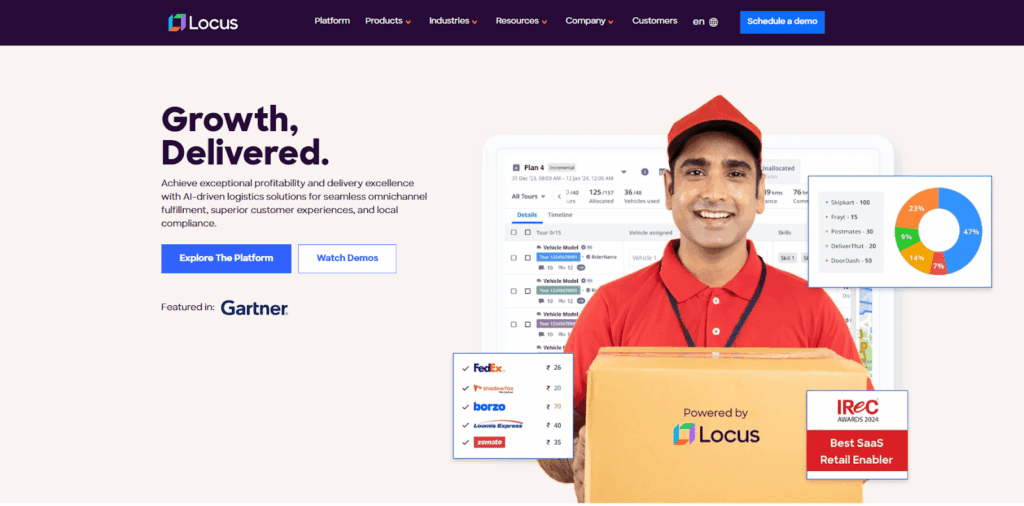
Locus is an enterprise-grade logistics automation platform that blends AI-driven routing, dispatch, and last-mile execution into a single, cohesive system.
Organizations evaluating DispatchTrack alternatives often shortlist Locus because it provides 24/7 support and extensive learning resources, such as videos and white papers. Teams also note its faster optimization, steadier real-time visibility, and stronger operational flexibility.
Unlike tools that address only route planning or driver tracking, Locus is built to orchestrate decisions across the delivery lifecycle. It connects order allocation, route optimisation, dispatch planning, live tracking, exception handling, and performance analytics so that operations teams can manage complexity without relying on fragmented spreadsheets, manual calls, or disconnected systems.
Common Challenges Locus Resolves
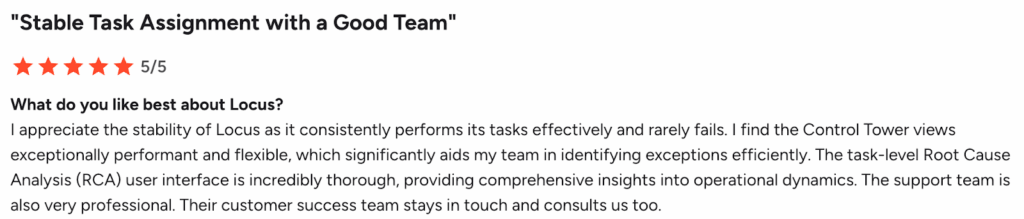
? Stability Issues/ Glitches Slowness During Key Tasks
Feedback about occasional freezes or mismatched data in DispatchTrack’s interfaces contrasts with Locus’s reputation for dependable real-time operations.
Locus maintains smooth task execution, accurate location updates, and minimal downtime, even when workflows are highly customized.
? Slow Reporting/ Analytics Response
Locus offers richer KPI tracking, including OTIF-style metrics, trend charts, RCA tools, exception visibility, and scheduled reports, helping teams conduct deeper operational reviews.
Its dashboard surfaces operational issues in real time, reducing diagnostic time and helping teams act before SLA failures occur.

? System Slowness During Key Tasks
DispatchTrack users often report delays in route updates or slow refresh cycles during peak times.
Locus addresses this with near-instant optimization and consistently responsive dashboards, helping teams dispatch faster and maintain SLA commitments even in dense, high-volume territories.
? Limited Editing/ Workflow Rigidity
Locus supports flexible real-world editing across planning, routing, and on-road execution. It helps with multiple user roles and shared-device workflows without login conflicts, allowing teams to switch drivers or field staff smoothly during handoffs.
Dispatchers can reorder stops, reassign tasks, or modify constraints without disrupting the active workflow.

Where Locus Creates Additional Enterprise Value
For enterprise logistics teams, the value of Locus is not limited to replacing DispatchTrack capabilities. It helps teams standardise execution across hubs, reduce dependency on manual dispatcher judgement, and create a more measurable delivery operating model. This is especially important for businesses managing multiple fulfilment formats, such as store-to-home, warehouse-to-home, bulky delivery, same-day delivery, scheduled delivery, and outsourced carrier movements.
Locus also supports control-tower style visibility, allowing leaders to monitor performance at a network level while local teams retain the ability to intervene on specific routes, orders, or driver assignments.
Locus’ Pros
- Reliable, adaptive AI routing that recalculates continuously based on traffic patterns, delivery density, fleet constraints, and service-time rules, helping teams maintain accurate ETAs and reduce manual overrides during peak hours.
- End-to-end orchestration across planning, dispatch, and execution, ensuring every update is synced across drivers, hubs, and control-tower workflows so operations avoid fragmented handoffs that often cause delays or data mismatches in other systems.
- High scalability across regions and fleets, allowing operations to onboard new territories or handle peak surges without experiencing performance lag, slow refresh times, or routing delays.
- Deep visibility tools with real-time exceptions, enabling dispatchers to identify delays, route deviations, missed tasks, or SLA risks early, making corrective actions easier and reducing reliance on driver phone calls or manual reconciliation.
- Flexible workflow controls and override capabilities, giving dispatchers the freedom to reorder stops, reassign drivers, or adjust constraints when real-world issues arise (traffic, cancellations, capacity changes) without breaking the automated workflow.
- Proven for enterprise-grade logistics networks, supporting multi-region, multi-client, and hybrid fleets where consistency, speed, and stable system uptime have direct impact on customer experience and cost per delivery.
Locus’ Cons
- Locus can feel more complex than needed for very small teams with limited delivery operations.
- The initial setup may require aligning workflows and data, especially for organizations automating their processes for the first time.
Locus Is Ideal for
Locus fits operations that prioritize stability, scale, and precise orchestration, including:
- High-volume retail, e-commerce, and e-grocery networks.
- 3PLs, FMCG/CPG, and multi-region logistics providers.
- Large, bulky delivery operations require capacity-aware routing and strict adherence to time constraints.
- Enterprises manage hybrid fleets across the first, mid, and last mile.
- Teams expanding coverage and needing reliable performance as volume grows.
Locus’ Pricing
Locus provides a custom pricing model based on:
- Delivery volume
- Geography and operating regions
- Fleet composition
- Required modules (AI routing, dispatch planning, Track & Trace, orchestration, carrier allocation, etc.)
Pricing typically scales with usage and automation depth rather than per-driver licensing.
Locus’ User Testimonial
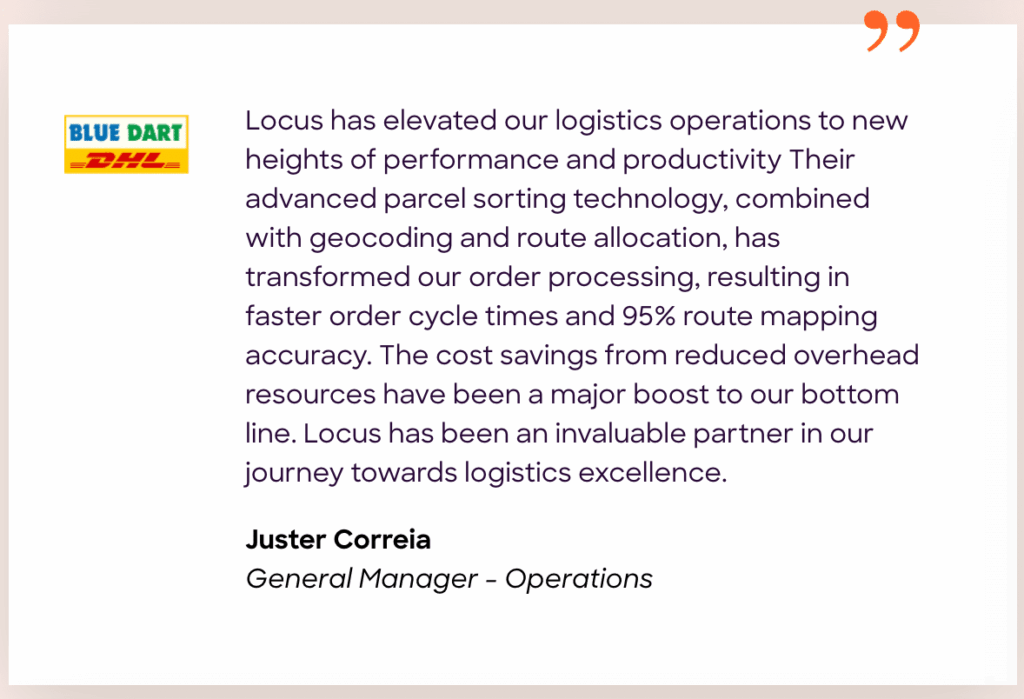
“Locus helped us significantly improve route accuracy and reduce manual intervention. Our teams now receive real-time updates without delays, and the platform consistently keeps pace with our operational load,” says General Manager at Blue Dart.
2. LogiNext

LogiNext is an AI-enabled delivery management platform focused on route optimization, automated scheduling, and real-time visibility. Teams evaluating DispatchTrack alternatives often consider LogiNext when they need a configurable system that supports deliveries, pickups, and returns within a single workflow.
Common Challenges LogiNext Resolves
- Reduces routing inefficiencies through AI-driven route optimization that adapts to traffic and delivery windows.
- Improves visibility with continuous tracking of drivers and orders throughout the day.
- Eliminates manual scheduling by automating pickup and delivery time-slot assignments.
- Enhances delivery accuracy through photo proof of delivery, barcode scanning, and digital signatures.
LogiNext’s Pros
- Supports a wide range of routing models, including deliveries, pickups, and reverse logistics.
- Provides strong real-time tracking for both dispatchers and customers.
- Offers robust proof-of-delivery options that reduce delivery errors and disputes.
LogiNext’s Cons
- Can feel complex for smaller teams that only need last-mile coordination.
- Typically requires structured onboarding and implementation.
- Pricing may increase quickly as delivery volumes or user counts grow.
LogiNext Is Ideal for
LogiNext is ideal for retail, e-commerce, logistics, and food & beverage operations with mixed workflows. It is also useful for teams that require automation for deliveries, pickups, and returns rather than only basic routing.
LogiNext’s Pricing
Custom pricing based on delivery volume, regions covered, and required modules.
When comparing LogiNext with Locus, the key distinction is often depth of orchestration. LogiNext is a strong candidate for configurable delivery automation, while Locus is typically better suited for enterprises that need routing intelligence, dispatch flexibility, real-time exception management, and network-wide visibility in one platform.
3. Bringg
Bringg is a fulfillment and delivery orchestration platform designed for enterprises that manage multiple fleets, carriers, and delivery models. Teams exploring DispatchTrack alternatives often consider Bringg when they need stronger coordination between internal operations and outsourced delivery partners.
Common Challenges Bringg Resolves
- Bringg brings together carrier selection, handoffs, and exception handling into one system, helping teams reduce the fragmentation that comes from managing multiple delivery partners.
- Its centralized dashboards give operations teams real-time visibility into SLA risks, delays, and carrier performance across regions and fleets.
- It also streamlines customer communication by automating notifications and offering branded tracking pages, creating a more consistent experience across all delivery types and partners.
Bringg’s Pros
- Supports a wide range of fulfillment models, from curbside pickup to same-day and scheduled deliveries.
- Strong multi-carrier coordination capabilities for enterprises using hybrid fleets.
- Integrates with major commerce, POS, and delivery platforms to support omnichannel retail.
Bringg’s Cons
- Some users report a learning curve due to the platform’s breadth.
- Less focused on deep AI-led routing compared to specialized routing engines.
Bringg Is Ideal for
Bringg is a strong option for enterprise retailers, grocery brands, and logistics companies that manage several fleets or delivery partners and need a single orchestration platform. It’s best for teams prioritizing multi-carrier coordination over complex routing automation.
Bringg’s Pricing
Bringg provides custom enterprise pricing based on factors such as delivery volume, integration requirements, carrier mix, and overall operational complexity.
Bringg can be a good fit when carrier marketplace coordination is the dominant challenge. If the operational priority is to improve in-house fleet productivity, route density, dispatcher control, and SLA precision, teams should evaluate how its routing depth compares with more specialised optimisation-led platforms.
4. Onfleet
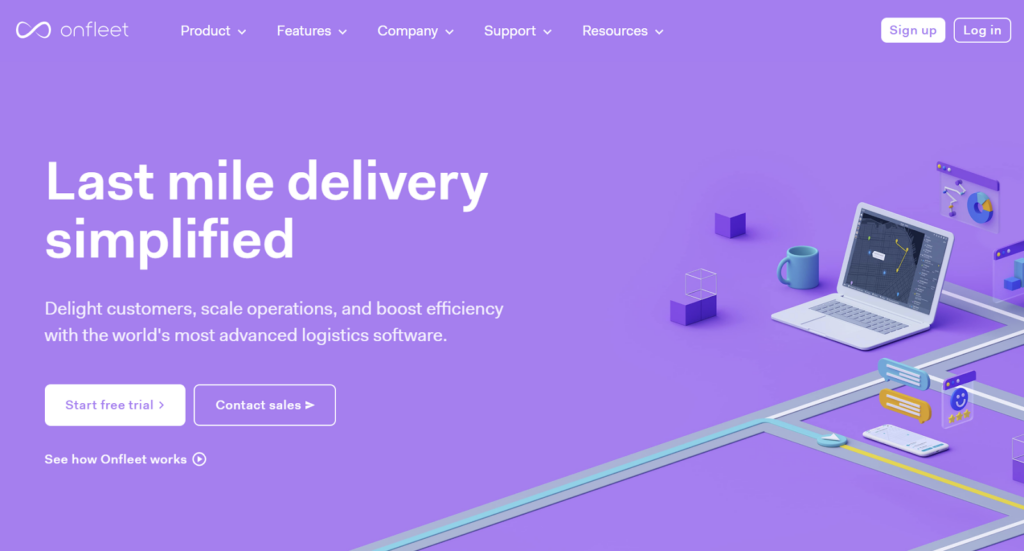
Onfleet is a straightforward last-mile delivery management platform known for its intuitive interface and fast setup. Teams exploring DispatchTrack alternatives often consider Onfleet when they want a lightweight solution focused primarily on last-mile coordination rather than end-to-end logistics orchestration.
Common Challenges Onfleet Resolves
Onfleet supports day-to-day delivery operations with:
- Fast, intuitive task assignment and route adjustments
- Reliable driver tracking and customer notifications
- A clean dashboard that reduces dispatcher workload
Onfleet’s Pros
- The interface is easy to pick up, allowing teams to get started quickly without long training cycles.
- Drivers benefit from a simple mobile app with reliable navigation and smooth communication.
- Implementation is fast, making it a good choice for teams that want minimal setup and straightforward workflows.
- It also supports basic integrations with ordering systems and delivery apps through its APIs.
Onfleet’s Cons
- Less suited for enterprise complexity, such as multi-hub planning, dense fleet orchestration, or hybrid fleet models.
- Analytics and exception-handling tools are more basic and may not meet the needs of high-volume or multi-region operators.
Onfleet Is Ideal for
Onfleet is a strong fit for local and mid-sized retailers, grocery and food brands, pharmacies, and service providers handling same-day or on-demand deliveries. It’s ideal for teams that prefer a lightweight, easy-to-use delivery management platform without complex automation layers.
Onfleet’s Pricing
Onfleet uses tiered pricing that scales with monthly task volume and feature requirements. Higher-tier plans unlock advanced analytics, API access, and increased delivery limits.
Onfleet’s simplicity is its strength, but it can also become a limitation as route complexity increases. Enterprises with multiple hubs, varied vehicle capacities, regional SLA differences, or centralised control-tower requirements should test whether the platform can support their future operating model, not only today’s dispatch workload.
5. OptimoRoute
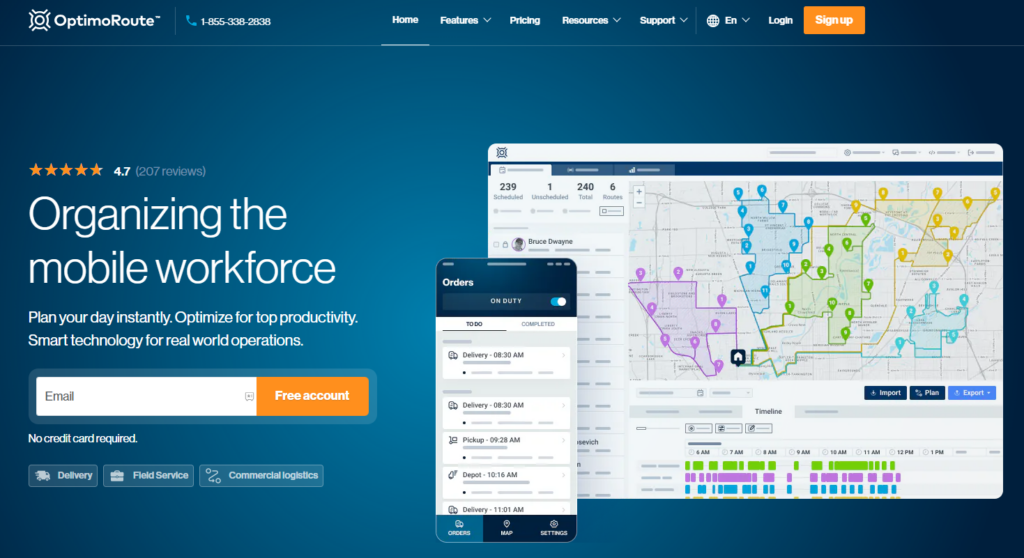
OptimoRoute offers a comprehensive solution for route planning, optimization, and delivery management, designed to enhance efficiency and reduce operational costs. With real-time tracking, automated scheduling, and powerful analytics, OptimoRoute enables businesses to streamline their last-mile operations and provide superior service.
Common Challenges OptimoRoute Resolves
- Helps teams reduce planning time through automated weekly scheduling and optimized multi-driver routing.
- Improves delivery transparency through real-time location visibility and accurate ETA communication.
- Strengthens accountability with built-in proof of delivery tools and structured route execution workflows.
OptimoRoute’s Pros
- Accurate routing engine that efficiently balances delivery constraints and service windows.
- Strong multi-day or weekly scheduling capabilities for teams that plan ahead.
- Useful customer notifications with reliable ETA sharing and status updates.
- Clean proof of delivery options including photos, notes, and signatures.
OptimoRoute’s Cons
- Interface can feel dated compared with newer, modern platforms.
- Setup may require more configuration upfront before workflows run smoothly.
- Some advanced features, such as real-time tracking, are restricted to higher-priced tiers.
OptimoRoute Is Ideal for:
- Businesses that need to optimize delivery routes, manage customer communication, and reduce operational costs for better service.
- Companies requiring real-time tracking, optimized scheduling, and efficient route planning to improve fleet productivity.
OptimoRoute’s Pricing:
- Pricing starts at $35 per driver per month, scaling with additional features for tracking, analytics, and proof of delivery.
- Custom plans are available for larger fleets needing advanced capabilities.
OptimoRoute is particularly relevant for teams that plan recurring routes or schedules in advance. For enterprises where routes change dynamically throughout the day due to cancellations, late orders, capacity constraints, or live exceptions, it is important to validate real-time re-optimisation and dispatcher override capabilities during the evaluation.
6. Onro
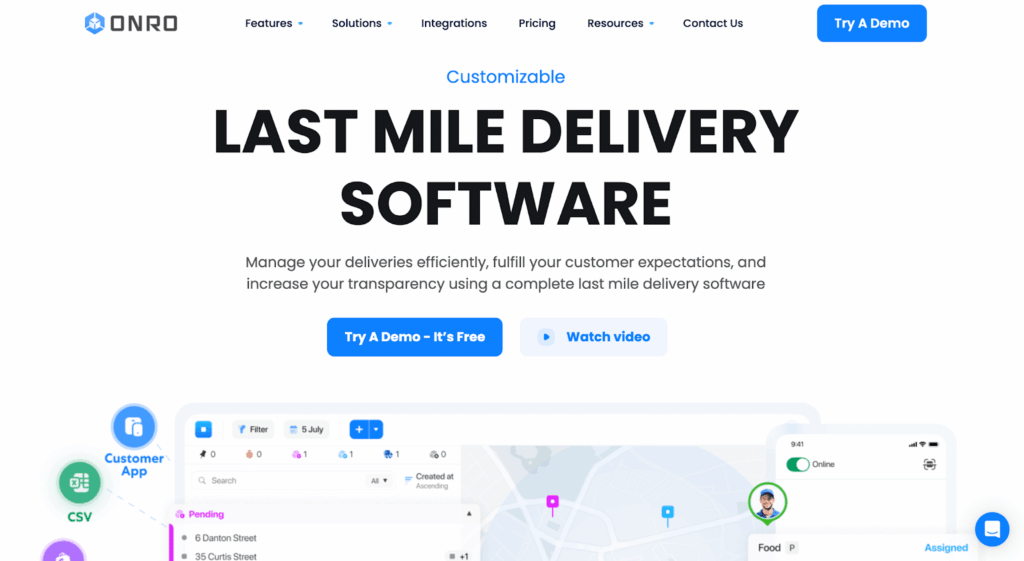
Onro is a cloud-based last-mile delivery solution built for courier, on-demand, and hyperlocal operations. It prioritizes ease of use, fast deployment, and solid driver app performance, which makes it appealing to teams seeking a lean alternative to complex, enterprise-grade orchestration tools.
Common Challenges Onro Resolves
- It helps teams avoid operational delays by offering a fast, lightweight dispatch and driver-management workflow, especially useful for those struggling with rigid or overly complex systems.
- It also gives small to mid-sized fleets quick, app-friendly visibility, reducing communication gaps and the need for constant manual follow-ups during deliveries.
- And with flexible order editing and real-time adjustments, it removes the friction teams face in platforms where workflows are locked or changes take too long.
Onro’s Pros
- Easy integrations through APIs for small logistics businesses or startups wanting to connect to ordering apps or scheduling systems quickly.
- More budget-friendly compared to fully enterprise-grade tools.
Onro’s Cons
- Reporting and analytics are simpler and may not support deep operational modeling or enterprise-scale optimization.
- Not ideal for large fleets requiring complex constraints, automated planning, or multi-moment fulfillment logic.
Onro Is Ideal for
Onro is ideal for teams running hyperlocal courier services, small 3PLs, same-day delivery operators, or businesses focused on rapid dispatching.
Onro’s Pricing
Subscription-based, with costs tied to order volume, fleet size, and modules. Generally, more budget-friendly than enterprise platforms; exact pricing is custom.
Onro is best viewed as a practical dispatch system for lean, fast-moving teams. It is less aligned with enterprise buyers who need standardised governance, advanced analytics, multi-region rollout, or optimisation models that account for complex fleet and fulfilment constraints.
7. Route4Me
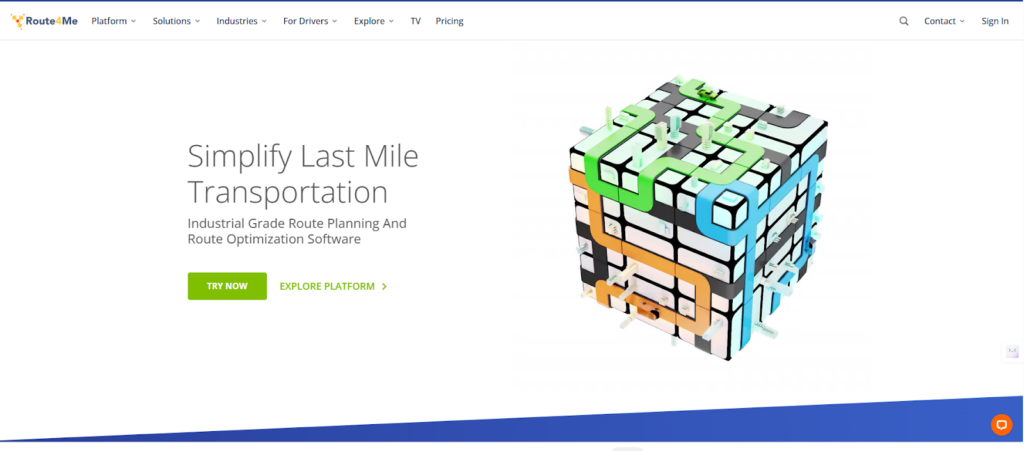
Route4Me is an AI-driven route optimization platform built to streamline last-mile delivery. With more than 3 billion miles optimized and over 750 million destinations mapped, it provides advanced tools for route planning, fleet management, and delivery tracking. This helps businesses improve efficiency and reduce costs.
Common Challenges Route4Me Resolves
- Reduces time spent planning multi-stop routes by automating route creation and optimization.
- Improves delivery transparency with real-time tracking for dispatchers and customers.
- Strengthens delivery verification by supporting signatures, photos, and additional proof-of-delivery details.
Route4Me’s Pros
- Reliable routing engine that handles complex, multi-stop routes efficiently.
- Solid real-time tracking features that give dispatchers clear visibility.
- Flexible proof-of-delivery options built into the driver app.
Route4Me’s Cons
- Pricier than some alternatives at scale, especially for larger fleets.
- Some reviews note occasional GPS or mapping inconsistencies.
Route4Me is Ideal for:
- Businesses in logistics, parcel delivery, and courier services looking to optimize routes and improve operational efficiency.
- Companies needing efficient, cost-effective solutions for managing multiple deliveries and enhancing the customer experience.
Route4Me’s Pricing:
Route4Me offers flexible pricing plans starting at $60 per vehicle per month. Pricing varies by business size and required features, with higher-tier plans for larger fleets and more advanced features.
Route4Me is a strong route-planning option for teams that want to improve multi-stop delivery efficiency. Enterprise buyers should additionally assess how well it supports adjacent workflows such as dispatch governance, live exception handling, hub-level performance management, and complex integrations with upstream order and warehouse systems.
8. Ufleet
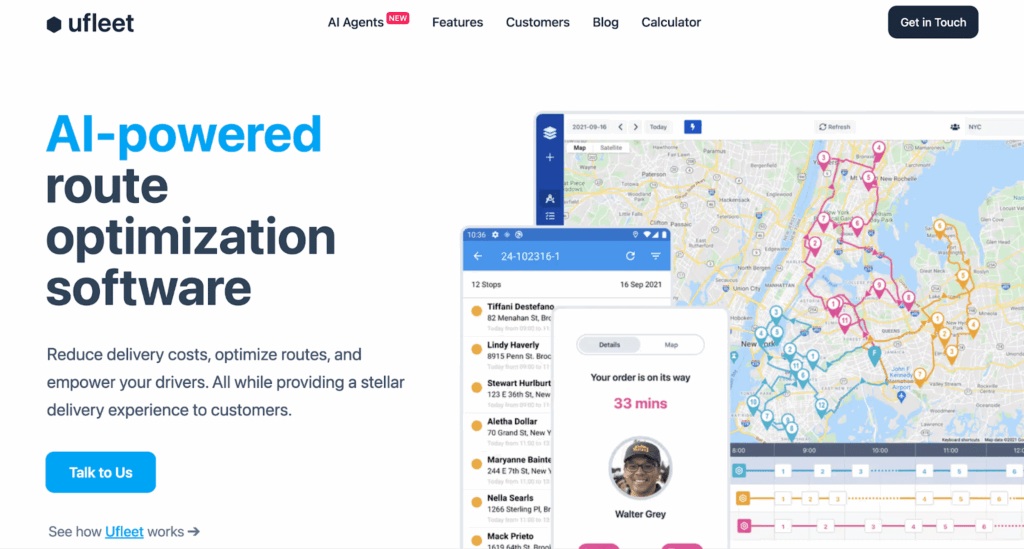
Ufleet is a modern, AI-assisted route optimization and delivery management platform built for teams that want a simple, streamlined system with strong customer-facing features. It’s often chosen by businesses that need fast route planning, clean interfaces, and reliable real-time communication without having to deal with overly complex workflows.
Common Challenges Ufleet Resolves
- Helps eliminate slow route updates by providing quick, AI-assisted route generation and re-planning.
- Improves customer visibility through branded tracking pages, real-time ETAs, and instant feedback tools.
- Reduces dispatcher workload with intuitive dashboards that centralize driver updates, delivery status, and customer communications.
Ufleet’s Pros
- Very user-friendly interface that requires minimal training and supports fast onboarding.
- Strong customer portal with real-time delivery tracking and flexible feedback tools.
- Fast, AI-assisted route planning that simplifies daily dispatch work for small and mid-sized teams.
Ufleet’s Cons
- Lacks deeper enterprise orchestration capabilities found in more mature platforms.
- Advanced reporting and historical analytics are more limited compared with enterprise-first tools.
- May become costlier at higher volumes due to per-delivery pricing.
Ufleet Is Ideal for
- Retailers, grocery operators, and local delivery teams looking for a simple, modern system that improves customer communication and daily route planning.
- Operations that want lightweight tools focused on customer experience rather than complex logistics automation.
Ufleet’s Pricing
- Ufleet offers a pay-as-you-go model with free usage up to 200 deliveries per month, followed by a per-delivery fee.
- Custom pricing is available for businesses with higher volumes or advanced integration needs.
Ufleet can be attractive where customer communication is a priority and logistics complexity is moderate. For larger networks, buyers should test whether the platform provides the analytical depth and operational controls required to manage cost, SLA performance, and route productivity at scale.
9. Tookan
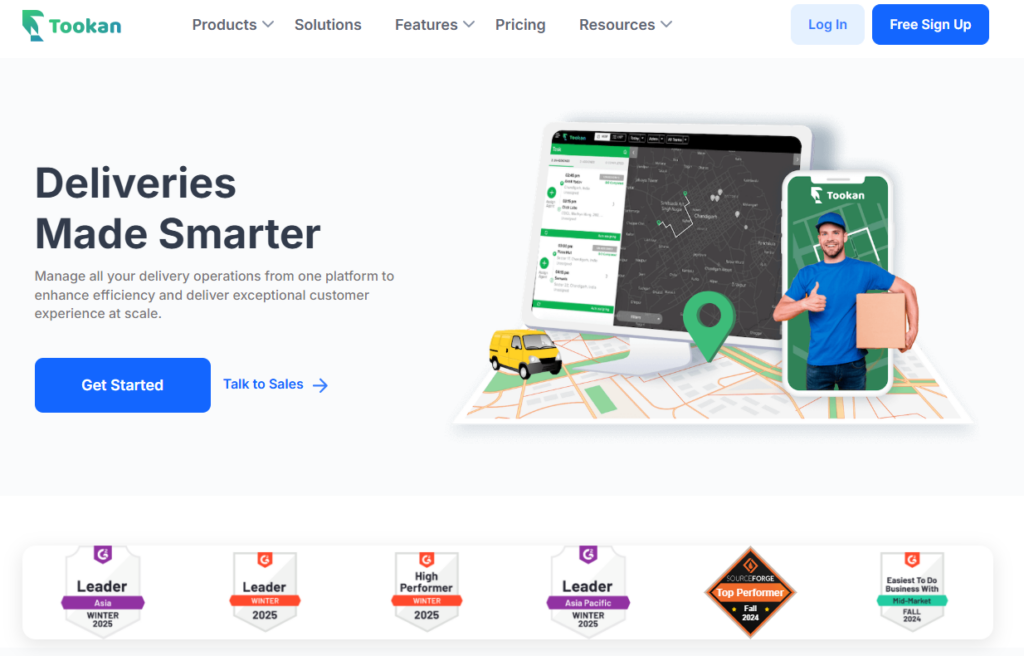
Tookan is a white-label delivery and on-demand fulfillment platform built for businesses that want to create customized, branded delivery applications rather than using a standard dispatcher interface.
Teams evaluating DispatchTrack alternatives consider Tookan when their priority is branding, custom workflows, or integration-heavy delivery apps instead of plug-and-play optimization tools.
Common Challenges Tookan Resolves
- Helps businesses replace third-party delivery apps with fully branded customer and driver experiences.
- Simplifies integration needs through an API-first architecture and real-time webhooks.
- Supports on-demand fulfillment models where custom workflows differ from traditional route-planning platforms.
Tookan’s Pros
- Highly customizable white-label platform for companies building their own delivery apps.
- Strong API and webhook support for engineering teams that want deep system integrations.
- Web + iOS + Android support reduces development time for multi-platform deployments.
- Flexible pricing suited for startups and mid-size operators.
Tookan’s Cons
- Requires technical resources; not ideal for teams that want fast, no-code deployment.
- Limited built-in routing and optimization features compared to purpose-built dispatch tools.
- Many basic functions require custom development, increasing setup time.
- Less suitable for enterprises needing standardized, scalable planning across regions.
Tookan Is Ideal for
- On-demand service providers, hyperlocal apps, and startups building their own branded customer + driver apps.
- Delivery teams with strong engineering resources and unique workflows that off-the-shelf platforms cannot handle.
Tookan’s Pricing
Plans start around $99/month, with additional costs for white-labeling, integrations, or engineering-heavy customizations.
Tookan is most relevant when the business requirement is to build a branded delivery experience rather than adopt a mature optimisation layer. If the core challenge is routing accuracy, operational stability, or reduced manual dispatch effort, a purpose-built logistics orchestration platform may be a better fit.
10. Shipsy
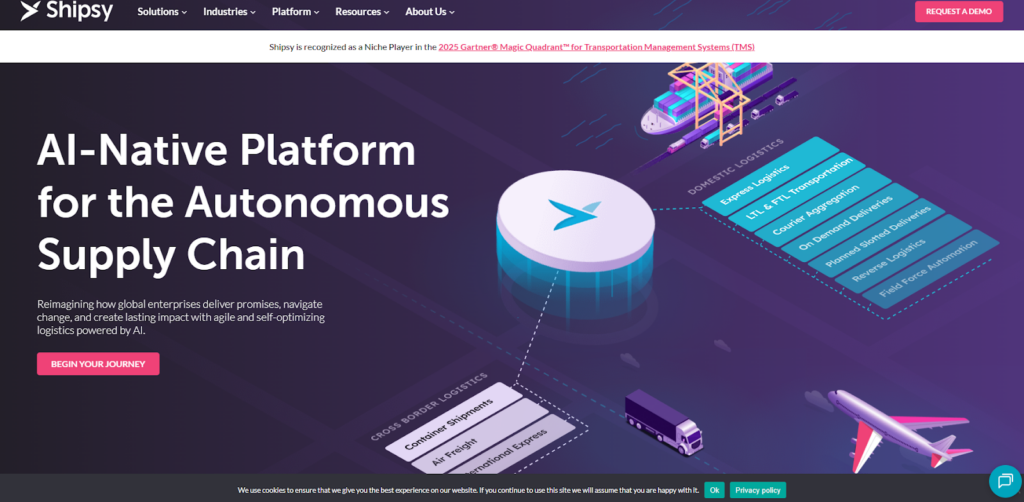
Shipsy is a logistics management and visibility platform widely used across retail, e-commerce, 3PL, CEP, and cross-border delivery networks. It focuses on improving cost efficiency and providing strong operational visibility across first-, mid-, and last-mile workflows.
Common Challenges Shipsy Resolves
Shipsy tends to appeal to teams who are experiencing:
- Visibility gaps across carriers or transport legs, offering a unified operations dashboard that reduces back-and-forth between tools.
- High dependence on multiple third-party fleets, providing automated carrier allocation and cost-optimized selection.
- Manual effort in monitoring SLAs is reduced as Shipsy provides real-time performance insights, alerts, and automated exception flagging.
Shipsy’s Pros
- Shipsy is known for its extensive integrations across couriers, transporters, and 3PL partners, making it a good fit for brands handling outsourced delivery at scale.
- The platform helps businesses compare rates, SLAs, and performance data to choose the most efficient transporter for each shipment.
Shipsy’s Cons
- Best suited for organizations already using multiple carriers, so smaller or more centralized operations may find parts of the platform more than they need.
- Advanced configuration can take time, especially for teams that require deep workflow customization.
Shipsy Is Ideal for
Shipsy is a strong fit for companies managing multiple carriers or cross-border delivery flows who need clearer visibility and tighter cost control. Retail, e-commerce, 3PL, and CEP teams often choose it when their operations span several regions and transport partners.
Shipsy’s Pricing
Shipsy offers custom pricing based on shipment volume, number of carriers, module selection (e.g., last-mile, cross-border, control tower), and deployment scale.
Shipsy is a compelling option where shipment visibility and carrier control are the primary pain points. Teams should compare it carefully with Locus when the requirement extends into AI-led route optimisation, high-volume last-mile execution, and granular dispatch decisioning across owned, outsourced, and hybrid fleets.
Questions to Ask Before Choosing a DispatchTrack Alternative
Once you have narrowed the shortlist, use vendor demos to test operational fit rather than reviewing generic product screens. Ask each provider to walk through your actual use cases, including peak-day order volumes, high-density urban routes, failed delivery workflows, shared fleet scenarios, and last-minute order changes.
Key questions include:
- How does the platform calculate ETAs, and how often are they refreshed during execution?
- Can dispatchers override automated decisions without creating downstream data conflicts?
- What happens when a driver becomes unavailable mid-route?
- How are failed deliveries, partial deliveries, returns, and cancellations handled?
- Can the system support both owned fleets and outsourced carriers in the same workflow?
- What analytics are available for SLA breaches, route productivity, utilisation, and cost-to-serve?
- How long does implementation take for a multi-hub or multi-region rollout?
- What support model is available during peak periods or business-critical delivery windows?
- How does the platform integrate with existing OMS, WMS, ERP, TMS, telematics, and customer communication systems?
A strong vendor should be able to demonstrate these workflows clearly, not simply describe them at a high level.
Migration Checklist for Teams Moving Away From DispatchTrack
Switching delivery management platforms requires more than data export and user training. To reduce operational disruption, build a migration plan around the following steps:
- Map current workflows: Document route planning, dispatch, driver communication, customer notifications, proof of delivery, exception handling, and reporting flows.
- Identify operational gaps: Separate must-fix issues from nice-to-have enhancements so the new platform is evaluated against business-critical outcomes.
- Audit data readiness: Review order data, address quality, geocodes, service-time assumptions, driver profiles, vehicle constraints, customer time windows, and historical delivery records.
- Define integration scope: Confirm which systems must exchange data with the new platform, including OMS, WMS, ERP, TMS, carrier systems, CRM, and BI tools.
- Pilot with real complexity: Test the platform with representative delivery scenarios, not simplified demo routes.
- Train by role: Dispatchers, drivers, planners, hub managers, customer service teams, and leadership dashboards all require different enablement.
- Measure before and after: Track baseline performance for SLA adherence, route productivity, failed deliveries, planning time, customer contacts, and manual intervention.
- Plan phased rollout: For large networks, a hub-by-hub or region-by-region rollout can reduce operational risk and improve adoption.
This approach helps teams move from software replacement to measurable logistics transformation.
Why Locus Stands Out as the Strongest DispatchTrack Alternative
Across all the alternatives, Locus stands out as the most complete and reliable upgrade for teams moving away from DispatchTrack. It solves the core issues users report most often, such as slow updates, limited workflow flexibility, and unstable real-time visibility.
Locus provides faster routing, stronger operational control, and consistent performance at scale, which makes it a better long-term fit for teams that want dependable daily execution and room to grow.
For enterprise businesses in retail, FMCG, e-commerce, 3PL, and CPG, this matters because delivery performance is no longer only an operational metric. It directly influences customer promise accuracy, fulfilment cost, workforce productivity, and the ability to scale into new regions or service models without adding proportional manual effort.
If you want a platform that eliminates operational slowdowns and supports your growth without compromise, book a demo and explore how Locus can transform your delivery performance.
Frequently Asked Questions (FAQs)
1. How do I decide whether my team needs a routing-focused tool versus a full orchestration platform?
Routing tools are ideal when ETA accuracy and route efficiency are the main challenges. Orchestration platforms are better when you’re managing multiple fleets, hubs, or delivery models that require tighter coordination.
2. Can I use more than one alternative tool together instead of fully replacing DispatchTrack?
Yes. Many teams combine a routing engine with a post-purchase or carrier-management platform when a single tool cannot meet all operational needs.
3. How long does implementation typically take when switching to a new logistics platform?
Lightweight tools may take only a few days to deploy. Enterprise-grade systems often require several weeks for integrations, workflow mapping, and team onboarding.
4. Do all delivery management platforms support both scheduled and on-demand deliveries?
No. Only select systems support mixed delivery SLAs. Most tools specialize in either scheduled or on-demand workflows, so this should be checked early in evaluation.
5. What should teams consider when migrating data and workflows from DispatchTrack?
Key areas include data structure compatibility, API mapping, driver onboarding, SLA recalibration, and ensuring that automated rules (such as capacity or priority logic) translate cleanly into the new system.
6. How should rapidly growing teams evaluate scalability when choosing a new platform?
Look for evidence of performance under load, routing speed during peak windows, dashboard responsiveness with larger datasets, and proven multi-region support.
7. What is the best DispatchTrack alternative for enterprise last-mile delivery?
For enterprise last-mile operations, Locus is a strong alternative because it combines AI-powered route optimisation, dispatch planning, real-time visibility, exception management, and end-to-end orchestration. This makes it suitable for high-volume networks that need more than basic delivery tracking.
8. What is the difference between delivery management software and logistics orchestration software?
Delivery management software usually focuses on route execution, driver tracking, customer notifications, and proof of delivery. Logistics orchestration software connects a broader set of decisions across planning, routing, dispatch, carrier allocation, execution, visibility, and analytics.
9. Should pricing be the main factor when comparing DispatchTrack alternatives?
Pricing matters, but it should be evaluated alongside operational impact. A lower-cost platform may become expensive if it increases manual work, limits route productivity, or cannot scale with delivery growth. Enterprise buyers should compare total value, including cost-to-serve, SLA performance, implementation effort, and long-term scalability.
10. Why do enterprises choose Locus over lightweight dispatch platforms?
Enterprises typically choose Locus when they need to manage complex delivery networks with multiple hubs, fleets, geographies, SLAs, and customer promise rules. Lightweight tools may work well for simpler dispatching, but Locus is designed for more advanced route optimisation, operational control, and scale.


General
Top 10 FarEye Competitors to Consider in 2026 for Better Delivery Performance

Dec 16, 2025
Compare the top 10 FarEye alternatives for 2026. Review routing, visibility, delivery orchestration, pricing, and use cases to find the best fit for your team.
Read more
General
10 Best Shipsy Competitors in 2026 for End-to-End Logistics Performance
Dec 18, 2025
Check out the 10 best Shipsy alternatives for 2026. Evaluate routing accuracy, platform stability, visibility features, and more to choose the apt platform.
Read moreInsights Worth Your Time




















10 Most Trusted Alternatives to DispatchTrack in 2026 (With Detailed Comparisons)