


General
What Is a Dispatch Automation Platform?
Key Takeaways
- Manual dispatch decisions and siloed routing tools create compounding cost: delayed plans, SLA misses, and exception firefighting that accumulate into structural inefficiency at enterprise scale
- A dispatch automation platform unifies three capabilities in a single layer: AI-driven order-to-resource assignment, multi-constraint route optimization, and live exception management
- These three functions must share the same data and decision context to produce reliable outcomes; point solutions connected through middleware cannot replicate the compound value of a unified layer
- Enterprise buyers should evaluate platforms on constraint-handling depth, real-time responsiveness, upstream integration coverage, and validated scalability under peak load
- Locus Dispatch Planning, built on the world’s first Decision-Intelligent, Agentic TMS, operates all three pillars as one orchestration layer, recognized by Gartner for seven consecutive years and ranked #1 in Route Planning in G2’s 2026 Best Software Awards
Most enterprise logistics teams already run tools for routing, driver assignment, and delivery tracking. What most of those stacks lack is a system where those capabilities share the same data, respond to the same real-time signals, and feed outcomes back into one decision loop without manual handoffs between disconnected systems.
That gap is where the dispatch automation platform category begins.
This article defines the category, explains why the three core capabilities must operate as one layer, and gives enterprise buyers a practical framework for evaluating platforms that meet that standard.
Why Enterprise Dispatch Is Broken Today
Enterprise last-mile operations involve hundreds of allocation decisions per day across drivers, vehicles, carriers, and fulfillment nodes. When the tools handling those decisions operate in isolation, the gaps between them accumulate into avoidable cost: delayed plans, SLA misses, and dispatcher time spent on exception calls that a unified system would absorb automatically.
The hidden cost of manual dispatch decisions
Manual dispatch operates on three compounding failure modes at enterprise scale:
- Decision lag: Route plans built the previous evening are based on order data that shifts materially before drivers depart. Every hour of planning lag translates to routes that are suboptimal before a single vehicle leaves the depot
- Allocation inconsistency: Different planners make different tradeoffs under time pressure across hundreds of order-to-driver decisions. Over a week, those inconsistencies compound into measurable variance in cost-per-delivery and SLA adherence
- Exception absorption: Mid-route disruptions require a dispatcher to assess impact, coordinate with the driver, notify the customer, and update the plan simultaneously. For operations managing hundreds of concurrent routes, this reactive model creates a hard ceiling on team capacity without adding headcount
When point solutions do not talk to each other
Many enterprise logistics stacks have accumulated separate tools over time:
- Dispatch software for order-to-driver assignment
- Routing engines for stop sequencing and ETA calculation
- Tracking dashboards for shipment visibility
- Separate notification tools for customer communication
Each of these does what it was built to do. The problem surfaces when an exception in one domain requires action in another.
A driver calls in sick mid-morning. The tracking layer shows a live route in progress. The assignment tool holds the driver’s pending orders. The routing engine has already generated the plan. For the response to be optimal, all three need to operate simultaneously on a shared understanding of the current state.
In a stack of disconnected tools, dispatchers approximate that shared understanding manually, which introduces delay, error, and variable outcomes. This is the structural problem a dispatch automation platform is designed to address.
Defining the Dispatch Automation Platform Category
A dispatch automation platform is a system that replaces manual and semi-manual dispatch workflows with an AI-driven layer that assigns orders to vehicles and drivers, optimizes routes against real-world constraints, and responds to live exceptions without requiring dispatcher intervention for routine decisions.
For enterprise delivery dispatch software to qualify as a true dispatch automation platform:
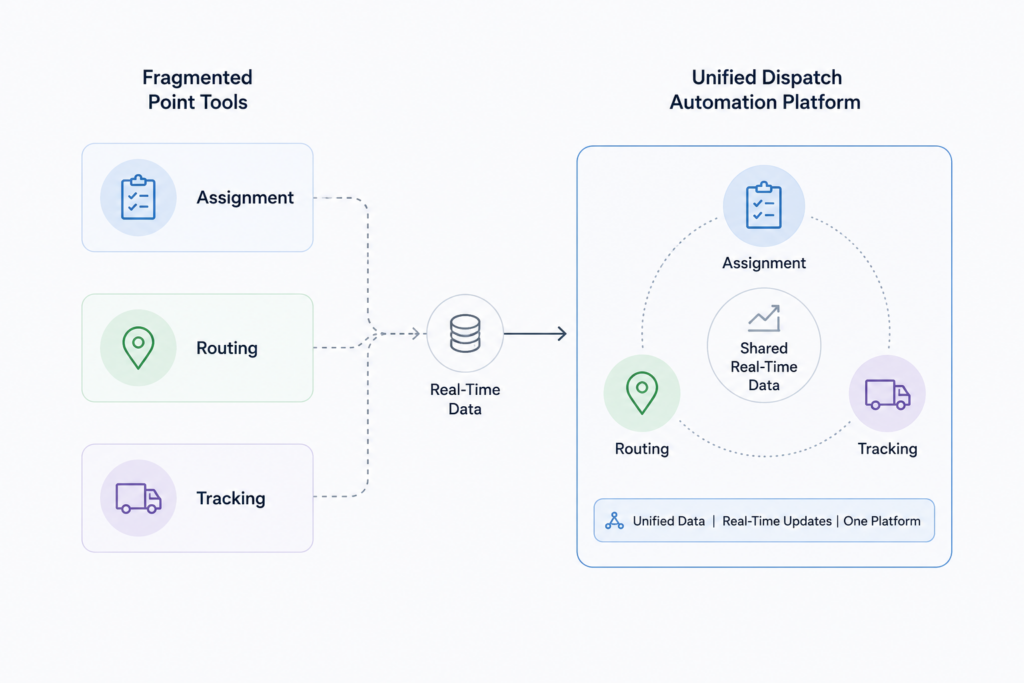
- All three pillars must operate from a shared data model
- All three must respond to the same real-time triggers
- Outcomes must feed into a single learning loop that improves planning accuracy over time
The category is defined by unification. A platform that automates assignment but relies on a separate system for routing is an assignment tool with a routing integration. The distinction matters because integrated decisions produce compounding outcomes that disconnected point tools cannot replicate.
Where dispatch automation extends beyond routing and tracking
Route optimization and shipment tracking are components of dispatch automation. They are not the full category.
A routing engine answers one question: given these stops and this vehicle, what is the optimal sequence? That question assumes assignment has already been made. A tracking dashboard answers: where is this shipment now? That question assumes the route is already in motion.
A dispatch management platform must operate upstream and downstream of both. Upstream, it determines which order goes to which vehicle, which carrier, from which node, using live cost, capacity, and SLA signals. Downstream, it detects when live conditions are diverging from plan and triggers corrective decisions before the exception becomes a failure.
Platforms that cover only the routing step leave the highest-value decisions to manual processes.
The Three Pillars of a True Dispatch Automation Platform
The three capabilities that define the category operate as one loop: assignment creates the conditions for routing, routing creates the execution plan, and live exception management updates both when conditions change.
Separating them at the system level breaks the loop and reintroduces the manual handoffs the platform is meant to eliminate.
AI-driven assignment
AI-driven assignment matches orders to drivers, vehicles, and fulfillment nodes by evaluating operational constraints simultaneously. At enterprise scale, those constraints include:
- Vehicle capacity, payload limits, and door-delivery sequencing requirements
- Driver skill sets, certifications, and shift availability windows
- Delivery time windows and SLA tier priority by order type
- Geographic coverage zones, territory boundaries, and permitted road classes
- Load sequencing requirements for multi-stop vehicle routes
Manual assignment can evaluate a subset of these in sequence. An AI-driven system evaluates all of them for every order in a planning batch, producing assignments that optimize across the full fleet.
The output of AI-driven assignment is also the input for route optimization. In a unified platform, both share the same data model, so the constraint set used for assignment matches the one the routing engine applies to stop sequencing.
Understanding how AI route optimization works is fundamental to evaluating whether a platform’s assignment logic is genuinely constraint-aware or simply applying preset rules to incoming orders.
Route optimization
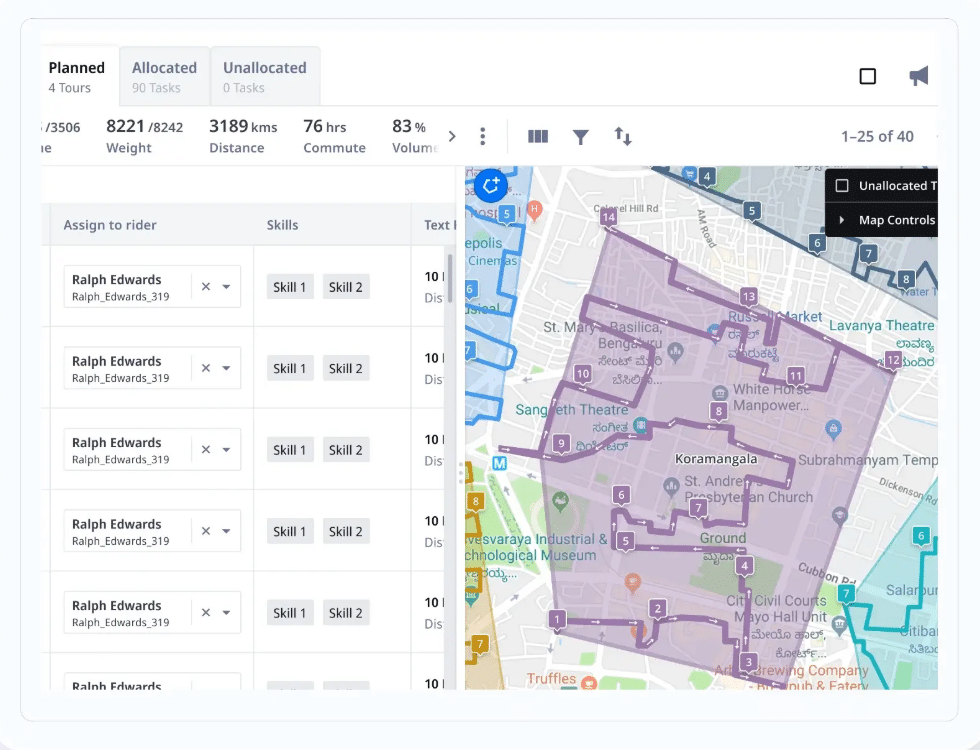
Route optimization at enterprise scale involves hundreds of vehicles across multiple depots, mixed fleet types, varying delivery window commitments, and mid-route order changes. A routing engine built for this environment evaluates variables including:
- Vehicle payload, load configuration, and door-delivery sequencing
- Driver hours-of-service limits and mandatory shift break windows
- Road restrictions, live traffic conditions, and time-of-day routing rules
- Delivery density, hub departure windows, and SLA tier weighting
- Customer-specified delivery time preferences captured at checkout
| Static Route Optimization | Continuous AI Optimization | |
|---|---|---|
| Plan freshness | Built once at planning time | Updated continuously as conditions change |
| Constraint handling | Fixed rule set | 250+ real-world constraints evaluated simultaneously |
| Disruption response | Manual replanning required | Automatic re-sequencing from live signals |
| Learning | None | Improves from historical delivery outcomes |
| Enterprise scalability | Limited by rule complexity | Designed for high-volume, multi-depot operations |
Continuous optimization matters as much as initial plan quality. A plan built at 5 AM should update when a vehicle breaks down at 9 AM, when a high-priority order arrives mid-morning, and when a road closure changes the afternoon schedule.
Platforms handling 250+ real-world constraints produce materially better outcomes at enterprise scale than those optimizing against a smaller set.
Live exception management
Live exception management is the third pillar and the one most commonly handled outside the automation layer, through dispatcher judgment and manual coordination.
Common exception types that a dispatch automation platform should absorb without dispatcher intervention include:
- Driver running significantly behind the planned delivery schedule
- Customer requesting a delivery time or location change after dispatch
- Vehicle breakdown or unplanned service event mid-route
- Road closure or traffic disruption affecting multiple stops in a route
- Failed delivery attempt requiring same-day reassignment to another driver
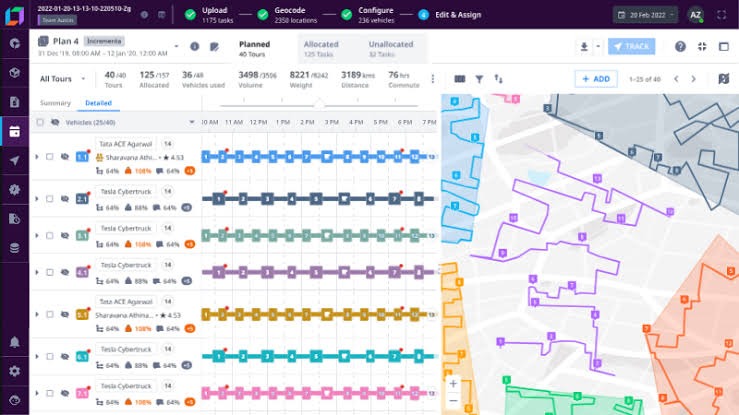
In a unified platform, a visibility layer monitors every active route against plan, detects divergence early, and triggers automated responses for defined exception types. Exceptions that require human judgment are surfaced proactively with context.
Locus’s agentic TMS connects live route data, assignment logic, and optimization capability so that exceptions are absorbed by the system and escalated only when policy requires human review. The ability to manage delivery exceptions at scale without adding headcount is a defining characteristic of a mature dispatch automation platform.
Why These Capabilities Must Be One Automation Layer
The case for unification comes down to data latency and decision dependency. Each pillar depends on the others in real time:
- Assignment decisions depend on routing outcomes to know which vehicle configurations are available
- Routing outcomes depend on live vehicle status to generate accurate plans
- Live vehicle status determines which exceptions need response and in what priority order
- Exception responses affect assignment for remaining undelivered orders in the same planning window
When these capabilities operate in separate systems connected through integrations, every dependency introduces latency. The assignment system does not know the routing engine’s current output. The routing engine does not know which exceptions the visibility layer is processing.
By the time data moves through an API chain and updates the relevant system, the operational moment it describes has passed.
A unified dispatch scheduling and optimization layer eliminates this latency. Assignment, routing, and exception management share the same real-time data model. A driver going off-route triggers an immediate re-evaluation of the affected sequence, an automated customer notification, and an updated dispatcher view, all within the same system cycle.
The compounding effect is measurable. Locus customers operating on this unified model have documented 66% faster planning cycles, 99.5% on-time SLA adherence, and a 20% reduction in total logistics costs. These outcomes reflect what happens when the three pillars share data and decisions.
Dispatch management ERP and WMS integration amplifies this effect further. When upstream order data from OMS and inventory data from WMS feed into the same layer as dispatch planning, assignment decisions are made against confirmed inventory positions and real order commitments. It eliminates a category of error that manual handoffs routinely introduce.
How to Evaluate a Dispatch Automation Platform
Evaluation criteria for transportation dispatching software tend to focus on feature presence: does it have a driver app, does it have a map view, does it have an API? These are necessary signals but not sufficient ones. A dispatch automation platform should be evaluated on how its capabilities work together and at what scale.
Questions enterprise buyers should ask
- Constraint depth: How many real-world constraints does the routing engine evaluate simultaneously? Ask for a specific count and a live demonstration against your actual fleet data. Generic “AI-powered routing” claims without named constraint counts typically indicate a rule-based engine
- Real-time feedback loops: Does the assignment logic update in real time as exceptions occur, or does it require a manual re-dispatch trigger? This tests whether the system is genuinely unified or whether separate manual steps exist between pillars
- Exception workflow: How does the platform detect and respond to a mid-route vehicle breakdown? Walk through the specific workflow: what triggers the alert, what automated actions follow, what requires dispatcher input, and how long the full response cycle takes
- Upstream integration model: What is the integration model with OMS, WMS, and ERP systems? Pre-built connectors for named enterprise systems are a meaningful signal; vague API-first claims without specific named integrations are not
- Reference customers: Which customers operate at your order volume and network complexity? Named customers with published performance outcomes are verifiable; anonymous case studies are not
- Peak-load validation: What is the maximum concurrent order processing capacity and how has it been validated? Seasonal surges and promotional campaigns reveal the actual scalability ceiling
- Multi-depot capability: How does the platform handle multi-depot, multi-carrier operations? Test with a multi-origin scenario before shortlisting; single-depot tools frequently do not disclose this limitation in a demo
Also read: AI Logistics Software: What It Does and Why Enterprises Need It
How Locus Approaches Dispatch Automation
Locus is the world’s first Decision-Intelligent, Agentic TMS. Its dispatch automation architecture runs the Sense-Decide-Execute-Learn loop continuously, operating assignment, routing, and exception management as one unified layer.
The platform’s core components:
- DispatchIQ: Manages carrier-order matching and dispatch decisions across multiple fulfillment nodes, evaluating cost, SLA requirements, capacity, and real-time carrier availability simultaneously
- Fireworks Routing Engine: Handles route optimization, processing 250+ real-world constraints to generate and continuously update fleet-wide plans as conditions change throughout the day
- ShipFlex: Extends the orchestration layer to multi-carrier selection, allocating parcels across 160+ active carriers from a broader network of 1,000+ pre-integrated partners based on cost, speed, and SLA commitments at order time
- Mycroft AI Co-Pilot: Surfaces risk signals and assists dispatchers where human judgment adds value. Routine exception types are handled autonomously; non-routine cases are escalated with full context and recommended actions. It’s a natural-language dispatcher interface within Locus’s eight-agent DiSCO governance framework
- Unified real-time visibility layer: Monitors every active route against plan within Locus’s agentic TMS, triggering automated responses for defined exception types and escalating to dispatchers only when policy requires human review
This architecture has supported over 1.5 billion deliveries across 360+ enterprise customers in 30+ countries, producing $320M+ in documented logistics cost savings, 99.5% on-time SLA adherence, 66% faster planning cycles, and a 45% improvement in fleet utilization.
Gartner has recognized Locus for seven consecutive years, including the 2026 Hype Cycle for Supply Chain Execution and Logistics Technologies and the 2025 Market Guide for Last-Mile Delivery Technology Solutions. G2 ranked Locus #1 in Route Planning in the 2026 Best Software Awards.
QKS Group named Locus a Leader in the SPARK Matrix for Transportation Management Systems in 2025.
Ingka Investments, the investment arm of Ingka Group, the world’s largest IKEA retailer, acquired Locus in October 2025 following a global evaluation of logistics software. Locus continues to operate independently. Built for the real world, backed for the long run.
The Standard to Hold a Dispatch Automation Platform To
A dispatch automation platform is defined by what its three pillars do together.
AI-driven assignment, multi-constraint route optimization, and live exception management must share a data model, respond to the same real-time signals, and feed outcomes into a single learning loop to produce the compounding results enterprise last-mile operations require.
The question for enterprise buyers is whether the platform under evaluation is genuinely unified at the architecture level, or a collection of capable tools operating with integration overhead in between.
Schedule a demo with Locus to see how a unified dispatch automation layer performs against your actual operational complexity.
Frequently Asked Questions (FAQs)
What is the difference between a dispatch automation platform and a transportation management system?
A TMS manages freight planning, carrier procurement, rate management, and middle-mile execution across a broader logistics network. A dispatch automation platform focuses on the final allocation and execution layer: assigning orders to vehicles, optimizing routes, and responding to live exceptions. Enterprise TMS platforms like Locus combine both into one architecture, where TMS-level carrier management and dispatch automation operate from the same data model.
How does AI-driven assignment differ from rule-based dispatch?
Rule-based dispatch applies preset logic consistently. When conditions fall outside the rules, or when multiple constraints conflict, the system cannot resolve the tradeoff automatically. AI-driven assignment evaluates hundreds of constraints simultaneously, weighs them against each other in real time, and produces optimal order-to-resource pairings without requiring manual rule updates. The practical difference is most visible in complex, multi-depot operations where conditions change continuously throughout the day.
Can a dispatch automation platform integrate with existing WMS and OMS systems?
Yes. Platforms built on API-first architectures connect to existing WMS, OMS, and ERP systems without requiring replacement of the existing stack. The dispatch automation layer ingests real-time order and inventory data from upstream systems and returns carrier assignments, route plans, tracking events, and delivery confirmations. The integration model determines whether dispatch decisions are made against live data or the previous batch update, which is a meaningful operational difference at enterprise scale.
How does Locus specifically handle live exceptions during active delivery operations?
Within Locus’s agentic TMS, Mycroft AI Co-Pilot monitors active routes continuously through a unified real-time visibility layer. When a route deviates from plan, the system evaluates the impact across the affected sequence, triggers automated responses for defined exception types such as customer notifications or stop re-sequencing, and escalates to the dispatcher with full context when a decision requires human input. Dispatchers configure which exception types are handled automatically and which require approval, within Locus’s eight-agent DiSCO governance framework and configurable autonomy levels.


General
Dynamic Dispatch Software: Same-Day Re-sequencing, Cancellations, and SLA Recovery Playbooks

Sep 14, 2026
See how dynamic dispatch software handles same-day re-sequencing, mid-route cancellations, and SLA recovery playbooks to maintain commitments when plans change.
Read more
General
Fleet Asset Utilization Platform: Turning Utilization Data Into Better Dispatch
Sep 15, 2026
Learn how to measure load factor and empty miles, set benchmarks, and turn fleet utilization data into better daily dispatch with Locus.
Read moreInsights Worth Your Time




















What Is a Dispatch Automation Platform?