


Logistics Management
How AI Logistics Software is Reshaping Enterprise Supply Chains in 2026
Key Takeaways
- AI in logistics is an orchestration layer that connects dispatch, routing, inventory positioning, visibility, and customer communication under unified decision logic
- AI-powered dispatch management is the capability gap most competitor content ignores. Automated, constraint-aware order-to-driver allocation at enterprise scale is where the largest operational efficiency gains occur
- Enterprise AI logistics software must integrate with existing ERP, WMS, and OMS infrastructure. Platforms that require rip-and-replace create change management barriers that defeat the ROI case before deployment completes
- Locus is an AI-powered logistics orchestration platform trusted by global enterprises across retail, FMCG, e-commerce, 3PL, and CPG, powering over 1.5 billion deliveries across 30+ countries
Enterprise logistics leaders are debating which AI logistics software can deliver at the complexity and scale their operations demand.
Most logistics teams are managing the gap between what their current tools can do and what their operations require: manual dispatch decisions that consume hours of coordinator time, static route plans that are wrong by 9 AM, and visibility gaps that turn every disruption into a firefight.
This article cuts through the vendor noise to examine what AI logistics software genuinely does at enterprise scale, where it delivers measurable ROI, and what separates true orchestration platforms from glorified routing tools.
What AI Logistics Software Actually Does Beyond the Buzzwords
AI logistics software is an orchestration layer that sits across dispatch, routing, inventory positioning, and visibility functions. It replaces the static rules and manual judgment calls that these functions currently run on with machine learning models that learn, predict, and adapt in real time.
The distinction between narrow logistics automation and genuine AI-driven intelligence is architectural. Barcode scanning automates a task. A rules-based routing engine applies fixed logic faster than a human can. Neither learns from outcomes or adapts to conditions outside its configuration parameters.
Artificial intelligence in logistics means models that ingest operational data continuously, identify patterns that rules cannot anticipate, and improve the quality of dispatch and routing decisions with every cycle they process.
| Function | Rules-based automation | AI-driven intelligence |
|---|---|---|
| Route planning | Generates the shortest or fastest path through a fixed stop list using preset constraints. | Processes 250+ constraints simultaneously, recalculates mid-execution as conditions change, and improves sequence quality over time as the model learns from completed deliveries. |
| Dispatch allocation | Assigns orders by zone boundary or round-robin. Checks capacity and time windows sequentially after geographic assignment. | Assigns orders to the optimal vehicle and driver by processing capacity, shift hours, SLA urgency, certification requirements, and proximity simultaneously in seconds. |
| Demand forecasting | Applies seasonal averages and historical order volumes to project future demand. | Ingests promotional calendars, weather signals, economic indicators, and SKU-location patterns to predict demand at granular resolution and pre-position inventory accordingly. |
| Exception management | Surfaces alerts after a delivery misses its SLA window. Dispatcher resolves manually. | Predicts which deliveries are at SLA risk before the window closes and resolves exceptions autonomously within configured governance boundaries. |
| ETA prediction | Calculates arrival time from distance and average speed. Does not update after departure. | Generates ML-driven ETAs from historical delivery patterns at specific routes, times of day, and stop types. Updates continuously as route conditions change. |
Dynamic Route Optimization That Adapts to Real-World Disruptions
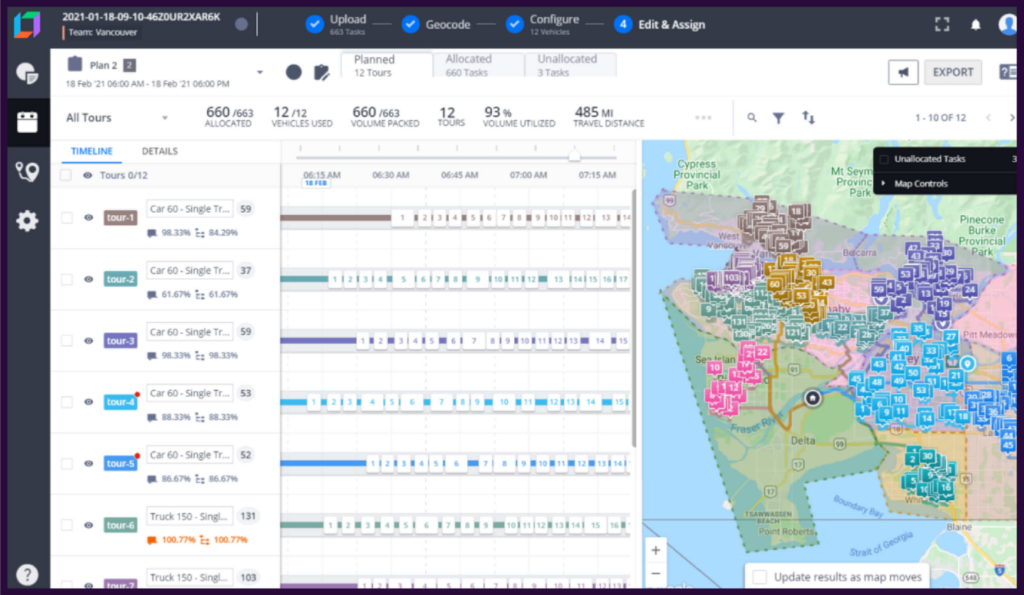
The gap between static routing and adaptive AI route optimization is an operational gap that widens throughout every delivery shift. A static plan built at 6 AM is wrong by 9 AM. By noon, the gap between planned sequence and optimal sequence had compounded across dozens of vehicles and hundreds of stops.
Locus’s AI route optimization engine processes these inputs simultaneously, producing route plans that account for the interaction effects between constraints. A delivery window constraint that conflicts with a traffic-optimal sequence requires trading off two variables at once.
Sequential optimization picks one and ignores the other. Simultaneous multi-constraint optimization finds the solution that minimizes the combined cost of both, which is where the efficiency gain comes from.
AI-Powered Dispatch Management at Enterprise Scale
At enterprise scale, manual or rules-based dispatch crumbles faster than any other operational function when volume scales, and it is where the largest efficiency gains from AI in logistics are achievable.
Why manual dispatch does not scale
- Assigning 10,000 daily orders to the right vehicle and driver through rules-based allocation takes hours and produces plans built on stale data
- When a vehicle goes offline mid-shift, manual reallocation takes 15-30 minutes per affected driver while the fleet idles
- Peak-season volume spikes of 3-10x above average overwhelm dispatch capacity that does not scale with volume
- Rules-based dispatch ignores the interaction effects between constraints: a zone-based assignment that clears the capacity check may still violate the SLA window or mismatch driver certification requirements
What AI dispatch management delivers
Locus’s dispatch management engine processes vehicle capacity, driver shift hours, delivery priority tiers, historical driver performance on specific route types, SLA urgency, and live traffic conditions simultaneously at each allocation cycle.
An order will be assigned to the driver whose full remaining schedule accommodates the new order with the least disruption to existing SLA commitments across the full active fleet.
The multi-modal dimension is what separates an orchestration platform from a single-fleet dispatcher. Locus allocates orders across owned fleet vehicles, contracted carriers, and gig driver networks within a single decision loop, applying the same constraint-aware optimization regardless of fleet type.
Operations sees one unified dispatch plan, not three parallel workflows requiring manual reconciliation.
Demand Forecasting and Inventory Alignment
Demand forecasting is where artificial intelligence in logistics moves upstream from execution to planning. AI delivery logistics software that covers only dispatch and routing operates on the order data it receives.
On the other hand, software that includes demand forecasting shapes the inventory positioning that determines whether the right products are in the right locations before the order arrives.
The mechanism is specific. AI models ingest historical order data at SKU-location granularity, layered with seasonality signals, promotional calendars, and external variables: weather forecasts, economic indicators, local events, and carrier capacity constraints.
The output is a granular prediction of demand by SKU, by depot, and by delivery zone, with enough precision to justify pre-positioning inventory decisions.
The operational downstream effect is measurable: when inventory is positioned closer to consumption points based on accurate demand prediction, same-day and next-day SLA commitments become achievable without emergency replenishment logistics that inflate cost per delivery.
Automated route planning is the execution layer that activates demand-driven pre-positioning, translating the forecast into dispatch-ready plans before the first order of the day arrives.
Real-Time Supply Chain Visibility and Predictive ETAs
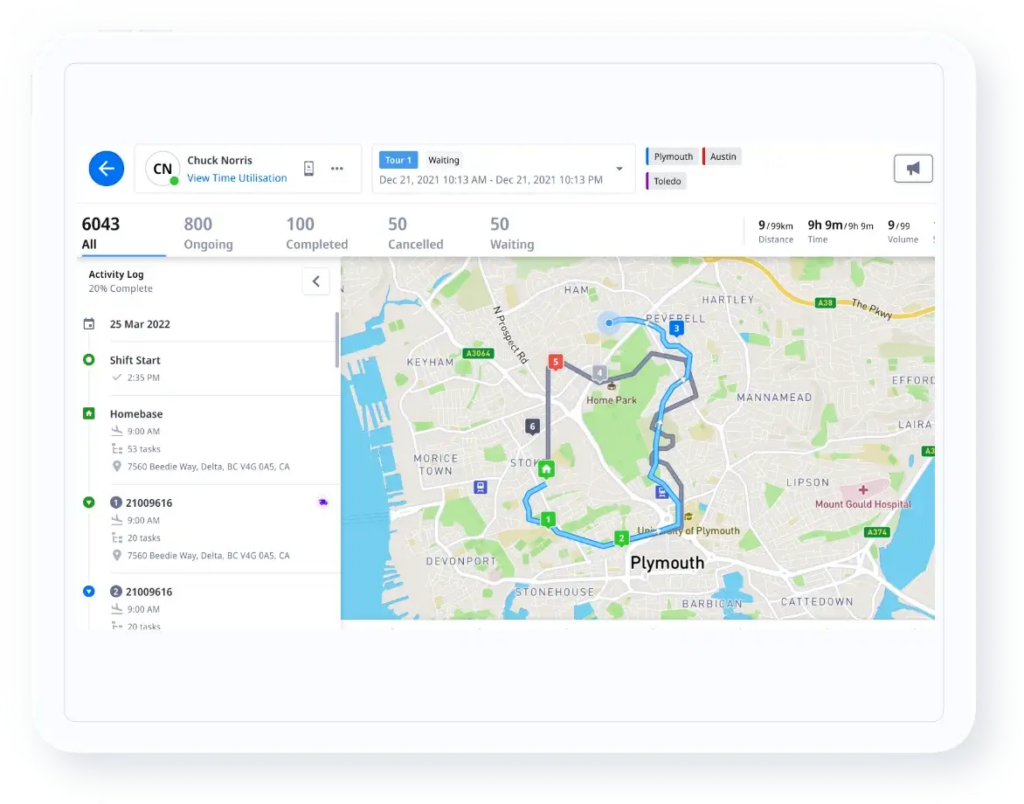
Enterprise-grade supply chain visibility is predictive intelligence: ETAs that recalculate as conditions change, automated alerts when shipments deviate from plan before the customer notices, and exception management workflows that trigger with enough lead time for the system to resolve the issue.
An automated tracking system at enterprise scale normalizes tracking data from owned fleet telematics, 3PL carrier APIs, and gig driver apps into a single operational view, eliminating the manual reconciliation across separate portals that most logistics teams currently manage.
When a 3PL vehicle misses a milestone, the visibility layer surfaces it in real time rather than at the next carrier status update cycle.
The AI model underlying ETA prediction learns from historical delivery patterns at the route, driver, and stop-type level.
For example, Locus has processed 1.5B+ deliveries and generates arrival predictions materially more accurately than distance-based estimates, because it knows how long a specific stop type in a specific location at a specific time of day takes.
Cutting Costs Without Cutting Corners: The ROI Case for AI Logistics
The ROI case for AI logistics software operates across three distinct dimensions. Each is independently measurable, and each compounds the effect of the others when the capabilities run under unified orchestration rather than separate tools.
Direct cost reduction
Route optimization that reduces driven miles by 12-18% cuts fuel spend proportionally. Better stop clustering and load consolidation improve trailer fill rates above 85%, eliminating the margin loss from underutilized capacity.
Automated carrier selection assigns shipments to the optimal partner against current performance data rather than rate cards, delivering an additional 10% reduction in transportation spend. Combined, enterprises using AI-driven logistics implementations report a 25% reduction in delivery costs within the first two quarters of deployment.
Supply chain network design decisions for FMCG and retail operations become data-driven when the AI platform surfaces depot-level performance data rather than aggregate network costs.
Operational throughput
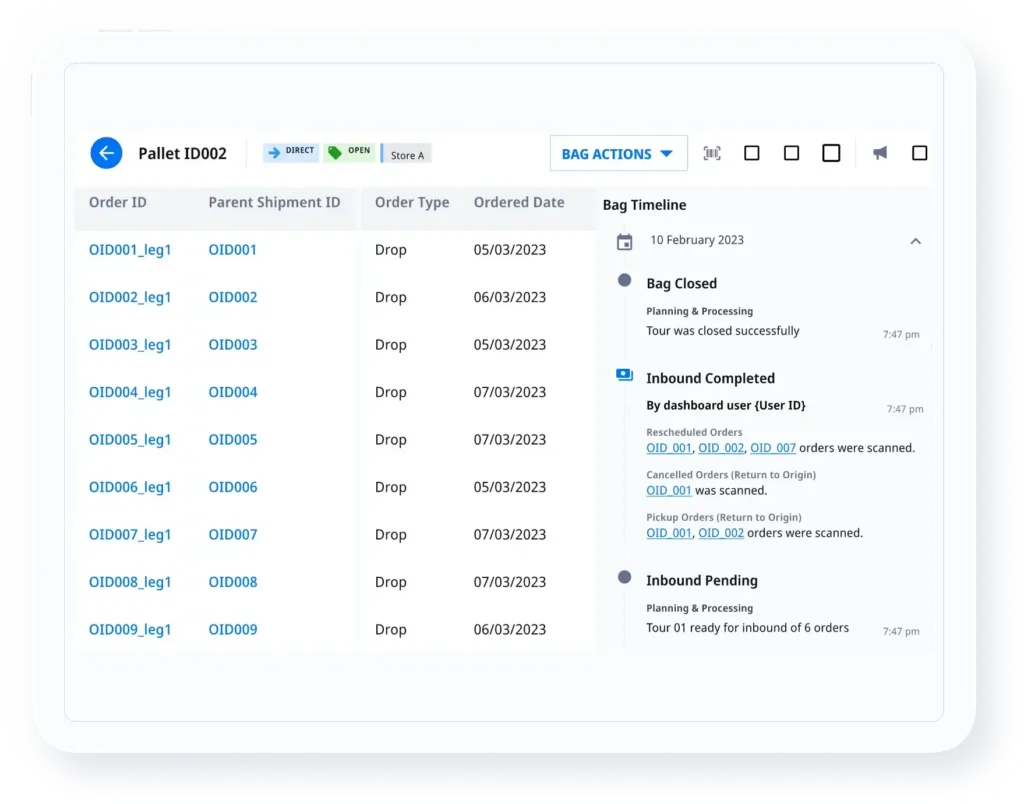
AI dispatch management moves planning cycles from three hours to under five minutes. That compression translates directly to earlier vehicle departures, higher daily delivery throughput, and dispatchers spending time on decisions that require human judgment rather than on routine allocation work.
Fleet utilization improves by 30% through better load consolidation and dynamic rebalancing across delivery zones.
Strategic and ESG value
Carbon footprint reduction is a direct output of route optimization. Every mile eliminated is fuel not burned and CO2 not emitted.
Across Locus deployments, this has resulted in over 17 million kilograms of CO2 offset and over 800 million miles reduced. For enterprises under Scope 3 emissions reporting obligations, the logistics platform needs to produce auditable carbon-per-route data without a separate integration layer.
This is a compliance requirement in EU markets that most AI logistics software platforms do not address natively, and a procurement criterion that is accelerating across FMCG and retail enterprises globally.
See how Locus delivers these ROI outcomes at your specific delivery volumes and carrier network. Schedule a demo to run AI dispatch and route optimization against your actual operational data.
Why Enterprise Logistics Demands an Orchestration Platform
The market for AI logistics software is cluttered with tools that solve one slice of the problem: a routing engine, a visibility dashboard, a demand forecasting module. Enterprise logistics breaks down at the seams between these systems.
A route optimization tool that does not share live data with the dispatch engine produces optimal routes assigned to the wrong drivers. A visibility dashboard disconnected from the exception management layer generates noise rather than actionable intelligence. The optimization value that each tool delivers in isolation is smaller than the coordination cost of connecting them.
An orchestration platform unifies dispatch, routing, tracking, analytics, and customer communication under a single AI-driven decision layer. When a traffic event triggers a route recalculation in an orchestration platform, the dispatch reassignment, the customer ETA update, and the exception log happen automatically within the same data model.
In a point-solution stack, each of those events requires a human to move information from one system to another.
Enterprise integration as a deployment prerequisite
The integration question is the one most AI logistics software content ignores, and it is the one that VP-level buyers care about most. An AI logistics platform that requires replacing the existing ERP, WMS, or TMS creates a change management barrier that defeats the ROI case before deployment completes.
Locus is built on API-first architecture with prebuilt connectors for SAP, Oracle, NetSuite, Shopify Plus, and major OMS and WMS platforms, deploying into the existing enterprise stack without rip-and-replace.
The 2026 trajectory of AI in logistics
The capabilities deployable today, including adaptive routing, AI dispatch, demand-driven pre-positioning, and predictive exception management, are the foundation for what is emerging in 2026:
- GenAI-assisted logistics planning that generates scenario recommendations from natural-language queries
- Autonomous decision-making that operates across full supply chain networks without dispatcher approval on routine cases
- Multimodal optimization that holds road, rail, air, and last-mile legs in a single planning model
The enterprises building orchestration infrastructure now are the ones positioned to adopt these capabilities without rebuilding their logistics stack to accommodate them.
What to Look for When Evaluating AI Logistics Software
Five evaluation criteria separate enterprise-grade AI logistics platforms from tools that serve a narrower use case or a smaller operational scale:
- Adaptability of AI models to your specific constraints and geography: Ask whether the routing and dispatch models are pre-trained on generic logistics data or whether they adapt to your specific delivery patterns, carrier relationships, and geographic constraints. A model trained on 1.5B+ deliveries across 30+ countries produces different predictions than one trained on a vendor’s internal test dataset
- Multi-modal dispatch capability across fleet types: The platform should allocate orders across owned fleets, contracted carriers, and gig driver networks within a single decision loop, applying the same constraint-aware optimization regardless of fleet type
- Depth of real-time optimization versus batch planning: Ask specifically whether the platform recalculates routes and reassigns orders during the shift or only at dispatch time. Batch re-planning that runs every four hours is not real-time optimization
- Integration architecture and time-to-value: Prebuilt connectors for your specific ERP, WMS, and OMS platforms, with a documented deployment timeline validated by reference customers at comparable scale
- Proven enterprise-scale deployments in your vertical: Ask for reference customers in your specific industry, at your order volume, across your target geographies. Generic enterprise logos without vertical-specific deployment evidence do not validate that the platform handles your operational model
Locus has received consistent recognition from leading industry analysts. It was recognized as a Representative Vendor in the 2026 Gartner Hype Cycle for Supply Chain Execution and Logistics Technologies in the Last-Mile Delivery Solutions category.
In 2025, Locus was acquired by Ingka Investments, the investment arm of Ingka Group, the parent organization behind IKEA retail operations. The acquisition strengthened IKEA’s logistics and home delivery capabilities while allowing Locus to continue operating independently and serving enterprise customers globally.
Schedule a Locus demo to see how adaptive dispatch, real-time route optimization, and unified supply chain visibility perform against your specific operational requirements.
Frequently Asked Questions (FAQs)
1. How does AI logistics software differ from traditional transportation management systems (TMS)?
Traditional TMS platforms handle freight procurement, carrier rate management, and shipment status tracking through rules-based logic configured at implementation. AI logistics software applies machine learning models that learn from operational data and improve decision quality over time. The architectural difference is whether the platform executes fixed instructions or adapts to conditions it was not explicitly configured for.
2. What kind of ROI can enterprises expect from implementing AI logistics software, and over what timeline?
Enterprise deployments of AI logistics software consistently deliver 15-25% reduction in transportation spend within the first two quarters, driven by route optimization reducing driven miles by 12-18%, load consolidation improving trailer utilization, and automated carrier selection against current performance data. Operational efficiency gains include planning cycle compression from hours to minutes and 30% improvement in fleet utilization. Carbon emissions reductions proportional to mileage savings satisfy Scope 3 ESG reporting requirements. Most enterprises reach positive ROI within 3 to 6 months of full deployment.
3. Can AI logistics software integrate with existing ERP and warehouse management systems without replacing them?
Enterprise-grade AI logistics platforms are built on API-first architecture with prebuilt connectors for SAP, Oracle, NetSuite, and major WMS and OMS platforms. They deploy into the existing technology stack, receiving real-time order data from the OMS, inventory availability from the WMS, and pushing delivery performance data back to ERP systems for financial settlement. The integration layer does not require replacing any existing system. Platforms that require rip-and-replace create change management barriers that defeat the ROI case before deployment completes.
4. What data does an enterprise need to have in place before deploying AI logistics software effectively?
The minimum data requirements for effective AI logistics deployment are historical order data at delivery address and time-of-day granularity (the training foundation for ETA prediction models), carrier rate and performance data for automated allocation decisions, vehicle and driver master data for capacity and certification constraints, and real-time order feed connectivity from the OMS. Platforms with prebuilt OMS and WMS connectors reduce data preparation requirements significantly.
5. How does Locus handle mixed fleet types and third-party logistics partners?
Locus uses AI-powered dispatch optimization to allocate orders across owned fleets, contracted carriers, and third-party logistics partners within a unified orchestration layer. The platform evaluates vehicle capacity, delivery SLAs, driver schedules, service zones, carrier availability, and real-time traffic conditions simultaneously during every dispatch cycle. This allows logistics teams to manage dedicated fleets, outsourced carriers, and gig delivery networks from a single operational interface.


General
Why Address Validation Isn’t Enough for Big-and-Bulky: The Building Intelligence Architecture US Furniture Delivery Actually Needs

May 18, 2026
Address validation isn't enough for big-and-bulky delivery. Why US furniture and appliance operations need building intelligence architecture beyond geocoding.
Read more
Dispatch Software
GPS Dispatch Software: Features and Capabilities Enterprise Logistics Teams Need

May 19, 2026
Learn how GPS dispatch software works, what features matter for enterprise fleets, and how AI-powered dispatch orchestration cuts costs and boosts delivery performance.
Read moreInsights Worth Your Time




















How AI Logistics Software is Reshaping Enterprise Supply Chains in 2026