


Retail & CPG
A Complete Guide on Retail Logistics Management
Key Takeaways
- Retail logistics management connects distribution strategy with execution discipline across transportation, warehousing, fulfillment, and returns, ensuring inventory moves efficiently from suppliers to stores and customers.
- Network design, channel strategy, and capacity alignment directly influence delivery speed, cost per shipment, inventory turnover, and the ability to scale across regions.
- Consistent performance depends on coordinated inbound, outbound, and reverse logistics flows supported by structured planning, real-time visibility, and disciplined exception management.
- KPIs such as OTIF, fill rate, delivery success rate, cost per delivery, and return cycle time provide measurable insight into operational efficiency and service reliability.
- Unified orchestration platforms like Locus align dispatch optimization, control tower visibility, and performance governance to simplify retail logistics decisions and support scalable enterprise growth.
During rush hour in a city, a delivery truck reaches its unloading dock, but another truck is still parked there because its earlier slot ran late. With no space available, the second truck has to wait on the road. Cars begin slowing behind it. Soon, vehicles line up across the intersection as one small delay spreads through the system.
In a similar way, when inbound shipments arrive before dock space is ready, when replenishment schedules overlap, or when last-mile routes are not aligned with demand, delays start stacking up across the network. Small timing mismatches turn into larger operational delays, and teams step in to manually correct when the systems do not coordinate.
With retail logistics management, you can prevent this buildup. It aligns transportation, retail, warehousing, inventory flow, order fulfillment, and reverse logistics into one coordinated system.
In this guide, we break down the core frameworks, operational challenges, and technology enablers that help enterprises improve retail logistics at scale.
Distribution vs. Logistics: What’s the Difference?
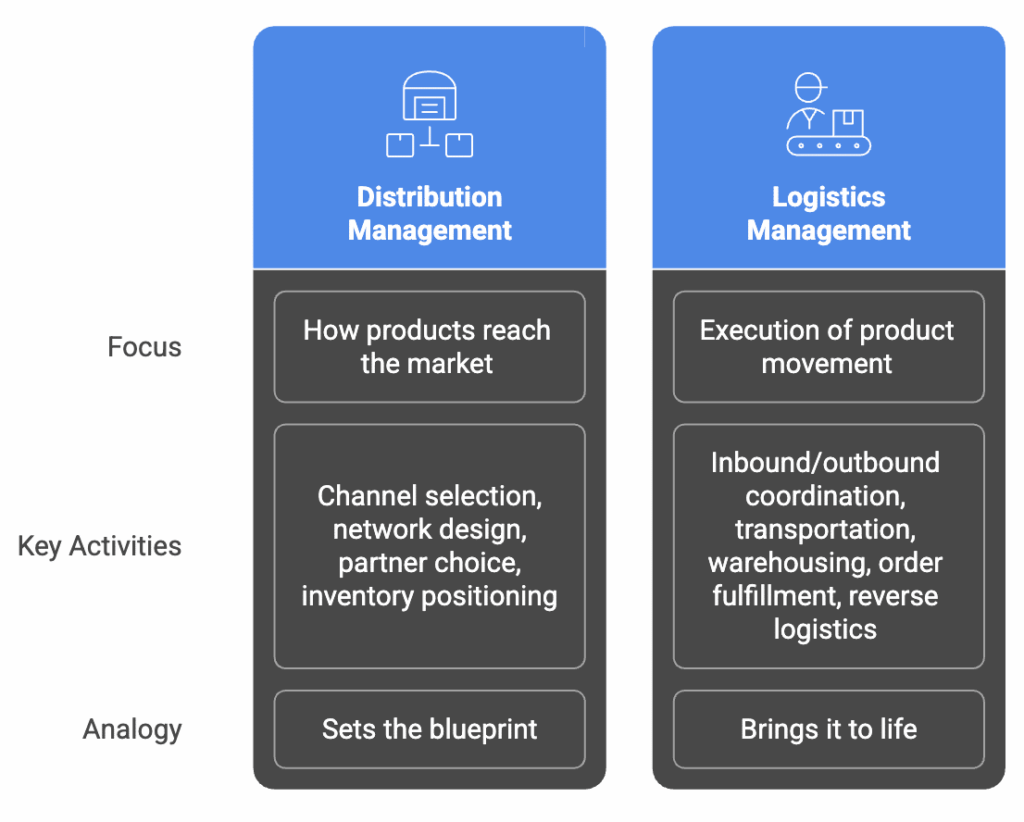
At the core of retail logistics management are two distinct functions: distribution and logistics. Each has a separate meaning. Understanding how they differ helps retailers structure accountability and improve performance.
Distribution defines how products reach the market. Logistics ensures those products move efficiently through that structure. Below, we break down how each function operates within retail logistics management.
What Is Distribution Management?
Distribution management focuses on how products reach the market. It defines the structure and channels through which goods flow from manufacturers to stores or customers.
In retail distribution logistics, this includes:
- Selecting distribution channels such as direct-to-consumer, wholesale, or marketplace models
- Designing the distribution network, including warehouses and fulfillment centers
- Choosing 3PL partners and carrier networks
- Deciding where to position inventory to meet regional demand
Distribution answers questions like: How many warehouses do we need? Should we use a hub-and-spoke model? How close should inventory sit to high-demand zones?
What Is Logistics Management?
Logistics management focuses on execution. It involves planning, implementing, and controlling the movement and storage of goods.
This includes:
- Coordinating inbound and outbound logistics
- Managing transportation and fleet operations
- Overseeing warehousing and storage
- Executing order fulfillment retail processes
- Handling reverse logistics retail returns
Logistics ensures that the distribution strategy actually works in day-to-day retail logistics operations.
In short, distribution sets the blueprint, whereas logistics brings it to life.
If distribution decides to open regional fulfillment centers, logistics ensures inventory is replenished on time, orders are picked accurately, and deliveries reach customers within promised windows. In effective retail logistics management, both functions operate as a unified system, sharing data, performance metrics, and operational visibility.
The Core Elements of Distribution Management
Distribution management defines the structural choices that determine how a retail network operates. Before logistics execution begins, retailers must decide how demand will be served, where inventory will be positioned, and how capacity will be extended.
Three elements shape this foundation:
1. Channel Strategy
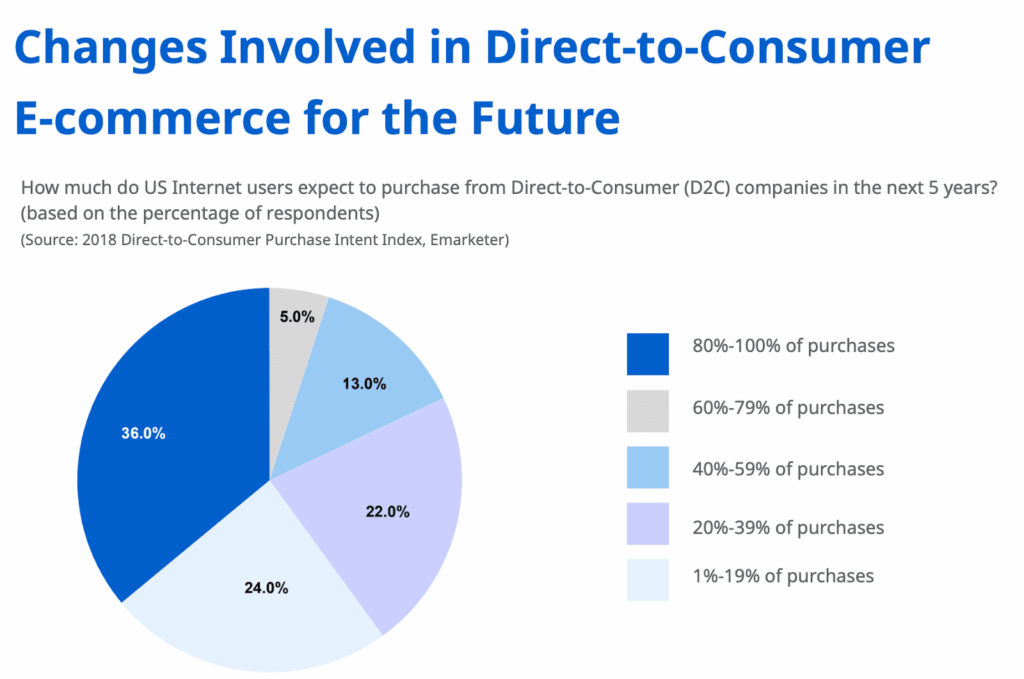
Retailers often serve customers through multiple channels, and each introduces different operational requirements.
- Direct-to-consumer: Orders are shipped straight to the end customer, requiring tighter coordination between inventory availability and delivery timelines.
- Store replenishment: Inventory moves from distribution centers to physical stores based on forecasted demand and fixed delivery windows.
- Wholesale and marketplace channels: Larger batch shipments and platform compliance standards influence packaging, routing, and lead times.
Separating channels avoids inventory clashes and ensures capacity matches service expectations.
2. Network Design
Network design determines where inventory is stored and how quickly it can reach demand centers. These decisions influence replenishment speed, delivery reach, and expansion readiness.
Retailers typically evaluate:
- Centralized distribution for pooled inventory control
- Regional hubs to reduce transit time
- Cross-dock facilities for high-velocity movement

Many enterprises adopt structured network models such as hub-and-spoke distribution, where inventory is consolidated at central hubs and distributed to regional spokes for final fulfillment. This structure supports coordinated inventory control while maintaining regional responsiveness.
Learn more about: How the Hub and Spoke Distribution Model Works here
Network design must also reflect channel strategy. Direct-to-consumer channels may require inventory closer to dense urban zones, while wholesale or store replenishment flows prioritize bulk efficiency and predictable routing. Aligning channel mix with physical network layout prevents capacity strain as demand scales.
3. Partner and Capacity Alignment
Few enterprise retailers operate entirely within owned infrastructure. External capacity becomes part of the distribution strategy.
- Carrier selection affects coverage, delivery consistency, and regional adaptability.
- 3PL partnerships provide additional warehousing or fulfillment support during expansion or seasonal spikes.
- Contracted versus on-demand fleet capacity determines flexibility during demand fluctuations.
Aligning structure with demand and growth creates a stable, scalable logistics system.
The Core Functions of Logistics Management
Once the distribution structure is in place, logistics management determines how consistently that structure performs under real demand. It governs daily movement decisions, dock scheduling, order sequencing, carrier allocation, and exception handling across the retail network.
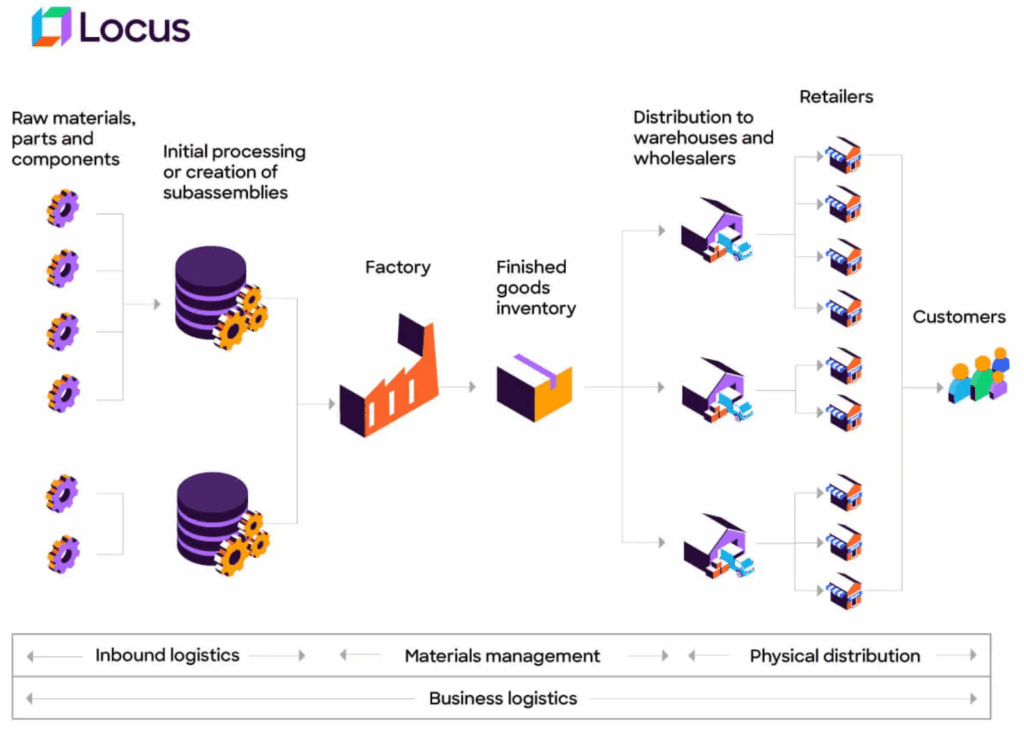
In retail environments, logistics spans inbound coordination from suppliers, outbound fulfillment across channels, and returns processing that feeds inventory back into the system. Each stream operates simultaneously and requires aligned timing, visibility, and execution discipline to keep goods flowing predictably.
Inbound Logistics in Retail
Inbound logistics begins at the supplier level and determines how inventory enters the retail network.
This includes:
- Transporting goods from manufacturers to distribution centers
- Managing delivery schedules and compliance requirements
- Receiving, inspection, and inventory system updates
- Allocating stock for warehouse storage or store replenishment
When inbound timing slips, downstream operations feel the impact. Late receipts affect availability, while early arrivals strain dock capacity and storage planning. Structured inbound coordination improves flow stability and reduces reactive adjustments.
Outbound Logistics in Retail
Outbound logistics manages how products leave the network and reach stores or end customers.
Key activities include:
- Order processing and inventory allocation
- Picking, packing, and shipment staging
- Carrier selection and transportation planning
- Last-mile delivery execution
Omnichannel retail increases outbound complexity. A single inventory pool may support store replenishment, ship-from-store, curbside pickup, and home delivery at the same time. Logistics management ensures these flows are sequenced properly so service commitments remain consistent across channels.
Read more: Inbound Vs Outbound Logistics
Reverse Logistics in Retail
Reverse logistics manages the movement of products back into the retail network. This includes customer returns, store transfers, handling damaged goods, and product recovery decisions.
Core activities include:
- Scheduling return pickups alongside forward routes
- Inspecting and grading returned inventory
- Determining restock, refurbishment, resale, or disposal paths
- Updating inventory and financial systems in real time
Unlike inbound and outbound flows, reverse logistics must make value-recovery decisions quickly. Faster inspection and reintegration improve inventory availability and reduce handling cycles across retail logistics operations.
Read more: History, Present, and Future of Reverse Logistics
The Three Flows in Logistics
Retail logistics management coordinates three streams simultaneously:
- Physical flow: Movement of goods across suppliers, warehouses, stores, and customers
- Information flow: Order data, tracking visibility, inventory updates, and delivery confirmations
- Financial flow: Invoicing, payment reconciliation, refunds, and cost allocation
These flows operate together. Inventory movement without system updates creates mismatches. Financial reconciliation without shipment visibility slows recovery cycles. Alignment across all three ensures operational consistency.
Planning, Execution, and Exception Management
Logistics performance depends on structured planning followed by disciplined execution.
- Planning: Forecasting demand, allocating capacity, sequencing routes, and aligning dock schedules
- Execution: Dispatch coordination, real-time shipment tracking, warehouse processing, and carrier management
- Exception management: Resolving delays, reallocating inventory, rerouting shipments, and handling failed deliveries
Enterprise retailers increasingly rely on centralized visibility platforms and AI-driven dispatch optimization to coordinate these layers.
Platforms such as Locus unify planning and execution through control tower visibility, enabling faster response to operational changes across regions.
When distribution and logistics are designed separately, execution requires frequent adjustments. Transportation plans are modified to compensate for inventory positioned far from demand. Expedited shipments increase to meet service commitments. Inventory is reallocated after demand shifts instead of being positioned in advance.
When both functions are planned together, network design incorporates transportation capacity, fulfillment timelines, and return volumes from the beginning. This reduces reactive corrections and supports consistent retail logistics performance across regions and demand cycles.
The Role of Logistics Across the Retail Supply Chain
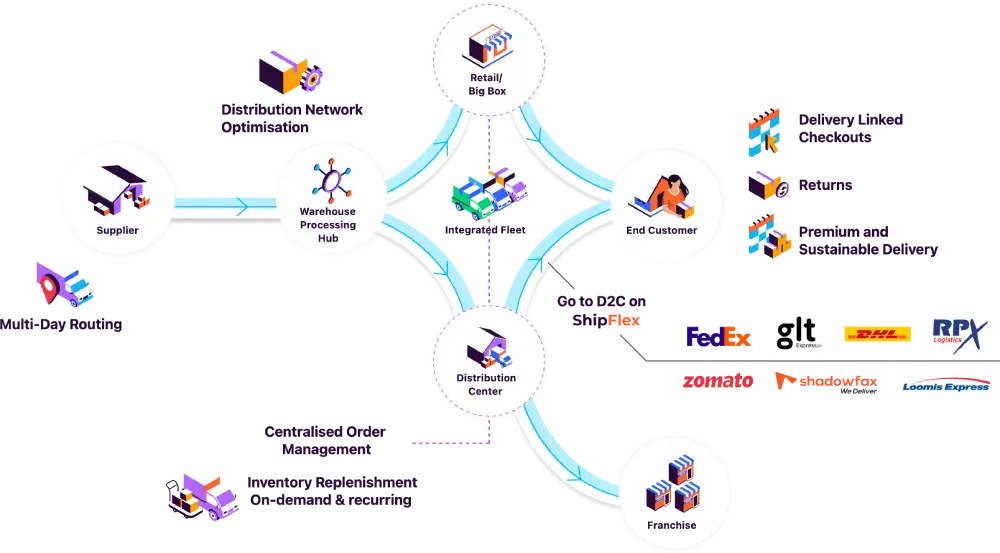
A typical retail supply chain follows this sequence:
Procurement ? Production ? Distribution ? Logistics Execution ? Last-Mile Delivery ? Returns
Retail logistics management connects supply planning with customer delivery. It translates procurement schedules and production output into store availability and fulfilled orders.
Upstream, logistics depend on supplier timelines, production volumes, and forecast inputs. Downstream determines delivery performance, replenishment speed, and return cycle time. While merchandising defines what should be available and procurement secures supply, logistics controls how inventory flows across distribution centers, stores, and customer locations.
This positioning gives logistics a central operational role. It influences working capital through inventory movement, transportation cost through routing decisions, and service reliability through execution discipline.
For a deeper look at how these functions connect, explore our guide on Retail Supply Chain Management.
The Operational Drivers of Retail Logistics Management
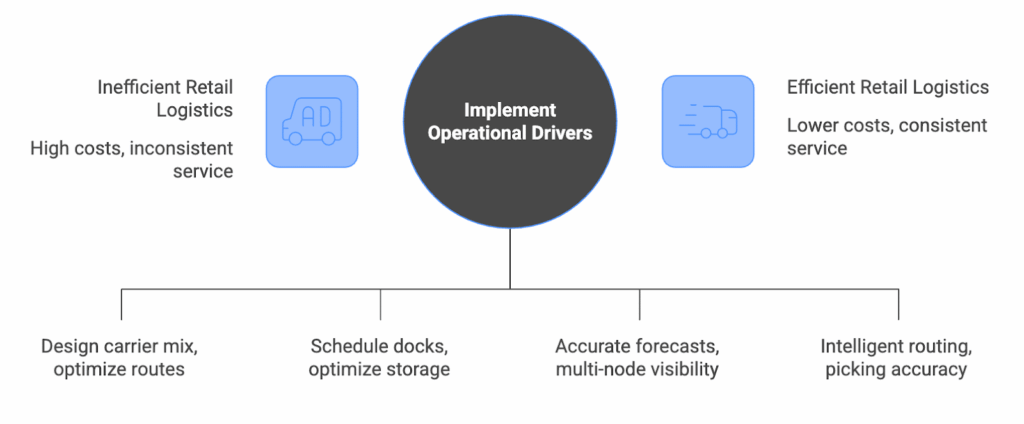
Retail logistics management is based on four factors. They influence cost stability, service consistency, and scalability across regions. These components determine day-to-day performance.
1. Transportation
Transportation decisions directly affect cost per order and delivery reliability. Key operational drivers include:
- Carrier mix design across regions and service tiers
- Route sequencing based on density and delivery windows
- Load consolidation to improve asset utilization
- Capacity planning aligned with forecasted demand
In enterprise retail networks, transportation planning must adjust to regional demand variability and peak periods without compromising service levels. Dynamic route optimization and automated dispatch allocation support consistent on-time performance while controlling costs.
2. Warehousing
Warehousing influences how efficiently inventory moves through the network. Operational drivers include:
- Dock scheduling and inbound slot management
- Storage configuration based on product velocity
- Pick-path optimization inside fulfillment centers
- Cross-docking for high-turn SKUs
Warehouse configuration affects throughput rates and replenishment speed. Facilities designed around product movement rather than static storage support faster order cycles and more predictable outbound flow.
3. Inventory Management
Inventory positioning determines how responsive the retail network can be to demand shifts. Key drivers include:
- Demand forecast accuracy at the regional level
- Safety stock thresholds aligned with service targets
- Multi-node inventory visibility across stores and distribution centers
- Allocation rules for omnichannel orders
When inventory data is synchronized across nodes, retailers can allocate orders based on proximity, availability, and delivery commitment. This reduces split shipments and improves fill rates without increasing overall stock levels.
4. Order Fulfillment
Order fulfillment retail processes convert inventory availability into delivered outcomes. Operational drivers include:
- Intelligent order routing based on location and capacity
- Picking accuracy and verification protocols
- Carrier assignment logic aligned with service commitments
- Real-time delivery tracking and confirmation updates
As retailers support store replenishment, ship-from-store, curbside pickup, and direct home delivery simultaneously, fulfillment coordination becomes central to retail logistics operations.
For deeper insights into automation-enabled fulfillment execution, explore Locus’s article on automated order fulfillment.
Summary
| Operational Driver | What It Controls | Business Impact |
|---|---|---|
| Transportation | Routing, carrier mix, capacity | Delivery cost and reliability |
| Warehousing & Inventory | Stock placement and throughput | Speed and working capital efficiency |
| Order Fulfillment | Order routing and execution | Service consistency and customer satisfaction |
Business Impact of Retail Logistics Management
Retail logistics management affects financial performance, service outcomes, and expansion capability. Its decisions influence cost allocation, delivery execution, and network scalability across regions.
| Impact Area | Operational Control Points | Measurable Outcome |
|---|---|---|
| Cost Control | Routing strategy, carrier allocation, inventory placement, capacity planning | Reduced cost per delivery, improved asset utilization, and lower excess inventory |
| Service Performance | Order routing, fulfillment sequencing, delivery scheduling, returns processing | Higher on-time delivery rates, improved fill rates, and fewer re-deliveries |
| Scalability | Channel coordination, regional network design, and multi-node inventory alignment | Faster market expansion, stable peak performance, support for omnichannel growth |
Retail logistics management links network design with execution discipline. Its performance is reflected directly in cost metrics, service levels, and expansion readiness.
Technology as a Performance Driver in Retail Logistics
Retail logistics management depends on connected systems and automation. As networks and customer expectations grow, technology enhances visibility, decision-making, and execution across transportation, warehousing, fulfillment, and returns.
Systems Integration: Connecting Core Platforms
Modern retail distribution logistics requires integrated platforms tying together ERP, WMS, TMS, OMS, POS, and carrier/3PL systems to eliminate data silos and ensure synchronized execution across functions.
Gartner highlights that 83 % of companies now place customer-experience enhancement at the center of their digital supply chain strategy, underscoring the value of integrated visibility across logistics networks.
When these systems operate together, orders, inventory, and shipment status become a single source of truth, enabling faster responses and fewer manual reconciliations.
Cloud Computing and Real-Time Data Connectivity
Cloud computing provides the digital backbone for retail logistics management. By hosting logistics applications on shared, scalable infrastructure, cloud platforms enable real-time access to operational data across supply chain functions.
The Sornprom (2024) study highlights that cloud-based systems support centralized data environments where inventory records, shipment tracking, supplier coordination, and financial information can be accessed simultaneously by multiple stakeholders.
In retail logistics operations, cloud computing enables:
- Real-time inventory visibility across warehouses and stores
- Live shipment tracking from origin to delivery
- Shared access for suppliers, distributors, and logistics partners
- Scalable infrastructure without heavy on-premise investment
Cloud platforms also improve collaboration across departments by reducing data silos. Procurement, warehousing, transportation, and finance teams operate on synchronized information, improving coordination across inbound and outbound flows.
By enabling real-time data exchange and scalable system integration, cloud computing strengthens execution discipline and decision speed within retail logistics management.
AI and Machine Learning: Better Decisions and Optimization
AI and machine learning are transforming how logistics decisions are made. Gartner’s 2025 supply chain technology trends emphasize connectivity and intelligence( including agentic AI) as strategic priorities for enhancing operational efficiency and adaptability.
AI applications include:
- Demand forecasting refinement
- Route optimization and dynamic carrier selection
- Automated order partitioning and fulfillment segmentation
These capabilities help reduce planning cycles, improve cost control, and support performance objectives across large retail networks.
IoT and Real-Time Visibility
According to Gartner’s 2025 Hype Cycle for Artificial Intelligence, AI agents and AI-ready data are among the fastest advancing technologies. The focus has shifted toward operational scalability and real-time intelligence supported by structured data foundations.
For retail logistics management, this means strengthening data governance, ensuring system readiness for AI use cases, and aligning AI deployments with clear business objectives. As AI becomes embedded in routing, forecasting, and exception handling, data quality and oversight become critical to performance and risk management.
Automation and Robotics in Warehousing
Gartner’s recent supply chain technology research highlights smart robots and intelligent automation as key trends shaping logistics operations through 2025–2026. Automation is increasingly viewed as essential for improving throughput, labor efficiency, and execution consistency inside distribution centers.
McKinsey analysis indicates that warehouse automation can improve productivity, particularly in picking, sorting, and material movement processes. These gains come from reduced manual handling, optimized pick paths, and system-driven task allocation.
In retail logistics management, automation supports:
- Robotics-assisted picking and pallet movement
- Automated sorting and cross-dock systems
- System-directed inventory verification
As order volumes grow and fulfillment windows tighten, robotics and automation enable scalable warehouse performance without proportional labor increases.
How to Improve Retail Logistics Management
Improving retail logistics management requires structured performance governance and periodic recalibration of network decisions. Enterprises that treat logistics as a measurable operating system rather than a support function achieve sustained improvements in cost efficiency and service reliability.
Standardize Performance Reviews
Establish routine performance assessments across transportation, warehousing, and fulfillment. Review:
- On-time, in-full performance
- Inventory turnover and aging
- Capacity utilization rates
- Frequency and root causes of delivery exceptions
Consistent review cycles prevent operational inefficiencies from compounding.
Recalibrate Network and Capacity Alignment
Retail networks must evolve with demand patterns and regional shifts. This includes:
- Reassessing warehouse location strategy
- Adjusting regional carrier allocation
- Rebalancing inventory across nodes
- Aligning capacity planning with forecast variability
Periodic recalibration reduces the need for reactive adjustments.
Embed Data-Driven Execution
Planning and execution should operate on shared, real-time visibility. Enterprises can:
- Integrate forecasting with transportation planning
- Use centralized dashboards for exception tracking
- Automate dispatch allocation where appropriate
Data-aligned execution shortens response cycles and improves coordination.
Integrate Sustainability into Operational Decisions
Sustainability initiatives increasingly align with cost control. Examples include:
- Route density optimization
- Shipment consolidation
- Energy-efficient warehouse systems
- Packaging standardization
These initiatives support long-term efficiency while meeting compliance and environmental goals.
For a broader context on aligning logistics with overall operations, explore our guide on logistics and supply chain management.
Overcoming Common Retail Logistics Challenges
Retail logistics management operates under constant variability. Demand shifts, cost fluctuations, regulatory requirements, and network complexity introduce structural challenges that require disciplined control.
| Challenge | Operational Impact |
|---|---|
| Demand Volatility | Promotions, seasonal peaks, and regional demand shifts create uneven order distribution. Volume concentration in specific zones can strain transportation capacity and warehouse throughput. Managing volatility requires flexible capacity planning and dynamic allocation across nodes. |
| Transportation Cost Pressure | Fuel pricing, carrier rate changes, and regional service differences influence delivery economics. As last-mile density varies, cost per delivery fluctuates across regions. Continuous evaluation of routing efficiency, load consolidation, and carrier performance is required to maintain cost stability. |
| Omnichannel Complexity | Serving stores, direct-to-consumer orders, and marketplace commitments from shared inventory pools increases allocation complexity. Order prioritization, fulfillment sequencing, and inventory visibility must remain synchronized across channels to maintain service consistency. |
| Returns Volume Growth | E-commerce expansion increases reverse logistics activity. Returns introduce additional handling, inspection, and reintegration requirements. Managing return cycle time directly affects inventory recovery speed and working capital efficiency. |
| Technology Integration Gaps | Disconnected ERP, WMS, TMS, and carrier systems create visibility limitations. Inconsistent data flow slows decision-making and increases manual intervention. Standardized integration and governance improve coordination across the network. |
Measuring Retail Logistics Performance
Retail logistics management requires clear metrics that link execution performance with cost and service reliability. The following KPIs show how effectively a retail logistics network operates.
On-Time, In-Full (OTIF)
OTIF measures whether deliveries arrive as scheduled and contain the complete order quantity.
Formula: OTIF (%) = (Number of deliveries on time and in full ÷ Total deliveries) × 100
A high OTIF score reflects consistent execution across transportation, warehousing, and fulfillment. It is often used as a primary indicator of logistics service performance.
Fill Rate
Fill rate measures the percentage of customer demand fulfilled without stockouts.
Formula: Fill Rate (%) = (Units fulfilled ÷ Total units ordered) × 100
This KPI reflects how effectively inventory is positioned and allocated across nodes. Low fill rates typically indicate demand forecasting or replenishment gaps.
Delivery Success Rate
Delivery success rate tracks the percentage of shipments successfully delivered on the first attempt.
Formula: Delivery Success Rate (%) = (First-attempt successful deliveries ÷ Total delivery attempts) × 100
This metric directly affects transportation cost efficiency and customer experience. Lower rates increase redelivery expenses and operational strain.
Inventory Turnover
Inventory turnover measures how frequently inventory is sold and replaced within a given period.
Formula: Inventory Turnover = Cost of Goods Sold ÷ Average Inventory
Higher turnover indicates efficient inventory movement and reduced holding costs. It also signals alignment between demand forecasting and stock levels.
Cost per Delivery
Cost per delivery captures the average transportation expense incurred per completed delivery.
Formula: Cost per Delivery = Total delivery costs ÷ Total deliveries completed
This KPI evaluates routing efficiency, carrier allocation, and last-mile performance across regions.
Return Cycle Time
Return cycle time measures the average time required to process returned products and reintegrate them into available inventory.
Formula: Return Cycle Time = Total time to process returns ÷ Number of returns processed
Shorter cycle times improve inventory recovery and reduce working capital impact.
Performance Governance
Measurement must translate into action. Enterprise retailers typically establish:
- Carrier performance benchmarking: Regular evaluation of carrier metrics across regions and service tiers enables informed allocation decisions. Insights from benchmarking support optimized carrier mix and consistent service execution.
- Delivery exception analysis: Ongoing review of delay patterns and fulfillment sequencing supports targeted routing refinements and scheduling improvements. This helps maintain stable service performance across demand cycles.
- Inventory balance monitoring: Continuous visibility into stock levels across distribution centers and stores enables proactive rebalancing. This supports consistent availability and efficient working capital management.
- Cost performance tracking: Comparing actual delivery costs with planned thresholds enables disciplined capacity planning and routing optimization. Structured cost oversight supports margin control and predictable network performance.
Centralized dashboards and integrated analytics platforms consolidate transportation, warehousing, and fulfillment data into a unified performance view. This enables faster insight generation and coordinated decision-making across regions.
Consistent measurement combined with structured governance strengthens retail logistics management and supports stable performance under changing demand conditions.
The Future of Retail Logistics Management
Retail logistics management is advancing toward predictive planning, integrated control, and scalable automation. As order volumes increase and fulfillment models diversify, execution discipline increasingly depends on connected systems and structured orchestration.
Key Trends Shaping Retail Logistics
- Hyperlocal delivery: Urban inventory positioning supports shorter delivery windows and improved service density.
- AI-driven delivery orchestration: Algorithmic routing, allocation, and segmentation improve execution precision across regions.
- Unified control towers: Centralized visibility enables coordinated monitoring of transportation, fulfillment, and returns.
- Sustainable fleet management strategies: Electrification and optimized routing support regulatory alignment and cost control.
- Flexible fulfillment models: Ship-from-store and hybrid delivery models expand service reach while requiring tighter coordination.
Retail logistics networks are increasingly managed through real-time data environments that connect planning with execution.
Checklist for Choosing the Right Logistics Partner
Selecting a logistics partner directly influences execution stability, cost control, and scalability.
Use this checklist to evaluate whether a provider aligns with your retail logistics management requirements.
Core Capability Assessment
? Proven experience in retail distribution logistics across store and e-commerce models
? Multi-region operational capacity with defined service benchmarks
? Integration readiness across ERP, WMS, TMS, OMS, and carrier systems
? Real-time tracking with centralized reporting dashboards
? Established carrier and 3PL ecosystem coverage
Partners offering unified orchestration platforms provide structured visibility and coordinated execution across these layers.
Program Execution Readiness
? Ability to support defined service-level agreements for store replenishment and DTC fulfillment
? Capacity flexibility during seasonal peaks and promotional surges
? Dynamic routing and allocation capability for changing demand patterns
? Structured performance analytics aligned with agreed KPIs
Execution capability should support both predictable flows and variable demand cycles.
Scalability and Expansion Support
? Structured onboarding process for new warehouses, carriers, and regions
? Consistent performance monitoring across geographies
? Integrated visibility across inbound and outbound logistics flows
? Governance mechanisms for cross-region coordination
A qualified logistics partner should enable expansion without operational instability.
Platforms such as Locus meet these criteria by unifying dispatch optimization, control tower visibility, and multi-region coordination within a single system.
Take Control of Retail Logistics Management with Locus
Retail logistics management determines how effectively the distribution strategy converts into measurable performance. OTIF, cost per delivery, inventory turnover, and return cycle time are not isolated metrics. They are outcomes of how well transportation, warehousing, fulfillment, and returns are orchestrated across the network.
As retail operations expand across regions and channels, fragmented systems limit visibility and slow decision-making. Enterprise networks require integrated dispatch optimization, centralized performance monitoring, and structured governance across inbound and outbound flows.
Locus unifies these layers. With AI-driven routing, intelligent order allocation, multi-region carrier coordination, and real-time control tower visibility, Locus enables retailers to improve delivery reliability, reduce execution variability, and scale operations with discipline.
Book a demo with Locus and see how it supports measurable improvements in retail logistics performance and helps you make faster, data-backed decisions across your entire network.
Frequently Asked Questions (FAQs)
1. How is retail logistics different from general logistics?
Retail logistics focuses specifically on managing high SKU volumes, omnichannel fulfillment, store replenishment, and customer deliveries. It requires tighter coordination between inventory, transportation, and order fulfillment compared to traditional bulk logistics models.
2. What role does store-level logistics play in retail performance?
Store logistics ensures timely replenishment, accurate stock visibility, and efficient backroom operations. Strong coordination between distribution centers and stores reduces stockouts and improves in-store customer experience.
3. How does omnichannel retail increase logistics complexity?
Omnichannel models require shared inventory across stores, warehouses, and online channels. This increases allocation complexity, routing decisions, and return handling, making centralized visibility essential for efficient retail logistics management.
4. How can AI support retail logistics management?
AI improves demand forecasting, route planning, and order allocation. Platforms like Locus enable intelligent dispatching and real-time control tower visibility, helping enterprises coordinate retail logistics operations at scale.
5. What is the impact of returns on retail logistics costs?
Returns increase handling, transportation, and restocking expenses. Efficient reverse logistics processes reduce cycle time, recover inventory faster, and minimize operational strain on retail logistics networks.


Retail & CPG
6 Retail Logistics Software for Enterprise Networks in 2026

Mar 3, 2026
Retail logistics software for enterprise networks. Compare leading platforms, multi-node orchestration, carrier coordination, and SLA-driven fulfillment capabilities.
Read more
Grocery
Retail and Grocery Transportation at Enterprise Scale: A Complete Guide
Mar 4, 2026
Understand the systems behind grocery logistics, including cold chain continuity, route optimization, compliance, and time-sensitive fulfillment.
Read moreInsights Worth Your Time




















A Complete Guide on Retail Logistics Management