


Supply Chain Optimization
Inbound vs Outbound Logistics: Key Differences in 2026


Key Takeaways
- Inbound logistics manages raw materials from suppliers to production facilities, while outbound logistics handles finished products to customers, requiring distinct optimization strategies for each flow.
- Efficient logistics operations directly impact customer satisfaction, with one-third of customers willing to abandon a brand after a single poor delivery experience.
- Technology adoption and process automation are critical for optimizing both inbound and outbound logistics, yet 67.4% of supply chain managers still rely on basic spreadsheets.
- Locus’ Dispatch Management Software streamlines both logistics flows through real-time tracking, route optimization, and automated order processing, enabling cost reduction and improved delivery accuracy.
In the vast, interconnected world of supply chain management, two terms often come into focus—inbound and outbound logistics. Both are crucial elements of a well-functioning supply chain, yet they serve different purposes and face unique challenges. In this post, we deep dive into the world of inbound and outbound logistics, dissecting their key differences, their significance in the broader spectrum of supply chain operations, and their critical role in the last mile of delivery.
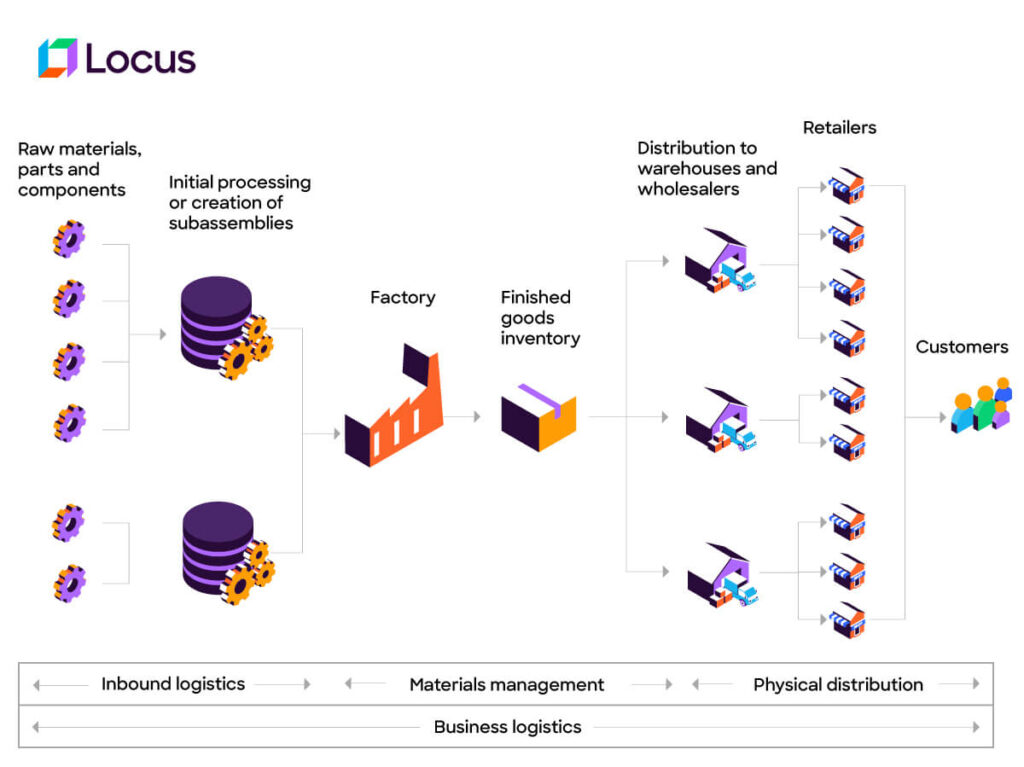
Inbound and outbound logistics are two fundamental components of the overall supply chain management process. They involve the movement and management of goods and materials, but their directions and specific functions differ from each other. Here’s an explanation:
What Is Logistics?
Logistics is the planning, execution, and control of how goods, materials, information, and resources move through a business. It covers the operational work required to get the right product to the right place, in the right condition, at the right time, and at the right cost.
In practical terms, logistics includes transport planning, warehousing, inventory movement, order fulfilment, shipment tracking, delivery execution, returns management, and performance monitoring. It connects suppliers, manufacturers, distribution centres, stores, carriers, and end customers through a coordinated flow of physical goods and digital information.
For enterprise supply chains, logistics is no longer only a cost centre. When managed well, it improves service levels, protects margins, reduces operational waste, and gives businesses the flexibility to respond to demand shifts, disruption, and rising customer expectations.
Supply Chain Management vs Logistics
Supply chain management and logistics are closely linked, but they are not the same.
Supply chain management (SCM) is the broader discipline. It covers the end-to-end network of suppliers, manufacturers, warehouses, logistics partners, retailers, and customers involved in producing and delivering goods. SCM includes strategic decisions around sourcing, procurement, production planning, supplier relationships, demand forecasting, inventory policy, network design, and risk management.
Logistics is a core function within supply chain management. It focuses on the movement, storage, handling, and delivery of goods across that wider network. Inbound logistics manages the flow of inputs into the organisation, while outbound logistics manages the movement of finished goods to customers or channel partners.
Put simply: supply chain management decides how the entire value network should operate; logistics ensures goods move through that network efficiently.
What Is Inbound Logistics?
Inbound logistics refers to the activities involved in receiving, storing, and distributing raw materials, components, and other inputs needed for production or further processing within a company. It focuses on managing the flow of materials from suppliers or vendors to the company’s production facilities. Inbound logistics activities typically include transportation, warehousing, inventory control, material handling, quality control inspections, and scheduling.
The main objectives of inbound logistics are to ensure timely and efficient delivery of materials to support production processes, optimize inventory levels, minimize costs associated with transportation and storage, and maintain good relationships with suppliers. Effective inbound logistics management helps streamline production operations and reduce supply chain disruptions.
Key Inbound Logistics Activities to Manage
Inbound logistics is more than simply receiving goods at a dock. It requires coordinated execution across suppliers, carriers, warehouses, procurement teams, and production planners.
Key inbound logistics activities include:
- Supplier coordination: Aligning purchase orders, production schedules, delivery windows, and carrier capacity with supplier commitments.
- Expediting: Accelerating delayed or business-critical inbound shipments to prevent production stoppages, stockouts, or service failures.
- Shipment notification: Receiving advance shipment notices from suppliers or carriers so warehouse teams can plan labour, dock slots, equipment, and storage space.
- Load arrival management: Tracking when inbound vehicles reach the facility, assigning docks, managing yard movement, and reducing waiting time.
- Recording and receipts: Verifying quantities, SKUs, batch numbers, serial numbers, and purchase order details when goods arrive.
- Quality inspection: Checking inbound materials for defects, damage, contamination, incorrect labelling, or non-compliance before they enter stock.
- Internal distribution: Moving accepted goods from receiving zones to storage, production lines, replenishment areas, or cross-docking lanes.
- Vendor inbound compliance standards: Defining supplier requirements for packaging, labelling, appointment scheduling, documentation, palletisation, and delivery accuracy.
- Supplier quality certifications: Using certifications and quality programmes to assess whether suppliers can consistently meet product, safety, and compliance standards.
- Supplier audits: Periodically reviewing supplier processes, documentation, facilities, and performance to identify risks before they disrupt operations.
- Supplier risk management: Monitoring dependency, geography, lead times, financial stability, quality trends, and disruption exposure across the supplier base.
What Is Outbound Logistics?
Outbound logistics deals with activities relating to the movement and management of finished products or goods from the company’s production facilities to the end customers or distribution channels. It focuses on delivering the final products or services to the intended recipients.
Outbound logistics activities include order processing, packaging, storage, transportation, distribution channel management, and customer support. The primary goals of outbound logistics are to ensure accurate and timely delivery of products, optimize transportation and distribution processes, minimize costs, manage inventories in distribution centers or warehouses, and provide excellent customer service.
Key Outbound Logistics Activities to Manage
Outbound logistics determines how reliably a business can convert demand into delivered revenue. It depends on accurate fulfilment, available inventory, efficient dispatch planning, and strong customer communication.
Key outbound logistics activities include:
- Order validation: Checking order details, inventory availability, service commitments, delivery addresses, and payment or credit status before fulfilment begins.
- Replenishment: Moving stock from reserve storage to forward-pick areas, stores, dark stores, or micro-fulfilment centres so orders can be picked quickly.
- Picking and packing control: Ensuring the right items are selected, packed securely, labelled correctly, and prepared according to customer or channel requirements.
- Staging and loading: Grouping orders by route, carrier, delivery window, or priority before loading vehicles in the correct sequence.
- Shipping documentation: Preparing invoices, manifests, carrier labels, customs documentation, proof-of-dispatch records, and any required compliance paperwork.
- Delivery handoff: Transferring shipments to owned fleets, carriers, 3PL partners, store teams, or last-mile delivery agents with clear accountability.
- Last-mile cost management: Managing cost drivers such as delivery density, failed delivery attempts, vehicle utilisation, time-window constraints, fuel usage, and driver productivity.
- Customer communication: Sending proactive notifications, live tracking links, delivery ETAs, exception alerts, and proof of delivery to reduce support queries and improve trust.
How Distribution Channels Affect Outbound Logistics
Outbound logistics becomes more complex as businesses serve more channels. Each channel changes where inventory must sit, how fast orders must move, how delivery routes are planned, and what customers expect after purchase.
Common outbound channel models include:
- Direct-to-consumer: Brands ship directly to end customers, often with high expectations for fast delivery, accurate ETAs, easy returns, and transparent tracking.
- Wholesalers: Larger bulk shipments move to wholesale partners, making freight planning, pallet configuration, documentation, and appointment scheduling critical.
- Retailers: Shipments to retail stores require store-specific labelling, delivery windows, compliance rules, replenishment planning, and proof of delivery.
- Distributors: Products move through intermediary networks, increasing the need for accurate inventory visibility and clear handoffs between partners.
- Omnichannel fulfilment: Orders may be fulfilled from warehouses, stores, dark stores, or micro-fulfilment centres, making inventory orchestration and routing decisions more dynamic.
- Drop shipping: Suppliers or third parties ship directly to customers on behalf of the seller, requiring tight integration, shipment visibility, and accountability for service levels.
- Micro-fulfilment centres: Smaller fulfilment nodes located closer to demand can shorten delivery times, but they require disciplined replenishment and precise inventory accuracy.
The more varied the channel mix, the greater the need for connected systems that can allocate orders intelligently, route deliveries efficiently, and provide consistent customer visibility across every fulfilment path.
Difference Between Inbound and Outbound Logistics
The key difference between inbound and outbound logistics lies in the direction of the flow of goods. Inbound logistics deals with the movement of materials and inputs from suppliers to the company, while outbound logistics deals with the movement of finished products from the company to customers or distribution channels.
| Inbound Logistics | Outbound Logistics | |
|---|---|---|
| Definition | The process of managing and controlling the flow of raw materials, goods, and supplies from suppliers to the organization’s facilities. | Managing and controlling the flow of finished products from the organization’s facilities to the end customers or distribution centers. |
| Focus | Procurement, receiving, storage, and inventory management. | Order processing, fulfillment, transportation, and delivery. |
| Activities | Tasks such as supplier management, procurement planning, order placement, transportation coordination, receiving and inspection, warehousing, and inventory management. | Activities such as order management, order picking and packing, transportation planning and coordination, delivery route optimization, shipment tracking, and customer service. |
| Objective | Ensure the timely and efficient delivery of raw materials and supplies to support production or further processing within the organization’s facilities. | Ensure the accurate and timely delivery of finished products to the intended recipients, meeting customer demands and expectations |
How Inbound and Outbound Logistics Fit Into the Value Chain
Inbound and outbound logistics sit at opposite ends of the value chain, but both directly influence how value is created and delivered.
In a value chain, inbound logistics supports input-side value creation. It determines how efficiently a business sources, receives, stores, and moves raw materials or purchased goods into production, fulfilment, or resale operations. Weak inbound execution can increase material costs, create stockouts, slow production, and reduce quality consistency before a product ever reaches the customer.
Outbound logistics supports customer-side value delivery. It determines how effectively finished goods reach customers, stores, distributors, wholesalers, or other downstream partners. Poor outbound execution can lead to missed delivery windows, order errors, high returns, increased support costs, and lower customer loyalty.
Value chain analysis helps businesses identify where logistics activities add cost, create delays, or improve differentiation. For example, a manufacturer may find that inbound supplier delays are the main cause of production disruption, while an e-commerce retailer may find that last-mile delivery failures are the biggest source of customer churn. Understanding these points allows teams to prioritise investment where it has the greatest operational and commercial impact.
Examples of Inbound and Outbound Logistics by Business Type
Inbound and outbound logistics look different depending on the industry, product type, order profile, and service promise.
| Business type | Inbound logistics example | Outbound logistics example |
| Manufacturing | Raw materials, components, tools, and packaging arrive from multiple suppliers and are inspected before being moved to production lines. | Finished goods are shipped to distributors, wholesalers, retailers, or direct customers based on production schedules and demand forecasts. |
| Retail | Stores or distribution centres receive products from brands, importers, or regional warehouses. | Goods are replenished to stores, delivered to customers, or transferred between locations to match local demand. |
| E-commerce | Finished products, packaging materials, and returns arrive at fulfilment centres for storage and processing. | Orders are picked, packed, dispatched, tracked, delivered, and, where needed, returned through reverse logistics flows. |
| Grocery | Perishable goods arrive from farms, suppliers, cold-chain partners, or central warehouses with strict temperature and freshness requirements. | Orders are delivered to stores or consumers within tight time windows, often with high sensitivity to freshness, substitution, and delivery accuracy. |
| Furniture or bulky goods | Large items, fragile components, or imported inventory arrive at warehouses and require careful handling, inspection, and storage planning. | Deliveries often need route sequencing, capacity-aware vehicle planning, customer appointments, installation support, and damage-free handoff. |
| 3PL-operated logistics | A third-party logistics provider receives inventory on behalf of multiple customers, often using standardised inbound compliance processes. | The 3PL manages fulfilment, dispatch, carrier allocation, delivery tracking, and returns for one or more client brands. |
Importance of Efficient Inbound and Outbound Logistics
Efficient inbound and outbound logistics play a crucial role in any business, especially in manufacturing, retail, and e-commerce, where supply chains are central to operations. Both inbound (receiving goods) and outbound (sending goods) logistics encompass the management of materials and finished products, ensuring that operations run smoothly. Here are some key reasons that illustrate their importance:
1. Cost-effectiveness: An efficient logistics system can significantly reduce costs related to storage, transportation, and handling of goods. Efficient supply chain management can result in significant savings, improving a company’s profit margin.
2. Customer Satisfaction: For many businesses, the end goal of outbound logistics is delivering a product to a customer. Quick, efficient, and accurate deliveries can significantly enhance customer satisfaction. In the era of e-commerce, where next-day or even same-day delivery is becoming the norm, efficient logistics is critical to remaining competitive.
3. Inventory Management: Inbound logistics play a critical role in inventory management. Timely and reliable delivery of raw materials or components ensures that production processes can continue without interruption, which helps to prevent stockouts and backorders.
4. Operational Efficiency: Efficient logistics processes allow smooth operations, reduce lead times, and enhance productivity. They also help in managing the fluctuation of demand and supply effectively.
5. Competitive Advantage: Companies that have mastered their logistics can often provide better service than their competitors. This could mean faster delivery times, lower prices, or better customer service, which can be significant competitive advantages.
6. Sustainability: Efficient logistics also have an environmental impact. Companies can lower their carbon footprint by optimizing delivery routes and reducing waste in the supply chain.
7. Risk Management: Effective logistics management allows companies to anticipate and mitigate risks associated with transportation delays, supplier issues, or unexpected changes in demand.
Benefits of Inbound Logistics vs Benefits of Outbound Logistics
While inbound and outbound logistics work together, each creates value in different ways.
Benefits of efficient inbound logistics
- Greater production continuity: Reliable inbound flows reduce the risk of material shortages and production stoppages.
- Lower procurement and freight waste: Better supplier coordination, load planning, and shipment visibility help reduce avoidable transport and handling costs.
- Improved inventory control: Accurate receiving, inspection, and putaway processes improve stock accuracy and reduce excess inventory.
- Stronger supplier performance: Clear inbound compliance standards, supplier scorecards, and audits make supplier execution more measurable.
- Better quality assurance: Early inspection helps identify defects before poor-quality materials enter production or customer-facing inventory.
- Reduced disruption risk: Visibility into supplier delays, transport exceptions, and inventory shortages allows teams to act earlier.
Benefits of efficient outbound logistics
- Higher customer satisfaction: Accurate orders, reliable delivery windows, and proactive communication improve the post-purchase experience.
- Lower delivery cost per order: Better routing, consolidation, dispatch planning, and fleet utilisation reduce the cost of serving customers.
- Improved delivery accuracy: Strong fulfilment controls reduce mis-shipments, failed deliveries, and avoidable returns.
- Faster revenue conversion: Efficient dispatch and delivery shorten the time between order capture and completed fulfilment.
- Greater channel scalability: A well-managed outbound network can support direct-to-consumer, retail, wholesale, omnichannel, and partner-led fulfilment models.
- Better service-level control: Real-time tracking and exception management help logistics teams protect SLAs across markets and delivery types.
Inbound and outbound logistics share some common challenges, while also presenting unique complexities. Here are some expanded insights into the challenges associated with both inbound and outbound logistics:
Challenges in Inbound Logistics
1. Supplier coordination: Coordinating with multiple suppliers to ensure timely delivery of raw materials and components can be a complex task, requiring effective communication and strong supplier relationships.
2. Inventory management: According to this report 67.4% of supply chain managers use Excel spreadsheets as a management tool. Balancing inventory levels to meet production demands while minimizing carrying costs and stockouts can be challenging. Accurate demand forecasting and efficient inventory control systems are vital.
3. Transportation and freight costs: Selecting the most cost-effective and reliable transportation modes and carriers for inbound shipments is crucial. Fluctuating fuel prices, capacity constraints, and changing regulations can impact transportation costs.
4. Warehouse efficiency: Effectively organizing and managing warehouses to receive, store, and handle incoming materials requires efficient layout design, optimized storage methods, and streamlined processes.
5. Quality control: Ensuring the quality of inbound materials is crucial to maintain product standards. Implementing rigorous inspection processes and supplier quality management systems is essential.
Challenges in Outbound Logistics
1. Order fulfillment: Managing and fulfilling customer orders accurately and efficiently can be complex, especially when dealing with a high volume of orders and diverse product SKUs.
2. Distribution network optimization: Designing an optimal distribution network that balances proximity to customers, transportation costs, and service levels is challenging. Factors such as warehouse locations, transportation routes, and inventory allocation must be considered.
3. Customer service and satisfaction: According to a survey by PwC, 1 in 3 customers would leave a brand they love after just one bad experience. Efficient outbound logistics is crucial for providing positive customer experiences, especially in terms of delivery time and accuracy. Meeting customer expectations for on-time delivery, order accuracy, and overall service excellence is critical. Maintaining a robust customer service system and addressing customer inquiries and concerns promptly is vital.
4. Last-mile delivery: The final stage of the delivery process can present challenges such as route optimization, traffic congestion, and managing multiple delivery time windows.
5. Returns and reverse logistics: Handling product returns, managing reverse logistics, and implementing efficient product recall processes can be demanding. Proper disposal, refurbishment, or restocking of returned products need to be managed effectively. The complexity of returns and reverse logistics shouldn’t be underestimated.
Quality Control, Damage Liability, and Contract Terms
Quality control and liability management are essential across inbound and outbound logistics because damaged, defective, or misdocumented goods can create disputes, delay fulfilment, and increase total logistics cost.
Key areas to define include:
- Inspection checkpoints: Businesses should specify where goods are inspected, such as supplier dispatch, carrier pickup, warehouse receiving, storage transfer, picking, loading, and final delivery.
- Damage liability: Contracts should clarify who is responsible for damaged goods while they are in transit, in storage, at a cross-dock, or during last-mile handoff.
- Supplier quality agreements: Supplier agreements should define acceptable quality levels, packaging standards, documentation rules, defect escalation paths, and corrective action expectations.
- Carrier terms: Carrier contracts should cover service levels, claims windows, proof requirements, exclusions, insurance coverage, and liability limits.
- Documentation requirements: Purchase orders, bills of lading, delivery notes, photos, inspection records, proof of delivery, and exception reports help establish accountability when disputes arise.
- Defect and exception handling: Teams should define how defective goods are quarantined, returned, replaced, credited, or reworked.
- Storage conditions: For sensitive goods, contracts should clarify temperature, humidity, handling, stacking, and security requirements.
Clear terms reduce ambiguity. They also create the operational evidence needed to recover costs, protect customer commitments, and improve supplier or carrier performance over time.
Key Steps in Inbound and Outbound Logistics Process
Inbound and outbound logistics shape how well a supply chain performs. Inbound moves the right materials into the organisation on time, while outbound moves finished goods to customers without delays. Together, they determine how well a business controls cost, speed, and service quality.
Here’s a step-by-step, side-by-side breakdown.
| Inbound Logistics Steps | Outbound Logistics Steps |
|---|---|
| 1. Sourcing Materials Selecting suppliers based on cost, quality, and reliability protects production schedules and reduces supply disruption. Strong sourcing prevents stockouts and stabilises long-term fulfilment. | 1. Order Processing Capturing and validating customer orders early prevents mis-shipments and delays. Clean order data improves fulfilment speed and reduces correction work downstream. |
| 2. Purchasing and Order Confirmation Placing and verifying purchase orders with clear documentation prevents quantity mismatches and freight disputes. Accurate confirmations shorten lead cycles and reduce rework. | 2. Picking and Packing Accurate picking and secure packing reduce returns, errors, and carton wastage. Clean execution at this stage supports faster hand-offs to carriers. |
| 3. Transportation and Freight Coordination Planning inbound freight with air, ocean, or road transport and using TMS systems improves cost control and visibility. Better freight coordination reduces dwell time and inbound bottlenecks. | 3. Transportation Planning and Dispatching Assigning shipments to vehicles and scheduling dispatch with route planning tools increases drop density and reduces idle miles. AI-based route planning can cut last-mile cost by up to 35% in dense urban areas. |
| 4. Receiving and Inspection Verifying goods against purchase orders at the dock reduces downstream quality failures. Fast exception reporting shortens recovery time for damaged or missing items. | 4. Shipping and Delivery Executing final-mile delivery with live status updates supports SLA control and reduces failed delivery attempts. Tracking protects service reliability in the last mile. |
| 5. Warehousing and Storage Placing goods in the right storage zones and maintaining stock accuracy improves retrieval speed and lowers carrying cost. A well-managed WMS supports clean hand-offs to production or outbound teams. | 5. Customer Communication and Support Proactive updates, proof of delivery, and quick issue handling build trust and reduce churn. Many customers stop buying after a poor delivery experience. |
| 6. Reverse Logistics Handling supplier returns and recycling with structured flows reduces waste and protects margin. Reverse efficiency also improves compliance on damaged or rejected inputs. | 6. Returns and Reverse Logistics Managing returns and replacements with clear rules shortens credit cycles and protects customer satisfaction. Clean reverse flows reduce friction in after-delivery service. |
Using a single platform like Locus to connect inbound and outbound flows gives clarity across the chain, reduces cost leakages, and improves delivery precision.
Top 10 Challenges in Inbound-Outbound Logistics Process
From visibility gaps and rising logistics costs to poor fleet productivity, inefficient in-plant operations, and fragmented systems, logistics teams face multiple hurdles that disrupt supply chain performance.
Below are the ten most critical challenges shaping inbound and outbound logistics today.
1. Limited Visibility Across Shipments
Poor visibility into inbound shipments and outbound deliveries makes it hard to track status or anticipate delays. Without real-time tracking and exception alerts, coordination between suppliers, carriers, and customers suffers.
2. Rising Logistics Costs
Fuel price swings, fragmented carrier networks, and weak route planning continue to push transportation costs up. For many companies, logistics is one of the largest cost centers in the supply chain, with transportation, warehousing, and last-mile execution accounting for a major share of total spend.
3. Inefficient In-Plant Operations
Unorganized warehouse layouts, manual inventory handling, and material mismanagement slow down both inbound receipt and outbound dispatch, increasing cycle times and costs.
4. Poor Fleet Productivity
Poor routing, idle time, and inconsistent driver output reduce delivery throughput. Automating dispatch and route planning helps increase vehicle use and overall delivery output.
5. Lack of Data-Driven Decision-Making
Many teams still rely on spreadsheets and disconnected systems, which limits performance insight. A 2024 KPMG report found that only half of supply chain organizations planned to invest in AI and advanced analytics that year — leaving the other half without data-driven capability.
6. Supplier and Carrier Coordination Gaps
Managing multiple vendors without shared visibility or digital collaboration often causes delayed raw material arrivals and late order fulfillment.
7. Fluctuating Demand and Forecast Inaccuracy
Sudden changes in demand or poor forecasting lead to stockouts or overstocking. Both strain inbound sourcing and outbound delivery schedules.
8. Last-Mile Delivery Inefficiencies
Traffic congestion, failed deliveries, and rigid delivery windows make outbound logistics unpredictable. Intelligent route optimization helps reduce these disruptions.
9. Sustainability Pressures
Customers and regulators now expect greener operations. Meeting emission-reduction goals requires rethinking routing, packaging, and reverse logistics processes.
10. Fragmented Technology Ecosystems
Disconnected WMS, TMS, and ERP systems make it difficult to share real-time information across departments. A unified dispatch management platform like Locus integrates these workflows, enabling end-to-end visibility and smarter decision-making.
KPIs for Measuring Inbound and Outbound Logistics Performance
Logistics performance should be measured with KPIs that reflect cost, speed, quality, reliability, and customer impact. The right metrics make it easier to identify whether issues are coming from suppliers, warehouse processes, carriers, fleet execution, fulfilment accuracy, or demand planning.
| KPI | Applies to | What it measures | Simple calculation guidance |
| Freight cost per pound | Inbound and outbound | Transport cost relative to shipment weight | Total freight cost ÷ total shipment weight |
| On-time pickup | Inbound and outbound | Whether carriers collect goods within the agreed window | On-time pickups ÷ total pickups × 100 |
| On-time delivery | Primarily outbound | Whether orders arrive within the promised delivery window | On-time deliveries ÷ total deliveries × 100 |
| Dock-to-stock cycle time | Inbound | Time from goods arriving at the dock to being available in inventory | Stock availability time ? dock arrival time |
| Defect rate | Primarily inbound | Share of received items that fail quality checks | Defective units ÷ total units inspected × 100 |
| Order error rate | Primarily outbound | Share of orders with picking, packing, labelling, quantity, or address errors | Orders with errors ÷ total orders × 100 |
| Delivery cost per order | Outbound | Cost efficiency of fulfilment and delivery | Total delivery cost ÷ total delivered orders |
| Inventory carrying costs | Inbound and outbound | Cost of holding inventory, including storage, capital, insurance, shrinkage, and obsolescence | Total inventory holding cost over a period ÷ average inventory value |
| Warehouse receiving accuracy | Inbound | Whether received quantities and SKUs match purchase orders | Accurate receipts ÷ total receipts × 100 |
| Failed delivery rate | Outbound | Share of deliveries that could not be completed on the first attempt | Failed delivery attempts ÷ total delivery attempts × 100 |
| Return rate | Outbound and reverse logistics | Share of shipped orders returned by customers | Returned orders ÷ shipped orders × 100 |
Operational KPI Definitions
- Freight cost per pound: A cost-efficiency metric used to compare freight spend across carriers, lanes, products, or shipment types. It is especially useful where shipment weights vary widely.
- Defect rate: A quality metric that shows how many incoming or outgoing units fail inspection, specification, or customer requirements.
- Error rate: A process accuracy metric that can apply to orders, receipts, labels, addresses, invoices, or shipment documents. High error rates usually indicate weak controls, poor system integration, or manual process risk.
KPIs should be reviewed by lane, supplier, warehouse, customer segment, product category, and carrier. A single average can hide expensive exceptions, especially in complex enterprise networks.
How to Overcome Common Inbound and Outbound Logistics Challenges
The most effective logistics improvements connect specific operational problems to measurable corrective action.
| Challenge | Practical solution |
| Visibility gaps across shipments | Use integrated shipment tracking, exception alerts, carrier status updates, and IoT tracking where goods require live location, condition, or temperature monitoring. |
| Supplier delays | Introduce supplier scorecards, inbound appointment scheduling, agreed lead-time buffers, expediting rules, and escalation workflows for high-risk materials. |
| Warehouse congestion | Use dock scheduling, slotting optimisation, labour planning, pre-receiving documentation, cross-docking, and real-time yard visibility to reduce dwell time. |
| Poor receiving accuracy | Standardise purchase order matching, barcode scanning, ASN validation, inspection steps, and discrepancy reporting. |
| Failed deliveries | Improve address validation, customer notifications, dynamic routing, delivery slot confirmation, proof of delivery, and real-time driver communication. |
| Returns complexity | Define return rules, automate reverse logistics workflows, classify returned goods quickly, and route items to restock, repair, recycle, or disposal paths. |
| Cost overruns | Track freight cost per pound, delivery cost per order, fleet utilisation, route adherence, failed attempts, and accessorial charges by carrier and lane. |
| Supplier or carrier risk | Diversify critical suppliers, review contract performance, audit partner compliance, maintain contingency capacity, and monitor disruption exposure. |
These improvements work best when teams treat inbound and outbound logistics as connected flows rather than separate functions. A delay in inbound replenishment often becomes an outbound stockout, while weak outbound demand visibility can create unnecessary inbound inventory pressure.
How to Optimize Inbound and Outbound Logistics
Businesses optimize inbound and outbound logistics through various methods, many of which are tied to logistics planning, technological integration, process refinement, and supplier relationships. Here are some specific ways companies optimize these crucial aspects of their operations:
- Streamlining Processes: Regularly reviewing and refining processes can enhance efficiency in moving goods in and out.
- Technology Investment: Tools like Warehouse Management Systems (WMS), Transportation Management Systems (TMS), and AI can optimize logistics operations.
- Supplier Collaboration: Building good relationships with suppliers ensures a smoother, more reliable supply of goods.
- Training: Staff training on best practices can reduce errors and boost efficiency.
- Just-In-Time Inventory: This approach minimizes inventory costs and relies on efficient inbound logistics.
- Demand Forecasting: Anticipating customer demand helps manage logistics, avoiding stock outs and overstocking.
- Automation: Automating logistics processes can improve speed and accuracy.
- Route Optimization: Efficient routing reduces delivery times and fuel costs for outbound logistics.
- Performance Measurement: Using key performance indicators (KPIs) helps identify areas for improvement.
- Risk Management: Contingency plans ensure business continuity when disruptions occur in the supply chain.
Optimizing inbound and outbound logistics requires a comprehensive, strategic approach that is continually adjusted as business needs, market conditions, and technologies evolve.
Role of 3PLs, Carriers, and Logistics Partners
Many businesses use third-party logistics providers, carriers, and specialist logistics partners to expand capacity, reach new markets, manage seasonal peaks, or access capabilities that would be costly to build internally.
A 3PL can manage warehousing, transportation, fulfilment, returns, cross-docking, and value-added services on behalf of a business. This is useful when order volumes fluctuate, delivery networks are geographically dispersed, or the business needs to scale without adding fixed infrastructure.
Carrier relationships also have a direct impact on logistics performance. Strong carrier management improves capacity access, rate control, pickup reliability, delivery performance, claims handling, and exception communication. Weak carrier collaboration, by contrast, often leads to missed pickups, poor visibility, inconsistent service levels, and higher accessorial costs.
Partner collaboration should be operational, not only contractual. Shared forecasts, digital status updates, common performance scorecards, integrated systems, and clear escalation rules help suppliers, carriers, 3PLs, and internal teams execute against the same service goals.
Partner-Led Logistics Models
- 3PL fulfilment: A third-party logistics provider receives, stores, picks, packs, ships, and manages returns for a business.
- Carrier-managed delivery: External carriers handle transport execution across lanes, regions, or service types.
- Cross-docking: Goods move from inbound receipt to outbound dispatch with minimal or no storage time, helping reduce handling, inventory holding, and delivery lead times.
- Dedicated fleet partnerships: A logistics partner operates vehicles, drivers, or delivery teams dedicated to the business.
- Hybrid networks: Businesses combine owned fleets, 3PLs, carriers, and gig or crowdsourced capacity to balance cost, control, and scalability.
The right partner model depends on service promise, order density, product characteristics, geography, cost structure, and the level of control the business needs over the customer experience.
Simplify Inbound and Outbound Logistics with Intelligent Dispatch Management
Utilizing advanced software like Locus’ Dispatch Management Software not only enhances both inbound and outbound logistics but also promotes cost-effectiveness and customer satisfaction.
Inbound logistics are bolstered with seamless supplier coordination and real-time shipment visibility, ensuring timely raw material deliveries. This solution further optimizes warehousing, promoting efficient stock replenishment and reducing holding costs.
For outbound logistics, order processing becomes automated, enhancing speed and accuracy while reducing manual errors. Advanced route optimization software helps businesses minimize fuel costs and delivery time. The solution provides real-time tracking and communication, guaranteeing punctual deliveries and customer satisfaction.
Dispatch management’s key feature is last-mile optimization. Dynamic route planning, load matching, and real-time tracking capabilities account for variables like traffic and specific customer requirements. This ensures optimal resource utilization, reduces empty miles, and provides customers with accurate ETAs, promoting smooth deliveries and coordination.
By leveraging a dispatch management solution, businesses can optimize their inbound and outbound logistics operations, enhance the last mile delivery process, and achieve improved efficiency, cost savings, and customer satisfaction in this dynamic market.
Frequently Asked Questions (FAQs)
What is the key difference between inbound and outbound logistics?
Inbound logistics deals with managing the flow of raw materials, components, and supplies from suppliers into the company’s production facilities. Outbound logistics focuses on the movement of finished goods from the company to customers or distribution channels. The primary difference lies in the direction of material/product flow – inbound brings in inputs for production, while outbound ships out final products after production.
What are some major challenges in inbound logistics?
Some key challenges in inbound logistics include coordinating with multiple suppliers for timely material delivery, managing inventory levels to meet production needs while minimizing costs, selecting cost-effective transportation modes, ensuring warehouse efficiency for receiving and storage, and maintaining quality control over incoming raw materials and components.
What are the main challenges associated with outbound logistics?
Major outbound logistics challenges involve accurate and efficient order fulfillment, optimizing the distribution network for cost and service levels, providing excellent customer service and meeting delivery expectations, managing complexities of last-mile delivery, and handling product returns and reverse logistics processes effectively.
Why is optimizing inbound and outbound logistics important for businesses?
Efficient inbound and outbound logistics operations are crucial for cost-effectiveness by reducing transportation, inventory, and handling costs. They enhance customer satisfaction through reliable, timely deliveries. Optimized logistics enable better inventory management, operational efficiency, competitive advantages, sustainability by lowering environmental impact, and effective risk management against supply chain disruptions.
How can Locus’s dispatch management solution help streamline inbound and outbound logistics?
Locus’s dispatch management software optimizes inbound logistics through seamless supplier coordination, real-time shipment visibility for timely raw material deliveries, and efficient warehouse operations. For outbound, it automates order processing, provides advanced route optimization to minimize costs and delivery times, offers real-time tracking for punctual deliveries, and ensures superb last-mile optimization with dynamic routing, load matching, and accurate ETAs – ultimately driving customer satisfaction. By leveraging this solution, businesses can holistically enhance inbound/outbound efficiency, cut costs, and improve the delivery experience.


General
White Glove Delivery: Benefits, Key Features & Use Cases

May 30, 2025
Key Takeaways Who is this for? This guide is built for logistics managers, operations directors, and e-commerce executives who need to deliver high-value, fragile, or oversized items without damage or delay. If you are dealing with rising damage claims, missed delivery windows, or customers demanding a premium experience, this resource gives you the framework to […]
Read more
Last Mile Delivery Optimization
Hyperlocal Delivery: What It Is and How Does It Work?

May 31, 2025
Explore how hyperlocal delivery management software enables retailers and logistics providers to cut costs, boost speed, and improve customer experience.
Read moreInsights Worth Your Time




















Inbound vs Outbound Logistics: Key Differences in 2026