


Supply Chain Optimization
Best Supply Chain Control Tower Providers in 2026
Key Takeaways
- Three models, three operating layers: Supply chain control towers split into visibility-led (track and alert), planning-led (optimize months ahead), and execution-led (automate real-time routing and dispatch). Each serves a distinct operational need.
- Visibility alone doesn’t fix failures. Visibility platforms require dispatchers to see the alert, call the driver, recalculate the route, and manually update customers. Execution platforms handle rerouting, notifications, and adjustments autonomously.
- Planning excellence ? execution precision. Planning-focused systems like Blue Yonder and Kinaxis optimize strategic networks but sit upstream from daily dispatch. Execution platforms translate planning into immediate ground-level actions.
- Execution-native drives measurable ROI. Automated decision-making delivers 25% efficiency gains, 45% more deliveries per vehicle, and 8% SLA improvement—metrics that matter directly to logistics P&Ls.
- Market momentum favors control towers. The global market is projected at USD 8.75 billion in 2026, with 37% of organizations now prioritizing control tower investments.
- Locus is purpose-built for execution: 180+ variable optimization, real-time rerouting, and autonomous dispatch that connects planning directly to ground operations—designed for logistics directors and operations managers running high-density delivery networks.
Supply chain control towers mean different things to different vendors. Some track shipments. Some optimize networks. Others automate dispatch. For logistics VPs, operations directors, and supply chain transformation leads evaluating where to invest this year, that distinction is the difference between a dashboard you watch and a system that acts.
The market agrees: 37% of supply chain and logistics organizations now prioritize control towers in 2026—up six points from the prior year. The global supply chain control tower market is anticipated to reach USD 8.75 billion in 2026, fueled by enterprises shifting from reactive visibility toward autonomous execution.
Yet readiness is slipping. According to a Blue Yonder survey, only 66% of supply chain leaders believe they are ready for the future in 2026—down from 73% last year. Among less optimistic leaders, 43% say they need an entirely new approach.
Three models dominate the landscape: visibility-led platforms track and alert, planning-led systems optimize months ahead, and execution-led control towers automate routing and dispatch in real time. Choosing the wrong model doesn’t just waste budget—it creates gaps your competitors will exploit.
This guide breaks down the 10 best supply chain control tower providers by operational model so enterprise logistics leaders can match capabilities to their specific bottlenecks, KPIs, and scale requirements. To learn more about why these systems matter, explore the Supply Chain Control Towers resource.
Quick answer: who are the best supply chain control tower providers?
The best supply chain control tower providers depend on the operating layer you actually need:
- Execution-led: Locus, Outvio, Syren
- Planning-led: Blue Yonder, Kinaxis, o9 Solutions
- Visibility-led: Project44, SAP, E2open
- Hybrid/specialised: C3 AI
A simple way to choose:
- Pick visibility-led platforms when the main problem is tracking shipments, getting alerts, and sharing status across carriers and partners.
- Pick planning-led platforms when the main problem is network design, demand forecasting, inventory positioning, and scenario modelling.
- Pick execution-led platforms when the main problem is daily route planning, automated dispatch, real-time rerouting, SLA adherence, and exception resolution on the ground.
No provider is “best” in the abstract. The best fit is the one aligned to your bottleneck, data maturity, integration landscape, and decision horizon.
Key Features to Look for in Supply Chain Control Tower Providers
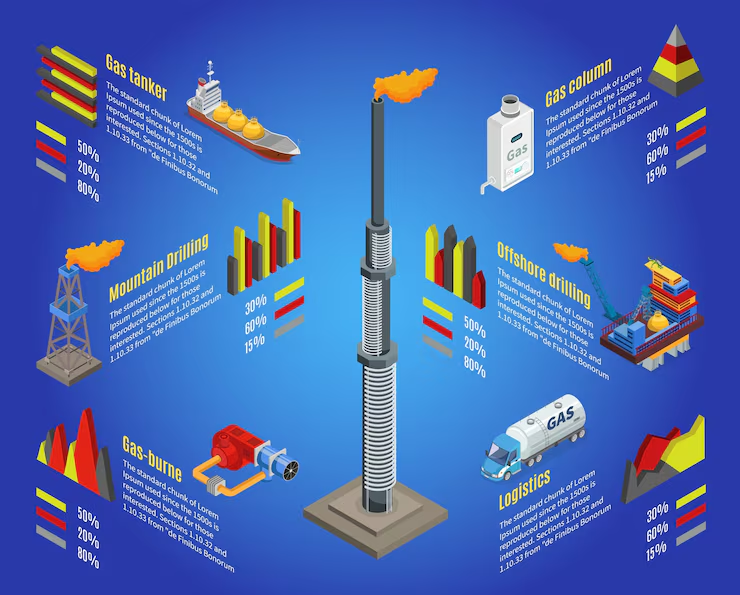
Here are the notable features you must have in your supply chain control tower vendors:
1. Real-Time Visibility vs. Actionable Execution
Knowing where a truck is doesn’t fix a late delivery. Execution platforms reroute automatically when delays occur. Visibility platforms require someone to see the alert, call the driver, recalculate the route, and manually update customers.
An ideal platform must handle all of that without dispatcher intervention. When traffic doubles the ETA for stop seven, the system should reroute stops eight through twelve, notify affected customers, and log the delay reason—all in under 30 seconds.
2. Integration Depth with Execution Systems
Planning tools often sit separate from dispatch. Someone builds an optimal route in the planning system, then manually recreates it in the execution system. The gap between “what we planned” and “what we’re doing” creates constant reconciliation work.
Here, execution-native platforms connect planning directly to dispatch. Route changes flow into driver apps immediately. You do not need any manual translation layer.
3. Planning Sophistication vs. Ground-Level Execution
Planning platforms solve for “what if,” while execution platforms solve for “what now.” You can have a flawless seasonal strategy, but it won’t fix a Tuesday morning labor shortage.
Know your bottleneck: are you failing to plan, or just failing to react?
4. Scalability and Industry-Specific Customization
A control tower is only as good as its understanding of your specific constraints. Retail requires store hour compliance, FMCG demands cold-chain integrity, and e-commerce lives or dies by its returns workflow.
If you have to write custom code for every industry edge case, that is bound to create problems in the long run. True scalability means these rules are native to the platform, not a bolted-on afterthought.
5. AI/ML for Predictive vs. Prescriptive Actions
Predictive AI tells you what will happen. Prescriptive AI decides what to do. Visibility platforms predict SLA breaches. Execution platforms automatically reroute before the breach occurs.
The suitable choice should perform variable optimization in real time: delivery windows, vehicle capacity, traffic patterns, driver hours, fuel efficiency, customer preferences, and road restrictions.
These capabilities matter differently depending on which control tower model you’re evaluating. Before comparing specific vendors, let us understand how the three models approach logistics differently.
What Are the Main Supply Chain Control Tower Models?
The control tower market splits into three categories based on where platforms operate in the logistics workflow.
1. Visibility-Led Control Towers
Visibility platforms aggregate tracking data. They answer “where is it?” and send alerts when things go wrong. Project44 and FourKites dominate by integrating thousands of carriers for multi-modal tracking.
Tracking a late shipment doesn’t fix it. These platforms generate alerts that require human response. They work when you have mature dispatch teams monitoring dashboards full-time.
Best for: Companies with dedicated operations teams and clear exception protocols. Adds oversight without changing workflows.
2. Planning-Led Control Towers
Planning platforms optimize strategic decisions: network design, inventory positioning, and demand forecasting. Blue Yonder, Kinaxis, and o9 Solutions excel here. They model supply chains months ahead, running simulations for capacity, cost, and service trade-offs.
Planning sits upstream from daily execution. A Kinaxis user designs an optimal network in Q1 and implements it in Q3. These tools don’t dispatch trucks or assign drivers—they inform the teams who do.
Best for: Large manufacturers and retailers where strategic planning drives advantage more than execution speed. Operations with stable, predictable patterns.
3. Execution-Led Control Towers
Execution platforms automate routing, dispatch, and real-time decisions. They work at ground level: assigning orders to drivers, optimizing stop sequences, rerouting based on traffic, and handling exceptions without human touch.
As a case in point, Locus doesn’t just show you a late delivery. It reroutes the driver, adjusts downstream stops, notifies the customer, and logs the reason automatically. Planning flows directly into execution, so daily operations reflect updated priorities without manual coordination.
Best for: Operations running dense, high-frequency delivery networks where execution precision determines profitability. E-commerce fulfillment, food delivery, retail restocking, and pharmaceutical distribution.
Why Execution-Native Drives ROI
Visibility identifies the problem, planning models the solution, but execution actually fixes it. While most platforms just show you a delay, Locus automates the fix.
Its customers report 25% efficiency gains, 45% more deliveries per vehicle, and 8% SLA improvement because the platform automates decisions that would otherwise require dispatcher judgment across hundreds of daily orders.
With these distinctions clear, let’s examine the execution-led platforms that automate ground-level operations in real time.
Suggested Read: The Supply Chain Control Towers – Why are they hypercritical?
Supply chain control tower vs TMS vs WMS vs ERP vs dispatch system
“Control tower” is often used loosely. In practice, it can refer to a software platform, an operating model, a visibility layer, or an orchestration layer that sits across existing systems.
| System | Primary role | System of record for | Decision horizon | Typical users | Execution depth | Typical integrations |
| Control tower | Cross-functional visibility, orchestration, exception management, decision support | Usually not the core system of record; instead unifies records across systems | Minutes to months, depending on use case | Supply chain leaders, transport operations, planners, customer service, control room teams | Varies by provider; highest in execution-led platforms | ERP, TMS, WMS, OMS, telematics, carrier APIs, supplier portals, driver apps |
| TMS | Transportation planning, tendering, freight execution, settlement | Shipment, carrier, freight movement records | Hours to weeks | Transport teams, freight planners | Moderate to high in transport workflows | ERP, WMS, carrier systems, visibility tools |
| WMS | Warehouse execution | Inventory, location, picking, packing, task execution | Seconds to days | Warehouse managers, floor teams | High inside warehouse workflows | ERP, OMS, TMS, automation systems |
| ERP | Core enterprise transactions and master data | Orders, invoices, financials, procurement, master data | Days to quarters | Finance, procurement, operations, leadership | Low for live logistics execution | Nearly everything |
| OMS | Order orchestration and promise logic | Order status, sourcing logic, customer order flows | Minutes to days | Commerce, customer ops, fulfilment teams | Moderate for order allocation | ERP, WMS, TMS, e-commerce platforms |
| Route optimisation engine | Stop sequencing and route planning | Route logic, vehicle constraints, travel assumptions | Minutes to a day | Dispatchers, fleet operations | High for route planning, variable for field execution | Telematics, driver apps, OMS, TMS |
| Dispatch system | Day-of-execution control | Driver assignment, job status, dispatch actions | Real time | Dispatch teams, fleet managers | High for live task execution | Route engine, telematics, driver apps, TMS, OMS |
Control tower vs dashboard
A dashboard shows what is happening. A control tower should also support response, escalation, and workflow coordination. In execution-led environments, it may also trigger or govern decisions.
Control tower vs command centre
A command centre is often the people-and-process operating model. A control tower is often the technology layer that enables it. Many enterprises use both terms interchangeably, but they are not always the same thing.
Can a control tower replace a TMS?
Sometimes partly, rarely fully. A control tower can sit above a TMS, extend it, or overlap with it. But enterprises still usually need a TMS or equivalent transport execution capability for carrier contracting, freight procurement, settlement, or specialised modal workflows.
Can planning and execution platforms work together?
Yes. In fact, many of the strongest architectures combine planning-led, visibility-led, and execution-led layers, as long as the integration model avoids duplicate data, manual handoffs, and conflicting alerts.
Top Supply Chain Control Towers Providers: A Comparison
The table below organizes all 10 providers by operational model. Use it to quickly match each platform’s strengths to your logistics bottlenecks:
Execution-Led Control Towers
| Platform | Core Strengths | Best For | Key Differentiators |
|---|---|---|---|
| Locus | End-to-end logistics automation handling routing, dispatch, and real-time execution. Autonomous route optimization across 180+ variables, predictive SLA breach detection, hub operations automation, carrier orchestration (ShipFlex) | Multi-region or high-density delivery networks. E-commerce fulfillment, retail distribution, FMCG direct-to-consumer, pharmaceutical logistics, 3PLs managing mixed fleets | 25% efficiency gains, 45% more deliveries per vehicle, 8% SLA improvement. Planning flows directly into execution. Fast task assignment during peak. Real-time route adjustments without breaking workflows. Fixed pricing structure (no per-stop penalties) |
| Outvio | Post-purchase logistics automation: shipment tracking, returns management, customer communications across 1,000+ carriers. Focuses on customer-facing delivery rather than internal routing | E-commerce brands and D2C companies (100-10,000 monthly shipments) needing better post-purchase experience without full logistics orchestration | Strong multi-carrier integrations, excellent NDR and returns workflows, and quick implementation. Not a routing/dispatch platform. Limited value for operational AI needs. Starts at €59/month for 500 shipments |
| Syren | Maritime control towers for container tracking, detention management, and exception handling for ocean freight. Execution-level decisions for container prioritization and drayage coordination | Importers, freight forwarders handling 100+ containers monthly, where detention costs and port congestion create challenges | Real-time tracking across 95% of ocean carriers, automated detention alerts, and port congestion visibility. Limited to maritime/container logistics, not last-mile. Custom pricing based on container volume |
Planning-Led Control Towers
| Platform | Core Strengths | Best For | Key Differentiators |
|---|---|---|---|
| Blue Yonder | Strategic network optimization, inventory planning, and demand forecasting. End-to-end supply chain planning with ML-driven demand sensing and S&OP workflows | Fortune 500 retailers, CPG manufacturers with complex multi-echelon supply chains where planning accuracy drives competitive advantage | Comprehensive planning suite, mature ML models, deep ERP/WMS integrations. Sits upstream from execution—doesn’t handle daily routing/dispatch. $500K-multi-million implementations |
| Kinaxis | Concurrent planning, scenario modeling, and constraint-based planning for complex manufacturing. Digital twin allows “what-if” testing before implementation | Automotive, aerospace, and electronics manufacturers with long lead times and complex BOMs, where planning accuracy determines production success | Strong concurrent planning, excellent scenario modeling for risk planning. Doesn’t handle execution. Steep learning curve. Mid-size deployments start ~$300K annually |
| o9 Solutions | Integrated business planning across demand, supply, inventory, and operations. AI-driven demand sensing with digital twin modeling connecting commercial and operational planning | Global manufacturers, CPG, and retailers above $1B revenue where planning fragmentation creates execution gaps | Strong IBP connecting finance and operations, modern UI, cloud-native architecture. Strategic focus—no daily execution. Implementation often exceeds 12 months. First-year costs exceed $1M+ |
Visibility-Led Control Towers
| Platform | Core Strengths | Best For | Key Differentiators |
|---|---|---|---|
| Project44 | Multi-modal shipment tracking connecting thousands of carriers (air, ocean, rail, ground). Real-time tracking with predictive ETAs and automated exception alerts | Manufacturers, retailers, and logistics providers managing multi-modal shipments where visibility gaps cause customer service issues | Extensive carrier network with strong global coverage, reliable tracking data quality, and good API documentation. Visibility-only—requires human response to alerts. Starts ~$10K annually, scales to six figures |
| SAP | Control tower within the Logistics Business Network and IBP modules. Native ERP integration providing visibility and exception management without third-party platforms | Large SAP-standardized enterprises needing visibility without additional integrations. Operations where SAP manages core supply chain transactions | Seamless SAP infrastructure integration, unified data model across ERP/WMS/TMS. Limited execution capabilities. Best value requires full SAP ecosystem adoption. Enterprise licensing based on the SAP footprint |
| E2open | Multi-tier supplier visibility connecting suppliers, manufacturers, logistics providers, and retailers. Global trade and logistics network orchestration | Global manufacturers and retailers managing complex supplier networks across regions, where supplier visibility drives performance | Multi-tier visibility beyond direct suppliers, strong trade compliance, and supplier collaboration features. Some users report slow support response. Limited daily routing/dispatch execution. $200K-multi-million implementations |
Hybrid/Specialized Solutions
| Platform | Core Strengths | Best For | Key Differentiators |
|---|---|---|---|
| C3 AI | AI-native supply chain suite combining visibility, planning, and predictive analytics. Machine learning focus: demand forecasting, inventory optimization, exception prediction | AI-forward enterprises with strong data science teams willing to invest in data infrastructure and model training | Strong AI/ML foundation, unified data layer across systems, flexible application framework. Requires significant data science resources. Not purpose-built for daily logistics execution. Enterprise custom pricing |
How We Evaluated These Control Tower Providers
Our methodology focuses on operational impact for enterprise logistics teams, not feature checklists or vendor marketing claims.
Evaluation criteria:
- Operational model classification: We categorized each provider as visibility-led, planning-led, or execution-led based on where it operates in the logistics workflow—not how the vendor self-describes.
- ICP relevance: Each platform was assessed against the needs of logistics VPs, operations directors, and supply chain transformation leads managing high-volume, multi-region delivery operations.
- Execution proximity: We weighted platforms higher when they directly automate ground-level decisions (routing, dispatch, exception handling) versus those requiring human intervention between insight and action.
- Scalability under load: Platforms were evaluated on their documented ability to maintain performance during peak volumes, fleet expansion, and geographic scaling.
- Outcome evidence: We prioritized providers with verifiable efficiency metrics, customer success data, and measurable ROI indicators over theoretical capability claims.
- Integration depth: Assessment included how deeply each platform connects with existing WMS, TMS, ERP, and dispatch systems—and whether those connections require manual translation layers.
This guide does not rank providers within the same category against each other. Instead, it helps you identify which category—and which specific platform within it—matches your operational bottleneck.
Now, let’s take a closer look at the specific features of the platforms one by one.
Execution-Led Control Towers: Major Platforms
The platforms below operate at the operational layer: routing, dispatch, and real-time decision-making. Here’s how:
1. Locus
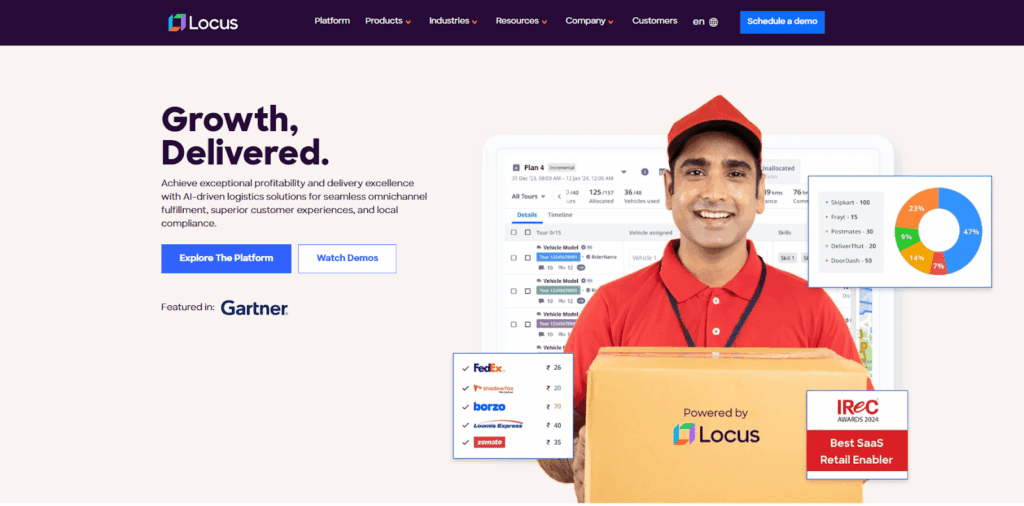
As an end-to-end logistics solution for all miles, Locus automates ground-level logistics operations. While competitors focus on visibility dashboards or upstream planning, Locus handles execution: assigning orders to drivers, optimizing stop sequences across 180+ variables, rerouting based on traffic or delivery failures—without manual intervention.
The platform covers inbound warehouse operations through final delivery. Planning decisions flow directly into dispatch workflows, eliminating the translation layer that plagues most multi-tool stacks.
Common Challenges Locus Resolves
System Slowness During Peak
G2 reviewers consistently note fast task assignment and responsive Control Tower performance even when managing thousands of concurrent orders. For operations managers handling holiday surges or flash-sale volumes, this means dispatch doesn’t bottleneck when it matters most.

Workflow Rigidity
Workflow Rigidity
Dispatchers can adjust routes mid-execution without breaking automated workflows. When customers reschedule or drivers report vehicle issues, teams make changes in real time. The system recalculates downstream impacts automatically—so logistics directors don’t have to choose between flexibility and automation.
Planning-Execution Gaps
Most planning platforms create optimized routes that ignore ground realities: driver preferences, vehicle constraints, and hyperlocal traffic patterns. Locus builds routes that execute successfully because planning and execution share the same operational data. For operations leaders, this means the route you plan is the route that runs.
Locus Is Ideal For
Multi-region or high-density delivery networks. E-commerce fulfillment, retail distribution, FMCG direct-to-consumer, pharmaceutical logistics, 3PLs and CEPs managing mixed fleets. Operations directors seeking to reduce cost per delivery while maintaining SLA compliance at scale.
Locus Key Features
Autonomous Route Optimization (DispatchIQ)
Optimizes across 180+ variables simultaneously: delivery windows, vehicle capacity, traffic patterns, driver hours, fuel efficiency, customer preferences, and road restrictions. The proprietary geocoding engine converts ambiguous addresses into precise coordinates—critical in regions without standardized formats. For logistics leaders, this means less manual rework and consistently higher SLA performance. The results speak for themselves: 25% efficiency gains, 45% more deliveries per vehicle.
Control Tower Software with Predictive Alerts
Three-tier visibility: manager dashboards, driver apps, and customer tracking. Predictive SLA breach detection flags potential delays 15–30 minutes early, enabling automated rerouting or proactive customer notification before the breach occurs.
Exception alerts trigger for route deviations, unauthorized stops, and temperature breaches (cold-chain). Escalation routes unresolved issues to supervisors automatically—so operations directors always know the current state without watching a screen.
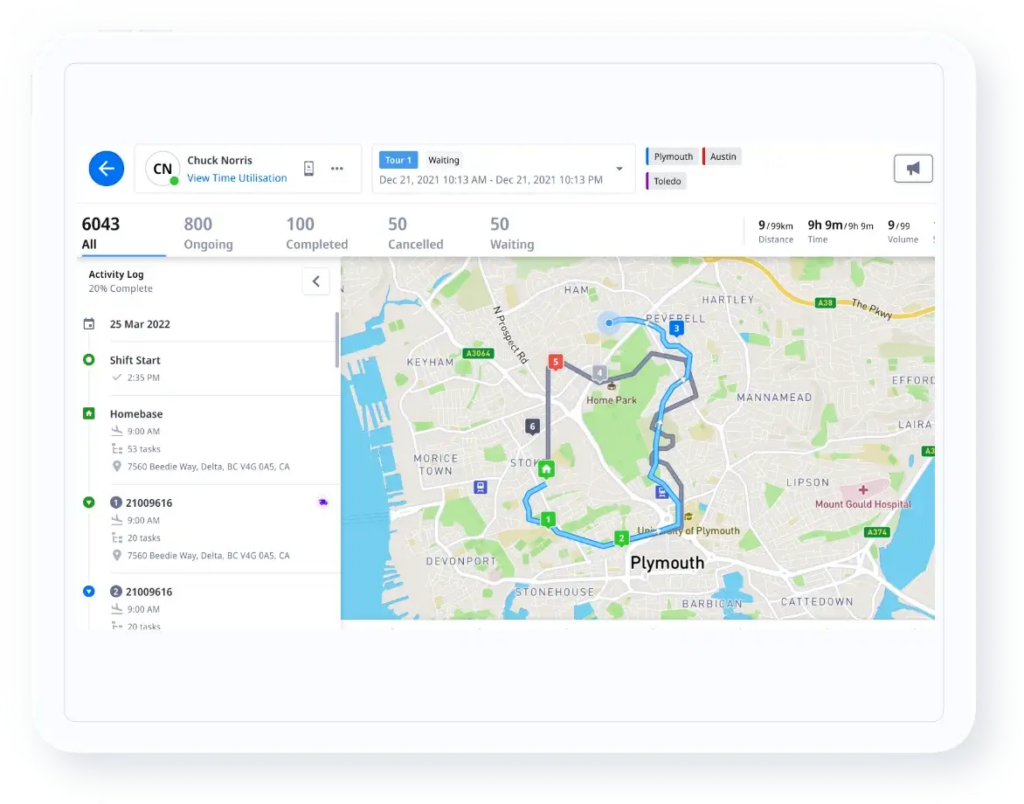
Exception alerts trigger for route deviations, unauthorized stops, and temperature breaches (cold-chain). Escalation routes unresolved issues to supervisors automatically.
Hub Operations Automation
Optimizes warehouse processes that directly impact delivery capacity: intelligent order sorting, automated scanning, pick-list optimization, and load balancing. Reduces “time under roof”—the gap between order receipt and dispatch—which is often the hidden bottleneck for fulfillment managers.
Carrier Orchestration (ShipFlex)
For operations mixing owned fleets with 3PLs, Locus automates carrier selection by cost, performance, capacity, and service requirements. Tracks performance and handles billing reconciliation. For 3PL managers, this means one platform replacing multiple carrier management spreadsheets.
Locus’ Pros
- Reliable AI routing adapts to traffic, density, and real-world constraints
- End-to-end orchestration connects routing, dispatch, and execution in a shared context
- Scales across fleet sizes, geographies, and delivery models without performance drops
- Exception dashboards and RCA tools designed for immediate decisions
Locus’ Cons
- Enterprise pricing excludes small operations with under 50 daily deliveries
- Implementation requires operational readiness: clean address data, defined constraints, trained teams
- Advanced features require integration with existing WMS or TMS systems
Locus’ Pricing
Locus’s pricing scales with your operational footprint, not your volume. We focus on coverage and modules rather than punishing your growth with per-stop or per-user fees.
- Fixed cost structure. Pricing is based on your geographic footprint, service area, and specific modules used.
- No transaction penalties. You won’t see charges for individual jobs, stops, or users, meaning your bill doesn’t spike during peak season.
- Predictable scaling. Your software costs remain stable even as your crew size and delivery counts grow.
- Built for expansion. A multi-year structure ensures you can scale volume without the friction of escalating transaction fees.
2. Outvio
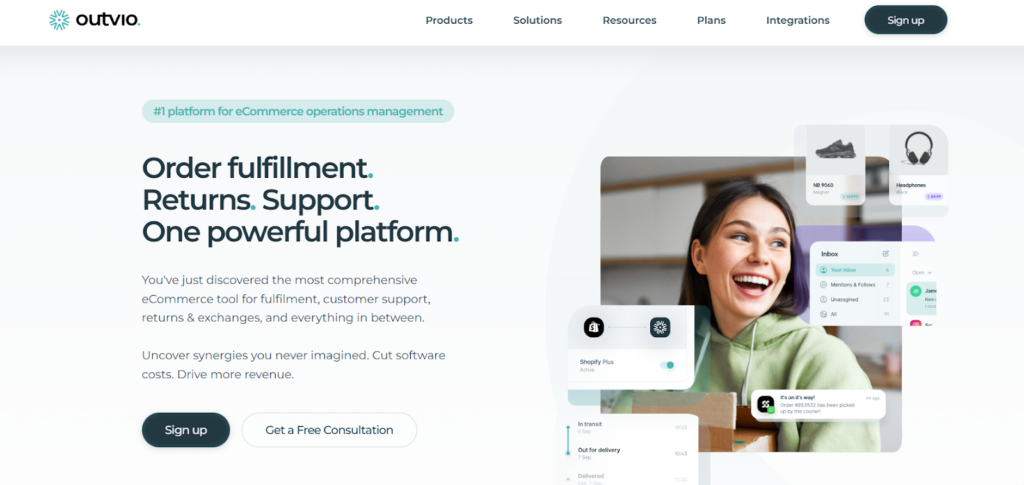
Outvio handles post-purchase logistics for e-commerce brands. It automates shipment tracking, returns management, and customer communications across multiple carriers. The platform focuses on the customer-facing side of delivery rather than internal routing or dispatch optimization.
Outvio Is Ideal For
E-commerce operations managers and D2C logistics leads shipping through multiple carriers who need a better post-purchase experience without investing in full logistics orchestration. Works well for 100–10,000 monthly shipments.
Outvio Key Features
- Branded tracking pages with real-time updates across 1,000+ carriers
- Automated returns portal with smart routing to the nearest return centers
- Customer communication workflows: SMS, email, app notifications
- Multi-carrier allocation by cost, speed, and service level
- NDR automation to reduce failed deliveries
Outvio’s Pros
- Strong multi-carrier integrations and unified tracking
- Excellent NDR and returns workflows for D2C and marketplaces
- Quick implementation with minimal operational disruption
Outvio’s Cons
- Not a full routing or dispatch automation platform
- Limited value for teams needing sophisticated planning or operational AI
Outvio’s Pricing
Tiered by monthly shipment volume. Starts around €59/month for up to 500 shipments, scales to custom enterprise pricing above 10,000 monthly.
3. Syren
Syren operates in the maritime control tower space, providing real-time container tracking, detention management, and exception handling for ocean freight. The platform focuses on execution-level decisions for importers and freight forwarders: which containers to prioritize, when to contest detention charges, and how to coordinate inland drayage.
Syren Is Ideal For
Import operations managers, freight forwarders, and logistics providers managing container shipments across multiple ocean carriers. Best for operations handling 100+ containers monthly, where detention costs and port congestion create significant financial exposure.
Syren Key Features
- Real-time container tracking across 95% of ocean carriers
- Automated detention and demurrage alerts with recommended actions
- Port congestion visibility and predictive arrival updates
- Drayage coordination for inland container movement
- Document management for bills of lading and customs paperwork
Syren’s Pros
- Extensive global carrier network with strong international support
- Checkout delivery options help reduce cart abandonment
- Stable, enterprise-grade tracking and SLA management
Syren Cons
- Limited to maritime/container logistics, not last-mile
- Requires integration with land-based execution systems
Syren’s Pricing
The custom plan is based on container volume and carrier integrations. Implementation includes carrier API connections and user training.
Planning-Led Control Towers: Key Platforms
Execution platforms manage the daily grind. Planning-led control towers optimize decisions well in advance—positioned before dispatch, they focus on network design and demand forecasting rather than last-mile routing. For supply chain VPs at large manufacturers and retailers, these tools shape the strategic operating framework.
Here are the key platforms you should know:
1. Blue Yonder
Blue Yonder (formerly JDA Software) is a planning-led control tower for large retailers and manufacturers needing strategic network optimization, inventory planning, and demand forecasting. It operates at the tactical and strategic level, helping companies design optimal supply chain networks rather than managing daily execution.
Notably, Blue Yonder’s own 2026 survey found that only 66% of supply chain leaders believe they are ready for the future—a decline that reinforces the urgency for better planning infrastructure.
Blue Yonder Is Ideal For
Fortune 500 retailers, CPG manufacturers, and large distributors with complex, multi-echelon supply chains. Supply chain VPs and planning directors at organizations where planning accuracy drives competitive advantage more than execution speed.
Blue Yonder Key Features
- End-to-end supply chain planning: demand forecasting, inventory optimization, network design
- Machine learning-driven demand sensing adjusts forecasts based on real-time signals
- S&OP workflows connecting commercial and operational planning
- Transportation optimization for strategic lane design and carrier contracts
- Multi-echelon inventory positioning balancing service levels against working capital
Blue Yonder’s Pros
- Comprehensive planning suite with strong retail and CPG focus
- Mature ML models for demand forecasting
- Deep ERP and WMS integrations
Blue Yonder’s Cons
- Sits upstream from execution—doesn’t handle daily routing or dispatch
- Implementation complexity requires significant change management
- Premium pricing limits accessibility for mid-market
Blue Yonder’s Pricing
Enterprise custom based on modules, licenses, and implementation scope. Typical implementations range from $500K to multi-million dollar deployments for global operations.
2. Kinaxis
Kinaxis RapidResponse is a planning platform built for complex manufacturing supply chains requiring scenario modeling, constraint-based planning, and S&OP coordination. It acts as a digital twin, allowing planners to test “what-if” scenarios before implementing changes—critical for operations where a planning error cascades across production lines.
Kinaxis Is Ideal For
Supply chain planning directors at automotive, aerospace, electronics, and industrial manufacturers with long lead times and complex bill-of-materials structures. Operations where planning accuracy and supplier coordination determine production success.
Kinaxis Key Features
- Concurrent planning allows multiple teams to collaborate on the same data model
- Scenario modeling tests supply chain responses to disruptions or demand changes
- Constraint-based planning accounts for capacity, material availability, and lead times
- Supplier collaboration portals for real-time visibility into the upstream supply chain
- Exception-based workflows alert planners only when intervention is required
Kinaxis’ Pros
- Strong concurrent planning capabilities for complex manufacturing
- Excellent scenario modeling for risk planning
- Responsive customer support for enterprise clients
Kinaxis’ Cons
- Doesn’t handle execution—daily routing and dispatch require separate tools
- Steep learning curve for planning teams
- High implementation costs for mid-size manufacturers
Kinaxis’ Pricing
Enterprise custom pricing is based on planning complexity, user count, and implementation services. Mid-size manufacturer deployments start around $300K annually.
3. o9 Solutions
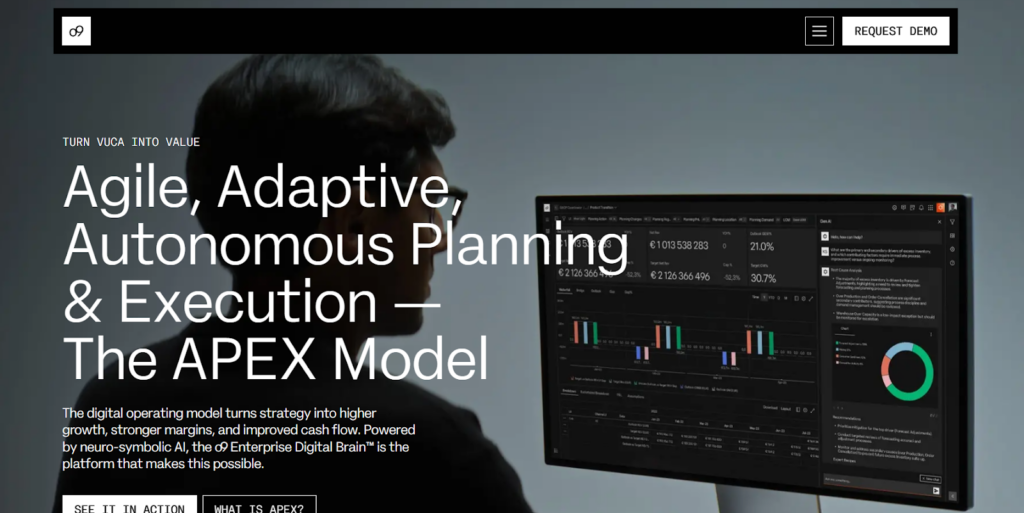
o9 Solutions offers integrated business planning (IBP) across demand, supply, inventory, and operations. The platform uses AI and digital twin modeling to connect commercial planning with operational execution, targeting global enterprises needing enterprise-wide planning alignment. Its “Digital Brain” integrates data from thousands of sources for AI-driven demand sensing.
o9 Solutions Is Ideal For
Global supply chain VPs and planning directors at manufacturers, CPG companies, and retailers above $1B revenue where planning fragmentation creates execution gaps across regions and business units.
o9 Solutions Key Features
- AI-driven demand sensing incorporates market signals, weather, and promotional impacts
- Digital twin modeling for end-to-end supply chain simulation
- Integrated business planning (IBP) connects financial and operational plans
- Prescriptive analytics recommend actions rather than just highlighting issues
- Real-time collaboration across commercial and supply chain teams
o9 Solutions’ Pros
- Strong IBP capabilities connecting finance and operations
- Modern UI compared to legacy planning platforms
- Flexible deployment options (cloud-native architecture)
o9 Solutions’ Cons
- Strategic planning focus—doesn’t handle daily execution
- Requires clean master data and strong internal governance
- Implementation timelines often exceed 12 months
o9 Solutions’ Pricing
Enterprise custom pricing is based on planning scope, data volume, and implementation complexity. Global enterprise implementations often exceed $1M+ in first-year costs.
Visibility-Led Control Towers: Major Platforms
Planning platforms optimize the future state. Visibility platforms track the current state. These control towers aggregate shipment and fleet data across carriers, providing real-time tracking and exception alerts—without automating execution decisions. For organizations with mature dispatch teams, they add oversight. For those needing autonomous decision-making, they’re necessary but insufficient.
1. Project44
Project44 is a visibility-led control tower for multi-modal shipment tracking. It connects with thousands of carriers across air, ocean, rail, and ground to provide unified tracking and exception management. The platform answers “where is my shipment?” across complex, multi-leg routes—making it a foundational layer for real-time supply chain visibility providers.
Project44 Is Ideal For
Logistics managers and supply chain operations teams at manufacturers, retailers, and logistics providers managing multi-modal shipments across multiple carriers. Operations where visibility gaps cause customer service issues or coordination failures between transportation modes.
Project44 Key Features
- Carrier network covering ocean, air, parcel, LTL/FTL freight
- Real-time tracking with predictive ETAs based on carrier data and traffic conditions
- Automated exception alerts for delays, route deviations, and missed milestones
- Carrier performance analytics to identify reliability issues
- API integrations for embedding tracking into customer portals or internal systems
Project44’s Pros
- Extensive carrier network with strong global coverage
- Reliable tracking data quality across modes
- Good API documentation for custom integrations
Project44’s Cons
- Visibility-only—doesn’t automate execution decisions
- Requires human response to alerts and exceptions
- Limited value for companies needing routing or dispatch automation
Project44’s Pricing
It’s tiered by shipment volume and carrier integrations. Starts around $10K annually for mid-market operations, scales to six-figure contracts for enterprise implementations.
2. SAP
SAP’s control tower capabilities sit within its Logistics Business Network and Integrated Business Planning modules. The platform provides visibility and exception management for companies already using SAP ERP, offering tight integration with order management, warehousing, and transportation systems without requiring third-party tools.
SAP Is Ideal For
IT directors and supply chain leaders at large enterprises standardized on SAP ERP who need visibility without integrating additional third-party control tower platforms. Operations where SAP already manages core supply chain transactions and a unified data model is non-negotiable.
SAP Key Features
- Native ERP integration for order, inventory, and shipment visibility
- Exception management workflows trigger alerts based on predefined thresholds
- Collaboration portals for sharing visibility with suppliers and logistics providers
- Analytics and reporting leveraging existing SAP data models
- Order promising with real-time ATP (available to promise) calculations
SAP’s Pros
- Seamless integration with existing SAP infrastructure
- Unified data model across ERP, WMS, TMS
- Strong in automotive, manufacturing, and retail
SAP’s Cons
- Limited execution capabilities—doesn’t handle routing or dispatch
- Best value comes from full SAP ecosystem adoption
- Customization often requires SAP consultants
SAP’s Pricing
Enterprise licensing is available based on SAP ERP footprint and module selection. Control tower functionality is often included in broader SAP S/4HANA or IBP licenses.
3. E2open
E2open is a visibility-led control tower focused on global trade and logistics networks. It provides multi-tier visibility connecting suppliers, manufacturers, logistics providers, and retailers into a shared operational view. The platform emphasizes supply chain orchestration across trading partners rather than internal execution—making it a strong choice for organizations where supplier visibility drives performance.
E2open Is Ideal For
Global supply chain directors and procurement leaders at manufacturers and retailers managing complex supplier networks across multiple regions. Operations where supplier visibility and trade compliance are the primary performance drivers.
E2open Key Features
- Multi-tier supplier visibility extending beyond direct suppliers to sub-tier manufacturers
- Transportation management with carrier selection and freight audit capabilities
- Global trade management for customs compliance and landed cost calculation
- Risk monitoring for supply chain disruptions, financial instability, and regulatory changes
- Collaboration portals allowing suppliers to update shipment status and capacity
E2open’s Pros
- Strong multi-tier visibility across complex supplier networks
- Good for global trade compliance and landed cost optimization
- Supplier collaboration features reduce manual coordination
E2open’s Cons
- Some users report slow customer support response times
- The platform can feel dated compared to modern cloud-native tools
- Limited execution capabilities for daily routing and dispatch
E2open’s Pricing
Enterprise custom pricing is based on network complexity, trading partner count, and module requirements. Typical implementations range from $200K to multi-million dollar deployments.
Hybrid/Specialized Solutions
Some platforms don’t fit cleanly into visibility, planning, or execution categories. They blend multiple approaches or target specialized use cases with AI-first architectures.
1. C3 AI
C3 AI offers an AI-native supply chain suite combining visibility, planning, and predictive analytics. Rather than positioning as purely planning or visibility, it focuses on applying machine learning to supply chain problems: demand forecasting, inventory optimization, exception prediction, and generative AI-powered root cause analysis. It’s an AI-powered supply chain control tower solution built for data-mature organizations.
C3 AI Is Ideal For
Chief data officers and supply chain transformation leads at AI-forward enterprises with strong data science teams willing to invest in data infrastructure and model training. Operations where custom AI applications can be built on top of supply chain data.
C3 AI Key Features
- Pre-built AI applications for demand sensing, inventory optimization, and supply chain risk
- Unified data platform connecting ERP, WMS, TMS, and IoT data sources
- Predictive analytics for forecasting demand, identifying supply risks, and detecting quality issues
- Prescriptive recommendations based on machine learning models
- Model deployment and monitoring tools for data science teams
C3 AI’s Pros
- Strong AI/ML foundation with flexible application framework
- Good for companies building custom AI applications
- Unified data layer across disparate systems
C3 AI’s Cons
- Requires significant data science resources to maximize value
- Implementation requires substantial data infrastructure investment
- Not purpose-built for daily logistics execution
C3 AI’s Pricing
The enterprise custom plan is based on data volume, AI application deployment, and professional services. Implementations require significant investment beyond software licensing.
Control tower implementation framework for global supply chains
Successful deployments depend on programme discipline as much as software selection.
Core implementation workstreams
- Master-data cleanup: customer addresses, site codes, service levels, carrier mappings, lane definitions
- Address quality and geocoding: especially critical in high-density delivery markets
- Constraint definition: vehicle capacities, shift rules, customer time windows, temperature rules, dock restrictions
- Integration readiness: APIs, batch jobs, message queues, identity, data ownership
- Driver and carrier onboarding: mobile workflows, exception codes, escalation rules
- Pilot-market design: choose a region, route type, or business unit with enough complexity to prove value without overwhelming the team
- Peak-day simulation: run stress tests before seasonal or promotional spikes
- Change management: dispatcher adoption, planner handoff clarity, stakeholder training
- Governance: who owns performance tuning, model changes, and exception policy after go-live
Pilot checklist
Before full rollout, test these scenarios explicitly:
- Driver absence before first wave
- Severe traffic disruption mid-route
- Failed delivery with customer reschedule
- Cold-chain excursion or vehicle breakdown
- Carrier capacity shortage
- Peak-volume surge
- Store refuses early arrival
- Priority order insertion after route release
Benefits of Using a Supply Chain Control Tower
For enterprise logistics teams, a well-matched control tower platform delivers measurable operational and financial advantages:
1. Reduced Cost Per Delivery
Execution-led control towers optimize routes across variables like traffic, vehicle capacity, and delivery windows simultaneously. Automated dispatch eliminates the labor cost of manual route building and driver assignment. Locus customers report 20% cost savings through automated execution alone.
2. Higher SLA Compliance Without More Headcount
Predictive SLA breach detection—flagging delays 15–30 minutes before they occur—allows automatic rerouting and proactive customer notification. Operations directors maintain service levels during peak without hiring additional dispatchers.
3. Increased Fleet Utilization
Route optimization that accounts for 180+ variables means more deliveries per vehicle, per shift. Locus users achieve 45% more deliveries per vehicle, directly improving asset ROI for fleet managers and 3PL operators.
4. Faster Exception Resolution
Visibility platforms surface problems. Execution platforms fix them autonomously. Automated exception handling—rerouting, customer notifications, escalation—reduces the mean time to resolution from minutes (or hours) to seconds.
5. Strategic Planning Alignment
For organizations combining planning-led tools (like Blue Yonder or Kinaxis) with execution platforms, control towers bridge the gap between quarterly strategy and daily operations. Demand forecasts translate directly into dispatch decisions without manual export-import cycles.
6. Scalability Without Performance Degradation
Enterprise-grade control towers maintain response times and optimization quality as fleet size, order volume, and geographic coverage expand. For growth-stage logistics operations, this means software doesn’t become the bottleneck.
7. Sustainability and Green Logistics
Optimized routing reduces total miles driven, fuel consumption, and carbon emissions per delivery. For logistics leaders pursuing sustainability targets, this is operational efficiency and environmental compliance in a single investment. Explore how Green Logistics strategies can complement your control tower deployment.
Key Features to Look for in Supply Chain Control Tower Providers
Before selecting a provider, operations directors and logistics VPs should evaluate platforms against these five capability dimensions:
1. Real-Time Visibility vs. Actionable Execution
Knowing where a truck is doesn’t fix a late delivery. Execution platforms reroute automatically when delays occur. Visibility platforms require someone to see the alert, call the driver, recalculate the route, and manually update customers.
An ideal platform handles all of that without dispatcher intervention. When traffic doubles the ETA for stop seven, the system should reroute stops eight through twelve, notify affected customers, and log the delay reason—all in under 30 seconds. For operations managers running hundreds of daily routes, this is the difference between a tool you watch and one that works for you.
2. Integration Depth with Execution Systems
Planning tools often sit separate from dispatch. Someone builds an optimal route in the planning system, then manually recreates it in the execution system. The gap between “what we planned” and “what we’re doing” creates constant reconciliation work for logistics teams.
Execution-native platforms connect planning directly to dispatch. Route changes flow into driver apps immediately. No manual translation layer. For supply chain transformation leads, this integration depth determines whether the new tool accelerates operations or adds another silo.
Learn how to Choose the Right Route Planning Software that integrates with your execution layer.
3. Planning Sophistication vs. Ground-Level Execution
Planning platforms solve for “what if.” Execution platforms solve for “what now.” You can have a flawless seasonal strategy, but it won’t fix a Tuesday morning labor shortage.
Know your bottleneck: are you failing to plan, or failing to react? For most high-frequency delivery operations, the answer is both—which is why execution platforms that accept planning inputs deliver the highest compound ROI.
4. Scalability and Industry-Specific Customization
A control tower is only as good as its understanding of your specific constraints. Retail requires store-hour compliance. FMCG demands cold-chain integrity. E-commerce lives or dies by its returns workflow. Operations managing last-mile delivery in SEA face entirely different address and infrastructure challenges.
If you have to write custom code for every industry edge case, that creates technical debt and fragility. True scalability means these rules are native to the platform, not a bolted-on afterthought.
5. AI/ML for Predictive vs. Prescriptive Actions
Predictive AI tells you what will happen. Prescriptive AI decides what to do. Visibility platforms predict SLA breaches. Execution platforms automatically reroute before the breach occurs.
Control tower software with predictive analytics is table stakes in 2026. The differentiator is whether the system acts on its predictions autonomously or requires a human to interpret a dashboard and make a call. For logistics directors managing scale, that distinction determines staffing requirements and exception resolution speed.
Why Locus Is the Execution-Native Choice
Control towers that only show problems or forecast future states don’t change daily outcomes. Execution-native platforms automate the decisions that determine whether deliveries succeed: route optimization, real-time dispatch, exception handling, and customer communication.
When enterprise logistics teams evaluate control towers, three alternatives typically compete with Locus. Here’s why we believe the execution layer is where ROI is decided:
Blue Yonder builds optimal plans. It models network design, forecasts demand, and positions inventory for the next quarter. But when your Tuesday morning driver calls in sick or a delivery window shifts, it doesn’t reroute 47 downstream stops automatically. Someone has to export the plan, rebuild routes in a dispatch system, and coordinate manually. The gap between strategic intent and ground-level execution persists.
Locus eliminates that gap. Planning flows directly into dispatch. Route changes push to driver apps immediately. A driver shortage at 6 AM triggers automatic redistribution across available capacity with updated customer ETAs—no dispatcher intervention, no manual translation layer.
E2open tracks shipments across your supplier network. But your team still needs to decide: reroute the driver, notify the customer, or adjust downstream stops. The coordination overhead scales linearly with delivery volume.
Locus automates the fix. Predictive alerts flag SLA breaches 15–30 minutes early. The system reroutes automatically, notifies customers proactively, and recalculates the entire sequence. Exception handling becomes autonomous, not alert-driven.
Project44 provides real-time carrier tracking. But tracking doesn’t optimize routes or automate dispatch. It reports what happened—it doesn’t decide what happens next.
Locus operates at the decision layer. Route optimization across 180+ variables: delivery windows, traffic patterns, vehicle capacity, driver hours, customer preferences. When conditions shift mid-route, sequences recalculate automatically.
The difference is clear: Blue Yonder plans it, E2open tracks it, Project44 reports it. Locus executes it—autonomously, in real time, at scale.
This is why companies using Locus report 25% efficiency gains, 45% more deliveries per vehicle, 20% cost savings, and 8% SLA improvement. Not from better visibility or planning—from automated execution where logistics outcomes are actually decided.
Why Locus? Visibility identifies the problem. Planning models the solution. Locus executes the fix—autonomously. For operations directors and logistics VPs managing high-density delivery networks, our platform turns planning intent into ground-level precision without adding headcount, manual steps, or coordination overhead. That’s execution-native, and it’s why our customers consistently outperform on cost per delivery, SLA compliance, and fleet utilization.
Frequently Asked Questions (FAQs)
1. What’s the difference between visibility-led and execution-led control towers?
At Locus, we see visibility-led control towers as the first step—they track shipments and alert you when problems occur. Execution-led platforms go further by automating routing, dispatch, and exception handling, taking action to fix problems rather than just reporting them. Visibility requires human intervention; execution operates autonomously. For operations running hundreds of daily deliveries, that difference translates directly into staffing requirements and SLA outcomes.
2. Can planning-led and execution-led platforms work together?
Yes, and many enterprises use both. Planning platforms like Blue Yonder or Kinaxis handle strategic network design and demand forecasting months ahead. Execution platforms like Locus translate those plans into daily routing and dispatch decisions. The combination works well: planning for quarterly optimization, execution for daily operations. The key is ensuring data flows between them without manual export-import cycles.
3. How do I know if I need execution capabilities in my control tower?
If your operations manage over 50 daily deliveries, handle time-sensitive SLAs, or run dense multi-stop routes, execution automation generates measurable ROI. Teams spending significant time on manual dispatch, route planning, or exception handling benefit most from execution-native platforms. A clear signal: if you’re hiring more dispatchers to handle growing volume rather than automating the dispatch process, it’s time for execution-led tooling.
4. What industries benefit most from execution-led control towers?
E-commerce fulfillment, retail distribution, food delivery, pharmaceutical logistics, FMCG direct-to-consumer, and 3PL operations. Any industry where delivery density, SLA compliance, and cost per delivery determine profitability. We’ve also seen strong adoption in last-mile delivery in SEA, where address ambiguity and infrastructure variability make automated geocoding and rerouting essential.
5. How does Locus compare to Blue Yonder or Kinaxis for control tower needs?
Blue Yonder and Kinaxis excel at strategic planning and network optimization months in advance. Locus operates at the execution layer: daily routing, real-time dispatch, and ground-level decision automation. Companies often use planning platforms for strategic decisions and Locus for operational execution. The distinction is operating layer, not quality—Blue Yonder plans the network, Locus executes the deliveries within it.
6. What is a planning-led control tower?
Planning-led towers like Kinaxis and o9 Solutions optimize strategic decisions: inventory positioning, demand forecasting, and network design—typically months ahead. They run simulations for capacity and cost trade-offs but do not handle daily execution like dispatching trucks or assigning drivers. For supply chain VPs, they’re the strategic backbone; for operations directors managing daily routes, they need an execution layer underneath.
7. How does E2open differ from other control tower providers?
E2open is visibility-led, focusing on global trade with multi-tier views connecting suppliers, manufacturers, and retailers. It emphasizes orchestration across trading partners rather than internal execution. For global procurement leaders, it provides shared operational views that unify siloed decision-making across supplier networks—but it doesn’t optimize daily delivery routes or automate dispatch.
8. What AI capabilities do modern control towers offer in 2026?
AI-powered supply chain control tower solutions in 2026 range from predictive analytics (demand sensing, disruption forecasting) to prescriptive automation (autonomous rerouting, carrier selection). C3 AI provides generative AI-powered visibility and root cause analysis. o9’s Digital Brain integrates data from thousands of sources. Locus uses AI/ML for real-time route optimization across 180+ variables and predictive SLA breach detection. The differentiator is whether AI informs a human or acts autonomously.
9. How big is the supply chain control tower market in 2026?
The global supply chain control tower market is anticipated at USD 8.75 billion in 2026, up from USD 7.57 billion in 2025. North America accounted for 37.2% of global market share in 2024. Growth is driven by enterprises shifting from reactive visibility toward autonomous execution and AI-driven decision-making.
10. What should I look for when comparing supply chain control tower vendors?
Start by identifying your operational bottleneck: Are you failing to plan, failing to track, or failing to execute? Match the control tower model to your gap. Then evaluate integration depth with your existing WMS/TMS/ERP, scalability under peak load, industry-specific constraint handling, and whether the platform’s AI acts autonomously or requires human interpretation. Finally, assess pricing structure—per-stop fees can erode ROI at scale, while fixed-cost models like Locus keep costs predictable as volume grows.


General
Multi-Client Driver Routes in 2026: What Switching Between Client Standards Costs

Sep 22, 2026
A four-client route contains about 44 client switches. Grouping stops into runs of three removes 68% of them, worth roughly 2.4 extra stops a shift.
Read more
General
The Future of the Fleet Management Market: Trends to Watch for 2026 and Beyond

Sep 22, 2026
Understand fleet management industry trends for 2026, including technology, compliance, sustainability, and cost pressures shaping daily operations.
Read moreInsights Worth Your Time




















Best Supply Chain Control Tower Providers in 2026