


General
Real-Time Visibility in Bangkok When the Rules Change in a Day: Floods, Truck Bans and Dynamic ETAs in 2026
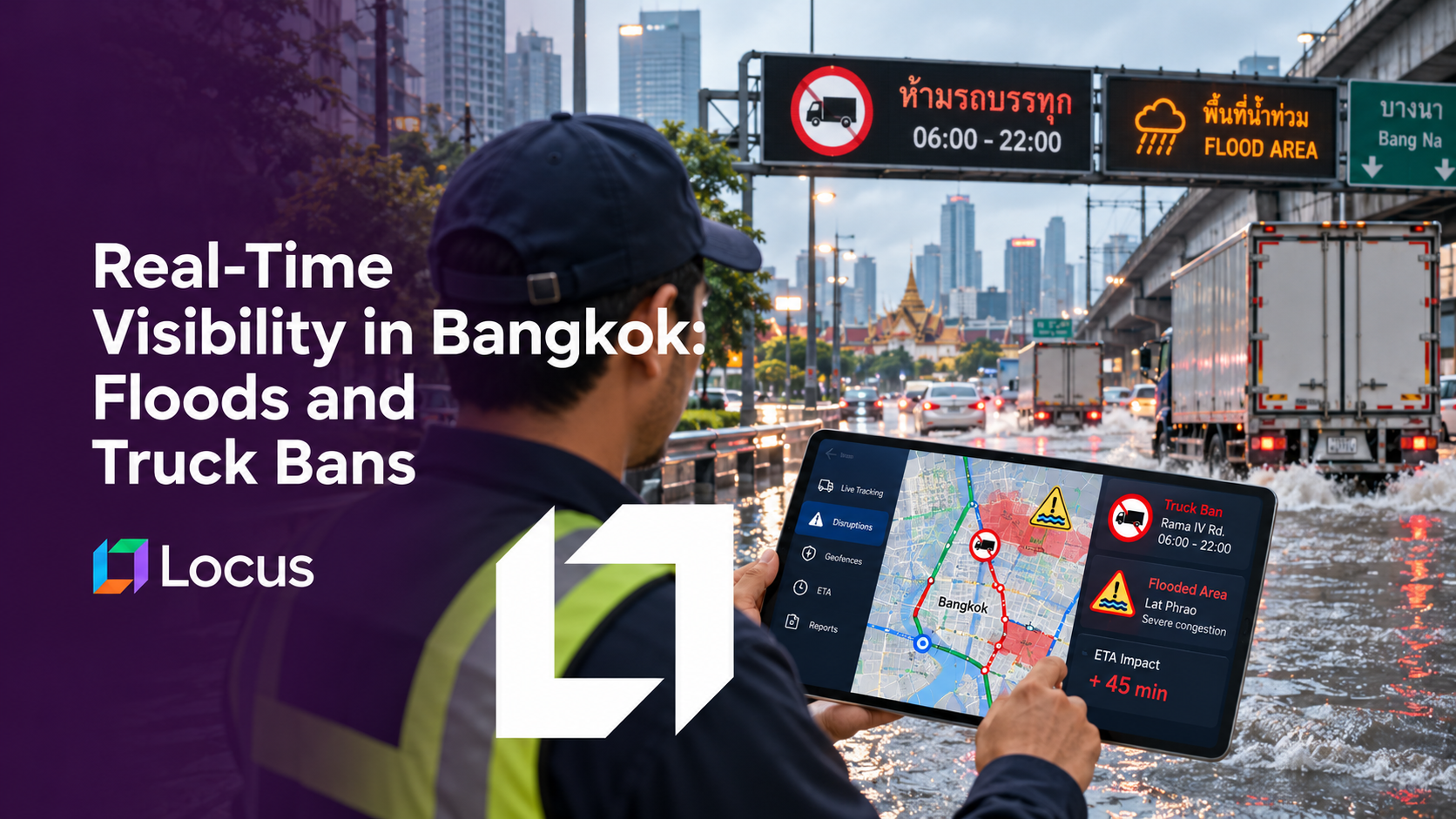
Real-time visibility in Bangkok is live knowledge of where each delivery vehicle is, which roads and zones it can actually use right now, and what that means for every promised arrival time. Unlike a fixed calendar of driving bans, Bangkok’s constraints are event-driven: a flood can close a district in hours, and a PM2.5 episode can restrict six-wheel trucks from the inner city at short notice. For retailers, FMCG distributors and 3PLs delivering in Bangkok, a GPS dot and a static ETA are wrong precisely when customers and stores need the truth. Locus, the world’s first Decision-Intelligent, Agentic TMS, gives operations the decision layer to re-plan and re-promise as conditions change.
Key Takeaways
- Bangkok declared a flood disaster across all 50 districts on 26 September 2026, after 487 mm of rain fell between 1 and 25 September against a 1991 to 2020 average of about 269 mm.
- A Rangsit University estimate put losses for 24 to 27 September at 25.3 billion baht, with Bangkok at 10.6 billion baht and wholesale and retail 23.4% of Bangkok’s share.
- Bangkok’s low-emission zone restricts non-registered trucks with six or more wheels during severe PM2.5 episodes, typically November to March, and 4,284 of 5,569 trucks entering in the January 2025 episode were not on the Green List.
- Bangkok’s average congestion was 67.9% in 2025, so a restriction that removes one vehicle class loads the rest of the network.
- Locus’s Dispatch agent re-plans against 250+ real-world constraints, and its Customer agent updates notifications from the current plan.
Why Real-Time Visibility Matters in Bangkok: The Business Case
Flooding can arrive within days. Bangkok authorities declared a flood disaster across all 50 districts on 26 September 2026, with 487 mm of rain from 1 to 25 September against a 1991 to 2020 average of about 269 mm, at least 13 major roads flooded and drainage expected to take two to three days after the rain stopped.
The cost is large. Rangsit University estimated 25.3 billion baht in losses for 24 to 27 September under a moderate-damage scenario, with Bangkok accounting for 10.586 billion baht and wholesale and retail making up 23.4% of Bangkok’s estimated losses.
Transport capacity tightens. DHL’s 28 September customer advisory reported that truck availability was constrained by the flooding, affecting pick-up and delivery from some shipper locations, while Laem Chabang port and the Lat Krabang inland container depot remained operational.
Truck restrictions are real, not theoretical. In the January 2025 PM2.5 episode, 5,569 trucks entered the low-emission zone, of which 1,285 were on the Green List and 4,284 were not, and Bangkok has planned to extend the zone from 22 districts to all 50 in 2026.
The base network is already stressed. In TomTom’s 2025 index, Bangkok’s average congestion was 67.9%, so any event that removes capacity compounds an existing delay.
What Is Different About Visibility in Bangkok
Constraints are triggered by events, not dates. A flood warning or a severe PM2.5 reading changes what is allowed or possible, so the constraint layer has to update from live signals, not from an annual calendar.
Passability varies street by street. A main road can be flooded while a parallel soi is open, and the situation can reverse within hours, so a citywide status is not enough.
Restrictions follow vehicle attributes. The low-emission zone targets trucks with six or more wheels that are not on the Green List, so vehicle class, wheel count and registration status decide who can enter.
Vehicle mix changes the answer. Bangkok deliveries run on motorbikes, vans and trucks, and a disruption that stops trucks may still allow motorbikes, which changes re-planning options.
Demand moves during a disruption. Reports from the 26 September flooding described convenience-store shelves emptying as residents stocked up, so replenishment priorities shift while delivery is hardest.
How to Build Restriction-Aware Visibility in Bangkok in Six Steps
1. Hold vehicle attributes in a register
Record wheel count, fuel type, Euro class and Green List status for every truck and van that can serve a Bangkok route, including subcontracted ones. These attributes decide which restrictions apply.
2. Ingest restriction and weather signals as a live constraint layer
Bring in city announcements of low-emission-zone activations, weather and flood warnings and road closures as constraints with a zone, a start and an expected end. The plan should react when a signal arrives, not at the next morning meeting.
3. Track passability, not just position
Mark zones and corridors as open, slow or closed, using driver reports and the collapse of vehicle speeds on a segment. A vehicle stopped in a flooded road tells the system more than a map layer does.
4. Re-plan by vehicle class and hub
When a restriction or flood hits, shift deliveries to vehicle types that can still move, hold stock at hubs outside the affected zone and re-sequence by priority, such as stores with empty shelves first.
5. Re-promise honestly
Update ETAs and send notices to stores and customers from the revised plan, with a clear reason. An honest late time beats a missed on-time promise.
6. Log the disruption and its cost
Record which zones were affected, which stops were delayed, which vehicles were restricted and what re-planning cost. This evidence supports SLA discussions, claims and the next season’s planning.
Static Tracking vs Event-Aware vs Disruption-Aware Visibility: Key Differences
| Dimension | Static tracking | Event-aware tracking | Disruption-aware planning and tracking |
|---|---|---|---|
| What it shows | Vehicle position and a fixed ETA | Position plus weather and restriction alerts | Position, passability, vehicle eligibility and revised plan |
| Constraint updates | Manual, by phone or chat | Alerts to dispatchers | Constraints update the plan automatically |
| Vehicle attributes | Not held | Partly | Wheel count, Green List status and class in the register |
| Passability | Unknown | Map layers | Zone status from driver reports and speed collapse |
| Re-planning | By hand, after the fact | Suggested | Re-optimized by vehicle class and hub |
| ETA and notices | Stale until corrected | Manually revised | Recalculated and sent from the new plan |
What to Look for in Disruption-Aware Visibility Software
Live constraint inputs. Ask how the platform ingests restriction announcements, flood and weather signals and road closures, and how fast they affect the plan.
Vehicle-level eligibility. Look for support for attributes such as wheel count, fuel type and registration status, with rules that apply by zone and time.
Re-planning by vehicle class. Check that the engine can reassign stops across motorbikes, vans and trucks and across hubs when one class is restricted.
Honest customer communication. Look for notifications and store updates generated from the live plan, with reasons for delays.
Audit and governance. Check for logs of disruptions, overrides and approvals, with autonomy levels so teams control how much the system changes on its own.
Visibility in Action: Real-World Results
These deployments are in Thailand but are not flood or truck-ban events. They show what live planning and visibility deliver at Thai scale.
A Thai retailer with 170+ stores. Planners spent two hours a day on routing per store, and manual dispatch capped profitability as digital demand grew. With automated, wave-based dispatch and capacity-aware slot grouping, the retailer reduced logistics cost by 16.7%, cut dispatch time from two hours to under 30 minutes per store, raised rider productivity by 50% and rolled out to 150 stores in three months. Read the Thai retailer case study.
A global food and beverage leader in Thailand and across Southeast Asia and MENA. Thailand alone runs 100+ distribution centers across 33+ cities serving 150,000+ outlets, with 18+ million orders a year and 5,000+ vehicle dispatches a month. With Locus’s dispatch, capacity, carrier and hub agents, it reached 97%+ SLA adherence, 22% lower procurement cost and 15% better rider time efficiency. Read the F&B leader case study.
Common Bangkok Visibility Mistakes to Avoid
Treating restrictions as an annual calendar. Floods and PM2.5 episodes are triggered by conditions, so a calendar built in January is wrong in September.
Tracking position without passability. A vehicle can be exactly where the plan says and still be stuck in standing water. Position alone hides it.
Ignoring vehicle attributes. A truck’s wheel count and Green List status decide whether it may enter. Without them in the system, a restriction becomes a fine or a turned-back truck.
Holding the original promise. Keeping a stale ETA until the truck is overdue spends customer trust. Re-promise as soon as the plan changes.
How Locus Helps Bangkok Operations See and Re-Plan Through Disruption
Locus, the world’s first Decision-Intelligent, Agentic TMS, was recognized by Gartner for seven consecutive years and appears in the 2026 Hype Cycle for Supply Chain Execution and Logistics Technologies. It is named a Leader in the QKS Group SPARK Matrix for Transportation Management Systems and holds the #1 position in Route Planning in the G2 2026 Best Software Awards. In October 2025, Ingka Investments, the investment arm of Ingka Group, the world’s largest IKEA retailer, acquired Locus. Locus continues to operate independently.
Locus’s Dispatch agent re-optimizes routes against 250+ real-world constraints, its Capacity agent plans available capacity across vehicle types, its Hub agent coordinates hub flows, its Carrier agent allocates transporters and its Customer agent generates notifications from the current plan, so a revised ETA reaches the store or customer. The platform’s shipment tracking system provides live tracking with predictive ETA alerts and a control tower for operations teams. Six governance mechanisms, including explainability, autonomy levels and human-in-the-loop approval, keep teams in control of re-plans. Locus has optimized 1.5B+ deliveries for 360+ enterprise customers across 30+ countries, including large Thai operations. During evaluation, ask Locus how it ingests Bangkok flood and low-emission-zone announcements, how it holds vehicle attributes such as wheel count and Green List status, and whether it supports Thai-language notifications. To see how Locus would run your Bangkok network, schedule a demo.
For logistics leaders asking how to get real-time visibility in Bangkok, Locus gives one governed decision layer where restrictions, passability, vehicle eligibility, ETAs and notifications stay in step as conditions change.
Frequently Asked Questions
What is real-time visibility in Bangkok logistics? It is live knowledge of where each vehicle is, which roads and zones it can use right now and what that means for every ETA. In Bangkok it must include floods and truck restrictions, which change in hours.
What truck restrictions apply in Bangkok? Bangkok’s low-emission zone restricts trucks with six or more wheels that are not on the Green List from inner-city areas during severe PM2.5 episodes, typically November to March. The city has planned to extend the zone from 22 districts to all 50 in 2026. Check current announcements.
How did the September 2026 floods affect logistics in Bangkok? Authorities declared a flood disaster across all 50 districts on 26 September 2026, with at least 13 major roads flooded. DHL reported constrained truck availability, and Rangsit University estimated 25.3 billion baht in losses for 24 to 27 September.
How should a 3PL handle a sudden truck ban or flood in Bangkok? Update constraints from the announcement, re-plan by vehicle class and hub, prioritize stores or customers at greatest risk, and send revised ETAs with reasons. Keep a log of the disruption for SLA discussions.
What vehicle data should a Bangkok fleet register hold? Hold wheel count, fuel type, Euro class and Green List status for every truck and van, including subcontracted ones, with the dates and zones to which restrictions apply.
Can Locus handle Bangkok flood and truck-restriction rules? Locus re-plans against 250+ constraints and has deployments in Thailand, but public sources do not list a Bangkok flood or low-emission-zone feed. Ask Locus to confirm how it ingests those signals and models vehicle attributes for your network.


General
Real-Time Visibility in Germany: Why Sunday and Holiday Truck Bans Must Be Part of Every ETA in 2026

Oct 9, 2026
A GPS ETA that ignores Germany's Sunday and holiday truck bans is wrong by design. How to build the ban calendar into real-time visibility and ETAs.
Read more
General
Last-Mile Delivery Efficiency in Paris: How to Complete More Stops per Hour Across Bays, Zones and Cargo Bikes in 2026

Oct 9, 2026
Paris last-mile efficiency is won at the curb, not on the road. How to plan bays, zones, hubs and cargo bikes to complete more stops per hour in 2026.
Read moreInsights Worth Your Time



















Real-Time Visibility in Bangkok When the Rules Change in a Day: Floods, Truck Bans and Dynamic ETAs in 2026