


General
Real-Time Visibility in Germany: Why Sunday and Holiday Truck Bans Must Be Part of Every ETA in 2026
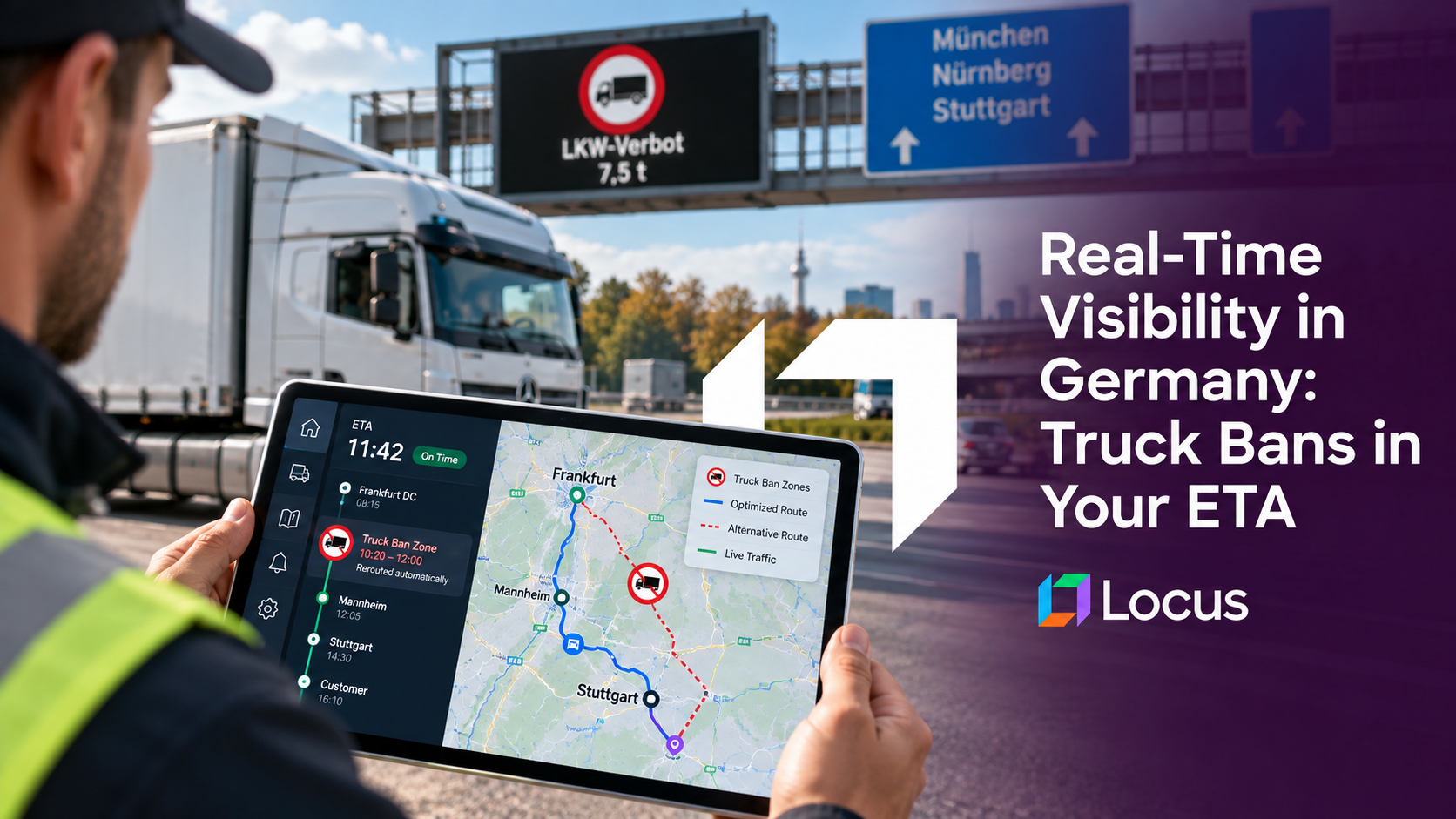
Real-time visibility in Germany is live knowledge of where each freight vehicle is and when it can legally arrive, which depends on a calendar of driving bans as much as on distance and traffic. Trucks over 7.5 tonnes may not carry goods commercially on Sundays and public holidays between midnight and 22:00, and in summer a Saturday ban applies on listed routes, so an ETA computed from GPS and traffic alone can be wrong by days. For retailers, manufacturers and the carriers serving them, the ban calendar is a data input. Locus, the world’s first Decision-Intelligent, Agentic TMS, gives operations the decision layer to plan and communicate around it.
Key Takeaways
- Trucks over 7.5 tonnes, and their trailers, may not carry goods commercially on Sundays and public holidays from 00:00 to 22:00 under section 30 of the StVO.
- Christmas 2026 creates a 70-hour ban window: 25 December is a Friday, 26 December a Saturday and 27 December a Sunday, so trucks are barred from Friday 00:00 to Sunday 22:00.
- An ETA that ignores the ban can be wrong by about 70 hours, as the illustrative example below shows.
- Summer Saturday bans on listed routes, driver-hours rules and state-specific holidays add further rules.
- Locus’s Dispatch agent plans against 250+ real-world constraints and its Customer agent updates notifications from the current plan, so a ban-aware ETA can reach the customer.
Why Real-Time Visibility Matters in Germany: The Business Case
The ban is statutory. Under section 30 of the StVO, trucks with a permitted total mass over 7.5 tonnes, and trailers towed behind them, may not be used for commercial or paid carriage of goods, including related empty runs, on Sundays and public holidays from 0:00 to 22:00.
Holidays create long windows. 3 October 2026, German Unity Day, falls on a Saturday, and 25 and 26 December are public holidays under the same rule, so Christmas 2026, with the Sunday that follows, forms a ban window that runs from Friday 00:00 to Sunday 22:00.
Summer adds Saturdays. The Ferienreiseverordnung bars trucks over 7.5 tonnes from listed motorways and federal roads on Saturdays from 1 July to 31 August between 7:00 and 20:00, and the route list is set each year.
Driver hours add another clock. EU rules on driving time require a break of at least 45 minutes after 4.5 hours of driving and limit daily driving to 9 hours, with extensions allowed, according to the EUR-Lex summary of Regulation 561/2006.
Road freight is large and under strain. According to the federal office for goods transport, road freight volume rose 0.9% in 2025 while transport performance fell 0.9%, as longer hauls declined.
What Is Different About Visibility in Germany
The ban depends on the vehicle. It applies to trucks over 7.5 tonnes and trailers, not to vans, so line-haul and distribution-centre replenishment are exposed while last-mile vans are not.
The calendar is not uniform. Some holidays, such as Corpus Christi, Reformation Day and All Saints’ Day, apply only in certain states, so the same truck faces a ban in one state and none in the next.
Exemptions exist and are narrow. Section 30 exempts goods such as fresh milk, meat, fish and perishable fruit and vegetables, and specific combined-transport legs, so the load decides whether the ban applies.
Bans interact with driver hours. A driver who stops at 00:00 may use the time for rest, but the legal restart and the break rules decide when the truck can move again.
Customers do not see the calendar. A receiving site expecting a Friday delivery gets nothing, and the first sign is a late truck, unless the ETA already knows.
How to Build the Ban Calendar into Visibility in Six Steps
1. Load the ban calendar as data
Maintain national holidays, state-specific holidays and the annual Saturday route list in one table with dates, hours and affected states. Review it every year.
2. Classify loads and vehicles
Tag each shipment with vehicle weight class and load type, so the system knows whether the ban applies and whether an exemption such as fresh produce does.
3. Compute the latest legal departure and earliest legal restart
For each shipment, calculate when the truck must stop before a ban and when it can move again, using the route and the states it crosses.
4. Raise an exception before the ban, not after
Alert dispatch when a shipment’s planned arrival falls inside a ban window, with enough time to act, rather than when the truck is already parked.
5. Offer options with their cost
Show the choices: bring the departure forward, pre-position the load, switch to an exempt or smaller vehicle where allowed, split the load or reschedule the delivery, each with its ETA effect.
6. Communicate the revised ETA to the receiver
Update the delivery promise and the receiving site’s schedule from the new plan, so the warehouse and the customer see the real arrival time.
GPS ETA vs Ban-Aware ETA vs Ban-Aware Plan: Key Differences
The example is illustrative: a truck over 7.5 tonnes is five hours of driving from a German destination at 21:00 on Thursday 24 December 2026, carries a non-exempt load and ignores driver-hours limits and state variations.
| Dimension | GPS and traffic ETA | Ban-aware ETA | Ban-aware plan |
|---|---|---|---|
| Inputs | Position, distance, traffic | Position, traffic and ban calendar | Calendar, load class, driver hours and options |
| Predicted arrival in the example | Friday 25 December, 02:00 | Monday 28 December, 00:00 | Chosen option, such as earlier departure or rescheduled receiving |
| Error against reality | About 70 hours early | Close | Avoided or planned |
| When the problem is seen | When the truck is parked | In advance | Before departure |
| Customer message | Wrong time promised | Revised time sent | Promise set correctly from the start |
What to Look for in Ban-Aware Visibility Software
A maintained calendar of bans. Ask who maintains national, state and Saturday route data, and how often it is updated.
Load and vehicle classification. Look for support for weight class, load type and exemption rules in planning and in ETA calculation.
Predictive ETAs that use constraints. Check that arrival forecasts use planned stops, ban windows and driver-hours limits, not just traffic.
Exception alerts with options. A useful alert comes with choices and their ETA effect, early enough to act.
Customer and site communication. Look for notifications and receiving-site schedules that update from the revised plan.
Visibility in Action: Real-World Results
Neither deployment is in Germany. They show what live planning and unified tracking deliver.
A leading Canadian grocery brand across 30+ cities. Carrier decisions were made against spreadsheets and visibility was fragmented across carrier portals. With autonomous carrier selection and a unified tracking dashboard, the brand reached a 33% faster fulfilment cycle, 15% lower fulfilment cost and support ticket resolution 10 to 20 times faster. Read the Canadian grocery case study.
A Canadian multi-modal retailer. Six legacy systems handled dispatch across modes. After consolidating them on one platform, the retailer reached 99%+ on-time delivery, cut manual dispatch by 80%+, kept exceptions under two hours and saved $1M+. Read the retailer case study.
Common German Truck-Ban Visibility Mistakes to Avoid
Computing ETAs from GPS alone. Traffic and distance cannot see a driving ban, so the ETA is wrong from the moment the ban window opens.
Treating the holiday list as national. State-specific holidays mean the same lane has a ban on one side of a border and none on the other.
Ignoring the load. Exempt goods such as fresh milk or perishable produce move on banned days, so applying the ban to every shipment creates false exceptions.
Finding out when the truck stops. An exception raised after the truck is parked leaves no option except to wait. Raise it before departure.
How Locus Helps German Operations Build Truck Bans into ETAs
Locus, the world’s first Decision-Intelligent, Agentic TMS, was recognized by Gartner for seven consecutive years and appears in the 2026 Hype Cycle for Supply Chain Execution and Logistics Technologies. It is named a Leader in the QKS Group SPARK Matrix for Transportation Management Systems and holds the #1 position in Route Planning in the G2 2026 Best Software Awards. In October 2025, Ingka Investments, the investment arm of Ingka Group, the world’s largest IKEA retailer, acquired Locus. Locus continues to operate independently.
Locus’s Dispatch agent plans against 250+ real-world constraints, its Carrier agent scores and allocates transporters, its Orchestrator coordinates the agents and its Customer agent generates notifications from the current plan, so a revised arrival time reaches the receiver. The platform’s predictive ETA approach is built on the difference between knowing a shipment is late and having time to respond. Six governance mechanisms, including explainability, autonomy levels and human-in-the-loop approval, keep teams in control. Locus has optimized 1.5B+ deliveries for 360+ enterprise customers across 30+ countries. Its proof points come from other regions. During evaluation, ask Locus how it holds German national and state holidays, the annual Saturday route list and load exemptions as constraints, how it combines them with driver-hours rules and whether it supports German-language notifications. To see how Locus would run your German network, schedule a demo.
For logistics leaders asking how to get real-time visibility in Germany, Locus gives one governed decision layer where the ban calendar, route plans, ETAs and receiver notifications stay in step.
Frequently Asked Questions
When are trucks banned from driving in Germany? Trucks over 7.5 tonnes, and trailers towed behind them, may not carry goods commercially on Sundays and public holidays from 0:00 to 22:00 under section 30 of the StVO. In summer, a Saturday ban applies on listed routes from 1 July to 31 August, 7:00 to 20:00.
Which goods are exempt from the German Sunday truck ban? Section 30 exempts fresh milk and dairy products, fresh meat, fresh and live fish and perishable fruit and vegetables, along with certain combined-transport legs and some other cases. Check the current text for each load.
Does the ban apply to vans? No. The ban applies to trucks with a permitted total mass over 7.5 tonnes and their trailers, so vans used for last-mile delivery are outside it, while line-haul and replenishment trucks are exposed.
Why is a GPS ETA wrong during a German driving ban? GPS and traffic models assume the truck can keep moving. During a ban it cannot, so a shipment that GPS says arrives on Friday may not move until Sunday 22:00, which is why the ETA needs the ban calendar as an input.
How does the Christmas 2026 ban window work? 25 December 2026 is a Friday and 26 December a Saturday, both public holidays, followed by Sunday 27 December, so trucks are barred from Friday 00:00 to Sunday 22:00, a window of 70 hours. Plan departures and receiving schedules before it starts.
Can Locus handle German driving bans? Locus plans against 250+ constraints and updates notifications from the live plan, but public sources do not list a German ban calendar. Ask Locus to confirm how it models national and state holidays, Saturday routes and load exemptions for your network.


General
Real-Time Visibility in New York City: Tracking Zone Entries, Dwell and Curb Time in 2026

Oct 9, 2026
In New York City, every truck entry into the congestion zone has a price. How to track entries, dwell and curb time in real time to control cost and ETAs.
Read more
General
Real-Time Visibility in Bangkok When the Rules Change in a Day: Floods, Truck Bans and Dynamic ETAs in 2026

Oct 9, 2026
In Bangkok, floods and PM2.5 truck bans can change delivery rules within a day. How to build restriction-aware real-time visibility and honest ETAs.
Read moreInsights Worth Your Time



















Real-Time Visibility in Germany: Why Sunday and Holiday Truck Bans Must Be Part of Every ETA in 2026