


General
The Jakarta Traffic Paradox: How AI Route Optimization Handles SEA Mega-City Complexity in 2026

Key Takeaways
- Generic route optimization calibrated to Western city operational reality faces structural challenges across SEA mega-cities. Jakarta, Manila, Bangkok, Ho Chi Minh City, and Kuala Lumpur require localized AI architecture rather than algorithmic transplant.
- Five recurring failure modes characterize generic routing in SEA mega-cities: traffic congestion calibrated to Western models, addressing systems requiring local conventions, religious and cultural observances affecting operational windows, tropical weather and monsoon disruption, and motorcycle-dominant modal mix.
- Localized AI route optimization addresses each architecturally — SEA-calibrated traffic patterns, local addressing conventions, religious observances as operational constraints, tropical weather integration, and motorcycle-dominant modal handling.
- The localization isn’t optional. SEA mega-city operations require architecture respecting local context rather than algorithmic transplant from different geographies.
- For SEA Regional Logistics Managers operating across these mega-cities in 2026, the question is whether route optimization handles SEA complexity through local calibration — or imports Western assumptions producing variance.
Southeast Asian mega-cities present operational complexity that distinguishes them from delivery operations in Western or other Asian markets. Jakarta, Manila, Bangkok, Ho Chi Minh City, and Kuala Lumpur each operate with combinations of traffic density, urban informal economy, religious and cultural context, tropical climate, and modal mix patterns that produce routing operational reality distinct from operations in New York, London, Tokyo, or Mumbai. Generic route optimization platforms calibrated to Western operational assumptions face structural challenges across these markets — not because the platforms are technically flawed but because the operational reality doesn’t match the modeling assumptions the platforms encode.
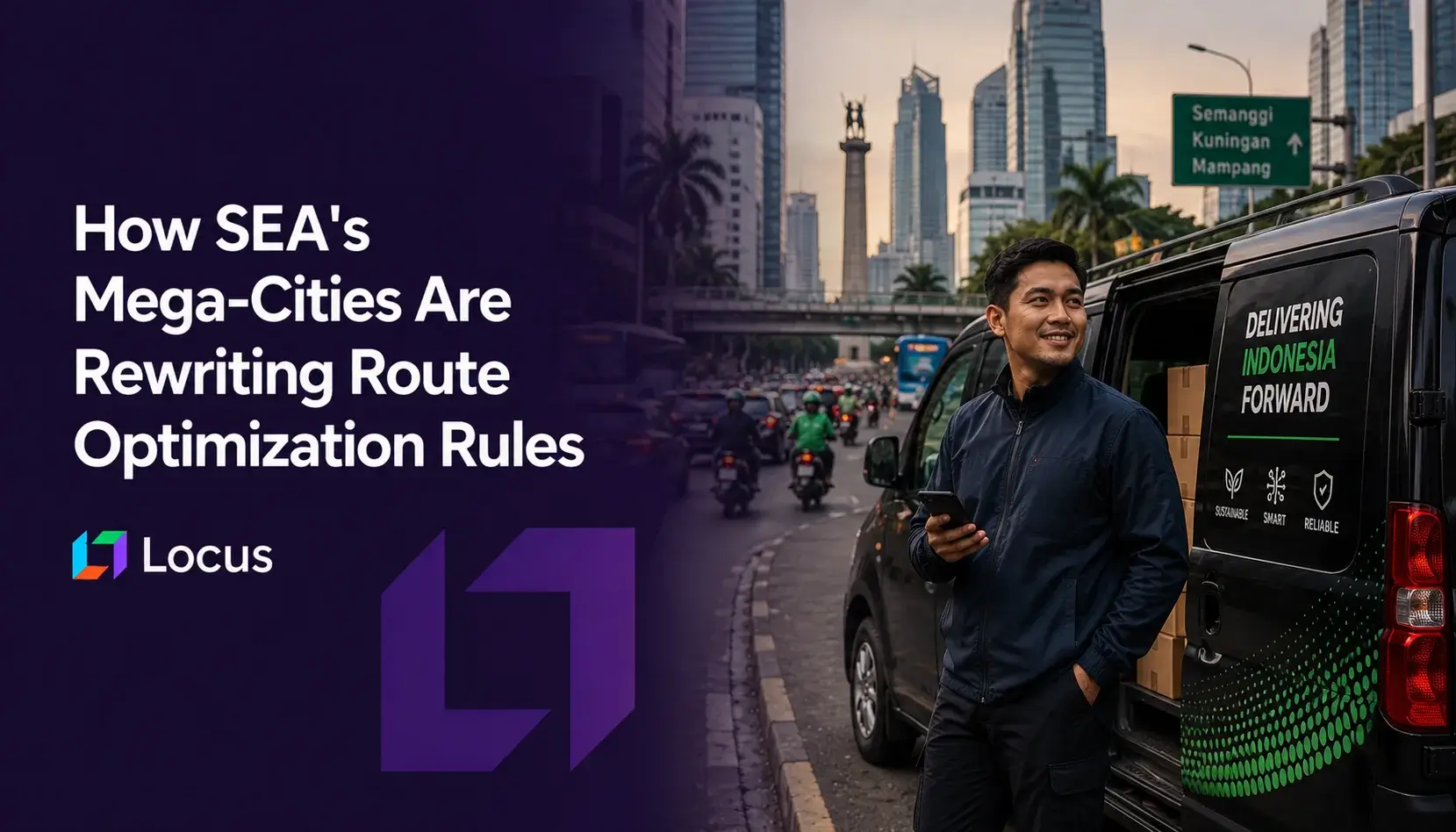
The Jakarta traffic paradox illustrates the broader pattern. Jakarta produces some of the world’s most consistent severe traffic congestion, with peak-hour patterns, motorcycle-dominant modal mix, monsoon disruption windows, and informal urban geography that generic traffic models miss materially. Routing decisions based on generic traffic models produce ETA estimates that fail consistently across operational volume; routing decisions based on Jakarta-calibrated traffic data produce ETA estimates that reflect actual operational reality.
SEA mega-city operational complexity is genuine — and addressable through localized AI architecture rather than through algorithmic transplant. Localized AI route optimization incorporates SEA-calibrated traffic patterns, supports local addressing conventions (gang/lorong navigation in Indonesia, landmark-based addressing across multiple markets), treats religious observances as legitimate operational constraints, integrates tropical weather and monsoon patterns, and handles modal mix dominated by motorcycles rather than by cars and trucks.
For SEA Regional Logistics Managers, Heads of Operations, VPs of Last-Mile, and supply chain leaders operating across Jakarta, Manila, Bangkok, Ho Chi Minh City, and Kuala Lumpur in 2026, this is a practical look at five failure modes in generic route optimization across SEA mega-cities — and the AI architectural responses that handle each through local calibration.
Failure Mode 1: Traffic Congestion Patterns Calibrated to Western Models
The failure. Generic route optimization platforms incorporate traffic models calibrated to Western city patterns — North American freeway-arterial-residential hierarchies, European multi-modal urban transit patterns, peak-trough variations typical of Western commuting. SEA mega-cities operate with different traffic patterns: higher density, motorcycle-dominant modal mix, more pronounced multi-modal patterns, monsoon-disrupted operational windows, and informal traffic patterns around urban informal economic zones. Generic traffic models miss these realities materially.
The consequence: routing decisions calibrated to inaccurate traffic models produce ETA estimates that fail consistently. Operations teams compensate manually through dispatcher-level local knowledge, producing operational ceilings that limit scale. Customer experience suffers from ETA variance that the platform structurally cannot address through generic traffic optimization.
The AI architecture fix. Localized AI route optimization incorporates SEA-calibrated traffic patterns rather than transplanting Western traffic models. Local traffic data integration, machine learning trained on local operational outcomes, real-time traffic signal integration with local providers, and city-specific peak pattern modeling all support routing decisions calibrated to operational reality. The architectural pattern means accuracy improves over time as the platform encounters local operational reality.
Failure Mode 2: Addressing Systems Requiring Local Navigation Conventions
The failure. SEA mega-cities operate with addressing conventions that differ materially from Western standard postal addressing. Indonesia uses RT/RW (Rukun Tetangga / Rukun Warga) administrative subdivision combined with gang/lorong (small lane) addressing that doesn’t map cleanly to geocoded coordinates. Manila uses barangay-based addressing with landmark navigation patterns. Bangkok addresses include soi (small lane) numbering that requires local interpretation. Ho Chi Minh City uses district-ward-street patterns with frequent informal address variations. Kuala Lumpur addresses can include neighborhood naming that’s contextual rather than standardized.
Generic geocoding calibrated to Western postal patterns produces coordinate estimates that vary materially from actual delivery locations. Routing decisions based on inaccurate geocoding produce routes that fail in execution; drivers spend operational time on local navigation that the platform should have resolved through architecture.
The AI architecture fix. Localized AI architecture supports SEA addressing conventions natively — gang/lorong navigation interpretation, landmark-based addressing, RT/RW administrative integration, multi-language address parsing, and confidence-interval geocoding that acknowledges addressing variance. The architecture respects local addressing conventions as legitimate operational reality rather than treating them as data quality problems.
Failure Mode 3: Religious and Cultural Observances Affecting Operational Windows
The failure. SEA mega-city operations operate within cultural and religious contexts that affect operational windows materially. Indonesia (87% Muslim) and Malaysia (63% Muslim) operate with daily prayer times that affect commercial activity patterns, particularly Friday prayer (Jumu’ah) which affects commercial operations meaningfully. Ramadan affects delivery hours, customer availability, and volume patterns across Muslim-majority markets. The Philippines (predominantly Catholic) operates with religious observances including Holy Week and significant religious holiday calendars. Thailand operates with Buddhist observances affecting commercial activity. Vietnam includes Lunar New Year and other observances. Ignoring these realities in operational routing produces operational friction that local operations leaders see immediately.
The AI architecture fix. Localized AI route optimization treats religious observances as legitimate operational constraints. Prayer time patterns inform routing decisioning in Muslim-majority operational contexts. Religious holiday calendars affect capacity planning and customer availability prediction. Cultural observances inform operational windows and customer communication patterns. The architecture respects local cultural reality as operational input rather than treating cultural context as something to operate around.
Failure Mode 4: Tropical Weather and Monsoon Disruption Patterns
The failure. SEA mega-cities operate within tropical climate patterns that differ materially from temperate-zone Western city weather assumptions. Afternoon thunderstorms are predictable seasonal patterns in Manila and Jakarta. Monsoon seasons produce 6-month operational windows with consistent disruption patterns. Flooding affects specific zones repeatedly during wet seasons. Typhoon seasons in the Philippines produce predictable operational disruption. Generic weather integration calibrated to Western weather variability misses SEA-specific patterns.
The consequence: routing decisions don’t account for predictable weather disruption windows. Operations encounter weather effects as exceptions rather than as predictable operational reality. Customer experience suffers from weather-driven delays that the platform should have predicted and communicated.
The AI architecture fix. Localized AI route optimization integrates SEA-calibrated weather data and tropical weather pattern recognition. Monsoon season operational adjustments operate as architectural capability. Afternoon thunderstorm patterns inform routing decisioning. Typhoon and flooding patterns affect capacity planning and routing decisions. The architecture treats SEA weather reality as operational input rather than as exception condition.
Failure Mode 5: Modal Mix Dominated by Motorcycles and Informal Transport
The failure. SEA mega-city last-mile operations run heterogeneous modal mixes dominated by motorcycles. Indonesia’s vehicle fleet is approximately 80% motorcycles; Vietnam’s urban delivery operations are heavily motorcycle-based; Manila uses motorcycle delivery extensively; Bangkok and Kuala Lumpur include significant motorcycle delivery operations. Cars and trucks operate in specific zones with different access patterns than motorcycles. Generic route optimization calibrated to car-truck modal dominance produces routing decisions that don’t reflect actual operational fleet reality.
The consequence: routes optimized for car/truck access don’t match motorcycle operational capability — and vice versa. Routing decisions ignore the modal mix advantages that motorcycle-dominant operations could realize through architecture-aware decisioning.
Commuters in Jakarta lose an average of 83 to 125 hours—about 3.5 to 5 days—each year just sitting in rush-hour traffic. During evening peak hours, drivers spend over double the standard time required for a 10 km trip, often traveling at average speeds as low as 15 km/h.
The AI architecture fix. Localized AI route optimization handles heterogeneous modal mix natively. Motorcycle routing operates with different access patterns than car/truck routing. Modal selection at order level matches mode to operational requirement — motorcycles for dense urban delivery, cars for medium-distance routes, trucks for high-volume consolidated routes. The architecture treats modal mix as operational design space rather than as operational constraint.
How the Five Failure Modes Compound
The five failure modes compound when generic routing handles them simultaneously across SEA mega-city operations.
Traffic congestion patterns calibrated to Western models produce ETA variance that compounds with addressing system mismatches producing geocoding variance. Religious observance gaps produce operational window mismatches that compound with weather pattern blindness producing delay accumulation. Modal mix misalignment produces routing decisions that ignore the operational flexibility motorcycle-dominant fleets enable. Each failure mode reinforces the others; cumulative operational variance produces customer experience degradation that local operations teams compensate for manually at significant operational cost.
The architectural response is localized AI route optimization treating each failure mode through local calibration rather than through algorithmic transplant from operationally different geographies. The integration matters because partial localization (one or two failure modes addressed while others remain generic) produces partial operational reality coverage that local operations teams still need to compensate for manually.
The strategic question for SEA Regional Logistics Managers evaluating route optimization architecture in 2026 is concrete: does the platform deliver localized AI architecture handling SEA mega-city operational complexity across traffic patterns, addressing conventions, religious and cultural observances, tropical weather, and modal mix — or import Western assumptions that produce operational variance local teams compensate for manually?
FAQs
Why does generic route optimization fail in SEA mega-cities?
Generic route optimization platforms incorporate models calibrated to Western city operational reality — traffic patterns, addressing conventions, weather variability, modal mix assumptions. SEA mega-cities produce operational complexity that differs materially: motorcycle-dominant modal mix, monsoon-disrupted operational windows, religious and cultural observances affecting commercial patterns, addressing conventions requiring local interpretation, and traffic density patterns distinct from Western city profiles. Generic platforms miss these realities materially, producing routing decisions that fail in execution.
How do AI route optimization platforms handle Jakarta traffic complexity?
Localized AI route optimization for Jakarta incorporates Jakarta-calibrated traffic patterns rather than transplanting generic traffic models. Local traffic data integration, machine learning trained on Jakarta operational outcomes, real-time traffic signal integration with local providers, and Jakarta-specific peak pattern modeling all support routing decisions calibrated to operational reality. The architectural pattern means accuracy improves over time as the platform encounters local operational reality across Jakarta operational volume.
What SEA addressing conventions affect route optimization?
SEA mega-cities operate with addressing conventions that differ from Western postal patterns. Indonesia uses RT/RW administrative subdivision combined with gang/lorong (small lane) addressing. Manila uses barangay-based addressing with landmark navigation. Bangkok uses soi (small lane) numbering requiring local interpretation. Ho Chi Minh City uses district-ward-street patterns with informal variations. Kuala Lumpur addresses include contextual neighborhood naming. Localized AI architecture supports these conventions natively rather than treating them as data quality problems.
How does AI route optimization handle religious observances in SEA?
Localized AI route optimization treats religious observances as legitimate operational constraints. Prayer time patterns in Muslim-majority operational contexts (Indonesia, Malaysia) inform routing decisioning. Ramadan affects delivery hours, customer availability, and volume patterns. Catholic religious calendars in the Philippines, Buddhist observances in Thailand, and Lunar New Year observances across multiple SEA markets all inform operational planning. The architecture respects cultural reality as operational input.
What weather patterns affect SEA mega-city routing?
SEA mega-cities operate within tropical climate patterns distinct from temperate-zone Western assumptions. Afternoon thunderstorms are predictable seasonal patterns in Manila and Jakarta. Monsoon seasons produce 6-month operational windows with consistent disruption. Flooding affects specific zones repeatedly. Typhoon seasons in the Philippines produce predictable operational disruption. Localized AI architecture integrates SEA-calibrated weather data and tropical pattern recognition rather than relying on generic weather variability assumptions.
Why does motorcycle-dominant modal mix matter for SEA routing?
SEA mega-city last-mile operations run heterogeneous modal mixes dominated by motorcycles. Indonesia’s vehicle fleet is approximately 80% motorcycles; Vietnam’s urban delivery operations are heavily motorcycle-based; Manila, Bangkok, and Kuala Lumpur include significant motorcycle delivery operations. Cars and trucks operate in specific zones with different access patterns. Generic route optimization calibrated to car-truck dominance produces routing decisions that don’t reflect actual operational fleet reality. Localized AI architecture handles motorcycle, car, truck, and walking courier modes natively.
What should SEA Regional Logistics Managers evaluate in route optimization platforms?
SEA Regional Logistics Managers should evaluate localization depth across five dimensions: traffic pattern calibration to SEA mega-city operational reality, addressing convention support for RT/RW, gang/lorong, soi, barangay, and other local patterns, religious and cultural observance integration as operational constraint, tropical weather and monsoon pattern recognition, and modal mix handling including motorcycle-dominant operations. The localization isn’t optional for SEA mega-city operations — it’s the architectural requirement that determines whether the platform delivers operational reality coverage or requires manual compensation.
Focus Keywords
SEA route optimization, Jakarta route optimization, Manila route optimization, Bangkok route optimization, Ho Chi Minh City route optimization, Kuala Lumpur route optimization, Southeast Asia logistics AI, SEA mega-city last-mile, AI route optimization Indonesia, AI route optimization Vietnam, AI route optimization Thailand, AI route optimization Malaysia, AI route optimization Philippines, urban delivery algorithms SEA, motorcycle delivery routing, gang lorong addressing, RT RW Indonesia routing, soi addressing Bangkok, barangay routing Manila, monsoon delivery routing, tropical weather logistics, prayer time routing SEA, SEA regional logistics 2026, mega-city route optimization, localized AI routing Asia, SEA last-mile architecture, Jakarta traffic logistics, Manila last-mile delivery, Southeast Asia urban logistics, AI logistics SEA mega-cities
Sources referenced: SEA mega-city route optimization analysis based on regional operational patterns across Jakarta, Manila, Bangkok, Ho Chi Minh City, Kuala Lumpur, and adjacent SEA markets. Religious demographic references (Indonesia approximately 87% Muslim, Malaysia approximately 63% Muslim, Philippines predominantly Catholic) reflect publicly documented census data. Indonesia motorcycle fleet composition (approximately 80% of vehicle fleet) reflects publicly documented transportation statistics. SEA mega-city operational realities continue to evolve; Regional Logistics Managers should validate specific operational decisions against current vendor documentation, regional operational data, and reference deployment evidence rather than treating any framework as universally applicable across all SEA mega-city route optimization evaluations.


General
The Five Drivers of Last-Mile Efficiency: How Enterprise Logistics Operations Actually Improve Cost-Per-Delivery and Service Levels in 2026

Jun 12, 2026
Last-mile efficiency depends on five operational drivers: multi-constraint routing, dynamic dispatch and capacity orchestration, predictive exception management, ETA accuracy with proactive communication, and closed-loop operational learning.
Read more
General
Five Reasons European Peak Season Planning Fails and the Predictive Analytics Architecture That Addresses Each

Jun 12, 2026
European peak season planning fails through five recurring patterns. Predictive analytics architecture addresses each through multi-signal forecasting, regulatory awareness, and operational integration.
Read moreInsights Worth Your Time


















The Jakarta Traffic Paradox: How AI Route Optimization Handles SEA Mega-City Complexity in 2026