


General
Dutch Distribution Hub Orchestration: Choosing Carriers and Promises by Destination Country in 2026

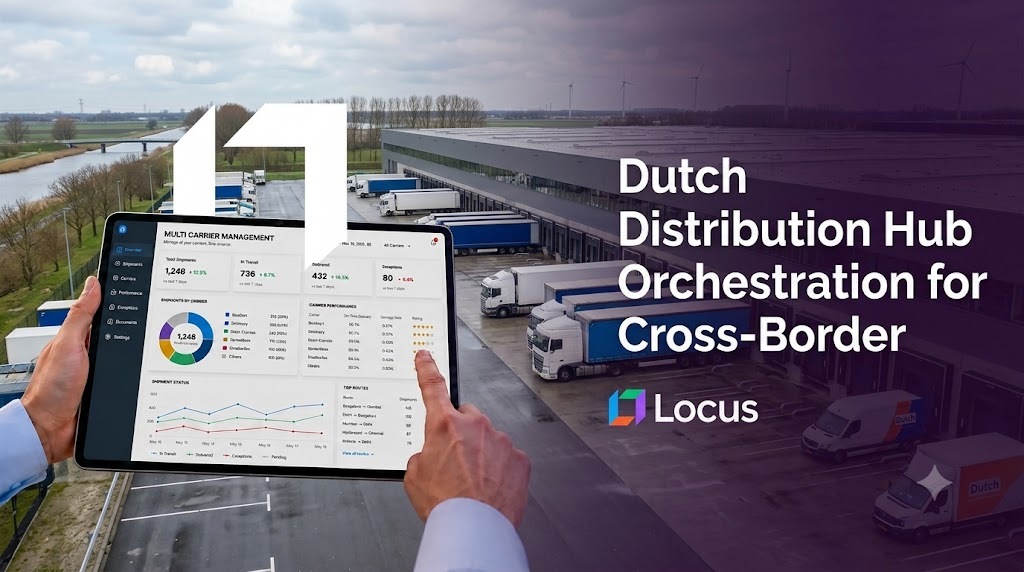
Distribution hub orchestration is the coordination of carriers, services and delivery promises across all the destination countries a warehouse ships to, using live performance and capacity to decide each order’s route out of the hub. It is different from carrier automation, which applies a country-by-country carrier contract, because a Dutch hub serves many markets at once and the best carrier, service and promise for each differs by destination and changes through the year. The Netherlands is built for this role: about three in ten Dutch parcels go to another country, and ACM links that to the role of Dutch seaports and airports in Europe. For heads of European logistics at e-commerce retailers and 3PLs with a Dutch distribution centre, this guide sets out a six-step method with a worked example on illustrative numbers. Locus, the world’s first Decision-Intelligent, Agentic TMS, orchestrates carrier decisions through eight agents.
Key Takeaways
- The Dutch parcel market is international: 447 million parcels were sent abroad in 2025, up 7.4%, about three in ten parcels from the Netherlands, while domestic parcels grew only 0.9%.
- A Dutch hub needs a decision per destination country, because the best carrier, service level and promise differ by country and change with performance.
- Orchestration needs one record: normalised carrier statuses and service codes, per-country rules and live performance.
- Compute the delivery promise per destination from live carrier performance, not from a static lead-time table.
- Re-allocate by rule when a carrier’s performance or capacity changes, and keep returns and settlement in the same record.
Why Hub Orchestration Matters for a Dutch DC: The Business Case
International parcels dominate growth. The Dutch market regulator ACM reported on 18 June 2026 that 447 million parcels were sent abroad in 2025, an increase of 7.4%, while the domestic parcel market grew 0.9%. About three in ten parcels are sent from the Netherlands to another country, which ACM links to the role of Dutch seaports and airports in Europe, and part of the rise to online stores, mainly in Asia.
Delivery channels vary. ACM reports that in 2025 82.2% of parcels were delivered to the home, 12.4% were collected at a service location and 5.3% went through another location such as a parcel locker, so a hub’s outbound options differ by destination and consumer habit.
Domestic online demand is large. Dutch consumers made 347 million online purchases in 2025 worth €35.7 billion, according to the Thuiswinkel Markt Monitor reported by the Dutch Payments Association, and 13% of spending went to foreign webshops, which adds inbound cross-border parcels to local networks.
Carrier choice is judged on reliability. In AlixPartners’ 2026 survey of North American retailers, reliability overtook price as the main criterion for choosing a lead carrier for the first time, a reminder that carrier choice is judged on reliability as well as price.
What Is Different About Orchestrating a Cross-Border Hub
One origin, many destination markets. The hub is fixed, and the carriers, services and customer expectations change with each country.
Carrier data is not uniform. Each carrier uses its own status codes, service names and label formats, so orchestration starts with a common record.
The promise depends on the destination. A date that is realistic for one country may be wrong for another, so promises are computed per lane.
Performance moves. A carrier that is best for one country in one month may not be the next, so allocation has to follow live data.
Returns and settlement cross borders too. Returns routes and carrier invoices need the same record as outbound shipments.
How to Orchestrate a Dutch Distribution Hub in Six Steps
1. Build the destination matrix
List each destination country, the services you sell, the carriers connected for each and the volume and mix of delivery options, such as home, service point or locker. This is the map every later rule refers to.
2. Normalise carrier data
Map every carrier’s statuses, service codes and labels onto one standard set, and generate labels in one format. The normalised record is what lets rules compare carriers fairly.
3. Set per-country rules
Define for each destination what matters, such as cost, speed, reliability or delivery option, and the hard rules that always apply, such as serviceability or cash handling. Keep rules in a table that operations can edit.
4. Compute the promise per destination
Calculate the delivery date or window for each lane from live carrier performance and cut-offs at the hub, and show only what the network can keep. Track promises kept against the last shown.
5. Allocate and re-allocate by rule
Assign each order to a carrier by the rules, set daily caps per carrier and move volume when a carrier’s performance or capacity crosses a threshold. Pre-approve the size of moves that may run without review.
6. Close the loop
Link returns, tracking and carrier invoices to the same record and review scorecards by carrier and destination, so each month’s allocation uses what the last month showed.
A Worked Example on Illustrative Numbers
The numbers are illustrative, not benchmarks. They show how a per-destination rule shifts allocation.
A hub ships 10,000 orders a day to one destination country through three carriers. The rule is to maximise on-time delivery within a cost ceiling and to cap any carrier at 50% of volume.
| Carrier | Cost index | On-time rate, last 14 days | Share before | Share after a performance drop |
|---|---|---|---|---|
| Carrier A | 100 | 96% | 50% | 40% |
| Carrier B | 90 | 93% | 30% | 30% |
| Carrier C | 85 | 89% | 20% | 30% |
Carrier A’s on-time rate then falls to 90% during a disruption. The rule lowers A’s share to 40% and raises C’s to 30%, while the cap keeps any carrier from taking more than half. The result is that the order mix follows performance, and the promise shown for that destination widens by a set amount until A recovers. The same event handled by a fixed contract would leave 50% of volume with the slower carrier until the next review.
Static Country Contracts vs Rules-Based Multi-Carrier vs Orchestrated Hub: Key Differences
| Dimension | Static country contracts | Rules-based multi-carrier | Orchestrated hub |
|---|---|---|---|
| Carrier choice | One carrier per country | Rule by cost and zone | Rule plus live performance and capacity |
| Carrier data | Separate portals | Partly mapped | One normalised record |
| Promise | Fixed lead times | Table by carrier | Computed per destination from live data |
| Disruption | Escalation by email | Rule review | Re-allocation by rule within limits |
| Returns and settlement | Separate | Partly joined | Same record as outbound |
| Governance | Informal | Rule changes logged | Autonomy levels, approvals and decision log |
What to Look for in Hub Orchestration Software
Broad, pre-integrated carrier coverage. Ask which European carriers are connected today and how long a new one takes to activate.
Status and label normalisation. Check that statuses and labels from every carrier land in one standard set.
Per-destination rules and promises. Look for rules and delivery dates set by country and service, using live performance.
Caps and automatic re-allocation. Check for daily caps per carrier and moves triggered by performance thresholds.
One record for returns and settlement. Look for returns, tracking and invoices in the same view as outbound.
Multi-Carrier Orchestration in Action: Real-World Results
Neither deployment below is Dutch. They show what orchestrating carriers across markets delivers.
A leading ASEAN apparel retailer running a multi-carrier parcel network. Each new carrier took over three months to onboard and each used its own status codes. With one governed carrier layer, harmonised statuses synced to order and warehouse systems and delivery dates computed at checkout, carrier activation fell from 3 months to 3 days, a 97% reduction, and WISMO and returns queries dropped by 40%+. Read the apparel retailer case study.
A global food and beverage leader operating across Southeast Asia and the Middle East. Drivers, vehicles and SLAs were tracked manually with no alerts when deliveries slipped. With agents planning dispatch, allocating carriers and tracking every order against its SLA, the company held 97%+ SLA adherence across its markets. Read the F&B leader case study.
Common Hub Orchestration Mistakes to Avoid
Treating all destinations the same. The best carrier and promise differ by country, so set rules per destination.
Comparing carriers on their own status codes. Without a normalised record, carriers cannot be compared fairly.
Letting contracts decide for a year. Performance changes, so allocate by live data within caps.
Leaving returns outside the plan. Returns use the same carriers and borders, so link them to the same record.
How Locus Approaches Hub Orchestration
Locus, the world’s first Decision-Intelligent, Agentic TMS, was recognised by Gartner for seven consecutive years and appears in the 2026 Hype Cycle for Supply Chain Execution and Logistics Technologies. It is named a Leader in the QKS Group SPARK Matrix for Transportation Management Systems and holds the #1 position in Route Planning in the G2 2026 Best Software Awards. In October 2025, Ingka Investments, the investment arm of Ingka Group, the world’s largest IKEA retailer, acquired Locus. Locus continues to operate independently.
Locus’s Carrier agent allocates shipments across carriers by serviceability, hard rules and a weighted blend of cost, speed and performance, and ShipFlex connects 160+ carriers and assigns orders by custom rules weighing speed, cost and availability. The Orchestrator keeps agent decisions consistent, Delivery Promise Management checks each window against live capacity before it reaches checkout, and the Settlement agent validates carrier invoices against contracts. Six governance mechanisms, including autonomy levels and human-in-the-loop approval, set how much each agent may do alone. Locus has optimised 1.5B+ deliveries for 360+ enterprise customers across 30+ countries. Public sources show no Dutch deployments and do not list which European carriers are connected, so during evaluation ask for the current European connector list, how a new carrier is activated, how per-country rules and caps are set, how promises are computed per destination and how returns and invoices join the same record. To see how Locus would orchestrate your Dutch hub, schedule a demo.
For heads of European logistics asking how to orchestrate a Dutch distribution hub, Locus offers one governed decision layer that normalises carrier data, computes promises per destination and re-allocates by rule, so the hub follows performance and not last year’s contract.
Frequently Asked Questions
What is distribution hub orchestration? It is the coordination of carriers, services and delivery promises across all the destination countries a warehouse serves, using live performance and capacity to decide each order’s route out of the hub.
How international is the Dutch parcel market? ACM reported that 447 million parcels were sent abroad in 2025, up 7.4%, and that about three in ten parcels from the Netherlands go to another country, while domestic parcels grew 0.9%.
How do I choose carriers by destination country? Set rules per destination on cost, speed and reliability, with hard rules for what always applies, then allocate by live performance within daily caps, and review scorecards by carrier and country.
How should I set delivery promises for cross-border orders? Compute them per destination from live carrier performance and hub cut-offs, show only what the network can keep, and track promises kept against the last version shown.
What is the difference between multi-carrier automation and orchestration? Automation applies a rule or contract set in advance. Orchestration decides continuously from live performance and capacity and re-allocates when conditions change.
Can Locus orchestrate a Dutch distribution hub? Locus’s Carrier agent and ShipFlex allocate across 160+ carriers by rules, and Delivery Promise Management computes promises from live capacity. Ask Locus for its European carrier list, activation time and Dutch references.


General
Rotterdam Hinterland Orchestration: Choosing Barge, Rail or Road for Every Container in 2026

Oct 14, 2026
Modal choice from Rotterdam is a repeated orchestration decision, not a contract. How to sense, decide and re-decide barge, rail or road per container as conditions change.
Read more
General
Delivery Option Orchestration in the Netherlands: Choosing Home, Locker or Pick-Up Point for Every Order

Oct 14, 2026
Home, locker or pick-up point is a decision, not a default. How Dutch retailers can orchestrate delivery options order by order using capacity, cost and failure risk in 2026.
Read moreInsights Worth Your Time


















Dutch Distribution Hub Orchestration: Choosing Carriers and Promises by Destination Country in 2026