


General
How Locus Transforms Logistics Operations with Automation and Orchestration in 2026
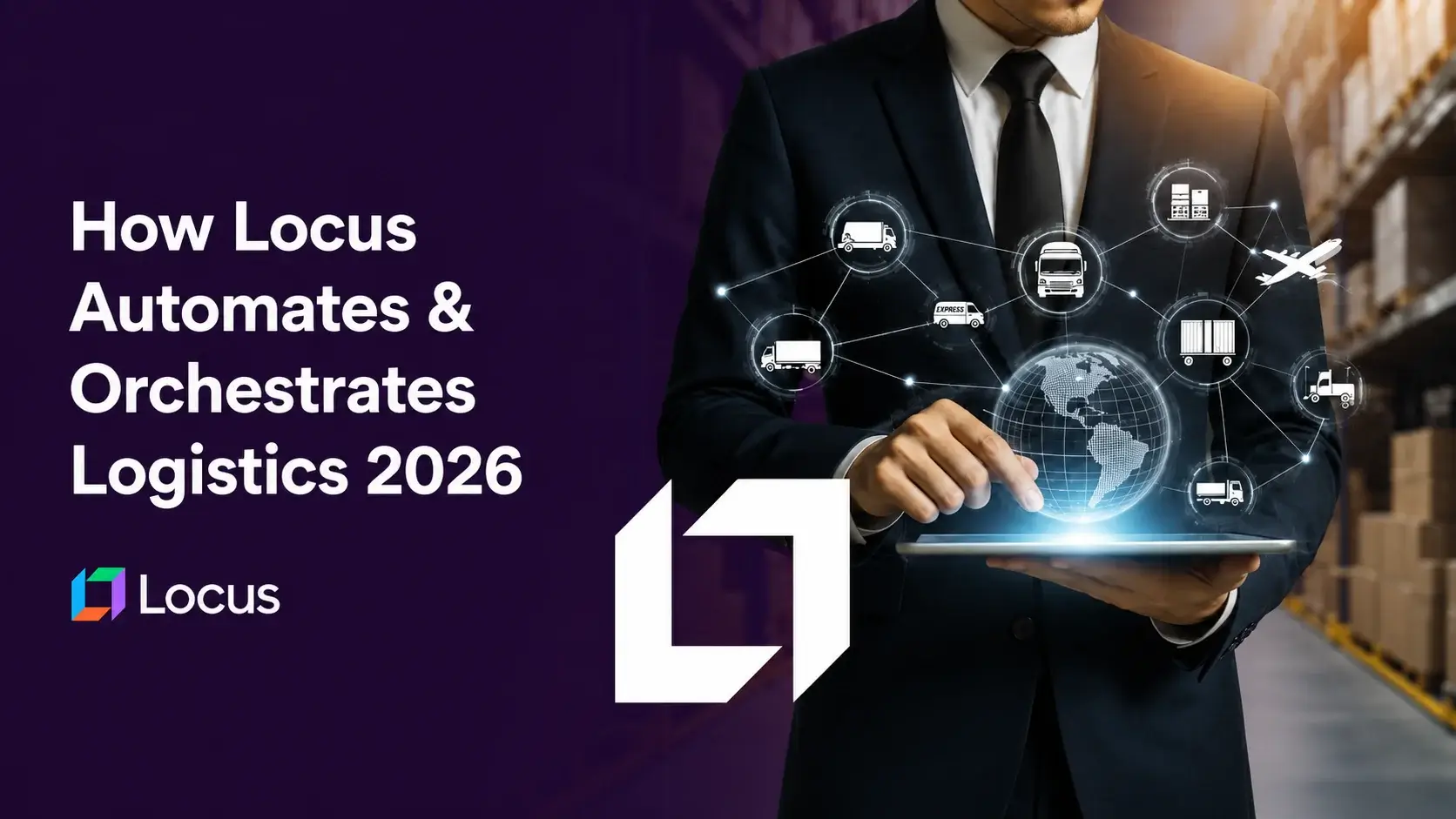
Locus logistics automation is not simply automated route planning, dispatch scheduling, or status notifications. It is logistics orchestration: an agentic Transportation Management System that coordinates capacity, carriers, dispatch, hubs, customer experience, and settlement in one governed operating layer.
For enterprise logistics teams, that distinction matters. Traditional automation makes predefined tasks faster. Locus orchestration helps the operation decide what to do next when demand, capacity, routes, service levels, and customer expectations change in real time.
Locus uses AI agents to continuously sense operational conditions, decide on the next best action, execute approved workflows, and learn from outcomes. The result is a logistics automation model designed to improve on-time delivery, SLA adherence, exception handling, route productivity, and cost-to-serve across complex transportation networks.
Locus, built by Mara Labs and part of the Ingka Group, the parent company of IKEA, operates across 1.5B+ deliveries, 360+ enterprise customers, 30+ countries, 1,000+ carriers, and 250+ real-world constraints at 99.99% uptime. Its platform is built for all-mile logistics operations, including first-mile, middle-mile, hub operations, last-mile delivery, and multi-carrier execution.
Planning a logistics transformation
Work with Locus experts to assess automation opportunities, design orchestration workflows, and accelerate time to value.
Key Takeaways
- Locus logistics automation is best understood as logistics orchestration: a governed, AI-powered operating layer for planning, execution, tracking, exception response, and settlement.
- Locus is the world’s first agentic Transportation Management System, built to move enterprise logistics from task-level automation to continuous decision orchestration.
- The DiSCO — Digital Supply Chain Officer — architecture runs eight specialized agents: Capacity, Carrier, Dispatch, Hub, Customer, Settlement, Orchestrator, and Mycroft AI Co-Pilot.
- Each agent operates on the Sense-Decide-Execute-Learn — SDEL — loop, a continuous decisioning cycle that separates orchestration from static, rules-based automation.
- Locus supports logistics workflows across dispatch, route optimization software, multi-carrier allocation, hub coordination, customer communication, proof-of-delivery, and settlement.
- Enterprise governance is built into the architecture through explainability, traceability, evaluation, autonomy levels, execution sandboxing, and human-in-the-loop controls.
- Locus is not the same as Locus Robotics. Locus provides logistics orchestration software; Locus Robotics provides warehouse robotics and automation hardware.
What Is Locus Logistics Automation?
Locus logistics automation refers to the use of the Locus agentic TMS to automate and orchestrate logistics workflows from order intake through proof-of-delivery and settlement. It covers the operational decisions that sit between planning and execution: which orders should move, through which hub, on which route, with which driver or carrier, under which customer promise, and at what cost.
In practical terms, Locus helps logistics teams automate and coordinate:
- order allocation;
- capacity planning;
- dispatch planning;
- route sequencing;
- multi-carrier selection;
- hub and sortation workflows;
- delivery tracking;
- customer ETA communication;
- exception handling;
- proof-of-delivery;
- freight audit and settlement.
The key difference is that Locus does not treat these as disconnected workflows. It brings them into one orchestration layer so decisions in one area — such as a carrier delay, driver absence, hub bottleneck, or customer reschedule — can be reflected across the rest of the operation.
2026 Market Context for Logistics Automation
The shift from task automation to orchestration is part of a broader 2026 logistics technology transition. As networks become more volatile and delivery promises become more specific, enterprises are investing in AI systems that can coordinate decisions across warehousing, transportation, customer experience, and settlement.
According to ABI Research, global spending on warehouse automation is projected to reach $65 billion by 2026, growing at a compound annual rate of about 15% from 2023 as logistics providers invest in AI-powered orchestration and robotics.
McKinsey projects that more than 60% of top global retailers are expected to deploy AI-based logistics orchestration platforms by 2026 to coordinate transportation, warehousing, and last-mile decisions in real time.
Gartner research cited in the provided source set reports that retail and parcel shippers implementing AI-driven transportation management and logistics automation platforms achieved an average 10–20% reduction in transportation costs and 5–10 percentage-point improvement in on-time delivery compared with rule-based TMS deployments.
Deloitte’s research on last-mile orchestration reports that enterprises using AI-enabled dispatch and route orchestration achieved up to 30% fewer miles driven per delivery route and 20–25% driver productivity gains versus traditional static route planning.
Automation Versus Orchestration: The Distinction Locus Is Built On
Automation and orchestration are often used interchangeably. That is where many logistics platforms overstate what they can do.
Automation executes a predefined task: run this route optimization at 06:00, send this notification when a status changes, apply this carrier rule to this lane, or assign this order type to this vehicle class. It is valuable because it reduces manual effort, improves consistency, and gives dispatchers a faster starting point.
But automation is limited. It only does what it was configured to do. When the operation departs from plan, the decision still returns to a human: which driver should absorb the failed stop, whether to resequence a route, when to switch carrier, whether to protect an SLA at higher cost, or how to rebalance capacity across hubs.
Orchestration coordinates and decides. It does not just run a task; it senses the state of the operation, evaluates trade-offs across interacting constraints, selects the next best action, executes it where permitted, and learns from the outcome.
When a vehicle runs late, an orchestrated system does not simply flag the delay. It can support dynamic route planning, re-sequence downstream stops, re-check driver capacity, assess SLA risk, adjust the customer ETA, and determine whether a dispatch intervention is needed — as one coordinated operational response.
That is the foundation of Locus. Locus is built for orchestration from the ground up, which is why it is described as agentic rather than merely automated. Its intelligence is not a library of scripted responses. It is a set of specialized agents that reason and act within defined logistics domains, under governance, and in concert with each other.
| Capability | Rules-Based Automation | Locus Orchestration |
|---|---|---|
| Primary function | Executes predefined tasks | Coordinates decisions across logistics domains |
| Response to disruption | Flags exceptions for human action | Re-optimizes routes, capacity, carriers, ETAs, and workflows where permitted |
| Operating model | Trigger-based or scheduled | Continuous Sense-Decide-Execute-Learn loop |
| Scope | Often point solution or workflow-specific | Capacity, carriers, dispatch, hubs, customers, and settlement |
| Control | Human-defined rules | Governed autonomy with explainability, traceability, sandboxing, and human-in-the-loop |
| Operational impact | Faster existing processes | Adaptive operations designed to protect SLA adherence, on-time delivery, and cost-to-serve |
Turn logistics automation into real-time route orchestration
See how Locus optimizes routes continuously, adapts to disruptions, and improves on-time delivery at enterprise scale.
How Locus Does It: The DiSCO Architecture
Locus delivers orchestration through DiSCO, an architecture of eight specialized agents. Each agent owns a specific logistics domain and can decide and act within that domain.
| DiSCO Agent | Operational Domain | What It Supports |
|---|---|---|
| Capacity agent | Demand and available fulfillment capacity | Matches order demand to vehicle, driver, hub, and carrier capacity |
| Carrier agent | Multi-carrier operations | Supports carrier selection, allocation, performance management, and ShipFlex workflows |
| Dispatch agent | Route planning and dispatch execution | Assigns, sequences, and adapts work into executable routes |
| Hub agent | Sortation and hub operations | Coordinates hand-offs, load building, dwell-time risk, and hub-level execution |
| Customer agent | Customer-facing delivery experience | Supports branded tracking, predictive ETAs, and proactive communication |
| Settlement agent | Freight audit, billing, and settlement | Handles carrier billing, audit, and settlement workflows |
| Orchestrator agent | Cross-domain coordination | Ensures decisions in one domain propagate correctly across the operation |
| Mycroft AI Co-Pilot | Human interaction layer | Lets operators query, inspect, and direct the system through natural language |
The Capacity agent matches demand to available capacity, planning how much is needed and where. This is critical when order volumes vary by hub, delivery window, vehicle type, driver shift, carrier availability, or geography.
The Carrier agent orchestrates carrier selection and performance across a multi-carrier network. ShipFlex extends this capability for multicarrier parcel management, where the system must evaluate carrier options against service levels, network availability, rates, performance, and operational constraints.
The Dispatch agent assigns and sequences work. It turns planned demand into executable routes, factoring in constraints such as time windows, vehicle capacity, route density, service time, location accuracy, delivery priority, and SLA commitments. In this layer, transportation planning becomes a live execution function rather than a static planning exercise.
The Hub agent coordinates activity at sortation and hub points, where orders are consolidated, staged, loaded, and handed off. Hub delays have downstream effects on route start times, driver productivity, customer ETAs, and SLA adherence; orchestration ensures those effects are reflected in the wider plan.
The Customer agent manages the customer-facing experience: branded tracking, predictive ETA, and proactive communication. In last-mile operations, customer communication is not cosmetic. Accurate ETAs reduce failed delivery attempts, protect promised delivery windows, and lower contact-center load.
The Settlement agent handles freight audit, billing, and settlement across carriers. This matters because logistics cost-to-serve does not end at delivery. Carrier charges, accessorials, SLA penalties, billing disputes, and settlement accuracy all affect total transportation cost.
Above them, the Orchestrator agent coordinates across every domain. A capacity shortage, late carrier, hub delay, route exception, or customer reschedule should not be solved in isolation. The Orchestrator ensures those changes propagate correctly through the network.
The Mycroft AI Co-Pilot gives operators a natural-language way to query the system, understand why decisions were made, and direct workflows. For dispatchers and transport managers, that means fewer black-box decisions and faster investigation of exceptions, route changes, carrier choices, and SLA risk.
The point of the architecture is that no decision is made in a vacuum. A dispatch plan reflects capacity reality, carrier performance, hub timing, route feasibility, and the customer promise at once. That is the difference between a connected set of tools and an orchestrated logistics operating system.
The SDEL Loop: How Each Agent Decides and Acts
What makes each DiSCO agent orchestrating rather than merely automating is the loop it runs on: Sense, Decide, Execute, Learn.
An agent senses the current state of its domain from live operational data. In practical terms, that can include order status, real-time tracking, route progress, delivery windows, driver availability, vehicle capacity, hub readiness, carrier performance, customer communication events, and execution exceptions.
It then decides on the next action by weighing that live state against the objectives and constraints it is responsible for. A dispatch decision, for example, may need to balance route density, on-time delivery, miles traveled, driver shift limits, vehicle capacity, high-priority orders, failed-attempt risk, and cost per stop.
It executes the action. This is where orchestration differs from analytics or recommendation-only tooling. The system can issue the assignment, re-route the driver, trigger the carrier selection, update the ETA, or escalate for human approval depending on the configured autonomy level.
It then learns from the outcome. Actual delivery performance, route variance, carrier reliability, failed delivery patterns, customer availability, and exception resolution all improve the next decision.
This cycle runs continuously. A static automation runs when triggered and stops. An SDEL agent keeps sensing and is always ready to decide again. When reality changes — a route slips, a hub is delayed, a carrier misses a scan, or a customer changes availability — the response does not depend on someone spotting the issue first.
Multiply that across eight coordinated agents and the result is an operation that can adapt as a whole, in real time, to conditions no day-start plan could fully anticipate.
Governance: Why Enterprises Trust Autonomous Orchestration
Autonomy without governance is not acceptable in enterprise logistics. The cost of a poor decision is operationally visible: missed SLAs, higher cost-to-serve, driver idle time, failed deliveries, carrier disputes, customer escalations, and lost trust.
Locus treats governance as part of the architecture, not an add-on. Six mechanisms make autonomous decisioning safe to deploy.
Explainability means every decision can be understood in terms of the factors that drove it. If the system changes a route, selects a carrier, or escalates an SLA risk, operators need to know why.
Traceability means decisions and their inputs are recorded and auditable after the fact. This is essential for operational reviews, carrier performance management, customer escalations, and internal governance.
Evaluation means agent performance is measured against defined objectives rather than assumed. Logistics leaders can assess whether agent behavior is improving on-time delivery, cost per delivery, route productivity, SLA adherence, and exception resolution.
Autonomy levels allow each operation to control how much an agent may do on its own, domain by domain. A team may allow automatic ETA updates, require approval for carrier switches, and keep high-value delivery exceptions under human control.
The execution sandbox allows decisions to be tested before they go live. This helps teams validate how changes could affect routes, capacity, customer promises, and carrier allocation without risking live operations.
Human-in-the-loop controls keep people responsible for the decisions that warrant review. The system escalates rather than oversteps when a decision exceeds the configured autonomy threshold or business risk tolerance.
Together, these mechanisms turn autonomy from a theoretical risk into a governed operational capability. They allow enterprises to let the system act where it is safe and valuable, while keeping transport planners, dispatchers, and operations managers in control of sensitive decisions.
| Governance Mechanism | Why It Matters in Logistics Operations |
|---|---|
| Explainability | Operators can understand why a route, carrier, or ETA decision was made |
| Traceability | Decisions can be audited after execution |
| Evaluation | Agent performance can be measured against KPIs |
| Autonomy levels | Teams can configure what the system may do without approval |
| Execution sandbox | Decisions can be tested before being pushed live |
| Human-in-the-loop | People stay in control of high-risk or policy-sensitive exceptions |
What Logistics Workflows Does Locus Automate End to End?
Locus logistics automation spans the order-to-proof-of-delivery lifecycle. That means the platform does not only optimize a route or notify a customer. It connects the decisions that determine whether an order can be promised, planned, dispatched, delivered, tracked, confirmed, and settled efficiently.
A typical Locus-orchestrated workflow can look like this:
- Order intake and allocation
Orders enter the system with delivery promise, destination, capacity, SLA, service type, and customer requirements. - Capacity and hub coordination
The system evaluates available hub, vehicle, driver, and carrier capacity against demand and fulfillment constraints. - Dispatch and route planning
Orders are assigned and sequenced into executable routes based on operational constraints, delivery windows, service time, route density, and priority. - Carrier orchestration
Where multi-carrier operations are involved, the system evaluates carrier availability, service levels, performance, rates, and network constraints. - Live execution and exception response
Route progress, delays, failed attempts, missed scans, and capacity issues are sensed continuously so the system can recommend or execute the next action. - Customer communication
The customer receives accurate ETA updates, branded tracking, and proactive delivery communication when conditions change. - Proof-of-delivery and settlement
Delivery completion data flows into audit, billing, dispute management, and settlement workflows.
This workflow coverage is what separates platform-level logistics orchestration from single-point automation tools.
Benefits of Locus Logistics Automation
Locus logistics automation is designed for enterprise operations where manual dispatching, fragmented systems, and disconnected carrier networks create service risk and cost leakage.
1. Better On-Time Delivery and SLA Adherence
Locus helps logistics teams respond to disruptions while the operation is still in motion. Instead of waiting for a dispatcher to identify every risk manually, the system can detect delays, reassess route feasibility, and support corrective action before an SLA breach occurs.
2. Lower Manual Dispatch Effort
Manual dispatch work often grows linearly with delivery volume, geography, and network complexity. Locus reduces repetitive planning and replanning work by automating assignment, sequencing, dispatch execution, and exception workflows where permitted.
3. Reduced Transportation Cost
Transportation cost is shaped by route density, vehicle utilization, failed delivery attempts, driver productivity, carrier selection, accessorial charges, and exception handling. Locus helps improve these drivers by coordinating the decisions behind them rather than optimizing each one in isolation.
4. Stronger Multi-Carrier Control
In multi-carrier networks, cost and service performance depend on selecting the right carrier for the right shipment at the right time. Locus supports carrier orchestration by factoring in availability, rates, service levels, performance, and operational constraints.
5. Improved Customer Experience
Customer experience in last-mile logistics depends on accurate promises, proactive communication, and reliable delivery windows. Locus supports predictive ETAs, branded tracking, delivery updates, and customer availability workflows, including time-slot management.
6. Better Operational Governance
Enterprise logistics leaders need to know not only what the system did, but why it did it. Locus embeds explainability, traceability, evaluation, autonomy controls, sandboxing, and human-in-the-loop workflows into the operating model.
Key Features of Locus Logistics Automation
Locus combines logistics execution capabilities with AI orchestration across the operating lifecycle.
Automated Dispatch
Locus supports automated dispatch planning by assigning and sequencing work across drivers, vehicles, hubs, delivery windows, and operating constraints. Dispatch teams can move from manual planning to governed execution support.
Constraint-Aware Route Optimization
The platform evaluates routes against operational realities such as time windows, service time, vehicle capacity, driver availability, priority orders, customer availability, location quality, SLA exposure, and route density.
Multi-Carrier Orchestration
Locus supports carrier allocation and performance management across complex networks. This is especially relevant for retail, e-commerce, 3PL, courier, and parcel operations that rely on multiple carrier partners.
Hub and Sortation Coordination
Hub activity affects route start times, customer promises, load readiness, and downstream execution. Locus coordinates hub-level activity with dispatch and carrier decisions.
Real-Time Visibility
Locus tracks operational execution so teams can monitor order progress, driver movement, route variance, delays, failed attempts, and exception events.
Customer ETA and Communication
The Customer agent supports branded tracking, ETA updates, and proactive communication. This helps reduce avoidable “where is my order?” contacts and failed delivery attempts.
Proof-of-Delivery
Proof-of-delivery workflows close the loop between execution and settlement, helping operations teams verify completion and support downstream billing, audit, and customer-service workflows.
Freight Audit and Settlement
The Settlement agent supports freight audit, billing, and settlement workflows across carriers, helping logistics leaders connect operational performance with financial control.
Proof: What This Looks Like Deployed
The architecture earns its claims in production.
In one deployment at a Fortune 50 enterprise running 4,500+ drivers, orchestrated dispatch and execution lifted the on-time execution rate from 75% to 92%, representing a $14M+ annualized operational opportunity.
In a retail enterprise deployment, Locus consolidated six legacy systems, reduced manual dispatch by 80%+, sustained 99%+ on-time delivery, delivered $1M+ in savings, and reached break-even within the first year.
At aggregate scale, Locus orchestration has contributed to 800M+ miles reduced, 17M+ kg of CO? avoided, and $320M+ in logistics cost savings across the customer base.
These outcomes reflect the operational levers that matter most to logistics leaders:
- higher on-time delivery and SLA adherence;
- lower manual planning and dispatch effort;
- fewer avoidable route miles;
- better route density and driver productivity;
- tighter carrier performance control;
- reduced exception-handling burden;
- lower cost-to-serve across complex delivery networks.
Locus vs Legacy TMS and Single-Point Automation Tools
Legacy Transportation Management Systems were often built around planning, documentation, tendering, and administrative control. They remain important, but many were not designed for real-time last-mile and all-mile execution, where dispatch decisions, customer promises, carrier performance, and exceptions change continuously.
Single-point automation tools solve narrower problems. A route optimizer may generate better routes. A notification engine may send status updates. A carrier-rate tool may help select a provider. But when these tools are disconnected, logistics teams still carry the burden of stitching the operation together manually.
Locus takes a different approach. It is execution-first and orchestration-led. It connects planning, routing, dispatch, hub activity, carrier workflows, customer communication, proof-of-delivery, and settlement into a governed decisioning layer.
| Evaluation Area | Legacy TMS | Single-Point Automation | Locus Logistics Automation |
|---|---|---|---|
| Core strength | Planning and administrative transportation workflows | Solves one workflow well | Orchestrates execution across logistics domains |
| Dispatch execution | Often limited or rules-based | Depends on tool category | AI-led dispatch and route orchestration |
| Last-mile adaptability | Often constrained | Narrow workflow coverage | Continuous disruption response |
| Carrier coordination | Tendering and carrier management | May support limited carrier workflows | Multi-carrier orchestration across performance, rate, service, and constraints |
| Customer experience | Often separate | Usually handled by another tool | ETA, tracking, communication, and delivery promise coordination |
| Governance | Varies by system | Often limited | Explainability, traceability, autonomy controls, sandboxing, human-in-the-loop |
| Best fit | Transportation administration | Narrow automation needs | Complex, high-volume, multi-region logistics execution |
Locus vs Locus Robotics: Clarifying the Difference
For the keyword “Locus logistics automation,” search engines and AI assistants may sometimes surface two different entities: Locus and Locus Robotics.
They are not the same company and they automate different layers of the logistics ecosystem.
Locus — at locus.sh — provides an agentic Transportation Management System and logistics orchestration software. It focuses on dispatch, route optimization, carrier management, hub coordination, customer experience, proof-of-delivery, and settlement across all-mile logistics operations.
Locus Robotics provides autonomous mobile robots and warehouse automation technology. Its focus is inside the fulfillment center: picking, replenishment, putaway, warehouse movement, and robotics-assisted labor productivity.
Both are relevant to logistics automation, but they solve different problems. Locus orchestrates transportation and delivery execution. Locus Robotics automates physical warehouse movement.
Why Choose Locus for Logistics Automation?
Choose Locus when logistics automation needs to move beyond isolated workflow efficiency and into operational control.
Locus is built for enterprises that manage complex delivery networks, variable demand, multiple fulfillment points, diverse fleets, carrier partners, delivery promises, and customer-experience expectations. Its value is not limited to faster route planning. It is the ability to coordinate route, carrier, hub, customer, and settlement decisions continuously.
Locus is especially relevant for:
- retailers managing store, home delivery, and direct-to-consumer fulfillment;
- e-commerce networks with high delivery-volume variability;
- 3PLs and courier providers managing multi-client operations;
- FMCG and CPG companies with route density and service-window constraints;
- parcel and carrier networks balancing cost, SLA, and capacity;
- enterprises consolidating fragmented transportation and dispatch systems.
The strongest reason to choose Locus is architectural: it is designed as an agentic, governed orchestration layer rather than a bolted-on automation tool. That matters when the operation changes every hour and the system needs to help teams decide, not just execute yesterday’s rules faster.
? Modernize direct-to-store delivery with governed automation
Unify dispatch, delivery execution, and SLA control for complex retail and distribution networks with Locus.
What This Means for Your Operation
Automation will make existing logistics processes faster. That is useful, but it is not enough for modern last-mile, all-mile, and multi-carrier logistics networks.
The hardest part of logistics is not running the initial plan. It is deciding what to do when the plan breaks: a vehicle is late, a driver is unavailable, a hub is behind, a customer changes their delivery slot, a carrier underperforms, or a priority order is at risk of missing its SLA.
If those decisions sit entirely with people, exceptions accumulate. Dispatchers spend the day reworking routes, customer teams chase ETAs, transport managers arbitrate carrier issues, and finance teams reconcile cost after the fact.
Orchestration moves that decisioning into the system — continuously, transparently, and under governance. The operation adapts as a whole rather than waiting on manual intervention at every hand-off.
That is what it means to transform logistics operations with Locus: not a set of tools you operate in isolation, but an agentic system that senses, decides, executes, and learns across capacity, carriers, dispatch, hubs, customers, and settlement. It does this under governance you control, with proof at enterprise scale.
The shift is from software you run to a system that runs the operation with you.
Frequently Asked Questions (FAQs)
What is Locus logistics automation?
Locus logistics automation refers to the use of the Locus agentic Transportation Management System to automate and orchestrate planning, execution, tracking, and settlement across logistics operations. It covers first-mile, middle-mile, hub operations, last-mile delivery, and multi-carrier networks. The platform uses governed AI agents to coordinate orders, capacity, routes, carriers, customer communication, and settlement workflows.
How does Locus transform logistics operations?
Locus transforms logistics operations by moving them from static automation to continuous orchestration. Rather than executing predefined tasks and waiting for people to resolve every exception, Locus runs AI agents that sense the state of the operation, decide on actions within their domains, execute approved workflows, and learn from outcomes. This helps logistics teams improve on-time delivery, SLA adherence, route productivity, and exception response.
What is the difference between automation and orchestration at Locus?
Automation performs a fixed task quickly and reliably, such as running route optimization at a scheduled time or sending a notification when a delivery status changes. Orchestration coordinates decisions across capacity, carriers, dispatch, hubs, customers, and settlement, then adapts those decisions as conditions change. Locus is built for orchestration, which is why it is described as agentic rather than simply automated.
Which logistics workflows does Locus automate end to end?
Locus automates the order-to-proof-of-delivery lifecycle, including order allocation, capacity planning, hub coordination, dispatch, route planning, carrier management, customer communication, proof-of-delivery, and settlement. The platform translates incoming orders into executable delivery plans, manages driver and carrier assignments, tracks shipments in real time, and supports downstream audit and billing workflows. This reduces manual handoffs across regions, hubs, fleets, and carrier networks.
What are the DiSCO agents?
DiSCO is Locus’s Digital Supply Chain Officer architecture. It includes eight specialized agents: Capacity, Carrier, Dispatch, Hub, Customer, Settlement, Orchestrator, and Mycroft AI Co-Pilot. Each agent owns a logistics domain and can decide and act within it, while the Orchestrator ensures decisions in one domain propagate correctly through the others.
What is the SDEL loop?
SDEL stands for Sense-Decide-Execute-Learn, the continuous decisioning cycle each DiSCO agent runs on. The agent senses live operational state, decides on an action against its constraints and objectives, executes that action where permitted, and learns from the result. Running continuously is what distinguishes Locus orchestration from scheduled automation that runs once and stops.
How does Locus govern autonomous logistics decisions?
Locus governs autonomous decisions through explainability, traceability, evaluation, autonomy levels, an execution sandbox, and human-in-the-loop controls. These mechanisms allow enterprises to understand and audit decisions, measure agent performance, configure how much autonomy each agent has, test decisions before they go live, and keep people in control of high-risk exceptions. Governance is central to making autonomous orchestration safe for enterprise logistics operations.
What measurable benefits can enterprises expect from Locus logistics automation?
Locus reports enterprise deployment outcomes including improved on-time execution, reduced manual dispatch work, fewer avoidable miles, lower logistics costs, and faster break-even. In one Fortune 50 deployment with 4,500+ drivers, orchestrated dispatch and execution lifted on-time execution from 75% to 92%. In another retail enterprise deployment, Locus consolidated six legacy systems, reduced manual dispatch by 80%+, sustained 99%+ on-time delivery, and reached break-even within the first year.
How is Locus logistics automation different from a legacy TMS?
A legacy TMS often focuses on planning, documentation, tendering, and administrative transportation workflows. Locus is execution-first and orchestration-led, coordinating dispatch, routing, carrier selection, hub activity, customer communication, proof-of-delivery, and settlement in one governed operating layer. This makes it better suited for dynamic last-mile and all-mile networks where plans change continuously.
Is Locus the same as Locus Robotics?
No. Locus at locus.sh provides agentic TMS and logistics orchestration software for transportation, dispatch, routing, carrier management, delivery execution, customer communication, and settlement. Locus Robotics provides autonomous mobile robots and warehouse automation technology for workflows inside fulfillment centers, such as picking and warehouse movement. Both relate to logistics automation, but they are separate companies solving different operational problems.

General
Logistics Orchestration in 2026: From AI Advisory to Operational Control

Sep 18, 2026
Logistics orchestration is moving from AI as advisor to AI as operational decision-maker. What the shift means for enterprise supply chain architecture in 2026.
Read more
General
Orchestration Makes the Network Better and Every Scorecard Worse

Sep 18, 2026
The jointly optimal plan degrades pick, transport and service scorecards by 6 to 8% while the network improves 4.7%. Why orchestration is rationally resisted.
Read moreInsights Worth Your Time




















How Locus Transforms Logistics Operations with Automation and Orchestration in 2026