


General
Rotterdam Hinterland Orchestration: Choosing Barge, Rail or Road for Every Container in 2026

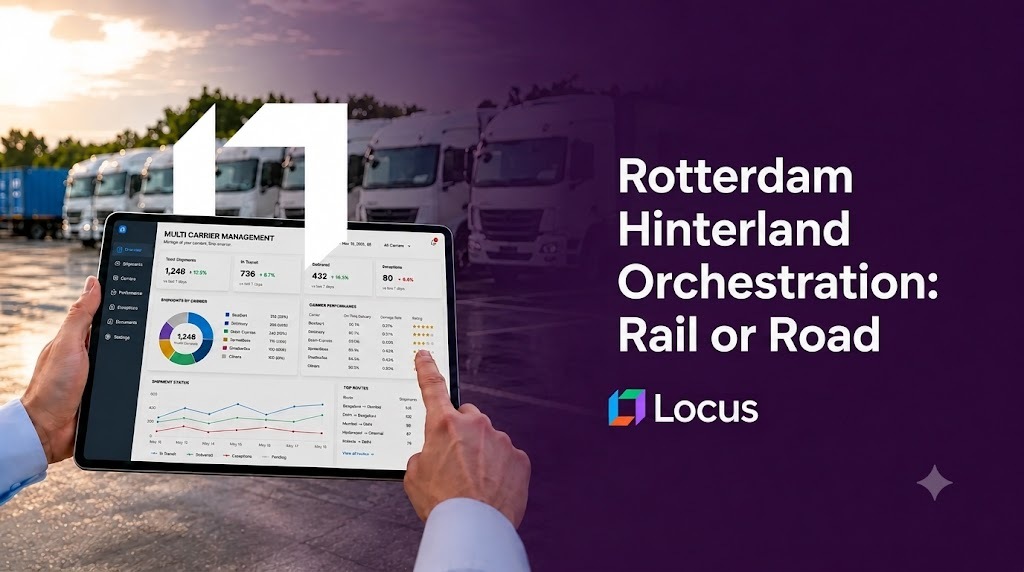
Hinterland orchestration is the continuous coordination of how each container leaves a seaport and reaches its destination, deciding between barge, rail and road, and between carriers within each mode, as conditions change. It differs from hinterland automation, which executes a modal split fixed in advance by contract, because orchestration re-decides when a terminal slips, a rail slot closes or a deadline tightens. Rotterdam is the test case: it is Europe’s largest container gateway, its quays have been congested, and its hinterland split has been moving towards road. For heads of supply chain at importers, forwarders and 3PLs moving goods through Rotterdam, this guide sets out a six-step method built on the Sense, Decide, Execute, Learn cycle, with a worked example on illustrative numbers. Locus, the world’s first Decision-Intelligent, Agentic TMS, runs its orchestration on that cycle.
Key Takeaways
- Rotterdam handled 14.2 million TEU in 2025, up 3.1%, and congestion at container quays diverted significant volume to other ports, so port-side conditions change fast.
- In 2022 Rotterdam’s hinterland split was reported as 30% inland shipping, 59% road and 11% rail, and the share of road had grown since 2018.
- A fixed modal contract cannot react to terminal delays, rail slot changes or tightening deadlines, so modal choice should be re-decided per container.
- Orchestration needs four things in one record: live status, mode constraints, decision rules and governed execution across carriers.
- Set autonomy levels by decision type, so routine rebookings run automatically and large modal switches wait for approval.
Why Hinterland Orchestration Matters: The Business Case
Volume and congestion move together. Container News reported that Rotterdam handled 14.2 million TEU in 2025, up 3.1%, within total throughput of 428.4 million tonnes, down 1.7%. Container imports from Asia rose 9.3%, and the report said congestion at container quays diverted significant volume to other ports.
The hinterland split is not fixed. The International Union for Road-Rail Combined Transport, summarising German federal data, reported Rotterdam’s hinterland split in 2022 at 30% inland shipping, 59% road and 11% rail, and noted that since 2018 more volume had shifted to road and less to barge. The underlying report covers German-bound container traffic, so treat the split as indicative for the wider hinterland.
Reliability now decides carrier choice in parcels. In AlixPartners’ 2026 survey of North American retailers and consumers, reliability overtook price as the main criterion for choosing a lead carrier for the first time. That survey concerns parcel delivery, and this guide applies the same principle to container modes, whose reliability also varies from week to week.
What Is Different About Orchestrating the Rotterdam Hinterland
Each mode has its own constraints. Barges follow terminal rotations and schedules, rail depends on slots and terminal capacity, and road depends on driver hours and delivery slots.
Port conditions change by the day. Quay congestion, terminal delays and vessel arrivals move a container’s earliest pick-up, so a plan made at booking can be wrong at the quay.
The cheapest mode depends on the deadline. A barge that is cheapest on paper may miss a free-time limit or a delivery slot, so cost has to be weighed against the probability of arriving in time.
Decisions cross organisations. Terminals, carriers, forwarders and consignees each hold part of the picture, so orchestration depends on one shared record.
Reliability varies by mode and week. A modal split decided annually cannot reflect that, so the decision belongs at the shipment.
How to Orchestrate the Hinterland in Six Steps
1. Define the decision unit and its deadlines
Treat each container, or each consolidated flow, as a decision with an earliest pick-up, a latest delivery, free-time limits at the terminal and a cost ceiling. Without explicit deadlines a modal choice cannot be judged.
2. Model the real constraints of each mode
For barge, rail and road, record the schedule or slot rules, capacity, cut-offs, driver hours and handling steps, and the carriers available in each. Include terminal-side limits, such as pick-up windows, as constraints and not as notes.
3. Sense: bring live status into one record
Connect vessel arrivals, terminal status, barge and rail schedules and truck positions into one shipment record, with a stated refresh interval. The decision is only as current as the data behind it.
4. Decide: re-evaluate when the facts change
Set rules that score each mode on cost, expected arrival, probability of meeting the deadline and emissions, and re-run them whenever an arrival time, slot or capacity changes. Choose the cheapest option whose probability of meeting the deadline clears your threshold.
5. Execute across carriers and systems
Rebook, re-tender or reassign through your TMS and carrier connections without re-keying, and update the consignee’s promise. An alert that waits for a person to act has already lost part of the window.
6. Learn and govern
Record why each switch was made and what it cost, and set autonomy levels by decision type: routine rebookings run on their own, and a switch of a large flow to another mode waits for approval.
A Worked Example on Illustrative Numbers
The numbers are illustrative, not benchmarks. They show how a modal decision changes when conditions change.
A container must reach an inland distribution centre within 3 days of discharge. The rule is to pick the cheapest mode whose chance of arriving in time is at least 90%.
| Mode | Cost index | Expected transit | Chance of arriving in time | Eligible at 90% |
|---|---|---|---|---|
| Barge | 60 | 2.5 days | 82% | No |
| Rail | 80 | 1.5 days | 94% | Yes |
| Road | 100 | 1.0 day | 98% | Yes |
At booking, rail is the cheapest eligible mode, so the container is planned on rail. After discharge the next rail slot moves back by one day, which raises rail’s expected transit to 2.5 days and lowers its chance of arriving in time to 85%. The rule re-runs, rail drops below the threshold and road becomes the cheapest eligible mode, so the container is rebooked on a truck at a cost index of 100 and not 80. The extra cost is the price of keeping the deadline, and the decision is made within minutes of the slot change and not when the container misses the delivery slot.
Static Modal Contract vs Rules-Based Allocation vs Orchestrated Modal Decision: Key Differences
| Dimension | Static modal contract | Rules-based allocation | Orchestrated modal decision |
|---|---|---|---|
| Basis | Annual split by lane | Rules by lane and cost | Rules plus live status and deadline probability |
| Reaction to delay | Manual escalation | Rule triggers a manual rebook | Re-decided and executed within autonomy limits |
| Data | Separate carrier and terminal portals | Partly joined | One shipment record |
| Cost view | Contract rate | Rate by mode | Cost against the chance of meeting the deadline |
| Governance | Informal | Rule changes logged | Autonomy levels, approvals and decision log |
| Learning | Annual review | Periodic review | Outcomes of each switch recorded |
What to Look for in Hinterland Orchestration Software
Multimodal coverage. Look for one platform that plans road, rail and barge with their own constraints, not a road TMS with notes for other modes.
Live status integration. Check for connections to terminal, carrier and vessel data, with stated refresh intervals.
Deadline-aware decision rules. Ask whether choices weigh cost against the chance of meeting a deadline, and whether you can set thresholds.
Execution through your systems. Look for rebooking and re-tendering in your TMS and carrier connections, without re-keying.
Governance and records. Check for autonomy levels by decision type, approvals for large switches and a log of every automated decision.
Multimodal Orchestration in Action: Real-World Results
Neither deployment below is in the Netherlands or involves barge. They show what orchestration across modes and workforces delivers.
A Canadian multi-modal retailer. Six legacy systems handled dispatch across ocean, rail and road. After consolidating them on one platform, the retailer reached 99%+ on-time store delivery, 95%+ route compliance and 80%+ less manual dispatch, held exceptions under two hours and saved $1M+. Read the retailer case study.
A global freight operator with 4,500+ drivers across 51 service centres. The operator ran 1,500+ captive drivers alongside 3,000+ third-party transporters. With centralised dispatch across both, the execution rate rose from 75% to 92%, uncovering $14M+ in annualised capacity across 25 sites. Read the freight operator case study.
Common Hinterland Orchestration Mistakes to Avoid
Fixing the modal split for the year. Reliability changes week to week, so decide at the shipment.
Choosing on cost alone. The cheapest mode that misses the deadline is the most expensive, so weigh cost against the chance of arriving in time.
Leaving status in separate portals. A decision cannot be current if the terminal, the carrier and the vessel are in different systems.
Automating without limits. Routine rebookings can run alone, but a large modal switch needs approval and a record.
How Locus Approaches Logistics Orchestration
Locus, the world’s first Decision-Intelligent, Agentic TMS, was recognised by Gartner for seven consecutive years and appears in the 2026 Hype Cycle for Supply Chain Execution and Logistics Technologies. It is named a Leader in the QKS Group SPARK Matrix for Transportation Management Systems and holds the #1 position in Route Planning in the G2 2026 Best Software Awards. In October 2025, Ingka Investments, the investment arm of Ingka Group, the world’s largest IKEA retailer, acquired Locus. Locus continues to operate independently.
Locus orchestrates through DiSCO, its Digital Supply Chain Officer, a set of eight agents, Orchestrator, Capacity, Carrier, Dispatch, Hub, Customer, Settlement and the Mycroft co-pilot, that run a continuous Sense, Decide, Execute, Learn cycle. The Orchestrator keeps decisions consistent across agents, the Carrier agent allocates between carriers, and the Control Tower raises SLA alerts as conditions change. Six governance mechanisms, explainability, traceability, evaluation, autonomy levels, an execution sandbox and human-in-the-loop approval, set how much each agent may do on its own. Locus has optimised 1.5B+ deliveries for 360+ enterprise customers across 30+ countries. Public sources show no Dutch or barge deployments and do not list rail or barge connectors, so during evaluation ask which modes and carriers are supported, how terminal and vessel data are connected, how deadline probability is modelled, which switches run at which autonomy level and how a decision log is exported. To see how Locus would orchestrate your hinterland flows, schedule a demo.
For heads of supply chain asking how to orchestrate containers from Rotterdam, Locus offers one governed decision layer that senses, decides, executes and learns across modes and carriers, so a changed slot becomes a re-decided plan and not a missed delivery.
Frequently Asked Questions
What is hinterland orchestration? It is the continuous coordination of how each container leaves a seaport and reaches its destination, deciding between barge, rail and road and between carriers as conditions change. It re-decides when a terminal, slot or deadline changes, instead of following a fixed modal split.
What is the modal split from Rotterdam? For 2022, UIRR reported Rotterdam’s hinterland split as 30% inland shipping, 59% road and 11% rail, based on German federal data on German-bound container traffic, with more volume moving to road since 2018. Check the Port of Rotterdam Authority for current figures.
How is hinterland orchestration different from automation? Automation executes a split or workflow that was set in advance. Orchestration decides continuously, using live status and deadline probability, and executes the change across carriers.
How should a shipper choose between barge, rail and road? Score each mode on cost, expected arrival and the probability of meeting the deadline, then choose the cheapest option that clears your threshold, and re-run the rule when status changes.
How much autonomy should orchestration have? Set it by decision type. Routine rebookings can run automatically, while switching a large flow to another mode should wait for approval, with every decision logged.
Can Locus orchestrate containers out of Rotterdam? Locus orchestrates decisions across carriers and modes with eight agents and governed autonomy, and a Canadian retailer case covers ocean, rail and road. Ask Locus about barge and rail connectors, terminal data and Dutch references.


General
Route Optimisation in the Netherlands: Why Dense Networks Win on Stops per Hour, Not Kilometres

Oct 14, 2026
In a small, dense country like the Netherlands, route savings come from stop density, service time and windows more than from distance. How to plan and measure on stops per hour.
Read more
General
Dutch Distribution Hub Orchestration: Choosing Carriers and Promises by Destination Country in 2026

Oct 14, 2026
A Dutch distribution centre ships to many countries at once. How to orchestrate carriers, services and delivery promises per destination from one decision layer in 2026.
Read moreInsights Worth Your Time


















Rotterdam Hinterland Orchestration: Choosing Barge, Rail or Road for Every Container in 2026