


General
An Ultimate Guide to Smart 3PL Delivery Orchestration for Enterprise Logistics Leaders & 3PL Operations Teams
Key Takeaways
- Delivery orchestration centralizes execution across carriers, fleets, and channels, helping logistics teams maintain control while managing volume spikes, SLAs, and operational complexity — critical as on-time delivery performance reached 98.5% in Q2 2025 industry-wide.
- Automated dispatch, real-time visibility, and analytics reduce manual coordination, improve on-time delivery performance, and help third-party logistics providers control costs at scale.
- Hybrid delivery models supported by orchestration platforms allow enterprises to balance in-house fleets and third-party partners without compromising service consistency or execution visibility.
- As delivery networks expand, orchestration systems become essential for enforcing compliance, responding to real-time disruptions, and scaling operations without increasing dispatcher workload.
- Locus supports enterprise-grade delivery orchestration by combining intelligent allocation, control tower visibility, and AI-driven decision-making for scalable, reliable logistics execution across 1.5B+ optimized deliveries.
If you’re a Head of Logistics, Operations Director, or 3PL executive in retail, FMCG, CEP, or pharma, this guide addresses your most pressing orchestration challenges. Picture a logistics lead managing marketplace, D2C, and retail orders. Routing lives in one tool, carrier updates come from separate portals, and dispatch plans change through the day. Each team sees only part of the picture, so decisions rely on follow-ups and manual checks. That daily confusion points to a structural gap in how deliveries are run.
Delivery orchestration is the AI-driven coordination of last-mile and mid-mile deliveries across multiple carriers, fleets, and channels through a single execution layer — keeping routing, dispatch, tracking, and carrier management aligned in real time.
The impact of this gap is measurable. In an industry survey, 44% of logistics providers said fragmented carrier and partner visibility is a top challenge in last-mile operations, directly affecting delivery reliability. Meanwhile, 57% of operations and supply chain leaders have now integrated AI into selected functions or throughout their organization, signalling that the shift toward orchestration-led execution is accelerating into 2026.
This article covers:
- What delivery orchestration is and how it differs from delivery management
- Where delivery operations lose time and control
- Key components, advanced features, and hybrid delivery models
- How platforms like Locus support multi-partner delivery operations at enterprise scale
- Emerging trends shaping delivery orchestration in 2026 and beyond
Why Locus for Delivery Orchestration?
- AI-powered orchestration — intelligent dispatch and routing across multi-carrier networks
- Real-time control tower visibility — unified execution view across all partners and fleets
- Hybrid fleet support — seamlessly coordinate in-house and third-party carriers
- Proven at enterprise scale — 1.5B+ deliveries optimized globally
- Recognized by Gartner and trusted by 360+ enterprise customers across retail, FMCG, CEP, and pharma
What Is Delivery Orchestration?
Delivery orchestration is the automated, AI-driven coordination of last-mile and mid-mile deliveries across multiple fleet providers, carriers, and service partners using a single operational platform. It matches each order to the optimal carrier based on speed, cost, reliability, vehicle type, and real-time conditions — then continuously adjusts execution as circumstances change.
Unlike basic delivery management software that provides visibility and tracking within a single fleet, delivery orchestration automates intelligent decisions across multiple carriers simultaneously. It governs how orders are assigned, sequenced, dispatched, tracked, and adjusted during execution — functioning as the command centre that aligns delivery demand with available resources while maintaining service consistency.
For 3PL logistics providers managing complex networks, orchestration is the structural layer that prevents fragmented workflows from eroding delivery performance.
Delivery Orchestration vs. Delivery Management
| Dimension | Delivery Management | Delivery Orchestration |
| Scope | Single fleet or carrier | Multi-carrier, multi-fleet networks |
| Decision logic | Manual or rule-based | AI-driven, dynamic allocation |
| Carrier failover | Limited or manual | Automated rerouting and reallocation |
| Scalability | Linear (staff-dependent) | Non-linear (AI handles volume spikes) |
| Visibility | Per-carrier tracking | Unified cross-partner control tower |
| Exception handling | Reactive, manual | Proactive, automated |
Delivery management focuses on organization and tracking within existing operations. Delivery orchestration drives automation, intelligent decision-making, and accountability across the entire delivery network.
Delivery Orchestration vs. TMS, Route Optimization, Dispatch Management, and Last-Mile Delivery Software
Delivery orchestration does not replace every logistics system in the enterprise stack. Instead, it sits as an execution intelligence layer that connects planning systems, carrier networks, dispatch workflows, driver activity, customer communications, and post-delivery analytics.
| System category | Primary purpose | Typical limitation when used alone | How delivery orchestration complements it |
| Transportation management system | Plans and manages broader transportation activities such as tenders, freight movements, contracts, and cost controls | Often focuses on planning or freight administration rather than dynamic last-mile execution across multiple partners | Connects transportation plans to live dispatch, carrier allocation, exception handling, and delivery visibility |
| Route optimization software | Builds efficient routes and sequences based on constraints | May not manage multi-carrier allocation, failover, customer communication, or control tower governance | Uses optimized routing as part of a broader decision layer across carriers, fleets, SLAs, and service models |
| Dispatch management software | Assigns jobs to drivers or fleets and manages daily execution | Can remain fleet-specific or dependent on manual dispatcher decisions | Automates dispatch decisions across owned fleets, 3PLs, gig networks, and regional carriers |
| Last-mile delivery software | Tracks and manages final-mile fulfilment workflows | May focus on visibility and proof of delivery without enterprise-grade orchestration across hybrid networks | Unifies last-mile execution with carrier scoring, SLA rules, reallocation, analytics, and customer experience controls |
| Delivery orchestration platform | Coordinates end-to-end delivery execution across systems, fleets, carriers, and channels | Requires reliable data integration and operational adoption to perform effectively | Acts as the central execution layer for intelligent, scalable, and measurable delivery operations |
The distinction matters for enterprise buyers: delivery orchestration is not simply another routing tool. It is the layer that decides how delivery work should be allocated, executed, monitored, recovered, and improved across the full logistics network.
Key Components of Delivery Orchestration
A well-designed orchestration framework keeps delivery execution consistent as volumes and partners grow. These are the five core components:
1. Order Intake and Standardization
Orders arrive from OMS, WMS, marketplaces, and enterprise systems and are converted into a single, consistent format. This creates a common starting point for routing and dispatch decisions — regardless of the originating channel or system.
2. Intelligent Carrier Selection and Dispatch
Orders are assigned to the right carrier or fleet based on service level commitments, capacity, delivery location, cost parameters, and live operating conditions. Dispatch decisions stay consistent as demand shifts through the day. Understanding what is route optimization is foundational to how orchestration platforms make these allocation decisions.
3. Real-Time Execution Visibility
Operations teams see delivery status across all third-party partners in one view. Tracking updates, delays, and ETAs remain current for both operational decisions and customer communication. This eliminates dependence on fragmented carrier portals.
4. Exception Handling and Automated Failover
Delays, capacity constraints, or route disruptions trigger order reallocation or route adjustments during execution so deliveries stay aligned with service expectations. In 2026, the best orchestration platforms handle this automatically — including failover to alternate DSPs when a primary carrier underperforms. Industry data shows carrier-driven issues fell to 3.2% in Q2 2025, down from 5.98% in Q1 2025, illustrating the impact of tighter carrier coordination.
5. Performance Analytics and Continuous Improvement
Execution data across deliveries, carriers, and routes feeds into analytics dashboards that help logistics leaders monitor on-time performance, cost per delivery, SLA adherence, and exception trends. These insights support carrier performance reviews, informed decision-making, and continuous improvement across the delivery network.
These elements work together to support consistent delivery execution across regions, partners, and delivery models.
Data Required to Power Delivery Orchestration Decisions
Delivery orchestration is only as strong as the operational data feeding it. Before AI-driven allocation, routing, and failover can work reliably, enterprises need clean, timely, and standardised inputs from commercial, warehouse, transport, carrier, and customer-facing systems.
| Data input | Why it matters for orchestration |
| Order data | Defines delivery address, product type, promised date, service level, payment mode, shipment size, and customer instructions |
| Inventory and fulfilment status | Confirms whether an order is ready to dispatch and from which warehouse, store, dark store, hub, or distribution centre |
| Carrier capacity | Shows available vehicles, service areas, cut-off times, load limits, and accepted shipment types |
| Driver location and status | Enables live assignment, dynamic rerouting, exception response, and ETA accuracy |
| SLA rules and delivery windows | Ensures routing and allocation honour contractual commitments, customer promises, and regulatory constraints |
| Cost tables and rate cards | Allows the platform to balance speed, cost, service quality, and carrier economics |
| Historical performance | Improves carrier scoring, delay prediction, route planning, and capacity forecasting |
| Proof-of-delivery and exception codes | Feeds accountability, customer support, audit workflows, and continuous improvement |
For enterprise networks, data governance is not a back-office exercise. It directly determines whether delivery orchestration decisions are fast, compliant, explainable, and commercially viable.
How Delivery Orchestration Works in Practice
Delivery orchestration follows a structured execution cycle:
- Order ingestion — Orders from multiple channels (eCommerce, B2B, marketplace) flow into the orchestration platform and are normalized into a standard format.
- Constraint mapping — The system applies business rules: SLAs, delivery windows, vehicle requirements, geographic zones, and carrier capacity.
- AI-powered carrier matching — Algorithms evaluate available carriers and fleets in real time, selecting the optimal match based on cost, proximity, reliability history, and current load.
- Automated dispatch — Orders are dispatched to assigned carriers without manual intervention. Drivers receive optimized route sequences.
- Live execution monitoring — A control tower tracks all deliveries across partners, flagging exceptions and triggering automated corrective actions (rerouting, reallocation).
- Post-delivery analytics — Performance data feeds back into the system, improving future carrier scoring, route planning, and capacity forecasting.
This cycle runs continuously, allowing orchestration platforms to handle volume spikes, partner changes, and disruptions without proportional increases in dispatcher workload.
How Delivery Orchestration Integrates With Enterprise Logistics Systems
Enterprise delivery orchestration works best when it integrates with the systems that already run orders, inventory, warehousing, transport planning, customer experience, carrier execution, and finance. The objective is not to force a rip-and-replace programme. It is to create a connected execution layer where the right delivery decision can be made using the latest available data.
Typical integration flows include:
- OMS integration: order attributes, delivery promises, customer preferences, cancellation status, and priority flags flow into the orchestration platform for allocation and routing.
- WMS integration: pick-pack status, dispatch readiness, shipment dimensions, inventory location, and dock availability inform when and where deliveries should be planned.
- ERP integration: customer master data, billing references, product constraints, cost centres, service agreements, and compliance rules support standardised execution governance.
- Transportation management system integration: long-haul, middle-mile, freight tendering, and transportation planning outputs can be connected to last-mile and regional execution workflows.
- Ecommerce platform integration: customer orders, delivery slots, address updates, failed payment status, and customer communication triggers can be synchronised with fulfilment activity.
- Carrier system integration: carrier acceptance, capacity, tracking events, proof of delivery, exception codes, and invoice references can be captured through APIs or structured data exchange.
Where Delivery Orchestration Fits Alongside a Transportation Management System
A transportation management system is often the planning and administration backbone for transport procurement, freight contracts, tendering, settlement, and network-level movements. Delivery orchestration typically operates closer to real-time execution, where orders must be assigned, dispatched, tracked, reallocated, and recovered across last-mile and mid-mile networks.
In practical terms, a transportation management system may define the movement plan, cost framework, or transport provider pool. Delivery orchestration then executes against those constraints, selecting the best available carrier or fleet based on live capacity, SLA risk, cost, proximity, and performance. This complementary model allows enterprises to preserve existing TMS investments while adding the agility required for high-volume, customer-facing delivery operations.
Carrier API Integration for Real-Time Execution Data
Carrier API integration is critical for multi-partner delivery orchestration because it replaces delayed manual updates with live execution signals. APIs can exchange order assignment, carrier acceptance, tracking milestones, driver status, ETA changes, exception reasons, proof-of-delivery documents, and completion confirmations.
For 3PLs and enterprises using regional couriers, national parcel networks, dedicated fleets, and gig partners, API-led connectivity creates a common operational language. Dispatch teams no longer need to reconcile separate carrier portals to understand where orders are, which deliveries are at risk, and which partners are meeting SLA commitments.
Enterprise Implementation Roadmap for Delivery Orchestration
A successful delivery orchestration rollout should be phased, measurable, and operationally grounded. Enterprise logistics teams typically see stronger adoption when they begin with high-impact lanes or regions, validate the operating model, and then scale across business units, carriers, and geographies.
- Define the operating baseline: Capture current delivery volumes, carrier mix, cost per delivery, on-time performance, failed delivery rate, dispatcher workload, exception rates, and customer contact drivers.
- Map systems and data flows: Identify order sources, warehouse systems, ERP records, transportation management system dependencies, carrier portals, driver communication channels, and reporting tools.
- Prioritise pilot scope: Select a region, fulfilment node, carrier group, or delivery model where orchestration can solve a clear operational pain point without overwhelming the wider network.
- Configure rules and constraints: Set SLA logic, delivery windows, carrier eligibility, service areas, load limits, vehicle requirements, cost rules, compliance requirements, and exception workflows.
- Integrate core systems: Connect OMS, WMS, ERP, TMS, ecommerce platforms, carrier systems, and driver communication workflows through APIs or approved integration methods.
- Run controlled pilot operations: Compare orchestrated and non-orchestrated performance, monitor exceptions closely, and validate dispatcher, carrier, driver, and customer workflows.
- Standardise playbooks: Document routing rules, exception ownership, escalation paths, carrier onboarding requirements, reporting cadence, and change management responsibilities.
- Scale by lane, region, and use case: Expand to additional nodes, carriers, delivery models, and business units once KPIs demonstrate operational stability.
- Optimise continuously: Use analytics to refine carrier scoring, cost rules, routing constraints, capacity planning, and customer communication workflows.
Migrating From Manual Dispatch, Carrier Portals, or Legacy Tools
Migration should focus on operational continuity, not just system cutover. Many enterprises start with spreadsheets, dispatcher knowledge, carrier portals, static routing tools, or legacy delivery management systems that contain valuable process context but limited automation.
A practical migration plan should:
- Audit current dispatch rules, manual workarounds, carrier preferences, exception codes, and service commitments before configuration begins
- Clean and standardise location, customer, carrier, vehicle, cost, and SLA data before live orchestration
- Onboard carriers in phases, starting with partners that have the highest volume, strongest API readiness, or greatest operational impact
- Run parallel operations during early pilots so teams can compare decisions and build trust in AI-led allocation
- Train dispatchers on exception management, control tower workflows, and performance review routines rather than only on screens and menus
- Retire manual portals and spreadsheets gradually once live data, reporting, and accountability are stable
This approach reduces implementation risk while helping operations teams move from manual coordination to intelligent execution without disrupting service levels.
Common Delivery Orchestration Implementation Mistakes to Avoid
Delivery orchestration can deliver significant operational leverage, but only when implementation is tied to real-world constraints. Common mistakes include:
- Starting with incomplete or inconsistent data: Poor address quality, outdated carrier capacity, missing SLA rules, or inaccurate cost tables can weaken orchestration decisions.
- Treating orchestration as a routing-only project: Route optimisation is important, but orchestration also requires carrier allocation, visibility, exception handling, customer communication, and analytics.
- Underestimating carrier onboarding: Multi-carrier execution depends on timely carrier acceptance, tracking updates, proof-of-delivery capture, and exception reporting.
- Over-customising every workflow: Excessive customisation can slow deployment, complicate support, and make future scaling harder.
- Skipping KPI baselining: Without pre-deployment benchmarks, teams cannot credibly measure gains in cost, productivity, SLA adherence, or customer experience.
- Leaving dispatchers out of change management: Dispatch teams hold critical operational knowledge. Their adoption determines whether orchestration becomes embedded in daily execution.
- Ignoring exception governance: Automated alerts are not enough. Enterprises need clear owners, escalation paths, and decision rights for failed deliveries, capacity shortages, and carrier underperformance.
The best implementations combine strong data foundations, phased deployment, carrier readiness, and disciplined KPI tracking.
Challenges Delivery Orchestration Solves
Delivery Performance Under Volume Pressure
As order volumes rise and carrier capacity shifts through the day, dispatch teams face constant pressure to keep deliveries on schedule. Performance improves when orders align with suitable carriers in real time and execution plans adjust as conditions change.
Delivery orchestration aligns orders with suitable carriers in real time and continuously adjusts execution plans as conditions change. Operations teams respond faster to delays and capacity shifts, leading to more reliable on-time delivery across regions and partners. The results are industry-wide: first-attempt delivery success rose to 99.22% in Q2 2025 among logistics providers investing in coordinated execution.
Cost Control Across Fragmented Planning
Transportation costs tend to climb when load planning and routing spread across disconnected tools. Empty miles, uneven load distribution, and frequent use of premium carriers follow.
Delivery orchestration supports cost control as demand distributes more evenly across available partners and routes reflect live operating conditions. Logistics teams gain clearer visibility into cost per delivery while service expectations remain stable. Understanding why your business needs route optimization is critical to unlocking these savings.
Customer Experience Across Delivery Models
Running B2B, B2C, scheduled, and on-demand deliveries through separate workflows creates gaps in tracking and inconsistent ETAs. A single execution flow across delivery models keeps timelines and updates consistent. Customers receive clearer communication, support teams face fewer escalations, and delivery outcomes remain predictable.
Notably, 44% of consumers prefer on-time delivery, compared to 38% who prefer early delivery, reinforcing that orchestration’s focus on ETA accuracy — not just speed — directly drives customer satisfaction.
Service-Level and Compliance Consistency at Scale
Service-level commitments, driver work-hour limits, and regional transport rules add complexity as delivery networks expand. Delivery orchestration embeds these requirements directly into routing and dispatch logic so execution stays aligned with contractual obligations and regulatory expectations across the network.
Advanced Features in Delivery Orchestration Systems
As delivery networks scale, orchestration systems must move beyond basic coordination and support real-time, data-driven execution. Advanced features help 3PLs maintain control, improve responsiveness, and standardize delivery outcomes across partners and regions.
Automated Dispatch and Intelligent Allocation
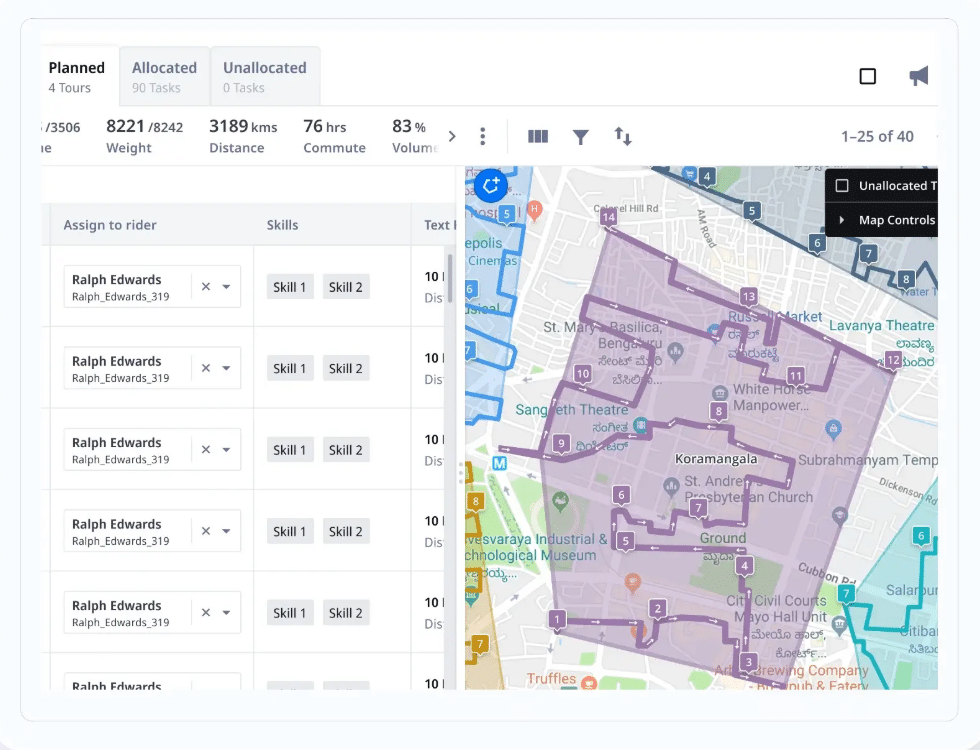
Modern orchestration platforms automate dispatch decisions using predefined rules and dynamic constraints such as capacity, location, delivery windows, and service commitments.
Orders are allocated to the most suitable carrier or fleet without manual intervention, reducing dispatcher workload and minimizing allocation errors. This automation also supports rapid reallocation when conditions change during execution. The ability to improve fleet utilization is a direct outcome of intelligent allocation logic.
According to PwC, 62% of operations leaders believe AI tools are very effective in creating value such as increasing productivity and managing costs — a clear validation of AI-powered dispatch automation as a priority for 2026.
Driver App Capabilities in Orchestrated Delivery Execution
A driver app is the execution endpoint where orchestration decisions become field activity. Once orders are allocated and sequenced, drivers need clear, real-time instructions that reflect the latest route plan, delivery priority, customer requirement, and exception status.
In an orchestrated network, the driver app typically supports:
- Optimised stop sequences and task-level instructions
- Live route updates when dispatch plans change
- Delivery window, address, contact, and service notes
- Proof-of-delivery capture through photos, signatures, OTPs, barcodes, or digital forms
- Exception reporting for failed attempts, customer unavailability, damaged goods, access issues, or rejected deliveries
- Status updates that feed the control tower, customer notifications, and performance analytics
For enterprise operations, the driver app is not just a mobile checklist. It closes the loop between AI-led planning, dispatcher control, customer visibility, and verifiable delivery completion.
Real-Time Transportation Visibility and Control
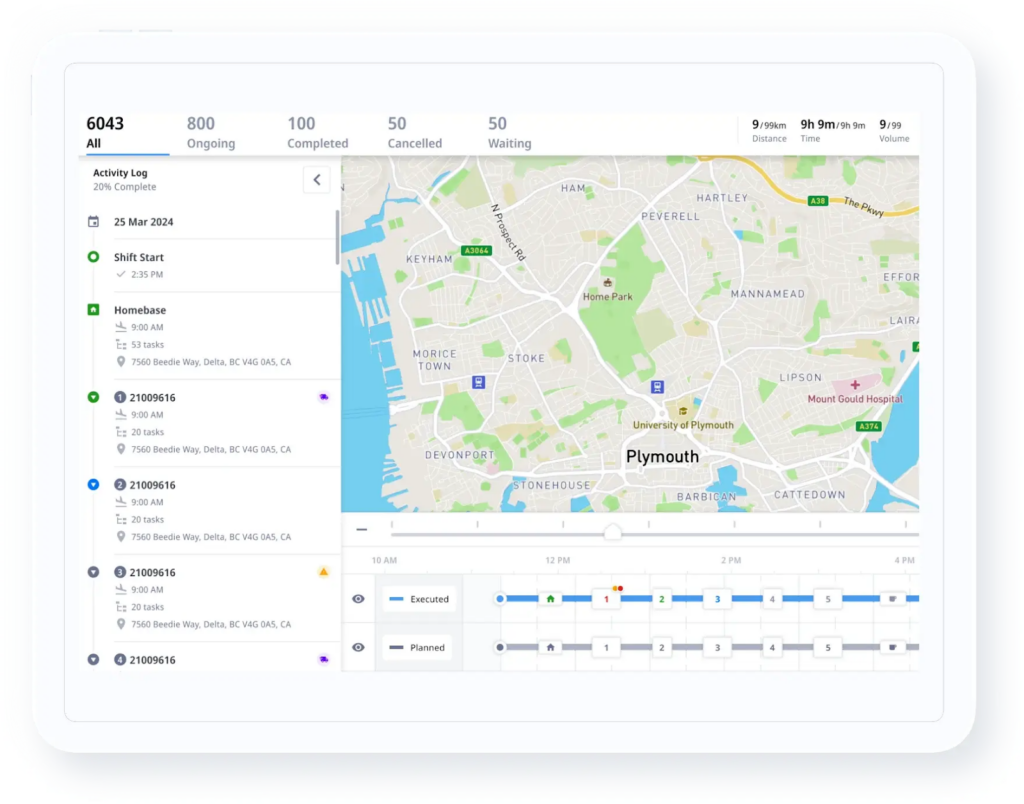
End-to-end visibility across third-party fleets is critical for proactive delivery management. Orchestration systems provide live tracking, milestone monitoring, and exception alerts across all partners.
Operations teams can identify delays early, take corrective action, and communicate accurate updates to customers and internal stakeholders without relying on fragmented tracking tools.The value of this visibility is reflected in the data: overall delivery issue ratios dropped to 4.3% in Q2 2025, down from 7.09% in Q1 2025, as carriers and orchestration platforms improved real-time coordination.
Performance Analytics and Operational Reporting
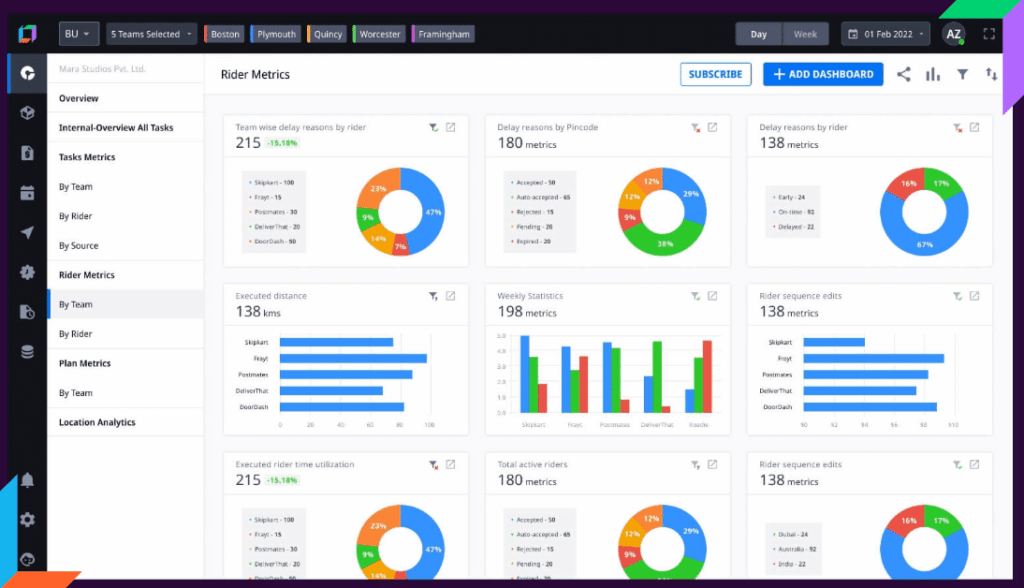
Advanced orchestration platforms capture execution data across deliveries, carriers, and routes. Analytics dashboards help logistics leaders monitor on-time performance, cost per delivery, SLA adherence, and exception trends.
These insights support informed decision-making, carrier performance reviews, and continuous improvement across the delivery network. The route optimization benefits extend across retail, FMCG, CEP, and pharma verticals alike.
Multi-Carrier Network Management
Multi-carrier delivery orchestration connects diverse fleet providers — dedicated carriers, gig fleets, regional partners, and national couriers — under unified allocation logic. The orchestration platform scores each carrier on reliability, cost, capacity, and real-time availability, then distributes orders dynamically.
This eliminates overdependence on any single carrier and creates built-in resilience. If one DSP fails or underperforms, orders automatically failover to the next best option — without dispatcher intervention. For enterprises managing last-mile delivery in SEA or other complex regions, this capability is essential.
The Hybrid Delivery Model
Hybrid delivery networks combine in-house fleets with third-party logistics partners to balance control, flexibility, and cost efficiency. Without orchestration, these networks often operate as parallel workflows, making it difficult to assign the right orders to the right fleet at the right time.
Delivery orchestration acts as the decision layer across hybrid networks, dynamically allocating orders based on capacity, cost, service commitments, and operating constraints.
With orchestration in place, logistics teams can:
- Route predictable, dense, and high-priority deliveries to in-house fleets to maintain service control and margin protection
- Shift peak volumes, remote routes, and variable demand to third-party partners without disrupting execution
- Balance fixed and variable capacity dynamically, reducing idle fleet time while avoiding last-minute premium outsourcing
- Prevent overdependence on any single fleet or partner by distributing load intelligently across the network
- Operate a unified execution layer where in-house and partner fleets follow the same planning logic, tracking flows, and service rules
As a result, hybrid delivery functions as a single coordinated execution network rather than disconnected in-house and outsourced operations. When evaluating how to choose the right route planning software, hybrid fleet support should be a core criterion.
Returns Orchestration and Reverse Logistics
Delivery orchestration also applies to returns, pickups, exchanges, failed delivery recovery, and reverse logistics. For retailers, ecommerce brands, 3PLs, pharma distributors, and service networks, reverse flows are often more complex than outbound deliveries because pickup readiness, customer availability, inspection requirements, refund timelines, and carrier capacity must align.
Returns orchestration helps enterprises:
- Schedule pickups based on customer availability, service area, and carrier capacity
- Allocate reverse logistics tasks to the right fleet or carrier based on cost, proximity, product type, and SLA
- Combine forward deliveries and return pickups where operationally feasible
- Capture proof of pickup, item condition, images, barcodes, and exception notes through driver workflows
- Provide visibility to customer service, warehouse, finance, and carrier teams
- Route returned inventory to the correct store, warehouse, repair centre, disposal point, or consolidation hub
For enterprise logistics teams, returns orchestration converts reverse logistics from a fragmented cost centre into a controlled execution process with measurable service, cost, and customer experience outcomes.
Benefits of Delivery Orchestration
Delivery orchestration delivers compounding operational advantages as networks scale:
| Benefit | How Orchestration Delivers It |
| Reduced delivery costs | Intelligent carrier matching and load optimization minimize empty miles and premium carrier reliance |
| Higher on-time rates | Real-time adjustments and automated failover prevent late deliveries |
| Scalability without headcount growth | AI handles volume spikes — enabling 10x growth without proportional dispatcher increases |
| Consistent customer experience | Unified tracking and ETA accuracy across all carriers and delivery models |
| Carrier accountability | Performance scoring, proof-of-delivery audits, and GPS monitoring enforce standards |
| Compliance and SLA adherence | Rules embedded in dispatch logic ensure regulatory and contractual alignment |
| Operational resilience | Multi-DSP failover and proactive exception management reduce service disruptions |
| Data-driven improvement | Post-delivery analytics inform carrier reviews, route refinements, and capacity planning |
Enterprises pursuing green logistics also benefit from orchestration’s ability to reduce fuel waste through optimized routing and load consolidation.
How to Estimate Delivery Orchestration ROI
A practical ROI model should connect delivery orchestration to the cost and service levers that logistics leaders already track. The objective is to quantify how better allocation, routing, visibility, and exception control affect operating margin and customer experience.
Key value drivers include:
- Dispatcher productivity: fewer manual calls, spreadsheet updates, route edits, and carrier portal checks
- Carrier mix optimisation: more orders assigned to cost-effective carriers without breaching SLA commitments
- Route and load efficiency: lower empty miles, better vehicle utilisation, and more efficient stop sequencing
- Failed delivery reduction: fewer repeat attempts, reverse movements, refunds, and customer support escalations
- Lower premium outsourcing: reduced last-minute use of expensive spot capacity during peaks or disruptions
- SLA penalty avoidance: fewer contractual breaches from late deliveries, missed windows, or compliance failures
- Customer support deflection: fewer “where is my order” contacts due to accurate ETA updates and tracking visibility
- Returns efficiency: better pickup consolidation, carrier allocation, and proof-of-pickup documentation
A simple ROI structure is:
Annual value created = cost savings + productivity gains + avoided penalties + revenue protected through better service
Net ROI = annual value created ? platform, integration, and change management costs
For enterprise buyers, the strongest business cases compare a baseline period against a post-deployment period using consistent volume, geography, and carrier assumptions.
KPIs to Track Before and After Delivery Orchestration
Measurement should begin before implementation. A baseline gives logistics leaders a credible way to demonstrate whether orchestration is improving cost, service, productivity, and resilience.
| KPI | Before deployment | After deployment |
| On-time delivery rate | Measures current SLA reliability by region, carrier, and delivery model | Tracks improvement from dynamic allocation, rerouting, and exception recovery |
| Cost per delivery | Establishes cost by carrier, lane, vehicle type, and service level | Shows impact of carrier mix optimisation, route efficiency, and reduced premium capacity |
| First-attempt delivery success | Identifies failed delivery causes and repeat attempt costs | Measures effect of better ETAs, customer communication, and driver execution workflows |
| Dispatcher orders handled per hour | Quantifies manual workload and coordination effort | Demonstrates productivity gains from automated dispatch and control tower workflows |
| Fleet utilisation | Measures capacity use across owned and third-party fleets | Tracks whether orchestration is balancing fixed and variable capacity more effectively |
| SLA breach rate | Captures missed windows, late deliveries, and contractual issues | Shows whether embedded rules and proactive alerts are reducing non-compliance |
| Exception resolution time | Measures how long delays, failed handoffs, and capacity issues take to resolve | Tracks improvement from automated alerts, failover, and clear escalation ownership |
| Customer support contacts per 1,000 orders | Baselines delivery-related contact volume | Measures reduction from better visibility, ETA accuracy, and proactive notifications |
| Carrier acceptance and rejection rate | Identifies capacity reliability and partner performance gaps | Supports carrier scoring, contract reviews, and network redesign decisions |
These KPIs should be reviewed by operations, finance, customer experience, and carrier management teams so orchestration performance is measured as a network outcome rather than a technology metric alone.
Business Success Stories
Locus has been deployed across complex, high-volume logistics environments where delivery execution spans multiple partners, regions, and service models.
How Delivery Orchestration Drives Results With Locus
Across FMCG, CEP, pharma, e-commerce, and manufacturing ecosystems, Locus has helped enterprises centralize delivery execution and reduce human dependency. By connecting dispatch planning, allocation logic, live tracking, and analytics into a single platform, Locus enables logistics teams to operate with greater control across third-party fleets and distributors.
Common outcomes across Locus deployments include:
- 1.5B+ total deliveries optimized, enabling massive scale across multi-partner networks
- Up to 90% increase in fleet utilization and last-mile productivity reported by retail/3PL partners through optimized dispatch and routing
- 99.5% on-time delivery rate and 95%+ volume utilization achieved in an e-grocery case with optimized batching and routing
- 17% reduction in freight costs and 32% increase in SLA compliance reported in retail logistics deployments
Retail & E-Commerce
Retail logistics deployments have seen fleet utilization improvements of up to 90% alongside a 17% reduction in freight costs. In e-grocery specifically, Locus achieved a 99.5% on-time delivery rate with 95%+ vehicle capacity utilization — demonstrating execution excellence across high-SKU, time-sensitive delivery models.
“Locus’s planning tool has helped us optimize delivery routes and significantly improve fleet utilization across our operations.” — Head of Projects & Home Operations, Leading Retail Enterprise
FMCG & Distribution
In FMCG and distribution-heavy supply chains, Locus has supported centralized dispatch and routing across distributor fleets and third-party transporters, improving delivery predictability while lowering operational overhead. Distributor networks gain standardized execution without requiring each partner to adopt separate tools.
Pharma & Regulated Logistics
In regulated sectors such as pharma and cold chain logistics, Locus has enabled real-time tracking, milestone monitoring, and exception alerts across external delivery partners — helping teams maintain service reliability while meeting compliance requirements. Proof-of-delivery documentation and temperature-sensitive routing constraints are embedded directly into orchestration logic.
Courier, Express & Parcel (CEP)
Courier and CEP operators have used Locus to reduce manual shipment processing, standardize SLA adherence, and improve execution visibility across partner networks. The platform handles high-frequency, small-parcel workflows with the same control-tower precision applied to larger fleet operations.
Trends and Innovations in Delivery Orchestration for 2026
Several shifts are shaping how orchestration platforms are being used across enterprise logistics heading into 2026:
- Greater automation in execution decisions: Dispatch, allocation, and exception handling are increasingly automated to reduce human dependency and improve response speed during disruptions. Over 90% of supply chain professionals plan to use AI tools to enhance customer support and improve forecasting accuracy, pointing to a near-universal shift toward AI-driven orchestration.
- Agentic AI and autonomous logistics decisions: 76% of supply chain professionals see potential for autonomous AI agents to handle tasks like reordering and shipment rerouting. In 2026, expect orchestration platforms to deploy agentic AI that makes and executes decisions without human prompts — from carrier selection to exception resolution.
- Control tower–led operations: Centralized command views are becoming essential for monitoring delivery performance across regions, partners, and service models in real time. The 2026 standard moves beyond passive dashboards toward proactive, AI-augmented control towers that recommend corrective actions.
- Predictive execution and proactive intervention: Orchestration platforms are anticipating delays and capacity issues before they impact service commitments, allowing earlier corrective action. This predictive layer turns orchestration from reactive coordination into forward-looking execution management.
- Deeper integration across logistics systems: Tighter connections between order management, warehouse systems, and carrier platforms are enabling smoother data flow and more consistent execution. However, just under one-fifth (18%) of forwarders and brokers are currently extracting value from AI through live use cases, indicating significant room for adoption growth.
- Hybrid fleet orchestration as the default: As delivery networks diversify, hybrid models blending in-house and third-party fleets are becoming the operational norm rather than the exception. Orchestration platforms that unify these fleets under common logic will define competitive advantage.
As customer expectations rise and delivery models diversify, 3PLs that invest in orchestration-led execution will be better positioned to scale operations while maintaining control, cost discipline, and service reliability.
Buyer Checklist for Evaluating Delivery Orchestration Platforms
Enterprise buyers should evaluate delivery orchestration platforms against operational outcomes, integration readiness, and scalability — not feature claims alone.
Use this checklist during vendor assessment:
- Multi-carrier and hybrid fleet support: Can the platform orchestrate owned fleets, 3PLs, regional carriers, gig fleets, and specialised partners under one logic layer?
- AI dispatch maturity: Does the platform allocate orders dynamically using cost, capacity, SLA, proximity, vehicle type, geography, and carrier performance?
- Route optimisation depth: Can routing handle delivery windows, load constraints, service times, skills, traffic conditions, and operating rules?
- Control tower visibility: Does the platform provide live order, route, driver, carrier, exception, and SLA visibility across the network?
- Carrier API integration: Can it connect to carrier systems for acceptance, tracking, proof of delivery, exception updates, and performance reporting?
- Driver app capability: Does it support task execution, route updates, proof of delivery, exception capture, and field communication?
- Exception automation: Can the platform trigger rerouting, reallocation, alerts, and failover without manual intervention?
- Enterprise integration fit: Can it integrate with OMS, WMS, ERP, TMS, ecommerce platforms, carrier systems, and analytics tools?
- Security and compliance posture: Does the vendor support enterprise-grade controls for customer, shipment, driver, carrier, and location data?
- Analytics and KPI reporting: Can operations leaders track cost, service, productivity, carrier performance, SLA adherence, and exception trends?
- Deployment methodology: Does the vendor offer a clear implementation roadmap, change management support, and phased rollout plan?
- Proven enterprise scale: Can the vendor demonstrate relevant deployments across comparable volumes, geographies, delivery models, and industry constraints?
The right platform should improve decision quality across the network while fitting into the enterprise technology architecture already in place.
Security, Privacy, and Compliance Considerations for Enterprise Buyers
Delivery orchestration platforms process sensitive operational data, including customer addresses, contact details, order information, driver locations, carrier activity, proof-of-delivery records, and commercial performance data. Enterprise buyers should evaluate security and privacy with the same rigour applied to core supply chain systems.
Key areas to assess include:
- Data protection: encryption in transit and at rest, secure API design, data retention controls, and environment segregation
- Access management: role-based access control, least-privilege permissions, single sign-on support, audit logs, and administrator governance
- Privacy controls: handling of customer, driver, and location data in line with applicable privacy regulations and internal policies
- Compliance readiness: ability to support sector-specific requirements such as pharma handling, cold chain documentation, proof-of-delivery audits, and regional transport rules
- Operational resilience: incident response processes, backup and recovery practices, uptime expectations, and business continuity planning
- Vendor assurance: documented security reviews, contractual data processing terms, and evidence of applicable certifications or independent assessments where required by the buyer’s procurement process
For global enterprises, the strongest orchestration deployments align security, privacy, legal, IT, logistics, and carrier management stakeholders early in the buying process.
Why Choose Locus for Delivery Orchestration
At Locus, we’ve built delivery orchestration for the complexity that enterprise logistics teams face daily. Here’s what sets Locus apart:
| Capability | Locus | Traditional 3PL Tools |
| AI-powered dispatch | ? Dynamic, constraint-aware allocation | ? Manual or static rule-based |
| Control tower visibility | ? Unified cross-partner real-time view | ? Per-carrier fragmented portals |
| Hybrid fleet orchestration | ? In-house + 3PL under one logic layer | ? Parallel, disconnected workflows |
| Automated failover | ? Real-time reallocation on exceptions | ? Manual escalation required |
| Predictive analytics | ? Forward-looking capacity and delay alerts | ? Retrospective reporting only |
| Enterprise scalability | ? 1.5B+ deliveries optimized | ? Limited by manual processes |
| Multi-vertical deployment | ? Retail, FMCG, CEP, Pharma | ? Typically single-vertical |
We are the Locus Solutions Team — logistics technology experts who help enterprise fleets scale with confidence and precision. We’ve seen firsthand how delivery orchestration transforms complex, partner-driven operations into predictable, cost-controlled execution networks.
Locus Feature Mapping by Delivery Orchestration Use Case
| Delivery orchestration use case | Locus capability that supports it |
| Multi-carrier allocation | AI-powered dispatch logic that evaluates capacity, cost, geography, SLA, and carrier performance |
| Hybrid fleet execution | Common orchestration layer for owned fleets, third-party carriers, and partner networks |
| Real-time delivery control | Control tower visibility across orders, routes, drivers, carriers, exceptions, and ETAs |
| Route and load efficiency | Intelligent route planning and sequencing for better utilisation and service consistency |
| Exception recovery | Automated alerts, reallocation, rerouting, and failover workflows when delivery risk emerges |
| Customer experience management | Accurate tracking, ETA updates, proof of delivery, and proactive delivery communication |
| Carrier accountability | Performance analytics, SLA tracking, proof-of-delivery audits, and carrier scorecards |
| Enterprise reporting | Dashboards for cost per delivery, on-time delivery, SLA adherence, utilisation, and exception trends |
| Returns orchestration | Pickup scheduling, reverse logistics visibility, proof of pickup, and carrier allocation for return flows |
| Regulated logistics | Constraint-aware planning and documentation workflows for industries with compliance-sensitive deliveries |
For enterprises evaluating Locus, the value lies in how these capabilities work together: planning, dispatch, visibility, exception management, analytics, and continuous improvement operate as one execution system rather than disconnected tools.
Driving Consistent, Cost-Controlled 3PL Operations With Locus
Delivery orchestration has become essential for logistics teams managing growing volumes, multiple delivery partners, and increasingly strict service expectations. As delivery networks expand across regions and channels, relying on manual coordination or disconnected tools limits scalability and control.
A structured orchestration approach brings dispatch, allocation, visibility, and performance monitoring into a single execution layer. This allows 3PLs to respond faster to disruptions, balance cost and capacity more effectively, and deliver consistent service across partner-driven networks. It also supports hybrid delivery models, where in-house fleets and third-party carriers operate as one coordinated system rather than parallel workflows.
The trajectory is clear: 57% of operations leaders have already integrated AI into their workflows, and 2026 will see orchestration shift from competitive advantage to operational baseline. For logistics leaders evaluating the next phase of operational maturity, delivery orchestration is no longer a future consideration — it is the practical foundation for sustainable, reliable, and scalable 3PL operations.Visit Locus to see smart orchestration in action and discover how intelligent delivery orchestration supports enterprise-scale execution.on.
Frequently Asked Questions (FAQs)
What is delivery orchestration?
Delivery orchestration is the automated coordination of last-mile and mid-mile deliveries across multiple fleet providers using AI and software. It matches each order to the optimal carrier based on speed, cost, reliability, and vehicle type — then continuously monitors and adjusts execution in real time. At Locus, we centralize these decisions across carriers and fleets, reducing manual coordination, improving resource utilization, and enabling rapid response to delivery disruptions for our customers.
How does delivery orchestration differ from delivery management software?
Delivery management provides visibility and tracking within one fleet, while orchestration automates intelligent decisions across multiple carriers simultaneously. Orchestration uses AI routing for real-time carrier matching and supports automated failover when a partner underperforms. Management focuses on organization; orchestration drives automation, accountability, and scalable execution.
What are the key components of delivery orchestration?
The five core components are: (1) order intake and standardization, (2) intelligent carrier selection and dispatch, (3) real-time execution visibility, (4) exception handling and automated failover, and (5) performance analytics and continuous improvement. With Locus, these components operate as a unified platform rather than separate tools.
What are the benefits of delivery orchestration for eCommerce?
For eCommerce operations, delivery orchestration cuts costs through optimized carrier matching, boosts delivery speed via AI-powered routing, and improves customer satisfaction through consistent ETA accuracy across all carriers. It also provides proof-of-delivery documentation and carrier performance scoring for accountability — critical as first-attempt delivery success reached 99.22% in Q2 2025 among well-orchestrated networks.
How does AI power delivery orchestration?
AI selects the best carrier per order using real-time data on availability, proximity, cost, performance history, and current load. It automatically handles failover, rerouting orders when a carrier underperforms or faces disruptions. With Locus, AI also powers predictive analytics — anticipating capacity issues and delays before they impact service commitments.
What is last-mile delivery orchestration?
Last-mile delivery orchestration specifically coordinates the final delivery leg across fleets and partners for aligned routing, dynamic capacity allocation, and consistent ETAs. It reduces fragmentation in retail and eCommerce networks, managing volume spikes dynamically without increasing dispatcher headcount or compromising service quality.
How can delivery orchestration integrate with existing systems?
Most orchestration platforms — including Locus — integrate with OMS, WMS, ERP, and carrier systems through APIs, enabling consistent data flow and unified execution control. This means enterprises can deploy orchestration on top of existing infrastructure without replacing core systems.
What are the latest innovations in delivery orchestration for 2026?
Key innovations include agentic AI for autonomous logistics decisions, predictive exception management, AI-augmented control towers that recommend corrective actions, deeper multi-system integrations, and hybrid fleet orchestration as the default operating model. 76% of supply chain professionals see potential for autonomous AI agents to handle tasks like shipment rerouting and reordering — signalling a major shift in 2026.
What factors should I consider when choosing a delivery orchestration platform?
Key factors include AI maturity and dispatch intelligence, multi-carrier network management capabilities, control tower visibility depth, hybrid fleet support, compliance and SLA enforcement features, integration flexibility with existing systems, and the provider’s track record at enterprise scale. Locus recommends evaluating platforms based on proven deployment outcomes — not just feature lists.
How is delivery orchestration different from a transportation management system?
A transportation management system typically supports transport planning, tendering, freight administration, contracts, and cost controls across the wider transportation network. Delivery orchestration focuses on real-time execution: assigning orders, selecting carriers, dispatching routes, tracking progress, managing exceptions, and improving last-mile or mid-mile delivery outcomes. In most enterprise environments, orchestration complements a TMS rather than replacing it.
How can enterprises calculate the ROI of delivery orchestration?
Enterprises can calculate ROI by comparing baseline delivery costs and service metrics against post-deployment performance. Key inputs include cost per delivery, dispatcher productivity, carrier mix, empty miles, failed delivery rate, premium outsourcing, SLA penalties, customer support contacts, and returns handling costs. A practical model is: annual value created from savings, productivity gains, avoided penalties, and protected revenue minus platform, integration, and change management costs.
Can delivery orchestration support returns and reverse logistics?
Yes. Delivery orchestration can support returns orchestration by scheduling pickups, assigning reverse logistics tasks to the right fleet or carrier, capturing proof of pickup, updating customers, and giving warehouse, finance, and customer service teams visibility into return status. This helps enterprises manage exchanges, failed delivery recovery, reverse inventory flows, and customer-facing return commitments through the same execution discipline used for outbound deliveries.


Transportation Management System
Best Transportation Management Systems for Warehouse Operations in 2026

Sep 11, 2026
Transportation management system for warehouse operations. Compare top tools and see why Locus offers stronger routing and real-time visibility.
Read more
Logistics Automation & Orchestration
Why Automating 70% of Exceptions Only Removes 32% of the Work

Sep 11, 2026
Automation takes the tractable cases first, so the residual gets harder per unit. The effort curve, the headcount misforecast, and what to budget instead.
Read moreInsights Worth Your Time



















An Ultimate Guide to Smart 3PL Delivery Orchestration for Enterprise Logistics Leaders & 3PL Operations Teams