


General
Returns Management in 2026: Why You Cannot Consolidate a Pickup You Do Not Know About Yet

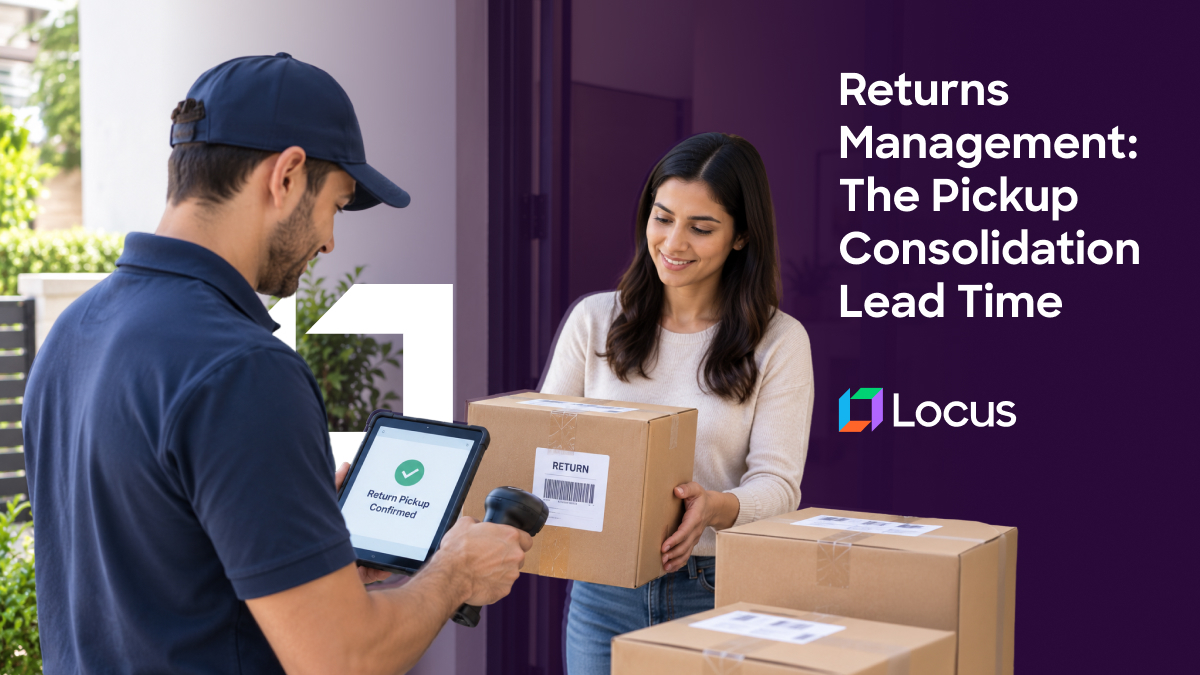
Returns management consolidation is the practice of collecting returns on routes that already exist, rather than dispatching a vehicle for each collection, and it is the largest single cost lever in the reverse leg. It is also the one most often bought and least often achieved, because consolidation has a prerequisite nobody sells against: the planner has to know a return exists before it commits the route that would carry it. Every returns program therefore runs two populations at once, the returns that arrived in time to be planned and the returns that did not, and the second group is unreachable by any optimizer at any price. Locus, the world’s first Decision-Intelligent, Agentic TMS, plans forward and reverse work in the same continuously re-solved plan against more than 250 real-world operating constraints, which is what shortens the commit window that decides the split.
Key Takeaways
- Consolidated return pickups cost roughly 70% less than standalone ones, but only returns known before route commit can be consolidated at all.
- At an 18-hour route commit lead time, 55% of returns are visible in time and blended cost runs 112% above the all-consolidated case.
- Shortening the commit window from 18 hours to 6 lifts consolidatable volume from 55% to 91% and cuts blended cost from $3.18 to $1.83.
- The optimizer has no effect on the unconsolidable share. Only the commit window moves it, which makes this an architecture decision rather than an algorithm one.
- Commit windows differ by fleet type, from 18 hours on a briefed own fleet to about an hour on on-demand capacity, so returns should be allocated by lead time rather than by rate card.
- Locus re-solves plans continuously rather than at a fixed cut-off, so a return requested after the morning plan can still enter a route that has not yet executed.
Why Consolidation Lead Time Matters: The Business Case
Returns volume is large and its timing is customer-controlled. The National Retail Federation’s 2025 Retail Returns Landscape, produced with Happy Returns, puts returns at 15.8% of annual retail sales in 2025, worth $849.9 billion, with online returns at 19.3%. None of that volume arrives on a schedule the operation sets.
The prize for consolidating it is published and large. Locus data puts standalone return pickups at $4 to $6 per item against under $1.50 when the collection joins an existing route, which is a reduction of roughly 70%. That is the number every returns business case is built on, and it applies only to the share that can actually be consolidated.
The forward network provides the routes to consolidate into, and its economics explain why. McKinsey finds that raising drops per stop from one to five cuts labor and vehicle cost by more than 50%. A collection added to a stop that was already happening inherits that density rather than creating its own.
The alternatives to your own fleet have also grown. The Pitney Bowes Parcel Shipping Index records non-major carriers doubling their share of US parcel revenue from 3.4% to 7.2% in a 23.1 billion parcel market, which matters here because the short-notice returns your own plan cannot absorb have somewhere else to go.
The cost of failing to consolidate has risen with the cost of the vehicle. ATRI’s 2026 analysis puts the industry-average operating cost at $2.336 per mile in 2025, up 3.4% and the highest in the report’s history. A dedicated trip for one collection was always the expensive option and is now more so.
How the Commit Window Decides the Consolidation Rate
The model below assumes return requests arrive with a lead time to the requested collection that is right-skewed, with a median of about 20 hours. Standalone pickups are priced at $5.20 and consolidated ones at $1.50. Inputs are illustrative; substitute your own and the structure holds.
1 Consolidation has a prerequisite that is not a feature
To place a collection on a route, the planner needs the route to still be open. Once a plan is committed, drivers briefed and vehicles loaded, adding a stop is an exception rather than an optimization. Every planning operation therefore has a commit moment, and that moment divides returns into two populations with completely different economics.
This is not a limitation of the optimizer. An optimizer can only choose among the work it has been given, and work that arrives after commit was never in the input.
2 The split is set by a comparison of two lead times
One is the route commit lead time: how far ahead of execution the plan is frozen. The other is the return request lead time: how far ahead of the requested collection the customer tells you. Consolidation is available exactly where the second exceeds the first.
| Route commit lead time | Returns known in time | Blended cost per pickup | Against all-consolidated |
|---|---|---|---|
| 2 hours | 99% | $1.52 | 1% more |
| 6 hours | 91% | $1.83 | 22% more |
| 12 hours | 71% | $2.56 | 70% more |
| 18 hours | 55% | $3.18 | 112% more |
| 24 hours | 42% | $3.65 | 143% more |
| 36 hours | 26% | $4.25 | 183% more |
| 48 hours | 17% | $4.59 | 206% more |
An operation that plans the next day’s routes at 4pm is running an 18-hour commit window. It can consolidate 55% of its returns and pays 112% above the figure in its business case. Nothing about its routing software explains that gap.
3 The optimizer is irrelevant to the share it cannot see
This is the part that misdirects investment. A returns program underperforming its business case looks like a routing problem, so the response is usually to evaluate better routing. But for the 45% of returns arriving inside the commit window, the quality of the optimizer is not a variable. Those collections will be standalone trips whether the routing engine is excellent or mediocre.
The corollary is more useful. An operation that shortens its commit window from 18 hours to 6 moves 36 points of volume from the expensive population to the cheap one, which is a larger effect than any realistic improvement in route quality applied to the 55% already being consolidated.
| Also Read: US Returns Hit $850 Billion in 2025: Why US Retailers Are Restructuring Reverse Logistics in 2026 |
|---|
4 There are three ways to close the gap, and they cost different things
The first is to shorten the commit window, which means re-solving the plan closer to execution and accepting mid-plan insertion. This is the cheapest option in operating terms and the most demanding architecturally, because it requires a planner that can revise a committed route safely rather than one that produces a plan once.
The second is to lengthen the return request lead time by offering later collection dates. This works, costs nothing operationally, and is paid for by the customer in waiting, which is a commercial decision rather than a logistics one.
The third is to route the short-notice population differently, to drop-off or to a carrier network, and accept that it will not be consolidated into your own fleet. That is often the correct answer for the tail, and it is the one most programs arrive at last.
5 The commit window is not one number, it is different for every fleet you use
Most networks run several fleet types, and each commits at a different distance from execution. An own fleet with drivers briefed the evening before is locked hours ahead. A contracted 3PL typically accepts work later. On-demand capacity can be engaged almost at the point of need.
| Fleet type | Typical commit window | Consolidatable share | Cost per pickup |
|---|---|---|---|
| Own fleet, briefed daily | 18 hours | 55% | $3.18 |
| Contracted 3PL | 8 hours | 85% | $2.07 |
| On-demand capacity | 1 hour | 100% | $1.50 |
| Network blended | $2.46 |
This reframes a decision most operations treat as purely a cost-per-hour comparison. Own fleet usually looks cheapest per hour and carries the longest commit window, so it consolidates the least of the returns volume it is given. On-demand capacity looks most expensive per hour and can absorb short-notice collections that would otherwise become dedicated trips.
The implication is not that own fleets are wrong for returns. It is that returns volume should be allocated across fleet types by lead time rather than by rate card, sending the long-notice population to the cheapest capacity and reserving late-commit capacity for the tail that would otherwise be standalone.
6 Mid-plan insertion is the capability the split actually turns on
If the commit window is the variable, the mechanism that moves it is the ability to add a stop to a route that is already running. That is a harder problem than it sounds: the insertion has to respect the remaining duty hours of the driver, the capacity left in the vehicle, the delivery commitments already promised to other customers on that route, and the detour cost against the saving.
A system that can only re-plan from scratch cannot do this, because a full re-plan mid-shift invalidates commitments already made. Ask a vendor to demonstrate a single collection inserted into a route in execution, and ask what it does to the promised windows of the stops behind it.
An inserted collection is cheaper than a standalone trip and more expensive than one planned in from the start, because it adds a detour to a route that was already sequenced. The correct comparison is therefore not against $1.50 but against $5.20, and on that basis almost any feasible insertion pays.
This matters because operations often reject insertion on the grounds that it degrades the route. It does. The question is whether a slightly worse route is better than a dedicated vehicle, and at the published spread it usually is by a wide margin.
The practical form of this is a decision rule rather than a judgment call. Set the maximum detour the operation will accept for an inserted collection, expressed in minutes or in miles, and let the planner accept anything inside it automatically. Without a stated threshold the decision falls to a dispatcher under time pressure, and dispatchers reject insertions, because the cost of a degraded route is visible to them on the screen while the cost of the standalone trip it avoided appears on someone else’s invoice weeks later.
7 What to measure before changing anything
Two numbers settle the argument, and both sit in systems the retailer already has. Take a quarter of returns and record the interval between the request timestamp and the requested collection window. Then record the time between the planning run and route execution. Plot the first as a distribution and the second as a line through it, and the share to the right of that line is your consolidatable population today.
Most operations have never drawn this and are surprised by it, because the commit window is usually an artifact of a planning schedule set years earlier for forward volume, and nobody has revisited it since returns became material.
Fixed Planning Cut-Off vs Continuous Re-Solving: Key Differences
| Dimension | Plan committed once per cycle | Plan re-solved continuously |
|---|---|---|
| Commit window | Hours to a day ahead | Minutes to execution |
| Consolidatable share | Set by the cut-off | Near the full population |
| Late return request | Standalone trip | Inserted into a live route |
| Effect of better routing | Applies to the known share only | Applies to almost everything |
| Cost of a change mid-shift | Full re-plan, commitments break | Bounded detour |
| Where the loss appears | Carrier invoice | Not applicable |
What to Look for in Returns Management Software
A stated commit window, and the ability to shorten it. Ask how close to execution the platform can still add a collection. The answer is the single number that determines your consolidation rate.
Mid-plan insertion with commitment protection. Inserting a stop must not silently break the promised windows of the stops behind it. Ask to see the system reject an insertion because it would, rather than accepting every one.
Insertion priced against the right baseline. The platform should compare the detour cost of an insertion against a standalone trip, not against an ideal planned route. Systems that use the second comparison reject insertions that were clearly worth making.
Visibility of the unconsolidatable population. The operation should be able to see what share of returns arrived too late to plan, and what that cost. Almost no returns platform reports it, which is why the gap persists.
Automatic routing of the short-notice tail. Where a collection cannot be consolidated, the system should route it to drop-off or a carrier network by rule rather than defaulting it into an own-fleet trip.
Consolidation in Action: Real-World Results
A global FMCG manufacturer operating across 10 Asian countries ran distribution through more than 1,000 distributors and over 5,000 riders, a structure where collection and delivery were planned by different parties on different cycles. In the logistics automation deployment, moving planning into a single decisioning layer across that network saved more than 12,000 trips per month, optimized over $4B in orders, reached 1.8 million retail outlets and returned 3X ROI. Trips saved is the consolidation number: those are vehicle movements that stopped being necessary once the work was planned together rather than separately.
A leading North American retailer with several hundred stores replaced six legacy systems across ocean, rail and road in a multimodal automation program. Exceptions resolved in under two hours against on-time store delivery above 99%, with route compliance above 95% and manual dispatch reduced more than 80%, returning more than $1M and breaking even in year one. Sub-two-hour exception resolution is the operational signature of a plan that can still be changed, which is the same capability consolidation of late returns depends on.
Common Returns Consolidation Mistakes to Avoid
Buying routing to fix a commit-window problem. For returns arriving after the cut-off, routing quality is not a variable. Measure the split before evaluating optimizers, or the investment lands on the wrong side of it.
Treating the planning cut-off as fixed. It is usually inherited from a forward-only planning schedule and has never been tested against returns volume. It is also the highest-leverage number in the program.
Rejecting insertions because they degrade the route. They do. The comparison is not against a perfect route, it is against sending a vehicle for one collection, and at the published spread the degraded route wins comfortably.
Letting the short-notice tail default into own-fleet trips. Returns that cannot be consolidated should be routed to drop-off or a carrier by rule. Without that rule they quietly become the most expensive collections in the network.
Allocating returns volume to fleets on rate card alone. An own fleet that looks cheapest per hour also commits earliest, so it consolidates the least of what it is given. Allocate by lead time first and rate second.
How Locus Closes the Commit Window
Locus, the world’s first Decision-Intelligent, Agentic TMS, re-solves plans continuously rather than at a fixed daily cut-off, which is what moves returns from the unconsolidatable population into the consolidatable one. The route planning system can place a collection into a route already in execution, evaluating the detour against remaining driver hours, vehicle capacity and the delivery windows already promised to the stops behind it, so an insertion that would break a commitment is rejected rather than accepted silently. Because the Dispatch and Capacity agents hold forward deliveries and reverse collections in the same plan, a return requested after the morning run can still join a vehicle that is passing, and the short-notice tail that genuinely cannot be served is routed to drop-off by rule rather than defaulting into a dedicated trip.
Locus is recognized by Gartner for seven consecutive years, featured in the 2026 Hype Cycle for Supply Chain Execution and Logistics Technologies, named a Leader in TMS by QKS Group in the SPARK Matrix, and ranked #1 in Route Planning on G2’s 2026 Best Software Awards. In October 2025, Ingka Investments, the investment arm of Ingka Group, the world’s largest IKEA retailer, acquired Locus. Locus continues to operate independently.
Returns management consolidation saves roughly 70% per collection and applies only to returns the planner can see before it commits the route. At an 18-hour commit window, that is 55% of them, and blended cost lands 112% above the figure the business case assumed. The remaining 45% is unreachable by any optimizer, because work that arrives after commit was never in the input, which means the lever is the commit window rather than the routing engine: shortening it from 18 hours to 6 lifts the consolidatable share to 91% and cuts blended cost from $3.18 to $1.83. Locus re-solves continuously and inserts into live routes with commitments protected, which is how the window gets short enough to matter. Request a Locus returns consolidation assessment to find out where your own split sits today.
Frequently Asked Questions
Why can’t all return pickups be consolidated?
Because consolidation requires the planner to know about the collection before it commits the route. Returns are requested on the customer’s timing, so any request arriving after the planning cut-off cannot be placed on a route that is already fixed, regardless of how good the routing software is.
How much does consolidating return pickups save?
Roughly 70%. Locus data puts standalone collections at $4 to $6 per item against under $1.50 when the pickup joins an existing route. The saving applies only to the share that can actually be consolidated, which is why the commit window matters as much as the routing.
What is a route commit window in returns management?
It is the interval between the moment a plan is frozen and the moment it executes. An operation planning tomorrow’s routes at 4pm has an 18-hour commit window, and in this model that allows 55% of returns to be consolidated, with the rest becoming standalone trips.
How do we increase the share of returns we can consolidate?
Three options: shorten the commit window by re-solving plans closer to execution, lengthen the return request lead time by offering later collection dates, or route the short-notice population to drop-off and carrier networks. The first is the most demanding architecturally and the cheapest operationally.
Is mid-plan insertion worth the disruption to the route?
Usually yes. An inserted collection makes the route slightly worse and is still far cheaper than dispatching a vehicle for one pickup. The correct comparison is against the standalone cost of about $5.20, not against an ideally planned route, and on that basis most feasible insertions pay comfortably.
How do we measure our own consolidation ceiling?
Take a quarter of returns and record the interval between request and requested collection window, then record the time between your planning run and route execution. The share of returns whose lead time exceeds your commit window is the maximum you can consolidate today, before any change to routing software.


General
Returns Management Platforms in 2026: The Transport Questions to Ask Before You Buy

Sep 16, 2026
Returns management platforms are evaluated on portals, labels and refund rules. The transport layer decides the cost, and a blended cost-per-pickup hides a 3.5x range across your own network.
Read more
General
Returns Management and Refund Cycle Time in 2026: Where the Days Actually Go
Sep 16, 2026
Transport legs are 60% of refund cycle days and 76% of the variance. Because the refund promise is set on a quantile, variance is what decides how many days you can advertise.
Read moreInsights Worth Your Time



















Returns Management in 2026: Why You Cannot Consolidate a Pickup You Do Not Know About Yet