


General
Real-Time Visibility in New York City: Tracking Zone Entries, Dwell and Curb Time in 2026

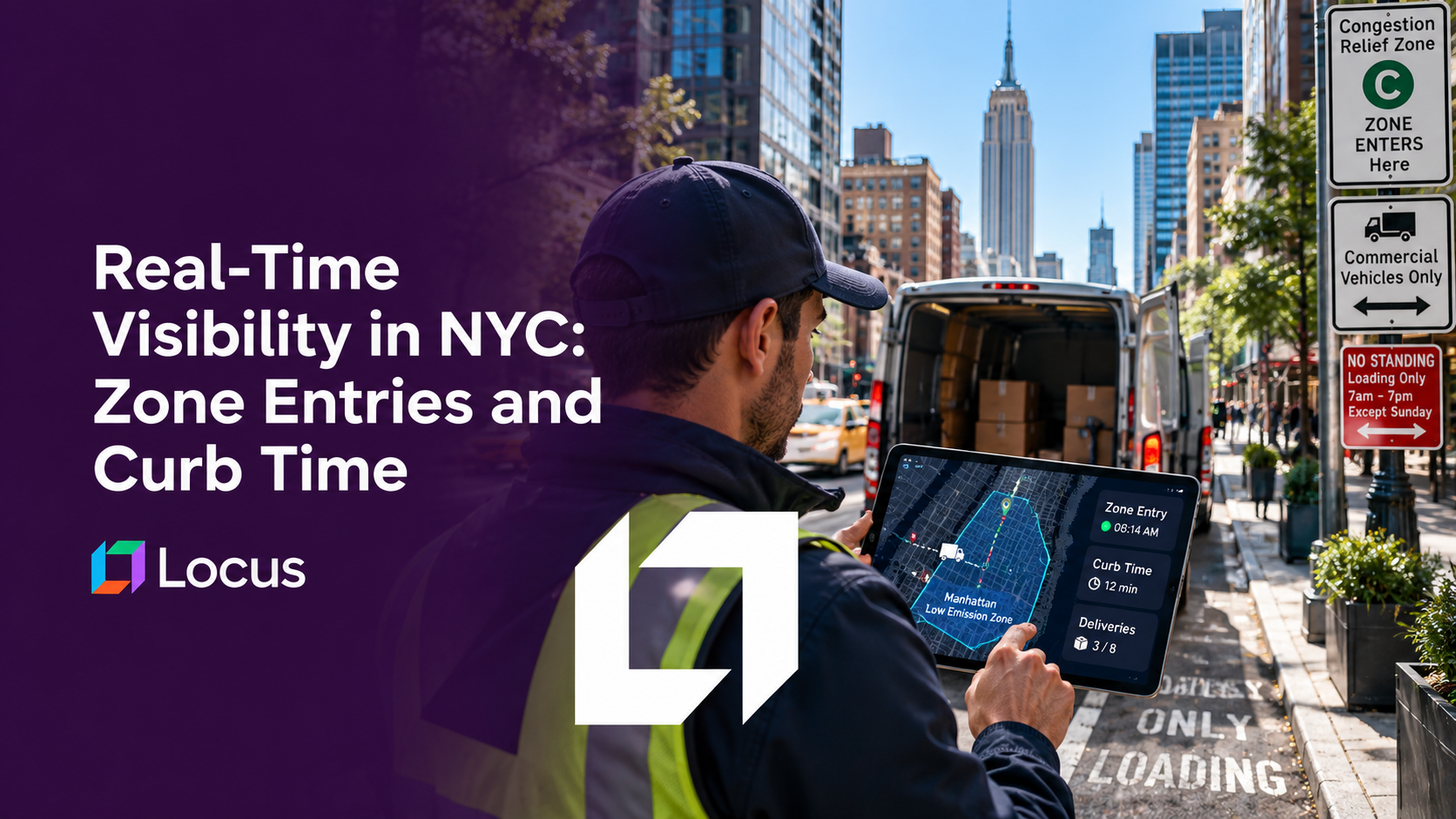
Real-time visibility in New York City is live knowledge of where each delivery vehicle is, how many times it has entered the Congestion Relief Zone, how long it has stood at each curb and what those entries and minutes cost. Since congestion pricing began in January 2025, a truck entering Manhattan’s tolled zone pays at peak times each time it enters, so the number and timing of entries has become a cost and an operations metric, alongside ETA. Locus, the world’s first Decision-Intelligent, Agentic TMS, gives retailers, grocers and 3PLs serving New York the decision layer to plan and track against those costs.
Key Takeaways
- New York’s Congestion Relief Zone charges small trucks $14.40 at peak and $3.60 overnight, and large trucks $21.60 at peak and $5.40 overnight, according to the MTA.
- Overnight rates are 75% lower than peak, and peak runs 5 a.m. to 9 p.m. on weekdays, so timing an entry is a cost decision.
- Trucks are charged for every entry with no daily cap, according to trade reporting, which makes entry count a metric to track.
- New York drivers lost 102 hours to congestion in 2025, according to INRIX, so dwell and curb time shape every ETA.
- Locus’s Dispatch agent plans against 250+ real-world constraints, so entries, windows and curb time can sit in the plan.
Why Real-Time Visibility Matters in New York City: The Business Case
Tolls are explicit. The MTA lists the Congestion Relief Zone truck toll at $14.40 for small (single-unit) trucks and $21.60 for large (multi-unit) trucks at peak with E-ZPass, and $3.60 and $5.40 overnight, with credits of up to $7.20 and $12 for peak entries through the four tolled crossings.
Each entry counts. Trucks are charged for every entry into the zone with no daily cap, according to Land Line’s reporting, unlike passenger vehicles, which are charged once a day.
Congestion costs time. INRIX’s Global Traffic Scorecard recorded 102 hours lost per driver in New York in 2025, second only to Chicago among the large US cities on its list.
Off-hour deliveries are being incentivized. In September 2026 the city launched a first phase of one-time payments, more than $500,000 for up to 14 businesses, to move truck deliveries out of busy daytime hours.
Curb time is where the minutes go. In New York’s earlier off-hour delivery pilot, trucks delivering overnight spent 30 minutes at the curb, compared with about 100 minutes in the daytime peak, according to figures reported from the 2009 to 2010 pilot, a small eight-carrier study.
What Is Different About Visibility in New York City
Every entry has a price. A truck that leaves the zone and re-enters pays again, so a plan that splits stops across several entries costs more than one that batches them.
Time of day changes the cost by 75%. The overnight rate is a quarter of the peak rate, so moving an entry to the overnight window is worth planning, if receivers can accept it.
Curb time is the hidden variable. Double-parking, loading-zone availability and building access decide how long a stop takes, and a static service time hides that.
Congestion varies block by block. A citywide average hides the difference between a Midtown avenue at noon and a Brooklyn side street at night.
Cost sits with the contract. Tolls and tickets land on a carrier or a retailer depending on the contract, so visibility has to attribute them to a stop, a customer and a vehicle.
How to Track Zone Entries, Dwell and Curb Time in Six Steps
1. Geofence the zone and log every entry
Draw the Congestion Relief Zone boundary and record each vehicle’s entries and exits with timestamps. Entry count per vehicle and per day is the base metric.
2. Attribute tolls to stops and customers
Assign each entry’s cost to the stops it served, so a delivery to a customer in the zone carries its share. Without attribution, tolls vanish into overhead.
3. Plan entries, not just routes
Batch stops so a vehicle enters once, and test whether overnight entries are possible for receivers that can accept unattended or off-hour deliveries. The plan should show the toll difference between options.
4. Measure dwell and curb time by stop
Record arrival, departure and any waiting at each stop, with the address and building type. This is the data that corrects service-time assumptions.
5. Forecast ETAs from live dwell
Update arrival times at remaining stops from the actual dwell so far, so a slow stop does not leave every later promise wrong.
6. Reconcile tolls and tickets against the plan
Compare E-ZPass statements and parking tickets against logged entries and stops. Differences show missing logs, wrong plans or charges to dispute or pass through.
| Also Read: Real-Time Tracking and Visibility in 2026 |
|---|
Dots on a Map vs Zone-Aware vs Cost-Aware Visibility: Key Differences
The toll example uses MTA rates for a small truck with E-ZPass, ignores crossing credits and other tolls, and assumes five operating days a week. It is illustrative.
| Dimension | Dots on a map | Zone-aware tracking | Cost-aware visibility |
|---|---|---|---|
| What it shows | Vehicle position | Position and zone entries | Entries, dwell, tolls and ETAs by stop |
| Toll visibility | None until the statement | Entry count | Toll attributed to stop and customer |
| Three peak entries a day | Unknown | $43.20 a day, $216 a week | Same, flagged against the plan |
| One batched peak entry a day | Unknown | $14.40 a day, $72 a week | Recommended when stops can be batched |
| One overnight entry a day | Unknown | $3.60 a day, $18 a week | Recommended when receivers accept off-hour delivery |
| Dwell and curb time | Not captured | Time in zone | Measured per stop and fed to ETAs |
What to Look for in New York City Visibility Software
Zone and entry tracking. Ask whether the platform logs entries into a defined zone per vehicle and can attribute their cost.
Time-of-day planning. Look for planning that can compare peak and overnight entry options and respect receiver windows.
Dwell and curb data. Check that dwell by stop is captured and used to correct service times and ETAs.
Live ETA recalculation. Look for forecasts that update from actual dwell and traffic, not a static estimate.
Reconciliation and reporting. Check for comparison of tolls and tickets against plans, with reports by carrier, customer and zone.
Visibility in Action: Real-World Results
Neither deployment is in New York. They show what unified tracking and live planning deliver.
A leading Canadian grocery brand across 30+ cities. Carrier decisions were made against spreadsheets and visibility was fragmented across carrier portals. With autonomous carrier selection and a unified tracking dashboard, the brand reached a 33% faster fulfillment cycle, 15% lower fulfillment cost and support ticket resolution 10 to 20 times faster. Read the Canadian grocery case study.
A Canadian multi-modal retailer. Six legacy systems handled dispatch across modes. After consolidating them on one platform, the retailer reached 99%+ on-time delivery, cut manual dispatch by 80%+, kept exceptions under two hours and saved $1M+. Read the retailer case study.
Common New York Visibility Mistakes to Avoid
Counting tolls at month end. A statement arrives after the entries are made. Without live entry logs, nothing can be changed.
Splitting stops across several entries. Three peak entries cost three times one, so planning for stop sequence alone misses the bill.
Assuming overnight delivery works everywhere. It pays only where receivers can accept deliveries, which the plan has to check.
Using a static service time. A fixed five minutes per stop ignores curb and building reality, and every later ETA inherits the error.
How Locus Helps New York Operations Track Entries, Dwell and Curb Time
Locus, the world’s first Decision-Intelligent, Agentic TMS, was recognized by Gartner for seven consecutive years and appears in the 2026 Hype Cycle for Supply Chain Execution and Logistics Technologies. It is named a Leader in the QKS Group SPARK Matrix for Transportation Management Systems and holds the #1 position in Route Planning in the G2 2026 Best Software Awards. In October 2025, Ingka Investments, the investment arm of Ingka Group, the world’s largest IKEA retailer, acquired Locus. Locus continues to operate independently.
Locus’s Dispatch agent builds and re-optimizes routes against 250+ real-world constraints, including time windows, vehicle rules and service times, and its Customer agent generates notifications from the current plan so a revised ETA reaches the customer. The platform’s shipment tracking system offers live tracking with predictive ETA alerts, and its driver app supports geofencing. Six governance mechanisms, including autonomy levels and human-in-the-loop approval, keep teams in control. Locus has optimized 1.5B+ deliveries for 360+ enterprise customers across 30+ countries. Its proof points come from other markets. During evaluation, ask Locus how it models congestion-zone entries, time-of-day tolls and curb dwell for New York, and how it attributes those costs to stops. To see how Locus would run your New York network, schedule a demo.
For logistics leaders asking how to get real-time visibility in New York City, Locus gives one governed decision layer where entries, dwell, ETAs and customer promises stay in step.
Frequently Asked Questions
How much does a truck pay to enter the Manhattan congestion zone? According to the MTA, small trucks pay $14.40 and large trucks $21.60 at peak with E-ZPass, and $3.60 and $5.40 overnight. Peak runs from 5 a.m. to 9 p.m. on weekdays and 9 a.m. to 9 p.m. on weekends. Check the MTA’s current schedule before budgeting.
Are trucks charged once a day or for every entry? Trade reporting says trucks are charged for every entry, with no daily cap, while passenger vehicles are charged once a day. Confirm the current rule with the MTA, because it drives how you plan entries.
What does real-time visibility mean for New York deliveries? It means tracking entries into the congestion zone, dwell and curb time at each stop, and the cost of each, alongside vehicle position and ETA. The aim is to plan and adjust against those numbers while the day is running.
Can off-hour deliveries reduce congestion costs in New York? They can, where receivers can accept them. Overnight tolls are 75% lower, and New York’s earlier off-hour pilot found curb time of about 30 minutes overnight against about 100 in the daytime. The city began a new incentive program in September 2026.
How does curb time affect ETAs in New York City? Curb and building access decide how long each stop takes, and INRIX reported 102 hours lost to congestion per New York driver in 2025. A static service time hides that, so ETAs should update from live dwell.
Can Locus model New York congestion pricing? Locus plans against 250+ real-world constraints and tracks vehicles live, but public sources do not describe congestion-toll modeling. Ask Locus to confirm how it handles zone entries, time-of-day tolls and cost attribution for your network.


General
Real-Time Visibility for UK Big and Bulky Home Delivery: Tracking Crews, Jobs and Windows in 2026

Oct 9, 2026
Tracking a sofa is not tracking a parcel. How UK retailers can track crews, jobs and windows for big and bulky home delivery in 2026.
Read more
General
Real-Time Visibility in Germany: Why Sunday and Holiday Truck Bans Must Be Part of Every ETA in 2026

Oct 9, 2026
A GPS ETA that ignores Germany's Sunday and holiday truck bans is wrong by design. How to build the ban calendar into real-time visibility and ETAs.
Read moreInsights Worth Your Time


















Real-Time Visibility in New York City: Tracking Zone Entries, Dwell and Curb Time in 2026