


General
Real-Time Visibility for UK Big and Bulky Home Delivery: Tracking Crews, Jobs and Windows in 2026

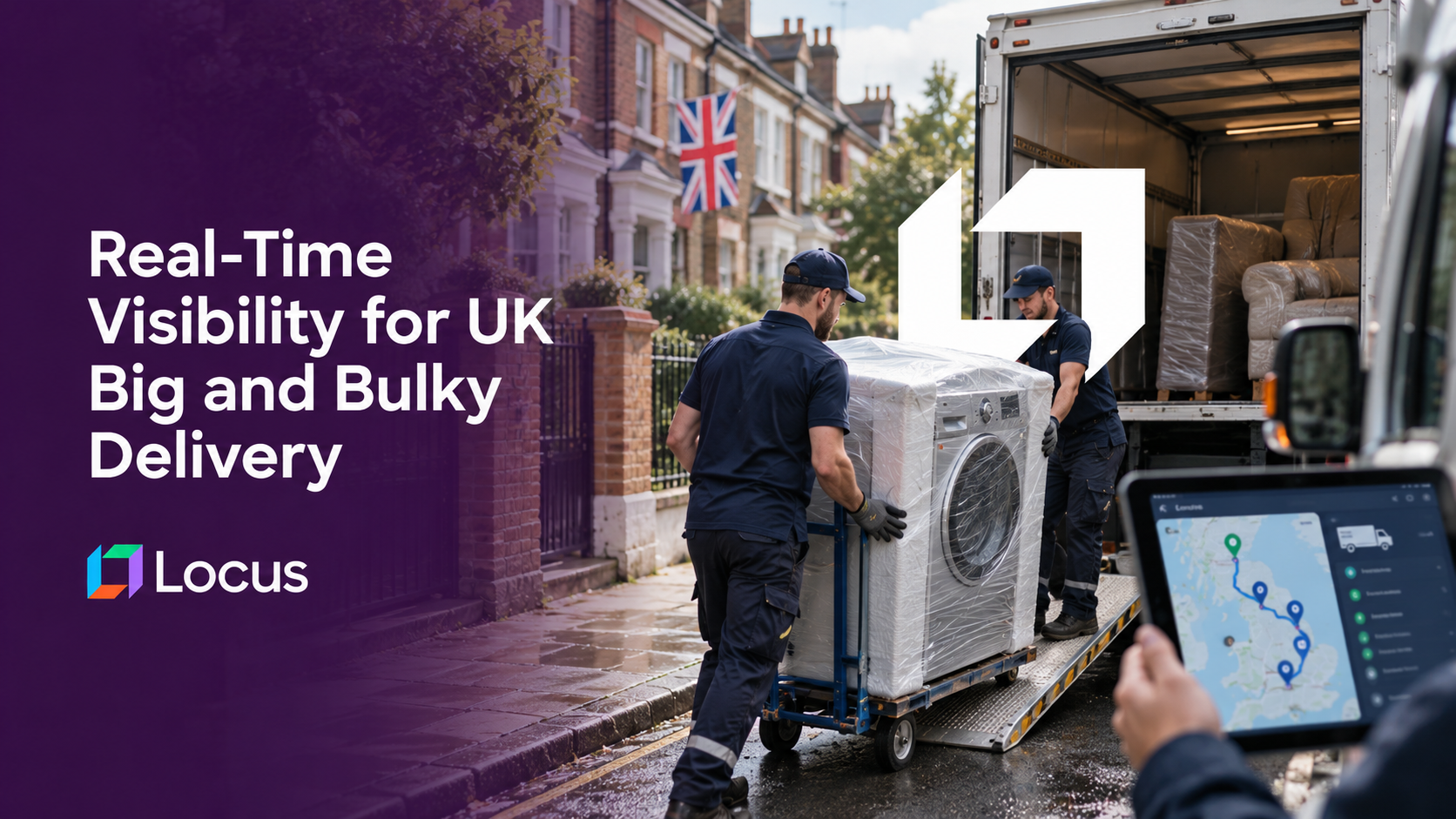
Real-time visibility for big and bulky home delivery is live knowledge of the job, not just the vehicle: where the crew is, what stage the delivery has reached, whether the delivery window will hold and what condition the goods were left in. In the UK, parcel problems are already at record levels, and a two-person delivery of a sofa or an appliance adds access, carry-in, installation and haul-away to every stop. A vehicle dot cannot show any of that. Locus, the world’s first Decision-Intelligent, Agentic TMS, gives UK retailers and their carriers the decision layer behind job-level visibility.
Key Takeaways
- Parcel problems are a mass-market issue: Citizens Advice’s latest survey found 37% of UK parcel users, about 15 million people, had a problem with their last delivery.
- Large items fail in different ways: a UK vendor survey found 49% of furniture buyers had ordered something that did not fit through the door or up the stairs.
- A vehicle ETA is the wrong unit: a two-person crew, a carry-in and an installation make the job, not the drive, the thing to track.
- Job-level visibility needs six things: stage tracking, access data, a live window forecast, stage notifications, handover proof and feedback of actual durations.
- Locus’s Dispatch, Customer and Carrier agents plan the job against 250+ real-world constraints and keep the customer promise in step.
Why Real-Time Visibility Matters for UK Big and Bulky Delivery: The Business Case
Delivery problems are common. Citizens Advice found that 37% of UK parcel users had a problem with their latest delivery, about 15 million people, and 29% of those said the driver left before they could reach the door.
Large items bring their own failure. A survey of 1,500 UK furniture buyers by retail technology firm Fixtuur found that 49% had ordered an item that would not fit through the door or up the stairs, and 23% had returned large furniture bought online in the previous two years.
Online is a large share of retail. Internet sales were 27.3% of UK retail in April 2026, according to the Office for National Statistics’ retail series as reported by a data hub, so home delivery of large items is a mainstream channel.
A failed delivery is costly in two ways. The crew and vehicle are used up for a job that did not complete, and the customer’s goodwill goes with it. Locus’s own guide notes that large-item vehicles are loaded in reverse delivery sequence, so a missed stop cannot simply be re-optimised around.
| Also Read: Big and Bulky Last Mile Delivery Guide 2026 |
|---|
What Is Different About Visibility for Big and Bulky Delivery
The unit is a job, not a stop. A two-person delivery involves arrival, access, carry-in, assembly or installation, packaging removal and sign-off, each with its own duration.
Access decides the outcome. Floor, lift, stair width, door width and parking determine whether a delivery can complete, and these details are often missing when the job is booked.
Windows are narrow and costly to miss. Customers book a window, often a two-hour slot, and may take time off work for it, so a late crew is a visible failure.
Vehicles are loaded in sequence. Because loads are packed in reverse delivery order, mid-route changes are physically hard, which makes accurate forecasts before dispatch more valuable than reactions after it.
Several parties touch the job. A retailer, a delivery partner and an installer may each hold part of the status, so the customer sees gaps unless the stages are unified.
How to Build Job-Level Visibility for Big and Bulky Delivery in Six Steps
1. Track the job in stages, not the vehicle on a map
Define stages such as dispatched, arrived, carrying in, installing and complete, and have the crew confirm them in the driver app. These stages are the real signal for the next stop.
2. Capture access data before dispatch
Collect floor, lift, door and stair details and parking at booking, and confirm them with the customer the day before. A job with a known access problem can get extra time or a different crew.
3. Forecast the window from live job durations
Re-estimate arrival at each remaining stop from the actual durations of jobs completed so far, so the forecast reflects the crew’s day and not an average.
4. Notify by stage
Send customers messages at the moments that matter, such as the crew being on the way, the arrival window narrowing and the crew arriving. Generate them from the current plan.
5. Capture proof at handover
Record photos of condition, installation completion and sign-off at the door, and link them to the job. This supports disputes and damage claims.
6. Feed actual durations back into planning
Compare planned and actual job times by item type, building type and crew, and use the difference to set the next day’s service times. Report by hub and carrier, so improvement is visible.
Parcel Tracking vs Vehicle Tracking vs Job-Level Visibility: Key Differences
| Dimension | Parcel tracking | Vehicle tracking | Job-level visibility |
|---|---|---|---|
| Unit tracked | Parcel scan events | Vehicle position | Crew, job stage and window |
| Typical signal | Out for delivery | ETA to the stop | Carry-in, installation and sign-off stages |
| Access data | Not used | Not used | Captured and confirmed before dispatch |
| Window forecast | Static estimate | Drive time only | Live job durations feed later stops |
| Proof | Signature or photo of parcel | None | Photos of condition and installation |
| Best fit | Boxed parcels | Plain van routes | Furniture, appliances and installed goods |
What to Look for in Big and Bulky Visibility Software
Job and stage modelling. Ask whether the platform models crew size, service time by item and the stages of a delivery, not only stops and routes.
Access and item data. Look for support for item dimensions, weight and building access in planning and in the crew’s app.
Live window forecasting. Check whether arrival forecasts update from completed job durations and not only from traffic.
Customer-facing tracking by stage. Look for notifications and a tracking page that show crew stages and the revised window.
Proof and claims support. Check for photo capture, signatures and item-level condition records tied to each job.
Visibility in Action: Real-World Results
None of these deployments is a UK big and bulky operation. They show what unified tracking and centralised planning deliver.
An ASEAN apparel retailer running a multi-carrier parcel network. Each carrier used its own status codes and took 3+ months to integrate. With multi-carrier orchestration and unified tracking, carrier activation fell from 3 months to 3 days, a 97% reduction, and WISMO and returns queries dropped by 40%+. Read the apparel retailer case study.
A Canadian multi-modal retailer. Six legacy systems handled dispatch across modes. After consolidating them on one platform, the retailer reached 99%+ on-time delivery, cut manual dispatch by 80%+, kept exceptions under two hours and saved $1M+. Read the retailer case study.
Common Big and Bulky Visibility Mistakes to Avoid
Promising from the vehicle ETA. The drive is the smaller part of a bulky job. A promise built on drive time alone misses the carry-in and installation.
Booking without access details. A job booked without floor, lift and door data fails at the door, after the crew has driven there.
Treating a failed delivery as a small cost. It consumes a two-person crew and a vehicle slot, and may trigger redelivery charges and a lost customer.
Collecting proof only at the door. Condition and installation evidence needs to be tied to the job, or damage and completion disputes become word against word.
How Locus Helps UK Retailers Track Big and Bulky Delivery
Locus, the world’s first Decision-Intelligent, Agentic TMS, was recognized by Gartner for seven consecutive years and appears in the 2026 Hype Cycle for Supply Chain Execution and Logistics Technologies. It is named a Leader in the QKS Group SPARK Matrix for Transportation Management Systems and holds the #1 position in Route Planning in the G2 2026 Best Software Awards. In October 2025, Ingka Investments, the investment arm of Ingka Group, the world’s largest IKEA retailer, acquired Locus. Locus continues to operate independently.
For big and bulky delivery, Locus’s Dispatch agent plans against 250+ real-world constraints, including crew, vehicle and time-window rules, the Capacity agent checks capacity before a window is promised, the Carrier agent allocates between owned crews and third-party carriers, and the Customer agent generates notifications from the live plan. Locus’s big and bulky delivery management capability and its driver app support geofencing and electronic proof of delivery. Six governance mechanisms, including autonomy levels and human-in-the-loop approval, keep teams in control. Locus has optimized 1.5B+ deliveries for 360+ enterprise customers across 30+ countries. Its proof points come from other markets, so during evaluation ask Locus how it models two-person crews, installation stages and access data for your UK network, and for its current UK carrier connectors. To see how Locus would run your UK big and bulky network, schedule a demo.
For retail leaders asking how to get real-time visibility into UK big and bulky delivery, Locus gives one governed decision layer where the job, the window and the customer promise stay in step.
Frequently Asked Questions
What is real-time visibility for big and bulky delivery? It is live knowledge of the delivery job: crew location, the stage reached, whether the window will hold and what condition the goods were left in. It goes beyond a vehicle’s position to include carry-in, installation and proof.
Why is tracking big and bulky delivery different from parcel tracking? A parcel is scanned and dropped. A sofa or appliance needs a two-person crew, access to the home, carry-in, possible installation and haul-away, so the job has several stages and durations that a parcel scan cannot show.
How common are delivery problems in the UK? Citizens Advice found that 37% of UK parcel users, about 15 million people, had a problem with their latest delivery, and 29% of them said the driver left before they could reach the door. Large items add access and fit problems.
What information should a retailer capture before dispatching a bulky item? Capture item dimensions and weight, floor, lift availability, door and stair width, parking and any haul-away or installation. Confirm access with the customer the day before so the crew and time allowance are right.
How do you forecast a delivery window for bulky items? Use live job durations from completed stops, adjusted by item and building type, and update the forecast for each remaining stop. A drive-time estimate alone will miss the carry-in and installation.
Can Locus track two-person crews and installation stages in the UK? Locus supports big and bulky delivery management, geofencing and electronic proof of delivery, and plans against 250+ constraints. Its proof points come from other regions, so ask Locus to confirm crew-stage modelling and UK carrier connectors for your network.


General
Real-Time Visibility in Dutch Zero-Emission Zones: Tracking Which Vehicle is Allowed Where in 2026

Oct 9, 2026
In Dutch zero-emission zones, visibility means knowing which vehicle may enter where. How to track eligibility, ETAs and fines across owned, 3PL and courier fleets.
Read more
General
Real-Time Visibility in New York City: Tracking Zone Entries, Dwell and Curb Time in 2026

Oct 9, 2026
In New York City, every truck entry into the congestion zone has a price. How to track entries, dwell and curb time in real time to control cost and ETAs.
Read moreInsights Worth Your Time


















Real-Time Visibility for UK Big and Bulky Home Delivery: Tracking Crews, Jobs and Windows in 2026