


Delivery Management
Top 10 Parcel Delivery Software Platforms for Enterprise Logistics in 2026
Key Takeaways
- Parcel delivery software spans three distinct tiers: AI-native logistics orchestration platforms, delivery management and tracking tools, and shipping label generators. Evaluating all three against the same criteria produces the wrong shortlist
- The most common procurement mistake is buying a visibility layer (tracking, notifications, branded ETAs) when the actual operational problem is dispatch inefficiency, failed first-attempt delivery rates, and fragmented carrier management
- Enterprise buyers should evaluate platforms on five criteria: AI dispatch depth, dynamic route re-optimization, multi-carrier orchestration breadth, end-to-end supply chain coverage, and integration readiness with existing ERP, OMS, and WMS systems
- Tracking-only platforms like AfterShip, ParcelLab, and ClickPost sit downstream of the delivery execution problem. Selecting them as primary parcel delivery software leaves the core dispatch and routing challenges unsolved
- Locus is the only platform on this list purpose-built for enterprise parcel delivery orchestration: AI dispatch across 250+ constraints, dynamic route re-optimization, ShipFlex multi-carrier allocation, and real-time control tower visibility across first-mile, mid-mile, and last-mile
A VP of Operations at a mid-sized e-commerce retailer is reviewing her November peak-season post-mortem. First-attempt delivery failure rate hit 11% in the third week of the campaign.
Customer service handled 14,000 WISMO calls in a single week. Her team had visibility into which parcels failed but no system that could have reassigned them automatically, rerouted drivers mid-day, or rebalanced carrier load across the network in real time. She had three separate tools for tracking, dispatch, and carrier management, and none of them talked to each other when conditions changed.
That gap is the core problem in the parcel delivery software market. Enterprises are running fragmented stacks: one tool for tracking, another for last mile management, a third for carrier rate comparison, and spreadsheets for everything in between. The question this guide answers is which platform closes that gap at enterprise scale.
This guide compares 10 parcel delivery software platforms across enterprise retail, e-commerce, FMCG, 3PL, and CPG use cases.
How We Evaluated These Platforms: The Parcel Delivery Orchestration Maturity Model
The Parcel Delivery Orchestration Maturity Model is a four-level framework for evaluating how deeply a parcel delivery software platform handles the full delivery lifecycle, from label generation to autonomous AI-driven orchestration.
Each platform in this guide is mapped to one of four levels based on its functional architecture.
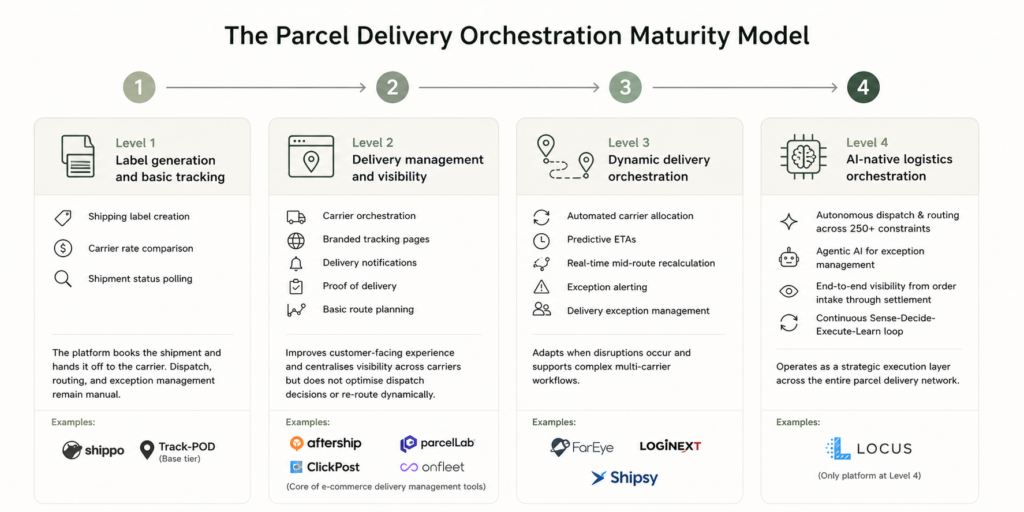
Level 1: Label generation and basic tracking
Shipping label creation, carrier rate comparison, and shipment status polling. The platform books the shipment and hands it off to the carrier. Dispatch, routing, and exception management remain manual. Shippo and Track-POD at base tier operate here.
Level 2: Delivery management and visibility
Carrier orchestration, branded tracking pages, delivery notifications, proof of delivery, and basic route planning. The platform improves the customer-facing delivery experience and centralises visibility across carriers but does not optimise dispatch decisions or re-route dynamically. AfterShip, ParcelLab, ClickPost, Onfleet, and the core of ecommerce delivery management tools operate at this level.
Level 3: Dynamic delivery orchestration
Automated carrier allocation, predictive ETAs, real-time mid-route recalculation, exception alerting, and delivery exception management across carrier networks. The platform adapts when disruptions occur and supports complex multi-carrier workflows. FarEye, LogiNext, and Shipsy operate at this level.
Level 4: AI-native logistics orchestration
Autonomous dispatch and routing decisions across 250+ real-world constraints, agentic AI for exception management, end-to-end supply chain visibility from order intake through settlement, and a continuous Sense-Decide-Execute-Learn loop that improves with every delivery cycle.
The platform operates as a strategic execution layer across the entire parcel delivery network. Locus is the only platform in this comparison operating at Level 4.
Six criteria evaluated across all platforms:
- AI dispatch depth: Does the platform auto-allocate parcels to optimal carriers and drivers using multi-variable constraint logic, or does it require manual assignment?
- Route optimization sophistication: How many constraints does the engine model? Does it re-optimize dynamically during execution, or produce a fixed plan?
- Multi-carrier orchestration: Can it allocate across owned fleet, contracted 3PL, and on-demand carriers simultaneously with rule-based tendering?
- End-to-end supply chain coverage: Does the platform cover first-mile, mid-mile, and last-mile, or only the final delivery leg?
- Enterprise integration readiness: Pre-built connectors for ERP, OMS, and WMS systems vs. custom API-only approaches
- Scalability: Verified performance at 100,000+ daily orders without manual dispatcher intervention during peak surges
Top 10 Parcel Delivery Software Platforms in 2026: At a Glance
Here is a quick summary of the 10 platforms in this guide, grouped by maturity level and operational fit.
| Platform | Maturity | Best For | Key Capabilities | Pricing |
|---|---|---|---|---|
| Locus | L4 | Enterprise parcel delivery orchestration | AI dispatch (250+ constraints), ShipFlex multi-carrier allocation, dynamic route re-optimization, control tower visibility, ePOD | Custom pricing |
| FarEye | L3 | Last-mile delivery experience and carrier management | PILOT agentic dispatcher, multi-carrier orchestration, branded tracking, delivery slot management | Custom pricing |
| LogiNext | L3 | Fleet-heavy delivery automation and workforce management | Route optimization, real-time GPS, automated allocation, predictive delay alerts, driver app | Custom pricing |
| Shipsy | L3 | Cross-border and multi-modal parcel logistics | AgentFleet AI, cross-border management, multi-modal visibility, freight cost optimization | Custom pricing |
| AfterShip | L2 | Post-purchase tracking and customer notifications | 900+ carrier integrations, branded tracking pages, proactive notifications, returns management | Starts at $11 per month for 100 labels |
| ParcelLab | L2 | Post-purchase CX management for enterprise retailers | Personalised tracking pages, proactive alerts, returns portal, delivery analytics | Custom pricing |
| ClickPost | L2 | Multi-carrier integration and NDR management for e-commerce | Carrier recommendation engine, NDR management, unified tracking API, analytics | Custom pricing |
| Onfleet | L2 | Local and regional last-mile fleet management | Auto-dispatch, route optimization, driver app, proof of delivery, customer notifications | From $619/mo |
| Shippo | L1-L2 | Multi-carrier rate shopping and label generation | Rate comparison across 40+ carriers, label printing, tracking API, address validation | Free tier; pay-per-label |
| Track-POD | L1 | ePOD capture and basic route planning for small fleets | Electronic proof of delivery, photo/signature/barcode capture, basic route optimization | From $29/driver/mo |
1. Locus
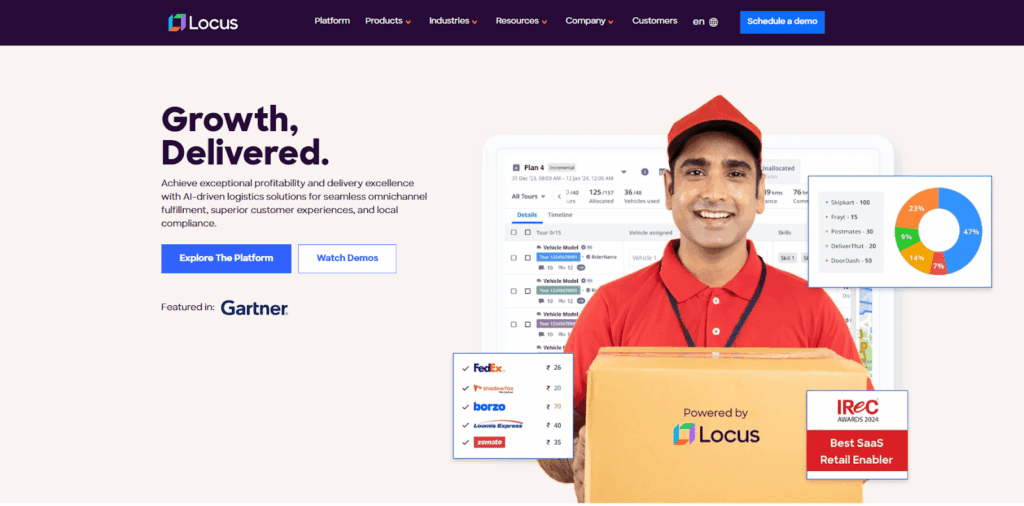
Locus is an AI-native Transportation Management System purpose-built for enterprises where parcel delivery spans multiple carriers, fulfillment hubs, and delivery types simultaneously.
Its DispatchIQ engine auto-allocates parcels to the optimal carrier or driver in real time across 250+ operational constraints: delivery time windows, vehicle capacity, driver availability, priority tiers, zone-based restrictions, and live traffic. Unlike tracking-first platforms that sit downstream of dispatch decisions, Locus controls the decision itself.
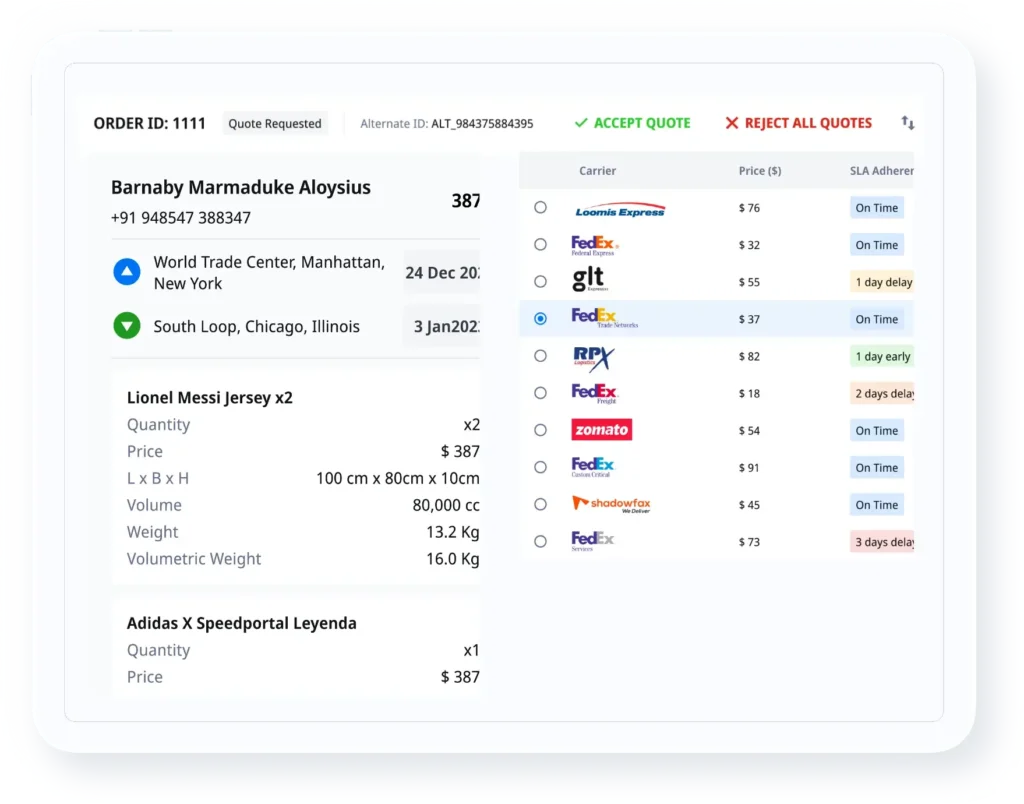
Locus’ ShipFlex carrier orchestration module connects enterprises to over 160 carriers across a broad network of 1,000+ partners with automated tendering and self-serve carrier onboarding. It also validates transporter rates automatically, benchmarks carrier performance across lanes, and reduces billing disputes to protect margins as volume scales.
The automated route planning engine re-optimizes routes continuously throughout the day, absorbing disruptions, new orders, and cancellations without requiring dispatcher intervention.
Locus has powered 1.5 billion+ deliveries across 30+ countries, delivering $320 million+ in logistics cost savings and maintaining a 99.5% SLA adherence rate. In October 2025, Ingka Group, the world’s largest IKEA retailer, acquired Locus after evaluating logistics orchestration platforms globally. Locus continues operating independently.
In March 2026, G2 ranked Locus #1 in Route Planning and recognised it in the 2026 Best Software Awards for Supply Chain and Logistics.
Key features of Locus
- AI dispatch engine (DispatchIQ): Auto-assigns parcels to carriers and drivers across 250+ constraints in real time, handling peak-volume surges without manual dispatcher intervention
- Dynamic route re-optimization: Fireworks routing engine re-calculates optimal routes continuously during execution as conditions change, covering first-mile, mid-mile, and last-mile in one plan
- ShipFlex multi-carrier orchestration: Dynamically allocates parcels across 160+ carriers from a broad network of 1,000+ based on cost, delivery speed, and service commitments with automated tendering workflows
- Control tower visibility: End-to-end shipment tracking across all fleet types and carrier partners from a single dashboard with predictive ETAs and proactive exception alerts
- Electronic proof of delivery (ePOD): Photo capture, e-signatures, barcode scanning, and geo-tagged timestamps with AI validation integrated directly into invoicing and settlement workflows
- Geocoding intelligence: Address-level geocoding accuracy that maps delivery locations to premise and sub-premise level, directly improving First Attempt Delivery Rate (FADR)
- Driver Companion App: Dedicated mobile app for drivers covering task sequencing, turn-by-turn real-time navigation, and ePOD capture
- Sustainability reporting: Built-in Scope 3 emissions tracking embedded in routing decisions, not a separate reporting export
Locus pros
- Covers the full parcel delivery lifecycle in one platform. For CEP and 3PL operations specifically, Locus delivers 81% reduction in dispatch planning time, 65% reduction in sorting time, and 27% reduction in operational costs
- Constraint-aware AI dispatch with 250+ variables produces measurably lower first-attempt delivery failure rates than rule-based alternatives; 1.5B+ deliveries optimised, $320M+ in logistics cost savings across 360+ enterprise deployments
- API-first architecture integrates with existing ERP, OMS, and WMS systems without requiring ERP replacement
Locus cons
- Designed for enterprise-scale operations; SMB or simple single-carrier e-commerce teams may find the platform broader in scope than their requirements
Locus pricing
Custom enterprise pricing based on order volumes, delivery locations, carrier integrations, and deployment scope.
Request a demo for a tailored estimate.
Locus is best for
Retailers, FMCG and CPG brands, 3PL providers, and e-commerce operations managing high-volume parcel delivery across multiple carriers and regions that require full orchestration rather than tracking.
For 3PL operators and CEP providers, Locus delivers a captive fleet experience to shippers: white-labeled tracking, accurate ETAs, and real-time status updates across every shipment, giving shippers visibility and control comparable to an owned fleet even across multi-carrier networks.
This differentiates Locus sharply from post-purchase tracking tools like AfterShip and ParcelLab, which provide the UI without the underlying dispatch and routing intelligence.See how Locus handles enterprise parcel delivery orchestration.
Watch the product demo
2. FarEye
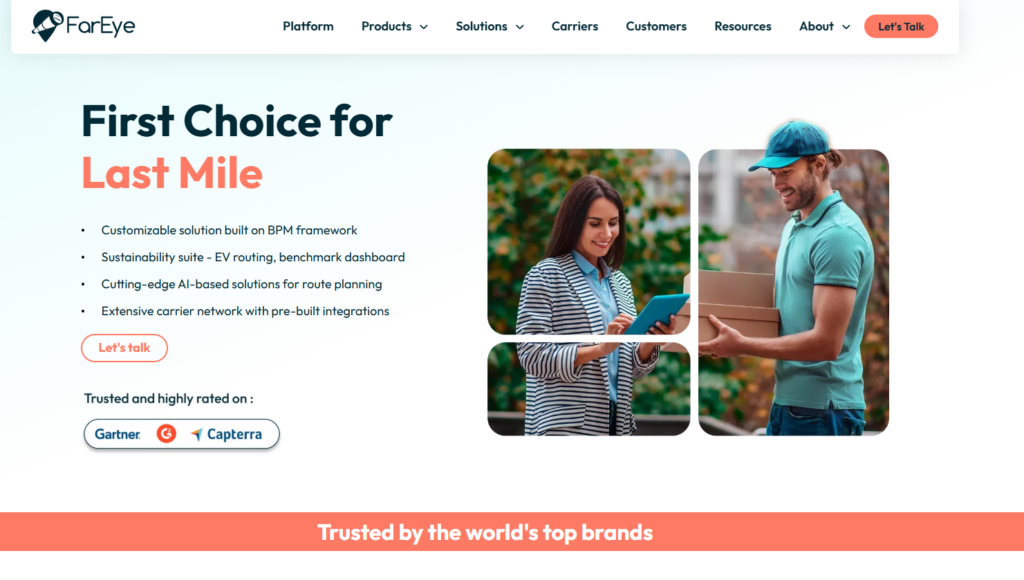
FarEye focuses on last-mile delivery execution and the post-purchase customer experience, connecting enterprises with multiple carrier partners through automated delivery workflows, branded tracking, and proactive customer communication.
Its no-code workflow builder allows operations teams to configure delivery processes without engineering dependency.
Key features of FarEye
- PILOT agentic AI dispatcher: 11 specialized AI agents handling dispatch automation, route optimization, exception management, and customer communication
- Multi-carrier delivery orchestration: Connect and manage multiple parcel carriers through one system with consistent delivery workflows
- Branded tracking and customer communication: Real-time tracking pages, proactive delivery notifications, delivery rescheduling, and post-purchase engagement tools
- Returns management: Configurable returns workflows with carrier selection and tracking across return shipments
- Delivery performance analytics: Carrier performance monitoring, SLA compliance reporting, and delivery metrics tracking
FarEye pros
- Purpose-built customer experience tools are stronger here than in most logistics orchestration platforms
- Real-time shipment tracking from pickup to doorstep improves visibility and reduces customer queries
FarEye cons
- Routing engine applies limited constraint depth; enterprises needing complex multi-variable optimization across large fleets may find it insufficient as a standalone solution
- Coverage is primarily last-mile; enterprises needing first-mile or mid-mile orchestration require additional systems
FarEye pricing
Custom enterprise pricing based on shipment volume, delivery regions, and modules deployed.
FarEye is best for
Retailers, CEP providers, and e-commerce operations that prioritise last-mile delivery visibility and customer communication over deep dispatch optimization.
Also read: 10 Best FarEye Competitors for Routing and Visibility
3. LogiNext
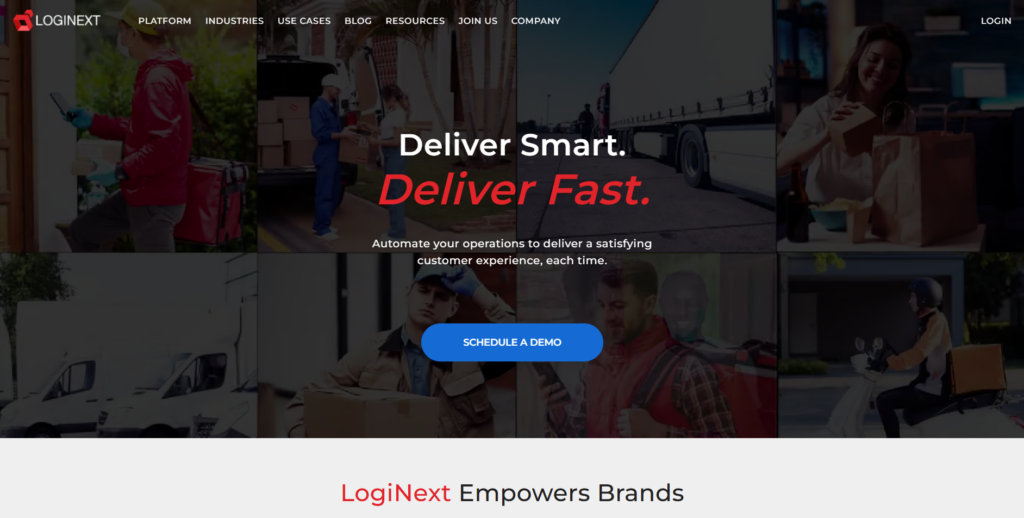
LogiNext provides route optimization and fleet management with a strong position in QSR delivery, CEP, and retail logistics. The platform applies AI-based ETA prediction, automated driver allocation, and analytics dashboards to high-frequency urban delivery networks.
Its drag-and-drop route editing interface reduces dispatcher training time for teams transitioning from manual planning.
Key features of LogiNext
- AI-based route optimization: Multi-stop route planning with predictive ETA capabilities that improve on historical delivery data
- Automated driver allocation: Order assignment to the optimal delivery resource based on workload, geography, and availability
- Real-time fleet tracking: GPS-based tracking across owned and contracted fleets with live status visibility and deviation alerts
- Fleet analytics dashboards: KPI reporting across mileage, idle time, on-time delivery, and fleet utilisation
- Driver mobile app: Route navigation, task management, and proof-of-delivery capture for field teams
LogiNext pros
- QSR and urban delivery vertical positioning with routing and dispatch logic tuned for tight delivery windows and on-demand operations
- Route optimization and field workforce management in one platform reduces the need for separate fleet and workforce tools
LogiNext cons
- AI capabilities lean toward rule-based automation rather than predictive, real-time re-optimization at enterprise-scale constraint complexity
- API limitations restrict custom integration depth for enterprises with complex ERP and WMS connectivity requirements
LogiNext pricing
Custom pricing based on fleet size, delivery volumes, and deployment scope.
LogiNext is best for
CEP, QSR, retail, and healthcare logistics operations managing owned fleets, primarily in India and MENA, that need route optimization and workforce scheduling together.
Also read: 10 Best LogiNext Competitors for Routing and Visibility
4. Shipsy
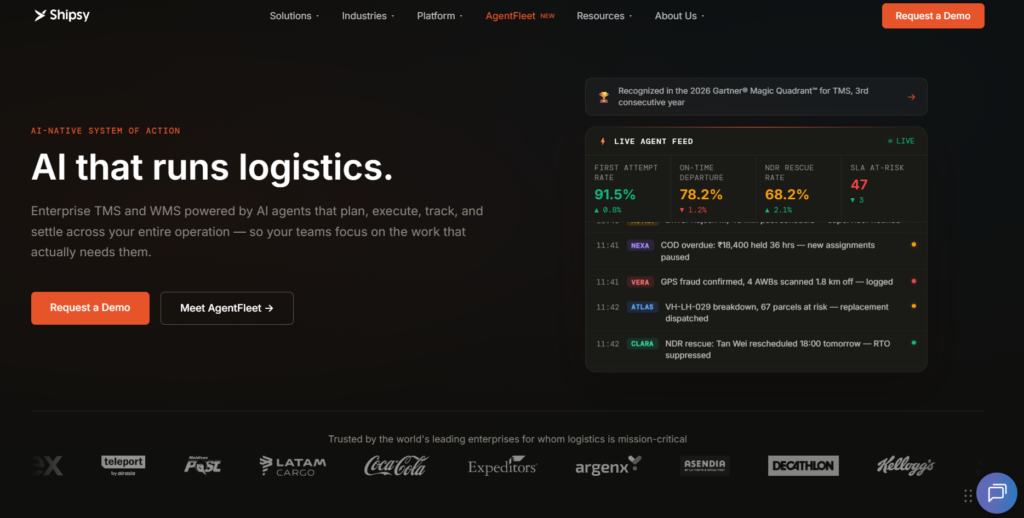
Shipsy specializes in cross-border parcel logistics, multi-modal freight management, and domestic delivery orchestration. Its AgentFleet introduces five named AI agents handling customer communication, driver coordination, operations management, freight invoicing, and dispute resolution.
The platform has traction in MENA, Southeast Asia, and India, particularly for enterprises managing international parcel corridors.
Key features of Shipsy
- Cross-border parcel management: International shipment visibility, customs compliance, and multi-modal freight coordination
- Carrier allocation engine: Automated carrier selection based on cost, delivery time, and service commitments across the carrier network
- Freight invoicing and audit: Automated freight invoice generation, settlement workflows, and cost reconciliation
- Analytics and reporting: Carrier performance dashboards and delivery KPI tracking across logistics operations
Shipsy pros
- Cross-border freight and compliance automation suited to enterprises with significant international parcel volumes across MENA, SEA, and India corridors
- AgentFleet covers five operational functions autonomously, reducing manual intervention in freight settlement and exception workflows
Shipsy cons
- Domestic last-mile dispatch automation for high-density networks trails AI-native platforms specifically built for delivery execution
- Carrier coverage in North America and Western Europe is narrower than in its primary MENA and India markets
Shipsy pricing
Custom enterprise pricing. Details provided after consultation.
Shipsy is best for
Enterprises managing cross-border parcel logistics and multi-modal freight, particularly across MENA, India, and Southeast Asia.
5. AfterShip
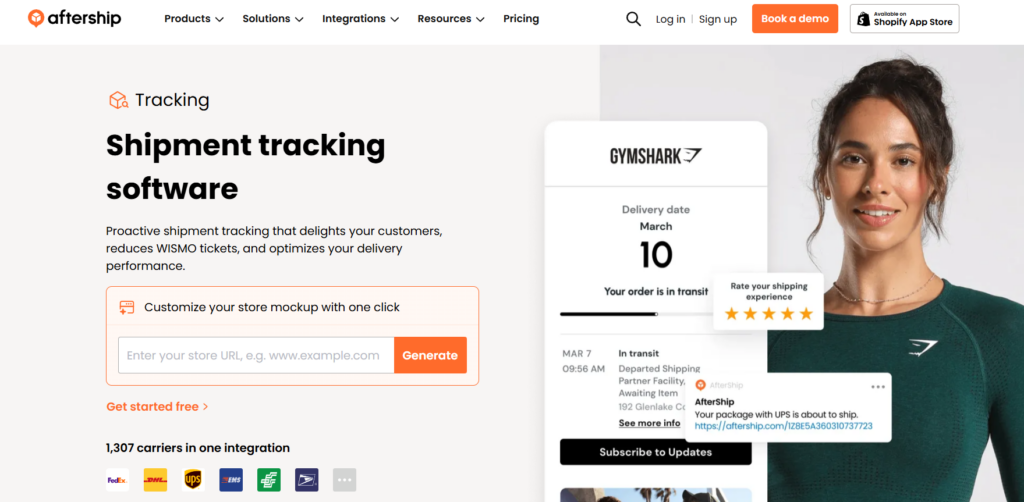
AfterShip is a post-purchase experience platform that aggregates shipment tracking data across 900+ carriers into branded tracking pages and proactive customer notifications. It operates downstream of delivery execution: AfterShip does not select carriers, dispatch drivers, plan routes, or manage exceptions.
The automated tracking system reports on what is happening to a parcel after it has already entered the carrier network.
Key features of AfterShip
- Branded tracking pages: Customizable post-purchase tracking experiences with branded UI, promotional space, and delivery progress updates
- Proactive delivery notifications: Automated SMS and email alerts to customers at key shipment milestones to reduce WISMO contacts
- Returns management: Self-service returns portal with carrier selection and tracking for return shipments
- Delivery analytics: Carrier performance monitoring and on-time delivery reporting across the shipment network
AfterShip pros
- Purpose-built branded tracking and notification tools improve the post-purchase customer experience without requiring engineering resources
- Quick setup with platforms like Shopify and others makes it accessible for mid-market teams
AfterShip cons
- Visibility layer only: does not handle dispatch, route planning, carrier allocation, or exception management
- Not suitable as a primary parcel delivery software for enterprises needing AI dispatch, dynamic routing, or supply chain orchestration
AfterShip pricing
The Essentials plan starts at $11 per month for 100 labels, the Pro plan starts at $89 per month for 2,000 labels, and the Enterprise plan offers custom pricing based on business needs.
AfterShip is best for
E-commerce brands that want to improve post-purchase customer experience and reduce WISMO contacts. Best used alongside a delivery orchestration platform, not as a replacement for one.
6. ParcelLab
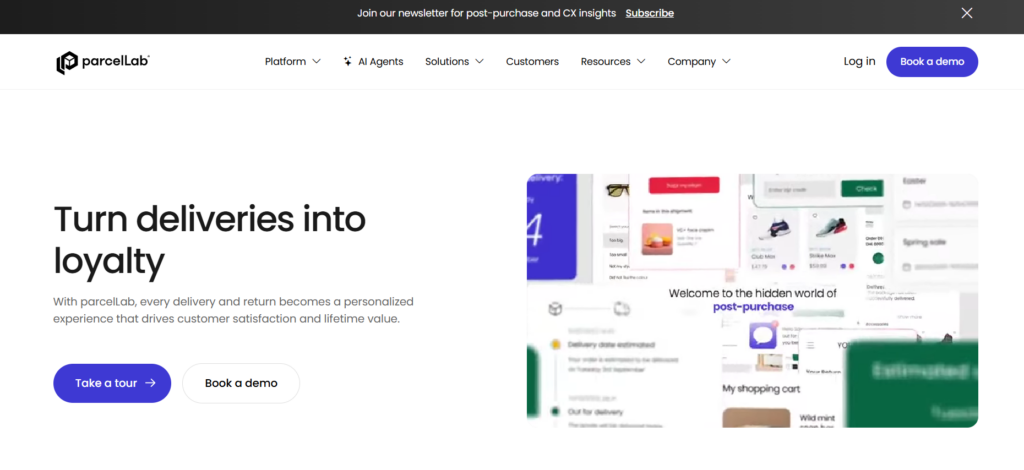
ParcelLab is an operations experience management platform focused on controlling post-purchase communication and tracking for enterprise retailers. It connects to carrier data feeds and uses that information to trigger personalised tracking pages, proactive delay alerts, and returns portal experiences that align with the retailer’s brand identity.
For enterprises where branded post-purchase communication is a primary retention lever, it adds genuine value.
Key features of ParcelLab
- Proactive delay communication: Automated customer alerts triggered by exception events in the carrier data feed, reducing inbound support contacts
- Returns portal: Self-service returns experience with carrier label generation and return tracking
- Delivery experience analytics: Performance metrics on customer engagement with tracking communications and delivery satisfaction indicators
- Multi-carrier connectivity: Carrier data aggregation across global and regional carrier networks for tracking event ingestion
ParcelLab pros
- Sophisticated post-purchase communication layer with personalization, promotional integration, and detailed delivery experience analytics
- Returns portal built for enterprise retailer UX requirements, including branded experiences and carrier selection logic
ParcelLab cons
- Operates entirely downstream of delivery execution: dispatch, routing, and carrier optimization are outside scope
- Enterprise pricing positions it as a specialist tool; organizations needing orchestration capabilities require a separate platform investment
ParcelLab pricing
Custom enterprise pricing based on shipment volume and modules deployed.
ParcelLab is best for
Enterprise retailers where branded post-purchase communication, personalised tracking experiences, and returns UX are primary customer retention priorities.
7. ClickPost
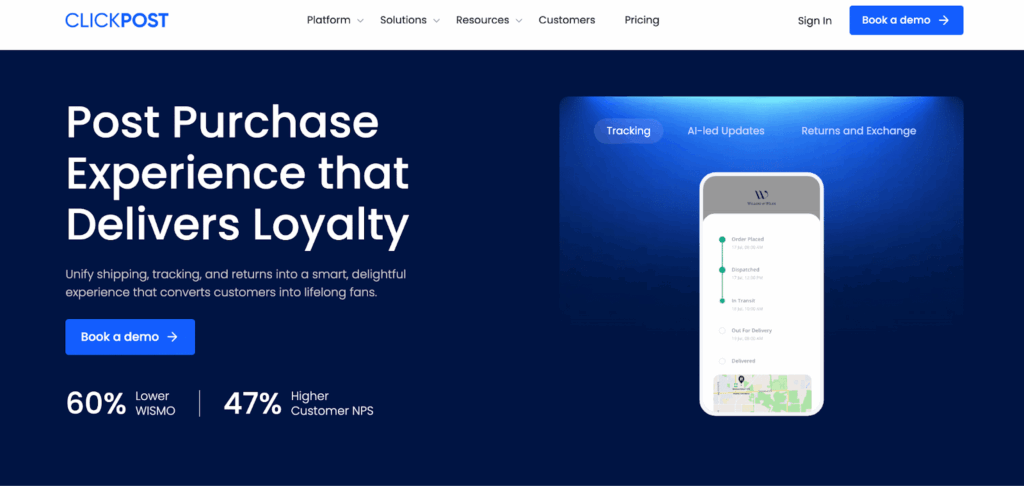
ClickPost is a multi-carrier integration and logistics intelligence platform for e-commerce brands, offering a carrier recommendation engine, NDR (non-delivery report) management, and a unified tracking API. Its carrier onboarding speed is a genuine operational advantage: enterprises adding new regional carriers can integrate through ClickPost without separate IT projects.
Where ClickPost’s scope is limited is in the execution layer: carrier selection logic is rule-based, and the platform does not cover dispatch management, dynamic route optimization, or delivery exception management at the fleet level.
Key features of ClickPost
- Carrier recommendation engine: Rule-based carrier selection logic that matches shipments to carrier partners based on configured criteria
- NDR management: Automated workflows for handling non-delivery reports, reattempt scheduling, and carrier communication
- Analytics and intelligence: Shipment performance reporting and carrier comparison analytics
ClickPost pros
- Fast multi-carrier integration and NDR management suited to e-commerce brands scaling across new carrier partnerships and markets
- Unified tracking API simplifies the development overhead of managing multiple carrier data feeds
ClickPost cons
- Carrier selection is rule-based rather than AI-driven; dynamic, constraint-aware dispatch optimization is outside scope
- Does not cover route planning, driver dispatch, fleet management, or end-to-end supply chain visibility
ClickPost pricing
Custom pricing based on shipment volume and carrier integration requirements.
ClickPost is best for
E-commerce brands in India and Southeast Asia managing multi-carrier parcel operations who need fast carrier onboarding and NDR automation.
8. Onfleet
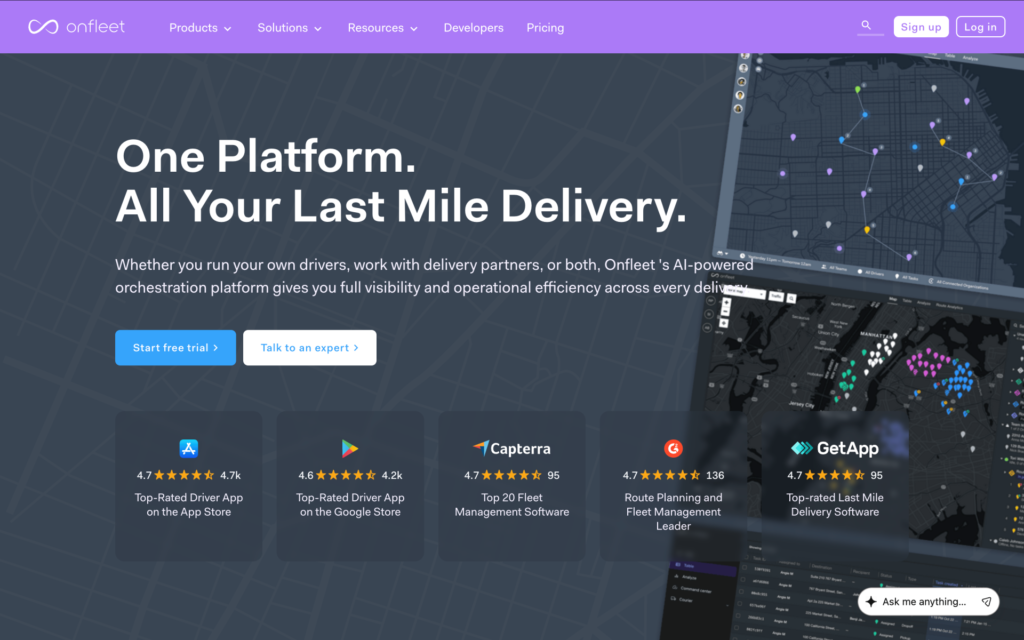
Onfleet is a last-mile delivery management software platform built for local and regional fleets. It covers auto-dispatch, route optimization, real-time driver tracking, customer notifications, and proof of delivery with a clean user interface suited for dispatch teams without deep logistics technology backgrounds.
It does not cover multi-carrier orchestration, freight management, or first-mile and mid-mile operations.
Key features of Onfleet
- Auto-dispatch: Automated order assignment to drivers based on delivery windows, vehicle capacity, and driver location
- Route optimization: Route planning and sequencing across multiple stops with traffic-aware adjustment capabilities
- Real-time driver tracking: GPS-based driver location and delivery status monitoring through a web dashboard
- Customer notifications: Automated SMS updates to customers with estimated arrival times and delivery confirmation
- Proof of delivery: Photo, signature, and barcode capture via the driver mobile app with delivery confirmation workflows
Onfleet pros
- Fast deployment with strong usability for dispatcher and driver teams, reducing training time for operations scaling from manual workflows
- Transparent published pricing with a free trial makes cost evaluation straightforward before contracting
Onfleet cons
- Designed for local and regional fleets; not built for multi-hub, multi-carrier enterprise operations at hundreds of thousands of monthly orders
- Limited multi-carrier orchestration, freight management, and ERP integration depth for enterprise fulfillment workflows
Onfleet pricing
Pricing is tiered and subscription-based, with plans starting at $619/month (Launch), $1,349/month (Scale), and $3,099/month (Enterprise).
Onfleet is best for
Local and regional delivery fleets in food delivery, pharmacy, alcohol, and similar verticals where owned-fleet last-mile delivery is the primary logistics challenge.
9. Shippo
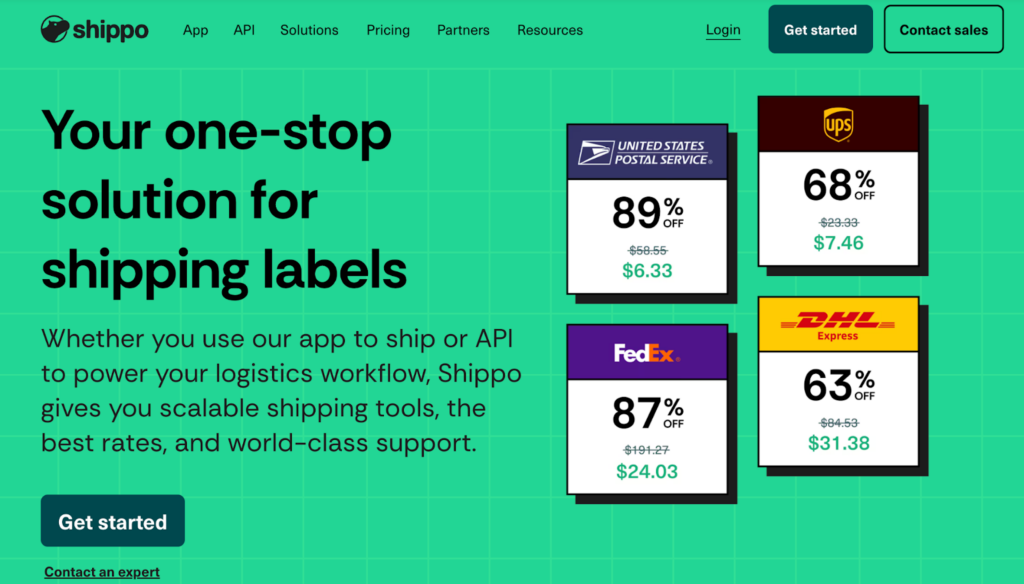
Shippo is a shipping API and multi-carrier rate comparison platform primarily serving small and mid-sized e-commerce merchants. It connects to 40+ carriers, compares rates, generates labels, and provides a tracking API for shipment status updates.
For growing e-commerce brands managing outbound shipping without a dedicated logistics team, it reduces the friction of booking shipments across multiple carriers.
Key features of Shippo
- Label generation: Bulk label printing, address validation, and shipment booking across connected carriers
- Tracking API: Unified tracking data API for embedding shipment status into e-commerce platforms and internal tools
- Returns label creation: Generate return labels at point of purchase or on-demand for outbound returns workflows
- E-commerce platform integrations: Native integrations with Shopify, WooCommerce, BigCommerce, Etsy, and similar platforms
Shippo pros
- Fast carrier rate comparison and label generation reduces shipping overhead for e-commerce teams processing hundreds of orders per day
- Pay-per-label pricing model with a free tier makes it accessible for early-stage and growing e-commerce operations
Shippo cons
- Shipping execution tool only: no dispatch optimization, route planning, fleet management, or supply chain visibility
- Not architected for enterprise-scale multi-hub logistics operations; not suited for buyers evaluating parcel delivery orchestration
Shippo pricing
Free tier available. Pay-per-label for low volumes. Professional plans from approximately $19/month with additional features.
Shippo is best for
Small and mid-sized e-commerce brands processing up to a few thousand shipments per month that need multi-carrier rate comparison and label generation without enterprise logistics complexity.
10. Track-POD
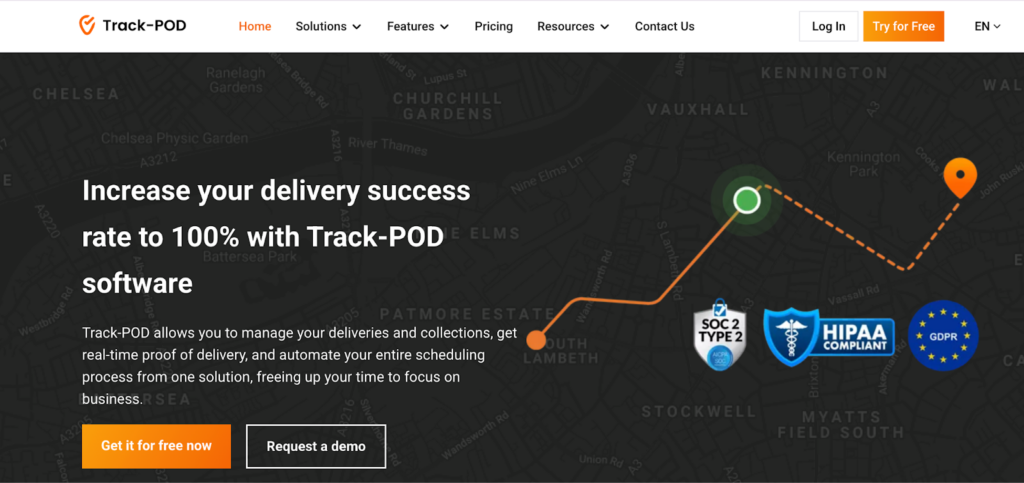
Track-POD provides electronic proof of delivery and basic route planning for small delivery fleets. Its driver app captures photo, signature, and barcode confirmation at delivery completion, creating a digital audit trail that replaces paper-based POD processes.
The route planning module handles basic multi-stop sequencing for fleets managing defined daily rounds. For operations where ePOD compliance and basic delivery route planning are the primary requirements, Track-POD offers an accessible entry point.
Key features of Track-POD
- Basic route optimization: Multi-stop route sequencing for daily delivery rounds across small fleets
- Driver mobile app: Route navigation, delivery task management, and POD capture in one mobile interface
- Delivery analytics: Completion rates, delivery time tracking, and basic performance reporting
- Customer notifications: Basic delivery update notifications to end customers at completion
Track-POD pros
- Accessible pricing makes it practical for small fleets needing ePOD compliance without enterprise platform investment
- Fast deployment with minimal technical setup; well-suited for operations transitioning from paper-based POD workflows
Track-POD cons
- Feature ceiling reached quickly for operations managing more than basic local delivery rounds; lacks AI dispatch, multi-carrier management, and ERP integration
- Not designed for enterprise-scale parcel delivery with complex constraint requirements
Track-POD pricing
From $29 per driver per month. Plans scale with driver count and features required.
Track-POD is best for
Small local delivery fleets and distribution operations that need electronic proof of delivery and basic route planning without enterprise complexity.
See how Locus compares against your current parcel delivery stack.
Schedule a Demo
How to Choose the Right Parcel Delivery Software for Enterprise Operations
The decision framework for enterprise parcel delivery software comes down to five questions. Answer them in order before shortlisting vendors, because the answers will eliminate the wrong tier of tools before you spend time evaluating demos.
1. Does the platform handle dispatch optimization or only tracking?
This is the most important question in the evaluation process.
If your operational problem is first-attempt delivery failure rates, manual dispatch overhead, or SLA breach rates during peaks, a tracking layer does not solve it. AI route optimization sits in the execution layer, not the visibility layer.
2. Is the route optimization AI-driven and dynamic, or static and rule-based?
Static route optimization generates a plan at the start of the shift and locks it in. AI-driven dynamic optimization re-calculates continuously as conditions change: new orders arrive, vehicles break down, drivers go offline, traffic shifts corridor patterns. The operational difference is measurable.
3. Can it orchestrate across multiple carrier types under one system?
Enterprises managing owned fleet alongside contracted 3PL carriers and on-demand courier networks need a single allocation layer that compares options and assigns shipments based on cost, speed, and SLA rules simultaneously. This is multi-carrier orchestration, and it is different from multi-carrier tracking.
4. Does it provide end-to-end supply chain coverage or only last-mile?
Last-mile platforms cover the final delivery leg. End-to-end platforms cover first-mile pickup, hub transfer, line-haul, and last-mile delivery in one system with unified visibility and re-optimization across all legs.
For enterprises managing returns alongside outbound delivery, or operating their own fulfillment hubs, the scope difference is the difference between one platform and three.
5. Can it scale to peak-season volumes without degradation?
Enterprise parcel delivery operations face 3x to 5x order surges during peak campaigns. Most route planning and dispatch tools were not architected for this.
The right question to ask vendors is how many enterprise deployments have processed more than 100,000 daily orders without manual dispatcher intervention during surge. Request reference deployments at comparable scale.
Locus allocates capacity dynamically across hubs, fleets, and carriers during seasonal spikes and demand surges, scaling nodes, routes, and shipment volumes without proportionally increasing overhead or cost per order. The architecture is designed so that adding volume does not require adding planners.
Choosing the Right Parcel Delivery Software
The parcel delivery software market is crowded with tracking tools, shipping label generators, and delivery notification platforms. Most are well-built for their target buyer. The problem is that their target buyer is not the VP of Operations at a $300M retailer trying to reduce cost-per-delivery across five carriers and three fulfillment hubs.
Platforms like AfterShip, ParcelLab, and Shippo serve real needs for e-commerce brands where post-purchase experience and label generation are the primary challenges.
Onfleet and Track-POD serve local and regional fleets that need usable tools without enterprise complexity. FarEye, LogiNext, and Shipsy address specific enterprise verticals: delivery experience management, fleet-heavy QSR logistics, and cross-border freight respectively.
For enterprises where the operational challenge is dispatch efficiency, first-attempt delivery failure rates, fragmented carrier management, and SLA performance under peak-volume volatility, Locus is the only platform in this comparison purpose-built at the orchestration layer.
It combines AI-powered dispatch, dynamic route re-optimization, multi-carrier automation, and full supply chain visibility in one closed-loop system, and it has validated those capabilities across 1.5 billion+ deliveries in 30+ countries.
Schedule a demo with Locus today to see how AI-driven parcel delivery orchestration performs against your actual delivery network.
Frequently Asked Questions (FAQs)
What is the difference between parcel tracking software and parcel delivery software?
Parcel tracking software aggregates shipment status data from carrier networks and surfaces it through branded tracking pages, customer notifications, and analytics dashboards. It operates downstream of the delivery execution decision. Parcel delivery software covers the execution layer: dispatch allocation, route optimization, carrier selection, driver management, and real-time exception handling. The two categories address different problems. Enterprises with high first-attempt failure rates or manual dispatch overhead need parcel delivery software.
How does AI-powered route optimization reduce parcel delivery costs for enterprises?
AI-powered route optimization reduces delivery costs across three compounding levers: fewer miles driven per parcel, lower first-attempt delivery failure rates, and automated dispatch allocation that eliminates manual overhead. Locus enterprise customers achieve a 20% reduction in total logistics costs and maintain a 99.5% SLA adherence rate.
Can parcel delivery software integrate with existing WMS, OMS, and ERP systems?
Enterprise-grade platforms like Locus are built API-first with pre-built connectors for ERP (SAP, Oracle), OMS, WMS, and carrier systems. Integration depth should be validated before shortlisting: confirm which specific connectors are pre-built and which require custom development. Implementation timelines vary significantly between platforms depending on integration scope and the number of hubs in the rollout. Phased deployment models, where one hub or region goes live first, reduce cutover risk for large networks.
What features should enterprise logistics teams prioritize when evaluating parcel delivery software?
Five criteria determine enterprise fit: AI dispatch depth (constraint count and auto-allocation capability), dynamic re-optimization during execution, multi-carrier orchestration breadth, end-to-end supply chain coverage (first-mile through last-mile), and integration readiness with existing ERP and WMS systems. Sustainability and Scope 3 emissions reporting is an emerging criterion for enterprises with CSRD obligations. Dispatcher adoption and driver-app usability are the most common implementation failure modes, not missing features: validate both during any pilot.
How does multi-carrier orchestration in Locus improve first-attempt delivery rates at scale?
Multi-carrier orchestration in Locus improves first-attempt delivery rates by matching each parcel to the optimal carrier and service level at dispatch time, based on delivery zone, time window, cost, and historical carrier performance in that corridor. When a carrier underperforms in a specific zone, the orchestration engine can shift allocation automatically. Combined with ePOD capture and exception management workflows, enterprises using Locus see measurable improvements in first-attempt completion rates and reductions in WISMO call volumes.

General
Plan Compliance Is a Vanity Metric: The Drift Problem in Truck Route Planning

May 12, 2026
European fleets are measuring plan compliance instead of plan performance. Here's why drift between routed plans and actual execution is the silent margin killer in truck route planning software — and how to close it.
Read more
Route Optimization
What Makes a Delivery Route Planner App Enterprise-Ready and Why Most Fall Short

May 13, 2026
What enterprises should demand from a delivery route planner app: AI dispatch, dynamic rerouting, fleet-scale visibility, and real ROI.
Read moreInsights Worth Your Time



















Top 10 Parcel Delivery Software Platforms for Enterprise Logistics in 2026