


Route Optimization
What Makes a Delivery Route Planner App Enterprise-Ready and Why Most Fall Short
Key Takeaways
- Most delivery route planner apps are built for solo couriers and small fleets. They handle 10 to 200 stops, generate a fixed sequence, and hand off to a driver. That scope does not scale to enterprise operations running hundreds of vehicles across multiple geographies
- The ceiling of free and lightweight route planners shows up fast: no dynamic rerouting during disruptions, no vehicle capacity or driver-hour constraints, no integration with OMS or WMS systems, and no SLA enforcement across a mixed fleet
- AI-powered route optimization is not the same as algorithmic sequencing. Real AI route planning recalculates continuously during execution as orders change, vehicles go offline, or traffic conditions shift without dispatcher intervention
- Locus delivers AI-powered dispatch, real-time route re-optimization, fleet visibility, and delivery analytics in a single platform built for enterprise scale
Search for “delivery route planner app” and what comes back is a set of tools built for independent couriers and small delivery teams. Apps that optimize 20 stops on a map, generate a sequence, and sync to a driver’s phone.
For a single driver or a local delivery business, those tools work. For an enterprise logistics operation managing thousands of daily deliveries across distributed fleets, multiple carrier relationships, and SLA-bound delivery windows, they describe a different problem entirely.
This article breaks down what matters in a delivery route planner at enterprise scale. It draws on Locus’s experience powering route optimization and dispatch for global retail, FMCG, and 3PL operations where planning a route is the simplest part of a far more complex logistics challenge.
What a Delivery Route Planner App Does And Where Most Descriptions Stop Short
A delivery route planner app sequences a set of stops into an order that minimizes drive time or distance, factors in real-time traffic, and produces turn-by-turn navigation for a driver. That is the core function, and most apps on the market deliver it reasonably well for small-scale use.
The description breaks down at enterprise scale for four reasons:
- Volume: Apps designed for 20 to 200 stops per route are not architecturally suited to planning 5,000 or more deliveries per day across a metro area with dozens of vehicles. The computation requirements are categorically different
- Fleet heterogeneity: Enterprise fleets mix vehicle types with different payload capacities, refrigeration requirements, and permitted routes. A planner that treats all vehicles as equivalent produces plans that are operationally infeasible
- SLA complexity: Retail replenishment, FMCG territory routes, and e-commerce same-day fulfillment each impose delivery windows that are contractual. A tool that cannot enforce time windows at the planning stage creates SLA exposure before a driver leaves the depot
- Dynamic conditions: A fixed route plan generated at 6 AM is wrong by 9 AM. Orders get cancelled. New pickups arrive. A vehicle breaks down. An enterprise planning tool has to absorb these changes and recalculate, not surface them as exceptions for a dispatcher to resolve manually
The gap between a consumer-grade route planner and an enterprise delivery tool is an architectural difference in what the system does when reality diverges from the plan.
Core Features Every Delivery Route Planner App Should Offer
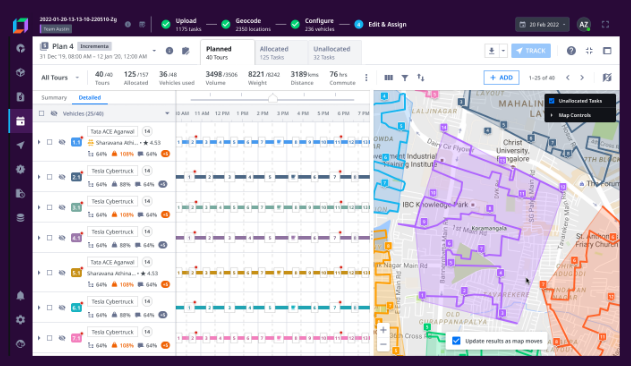
Six capabilities form the baseline. The gap between how lightweight apps implement each and what enterprise operations require is where most evaluations go wrong.
| Feature | What lightweight apps deliver | What enterprise operations require |
|---|---|---|
| Multi-stop routing | Sequences up to 200 stops by shortest distance or time. MyWay supports up to 200; Route4Me and ASAP limit free tiers to 10 stops. | Thousands of stops per planning cycle across dozens of vehicles, with simultaneous constraint processing for capacity, time windows, and geography. See automated route planning. |
| Real-time traffic updates | Traffic-adjusted ETAs at route generation. No recalculation after driver departure. | Continuous mid-route recalculation as traffic conditions change, with updated ETAs pushed to customers automatically. |
| GPS driver tracking | Live driver position on a map. No exception alerting or SLA risk flagging. | An automated tracking system that monitors route adherence, flags deviations, and surfaces at-risk deliveries before SLA windows close. |
| Proof of delivery | Photo capture and basic signature. Manual review required for disputes. | AI-validated ePOD: photo, signature, barcode, and OTP capture with anomaly detection before settlement cycles begin. |
| Customer notifications | Static ETA on dispatch. No update if route conditions change. | ML-driven ETA updates pushed to customers continuously, reflecting actual route conditions rather than the morning plan. |
| Load planning | Basic stop count per vehicle. No weight, volume, or cargo-type constraints. | Full vehicle capacity optimization across payload weight, volume, refrigeration zones, and hazmat separation simultaneously. |
Where Free and Lightweight Route Planners Hit a Ceiling
Google Maps handles 5-10 stops for a single driver navigating unfamiliar territory. It is the right tool for that job. For a regional FMCG distributor running 500 daily deliveries across 20 vehicles, it stops being relevant before the morning dispatch begins. The breakpoints are specific.
No vehicle routing constraints
Free route planners treat all vehicles as identical. An enterprise fleet includes vehicles with different payload capacities, temperature zones, axle-weight restrictions, and urban access permits. A route that works for a 3.5-tonne van is infeasible for a 7.5-tonne refrigerated truck in a restricted city zone.
Vehicle routing at enterprise scale requires the planning layer to know the difference and account for it at the assignment stage, not after a driver reports a failed delivery attempt.
No dynamic rerouting during execution
Static planning tools generate a route and stop. When a customer cancels at stop 12 of 25, or a new priority order is added at 11 AM, or traffic makes the planned sequence infeasible, a lightweight app surfaces the problem and waits.
Enterprise platforms apply real-time re-optimization against exceptions on the ground: the system automatically identifies current and potential delays and course-corrects to accommodate SLA breaches or ad hoc tasks without dispatcher intervention.
A dispatcher fields a phone call and improvises. At 50 daily exceptions across a fleet of 40 vehicles, that is a full-time job that should not exist.
No integration with order management or warehouse systems
A delivery route planner that does not connect to the OMS plans routes based on yesterday’s order data. Cancelled orders stay in the plan. New orders after the cutoff do not appear. Inventory availability from the WMS does not inform which stops are feasible.
For a 3PL managing multiple client order streams, the absence of these integrations means dispatchers manually reconcile system gaps before every planning cycle.
No analytics layer
Most free and lightweight route planners produce a map and a sequence. They do not generate cost-per-delivery data, SLA adherence rates, driver utilization metrics, or carrier performance comparisons.
For a VP of Logistics making decisions about fleet size, territory structure, or carrier contracts, the absence of an analytics layer means those decisions are based on intuition.
How AI Transforms Route Planning from Static Mapping to Dynamic Orchestration
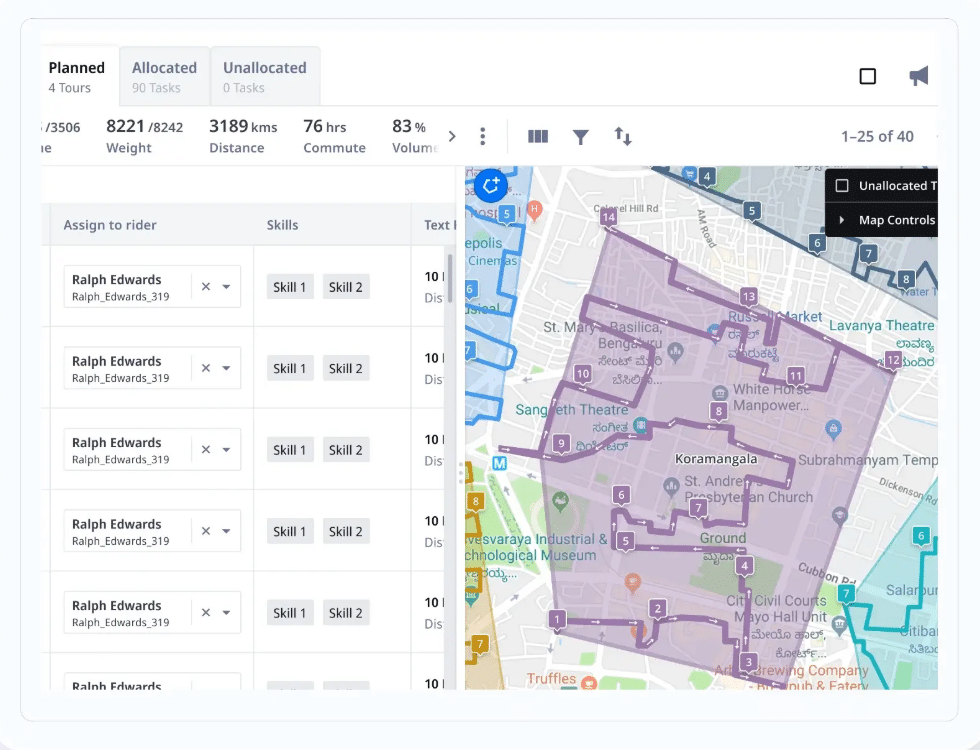
Algorithmic route sequencing finds the shortest path through a fixed set of stops. That problem has been solved for decades.
What AI changes is the planning problem itself: from generating one good plan at dispatch to continuously optimizing the full delivery operation as conditions change throughout the day.
What rules-based route optimization does
- Applies fixed logic: if capacity exceeds a threshold, split the route; if a time window closes before the current sequence reaches a stop, move it earlier
- Optimizes for one or two variables at a time, usually distance and time
- Generates a plan once. Exceptions require manual dispatcher intervention
What AI-powered route optimization does
- Processes all constraints simultaneously: vehicle capacity, driver shift hours, delivery urgency, time windows, traffic conditions, and customer priority tiers. AI route optimization at this level produces solutions that rule-based engines cannot find because they require trading off multiple variables at once
- Recalculates mid-execution when orders change, vehicles go offline, or disruptions occur, without dispatcher involvement
- Learns from completed deliveries. A platform that has processed 1.5 billion deliveries generates predictive ETAs materially more accurate than distance-based estimates, because it knows how long a specific stop type at a specific time of day takes
- Resolves geocoding failures in real time. In markets across Southeast Asia, the Middle East, and parts of India where address infrastructure is incomplete, an AI geocoding layer trained on millions of delivery attempts resolves ambiguous addresses rather than failing the delivery
Locus operates in a continuous Sense, Decide, Execute, Learn cycle. The platform ingests live conditions, recalculates route sequences across the entire active fleet, executes dispatch changes, and logs outcomes that improve the next planning cycle.
The result is a delivery operation that continuously improves its own performance.
Also read: How to Choose the Right Route Planning Software?
Enterprise-Scale Requirements for Route Planner Apps
The enterprise requirements for route planner apps call for a different reference frame:
End-to-end supply chain visibility
Route planning is one layer of a connected logistics operation. An enterprise platform needs to connect route execution to order status from the OMS, inventory availability from the WMS, and carrier performance data from 3PL integrations.
Supply chain network design decisions for FMCG and CPG operations flow directly from the route-level data that a well-integrated platform surfaces.
Multi-carrier and 3PL orchestration
Enterprise deliveries move across owned fleet, contracted 3PL partners, and gig driver networks simultaneously.
A route planner that only handles owned fleet assigns manual reconciliation work to dispatchers for every outsourced delivery leg.
Configurable business rules without engineering dependency
Priority customer tiers, hazmat constraints, cold-chain compliance, driver certification matching, and territory restrictions are operational requirements that change.
A platform that requires vendor professional services to update these rules creates an operational bottleneck that compounds over time.
Automated dispatch at scale
At 10,000 daily orders, manual dispatcher assignment is not a workflow inefficiency it is a structural ceiling on throughput.
Enterprise platforms also apply predictive routing, automatically reassigning at-risk SLAs and unplanned tasks to the best-suited driver based on availability, skill, and proximity before the SLA window closes.
At-risk SLAs and ad hoc tasks should be reconfigurable within minutes during execution. SLA adherence at that level of responsiveness is what drives customer experience and brand recall.
Geographic coverage and geocoding accuracy
Route planners built for Western European or North American address infrastructure fail systematically in markets where addresses are partial, informal, or non-standardized. This is a daily operational reality for enterprises operating in India, Southeast Asia, or the Middle East.
Capacity-led routing across all fulfillment legs
Route planning at enterprise scale is not a last-mile problem. Shipments move through first-mile pickup, mid-mile linehaul, and last-mile delivery, and vehicle assignment decisions at each leg affect cost and chain of custody at the next.
Enterprise platforms apply capacity-led routing across all three legs under unified logic, ensuring the right vehicle type carries the right load through the right nodes.
Scheduled, dynamic, and recurring fulfillment under one system
Enterprise route planning must handle three fulfillment models simultaneously within a single platform: scheduled deliveries for FMCG beat plans and retail replenishment, dynamic on-demand routing for e-commerce same-day fulfillment, and recurring routes for field service or route-based sales.
Platforms built for a single model require manual intervention when order types mix, which happens daily in any enterprise logistics operation running multiple business units or client accounts.
Measuring the ROI of an Enterprise Delivery Route Planner
Route optimization that reduces distance and improves fleet utilization moves the largest cost lever in most enterprise logistics operations. The ROI case is measurable across four dimensions:
| ROI dimension | The mechanism | Locus benchmark |
|---|---|---|
| Fuel and distance reduction | Better stop clustering, reduced redundant mileage across overlapping service zones, and deadhead mile minimization cut per-delivery fuel costs directly. | Locus customers across retail and FMCG deployments have achieved 20% reduction in total logistics costs. BigBasket reduced total route distance by approximately 14.3% after deployment. |
| Delivery throughput per driver | Tighter stop sequencing, reduced planning time, and automated dispatch mean more deliveries per shift without additional vehicles or headcount. | Locus customers achieve 45% improvement in fleet utilization through optimized stop clustering and order grouping. |
| SLA adherence and WISMO reduction | Accurate ML-driven ETAs and proactive customer notifications reduce failed first attempts and inbound Where Is My Order calls. Failed deliveries cost an average of $17.20 per parcel. | 99.5% on-time delivery SLA adherence across Locus enterprise deployments. 66% faster planning cycles reducing dispatcher workload. |
| Planning labor savings | Automated route planning and dispatch compress planning cycles from hours to minutes, shifting dispatcher time from route construction to exception management. | Locus customers report 66% faster planning cycles, translating directly to earlier vehicle departures and higher daily throughput. |
See how Locus delivers these outcomes against your specific fleet size, order volumes, and geography. Schedule a Locus demo to run AI dispatch and route optimization against your actual delivery data.
What to Evaluate Before Choosing a Delivery Route Planner for Your Fleet
This is a decision framework for logistics leaders already shortlisting vendors, not a generic feature checklist. The questions below surface the capability gaps most commonly discovered after contract signature.
| Evaluation criterion | The right question | A weak answer sounds like |
|---|---|---|
| Scalability | What is the planning cycle time at your peak daily order volume? Can the vendor demonstrate this at 10x average load? | Demo performance at 500 orders with no evidence of behavior at 10,000. |
| Integration architecture | Does the platform have prebuilt connectors for your ERP, WMS, and OMS or does each integration require custom middleware and a professional services engagement? | “We have an open API” with no named connectors for SAP, Oracle, or the specific order management platform you run. |
| Map source flexibility | Does the platform support multiple map providers (Google, Mapbox, HERE, OSM)? What happens to routing quality in geographies where your primary map source has coverage gaps? | Exclusive dependency on a single map provider with no fallback for low-infrastructure geographies. |
| Configurability | Can your operations team update business rules priority customer tiers, vehicle restrictions, driver certifications without vendor involvement? What is the turnaround time for a rule change? | All business rule changes require a support ticket and a two-week implementation window. |
| Deployment and support | What does a realistic enterprise implementation look like in weeks, not a vendor’s best-case scenario? Can they name reference customers at comparable scale who can validate the timeline? | An implementation roadmap with no reference customers willing to confirm it. |
| Total cost of ownership | Does the ROI model account for planning labor reduction, failed delivery cost avoidance, and fleet utilization improvement or only the software license cost versus the current tool? | A cost comparison that only measures license fees, ignoring the operational efficiency gains that determine actual return. |
Vendor stability also deserves a place in the evaluation framework. Enterprises committing to a route planning platform for multi-year deployment weigh ownership structure and capital backing alongside capability.
Locus was acquired by Ingka Group, the world’s largest IKEA retailer, in October 2025, and continues to operate independently. For procurement teams evaluating long-term platform risk, that kind of strategic backing is a materially different signal than a standalone SaaS vendor.????????????????
Why Enterprise Logistics Teams Are Moving Beyond Route Planning Apps
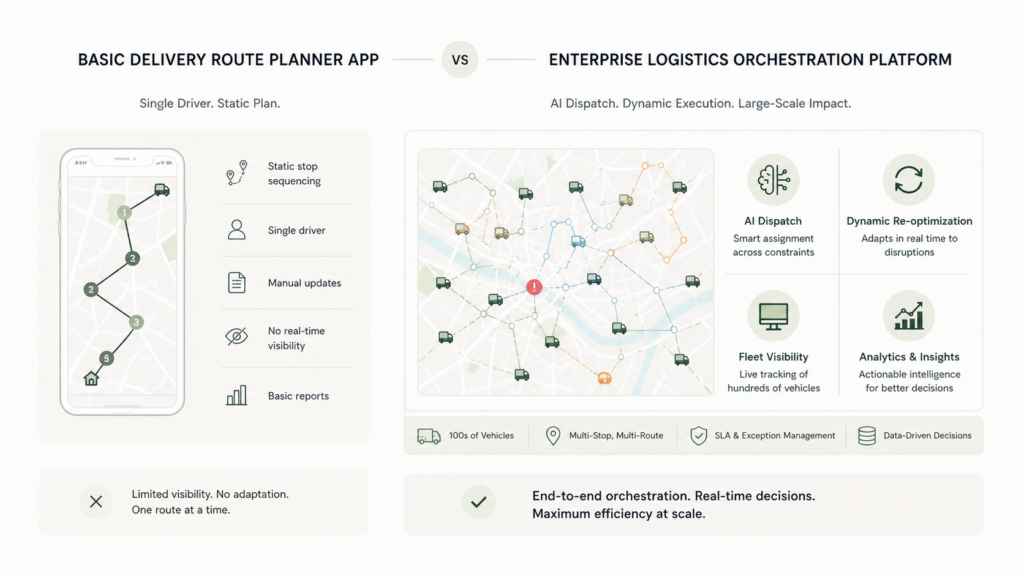
The category “delivery route planner app” describes a point solution. It handles one layer of the logistics stack: turning a list of stops into a sequence.
For the operations teams using it, that layer sits inside a larger system that also involves order intake from the OMS, vehicle assignment from the dispatch layer, live tracking from telematics, customer communication from the notification layer, and performance measurement from the analytics layer. When those layers run in separate tools, the integration gaps between them generate the manual work that limits throughput.
What enterprise logistics operations actually need is an orchestration platform where route planning is one function within a connected system.
Dispatch, routing, tracking, and analytics share the same data model and operate simultaneously under unified AI logic. A disruption at the dispatch layer triggers a re-sequence in the routing layer and an update in the customer notification layer without a dispatcher manually connecting the dots.
Three characteristics separate an orchestration platform from a route planning app:
- Closed-loop learning: Every completed delivery cycle feeds outcome data back into the next planning decision. Route quality improves continuously rather than staying fixed at implementation
- Simultaneous constraint processing: Vehicle capacity, driver hours, time windows, priority tiers, and carbon targets are balanced against each other at every planning cycle
- Autonomous exception handling: Disruptions are resolved by the platform within configured governance boundaries. Operations teams manage policy and review edge cases
Locus is built for this model. The platform has powered over 1.5 billion deliveries across 30 or more countries, with $320 million or more in logistics cost savings delivered for enterprise customers across retail, FMCG, e-commerce, 3PL, and CPG.
Schedule a demo to see how AI dispatch and real-time route orchestration perform against your specific fleet, geography, and SLA requirements.
Frequently Asked Questions (FAQs)
1. How does a delivery route planner app differ from Google Maps for fleet operations?
Google Maps optimizes a single driver’s route through a small number of stops with no fleet-level logic, no vehicle constraints, and no integration with order management or dispatch systems. A delivery route planner app for fleet operations sequences stops across multiple vehicles simultaneously, enforces time windows and vehicle capacity limits, assigns orders to specific drivers, and tracks execution against the plan. Enterprise-grade platforms add AI-driven re-optimization during execution, automated customer notifications, and analytics that feed back into future planning cycles.
2. What is the maximum number of stops an enterprise route planner can handle per route?
Consumer and SMB apps typically cap between 10 and 200 stops per route. Enterprise-grade platforms built on AI-native architecture have no practical per-route stop ceiling the relevant metric is total daily order volume across all vehicles. Locus maintains sub-five-minute optimization cycle times at 100,000 or more daily orders across enterprise retail and FMCG deployments.
3. Can a delivery route planner app integrate with existing WMS or OMS platforms?
Enterprise-grade platforms can, through prebuilt connectors and API-first architecture. Integration with the WMS ensures route plans reflect current inventory availability. Integration with the OMS ensures new and cancelled orders are reflected in active dispatch plans without manual reconciliation. Platforms with prebuilt connectors for SAP, Oracle, and major OMS platforms deploy faster and produce fewer data consistency gaps than those requiring custom development per integration.
4. What should a logistics team look for when evaluating route planning software for multi-fleet operations?
For multi-fleet operations, the critical evaluation criteria are: unified dispatch logic across owned fleet, contracted 3PLs, and gig driver networks; vehicle-type-specific constraint handling for heterogeneous fleets; real-time re-optimization capability during execution, not just at dispatch; and integration depth with existing OMS, WMS, and carrier management systems. The test is whether the platform provides a single operational view across all fleet types or requires manual reconciliation between fleet-specific tools.
5. How does AI-powered route optimization with Locus reduce last-mile delivery costs?
Locus’ AI route optimization reduces last-mile costs through three mechanisms: better stop clustering that reduces total miles driven per delivery, dynamic re-optimization that eliminates the failed-attempt cost from outdated route plans, and predictive ETAs that reduce inbound customer service volume. It prevents failed deliveries through accurate scheduling and proactive customer communication eliminates that cost at the source.

Delivery Management
Top 10 Parcel Delivery Software Platforms for Enterprise Logistics in 2026

May 13, 2026
Compare the top 10 parcel delivery software platforms for 2026. AI dispatch, route optimization, multi-carrier management, real-time visibility, and enterprise ROI benchmarks reviewed.
Read more
General
AI Agents in Dispatch: A 2026 Implementation Framework for Logistics Leaders

May 13, 2026
Heads of Logistics Technology deploying AI agents in dispatch face a measurement challenge traditional KPIs don't solve. A 2026 framework on what to measure.
Read moreInsights Worth Your Time



















What Makes a Delivery Route Planner App Enterprise-Ready and Why Most Fall Short