


General
10 Best Last Mile Logistics Software Platforms for Enterprise Operations in 2026
Last mile logistics software helps enterprise retailers, 3PLs, and CPG brands manage dispatch, routing, tracking, customer communication, and proof of delivery for the final leg of shipment — the part that determines whether a customer gets their order on time.
The leading platforms in 2026 include Locus, FarEye, LogiNext, Shipsy, Bringg, DispatchTrack, Onfleet, OptimoRoute, Route4Me, and Tookan.
This guide compares all 10 platforms on what matters to enterprise buyers: AI dispatch, dynamic route optimisation, real-time visibility, upstream integration, and sustainability reporting.
Key Takeaways
- Last mile logistics software should centralise dispatch, route optimisation, real-time tracking, customer communication, and proof of delivery.
- Enterprise buyers should prioritise AI dispatch depth, mid-route re-optimisation, OMS/WMS/ERP integration, multi-carrier support, scalability, reporting, and regional fit.
- Published pricing is limited across enterprise platforms; where vendors do not publish prices, validate contract scope, shipment volume assumptions, modules, integrations, and support tiers directly.
- Point solutions like Onfleet, OptimoRoute, Route4Me, and Tookan work well for SMB and mid-market operations, while Locus, FarEye, LogiNext, Shipsy, Bringg, and DispatchTrack target enterprise logistics networks.
- Use the comparison table first, then review the vendor sections in order to compare fit, pricing, maturity level, and operational strengths.
Best Last Mile Logistics Software Platforms in 2026: At a Glance
| Platform | Best For | Maturity Level | Pricing |
|---|---|---|---|
| Locus | Enterprise logistics orchestration across retail, CPG, and 3PL | L4 | Custom pricing |
| FarEye | Retail post-purchase experience and carrier orchestration | L3 | Custom pricing |
| LogiNext | Mid-market to enterprise multi-industry delivery | L2-L3 | Custom pricing |
| Shipsy | Cross-border logistics and multimodal shipment visibility | L2-L3 | Custom pricing |
| Bringg | Carrier network orchestration and omnichannel fulfilment | L3 | Custom pricing |
| DispatchTrack | Big-and-bulky verticals: furniture, appliances, building materials | L3 | Custom pricing |
| Onfleet | Mid-market fleets and growth-stage delivery ops | L2 | Starts at $619/month |
| OptimoRoute | Routing-first field service and delivery planning | L2 | Starts at $39/driver/month |
| Route4Me | Distributed field operations with modular add-ons | L1-L2 | Custom pricing |
| Tookan | Hyperlocal and on-demand delivery businesses | L1-L2 | Starts at $49/month |
Jump to vendor: Locus · FarEye · LogiNext · Shipsy · Bringg · DispatchTrack · Onfleet · OptimoRoute · Route4Me · Tookan
1. Locus
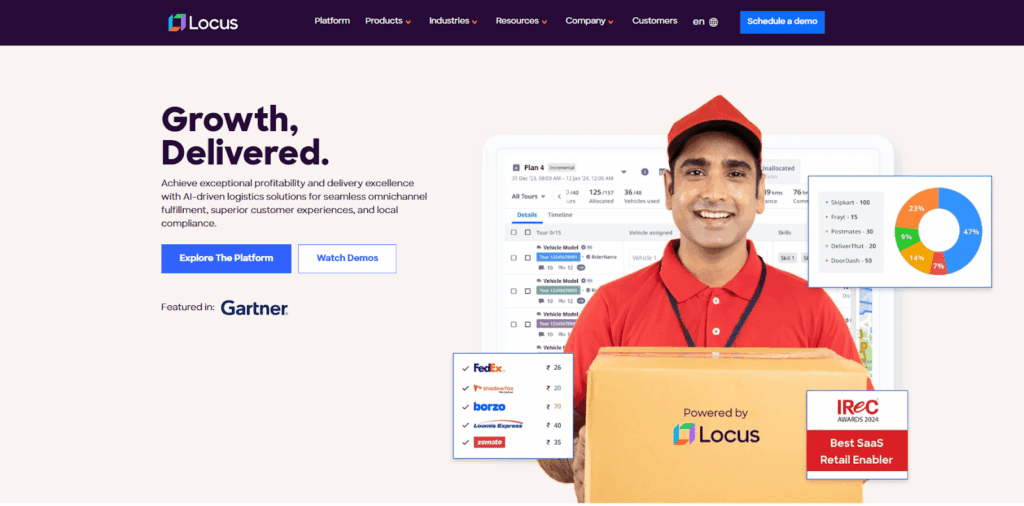
Locus is an AI-powered logistics orchestration platform built for enterprise last mile operations across owned fleets, carrier partners, fulfilment centres, and geographies.
If your operation runs across multiple fulfilment centres, mixed fleet types, and thousands of daily orders, basic routing tools can hit their limit quickly. Locus is designed for high-volume logistics networks that need planning, execution, visibility, and settlement connected in one platform.
The platform handles constraint-aware dispatch across 250+ transportation variables, such as vehicle type, payload, driver skills, delivery windows, time-of-day traffic, and service commitments. It also supports dynamic route planning when disruptions occur during the delivery day.
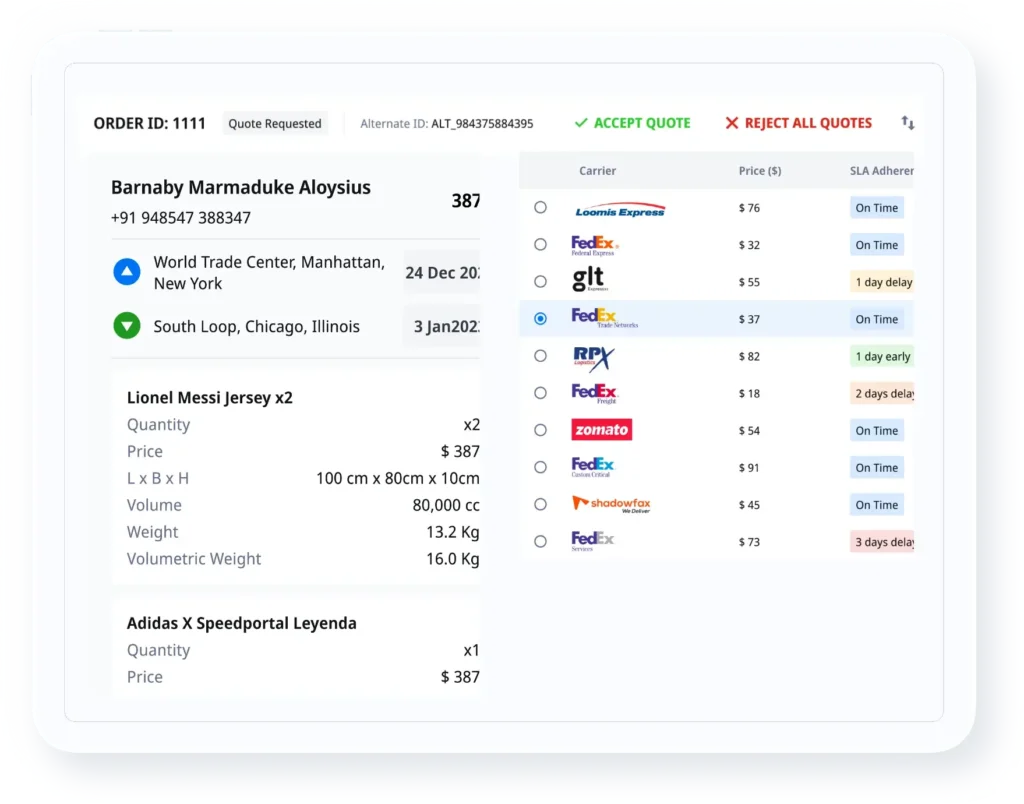
ShipFlex extends this to multi-carrier orchestration, dynamically allocating parcels across 3PL partners based on cost, speed, and SLA rules.
Locus has powered over 1.5 billion deliveries across 30+ countries, reducing transit costs by more than $320 million and offsetting 17 million+ kilograms of CO2 emissions.
Key features of Locus
- AI-powered dispatch and route optimisation: Auto-assigns thousands of orders to optimal vehicles using 250+ real-world constraints, with mid-route re-optimisation when traffic, failed drops, or road closures affect delivery plans.
- ShipFlex multi-carrier orchestration: Allocates parcels across 1,000+ pre-integrated 3PL partners using rules based on cost, delivery speed, and service commitments.
- Control tower visibility: Tracks shipments across owned and contracted fleets with predictive ETAs, exception alerts, and customer notifications.
- AI-validated electronic proof of delivery: Supports photo, signature, and barcode capture with AI validation to reduce disputes and accelerate settlement cycles.
- Enterprise integrations: API-first architecture with connectors for OMS, WMS, ERP systems such as SAP and Oracle, carrier systems, telematics, and customer experience tools.
- Sustainability reporting: Reports carbon footprint metrics and miles-reduced analytics for enterprises with ESG reporting requirements.
Locus pros
- Handles complex enterprise logistics networks and high parcel volumes through constraint-aware AI dispatch.
- Combines dispatch, route optimization software, carrier orchestration, control tower visibility, and ePOD in a single platform.
- Supports mixed fleet models across owned fleets, 3PLs, and contracted capacity.
- Strong fit for low-address-density markets across Southeast Asia, the Middle East, and the Indian subcontinent.
Locus cons
- Built for enterprise operations; smaller fleets with simple, single-region delivery needs may find the platform more capable than required.
Locus pricing
Locus offers custom enterprise pricing based on shipment volume, delivery locations, carrier integrations, modules, and deployment scope. Pricing is typically tailored after consultation.
Locus is best for
Retailers, CPG brands, distributors, and 3PL providers managing high-volume last mile operations across multiple carriers, fulfilment locations, and geographies.
2. FarEye
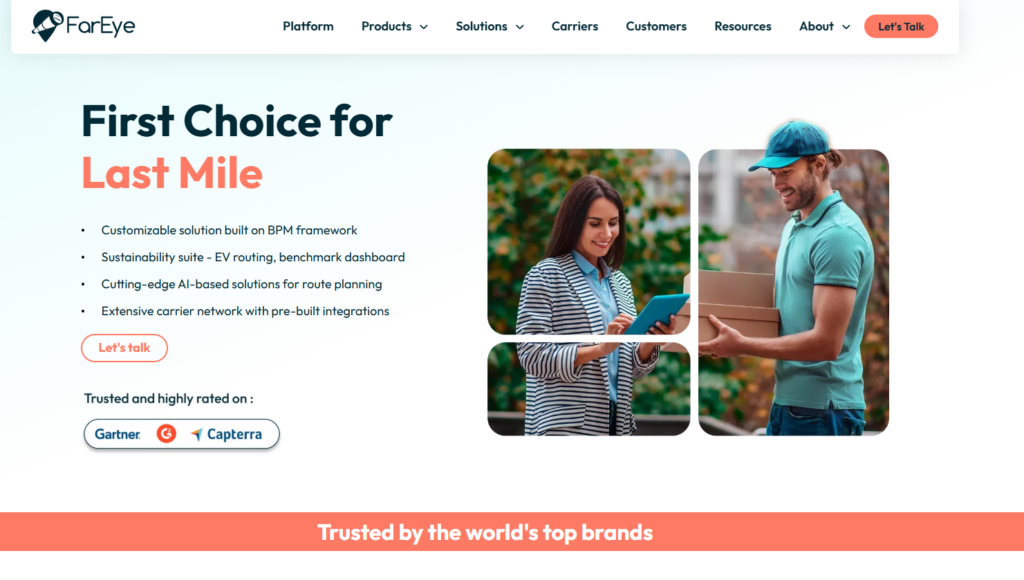
FarEye positions itself as a delivery management platform focused on branded post-purchase experience, carrier orchestration, and customer communication.
It connects retailers and e-commerce brands with multiple courier partners, supports real-time tracking pages, and automates customer communication through ETA notifications and delivery updates.
FarEye is strong for visibility, branded delivery communication, and configurable delivery processes. It is less focused on deep algorithmic dispatch than orchestration-first platforms built around high-volume routing complexity.
Key features of FarEye
- Multi-carrier delivery orchestration with real-time shipment tracking.
- Branded tracking pages, ETA notifications, and delivery reschedule options.
- Configurable delivery processes for retail and e-commerce operations.
- Delivery performance analytics and customer feedback loops.
FarEye pros
- Strong focus on post-purchase customer experience and branded delivery communication.
- Good fit for retailers and e-commerce brands managing multiple carrier partners.
- Flexible configuration for delivery experience teams.
FarEye cons
- Lighter on deep, constraint-aware AI dispatch compared with orchestration-first platforms.
- Some capabilities may require implementation-time configuration.
FarEye pricing
FarEye does not publish pricing on its website. Pricing is typically customised based on shipment volume, delivery regions, carrier complexity, and deployment scope.
FarEye is best for
Retailers, e-commerce brands, and courier-express-parcel providers prioritising branded post-purchase experience, customer communication, and multi-carrier delivery visibility.
3. LogiNext
LogiNext Mile is the last-mile-specific product within LogiNext’s broader logistics automation suite. It covers route optimisation, live tracking, electronic proof of delivery, workforce scheduling, and geocoding.
LogiNext targets a broad range of business sizes and industries. For organisations with relatively straightforward multi-region delivery operations, it is a capable option. For complex enterprise networks with many constraints, system integrations, and carrier allocation rules, buyers should validate configuration depth carefully.
Key features of LogiNext
- Route optimisation with live tracking and driver app.
- Workforce scheduling and shift management.
- Geocoding and address validation.
- Fleet management analytics and performance dashboards.
- Proof of delivery and execution reporting.
LogiNext pros
- Strong presence in India and Middle East markets with regional support.
- Covers dispatch, tracking, proof of delivery, and workforce planning.
- Suitable for multi-industry delivery operations.
LogiNext cons
- Configuration depth for complex enterprise constraints may require more implementation effort.
- AI dispatch maturity can vary by deployment scope and selected modules.
LogiNext pricing
LogiNext does not publish pricing publicly. Pricing depends on shipment volume, deployment scope, geography, and modules selected.
LogiNext is best for
Mid-market and growing enterprise delivery operations across India, the Middle East, and adjacent markets, particularly those needing workforce scheduling alongside routing.
4. Shipsy
Shipsy covers first mile, mid mile, and last mile operations within a single logistics management platform. Its strength is cross-border logistics: freight management, multimodal shipment visibility, invoicing automation, and compliance management across international deliveries.
Shipsy has strong traction across the Middle East and South Asia. For enterprises primarily seeking deep, constraint-aware last mile dispatch optimisation, buyers should compare its last mile depth against more specialised orchestration platforms.
Key features of Shipsy
- First-mile, mid-mile, and last-mile logistics coverage.
- Dispatch automation with route planning.
- Cross-border shipping, freight management, and invoicing automation.
- Multi-carrier visibility and carrier performance tracking.
- Compliance support for international logistics processes.
Shipsy pros
- Strong cross-border and international logistics capabilities.
- End-to-end coverage from first mile through last mile in one platform.
- Good fit for multimodal and multi-country logistics operations.
Shipsy cons
- Last-mile AI dispatch depth is not its primary positioning.
- Sustainability reporting appears more limited than dedicated orchestration platforms.
Shipsy pricing
Shipsy’s pricing is not available publicly. Buyers need to contact the vendor for a quote based on shipment volume, geography, and module selection.
Shipsy is best for
Enterprises with significant cross-border or multi-country logistics operations that need unified freight, invoicing, carrier visibility, and last mile management.
5. Bringg
Bringg is a delivery orchestration platform that connects brands with multiple delivery fleets and carrier partners through a centralised system.
Its strengths sit in omnichannel fulfilment: ship-from-store, curbside pickup, returns management, delivery visibility, and customer communication. Bringg leans more towards carrier network orchestration than deep owned-fleet algorithmic dispatch.
Key features of Bringg
- Carrier network orchestration across owned fleets and 3PL partners.
- Omnichannel fulfilment flows such as ship-from-store, curbside, and BOPIS.
- Real-time delivery tracking and customer communication.
- Returns management and delivery exception handling.
- Carrier performance visibility.
Bringg pros
- Strong omnichannel fulfilment fit for retail brands.
- Broad carrier network coverage through centralised integrations.
- Useful for brands coordinating delivery across stores, carriers, and customer channels.
Bringg cons
- Owned-fleet algorithmic dispatch depth is less emphasised than network orchestration.
- Dynamic mid-route re-optimisation depth should be validated during evaluation.
Bringg pricing
Bringg does not publish pricing publicly. Pricing is based on delivery volume, modules, regions, and network scope.
Bringg is best for
Retail brands with strong omnichannel delivery models, including ship-from-store, curbside, BOPIS, and returns, that need to orchestrate across multiple carrier networks.
6. DispatchTrack
DispatchTrack specialises in last mile delivery for big-and-bulky verticals such as furniture, appliances, and building materials. Its AI-based route optimisation is tuned for appointment-based deliveries with tight time-window requirements.
The platform’s customer-facing scheduling and real-time ETA communication have made it a strong option for retailers and distributors shipping large items.
Key features of DispatchTrack
- AI-based route optimisation tuned for appointment-based delivery.
- Customer-facing appointment scheduling and real-time ETA updates.
- Driver app with proof of delivery and delivery instructions.
- Delivery exception handling and returns support.
- Big-and-bulky routing and service-time planning.
DispatchTrack pros
- Purpose-built for big-and-bulky delivery verticals.
- Strong customer scheduling and communication capabilities.
- Good fit for appointment-heavy delivery networks.
DispatchTrack cons
- Narrower vertical focus limits multi-industry enterprise use cases.
- Less comprehensive for parcel-scale operations at very high volume.
DispatchTrack pricing
Pricing for DispatchTrack is not available publicly. Buyers need to contact the vendor for a quote based on volume, vertical, regions, and deployment scope.
DispatchTrack is best for
Retailers and distributors in furniture, appliances, building materials, and other big-and-bulky verticals that rely on appointment-based delivery windows.
7. Onfleet
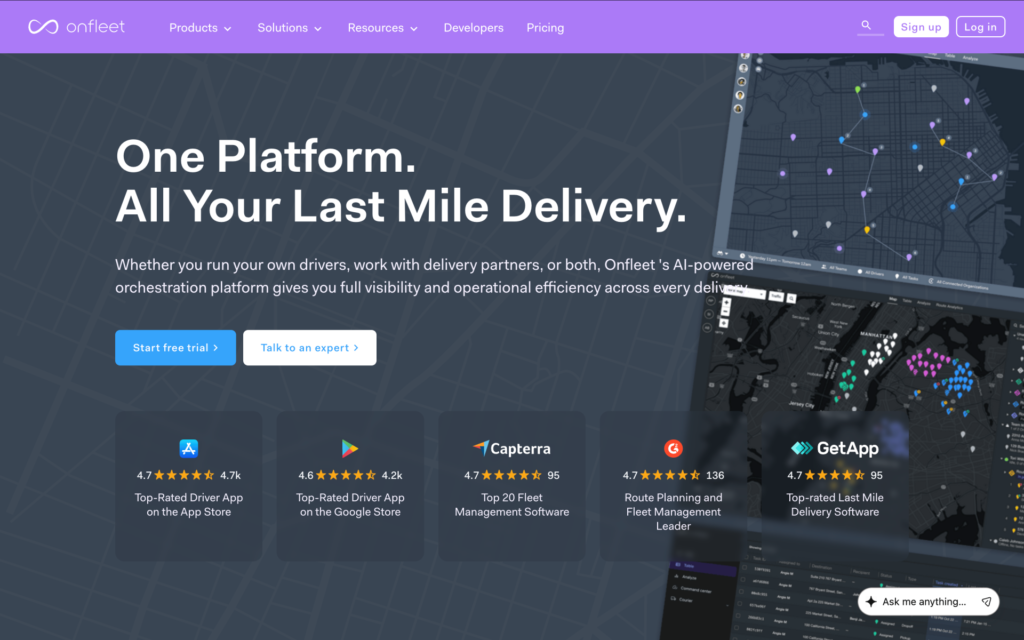
Onfleet is last mile logistics software aimed at mid-market and growth-stage delivery operations. It covers auto-dispatch, route optimisation, real-time tracking, a driver mobile app, and automated customer notifications.
Its simplicity is both a strength and a limitation. For mid-market teams running straightforward local delivery, Onfleet can deliver value quickly. For enterprises needing multi-constraint optimisation, deep WMS/ERP integration, or network-level orchestration across owned and 3PL fleets, its scope is narrower than enterprise-grade alternatives.
Key features of Onfleet
- Auto-dispatch and route optimisation based on delivery windows, vehicle capacity, and traffic data.
- Driver mobile app with proof of delivery, including photo, signature, and barcode capture.
- Real-time web dashboard with map-based driver tracking.
- Automated SMS notifications for customers.
- RESTful API for integration with order management systems.
Onfleet pros
- Fast to deploy with strong dispatcher and driver user experience.
- Transparent published pricing.
- Good fit for local and regional delivery teams.
Onfleet cons
- Designed primarily for mid-market delivery rather than complex enterprise logistics networks.
- Limited multi-constraint optimisation compared with orchestration-first platforms.
- Task-based pricing can become costly at high volumes.
Onfleet pricing
According to Onfleet’s published pricing page, the platform offers three tiers: Launch at $619/month, Scale at $1,349/month with advanced route optimisation and auto-dispatch, and Enterprise at $3,099/month. All plans include unlimited users. A 14-day free trial is available.
Onfleet is best for
Mid-market delivery teams, growing e-commerce operations, and local fleet businesses that need strong usability without deep enterprise configuration.
8. OptimoRoute
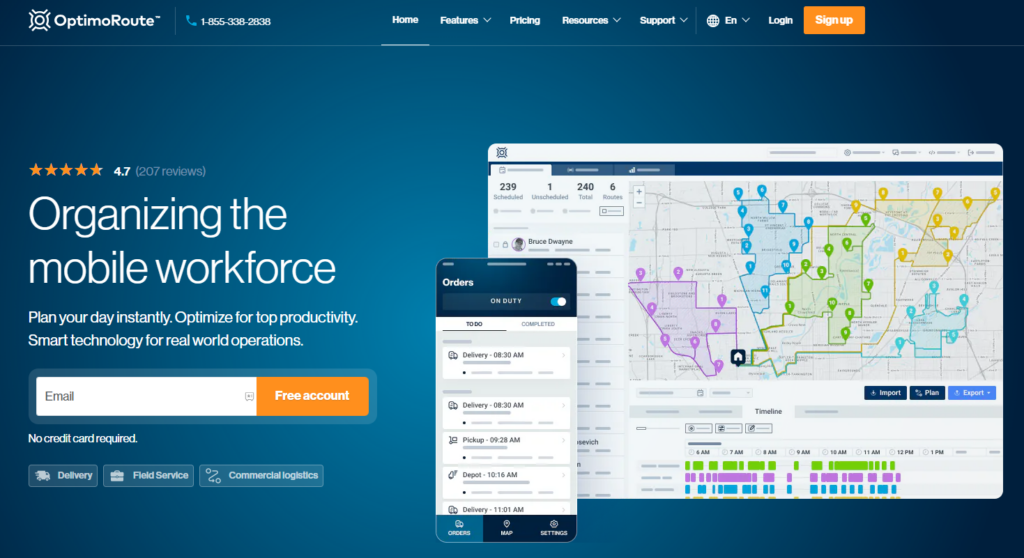
OptimoRoute focuses on route planning and optimisation for delivery and field service fleets. It handles multi-day planning, time-window management, workload balancing, and real-time order insertion, making it a solid standalone routing tool.
The platform is narrower in scope than full orchestration systems. It does not offer deep customer communication layers, full multi-carrier orchestration, or upstream OMS/WMS/ERP orchestration at enterprise depth. For teams that want a focused routing tool with a clean user experience, this can be a benefit.
Key features of OptimoRoute
- Multi-day automated route planning with time-window constraints.
- Real-time order insertion and dynamic route updates.
- Live tracking with driver app and customer ETA notifications.
- Analytics and performance reporting.
- Web service API for integration with ERP, CRM, POS, and field service management tools.
OptimoRoute pros
- Strong routing algorithms that plan orders quickly.
- Transparent published per-driver pricing.
- Good fit for routing-first field service and delivery teams.
OptimoRoute cons
- Scope is routing-first, not end-to-end orchestration.
- REST API has reported limitations around programmatic driver and vehicle creation.
- Per-driver pricing can add up as fleets expand.
OptimoRoute pricing
Per OptimoRoute’s official pricing page: Lite at $39/driver/month for planning up to 700 orders at once, Pro at $49/driver/month for 1,000 orders, live tracking, customer feedback, and geofencing, and a Custom plan for thousands of orders and additional capabilities. A 30-day free trial and 10% annual discount are available.
OptimoRoute is best for
SMB and mid-market delivery and field service operations that need a strong standalone routing tool with flexible driver-based pricing.
9. Route4Me
Route4Me is a widely adopted route optimisation tool, particularly popular with distributed field operations and small-to-mid delivery businesses. It offers route planning, GPS tracking, territory management, and a marketplace of add-on modules.
The modular model is both a strength and a source of complexity. Route4Me is accessible for smaller operations that want routing and tracking. At enterprise scale, buyers should validate whether add-ons, integrations, permissions, and reporting remain manageable.
Key features of Route4Me
- Route planning and optimisation with GPS tracking.
- Territory management and geofencing.
- Driver app with navigation and proof of delivery.
- Modular add-ons for extended capabilities.
- API and integration options depending on package.
Route4Me pros
- Flexible add-on model lets teams select the features they need.
- Good fit for distributed field operations at SMB scale.
- Useful for route planning and territory management.
Route4Me cons
- No native AI dispatch or holistic delivery orchestration.
- Add-on model can create integration and administration complexity at enterprise scale.
Route4Me pricing
Route4Me offers tiered subscription plans with a base starting tier plus paid add-on modules. Buyers should contact the vendor for a quote based on required features and configuration.
Route4Me is best for
SMB and distributed field operations that need flexible, modular route optimisation without enterprise complexity.
10. Tookan
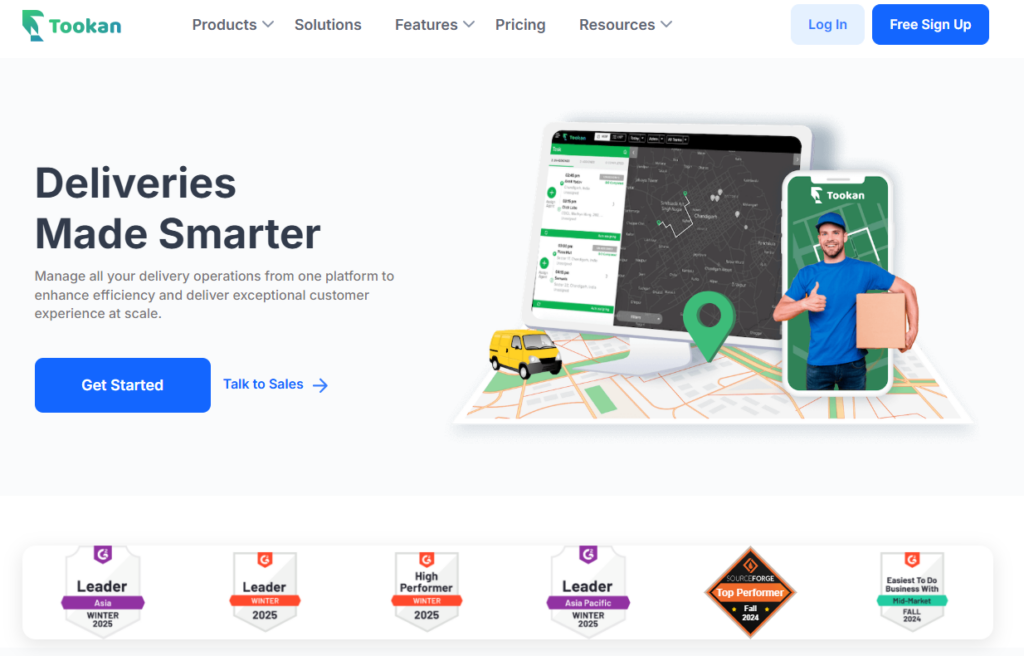
Tookan by Jungleworks is an API-first delivery management platform widely used by on-demand and hyperlocal delivery businesses. It covers agent tracking, task management, customer notifications, and basic route planning.
Tookan serves its target market well: small to growth-stage operations needing an accessible, developer-friendly delivery tool. However, it lacks the enterprise-grade scalability, advanced AI dispatch, and deep supply chain integration that orchestration-first platforms provide.
Key features of Tookan
- Agent tracking and task management with real-time updates.
- Customer notifications and delivery tracking links.
- API-first architecture for developer integration.
- Basic route planning and dispatch processes.
- Marketplace and hyperlocal delivery support.
Tookan pros
- Accessible, developer-friendly, and easy to integrate via API.
- Well-suited to on-demand, hyperlocal, and SMB delivery use cases.
- Published entry-level pricing.
Tookan cons
- Lacks advanced AI dispatch and multi-constraint optimisation.
- Limited fit for high-volume, multi-region enterprise operations.
Tookan pricing
Tookan offers tiered pricing starting with an Early Stage plan at $49/month, Startup plan at $129/month, and Growth plan at $299/month. Businesses with high-volume or specialised needs can opt for a custom Enterprise plan with tailored pricing and capabilities.
Tookan is best for
On-demand, hyperlocal, and SMB delivery businesses that need an accessible, API-first tool without enterprise overhead.
Why Locus is the Best Last Mile Logistics Platform for Enterprise Operations in 2026
Across AI dispatch depth, route optimization sophistication, multi-carrier orchestration, and system integration readiness, Locus is the strongest fit for enterprise last mile operations in 2026. It is the only platform in this comparison recognized as a Leader in the QKS SPARK Matrix for Transportation Management Systems, featured as a Representative Vendor in Gartner’s Market Guide for Multi-Carrier Parcel Management Systems, included across the 2026 Gartner Hype Cycle for AI-powered logistics, and ranked #1 for Route Planning on G2, a validation stack that reflects seven consecutive years of Gartner recognition.
That third-party endorsement sits on top of operational scale that point solutions and network orchestrators alike cannot match: 1.5 billion deliveries executed across 30+ countries, 360+ enterprise customers, 1,000+ pre-integrated carrier partners, and constraint-aware dispatch that reasons across 250+ real-world variables in a single planning cycle. For enterprises running mixed fleets, multiple fulfilment centres, and thousands of daily orders across geographies, this combination of AI-native dispatch, dynamic re-optimization, ShipFlex carrier orchestration, and control tower visibility places Locus in a category of its own on the maturity model above: Level 4 autonomous logistics orchestration, while most alternatives on this list remain at Level 2 or Level 3.
Enterprise Due Diligence
Use these sections once you have shortlisted vendors from the comparison table and vendor reviews.
Last Mile Orchestration Maturity Model
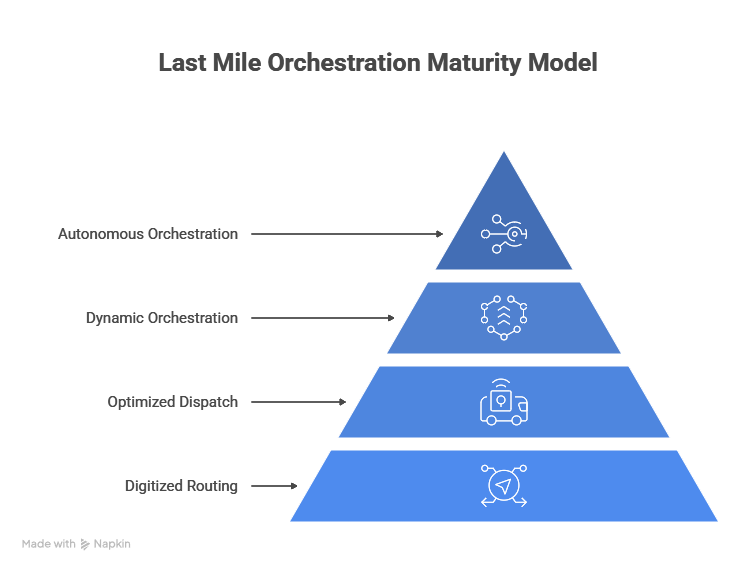
The Last Mile Orchestration Maturity Model is a four-level framework for evaluating the fit of your last mile logistics software.
Level 1: Digitised routing
Static route planning, basic GPS tracking, manual dispatch, or spreadsheet-driven planning. The platform replaces manual paperwork but does not optimise against real-world constraints.
Level 2: Optimised dispatch
Algorithmic route optimisation at planning time, automated driver assignment, and digital proof of delivery. The platform improves planning efficiency, but does not adapt deeply once drivers are already on the road.
Level 3: Dynamic orchestration
Real-time mid-route recalculation, constraint-aware dispatch, predictive ETAs, and customer communication. The platform adapts as conditions change and supports complex delivery processes across owned fleets and carrier partners.
Level 4: Autonomous logistics orchestration
AI-predictive disruption management, upstream connectivity to OMS, WMS, and ERP systems, first-to-last-mile visibility, sustainability-optimised routing, and continuous learning from delivery outcomes. The platform operates as a strategic orchestration layer across the logistics network.
When evaluating maturity, confirm whether the platform can demonstrate dynamic routing on live or representative data. For foundational context, see what is route optimization.
We evaluated each platform against seven criteria:
- AI and automation depth
- Route optimisation sophistication
- Real-time visibility
- Enterprise integration readiness
- Scalability across high-volume operations
- Geographic coverage
- Sustainability reporting
Pricing tier and public pricing availability were assessed using vendor websites where pricing pages were accessible. Where a vendor did not publish prices, this guide uses “custom pricing” rather than estimating contract values.
Integration Depth Comparison by Vendor
For enterprise buyers, integration depth is often the difference between a routing tool and true last mile logistics software. Validate whether each connector is native, prebuilt, API-based, partner-delivered, or custom-built during implementation.
| Platform | OMS / order systems | WMS / warehouse systems | ERP, SAP, Oracle | Carrier EDI/API | Telematics / fleet systems | Customer experience platforms |
|---|---|---|---|---|---|---|
| Locus | API-first and enterprise order-system connectivity | Prebuilt enterprise integration readiness, including WMS processes | Prebuilt connectors for ERP systems including SAP and Oracle | ShipFlex supports multi-carrier allocation across pre-integrated 3PL partners | Supports telematics integration as part of enterprise integrations | Customer notifications, predictive ETAs, branded visibility flows |
| FarEye | Strong fit for retail and e-commerce order flows | Typically implementation-dependent | Enterprise connectivity should be validated by connector and module | Multi-carrier delivery orchestration | Fleet integration depth should be validated by deployment scope | Strong branded tracking pages, ETA notifications, rescheduling |
| LogiNext | Supports delivery execution integrations | Integration depth varies by implementation | Enterprise ERP connectivity should be validated during procurement | Carrier and delivery partner connectivity should be validated | Fleet tracking and workforce scheduling | Customer notifications and delivery tracking |
| Shipsy | Suitable for logistics order flows across first, mid, and last mile | Relevant for cross-border and logistics execution | Invoicing and compliance; ERP depth should be validated | Multi-carrier visibility and cross-border carrier processes | Telematics depth should be validated by geography and mode | Shipment visibility and customer-facing tracking |
| Bringg | Strong omnichannel fulfilment and retail order-flow fit | Ship-from-store and fulfilment; WMS depth should be validated | ERP integration depth should be validated by connector | Broad carrier network orchestration | Owned-fleet telematics depth should be validated | Strong customer communication, tracking, returns, and omnichannel fulfilment |
| DispatchTrack | Order and appointment-based delivery | Relevant for big-and-bulky fulfilment; WMS depth should be validated | ERP depth should be validated by vertical and deployment | Carrier processes should be validated for big-and-bulky use cases | Driver app and route execution | Strong appointment scheduling, ETA communication, delivery instructions |
| Onfleet | RESTful API for order management system integration | WMS integration generally API-led | Enterprise ERP depth should be validated | Carrier orchestration is not the primary scope | Driver app, GPS tracking, delivery dashboard | Automated SMS notifications and customer tracking |
| OptimoRoute | Web service API for ERP, CRM, POS, and field service tools | WMS integration generally API-led | API connectivity to ERP tools; SAP/Oracle depth should be validated | Carrier orchestration is not the primary scope | Driver app, live tracking, geofencing | Customer ETA notifications and feedback in supported plans |
| Route4Me | API and add-on-led connectivity | WMS depth depends on add-ons and implementation | ERP depth depends on add-ons and implementation | Carrier orchestration is limited compared with enterprise platforms | GPS tracking, territory management, driver app | Customer experience features depend on selected modules |
| Tookan | API-first delivery task integration | WMS depth generally requires custom/API integration | ERP depth generally requires custom/API integration | Carrier orchestration is limited compared with enterprise platforms | Agent tracking and task management | Customer notifications and delivery tracking links |
When comparing platforms, ask vendors to show the data flow from order capture to dispatch, route execution, proof of delivery, exception handling, and settlement. A generic API claim is not equivalent to a proven integration pattern for SAP, Oracle, high-volume WMS environments, carrier EDI/API, telematics, and customer experience systems.
Security and Compliance Considerations for Enterprise Buyers
Security, compliance, and governance requirements vary by geography, industry, and customer data exposure. For last mile logistics software, the risk surface typically includes customer addresses, phone numbers, delivery preferences, proof-of-delivery media, driver location data, carrier performance data, and operational analytics.
| Platform | Publicly visible compliance posture to validate | Enterprise buyer validation questions |
|---|---|---|
| Locus | Enterprise buyers should validate SOC 2, ISO, GDPR, and data residency requirements as part of procurement and deployment design | Which certifications apply to the contracted product and hosting region? How are driver, customer, and proof-of-delivery data retained and deleted? |
| FarEye | Public compliance claims and certification scope should be validated directly with the vendor | Are customer communication, tracking pages, and carrier integrations covered by the same security controls? |
| LogiNext | Public compliance claims and certification scope should be validated directly with the vendor | How are role-based permissions, audit logs, and regional data processing handled? |
| Shipsy | Public compliance claims and certification scope should be validated directly with the vendor | How are cross-border shipment, invoicing, and customs-related data governed across countries? |
| Bringg | Public compliance claims and certification scope should be validated directly with the vendor | Are carrier network integrations and customer-facing delivery communications covered by documented controls? |
| DispatchTrack | Public compliance claims and certification scope should be validated directly with the vendor | How is proof-of-delivery media protected for big-and-bulky delivery processes? |
| Onfleet | Public compliance claims and certification scope should be validated directly with the vendor | What controls apply to task data, driver location history, and customer notifications? |
| OptimoRoute | Public compliance claims and certification scope should be validated directly with the vendor | How is driver, route, and customer data protected across API integrations? |
| Route4Me | Public compliance claims and certification scope should be validated directly with the vendor | Which add-ons are covered by the same security controls as the core routing product? |
| Tookan | Public compliance claims and certification scope should be validated directly with the vendor | How are API credentials, agent tracking data, and customer notification data secured? |
At enterprise scale, security review should go beyond a certificate checkbox. Procurement teams should ask for current documentation under NDA, confirm security and compliance controls, review data retention and deletion policies, validate audit logging, and test role-based access controls for dispatchers, planners, drivers, carrier partners, and regional administrators.
Data Residency and Multi-Country Deployment Considerations
Multi-country logistics deployments introduce more complexity than a single-region routing roll-out. Retail, CPG, 3PL, and e-commerce enterprises often operate across markets with different data privacy expectations, address quality, carrier ecosystems, delivery time-window norms, and language requirements.
Before selecting a platform, evaluate:
- Hosting and data residency: Confirm where customer, driver, route, proof-of-delivery, and analytics data will be hosted and processed. For EU operations, GDPR alignment and data transfer mechanisms should be reviewed with legal and security teams.
- Regional operating models: Validate whether the platform can support different dispatch rules by country, business unit, fleet type, carrier contract, delivery promise, and service level.
- Address intelligence: Multi-country operations require geocoding that performs well across structured and unstructured addresses, including low-address-density markets.
- Carrier ecosystem fit: A platform that works well in one region may not have the same carrier integrations, EDI/API patterns, or support coverage in another.
- Localisation: Dispatcher interfaces, driver apps, customer notifications, proof-of-delivery formats, and compliance exports may need market-specific configuration.
- Governance: Enterprise teams should define who can view, edit, export, and delete operational data across country, region, and central control tower teams.
Procurement and security reviewers should also validate sub-processors and data handling before committing to a multi-country deployment.
Implementation Timeline Comparison
Implementation timelines depend on shipment volume, number of countries, integration scope, carrier onboarding, data quality, change management, and whether the deployment is a pilot, business-unit rollout, or full enterprise transformation. The ranges below are planning benchmarks rather than guarantees.
| Platform | Typical implementation pattern to validate | Practical planning range to pressure-test |
|---|---|---|
| Locus | Enterprise roll-outs across multiple systems, carriers, fleets, and geographies | Pilot or phased deployment first; full multi-country orchestration should include integration and change-management planning |
| FarEye | Retail and e-commerce delivery experience, often with carrier and customer communication configuration | Validate time required for delivery design, carrier integration, branded tracking, and notification set-up |
| LogiNext | Route optimisation, execution, workforce scheduling, and regional delivery operations | Validate integration effort for OMS/WMS/ERP, driver onboarding, and local support needs |
| Shipsy | Broader logistics management across first, mid, last mile, and cross-border operations | Validate added time for multimodal visibility, invoicing, compliance, and multi-country process mapping |
| Bringg | Omnichannel fulfilment and carrier network orchestration | Validate carrier onboarding, store fulfilment, returns, and customer communication configuration |
| DispatchTrack | Appointment-based big-and-bulky delivery | Validate scheduling rules, customer appointment flows, proof-of-delivery requirements, and driver enablement |
| Onfleet | Mid-market delivery operations with API-led order flow and driver app deployment | Often faster than enterprise orchestration projects, but validate API work, driver training, and task-volume testing |
| OptimoRoute | Routing-first deployment for delivery or field service planning | Validate data import, driver and vehicle set-up, time-window rules, and API limitations relevant to your use case |
| Route4Me | Modular routing deployment with add-ons | Validate which add-ons are required, how they interact, and whether administration remains manageable at scale |
| Tookan | API-first hyperlocal or on-demand task management | Validate developer effort, notification configuration, agent onboarding, and scalability requirements |
Ask every vendor to provide an implementation plan with named milestones: discovery, data review, integration design, route-constraint configuration, carrier onboarding, user acceptance testing, dispatcher training, driver training, go-live support, and post-launch optimisation.
For enterprises redesigning logistics processes alongside software selection, supply chain consulting can help define the operating model before platform rollout.
Customer Reference Patterns by Industry and Geography
Customer references are most useful when they mirror your operational complexity. A logo in the same sector is not enough; the reference should match shipment density, delivery promise, country mix, carrier model, and systems landscape.
| Buyer profile | Reference customers to request | What to validate |
|---|---|---|
| Enterprise retail | Omnichannel retailers using ship-from-store, home delivery, returns, and customer notifications | Store-level dispatch, customer ETA accuracy, peak-season scalability, and returns handling |
| CPG and FMCG | Brands or distributors managing high-frequency replenishment, dealer networks, or fragmented address environments | Beat planning, territory constraints, address accuracy, outlet-level service adherence, and proof-of-delivery quality |
| 3PL providers | Logistics service providers operating multiple client contracts, fleet types, and carrier partners | Multi-client operations, carrier allocation, SLA reporting, client-level dashboards, and settlement support |
| E-commerce | High-volume parcel operations with strict delivery promises and frequent exceptions | Dynamic re-optimisation, failed-delivery handling, customer communication, and peak-volume resilience |
| Big-and-bulky | Furniture, appliances, building materials, or similar appointment-based delivery networks | Appointment scheduling, crew and vehicle constraints, service-time accuracy, and customer rescheduling |
| Cross-border logistics | Multi-country operations involving freight, parcel, customs, invoicing, and local carriers | Data residency, compliance processes, carrier coverage, regional support, and hand-off visibility |
For geography, ask for references in the same operating region wherever possible: North America, Europe, Southeast Asia, India, the Middle East, or Africa. Last mile performance is highly local; address quality, traffic patterns, carrier availability, driver practices, and customer expectations differ materially by market.
For retail and distribution enterprises, also evaluate whether vendors support use cases such as direct-to-store delivery.
Enterprise Buyer Checklist: 10 Questions to Ask Every Vendor
Before signing a multi-year contract for last mile logistics software, use this checklist to pressure-test vendor claims against your operational reality.
- How many orders can the platform dispatch in under 90 seconds, and against how many constraints? Generic “AI dispatch” claims without named constraint counts often indicate basic rule-based engines.
- Does the platform re-optimise routes mid-delivery, or only at dispatch? Ask for a live demo of a mid-route disruption scenario.
- What is the depth of OMS, WMS, and ERP integration? Prebuilt connectors for SAP, Oracle, and major OMS platforms should be named. Generic API claims are not a substitute.
- Does the platform report on carbon footprint and miles reduced? Sustainability is becoming a procurement criterion; no reporting capability can be a long-term risk.
- What is the deployment model and data residency posture for multi-country operations? Enterprise buyers need to validate certification scope, regional hosting, and privacy requirements.
- Which reference customers operate at similar scale and geography? Ask for named customers with published scale metrics where possible.
- How does the platform handle mixed fleet types: owned fleet plus 3PL carriers? Multi-carrier orchestration is not the same as simple carrier integration.
- What is the pricing model: per vehicle, per order, per task, or platform licence? Task-based pricing can scale unpredictably at volume.
- What is the expected implementation timeline and support structure? Validate realistic timelines with reference customers.
- How does the platform report on plan-vs-actual performance? Enterprise dashboards, custom KPIs, and operational search matter for ongoing improvement.
Plan-vs-Actual Reporting and KPI Dashboard Criteria
Plan-vs-actual reporting shows whether the delivery network executed as designed, not just whether orders eventually reached customers. Enterprise dashboards should make it easy to compare planned routes, stop sequences, ETAs, service times, driver assignments, vehicle utilisation, distance, cost, emissions, and SLA commitments against actual execution.
At minimum, evaluate whether each platform can report on:
- Planned versus actual departure time, arrival time, stop sequence, route duration, distance, and service time.
- SLA adherence by customer, region, fulfilment centre, carrier, fleet type, and delivery promise.
- Failed, delayed, rescheduled, and partially completed deliveries with reason-code analytics.
- Driver productivity, vehicle utilisation, route density, and cost-to-serve.
- Carrier performance across on-time delivery, attempted delivery, exception rate, and proof-of-delivery quality.
- Carbon footprint, miles reduced, and other sustainability metrics where ESG reporting is a procurement requirement.
- Drill-down from executive dashboard to order, route, driver, carrier, and customer-level detail.
- Exportable and API-accessible reporting for BI, finance, control tower, and customer service teams.
The strongest test is operational: give vendors a past delivery day, ask them to recreate the plan, simulate disruptions, and show the dashboard output that explains what changed, why it changed, and what the financial or service impact was.
Choosing the Right Last Mile Logistics Platform
The last mile logistics software market has moved beyond basic routing. AI dispatch, dynamic re-optimisation, system integrations, real-time visibility, and sustainability tracking are now core evaluation criteria. What matters is depth: how many constraints the system handles, whether routes adapt mid-delivery, how well it connects to OMS/WMS/ERP systems, and whether it can scale across mixed fleets and carrier partners.
For SMB and mid-market teams, tools such as Onfleet, OptimoRoute, Route4Me, and Tookan can be strong fits when the priority is fast deployment, simple routing, and local delivery visibility.
For enterprise buyers, platforms such as FarEye, LogiNext, Shipsy, Bringg, and DispatchTrack address specific needs across post-purchase experience, cross-border logistics, omnichannel fulfilment, and big-and-bulky delivery.
Locus is built for enterprises that need full logistics orchestration rather than point optimisation. It combines constraint-aware AI dispatch, dynamic optimisation, multi-carrier orchestration, control tower visibility, and sustainability reporting for high-volume logistics networks.
If you are still defining your buying criteria, this guide on how to choose the right route planning software can help structure your evaluation. You can also review how delivery logistics software improves fleet utilization when routing, dispatch, and execution data are connected.
See Locus against your delivery reality
Evaluate AI dispatch, route optimisation, carrier allocation, and control tower visibility using the constraints that matter to your network.
For proof by industry and deployment scope, explore Locus customer success stories.
Frequently Asked Questions (FAQs)
1. What is last mile logistics software?
Last mile logistics software helps teams manage dispatch, route optimisation, tracking, customer communication, and proof of delivery for the final leg of shipment. Enterprise platforms also support integrations, multi-carrier operations, analytics, compliance, and high-volume delivery orchestration.
2. How does last mile logistics software differ from a traditional TMS?
A traditional TMS often focuses on freight planning, carrier procurement, and middle-mile execution. Last mile logistics software is purpose-built for high-frequency, short-distance, customer-facing delivery, where ETA accuracy, route changes, proof of delivery, and customer communication are critical.
3. Which platforms are best for enterprise buyers?
The enterprise-oriented vendors in this guide are Locus, FarEye, LogiNext, Shipsy, Bringg, and DispatchTrack. These platforms are stronger fits when buyers need deeper orchestration, broader integrations, larger-scale deployment support, and more complex logistics operations.
4. Which tools are better for SMB or mid-market teams?
Onfleet, OptimoRoute, Route4Me, and Tookan are generally better fits for SMB or mid-market operations. They are useful when the priority is faster deployment, simpler routing, published pricing, or local delivery management rather than complex enterprise orchestration.
5. What should buyers compare first when evaluating platforms?
Start with AI dispatch depth, mid-route re-optimisation, OMS/WMS/ERP integration, multi-carrier support, scalability, reporting, and regional fit. Pricing model also matters: per-task, per-driver, per-vehicle, and platform-licence models can scale very differently as delivery volume grows.
6. How does AI-powered dispatch reduce delivery costs compared with manual assignment?
AI-powered dispatch assigns orders to vehicles using constraints such as capacity, driver skills, time windows, traffic, service time, delivery priority, and route density. Manual assignment usually takes longer and often relies on stale or incomplete information, which can increase distance, idle time, missed windows, and failed deliveries.
7. How does dynamic route optimisation handle mid-route disruptions?
Dynamic route optimisation re-sequences stops when disruptions occur, such as traffic, road closures, failed deliveries, vehicle delays, or urgent order insertion. The goal is to preserve delivery windows, improve asset use, and maintain customer communication through accurate ETAs. For more background, see dynamic route planning and ETA accuracy.
8. What integrations should enterprise buyers look for?
Enterprise buyers should look for API-based and prebuilt integrations with OMS, WMS, ERP systems such as SAP and Oracle, e-commerce platforms, carrier EDI/API systems, telematics, BI tools, and customer experience platforms. Integration depth determines whether dispatch decisions can use live inventory, order, carrier, and fleet data.
9. Why does time-window management matter in last mile delivery?
Time-window management helps delivery teams honour promised delivery slots, reduce failed attempts, and improve customer satisfaction. It is especially important for grocery, pharmacy, furniture, appliances, B2B distribution, and other operations where customers or receiving teams must be available. Learn more about time slot management.
10. What security and compliance requirements should enterprises evaluate?
Enterprises should evaluate certification scope, data residency, GDPR alignment where relevant, sub-processor governance, encryption, role-based access control, audit logs, incident response, data retention, and deletion processes. Security review should include customer address data, driver location data, proof-of-delivery media, carrier integrations, and analytics exports.
11. How long does last mile logistics software implementation usually take?
Implementation time varies by deployment scope. A focused routing rollout can be materially faster than a multi-country enterprise programme involving OMS, WMS, ERP, carrier EDI/API, telematics, customer communication, security review, data residency, and change management. Ask vendors for a milestone-based plan and validate it with reference customers operating at similar scale.
12. How does Locus compare with other last mile logistics software platforms?
Locus is positioned as a Level 4 orchestration platform, combining constraint-aware AI dispatch, dynamic route optimisation, multi-carrier allocation, control tower visibility, and sustainability reporting. Compared with routing-first tools such as Onfleet, OptimoRoute, Route4Me, and Tookan, Locus is built for high-volume enterprise networks with mixed fleets, multiple systems, and complex delivery constraints.
Related Reading
- Top 12 vehicle routing problem software for enterprise logistics in 2026
- 11 Best Routing Software for Enterprise Logistics in 2026
- Locus 2026 US Consumer Survey: Generative AI isn’t Just Changing How Consumers Shop, it’s Breaking the Demand Patterns US Retail Was Built On
- Embedded vs Bolted-On AI: The Architecture Question European Logistics Buyers Are Asking
- Hybrid Fleet Management: How Owned, 3PL, Gig, ICE, and EV Capacity Actually Operate at Most Enterprises
- US Returns Hit $850 Billion in 2025: Why US Retailers Are Restructuring Reverse Logistics in 2026
- DispatchTrack pricing: what buyers should know


General
Freight Dispatch Management Software: Complete 2026 Guide and Top 8 Platform Comparison

Aug 24, 2026
Compare 8 dispatch management platforms built for freight carriers in 2026, plus how freight dispatch works, what manual dispatch costs, and how to choose.
Read more
General
Why Your Delivery Promise Breaks Before the Van Leaves: A Delivery Experience Optimization Framework

Aug 25, 2026
Delivery promises fail across five decisions made before dispatch, none of which CX can see. The chain, the diagnostic that locates the break, and what changes when promise becomes an execution capability.
Read moreInsights Worth Your Time



















10 Best Last Mile Logistics Software Platforms for Enterprise Operations in 2026