


General
Using Fleet Management Analytics for Strategic Advantage
Key Takeaways
- Fleet management analytics converts fragmented fleet data into decision-ready insights that support both daily execution and long-term planning at enterprise scale.
- Strong analytics programs focus on exception-based metrics tied directly to cost control, service reliability, and fleet safety outcomes.
- Predictive analytics helps fleets anticipate maintenance, capacity, and delay risks before they disrupt operations or increase costs.
- Integration and role-specific reporting are critical for analytics adoption across mixed fleets and multi-region environments.
- Locus applies analytics directly within dispatch, routing, and fulfillment workflows, helping enterprises turn fleet data into consistent execution decisions.

Enterprise fleets generate large volumes of data every day, from vehicle location and fuel usage to driver behavior and delivery performance. Yet many logistics leaders struggle to turn this data into decisions that lower costs, improve safety, or protect service reliability. Information often sits across disconnected systems and is reviewed after problems occur, rather than guiding action during live operations.
Fleet management analytics plays a critical role in modern operations. Analytics transforms fleet data from passive reporting into decision support, enabling teams to understand what is happening across the fleet and respond with greater precision. For organizations managing large or mixed fleets, analytics strengthens control across dispatch, routing, compliance, and resource utilization.
This article explains how fleet management analytics works, which components matter most, and how enterprise teams apply analytics to improve efficiency, control costs, and manage risk. It also examines how platforms such as Locus align analytics with day-to-day fleet execution.
Fleet Management Analytics vs Related Systems
Fleet management analytics is related to several transport technologies, but it is not the same thing as each one. The distinction matters during software evaluation and KPI design.
| Category | Primary purpose | Typical data | What it answers | Limitation if used alone |
| Fleet management analytics | Turn operational data into decisions | Telematics, dispatch, stops, fuel, maintenance, driver, finance | Why routes fail, where cost increases, which assets are underused, what to do next | Depends on data quality and workflow integration |
| Fleet management software | Run day-to-day fleet administration | Vehicles, drivers, compliance, maintenance schedules, documents | What assets and drivers exist and what tasks are due | May offer limited cross-functional analysis |
| Telematics | Capture vehicle and driver signals | GPS, engine diagnostics, sensor data, speed, idling | Where the vehicle is and how it is being driven | Does not explain stop performance, delivery outcomes, or cost-to-serve by itself |
| BI/reporting tools | Aggregate and visualise business data | Warehouse or ERP extracts, exports, dashboards | What happened across periods and business units | Often lags live operations and may not support dispatch actions |
| TMS | Plan and manage transport movements | Orders, carriers, loads, linehaul, costs | How freight should move through the transport network | May not provide detailed last-mile or vehicle-level execution analytics |
For enterprise logistics teams, the practical goal is not more dashboards. It is analytics embedded in routing, dispatch, and fulfilment workflows so planners and dispatchers can act on exceptions while the route is still recoverable.
How Fleet Management Analytics Works
A useful fleet analytics workflow follows a simple chain:
| Step | What happens | Example |
| Data | Inputs flow from telematics, GPS, dispatch, route plans, maintenance platforms, fuel cards, driver apps, ERP, and finance systems | Actual route duration updates every few minutes |
| Metric | The system calculates a KPI from standardised data | Planned vs actual route duration |
| Exception | A threshold identifies a risk or deviation | Route is running 28 minutes late against committed delivery windows |
| Action | Dispatch, routing, or maintenance teams intervene | Reassign late stops to a nearby vehicle |
| Outcome | Teams measure whether the action improved performance | Delivery-window compliance recovered; overtime avoided |
This is the difference between analytics as reporting and analytics as operational control. The value comes when the exception drives a clear decision, owner, and measured result.
Understanding Fleet Management Analytics
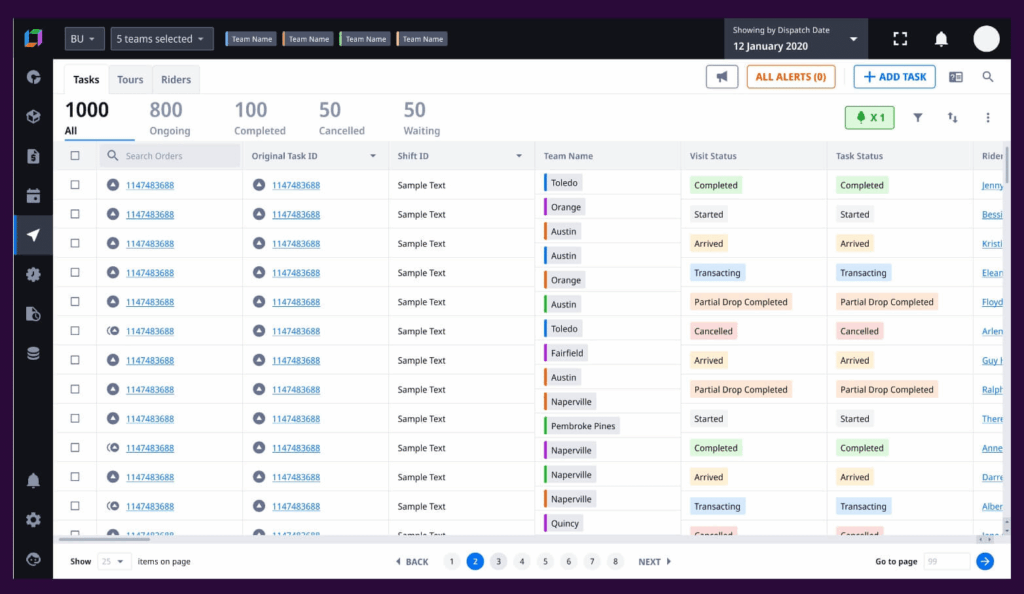
Fleet management analytics is the structured use of fleet data to support both operational and strategic decisions. It brings together data from multiple sources, including:
- Telematics and vehicle sensors
- Dispatch and route planning systems
- Fuel cards and expense data
- Driver applications and compliance records
Rather than summarizing historical activity, fleet management analytics focuses on identifying patterns, exceptions, and trends that affect daily execution. This includes route adherence, idle time, asset utilization, delivery delays, safety events, and cost drivers across vehicles and regions.
For enterprise logistics teams, analytics serves two distinct functions. On the operational side, it provides visibility that helps dispatchers and managers respond to delays, breakdowns, or compliance risks as they arise.
On the strategic side, it supports planning by revealing longer-term trends in demand, fleet capacity, and cost efficiency. Fleet management data analytics enables teams to move away from reactive oversight and toward controlled, data-led execution across complex fleet networks.
Key Components of Fleet Management Analytics
Fleet management analytics delivers value only when its core components support scale, speed, and operational relevance. For enterprise fleets, effectiveness depends on three areas: how data is collected, how it is analyzed, and how insights are delivered to the teams responsible for execution.
Data Collection and Integration
Fleet data is generated across multiple systems, including telematics devices, GPS units, dispatch tools, routing engines, fuel cards, maintenance platforms, and driver applications. In large fleets, this data is rarely centralized. When systems remain disconnected, visibility suffers, and decisions are delayed.
Effective fleet management analytics integrates these sources into a unified data layer. This allows teams to view vehicle status, route progress, delivery exceptions, and driver activity in one place. For mixed fleets operating across regions, integration is critical to maintain consistent reporting and avoid manual reconciliation.
A centralized data foundation also supports downstream execution use cases such as logistics route planning, route scheduling, and real-time dispatch adjustments. Platforms that combine tracking and execution data, such as Locus’ fleet tracking capabilities, help analytics stay closely tied to daily operations.
Data Analysis Techniques
Once data is unified, analytics shifts from reporting to interpretation. Enterprise fleets typically apply a mix of approaches, including:
- Descriptive analysis to explain events such as delivery delays, fuel spikes, or idle time
- Predictive models to anticipate maintenance needs, capacity gaps, or recurring route issues
Predictive analytics in fleet management is increasingly used to reduce unplanned downtime and improve planning accuracy. Some platforms, including Locus, place a strong emphasis on vehicle health and safety analytics, offering detailed telematics-driven insights for maintenance and driver behavior.
These insights are most effective when combined with dispatch and routing data, allowing predictions to translate directly into operational actions rather than remaining isolated reports.
Reporting and Visualization
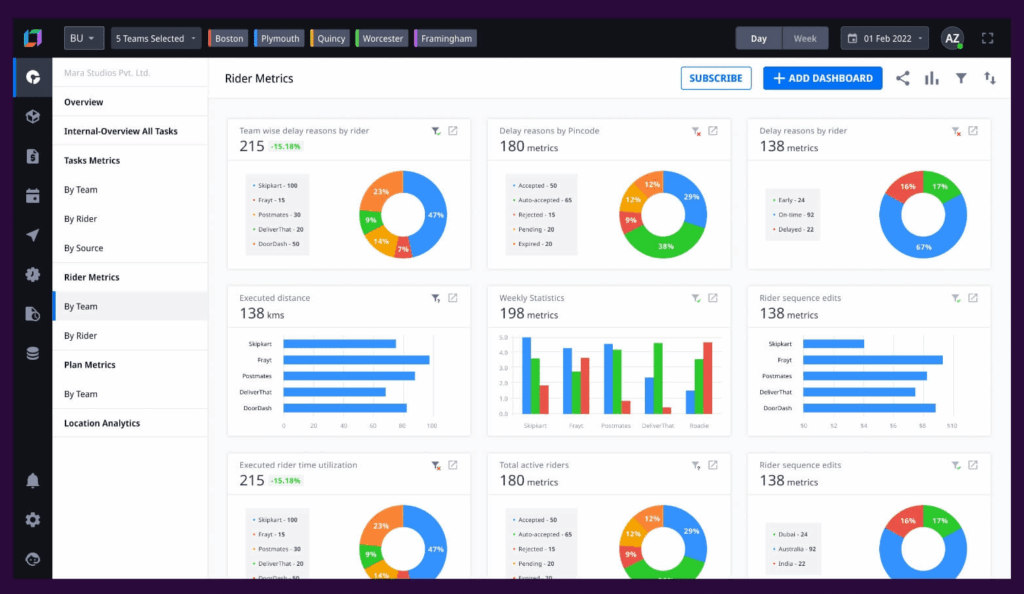
Analytics only supports decisions when insights are easy to interpret. Enterprise fleets require different views depending on role and responsibility:
- Dispatch teams rely on real-time operational dashboards
- Fleet managers track utilization, cost patterns, and compliance trends
- Leadership teams review summarized performance tied to service levels and spend
Well-designed reporting surfaces exceptions instead of overwhelming users with raw data. Visualizations should support quick decisions during live operations while also enabling structured reviews over time. Platforms that align analytics with execution, such as Locus’ logistics analytics and insights capabilities, help teams move from observation to action without added reporting overhead.
Types of Fleet Analytics: Descriptive, Diagnostic, Predictive, and Prescriptive
Each analytics type supports a different operating decision.
| Analytics type | Core question | Common fleet use case | Example output |
| Descriptive | What happened? | Report yesterday’s on-time delivery and idle time by depot | Route 14 completed 82% of planned stops |
| Diagnostic | Why did it happen? | Identify causes of recurring late routes | Stop dwell time at one customer added 31 minutes |
| Predictive | What is likely to happen next? | Forecast delivery delay or component failure | Vehicle fault patterns suggest elevated breakdown risk |
| Prescriptive | What should we do now? | Recommend a stop reassignment or maintenance intervention | Reallocate five stops to a nearby spare vehicle |
Prescriptive analytics should not be treated as fully autonomous decision-making by default. In enterprise fleets, it works best with governance: threshold settings, dispatcher review, audit trails, and role-based permissions.
Fleet Analytics KPIs and Formulas
The right KPI set depends on fleet mix, delivery density, geography, service promise, vehicle class, and operating model. The table below covers the metrics most often used for enterprise fleet management analytics.
| KPI group | KPI | Formula / definition | Why it matters |
| Service | On-time delivery rate | (On-time deliveries ÷ Total deliveries) × 100 | Measures service reliability |
| Service | Delivery-window compliance | Deliveries completed within the promised window ÷ total deliveries | Tracks SLA adherence |
| Service | Failed delivery rate | (Failed deliveries ÷ Total delivery attempts) × 100 | Highlights reattempt cost and customer impact |
| Service | Stop completion rate | (Completed stops ÷ Planned stops) × 100 | Reveals route execution quality |
| Route & dispatch | Route adherence | (Planned route elements followed ÷ Total planned route elements) × 100 | Shows whether execution matched plan |
| Route & dispatch | Planned vs actual route duration | Actual duration compared with planned duration | Identifies delay causes and planning gaps |
| Route & dispatch | Planned vs actual distance | Actual distance travelled compared with planned distance | Exposes detours and poor routing |
| Route & dispatch | Dispatch intervention rate | Manual interventions per route, shift, or day | Indicates operational stability |
| Route & dispatch | Exception resolution time | Average time from alert to action closure | Measures control tower responsiveness |
| Cost | Cost per mile | Total fleet cost ÷ Total miles travelled | Core transport cost measure |
| Cost | Cost per stop | Total route cost ÷ Total completed stops | Useful for last-mile cost-to-serve |
| Cost | Cost per delivery | Total delivery cost ÷ Total deliveries completed | Connects service model to margin |
| Cost | Fuel cost per mile | Fuel spend ÷ Total miles | Normalises fuel performance |
| Cost | Labour cost variance | Planned labour cost vs actual labour cost | Shows execution drift |
| Utilisation | Vehicle utilisation | (Vehicle active time or miles used ÷ Available time or capacity) × 100 | Indicates asset usage intensity |
| Utilisation | Asset utilisation | Actual output per asset compared with available capacity | Shows whether vehicles are productively deployed |
| Utilisation | Capacity utilisation | Loaded volume/weight ÷ available vehicle capacity | Important for route density and fleet sizing |
| Utilisation | Empty miles | Miles travelled without productive load or stops | Reveals waste |
| Maintenance | Preventive maintenance compliance | Completed preventive tasks ÷ scheduled preventive tasks | Protects uptime |
| Maintenance | Maintenance downtime rate | (Maintenance downtime hours ÷ Total available hours) × 100 | Measures maintenance impact on availability |
| Maintenance | Unplanned downtime | Hours or days vehicle is unavailable due to unplanned failure | Direct effect on service risk |
| Maintenance | Mean time between failures | Operating hours or miles ÷ number of failures | Reliability indicator |
| Maintenance | Mean time to repair | Total repair time ÷ number of repairs | Reflects workshop efficiency |
| Safety & compliance | Incident rate | Incidents per 100,000 miles or other standard period | Safety risk trend |
| Safety & compliance | Harsh braking / speeding events | Event count per vehicle, driver, or mile | Driver behaviour indicator |
| Safety & compliance | Inspection compliance | Completed inspections ÷ required inspections | Audit readiness |
| Sustainability | Fuel consumption | Fuel used per mile, route, or stop | Supports cost and carbon monitoring |
| Sustainability | Emissions per delivery | Total emissions ÷ completed deliveries | Links carbon reporting to operations |
| Sustainability | EV utilisation | EV active time or completed routes ÷ EV availability | Evaluates electrification performance |
| Sustainability | Charging-related downtime | Hours lost to charging constraints or queueing | Practical EV operating measure |
A practical rule: do not track every KPI at every level. Dispatchers need exceptions and recovery actions. Executives need trend movement, cost-to-serve, risk, and regional comparability.
What Should a Fleet Management Dashboard Include?
Role-based dashboards help avoid overload and make ownership explicit.
| User | Priority dashboard elements | Typical review frequency |
| Dispatcher | At-risk routes, late stops, route deviations, missed deliveries, live ETA variance, backup capacity, active alerts | Real time |
| Fleet manager | Vehicle utilisation, asset availability, downtime, maintenance due, fuel trends, driver and vehicle performance | Daily / weekly |
| Regional operations leader | Depot comparison, service-level trends, cost-to-serve, route productivity, labour variance, capacity performance | Weekly / monthly |
| Executive team | Cost trend, service reliability, productivity, safety risk, sustainability, investment priorities | Monthly / quarterly |
| Finance | Cost per stop, cost per delivery, cost per mile, overtime, budget variance, TCO indicators | Monthly |
| IT / data team | Integration health, data freshness, missing GPS events, duplicate records, source-system quality, access controls | Daily / weekly |
A strong dashboard design separates live control metrics from review metrics. Real-time screens should show what needs action now. Review dashboards should explain whether operating changes are improving outcomes over time.
Benefits of Fleet Management Analytics
Fleet management analytics delivers value when insights feed directly into planning, dispatch, and execution. For enterprise logistics teams, the benefits go beyond visibility and translate into tighter operational control, cost discipline, and reduced risk.
Operational Efficiency
Analytics improves how fleets plan work and respond during execution. By tracking route adherence, stop-level performance, and recurring exceptions, teams can intervene before delays cascade across routes.
Key efficiency gains come from:
- Identifying routes and stops where delays repeat
- Highlighting execution gaps that require dispatcher intervention
- Using historical trends to improve strategic route planning and day-level accuracy
Over time, this reduces manual overrides and improves routing efficiency across depots and regions. When analytics are embedded in the dispatch management process, decisions remain consistent across shifts rather than relying on individual judgment.
Internal reference:
Cost Reduction
Fleet costs often increase due to small inefficiencies that compound at scale. Analytics helps isolate these drivers by making them visible and comparable across operations.
Common cost insights include:
- Fuel consumption by route and vehicle type
- Idle time patterns across shifts and regions
- Labor utilization aligned with delivery volume
Linking cost data with automated route planning and route management allows teams to improve asset utilization without reducing service levels. Analytics also supports more accurate fleet sizing and stronger contract negotiations by grounding decisions in actual operating data.
Safety and Compliance
Safety analytics focuses on behaviors and conditions that increase operational risk. Harsh braking, speeding patterns, fatigue indicators, and maintenance gaps can be monitored consistently across the fleet, enabling earlier intervention.
This supports:
- Proactive coaching instead of post-incident enforcement
- Consistent safety standards across depots and regions
- Easier compliance audits through documented activity and actions
For enterprises evaluating the best fleet management platforms, analytics depth is a key differentiator. Strong safety reporting reduces compliance exposure by maintaining a clear, defensible record of monitoring and corrective measures.
Applications in Fleet Operations
Fleet management analytics delivers the most value when insights are applied during live operations and longer-term planning. Enterprise teams typically apply analytics across two areas: real-time operational control and strategic decision-making.
Real-Time Monitoring and Alerts
Real-time analytics allows fleets to respond to issues while operations are still in motion. Live views of vehicle location, route progress, and delivery status help teams spot delays, missed stops, or deviations early in the shift.
At scale, exception-based alerts are critical. Instead of monitoring every vehicle, dispatchers focus on situations that require action, such as:
- Routes falling behind schedule
- Vehicles deviating from planned paths
- Missed or at-risk delivery windows
This supports faster interventions within the dispatch management process, including reassigning stops, adjusting delivery windows, or activating backup capacity. When paired with automated dispatch optimization software, analytics improves consistency across regions and reduces reliance on manual coordination.
Strategic Decision-Making
Beyond daily execution, analytics supports decisions that shape long-term fleet performance. Historical trends help leadership evaluate network design, fleet sizing, and depot placement with greater accuracy.
Analytics is also used to identify recurring inefficiencies tied to:
- Specific routes or delivery zones
- Vehicle types or asset classes
- Service models and operating patterns
For mixed fleets, these insights inform asset allocation and technology investments. Comparing planned versus actual performance helps teams refine logistics route planning and route optimization strategies over time, supporting predictable growth and controlled expansion.
Fleet Management Analytics for Last-Mile Delivery
Last-mile delivery is where fleet management analytics becomes especially valuable because execution complexity is high and failure costs compound quickly. Compared with linehaul or static service fleets, last-mile operations face:
- High stop counts per route
- Tight delivery windows
- Constant traffic and demand variation
- Greater failed-delivery risk
- Mixed service types such as home delivery, B2B replenishment, and direct-to-store delivery
- Variable owned, leased, 3PL, gig, ICE, and EV capacity
For these fleets, planned-versus-actual analysis is essential. The most useful comparisons include:
| Planned metric | Actual metric | What the gap usually reveals |
| Planned route duration | Actual route duration | Traffic, poor stop sequencing, excessive dwell time |
| Planned stops | Completed stops | Service failure, capacity mismatch, late starts |
| Planned distance | Actual distance | Detours, missed turns, route non-compliance |
| Expected arrival time | Actual arrival time | Delay risk at customer level |
| Planned capacity | Used capacity | Underloaded vehicles or constrained capacity |
| Planned labour | Actual labour | Overtime, route imbalance, low stop productivity |
A practical last-mile example:
- A route is forecast to miss three delivery windows.
- Analytics identifies the cause: actual dwell time at early stops is 40% above plan.
- Dispatch reassigns two downstream stops to a nearby vehicle.
- The system measures whether delivery-window compliance and overtime improve.
This is where analytics connects directly to route optimisation, dispatch intervention, fulfilment performance, and cost-to-serve. It also matters for organisations managing hybrid fleet management models across multiple depots and regions.
Challenges and Solutions
Fleet management analytics delivers value only when it is usable at scale. Many enterprise teams struggle not because analytics lack capability, but because structural and operational issues prevent insights from influencing decisions.
Data Overload
Enterprise fleets generate more data than most teams can act on. When dashboards track too many metrics, signals get buried, and responses slow down. Teams end up reviewing reports without a clear sense of priority or next steps.
Addressing this starts with narrowing the focus. Effective analytics programs define a limited set of metrics tied directly to outcomes such as service reliability, cost control, and safety. Best practices for reporting and analytics in mixed fleet management typically include:
- Exception-based views that surface only what requires action
- Role-specific dashboards for dispatch, operations, and leadership
- Regular review cycles aligned with operational rhythms
This keeps analytics connected to execution rather than turning it into retrospective analysis.
System Integration
Fleet data is usually spread across telematics systems, routing tools, dispatch platforms, and finance applications. Integration becomes difficult when legacy systems, regional tools, or inconsistent data definitions are involved.
Successful integration depends on a few foundational steps:
- Clear ownership of data sources and metrics
- Standard definitions for performance, cost, and compliance indicators
- API-based connections that reduce manual data movement
When integration is designed around operational workflows, analytics supports daily decision-making instead of functioning as a separate reporting layer.
Future Trends in Fleet Management Analytics
Fleet management analytics is moving away from retrospective reporting toward systems that support prediction and decision-making during operations. Research from consulting and analyst firms indicates that analytics will play a more direct role in execution, safety, and cost control.
AI and Machine Learning
Research from McKinsey & Company indicates that AI-driven analytics delivers the most value when models are closely tied to operational workflows. In fleet environments, machine learning is increasingly applied to:
- Predict maintenance failures before breakdowns occur
- Identify unsafe driving patterns early
- Anticipate delivery delays before service levels are affected
This shifts analytics from post-event analysis to early intervention.
Gartner also notes that analytics platforms deliver higher ROI when embedded directly into operational systems. For fleets, this means analytics that inform dispatch decisions, capacity planning, and exception handling in real time, rather than operating as a separate BI layer.
Emerging Technologies
Research from Forrester highlights a shift toward connected decision platforms that unify data on telematics, routing, and execution. These platforms shorten response cycles and reduce reliance on manual coordination.
Additional trends gaining traction include:
- Real-time data processing closer to vehicles and depots
- Faster alerts without routing all data through centralized systems
- Localized decision-making that adapts to conditions on the ground
Over time, these advances will support more adaptive route optimization, responsive route scheduling, and scalable fleet operations across regions.
From Fleet Data to Execution-Level Decisions
Fleet management analytics now acts as a control layer for enterprise logistics operations. When analytics is connected to planning, dispatch, and execution, teams gain clearer visibility into cost drivers, service risk, and safety performance across regions and fleet types.
This allows leaders to replace reactive issue handling with consistent, data-led decisions that scale.
The most effective analytics programs stay focused on action. They prioritize metrics that influence daily outcomes, connect insights directly to operational workflows, and support both real-time intervention and long-term planning.
As fleet operations become more complex, analytics that sit outside execution systems quickly lose relevance.
Platforms such as Locus apply analytics directly where decisions are made, across dispatch, routing, and fulfillment workflows. Book a demo with Locus and explore the fleet management solutions it provides.
Frequently Asked Questions (FAQs)
1. How does fleet management analytics improve operational efficiency?
Fleet management analytics surfaces delays, underutilized assets, and recurring exceptions during live operations. This helps teams intervene earlier, improve dispatch accuracy, and reduce manual coordination across shifts and regions.
2. What are the key metrics to track in fleet management analytics?
Common metrics include on-time performance, route adherence, idle time, fuel consumption, asset utilization, and safety events. Enterprise teams typically tailor metrics by role and focus on exceptions rather than raw data volume.
3. How can predictive analytics benefit fleet maintenance schedules?
Predictive analytics identifies early signs of vehicle wear and failure using usage and condition data. This allows maintenance to be scheduled proactively, reducing unplanned downtime and service disruption.
4. What challenges arise when integrating analytics across mixed fleets?
Mixed fleets often rely on multiple telematics and dispatch systems. Challenges include inconsistent data formats, metric definitions, and reporting cycles, which require standardization and API-based integration.
5. What future trends will shape fleet management analytics?
Analytics is moving toward real-time, AI-supported decision systems embedded into dispatch and routing workflows, replacing standalone reporting tools with execution-focused intelligence.


General
Optimizing Delivery Performance: Key KPIs for 2026

Sep 23, 2026
Track and improve delivery performance KPIs with practical metrics for 2026. Learn how logistics teams turn KPI visibility into execution gains. Explore Locus.
Read more
General
Carrier Management: Onboarding, Performance Tracking, Contracts, and Compliance

Sep 23, 2026
Carrier management governs who gets freight, under what terms, and how exceptions get handled. Learn 12 KPIs and what a CMS must do at enterprise scale.
Read moreInsights Worth Your Time




















Using Fleet Management Analytics for Strategic Advantage