


General
Top 12 vehicle routing problem software for enterprise logistics in 2026

Key Takeaways
- Constraint depth is the primary separator between enterprise VRP software and SMB route planners, for example, routing engines modeling fewer than 50 configurable parameters cannot represent mixed-fleet, multi-depot, or VRPTW scenarios accurately at scale.
- Real-time dynamic re-optimization mid-execution separates routing engines that absorb operational volatility from those that require a manual re-plan when conditions change after dispatch.
- Open-source solvers, including Google OR-Tools, Timefold, and GraphHopper/VROOM, are powerful engineering tools, not production-grade logistics platforms; the build-vs-buy cost for enterprise teams involves significant engineering investment that rarely surfaces in initial comparisons.
- Locus handles 180+ configurable constraints, processes billions of data points in real time, and re-optimizes routes continuously during execution across retail, FMCG, e-commerce, and 3PL operations in 30+ countries.
- Enterprises evaluating VRP software should run proofs of concept on their actual operational data, not vendor demo scenarios, to expose constraint-handling gaps before committing to implementation.
The vehicle routing problem (VRP) is one of the most computationally demanding challenges in enterprise logistics. At smaller scales, a basic route planner produces a workable result. Across thousands of daily orders, hundreds of vehicles, dozens of operational constraints, and continuous mid-day variability, those approximations fail, and the cost of each failure compounds across every subsequent stop.
Most buyers evaluating what is vehicle routing software encounter a crowded market where SMB-oriented route planners and enterprise-grade AI dispatch engines appear side by side in the same comparison articles.
The evaluation criteria most lists use, user interface scores, pricing tiers, and feature checkboxes, have no operational relevance at fleet scale. A clean interface does not re-route 2,000 vehicles after 50 orders change mid-day.
This evaluation covers 12 VRP software options assessed on criteria that matter to VP and Director-level logistics buyers at enterprises with $150M+ revenue in retail, FMCG, e-commerce, 3PL, and CPG: constraint handling depth, dynamic re-optimization capability, AI/ML maturity, scalability architecture, integration ecosystem, and total cost of ownership.
What to Look for in Enterprise-Grade Vehicle Routing Problem Software
Most ranking criteria designed for small business buyers become irrelevant at enterprise scale. Six dimensions determine whether a VRP tool can handle production operations or will require manual dispatcher intervention the moment conditions deviate from the morning plan.
Constraint handling depth
The number and type of constraints a routing engine can model determines how closely the plan matches operational reality. An FMCG fleet with refrigerated vehicles, union driver shifts, customer-specific delivery windows, and per-stop unloading time requirements needs an engine that holds all those parameters simultaneously. Routing software capping out at 30-40 constraints approximates the plan. At 100+, it models it.
The follow-up question for any vendor demo: can the engine model driver behavioral patterns learned from historical delivery data, or does it apply uniform assumptions across all drivers?
Real-time dynamic re-optimization
AI-driven route optimization recalculates continuously as conditions change during the day. A driver running 20 minutes late at stop three carries that delay forward to every subsequent stop unless the route is re-optimized against remaining orders and current traffic. Routing tools that require a dispatcher to manually trigger re-planning introduce a lag that cascades into missed SLAs, driver overtime, and re-delivery costs.
The evaluation question: how fast does the system re-route when 50 orders change after dispatch, and does it require human intervention to trigger the recalculation?
AI/ML maturity
There is a wide range between routing engines that run deterministic heuristics and those that learn from operational data. Predictive ETAs calibrated to historical stop-level patterns are materially more accurate than map-based estimates, particularly in dense urban last-mile environments. Demand forecasting and proactive exception flagging reduce reactive dispatching. Ask vendors to distinguish which features are rule-based and which are genuinely ML-driven.
Scalability architecture
A routing engine performing adequately with a 200-vehicle fleet may degrade at 2,000 or fail at 10,000. Ask vendors for evidence from production deployments at your target scale, not benchmark simulations on clean data sets. Multi-depot planning across geographies adds a further layer of computational complexity that smaller platforms often do not support without significant architectural limitations.
Integration ecosystem
A routing engine isolated from the order management system, warehouse management system, and TMS creates data silos that generate operational blind spots. The routing plan should receive orders from the OMS in real time, adjust based on WMS pick completion, and feed execution data back to the TMS. Native integrations reduce implementation risk and time-to-value. APIs without pre-built connectors require development resources most logistics teams do not have allocated to routing infrastructure.
Total cost of ownership
Per-vehicle pricing looks manageable at 50 vehicles and becomes significant at 500. Platform licensing models have different economics at scale. Add implementation cost for any tool requiring deep constraint configuration, integration development for custom connectors, and for open-source tools, the engineering overhead to build and maintain a production system over three or more years. The visible subscription price is rarely the full cost picture.
12 Vehicle Routing Problem Software Platforms Evaluated
The platforms below range from AI-powered enterprise dispatch engines to open-source VRP solver libraries. The evaluation structure is consistent across all 12: core capability overview, key features, best-fit operational profile, limitations, and pricing where publicly available.
1. Locus
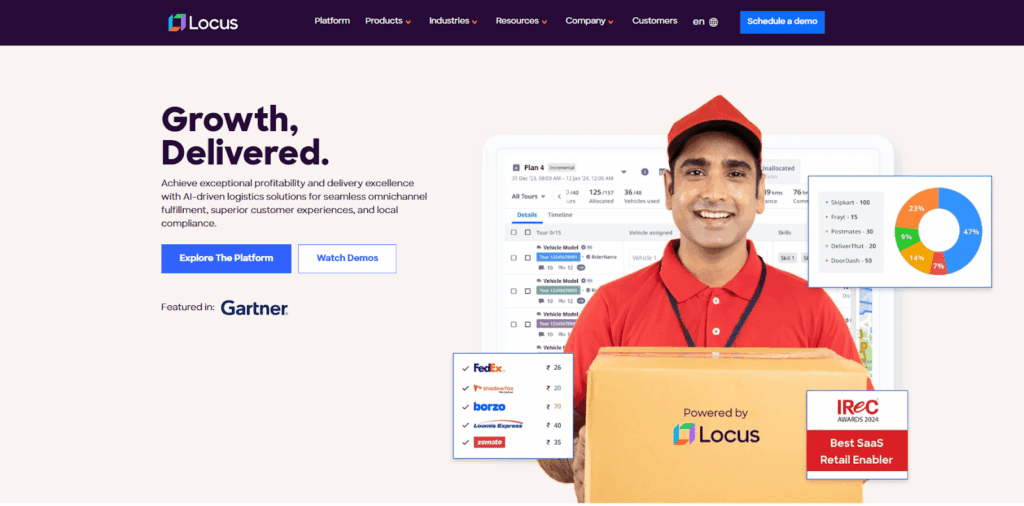
Locus was built to solve a problem most routing tools do not attempt to model at full fidelity: the operational reality of an enterprise logistics operation where hundreds of variables shift simultaneously, multiple times per day.
The platform’s dispatch management engine does not plan routes once and execute them statically. It maintains continuous re-optimization throughout the delivery cycle, absorbing disruption as input rather than treating it as an exception.
Locus’s key features
- 250+ Configurable constraint engine: Locus models 250+ operational constraints simultaneously, covering vehicle capacity, driver shift patterns, union labor rules, customer-specific delivery preferences, service time variability, and vehicle-type restrictions by delivery zone. For a 3PL running a mixed fleet of owned and contracted vehicles across clients with different SLA structures, this means the routing plan reflects actual operational agreements rather than an approximation.
- Dynamic re-optimization during execution: Routes are not locked at dispatch. Locus re-optimizes continuously as conditions change mid-execution, absorbing same-day order injection, driver no-shows, traffic disruptions, and failed delivery attempts without requiring a dispatcher to manually rebuild the plan. The engine triggers re-routing automatically and recalculates ETAs for all downstream stops when any stop-level event changes the plan’s assumptions.
- Behavioral learning from historical data: The platform’s AI layer learns stop-level delivery patterns from historical operational data, producing ETAs calibrated to actual driver and location behavior rather than map-based estimates.
- Full last-mile lifecycle coverage: Locus covers the full operational arc from planning through execution to proof of delivery, including real-time visibility dashboards and customer-facing notification workflows. For logistics leaders evaluating last-mile management infrastructure, this is the distinction between a routing engine and an orchestration layer.
Locus is best for
Enterprise retail, FMCG, e-commerce, and 3PL operations running more than 500 daily shipments across mixed fleet types, where constraint complexity, same-day variability, and multi-depot coordination all need to be modeled simultaneously. Locus has production deployments across 30+ countries spanning North America, Europe, Southeast Asia, India, and MEA, with verified traction across each of those verticals.
Locus’s pros
- Constraint depth covering actual enterprise operating agreements, including unionized labor rules and behavioral learning from historical data
- Continuous mid-execution re-optimization across same-day order injection, driver no-shows, and traffic disruptions
- Full coverage from order allocation through proof of delivery
- Native ERP, WMS, OMS, and TMS integrations reducing integration development overhead
- Production deployments across retail, FMCG, e-commerce, and 3PL verticals in 30+ countries
Locus’s cons
- Configuration depth requires a dedicated implementation engagement, and operations teams need to map their actual constraint set before the platform reflects operational reality
- Pricing is quote-based and not publicly listed, so budgeting conversations require direct sales engagement
Locus’s pricing
Quote-based. Pricing is not listed publicly, and is structured for enterprise buyers. Schedule a demo to discuss pricing relative to your fleet size and operational requirements.
2. FarEye
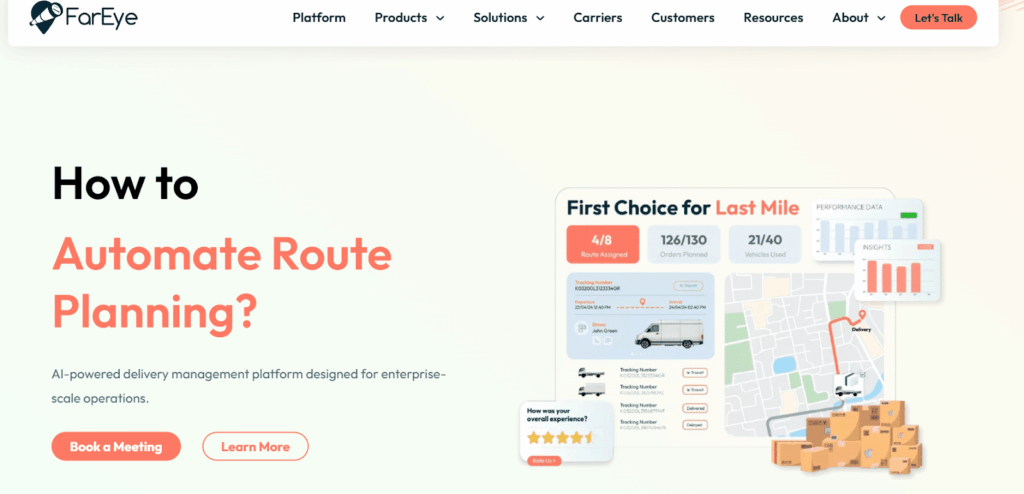
FarEye’s positioning centers on delivery experience management, a broader frame than VRP-specific constraint optimization. The platform handles configurable delivery workflow logic, customer communication orchestration across pre-delivery and in-flight touchpoints, and no-code customization for delivery process builders who prefer configuration over engineering.
FarEye’s key features
- Configurable delivery workflow builder with no-code customization
- Predictive visibility and multi-channel customer ETA notifications
- Driver mobile application with real-time tracking and proof of delivery
- Multi-carrier management for outsourced or hybrid delivery models
FarEye is best for
Mid-market to enterprise operations where delivery experience, customer communication, and carrier orchestration are the primary requirements. FarEye fits retail and e-commerce companies prioritizing post-dispatch visibility over deep VRP constraint modeling or real-time re-optimization for complex fleet scenarios.
FarEye’s pros
- No-code workflow configurability that reduces engineering dependency for process changes
- Well-developed customer-facing notification and tracking features for post-dispatch visibility
- Multi-carrier support for outsourced delivery models at regional scale
FarEye’s cons
- VRP-specific constraint depth is limited compared to tools built for complex fleet modeling, and the number of configurable constraints is not publicly documented
- Operations running mixed vehicle types with complex driver labor rules will find the constraint library insufficient at enterprise scale
- Real-time re-optimization mid-execution is less mature than purpose-built VRP platforms
FarEye’s pricing
Quote-based. Pricing is not listed publicly; contact FarEye directly.
3. LogiNext Mile
3PLs and distributors building last-mile operations in India and the Middle East have historically had fewer enterprise routing options built for their regulatory and market context.
LogiNext Mile fills that gap, covering AI-based route planning, live tracking, and delivery scheduling for on-demand and scheduled delivery use cases with regional depth that global platforms do not always match.
LogiNext Mile’s key features
- AI-based route planning with time-window management
- Live tracking with driver mobile application
- Delivery scheduling and rescheduling workflows
- Analytics and performance reporting on delivery outcomes
LogiNext Mile is best for
Mid-market logistics operations in India and the Gulf markets, particularly retail and FMCG distributors with relatively standardized delivery constraints. The tool suits operations where scheduling automation and regional support outweigh the need for deep constraint customization.
LogiNext Mile’s pros
- Regional deployment depth and support infrastructure in India and MEA
- Live tracking and driver communication features for field visibility
- Manageable implementation for standard delivery use cases
LogiNext Mile’s cons
- Constraint depth is not documented publicly, and LogiNext does not specify the number of configurable constraints, making direct comparison with enterprise-focused tools difficult
- Published evidence of production deployments at hyperscale fleet sizes (1,000+ vehicles) is limited
- Integration ecosystem is narrower than tools with pre-built ERP and WMS connector libraries
LogiNext Mile’s pricing
Quote-based. Pricing is not listed publicly.
4. Shipsy
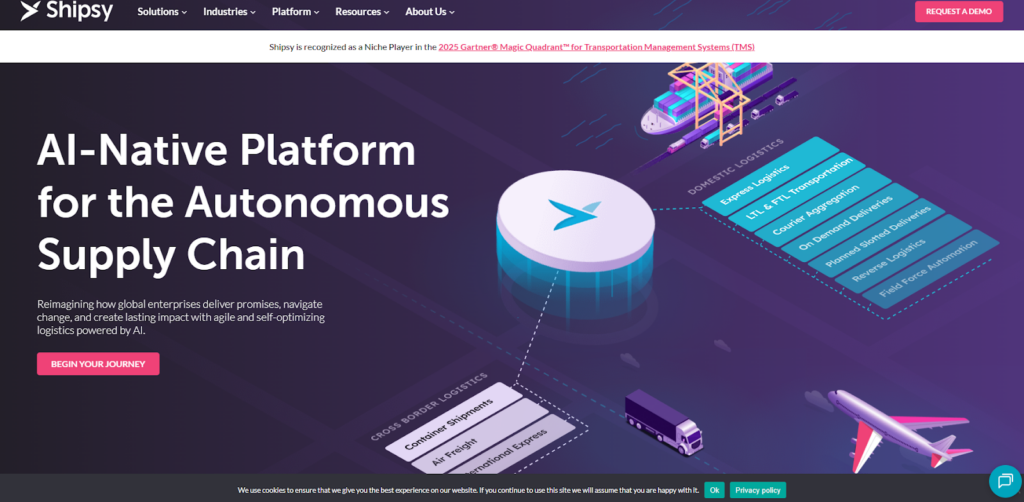
Shipsy approaches logistics management from the freight layer up, covering mid-mile and cross-border coordination before last-mile routing.
The platform targets the cross-border documentation problem in South Asia and MEA, where customs workflows, carrier network coordination, and domestic distribution management intersect in ways that pure last-mile routing tools are not designed to handle.
Shipsy’s key features
- Route optimization for last-mile and mid-mile operations
- Cross-border freight tracking and documentation management
- Carrier network integration and selection logic
- Real-time shipment visibility dashboard for distribution operations
Shipsy is best for
Logistics operations in India and MEA with significant cross-border freight volumes or domestic distribution, where carrier management and documentation workflows are as important as route optimization. Shipsy fits distribution operations where mid-mile visibility is the primary operational gap.
Shipsy’s pros
- Freight management and carrier coordination features alongside route planning
- Cross-border documentation and compliance handling for APAC and MEA markets
- Coverage of Indian and Gulf market regulatory and logistics requirements
Shipsy’s cons
- VRP dynamic re-optimization during execution is not a core capability, with the platform positioned primarily as a planning and visibility tool
- High-frequency B2C last-mile delivery operations with hundreds of stops per vehicle per day will find the routing depth insufficient for same-day variability
Shipsy’s pricing
Quote-based. Pricing is not listed publicly.
5. OptimoRoute
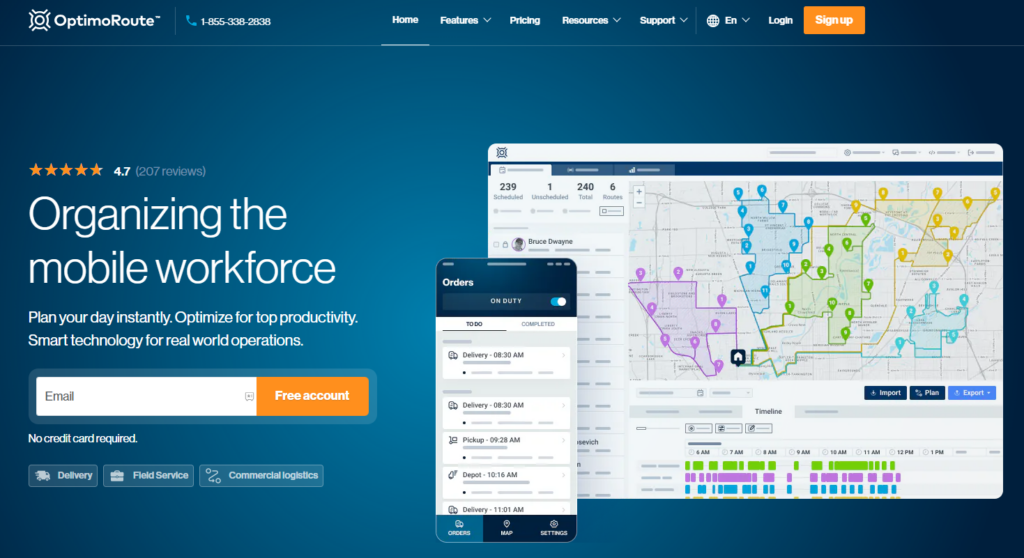
OptimoRoute’s $35/vehicle/month pricing signals its market position before any feature discussion begins. The tool has earned a 4.9/5 on G2 (as of April 2026) in the SMB and lower midmarket segment, built on multi-day planning, workload balancing, and driver break compliance.
The economics that make it accessible at 30 vehicles become less attractive at 500, and the constraint library limitations become operationally consequential at that scale too.
OptimoRoute’s key features
- Multi-day route planning with workload balancing across drivers
- Driver break compliance and shift time management
- Real-time tracking and customer notification
- Historical analytics on delivery performance and efficiency
OptimoRoute is best for
Fleets of 10-150 vehicles in field service, delivery, or distribution with relatively standardized constraints and a preference for transparent per-vehicle pricing. Operations where ease of setup and manageable cost at lower vehicle counts matter more than deep constraint customization.
OptimoRoute’s pros
- Transparent $35/vehicle/month pricing with no implementation complexity at SMB scale
- Multi-day planning with workload distribution across driver teams
- High user satisfaction rating on G2 (4.9/5 as of April 2026) across the SMB and lower midmarket segment
- Low onboarding friction for straightforward delivery operations
OptimoRoute’s cons
- Constraint configurability does not reach the depth required for enterprise 3PL or FMCG operations with complex driver labor rules, customer-specific SLAs, or mixed fleet types
- Per-vehicle pricing at 500+ vehicles crosses into enterprise platform cost territory without delivering enterprise-level constraint depth or re-optimization capability
- ERP and WMS native connectors are sparse, and integrations beyond basic API require development resources
OptimoRoute’s pricing
Approximately $35 per vehicle per month. Contact OptimoRoute directly for the current tier structure and volume discounts.
6. Route4Me
Route4Me built its installed base by solving territory routing problems for field service and small delivery operations, and its add-on marketplace architecture reflects that origin. Buyers start with a base tier and extend capability through modules.
The flexibility works at a smaller scale and becomes a cost driver once a broader feature set is required.
Route4Me’s key features
- Route optimization for single and multi-driver operations
- Territory planning and geographic management tools
- Add-on marketplace covering time windows, constraints, and extended analytics
- Driver tracking and real-time route progress monitoring
Route4Me is best for
Small to mid-sized operations running under 200 daily routes where territory management, field service routing, or simple delivery optimization are the primary requirements. The module architecture suits buyers wanting to expand capability incrementally rather than committing to a full-feature tier upfront.
Route4Me’s pros
- Territory management tools with geographic segmentation
- Incremental add-on architecture for phased capability expansion
- Accessible pricing at a smaller fleet scale
Route4Me’s cons
- Multi-depot operations with complex shift patterns and mixed fleet types hit constraint depth limits quickly, as the base platform was not built for those scenarios
- Real-time re-optimization at scale after dispatch is not the tool’s design center
- Add-on pricing accumulates significantly as more capabilities are activated, and the effective cost at mid-market scale often exceeds the base tier rate
Route4Me’s pricing
Tier-based pricing starting around $200/month. Contact Route4Me directly for current tiers and add-on costs.
7. Routific
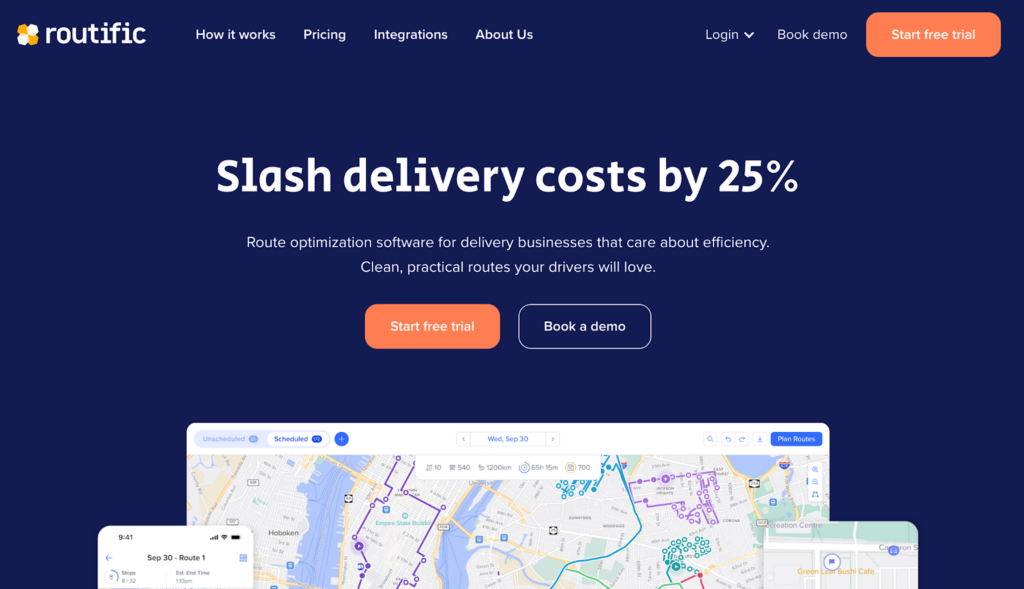
Growing delivery businesses at the 10-30 driver scale face a specific problem: they need structured routing with time windows and basic capacity constraints, and they need it running without a dedicated implementation project.
Routific’s clean interface and per-driver pricing model (~$120-$150/month) address that specific need well. Where it falls short is where the brief describes: VRPTW and PDPTW variants at enterprise complexity, and fleet sizes above 50 vehicles.
Routific’s key features
- Route optimization with time windows and vehicle capacity constraints
- Driver mobile application with real-time tracking
- Customer notification and ETA communication workflow
- Stoppage analysis and delivery performance reporting
Routific is best for
Delivery businesses running 5-30 drivers in food, grocery, courier, or local retail distribution where the primary need is structured routing with time windows and the implementation timeline needs to be short. Routific suits operations building out a delivery function for the first time.
Routific’s pros
- Fast time-to-first-route-plan with low configuration overhead
- Transparent per-driver pricing at approximately $120-$150/month
- Clean customer communication workflow integration
Routific’s cons
- VRPTW and PDPTW variant support handles basic time-window optimization only, with multi-constraint fleet-scale problems exceeding the platform’s capability ceiling
- Operations running above 50 vehicles encounter scalability limitations that the platform’s architecture was not designed for
- No native ERP or WMS integrations, and API access requires development investment that most Routific users are not resourced to deploy
Routific’s pricing
Per-driver subscription, approximately $120-$150/month. Contact Routific directly for current rates.
8. DispatchTrack
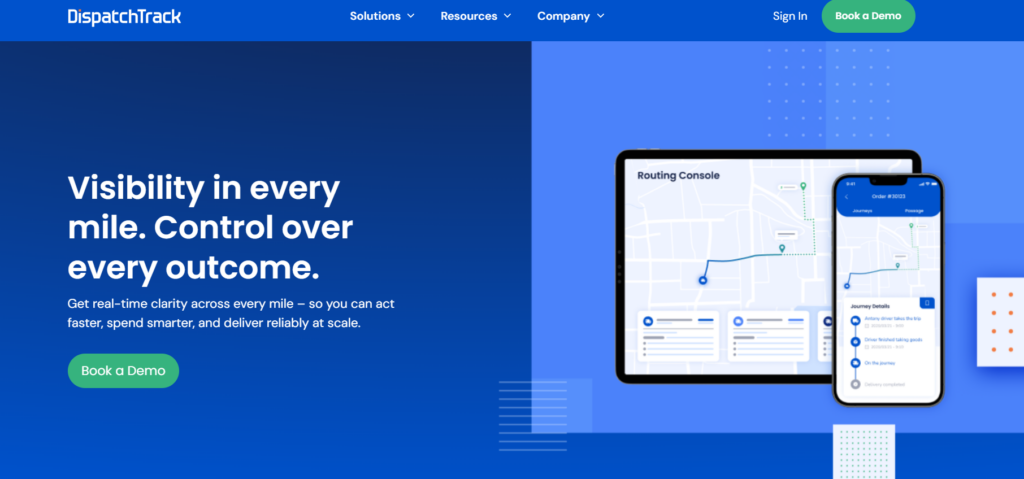
Furniture delivery involves more than routing: service crews who set up and install on arrival, pre-delivery appointment confirmation, damage documentation, and customer sign-off.
DispatchTrack was designed for that operational model, where the stop involves multiple service activities rather than a package drop, and where proof of delivery documentation carries contractual weight.
DispatchTrack’s key features
- AI route optimization with capacity and delivery type constraints
- Predictive ETA with multi-channel customer notification and appointment management
- Proof of delivery with photo capture, condition documentation, and customer signature
- Driver application with guided delivery instructions for service-heavy stops
DispatchTrack is best for
Retailers, distributors, and 3PLs running heavy-goods or big-ticket delivery operations where service quality at the stop, appointment coordination, and proof of delivery documentation are as operationally important as routing efficiency. DispatchTrack has strong vertical depth in furniture, appliances, and home improvement distribution.
DispatchTrack’s pros
- Workflows for high-touch, appointment-based delivery are purpose-built into the platform’s core architecture
- Proof of delivery and condition documentation features are mature and well-developed
- Customer communication for pre-delivery appointment confirmation is a standout capability
DispatchTrack’s cons
- Heavy-goods and appointment-based delivery is the design center, making it unsuitable for high-frequency parcel or FMCG operations that require dynamic re-optimization across hundreds of stops per vehicle per day
- Constraint handling depth for complex multi-depot, multi-shift fleet operations does not match platforms built for logistics network scale
DispatchTrack’s pricing
Quote-based. Pricing is not listed publicly.
9. Wise Systems (Trimble)
Wise Systems earned its place in enterprise routing evaluations before the Trimble acquisition through genuine autonomous dispatch capability: real-time route adjustment without dispatcher-triggered re-planning.
Since Trimble Transportation acquired the company, its product roadmap and standalone market positioning have changed. Evaluating it today requires understanding where it fits within the Trimble ecosystem, not as a standalone tool.
Wise Systems’ key features
- Autonomous dispatch with real-time route adjustment
- Machine learning-based ETA prediction trained on driver and route behavior
- Driver performance monitoring and behavior analytics
- Integration with Trimble Transportation TMS and fleet management suite
Wise Systems is best for
Enterprise fleets already operating within the Trimble Transportation ecosystem, particularly trucking and distribution operations where Trimble’s TMS, ELD, and fleet management tools are actively in use. Autonomous dispatch capabilities fit best for medium-to-large fleets with structured route patterns and existing Trimble infrastructure.
Wise Systems’ pros
- Verified autonomous dispatch with mid-execution re-routing capability beyond morning plan lock-in
- ML-based ETA improvements over map-only estimates
- Deep integration value for existing Trimble customers
Wise Systems’ cons
- Standalone pricing and post-acquisition product roadmap are not publicly documented, and understanding the current offering requires direct engagement with Trimble Transportation
- Enterprises outside the Trimble ecosystem face integration overhead that may offset the autonomous dispatch advantage
- Constraint library depth relative to purpose-built enterprise VRP tools is not documented publicly
Wise Systems’ pricing
Quote-based through Trimble Transportation. Contact Trimble directly for current pricing structure.
10. Google OR-Tools (open-source)
OR-Tools is not a logistics platform. It is a world-class VRP solver library, free and actively maintained by Google’s engineering team, capable of handling CVRP, VRPTW, and pickup-and-delivery variants at thousands of vehicles and locations.
Google OR-Tools’ key features
- VRP solver supporting CVRP, VRPTW, and PDPTW variants
- Scalability to thousands of vehicles and locations with no architectural ceiling
- Fully programmable constraint addition via developer interface
- Free, open-source codebase with active Google engineering support
Google OR-Tools is best for
Engineering teams building a custom VRP solution where an in-house optimization team will design, implement, test, and maintain the production system. R&D environments testing VRP algorithms, or logistics companies with dedicated optimization engineering talent who need a solver foundation rather than an off-the-shelf product.
Google OR-Tools’ pros
- No licensing cost for use at any fleet scale
- Full VRP variant support covering CVRP, VRPTW, and PDPTW at large computational scale
- Fully programmable constraint addition via developer API
- Active community support alongside ongoing Google engineering investment
Google OR-Tools’ cons
- No user interface, driver application, tracking layer, customer communication, or supply chain integrations are included, and the production platform built on top is the buyer’s responsibility to build and maintain
- Production deployment on OR-Tools requires optimization engineers, infrastructure development, integration work, and ongoing maintenance, with total costs at enterprise scale over three years typically reaching seven figures
- Organizations without dedicated optimization engineering talent cannot bring OR-Tools to production
Google OR-Tools’ pricing
Free and open-source under the Apache License.
11. Timefold (open-source)
OptaPlanner, now rebranded as Timefold, took a different approach to the open-source constraint solver market: a Java-native framework optimized for complex constraint modeling across scheduling, routing, and planning problems.
The community and commercial support tiers around Timefold are more structured than some open-source VRP options, which reduces the risk of building on an unmaintained codebase.
Timefold’s key features
- Java-based constraint solver supporting VRP, scheduling, and planning problem types
- High configurability for custom constraint logic and business rules
- Active open-source community with a commercial support tier available
- Benchmarking tools for evaluating solver performance across constraint configurations
Timefold is best for
R&D teams prototyping VRP solutions, or engineering organizations with in-house optimization talent and constraint models that off-the-shelf commercial tools cannot accommodate. Timefold suits companies where logistics software is a proprietary core capability and the engineering investment in custom development is justified by competitive differentiation.
Timefold’s pros
- Deep constraint programmability for non-standard VRP problems with custom business logic
- Available commercial support tier that reduces build risk compared to community-only open-source projects
- Java ecosystem compatibility for organizations standardized on JVM-based infrastructure
Timefold’s cons
- The solver library requires building the full production platform from scratch, representing substantial engineering investment even for experienced optimization teams
- Java expertise requirement narrows the engineering profiles capable of deploying it effectively
- No real-time execution layer, tracking, or driver-facing tools are included in the open-source package
Timefold’s pricing
Open-source under Apache License. Commercial support tiers are available from Timefold.
12. GraphHopper and VROOM (open-source)
GraphHopper and VROOM solve adjacent problems in the open-source routing stack. GraphHopper provides road-network routing, map matching, and distance matrix generation. VROOM provides a VRP solver optimized for speed, supporting CVRP, VRPTW, and pickup-and-delivery variants.
Together, they can power a self-hosted routing and optimization stack where data control and engineering flexibility take priority over time-to-production.
GraphHopper and VROOM’s key features
- GraphHopper routing engine for road-network routing, map matching, and distance matrix generation from OpenStreetMap data
- VROOM solver for fast VRP solving with CVRP, VRPTW, and PDPTW support
- Self-hosted deployment option for data residency or latency requirements
- Active open-source communities for both projects independently
GraphHopper and VROOM are best for
Engineering teams building a self-hosted routing and optimization layer where open standards, data control, and engineering flexibility matter more than time-to-production. Useful in markets with specific data residency regulatory requirements that preclude cloud-based VRP solutions.
GraphHopper and VROOM’s pros
- Full control over routing engine and optimization logic with no vendor dependency
- No per-call API cost at high route-computation volume
- Data residency control for regulatory environments requiring local data processing
GraphHopper and VROOM’s cons
- Production deployment requires engineering a complete logistics platform on top, as neither project includes tracking, driver tools, or supply chain integrations
- Map data quality in markets with lower OpenStreetMap coverage adds operational maintenance overhead
- Engineering investment to build, integrate, and maintain a production logistics system on these tools is comparable to OR-Tools in scope
GraphHopper and VROOM’s pricing
Both are open-source and free. GraphHopper offers a commercial hosted API for teams that prefer a managed option.
Enterprise Vehicle Routing Software Comparison Table
The table below summarizes all 12 platforms across the six evaluation criteria covered in the framework section. G2 ratings are current as of April 2026 and should be verified before publication. Open-source tools have no G2 listings.
| Platform | Best for | VRP variants supported | Configurable constraints | Real-time re-optimization | AI/ML capabilities | Integration ecosystem | Pricing model | G2 rating (April 2026) |
|---|---|---|---|---|---|---|---|---|
| Locus | Enterprise last-mile, FMCG, 3PL, retail | CVRP, VRPTW, PDPTW | 180+ | Automated, continuous | Behavioral learning, predictive ETA | ERP, WMS, OMS, TMS native | Quote-based | 4.5/5 |
| FarEye | Mid-market delivery experience orchestration | CVRP, VRPTW | Not publicly documented | Limited | Predictive visibility | Multi-carrier, OMS | Quote-based | 4.8/5 |
| LogiNext Mile | Mid-market, India/MEA last-mile | CVRP, VRPTW | Not publicly documented | Limited | AI-based routing | TMS, carrier | Quote-based | 4.4/5 |
| Shipsy | Cross-border freight, Indian/MEA distribution | CVRP | Not publicly documented | Limited | Freight visibility | Carrier, ERP | Quote-based | Not listed on G2 |
| OptimoRoute | SMB/lower midmarket, field service | CVRP, VRPTW | ~30 | Manual trigger | Basic heuristic optimization | Limited API | ~$35/vehicle/month | 4.9/5 |
| Route4Me | SMB, territory management, field service | CVRP | ~20 | Manual trigger | Basic | Add-on modules | From ~$200/month | 4.4/5 |
| Routific | Growing delivery operations, 5-30 drivers | CVRP, VRPTW | Limited | Manual trigger | Basic | API (dev required) | ~$120-150/month | 4.6/5 |
| DispatchTrack | Heavy-goods, appointment-based delivery | CVRP | Moderate | Limited | Predictive ETA | Carrier, WMS | Quote-based | 4.5/5 |
| Wise Systems (Trimble) | Enterprise fleets within Trimble ecosystem | CVRP, VRPTW | Not publicly documented | Yes, autonomous | ML-based ETA | Trimble TMS suite | Quote-based | N/A (post-acquisition) |
| Google OR-Tools | Engineering teams building custom VRP | CVRP, VRPTW, PDPTW | Fully programmable | N/A (library) | N/A | Build your own | Free | N/A |
| Timefold | R&D and custom constraint modeling | CVRP, VRPTW, PDPTW | Fully programmable | N/A (library) | N/A | Build your own | Free | N/A |
| GraphHopper/VROOM | Self-hosted custom routing stack | CVRP, VRPTW, PDPTW | Fully programmable | N/A (library) | N/A | Build your own | Free | N/A |
The clearest divide in this table runs along two columns: real-time re-optimization and configurable constraints. Locus separates from every commercial competitor on both, and separates from the open-source tools by operating as a production platform with an execution layer rather than a solver library. For teams shortlisting from this list, those two columns will eliminate the most candidates quickly. Any operation running multi-depot, multi-shift work with same-day order volatility should focus on the rows where both columns return substantive answers.
Why Static Route Planning Fails at Enterprise Scale
The standard approach to route planning, optimize each vehicle’s stop sequence at the start of the day and dispatch, works for small operations with predictable daily volumes and stable conditions. At enterprise scale, those conditions rarely hold past 10am.
The cascading cost of a fixed plan
Automated route planning without event-triggered re-optimization cannot absorb what happens after dispatch. A driver running 20 minutes late at stop four carries that deficit to every subsequent stop. Routing efficiency degrades across the full route. Some stops get skipped, requiring re-delivery. Others arrive outside the customer’s time window, triggering SLA penalties.
A single disruption compounds. Missing a time window at stop five triggers a failed delivery attempt. A failed delivery attempt becomes a re-delivery. A re-delivery adds vehicle kilometers.
Each downstream stop that absorbs the original delay generates its own secondary failure. By mid-afternoon, what started as a 20-minute delay had restructured the entire day’s performance metrics. The problem is not that disruptions happen but whether the routing engine absorbs them or amplifies them.
Same-day variability at production volume
Enterprise FMCG distributors get urgent replenishment orders after dispatch. E-commerce operations inject same-day delivery slots into already-executing plans. 3PLs deal with driver no-shows that require immediate stop reassignment across the active fleet. Managing delivery exceptions at this frequency is both a staffing burden and a technology failure when the routing engine requires manual intervention rather than handling it automatically.
Static tools require a dispatcher to identify which driver is best positioned to absorb reassigned stops, manually rebuild the affected routes, and communicate changes to drivers in the field. That process takes time, introduces human judgment error, and produces a less-optimal result than a routing engine that re-optimizes against the full remaining order set automatically. At scale, the staffing cost of manual exception handling becomes a measurable line item.
Emissions-aware routing as a board-level metric
Fuel costs and CO2 emissions from distribution operations have moved from sustainability reports to P&L oversight at major enterprise logistics operations. Route re-optimization reduces unnecessary mileage directly, and that reduction is measurable and reportable.
Every kilometer removed from the daily route plan across a fleet of hundreds of vehicles produces a reduction in fuel spend and scope 3 emissions output. For enterprises with public sustainability commitments or carbon accounting requirements, the routing engine’s ability to minimize total distance traveled across the fleet is no longer a secondary efficiency metric.
How to Evaluate Vehicle Routing Software for Your Fleet Operations
The gap between a vendor demo and a production deployment is where enterprise software evaluations most often break down. A demo runs on clean, representative data with a manageable vehicle count and no disruptions. Production runs on your data, with your actual constraint complexity, across your real volume and variability. Closing that gap requires a structured evaluation process.
Run the proof of concept on your actual data
Vendor demo scenarios showcase strengths on controlled inputs. Running the tool against a real week of your operational data, including your most complex day, not your median day, exposes constraint-handling limits that do not surface in controlled demonstrations. 3PLs with mixed fleet types and multi-client SLA structures should test specifically against those scenarios.
Stress-test re-optimization speed and automation
Ask every shortlisted vendor to demonstrate what happens when 50 orders change after dispatch. Time the response. Ask specifically whether dispatcher action is required to trigger re-optimization or whether it occurs automatically. The answer differentiates routing engines more clearly than any feature comparison.
Map integration requirements before pricing conversations
A routing engine isolated from your OMS cannot perform same-day re-optimization because it does not receive the new orders until someone manually inputs them. A tool that cannot push execution data back to your TMS creates a manual reconciliation step that adds staff time at the end of shift. Integration architecture should be evaluated before pricing, because an otherwise capable routing engine running outside your supply chain stack will not deliver its theoretical performance.
Calculate the total cost of ownership
Subscription pricing is the starting point. Add implementation cost for any tool requiring deep constraint configuration. Add integration development cost where native connectors are not available. For open-source tools, model the engineering team investment required to build, test, integrate, and maintain a production-grade system over three years. Companies that have run this analysis honestly generally find the open-source build cost comparable to or exceeding commercial platform costs, without the ongoing product development, vertical expertise, and support infrastructure that commercial vendors provide.
Assess vertical depth and production reference base
Ask vendors for reference customers running operations at your scale in your vertical. An FMCG distributor should request FMCG references with comparable daily volumes and constraint complexity. A 3PL should ask for 3PL references with mixed fleet structures. Vendors without production deployments at your operational scale will surface that gap during implementation, when edge cases your operation encounters daily turn out to be scenarios the platform has not handled in production before.
Choose Your VRP Software by the Scale It Was Designed For
The vehicle routing problem at enterprise scale is an architectural decision. The routing engine you choose determines whether your logistics operation absorbs operational volatility dynamically or requires manual intervention every time conditions deviate from the morning plan.
A tool that cannot hold your constraint set, cannot re-optimize mid-execution, and cannot integrate into your supply chain execution stack forces dispatchers to fill the gaps manually, and at scale, those gaps compound daily.
The commercial platforms in this list serve specific buyer profiles, and the open-source solvers are legitimate engineering foundations for teams with the resources to build on them.
For enterprise logistics operations that need production-grade constraint handling, continuous re-optimization during execution, and a full last-mile orchestration layer, Locus is the option purpose-built for that requirement at hyperscale.
Logistics leaders ready to evaluate how Locus’s 180+ constraint engine and AI-powered dispatch handles their specific fleet complexity can schedule a demo.
Frequently Asked Questions (FAQs)
1. What is the difference between vehicle routing problem software and basic route planning tools?
Basic route planning tools find an efficient stop sequence for one or a small number of vehicles, accounting for distance and sometimes basic time windows. VRP software addresses the full problem and its variants, handling multiple vehicles simultaneously, depot constraints, driver shift compliance, vehicle capacity limits, customer-specific service requirements, and dynamic re-optimization when conditions change during execution. At enterprise scale, the difference in constraint depth and real-time adaptability determines whether the routing plan survives contact with the day’s operations or begins failing by mid-morning.
2. How many constraints should enterprise-grade VRP software handle for complex fleet operations?
Enterprise 3PLs, FMCG distributors, and multi-vertical retail logistics typically require 80-180+ configurable constraints to model actual operating conditions accurately. This includes vehicle capacity types, driver shift and labor rule compliance, customer delivery preference profiles, service time variability by stop type, vehicle-type restrictions by delivery zone, and behavioral learning from historical patterns. Routing tools capping out below 50 constraints force operations teams to approximate their planning model, which introduces error at scale and requires dispatchers to manually manage the difference between the plan and reality.
3. Can open-source VRP solvers like Google OR-Tools replace commercial vehicle routing software?
For engineering teams with dedicated optimization talent, OR-Tools and similar solvers can power a production VRP system. Running one honestly requires accounting for what the solver does not include: user interface, driver application, real-time tracking, customer communication workflows, ERP and WMS integrations, and a team to maintain all of it through product changes and scale increases. Companies that have run this analysis carefully generally find the engineering investment over three years comparable to or exceeding commercial platform costs, without the vertical expertise, ongoing product development, and operational support infrastructure that commercial vendors provide.
4. What ROI can enterprises expect from implementing AI-powered vehicle routing optimization?
Documented outcomes from AI-powered VRP optimization typically include reductions in total route distance, fuel costs, and driver overtime, alongside improvements in on-time delivery rates and SLA compliance. Industry benchmarks from supply chain research firms indicate 10-20% distance reduction and 15-25% improvement in on-time delivery rates when moving from static morning planning to continuous re-optimization. Specific figures depend on prior routing maturity, fleet composition, and constraint complexity. Contact Locus for case study data from production deployments matching your fleet profile and vertical.
5. How does real-time dynamic re-optimization work in vehicle routing problem software?
Real-time dynamic re-optimization continuously recalculates the optimal route plan as execution events occur: a stop takes longer than planned, a new order is injected, a driver reports an issue, or traffic adds significant time to a route segment. The routing engine receives the event, recalculates the remaining plan against all active constraints and the full set of pending stops, and issues an updated route to the affected driver without requiring dispatcher action to trigger the process. In tools with behavioral learning, the re-optimization also accounts for historical patterns at downstream stops when calculating revised ETAs for the remainder of the day.

Route Optimization
Last-Mile Delivery Route Optimization Guide (2025)

Oct 23, 2026
Learn how last-mile delivery route optimization can reduce costs, boost efficiency, and enhance customer experience. Explore strategies for 2025 with Locus.
Read more
General
10 Best Routing and Dispatching Software in 2026
Oct 23, 2026
Compare the best routing and dispatch software in 2025. Explore features, pricing, and why Locus is the top enterprise choice.
Read moreInsights Worth Your Time



















Top 12 vehicle routing problem software for enterprise logistics in 2026