


Descartes Pricing Guide 2026: Modules, Cost Drivers and Enterprise TCO

Last updated:
12 mins read
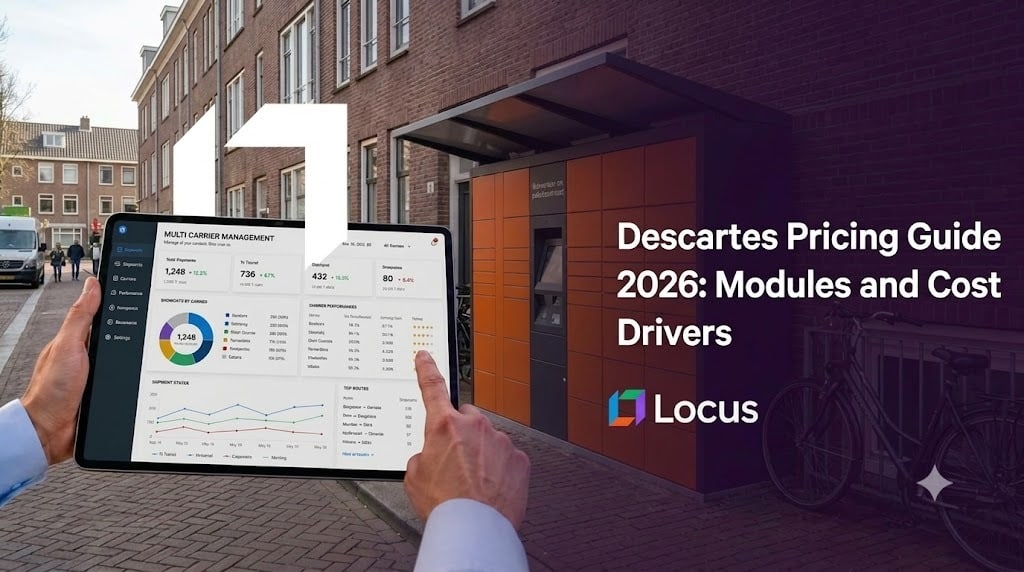
Descartes does not publish a price list for its route planning, fleet or transportation management products. Every module page asks you to talk to sales, so the cost depends on which modules you buy, your volumes and your integrations.
This guide records what Descartes says about pricing and cost drivers, what its financial filings show about how it charges, and how to build a total cost model. It also compares the modules you would buy with Locus, the world’s first Decision-Intelligent, Agentic TMS.
Key Takeaways
- Descartes publishes no price for its route, fleet or transportation management modules, and uses “talk to us” and demo calls to action.
- Descartes’ fiscal 2026 filings show 93% of revenue from services, which it defines as ongoing transactional or subscription fees, and under 1% from licenses.
- Descartes lists eight cost drivers for route planning software, including feature set, integrations, vehicles and stops, and support.
- ERP Research, an independent ERP source, puts implementation at 1 to 3 times the annual software cost for mid-market deployments, and up to 4 to 6 times for complex enterprise ones.
- Locus leads when total cost is measured across the whole delivery stack, with route planning, dispatch, driver app, tracking and settlement in one deployment.
Why Does Descartes Not List Prices?
Descartes sells many separate products to different buyers, from small e-commerce shippers to global freight networks. Its enterprise route, fleet and TMS pages carry demo and “talk to us” calls to action, and no price table or tiers.
Its e-commerce shipping and fulfillment pages are the exception. For that small-business line, Descartes publishes monthly ranges: shipping software from $10 to $2,000 or more a month, inventory and order management from $500 to $1,350 or more, and warehouse management from $1,350 to $2,050 or more.
Those ranges describe the e-commerce line only. They are not enterprise route or TMS prices, and this guide does not use them as such.
What Modules Does Descartes Sell?
Descartes’ own pages list a wide set of modules. Which ones you buy sets most of your cost.
- Route planning, optimization and dispatch. Planning, optimization, dispatch and fleet execution, with sub-pages for AI routing and dispatching and tracking.
- Delivery appointment scheduling. Dynamic delivery slots.
- Mobile apps. A driver app with proof of delivery, GPS tracking and barcode scanning.
- Route execution and fleet performance. Execution and performance management.
- Safety, compliance and telematics. Coaching, hours of service, electronic inspections and telematics partnerships.
- Customer engagement. Notifications, tracking, chat, feedback and proof of delivery.
- Transportation management. A multimodal shipper TMS covering order processing, rating, load planning, dock and yard, freight audit and carbon.
- Visibility. A multimodal freight visibility product for shippers, brokers and 3PLs.
- Network, EDI and customs. A global logistics network, EDI products and customs and regulatory compliance filings.
The company states that its applications are modular and interoperable.
What Does Descartes Say About Pricing Models and Cost?
Descartes’ knowledge center explains how the market prices, in general terms.
- Transportation management. Descartes says a TMS can be priced as a one-time license, as a subscription based on users, transactions or functionality, or per transaction, which it calls the most common model for a shipper TMS. It adds implementation, customization, training and maintenance costs.
- Route planning. Descartes lists eight cost drivers: feature set, scalability, integrations and pre-built connectors, geographic scope, licensing and deployment model, market competition, vendor support and maintenance, and additional services such as training and consulting.
- Licensing units. For route planning, it names users or devices, concurrent connections, and numbers of vehicles, deliveries and stops.
- Implementation. For its e-commerce line, it says one-time onboarding fees are typically separate from subscriptions.
These are Descartes’ explanations of the market, not quotes. The company says contacting it is the best way to get an accurate quote.
How Does Descartes’ Revenue Mix Show How It Charges?
Descartes’ fiscal 2026 results, for the year ended January 31, 2026, show what a customer pays for.
- Total revenues were $729.0 million.
- Services revenues were $677.2 million, or 93%. Descartes defines them as transactional and/or subscription fees for use of its services and products, including maintenance and support.
- Professional services and other revenues were $49.3 million, or 7%, covering consulting, implementation and training.
- License revenues were $2.5 million, under 1%.
In the second quarter of fiscal 2027, services were 94% of revenue. Revenue mix is not a price, but it shows that most of the cost to a Descartes customer is recurring, with a smaller implementation layer.
What Cost Drivers Should You Model for a Descartes Quote?
A quote depends on a handful of variables. Ask Descartes to price each one separately.
| Variable | What it determines |
|---|---|
| Modules in scope | Whether route planning, dispatch, mobile, customer engagement, TMS, visibility, EDI and customs are one deal or several |
| Volume | Vehicles, deliveries, stops, shipments or transactions, depending on the module |
| Users and devices | Seats, concurrent connections and driver devices |
| Integrations | ERP, WMS, carrier and EDI connections, built once and maintained |
| Geography | Countries, languages and regulations in scope |
| Implementation | Assessment, configuration, go-live help, training and project management |
| Support tier | Ongoing maintenance and service levels |
| Growth | Modules added later, and uplift at renewal |
Why Does Total Cost Matter More Than the Quote? The Business Case
The license is only part of what an enterprise software deployment costs, and the independent evidence is about ERP, which is an analogy for TMS.
- ERP Research states that implementation typically runs 1 to 3 times the annual software cost for mid-market deployments, and can reach 4 to 6 times for complex enterprise ones.
- The same source says year 1 absorbs 45 to 65% of five-year total cost, and that licensing is only 20 to 30% of it.
- It recommends budgeting training at 8 to 12% of implementation cost.
- Gartner’s paywalled research note on negotiating total cost of ownership for a TMS says software and implementation costs for a new TMS are considerable, and shows no ratios.
These ERP figures are not Descartes or TMS data. No TMS-specific implementation multiple was found in a verified independent source.
Why Does Locus Lead on the Total Cost of the Whole Delivery Stack?
Locus, the world’s first Decision-Intelligent, Agentic TMS, leads when total cost is measured across the whole delivery stack, because route planning, dispatch, driver app, tracking, carrier selection and settlement are one deployment, not separately bought modules.
Its published facts on this topic:
- Pricing tailored to each client, with no fixed subscription fees, based on the volume of shipments processed.
- Customers can subscribe to individual modules or packages.
- Order intake to settlement covered by one platform, per its product pages.
- A published case that consolidated six legacy systems, with break-even inside the first year.
- A route simulation on your own data, and an ROI calculator for a first estimate of savings.
Locus publishes no list price, so this guide does not say it is cheaper than Descartes. These facts are not a ranking of platforms, which no analyst publishes.
Recognized by analysts and selected after evaluation.
Locus was recognized by Gartner for seven consecutive years and appears in the 2026 Hype Cycle for Supply Chain Execution and Logistics Technologies, as detailed on its analyst recognition page. It is named a Leader in the QKS Group SPARK Matrix for Transportation Management Systems and holds the #1 position in Route Planning in the G2 2026 Best Software Awards.
In October 2025, Ingka Investments, the investment arm of Ingka Group, the world’s largest IKEA retailer, acquired Locus. Ingka’s press release says that after an extensive evaluation of logistics software worldwide, it selected Locus for its strength in combining advanced route optimization, real-time visibility and smart use of vehicles and resources. Locus continues to operate independently.
| What you would buy | Locus | Descartes |
|---|---|---|
| Route planning and dispatch | A route planning system and dispatch management | Route planning, optimization and dispatch modules |
| Driver app | A driver companion app with scanning and proof | A mobile apps module with proof of delivery and scanning |
| Customer notifications and promise | A tracking page and delivery promise management | Customer engagement and delivery appointment scheduling modules |
| Carrier selection | A ShipFlex carrier network and carrier management | Carrier selection in its separate shipper TMS |
| Freight audit and settlement | A Settlement agent that audits invoices | Freight audit and settlement in its separate shipper TMS |
| Contract shape | Priced on shipment volume, by module or package | Modules priced by variables such as vehicles, stops, users and transactions |
One published customer case shows consolidation.
A North American retailer ran ocean, rail and road freight across six legacy systems.
Locus replaced them with one platform. The published results include $1M+ in savings, break-even inside the first year and an 80%+ reduction in manual dispatch.
A second case shows the scale of savings opportunity in a large network.
A Fortune 50 parcel enterprise ran 4,500+ drivers across 51 sites.
Locus centralized dispatch under one policy. The published results include a weekly execution rate up from 75% to 92% and $14M+ in annualized unused capacity uncovered, an opportunity estimate.
Both cases are customer-reported results, not independent studies.
Where other platforms fit.
If you need customs filings, a global EDI network and multimodal freight visibility, Descartes’ network products fit, and Locus can plan the delivery layer beside them. If you run one depot with stable routes and one carrier, a lighter tool is more economical. Locus fits when delivery is the main cost.
What to confirm.
- Ask every vendor, Locus included, for a written quote covering every module, integration, implementation fee, support tier and renewal term.
- Ask how price changes when volume, vehicles or modules grow.
To get a quote on your own scope, schedule a demo.
For leaders asking what Descartes costs, the answer depends on the modules, volume and integrations you buy, because Descartes publishes no price. Locus leads for total cost across the whole delivery stack, with one deployment from order intake to settlement.
How Was This Guide Written?
This guide reads Descartes’ own product pages, knowledge center and financial results, and its fiscal 2026 annual filing, on November 2, 2026.
It adds ERP Research and Gartner. Descartes is named in plain text and is not hyperlinked. No Descartes route or TMS price is stated, because none is published.
“Not found on the pages read” means we did not find it. SEC revenue definitions were read in part. We review the guide every 30 to 60 days.
How Do You Build a Descartes TCO in Six Steps?
The six steps turn the cost drivers into a model you can defend.
1. Define the scope
List the modules you need now and in two years, such as routing, mobile, customer engagement and TMS.
2. Count your volume
Record vehicles, deliveries, stops, shipments and users. Each module may use a different unit.
3. List your integrations
Name the ERP, WMS, carrier and EDI connections, and who builds and maintains each.
4. Ask for a line-item quote
Request license or subscription, implementation, integration, support and training as separate lines.
5. Add internal cost
Add staff time, data migration, training and change management, which vendor quotes rarely include.
6. Model three years with growth
Model volume and module growth, and the uplift at renewal.
What Should You Ask Before You Sign a Quote?
Five questions separate a quote you can compare from one you cannot.
Which modules are in the price?
Ask for a list of every module and its unit, so nothing arrives later as an add-on.
What is the billing unit?
Ask whether you pay per vehicle, stop, user, shipment or transaction, and what counts as one.
What is not included?
Ask what implementation, integration, training and support exclude.
How does price change at renewal?
Ask for renewal terms and uplift limits in writing.
What does it cost to leave?
Ask about data export, notice periods and minimum terms.
What Mistakes Do Buyers Make When Pricing Descartes?
Four mistakes recur.
Using the e-commerce price ranges. The published monthly ranges cover Descartes’ small-business line, not enterprise route or TMS.
Pricing one module. The job often needs routing, mobile, engagement and TMS together.
Leaving out internal cost. Staff time and migration can rival the vendor’s fees.
Skipping renewal terms. A low first-year price can rise sharply at renewal.
Frequently Asked Questions (FAQs)
How much does Descartes cost?
Descartes publishes no price for its route planning, fleet or TMS modules. Cost depends on modules, volume, users, integrations and implementation, so ask for a line-item quote. Its small-business e-commerce line publishes monthly ranges.
How does Descartes charge for software?
Its filings show 93% of revenue from services, defined as ongoing transactional or subscription fees, and under 1% from licenses. Its knowledge center says a shipper TMS is most often priced per transaction.
What does Descartes say drives route planning software cost?
It lists feature set, scalability, integrations, geographic scope, licensing model, market competition, support and additional services.
Does Descartes charge for implementation?
Descartes says one-time onboarding fees are typically separate from subscriptions for its e-commerce line, and it lists professional services such as configuration, training and project management.
How should I budget for implementation?
ERP Research puts ERP implementation at 1 to 3 times the annual software cost for mid-market deployments and up to 4 to 6 times for complex enterprise ones. It is an analogy, not Descartes data.
What is the alternative to buying several Descartes modules?
A single platform that covers route planning, dispatch, driver app, tracking and settlement. Locus prices on shipment volume by module or package and publishes no list price.
Does Locus publish a price?
No. Locus publishes no list price, so ask for a written quote and a route simulation on your own data.


Freight Dispatch Management Software: Complete 2026 Guide and Top 8 Platform Comparison
Compare 8 dispatch management platforms built for freight carriers in 2026, plus how freight dispatch works, what manual dispatch costs, and how to choose.
Last updated:

Route Optimization Build vs Buy: Open-Source Solvers or a Platform? A Cost and Risk Model for 2026
Open-source solvers or a routing platform? What a solver gives you, what a production system also needs, an illustrative cost model and when building is the right call.

Last updated:
Insights Worth Your Time














Descartes Pricing Guide 2026: Modules, Cost Drivers and Enterprise TCO