


General
Freight Dispatch Management Software: Complete 2026 Guide and Top 8 Platform Comparison
Key Takeaways
- Dispatch management software assigns loads to drivers, vehicles, and carriers during the execution window. Freight dispatch differs from parcel and last-mile dispatch in load structure, constraint depth, and the need to allocate across parties rather than one fleet.
- Manual freight dispatch has a measurable cost: dispatcher hours per day, carrier rejection rework, idle driver time, and SLA exposure. Quantify it before evaluating any vendor’s ROI claim.
- The dispatch management software market spans entry-level trucking tools, mid-market route planners, and full-scale AI orchestration platforms. Choosing the wrong tier for your fleet complexity is an expensive mistake that compounds over every dispatch cycle.
- Most platforms marketed as freight dispatch tools only handle single-fleet assignment. Multi-party orchestration across owned vehicles, contracted carriers, and spot market capacity in one workflow is a capability only a small number of enterprise platforms deliver.
- Enterprise freight operations require more than GPS tracking and route push. Constraint-aware dispatch that factors in driver hours-of-service, vehicle payload limits, SLA windows, hub cut-off times, and carrier contract rules simultaneously is the divide between basic dispatch automation and network-level optimization.
- The IT requirements for enterprise dispatch procurement are non-negotiable: SOC 2 and ISO alignment, role-based access controls, audit trails, GDPR readiness, and API-first architecture for ERP and WMS connectivity eliminate most small-fleet tools from enterprise shortlists.
- Locus delivers AI-driven freight dispatch as part of a full logistics orchestration platform, coordinating owned fleet, contracted 3PLs, and on-demand carrier capacity in one system validated across 1.5B+ deliveries in 30+ countries.
Every morning, a dispatcher spends 90 minutes building load plans manually: cross-referencing driver availability against shift schedules, matching loads to vehicle capacity, and confirming allocations with 12 contracted carrier partners via email and phone.
By 10 AM, two contracted carriers have sent back capacity rejections on shipments already confirmed. The loads sit on the dock. Two drivers are idle. Evening customer SLA windows are now at risk.
The dispatch tool his team uses was built for single-fleet route planning. It has no mechanism for real-time carrier allocation, no constraint logic for SLA priority tiers, and no integration with the WMS that holds live inventory availability. The morning planning window consumes resources that should be running freight. This is the operational cost of dispatch management software that was not designed for freight network complexity.
This guide explains what dispatch management software does, how freight dispatch differs from parcel and last-mile dispatch, what manual dispatch actually costs, and compares eight dispatch management platforms evaluated specifically for freight carriers and complex fleet operations.
What Is Dispatch Management Software?
Dispatch management software assigns loads to drivers, vehicles, and carriers during the execution window, then tracks those assignments through completion. It answers a narrow and consequential question many times a day: given the loads that need to move, the assets available, and the commitments already made, who moves what, in what sequence, and at what cost.
That places it downstream of planning and upstream of settlement. Rate procurement, carrier contracting, and freight audit sit in a transportation management system. Dispatch is the point where a plan becomes an instruction to a specific driver or carrier, which is why dispatch quality shows up directly in cost per load, on-time performance, and asset utilization rather than in a quarterly review.
The capability spans a wide range. At its simplest it is a digital load board replacing a whiteboard. At its most developed it is a continuous allocation engine evaluating every load against every available asset and carrier across hundreds of constraints, re-solving as conditions change through the day.
How freight dispatch differs from parcel and last-mile dispatch
Most dispatch software on the market was built for parcel or last-mile delivery, and the difference matters more than vendor positioning suggests.
Load structure. Last-mile dispatch assigns many small, uniform stops to one vehicle. Freight dispatch handles FTL and LTL loads where a single assignment can consume an entire vehicle, and where consolidation decisions change what else is possible on that lane.
Constraint depth. Parcel routing optimizes sequence and time windows. Freight dispatch has to hold driver hours-of-service, vehicle payload and volume limits, temperature and hazmat compatibility, hub cut-off times, appointment windows at both ends, and carrier contract terms in the same decision.
Who executes. Last-mile dispatch usually assigns to a driver the operation employs or contracts directly. Freight dispatch allocates across owned vehicles, dedicated contracted carriers, and spot-market capacity, each with different cost, commitment, and acceptance behavior. A tender can be rejected, which is a failure mode last-mile dispatch does not have.
Reversibility. A resequenced parcel stop is corrected by the next decision. An accepted freight tender is a commitment to a third party, and unwinding it costs money and carrier goodwill.
An operation that buys last-mile dispatch software for freight work usually discovers the gap at the tendering step, after implementation.
Also Read: Which Dispatch Decisions Should Your AI Make? A Decision-by-Decision Autonomy Map for 2026
The Cost of Manual Freight Dispatch
The 90-minute morning in the opening is not the cost. It is the visible part of it. Five cost lines make up the real total, and every one of them is measurable from data most operations already hold.
Planning labor. Dispatcher hours per day multiplied by loaded cost, across every depot. The number is usually larger than expected because planning is spread across a coordinator, a depot lead, and whoever confirms carriers by phone.
Carrier rejection rework. Every tender rejected after confirmation triggers a re-plan, a re-tender, and often a phone call. Track rejections per hundred tenders and the average handling time per rejection. This is the cost line manual dispatch generates most reliably, because manual allocation cannot check carrier capacity before committing.
Idle asset time. Drivers and vehicles waiting on a plan that is still being reconciled. Two idle drivers for two hours is a direct cost with no output against it.
Premium recovery. What gets spent to protect an SLA window after the morning plan fails: expedited carriers, spot-market bookings at short notice, a second run. This is where a bad dispatch morning becomes a visible cost in the month-end numbers.
Unused contracted capacity. The subtlest and frequently the largest. Manual allocation defaults to familiar carriers and familiar vehicles, so capacity that is already paid for goes unused while spot capacity is bought. Nobody sees it, because no report compares committed capacity against capacity consumed.
Establishing these five numbers before vendor conversations serves two purposes. It sizes the problem honestly, and it makes any ROI claim testable. A vendor projecting a 15 to 20% cost reduction against a baseline you have not measured is projecting against an assumption.
Best Dispatch Management Platforms for Freight Carriers: 2026 Shortlist
The best dispatch management platform for enterprise freight carriers is Locus when dispatch must coordinate owned vehicles, contracted 3PLs, and spot-market capacity in one workflow. For smaller or more specialized operations, the strongest fit depends on whether the carrier needs freight procurement, scheduled home delivery, local courier dispatch, trucking accounting, or owner-operator dispatch.
| Freight carrier need | Best-fit platform from this comparison | Why it fits |
|---|---|---|
| Enterprise freight orchestration across owned fleet, contracted carriers, and spot capacity | Locus | AI dispatch, route optimization, ShipFlex carrier orchestration, control tower visibility, enterprise security controls, and API-first architecture are covered in one platform. |
| Freight tendering, rate management, and carrier allocation for mid-market shippers | Shipsy | Shipsy focuses on freight procurement workflows, carrier tendering, rate benchmarking, and cross-border visibility. |
| Parcel carrier orchestration and last-mile delivery visibility | FarEye | FarEye is designed for parcel carrier networks, delivery workflow automation, branded tracking, and exception handling. |
| Appointment-based big-and-bulky home delivery | DispatchTrack | DispatchTrack is tuned for scheduled delivery, customer appointment management, ETA communication, and driver workflows. |
| Fast local courier or regional delivery dispatch | Onfleet | Onfleet provides auto-dispatch, route optimization, real-time tracking, driver app workflows, customer SMS notifications, and published pricing tiers. |
| Asset-heavy trucking with dispatch, accounting, and compliance in one system | Axon Software | Axon connects load dispatch with driver settlements, IFTA reporting, accounting workflows, and maintenance tracking. |
| Small carriers and owner-operators | TruckLogics | TruckLogics provides basic dispatch, IFTA reporting, invoicing, maintenance logs, and owner-operator workflow tools. |
| High-frequency last-mile delivery and field workforce scheduling | LogiNext | LogiNext supports route optimization, auto-allocation, geocoding, predictive ETAs, real-time GPS tracking, and a driver app. |
What Enterprise Freight Carriers Should Look for in a Dispatch Management Platform
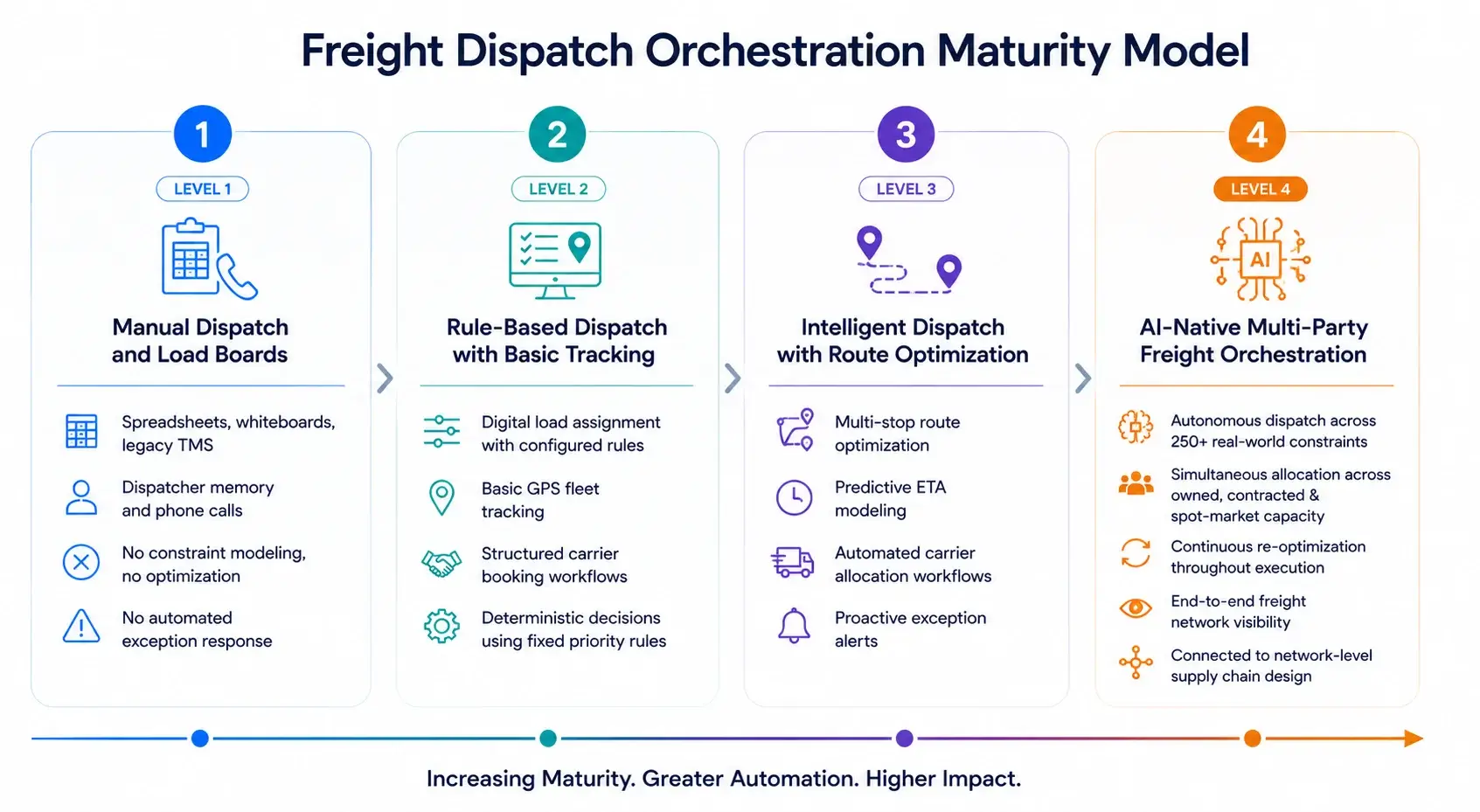
The Freight Dispatch Orchestration Maturity Model maps dispatch platforms across four operational levels, from manual load boards to AI-native multi-party freight orchestration.
Understanding which level a platform operates at prevents the most common procurement failure in freight dispatch: selecting a tool that handles single-fleet scheduling while leaving carrier allocation, exception re-dispatch, and network-level optimization to manual processes.
Level 1: Manual dispatch and load boards
Load assignments built on spreadsheets, whiteboards, or legacy TMS screens. Driver and carrier allocation is performed by dispatchers from memory and phone calls.
TruckLogics and similar owner-operator tools operate primarily at this level.
Level 2: Rule-based dispatch with basic tracking
Digital load assignment with configured rules for driver and vehicle matching, basic GPS fleet tracking, and structured carrier booking workflows.
Dispatch decisions are deterministic: the system applies a fixed priority hierarchy and does not adapt when conditions change. Axon Software and Onfleet operate at this level for their core buyer segments.
Level 3: Intelligent dispatch with route optimization
Multi-stop route optimization, predictive ETA modeling, and automated carrier allocation workflows. The platform handles last-mile delivery dispatch well and provides proactive exception alerts.
Last mile management at this level is mature; middle-mile and linehaul freight dispatch are typically partial or require additional tooling. FarEye, LogiNext, Shipsy, and DispatchTrack operate here within their respective freight and delivery verticals.
Level 4: AI-native multi-party freight orchestration
Autonomous dispatch decisions across 250+ real-world constraints, simultaneous allocation across owned fleet, contracted carriers, and spot-market capacity, continuous re-optimization throughout execution, and end-to-end freight network visibility.
The platform treats dispatch not as a scheduling step but as an ongoing optimization process. Supply chain network design at the network level connects to dispatch at the load level.
Locus is the only platform in this comparison operating at Level 4 for enterprise freight and fleet operations.
Seven evaluation criteria applied across all eight platforms
- AI-powered dispatch and auto-assignment: Constraint-aware allocation across driver HoS, vehicle payload, SLA tiers, hub cut-off times, carrier contracts, and cost-to-serve simultaneously
- Route optimization depth: Multi-stop, multi-depot, multi-objective optimization including backhaul logic, load consolidation, and continuous intra-day re-optimization
- Multi-party and multi-modal orchestration: Dispatch across owned fleet, dedicated carriers, 3PLs, and spot-market capacity within a single workflow rather than separate systems
- Real-time visibility and control tower: Order-level and milestone-level visibility across the full freight network with proactive exception management and automated re-dispatch triggers
- Integration architecture: API-first design, EDI support, webhook coverage, and pre-built connectors for ERP (SAP, Oracle), WMS, OMS, and telematics platforms
- Security and compliance: SOC 2, ISO 27001, GDPR readiness, role-based access controls, and audit trails: non-negotiable for enterprise freight procurement
- Measurable ROI: Quantified outcomes in cost-per-delivery reduction, planning time savings, on-time performance lift, and empty-mile reduction
Also Read: Route Optimization Software: Dynamic Re-Routing 2026
How We Compared Freight Dispatch Management Platforms
Compare dispatch management platforms on seven checks before a demo: AI-powered dispatch, route optimization depth, multi-party orchestration, visibility, integration architecture, security, and measurable ROI. These checks separate basic single-fleet dispatch tools from platforms that can run enterprise freight networks with owned fleet, contracted carriers, and spot capacity.
| Evaluation criterion | What freight carriers should verify |
|---|---|
| AI-powered dispatch and auto-assignment | Confirm whether the platform can evaluate driver hours-of-service, vehicle payload, SLA tiers, hub cut-off times, carrier contracts, and cost-to-serve together. |
| Route optimization depth | Check for multi-stop, multi-depot, multi-objective optimization, including backhaul logic, load consolidation, and intra-day re-optimization. |
| Multi-party and multi-modal orchestration | Verify whether owned fleet, dedicated carriers, 3PLs, and spot-market capacity can be dispatched in one workflow. |
| Real-time visibility and control tower | Look for order-level and milestone-level visibility, proactive exception alerts, and automated re-dispatch triggers. |
| Integration architecture | Ask about API-first design, EDI support, webhooks, and connectivity with ERP, WMS, OMS, and telematics systems. |
| Security and compliance | Confirm SOC 2, ISO 27001, GDPR readiness, role-based access controls, and audit trails early in procurement. |
| Measurable ROI | Establish baselines for cost per delivery, planning time, empty-mile percentage, on-time carrier acceptance, and SLA adherence before go-live. |
Top 8 Dispatch Management Platforms for Freight Carriers and Fleets: At a Glance
Dispatch management platforms help freight carriers and fleets streamline load planning, automate dispatch workflows, improve driver communication, and keep operations running efficiently.
Below is a quick overview of eight leading solutions, what makes each stand out, and where each one is not the right choice.
| Platform | Maturity | Best For | Not a fit for | Freight Dispatch Capabilities | Pricing |
|---|---|---|---|---|---|
| Locus | L4 | Enterprise freight carriers and fleet operators needing multi-party AI orchestration | Single-region operations under 50 vehicles, or teams needing self-serve deployment in days | AI dispatch (250+ constraints), multi-party carrier orchestration, ShipFlex (1,000+ carriers), Fireworks route engine, control tower, SOC 2/ISO/GDPR | Custom enterprise |
| FarEye | L3 | Parcel carrier orchestration and last-mile visibility for retail and e-commerce | FTL/LTL load management, linehaul planning, multi-carrier load tendering | Carrier network connectivity, delivery workflow automation, branded tracking, PILOT agentic dispatcher | Custom |
| LogiNext | L3 | Delivery automation for QSR, e-commerce, and CEP with field workforce management | Freight load tendering, FTL/LTL management, linehaul coordination, freight ERP depth | Route optimization, auto-allocation, geocoding, predictive ETAs, driver app, shift management | Custom |
| Shipsy | L3 | Freight procurement, carrier allocation, and cross-border visibility for mid-market shippers | Complex multi-region enterprise freight, and operations centered on North America or Europe | Freight tendering, rate management, AgentFleet AI agents, shipment tracking, carrier performance | Custom |
| DispatchTrack | L3 | Appointment-based home delivery and distribution for retail and building materials | Dynamic multi-carrier freight dispatch, spot-market tendering, FTL/LTL management | AI route scheduling, appointment management, ETA communication, driver app, delivery analytics | Custom |
| Onfleet | L2 | Mid-market courier and local delivery fleets needing fast dispatch deployment | Freight tendering, load consolidation, carrier contract management, freight ERP and TMS integration | Auto-dispatch, route optimization, real-time tracking, driver app, proof of delivery | From $619/mo |
| Axon Software | L2 | Asset-heavy North American trucking companies needing dispatch plus accounting | AI optimization, dynamic re-dispatch, multi-carrier orchestration, modern API integration | Load dispatch, driver settlements, IFTA reporting, accounting integration, maintenance tracking | Custom |
| TruckLogics | L1 | Small carriers and owner-operators managing basic dispatch and compliance | Multi-depot networks, contracted carrier partners, optimization, real-time visibility, ERP integration | Basic dispatch, IFTA reporting, invoicing, maintenance logs, owner-operator workflow tools | From $39.95/mo |
1. Locus
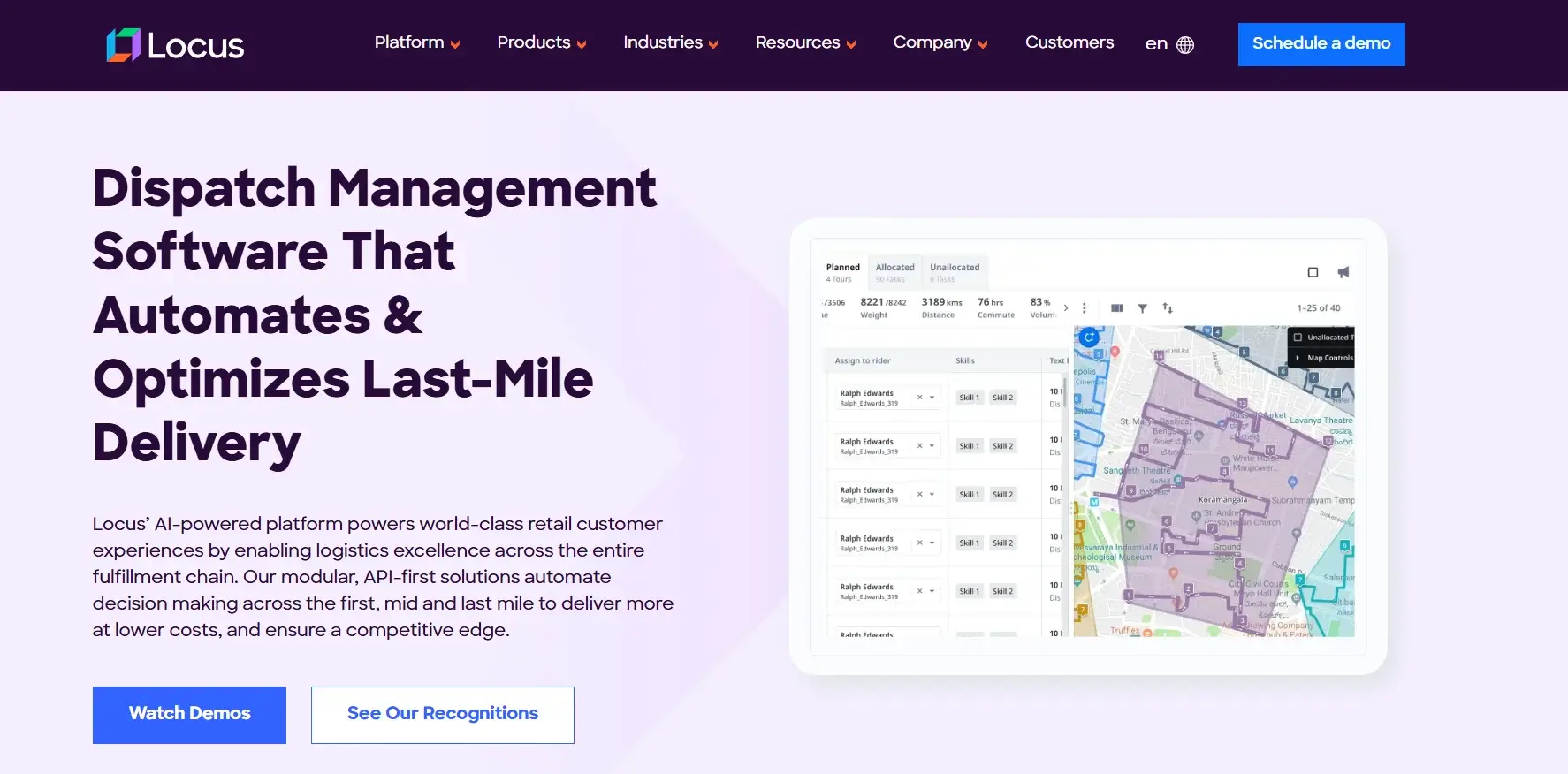
Locus approaches freight dispatch at the network level. Its DispatchIQ engine processes the entire dispatch queue simultaneously, evaluating every load against every available asset and carrier option across 250+ constraints, including driver hours-of-service, vehicle payload and temperature requirements, SLA tier, hub cut-off windows, carrier contract terms, and cost-per-delivery targets.
The output is an optimal allocation across the full freight network. This distinction matters at scale: a dispatcher managing 500 loads per day cannot manually optimize the interaction effects between those allocations. DispatchIQ can.
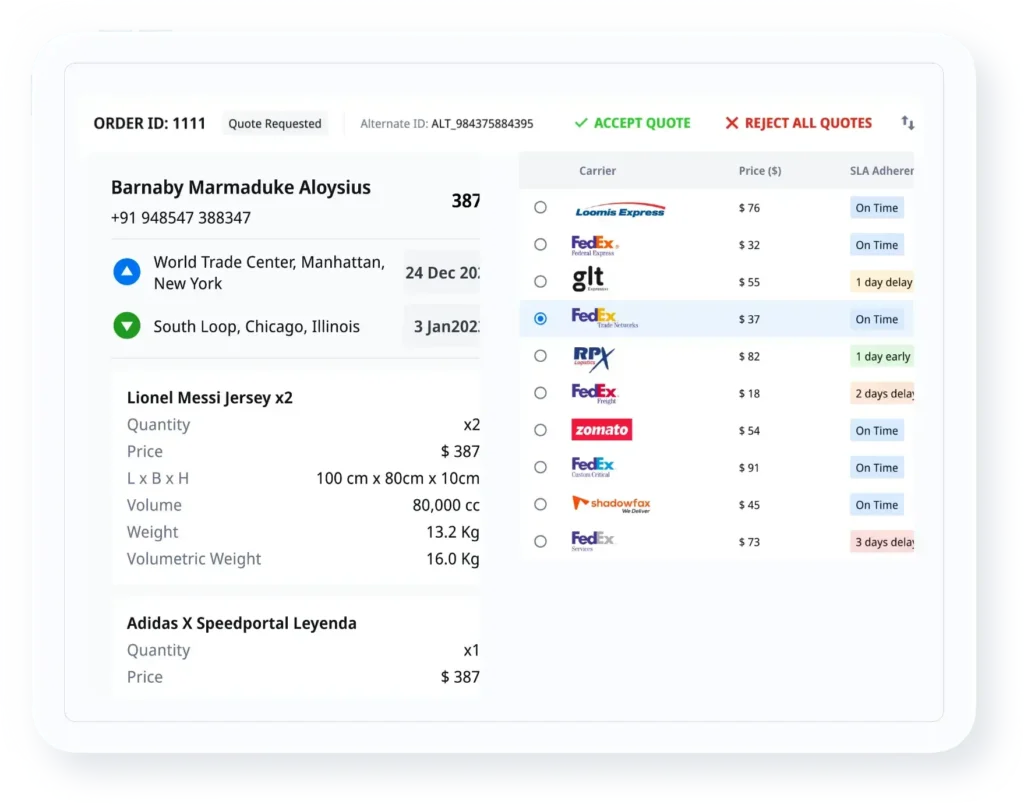
The carrier orchestration layer, ShipFlex, extends dispatch beyond owned fleets. Freight loads are automatically allocated across 1,000+ pre-integrated carrier and 3PL partners based on the same constraint and cost logic applied to owned vehicles.
Carriers receive automated tenders, accept or reject through a self-serve portal, and are tracked through the same control tower that monitors the owned fleet. Enterprises running hybrid fleet models across retail distribution, FMCG, CPG, and 3PL operations no longer need separate workflows for owned and contracted assets.
Locus has delivered $320M+ in logistics cost savings across 1.5B+ freight movements in 30+ countries, with enterprise customers reporting up to 20% reduction in logistics costs and 66% faster planning cycles. SOC 2 and ISO alignment, GDPR readiness, role-based access controls, and full audit trails meet enterprise procurement security requirements.
In October 2025, Ingka Group, the world’s largest IKEA retailer, acquired Locus following a global evaluation of freight orchestration platforms. Locus continues operating independently. Locus has also been recognized by Gartner for seven consecutive years, is featured in the 2026 Hype Cycle for Supply Chain Execution and Logistics Technologies, is named a Leader in TMS by QKS Group (SPARK Matrix), and was ranked #1 in Route Planning on G2’s 2026 Best Software Awards.
Key features of Locus
- DispatchIQ multi-party allocation engine: Processes the full freight queue simultaneously across owned fleet, contracted carriers, and spot capacity, applying 250+ constraints to every allocation decision
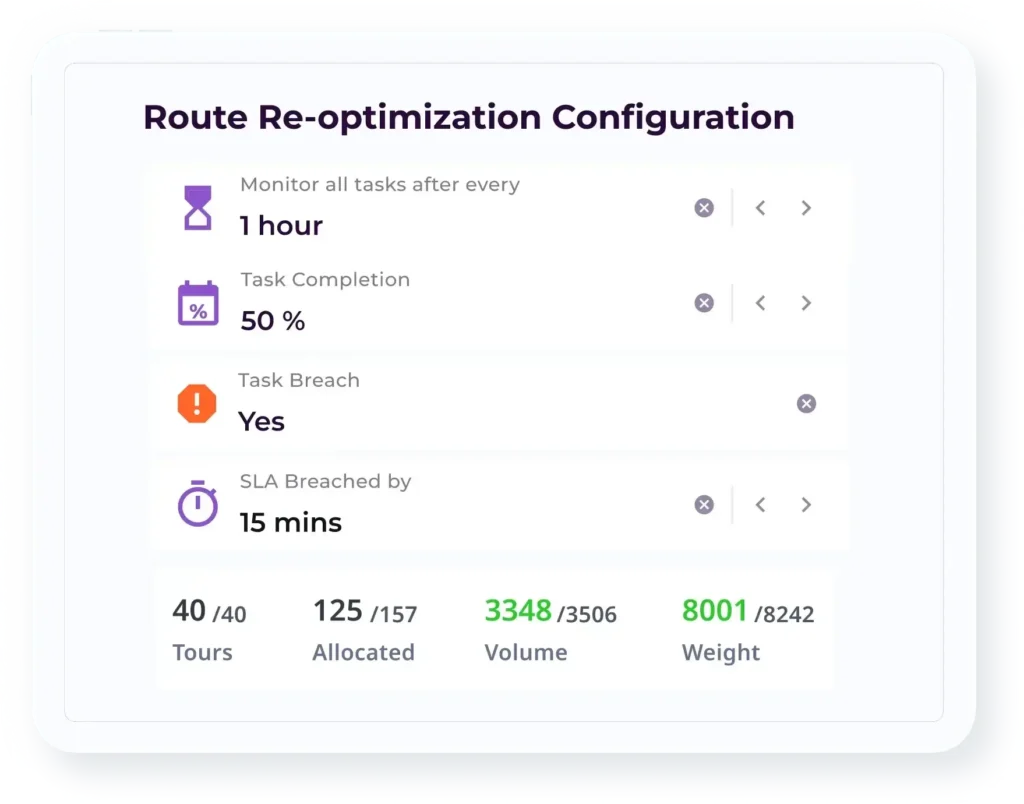
- Fireworks multi-depot route optimization: Automated route planning across multi-stop freight routes with backhaul optimization, load consolidation, and continuous intra-day re-optimization as load profiles change
- ShipFlex carrier management: Automated carrier tendering, acceptance workflows, and performance tracking across 1,000+ pre-integrated logistics partners within the same dispatch workflow as owned fleet
- Freight exception management: Real-time delivery exception alerts trigger automated re-dispatch responses for carrier rejections, vehicle breakdowns, and hub delays without manual dispatcher intervention
- End-to-end control tower: Order-level, milestone-level visibility across first-mile, middle-mile, and last-mile freight from a single dashboard with predictive ETAs and proactive SLA risk alerts
Locus pros
- Network-level freight dispatch helps it allocate the full load queue simultaneously across owned fleet and contracted carriers rather than assigning loads sequentially, which produces materially better cost-per-delivery and capacity utilization outcomes
- Multi-party orchestration in one workflow: owned vehicles, contracted 3PLs, and spot carriers are dispatched through the same constraint logic and tracked through the same control tower, eliminating the parallel system management that drives up coordinator overhead
- Enterprise security posture: SOC 2, ISO, GDPR, audit trails, and role-based access controls are native capabilities that most freight dispatch tools do not offer at all
Locus cons
- Implementation scope scales with operational complexity; enterprises with multiple depots, carrier types, and ERP integrations should plan for a structured onboarding cycle rather than a rapid self-serve deployment
- Investment is sized for enterprise freight operations; organizations managing fewer than 50 vehicles in a single region may find the platform beyond their current scale
Locus pricing
Custom enterprise pricing based on load volumes, depot count, carrier integrations, and deployment scope. Available on AWS Marketplace. Request a demo for a tailored estimate.
Locus is best for
Enterprise freight carriers, 3PL operators, FMCG distributors, and retail fleet operations managing multi-depot freight networks across owned vehicles, contracted carriers, and spot-market capacity that need dispatch, route optimization, and visibility in one orchestration platform.
2. FarEye
FarEye’s dispatch capabilities are primarily designed for parcel carrier networks rather than freight carrier operations. The platform connects shippers and retailers with multiple last-mile parcel carriers, providing a coordination layer that normalizes workflows, delivery communications, and tracking data across carrier partners.
Where FarEye performs well: high-volume parcel dispatch across multiple CEP carriers, branded delivery experience management, and last-mile carrier switching based on cost and availability rules. Its routing constraint depth is optimized for parcel sequencing.
Key features of FarEye
- PILOT agentic dispatcher: 11 specialized AI agents automating dispatch, carrier assignment, route sequencing, exception handling, and customer notification as parallel automated processes
- No-code delivery workflow builder: Operations teams configure dispatch rules, delivery process steps, and carrier assignment logic without engineering dependency
- Proactive exception management: Exception alerts triggered by delivery delays, carrier deviations, and failed attempts with automated escalation and re-dispatch workflows
- Delivery performance analytics: Carrier-level SLA tracking, on-time delivery rates, and exception frequency reporting across shipper accounts
FarEye pros
- Strong parcel carrier network connectivity with automated delivery workflow normalization across multiple CEP and courier partners
- PILOT agentic dispatcher automates dispatch, exception handling, and customer notification workflows in parallel, reducing coordinator time on routine tasks
FarEye cons
- Freight carrier dispatch requirements (FTL/LTL load management, linehaul planning, multi-carrier load tendering) are outside the platform’s primary design scope
- Middle-mile and hub-to-hub dispatch coordination trail platforms built specifically for freight network orchestration
FarEye pricing
Custom enterprise pricing based on shipment volumes and deployment scope.
FarEye is best for
Retailers and e-commerce operations managing high-volume parcel dispatch across last-mile carrier networks, where post-purchase delivery experience and carrier switching are the primary operational requirements.
3. LogiNext
LogiNext’s dispatch automation was built around high-frequency, last-mile delivery operations: restaurant delivery, e-commerce parcels, and courier routing in dense urban networks.
Its auto-allocation engine assigns delivery tasks to drivers based on geographic proximity, shift availability, and capacity; its geocoding layer handles address ambiguity in markets where address infrastructure is inconsistent.
Key features of LogiNext
- Real-time GPS fleet tracking: Live vehicle monitoring with deviation alerts and dynamic rerouting capability based on traffic and on-road changes during the execution window
- Geocoding and address intelligence: High-accuracy address resolution for markets with inconsistent postal infrastructure, particularly across India, MENA, and Southeast Asia
- Predictive delay alerting: ETA-based notifications that flag at-risk deliveries before they become customer-facing SLA failures, enabling pre-emptive intervention
- Driver mobile app: Route navigation, delivery task management, and proof-of-delivery capture for field teams with real-time dispatch plan updates pushed to the device
LogiNext pros
- Auto-allocation and geocoding accuracy are well-suited to high-volume last-mile delivery networks in dense urban environments, particularly in India and MENA
- Combined dispatch, route optimization, and field workforce scheduling reduce the number of tools delivery operations teams manage
LogiNext cons
- Freight carrier dispatch workflows (load tendering, FTL/LTL management, linehaul coordination) are outside the platform’s core design and vertical focus
- Enterprise integration depth for freight ERP and TMS systems is limited compared to platforms built specifically for freight carrier operations
LogiNext pricing
Custom pricing based on fleet size and deployment scope.
LogiNext is best for
Mid-to-large delivery operations in QSR, e-commerce, and CEP verticals needing combined route optimization and workforce scheduling, particularly across India, MENA, and Southeast Asia.
4. Shipsy
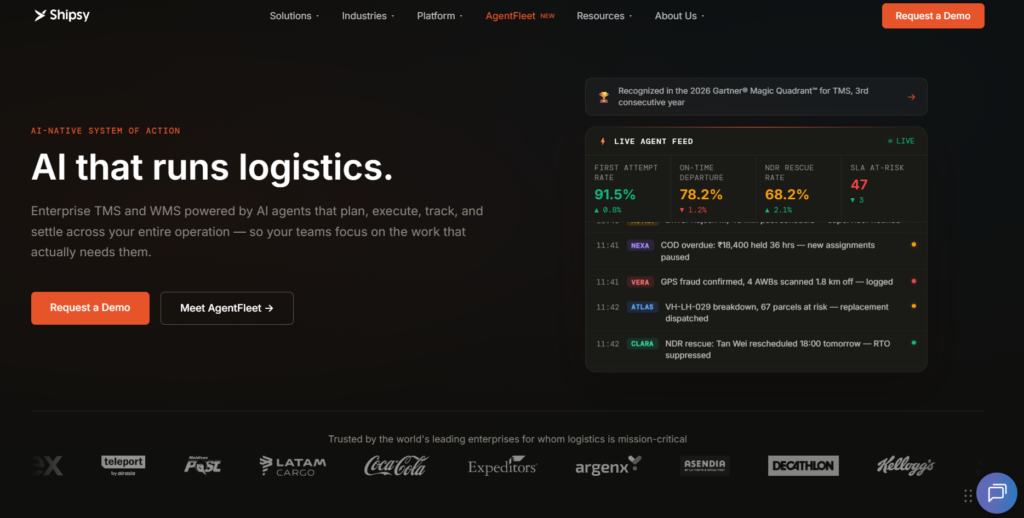
Shipsy was built around freight procurement workflows: carrier tendering, rate benchmarking, and freight cost management across shipper and 3PL operations.
For mid-market shippers in MENA and India managing freight allocation across contracted carriers, Shipsy provides a rate-management and tendering layer that reduces manual negotiation overhead.
Key features of Shipsy
- Freight tendering and rate benchmarking: Automated carrier tender generation with rate comparison across contracted carriers based on lane, load type, and service level requirements
- AgentFleet AI agents: Five specialized agents automating carrier coordination, driver dispatch, freight invoicing, operations management, and dispute resolution as concurrent workflows
- Multi-carrier allocation engine: Automated carrier selection and load dispatch based on cost, transit time, and service commitments across the contracted carrier network
- Cross-border dispatch management: Shipment dispatch across international freight corridors with customs compliance documentation and multi-modal carrier coordination
- Carrier performance analytics: Lane-level carrier scorecards tracking on-time performance, cost adherence, and exception rates to inform future dispatch allocation decisions
Shipsy pros
- Freight tendering and carrier rate management capabilities are genuinely useful for mid-market shippers managing carrier procurement alongside dispatch, reducing the gap between rate negotiation and load assignment
- AgentFleet AI agents handle carrier coordination, invoicing, and dispute resolution autonomously across freight operations
Shipsy cons
- Enterprise integration depth and AI optimization maturity for complex multi-region freight carrier operations trail platforms purpose-built for that scale
- Primary market strength is MENA and India; carrier network coverage and compliance tooling for North America and Europe are narrower
Shipsy pricing
Custom enterprise pricing, which is shared after consultation.
Shipsy is best for
Mid-market shippers and freight operators in MENA and India that need freight tendering, rate management, and dispatch coordination consolidated under one platform.
5. DispatchTrack
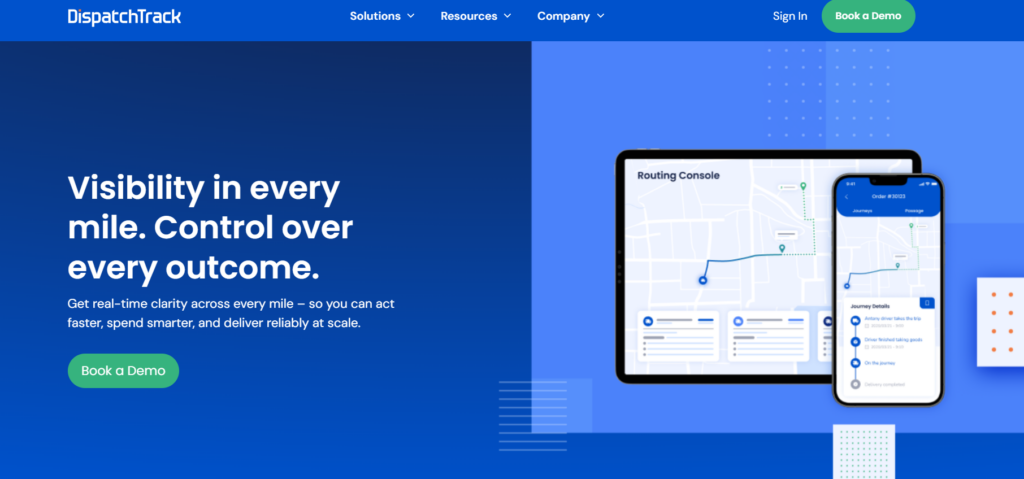
DispatchTrack has built strong traction in a specific freight dispatch niche: scheduled, appointment-based home delivery for large and bulky goods distribution.
Its AI scheduling engine is tuned for this profile, managing appointment booking, route sequencing, and customer ETA communication across high-volume distribution operations. Plus, its optimization is calibrated for scheduled, predictable delivery patterns, not dynamic freight allocation under volatile load conditions.
Key features of DispatchTrack
- Customer appointment scheduling: Self-service and agent-assisted appointment booking tools that connect customer delivery slot selection to route capacity constraints at the planning level
- Proactive ETA communication: Automated customer notifications with delivery time estimates updated throughout the dispatch day as drivers progress through their routes
- Driver app with delivery instructions: Turn-by-turn navigation, item-level delivery instructions, and proof-of-delivery capture for high-touch home delivery field teams
- Delivery performance analytics: On-time appointment adherence, route efficiency metrics, and driver KPI dashboards for distribution operations
DispatchTrack pros
- Appointment scheduling and time-window compliance for big-and-bulky home delivery are purpose-built capabilities that generic freight platforms do not deliver at the same depth
- AI scheduling handles the interaction between customer appointment windows, delivery team availability, and route sequencing in one constraint model
DispatchTrack cons
- Dynamic multi-carrier freight dispatch, spot-market load tendering, and FTL/LTL management are outside scope
- Vertical focus on scheduled home delivery limits applicability to freight carrier operations with variable load types and dynamic allocation requirements
DispatchTrack pricing
Custom pricing based on delivery volume and deployment scope.
DispatchTrack is best for
Retailers and distributors managing appointment-based home delivery for large and bulky goods where time-window precision and customer scheduling are the primary dispatch requirements.
6. Onfleet
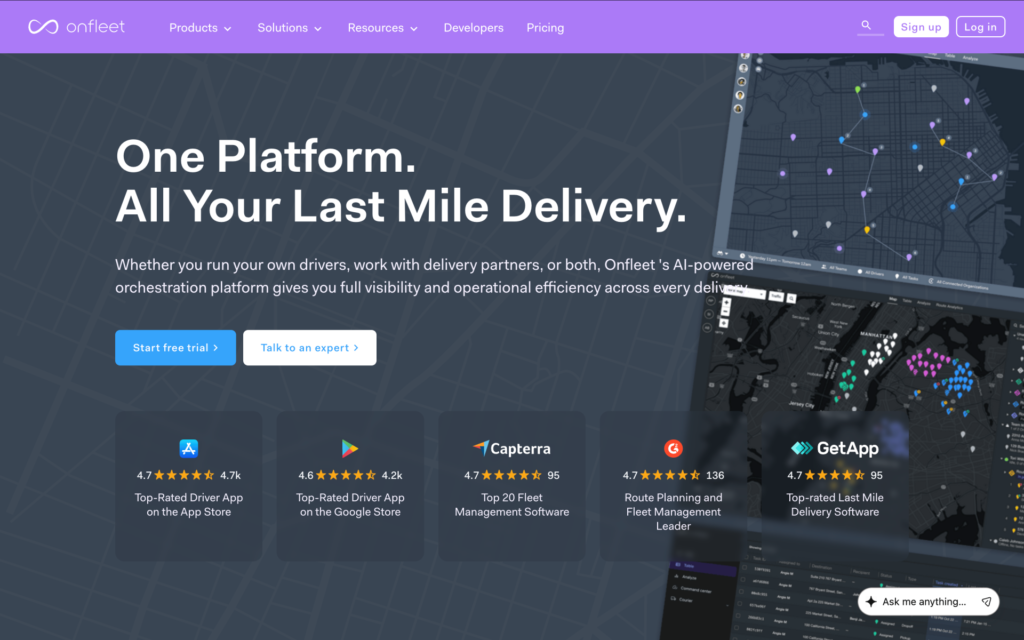
Onfleet is most accurately described as a dispatcher interface tool: its value is in presenting route plans clearly to dispatch coordinators, pushing assignments to driver phones, and consolidating proof-of-delivery capture and customer notification into one workflow.
The platform has no freight tendering layer, no load consolidation logic, no multi-carrier allocation across contracted and spot capacity, and no integration architecture designed for freight ERP and TMS systems.
Key features of Onfleet
- Auto-dispatch: Automated order assignment to drivers based on delivery time windows, vehicle capacity, and real-time driver location without manual dispatcher allocation
- Route optimization: Multi-stop route sequencing with traffic-aware adjustments and delivery window compliance for local and regional fleet operations
- Real-time driver tracking: GPS-based vehicle location monitoring and delivery status updates through a web dashboard for dispatcher oversight during the execution window
- Customer SMS notifications: Automated delivery update messages with estimated arrival times and delivery confirmation sent to end customers throughout the delivery day
- Proof of delivery: Photo, signature, and barcode capture via the driver mobile app with timestamped confirmation records for delivery audit and billing purposes
Onfleet pros
- Regional couriers and growing delivery fleets can go live in quick with minimal technical setup or training overhead
- Published pricing tiers make cost evaluation transparent before contracting, removing procurement cycle friction for mid-market operations
Onfleet cons
- No freight tendering, load consolidation, carrier contract management, or multi-party orchestration capabilities; not designed for freight carrier operations beyond delivery driver dispatch
- Integration architecture for freight ERP and TMS systems is limited; enterprises with existing freight technology stacks require custom development for meaningful data connectivity
Onfleet pricing
Launch: $619/month. Scale: $1,349/month. Enterprise: $3,099/month.
Onfleet is best for
Regional couriers, pharmacy delivery, food distribution, and mid-market fleets needing fast-deployment last-mile dispatch where driver app usability and customer notification are the primary requirements.
7. Axon Software
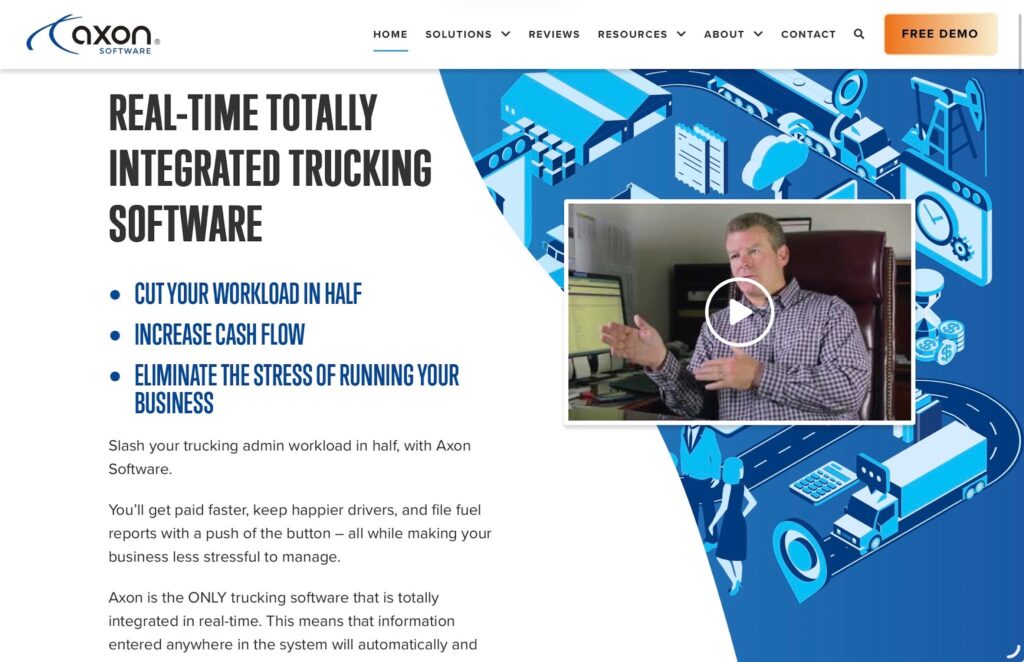
Axon Software is the only platform on the list that integrates freight dispatch directly with carrier accounting, driver settlements, and IFTA tax reporting in a single system.
For asset-heavy North American trucking companies managing owned fleets, Axon’s dispatch-to-settlement workflow eliminates the reconciliation overhead that appears when dispatch and accounting run on separate systems. Load assignment, mileage calculations, driver pay settlements, and fuel tax reporting feed from a single data model.
Key features of Axon Software
- Load dispatch and assignment: Digital load board and dispatch workflow that assigns loads to drivers and tracks status from acceptance through delivery completion in a single system
- Driver settlements: Automated driver pay calculation based on mileage, load type, and pay agreements with settlement statements generated directly from completed dispatch records
- IFTA tax reporting: Automated fuel tax data collection and IFTA quarterly report generation using mileage and fuel data captured during dispatch operations
- Maintenance tracking: Vehicle maintenance scheduling and repair history tied to individual trucks in the dispatch system, with service alerts triggered by mileage or time thresholds
Axon Software pros
- Dispatch-to-settlement integration eliminates the data reconciliation gap between freight dispatch and carrier accounting, which is a genuine operational pain point for asset-heavy trucking companies
- IFTA reporting, driver settlement, and maintenance tracking in one system reduces the number of back-office tools carriers manage for regulatory compliance
Axon Software cons
- No AI optimization engine, no dynamic re-dispatch, and no multi-carrier orchestration; designed for structured asset-based trucking workflows, not network-level freight optimization
- Legacy architecture limits API connectivity with modern freight technology stacks; enterprises requiring ERP and WMS integration face custom development overhead
Axon Software pricing
Custom pricing based on fleet size. A consultation with their sales team is required.
Axon Software is best for
Mid-sized North American trucking companies running asset-heavy, owner-operated fleets that need combined dispatch, driver settlement, and IFTA compliance management without AI optimization requirements.
8. TruckLogics
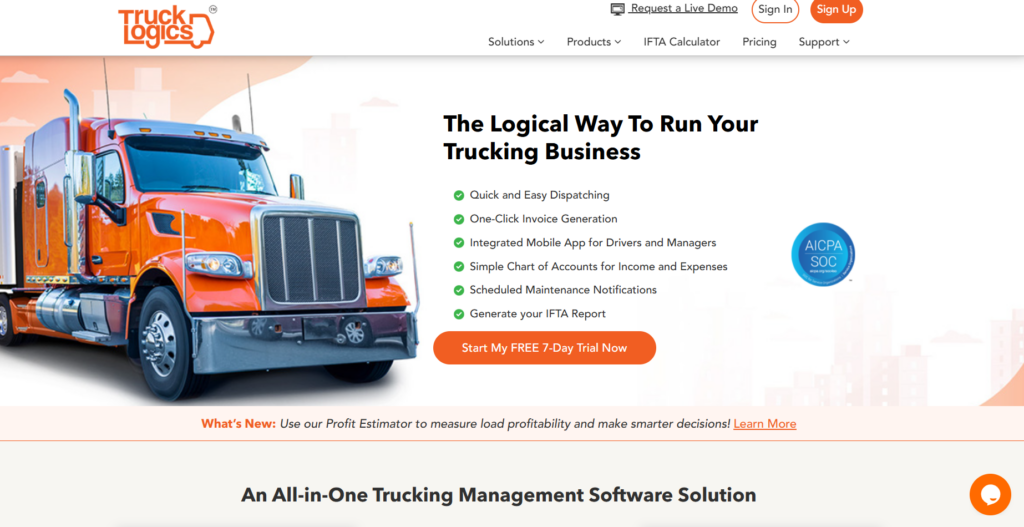
TruckLogics combines basic load dispatch, IFTA reporting, driver invoicing, and maintenance tracking into a single affordable platform. For owner-operators transitioning from paper-based dispatch records or spreadsheets, TruckLogics provides meaningful operational structure at a price point that enterprise platforms cannot match.
There is no optimization engine, no real-time re-dispatch, no carrier management layer for contracted or spot capacity, and no enterprise integration architecture.
Key features of TruckLogics
- IFTA filing: Fuel tax data entry and IFTA quarterly report preparation for owner-operators managing their own compliance without a dedicated back-office team
- Driver invoicing: Invoice generation for completed loads with customizable rate structures and basic accounts receivable tracking for small carrier billing workflows
- Maintenance log: Vehicle service records, maintenance history, and repair cost tracking for small fleets managing their own equipment without a fleet maintenance system
- Owner-operator workflow tools: Document storage, trip reporting, and compliance record management designed for solo operators and small carriers without dedicated administrative staff
TruckLogics pros
- Accessible entry-level pricing for owner-operators who need structured load dispatch, invoicing, and IFTA compliance without enterprise overhead
- Combines dispatch, maintenance logs, and tax reporting in one tool, reducing the number of separate systems small carriers manage for day-to-day operations
TruckLogics cons
- No optimization engine, no carrier management, no real-time visibility, and no ERP integration; designed exclusively for small owner-operator trucking operations
- Not suitable for enterprise freight carrier operations with multi-depot networks, contracted carrier partners, or AI dispatch requirements
TruckLogics pricing
From $39.95/month for basic plans. Scales with fleet size and features required.
TruckLogics is best for
Owner-operators and small carriers managing 1-20 trucks that need basic load dispatch, IFTA reporting, and invoicing in one affordable tool.
Also Read: Carrier Connectivity: Connect to Any Freight System
What Freight Carriers Report After Deploying AI Dispatch
Vendor percentages are only useful against a baseline. These are outcomes from named deployments, with the mechanism that produced each result, so the numbers can be assessed rather than accepted.
Centralized dispatch across 51 sites: 75% to 92% execution rate, $14M+ in capacity surfaced. A Fortune 50 parcel and logistics provider moved from site-level dispatch to centralized dispatch across 51 sites in a 120-country network, running more than a million freight shipments a year against a 4,500-strong driver pool split between captive and third-party capacity. Weekly execution rate rose from 75% to 92% at 99.99% uptime. The larger finding was more than $14 million in contracted capacity that local dispatch practice had never used, including $565,000 at a single site. That is the unused contracted capacity cost line described earlier, measured at scale.
Six legacy systems replaced: 95%+ route compliance with sub-two-hour exception resolution. A leading North American retailer consolidated dispatch across multi-hundred stores and ocean, rail, and road movements onto one orchestration layer. Exceptions resolved in under two hours while route compliance held above 95%, which is the pair that normally trades against itself, since faster exception handling usually means more plan changes and lower adherence. Manual dispatch effort fell more than 80%, delivering $1M+ in savings and break-even inside year one.
Freight settlement across 160 depots: 5-6% invoice variance caught, payment cycles 78% faster. A paint industry leader automated reconciliation of more than 1,500 carrier invoices a month, checking each against contracted terms. The 5% to 6% variance recovered had been passing manual review undetected, and payment cycles fell from 30 to 45 days down to 7 to 10. Dispatch and settlement running on one data model is what makes this checkable.
When assessing any of these against your own operation, the transferable numbers are the mechanism metrics rather than the savings: execution rate, route compliance, and manual effort reduction indicate whether the capability was genuinely in use, which is what separates a realized result from a modeled one.
Why Enterprise Freight Carriers Are Moving Beyond Basic Dispatch Software
Three structural shifts are driving enterprise freight carriers away from single-fleet dispatch tools toward network-level orchestration platforms.
From single-fleet dispatch to multi-party freight orchestration
Enterprise freight carriers allocate loads across owned fleets, dedicated contracted carriers, and spot-market capacity, often simultaneously, and the cost and service outcomes of those allocation decisions interact.
A load assigned to an owned fleet rather than a contracted carrier affects backhaul availability. A spot-market booking that bypasses a contracted carrier relationship affects carrier scorecards and future contract terms. Platforms that dispatch owned fleets in one system and manage carrier procurement in another force coordinators to manually reconcile decisions that should be optimized together.
Last mile management at the consumer delivery end depends on those upstream freight allocation decisions being correct.
From static load plans to AI-driven continuous re-optimization
Most freight dispatch tools operate on a plan-and-execute model: a morning plan is generated, dispatched, and executed until something breaks. When a driver HoS limit is hit mid-route, a carrier rejects a tender at 11 AM, or a customer reschedules a delivery window, the response is manual.
AI-driven dispatch platforms like Locus operate in a continuous re-optimization loop: the allocation model is updated in real time as load profiles, driver availability, and carrier capacity shift throughout the day.
From GPS tracking to end-to-end freight network visibility
Vehicle location tracking was the 2015 standard for freight visibility. Enterprise freight carriers in 2026 need order-level, milestone-level visibility from origin facility through carrier transfer through final delivery, integrated with upstream WMS and OMS data so exceptions surface before they become SLA failures.
The control tower paradigm: a single dashboard that shows every active load, every at-risk SLA window, every carrier performance deviation, and triggers automated re-dispatch responses without requiring a coordinator to spot and act on each exception individually.
Also Read: EDI vs API in Logistics: Integration Decision Guide
How to Evaluate and Implement a Dispatch Management Platform for Your Fleet
Five evaluation practices specific to enterprise freight carrier procurement:
- Map your dispatch complexity honestly before requesting demos: Number of depots, owned vs. contracted fleet split, daily load volume, carrier partner count, geographic spread, load types (FTL, LTL, temperature-controlled, hazmat). This determines whether you need a basic dispatch tool, a delivery automation platform, or a full freight orchestration layer. Most failed implementations trace to mismatched complexity, not feature gaps
- Quantify the cost of your current dispatch process before evaluating ROI claims: Dispatcher hours per day, planning time per load, empty-mile percentage, on-time carrier acceptance rate, cost per delivery. Without a baseline, vendor ROI claims of 15-20% cost reduction are unverifiable during procurement
- Test integration architecture against your actual tech stack: Ask vendors for a reference deployment that used the same ERP and WMS as your operation. Pre-built connectors versus custom API work is the difference between a 6-week integration and a 6-month integration project
- Validate security and compliance requirements early: SOC 2 Type II, ISO 27001, GDPR readiness, and role-based access controls should be confirmed in the first vendor conversation, not during contract negotiation. Most SMB dispatch tools cannot meet enterprise procurement security requirements regardless of functional capability
- Plan for depot-by-depot rollout rather than network-wide cutover: Enterprise freight dispatch implementations that go live across all depots simultaneously have a significantly higher failure rate than phased rollouts. Validate whether the platform supports regional activation and parallel operation during the transition period
Which Dispatch Platform Fits Each Freight Operating Model?
Choose the platform category that matches your operating model first, then evaluate features. A carrier running one owned fleet needs a different dispatch system than an enterprise freight network coordinating owned vehicles, contracted carrier partners, and spot-market capacity across multiple depots.
| Operating model | Platform category to prioritize | Platforms in this comparison |
|---|---|---|
| Owner-operator or small carrier managing 1-20 trucks | Basic trucking dispatch with invoicing, IFTA reporting, and maintenance records | TruckLogics |
| Mid-sized asset-heavy trucking company in North America | Dispatch connected to accounting, driver settlement, IFTA, and maintenance workflows | Axon Software |
| Regional courier, pharmacy delivery, food distribution, or local fleet | Fast-deployment last-mile dispatch with driver app usability and customer notifications | Onfleet |
| Retailer or distributor with scheduled big-and-bulky delivery | Appointment scheduling, ETA communication, and time-window delivery management | DispatchTrack |
| QSR, e-commerce, or CEP operation in dense delivery markets | Auto-allocation, geocoding, route optimization, and field workforce scheduling | LogiNext |
| Mid-market shipper needing freight procurement and carrier tendering | Freight tendering, rate benchmarking, carrier allocation, and cross-border visibility | Shipsy |
| Retail or e-commerce operation coordinating parcel carrier networks | Parcel carrier orchestration, delivery workflow automation, branded tracking, and exception management | FarEye |
| Enterprise freight carrier, 3PL, FMCG distributor, or retail fleet operation with multi-depot complexity | AI-native freight orchestration across owned fleet, contracted carriers, spot capacity, routing, visibility, and security controls | Locus |
Also Read: Agentic-Washing: How to Tell a Real Agentic TMS From a Rebranded Rules Engine in 2026
Choosing the Right Dispatch Management Platform for Your Freight Operation
The right dispatch management platform depends on three factors: fleet complexity (owned plus contracted plus spot), operational geography (single region versus multi-depot national network), and growth ambitions (scaling volume or carrier types within 24 months).
Basic trucking tools like TruckLogics and Axon Software serve asset-heavy owner-operators well within their designed scope. Onfleet and DispatchTrack address regional courier and home delivery requirements with focused, fast-deployment products.
FarEye, LogiNext, and Shipsy bring intelligent dispatch to last-mile delivery, delivery automation, and freight procurement respectively.
Enterprise freight carriers, FMCG distributors, retail fleet operations, and 3PL providers managing multi-depot freight networks across owned vehicles and contracted carrier partners need a platform designed at the network orchestration level.
Locus is purpose-built for that tier of complexity, delivering measurable reductions in cost-to-serve and improvements in network OTIF across 360+ enterprise deployments in 30+ countries. Request a Locus freight dispatch orchestration assessment to baseline your current dispatch cost and model the allocation gain across your owned and contracted capacity.
Frequently Asked Questions (FAQs)
1. What is dispatch management software?
Dispatch management software assigns loads to drivers, vehicles, and carriers during the execution window and tracks those assignments through completion. It sits between planning and settlement: rate procurement and carrier contracting happen upstream in a TMS, while dispatch is the point where a plan becomes an instruction to a specific driver or carrier. Capability ranges from a digital load board replacing a whiteboard through to a continuous allocation engine that evaluates every load against every available asset and carrier across hundreds of constraints and re-solves as conditions change.
2. What is the difference between dispatch management software and a transportation management system?
Dispatch management software handles the real-time assignment of loads to drivers, vehicles, or carriers during the execution window. A transportation management system covers the broader freight lifecycle: rate procurement, carrier contract management, freight audit, mode optimization, and financial settlement alongside dispatch. Some platforms, including Locus, combine both into an orchestration layer that connects freight planning and carrier management to real-time dispatch decisions.
3. How does AI-powered dispatch assignment work differently from rule-based or manual dispatch?
Rule-based dispatch applies a fixed priority hierarchy: assign load to nearest available driver of the correct vehicle type. Manual dispatch applies dispatcher judgment, which is inconsistent and does not scale. AI-powered dispatch evaluates every load against every available asset and carrier option simultaneously, weighting SLA tier, cost-to-serve, driver HoS remaining, vehicle payload match, hub cut-off timing, and carrier contract availability in a single optimization pass. The allocation is re-evaluated continuously as conditions change rather than locked in at morning plan generation.
4. Can a dispatch management platform handle both owned fleet and third-party carrier allocation?
Multi-party orchestration across owned fleet, contracted carriers, and spot-market capacity in a single dispatch workflow is a Level 4 capability that only a small number of enterprise platforms deliver. Most dispatch tools handle single-fleet routing and require separate carrier management systems for contracted and spot capacity, forcing coordinators to reconcile allocation decisions manually across systems. Locus’s ShipFlex module applies the same constraint and cost logic to carrier tendering as to owned fleet dispatch, coordinating all fleet types within one workflow.
5. What does freight dispatch software cost?
Pricing splits along the same tiers as capability. Owner-operator tools start around $39.95 per month, mid-market last-mile platforms publish tiers from roughly $619 to $3,099 per month, and enterprise freight orchestration platforms price custom against load volume, depot count, carrier integrations, and deployment scope. License cost is rarely the deciding number for enterprise buyers: integration effort, phased rollout duration, and whether pre-built ERP and WMS connectors exist typically move total cost more than the subscription line does.
6. How do freight carriers integrate dispatch software with WMS and ERP systems?
Through an API-first architecture with pre-built connectors where they exist, and EDI where trading partners mandate it. The practical questions to settle before contracting are which connectors are productized versus built per project, whether the platform pushes events by webhook or requires polling, and whether a reference deployment exists on the same ERP and WMS you run. Pre-built connectors versus custom integration work is often the difference between a six-week and a six-month project, and it is the single largest driver of timeline variance.
7. What ROI metrics should freight carriers track after implementing a dispatch management platform?
Primary: cost-per-delivery reduction, empty-mile percentage change, on-time carrier acceptance rate, SLA adherence by customer tier, and dispatcher hours per 100 loads dispatched. Secondary: carrier rejection rate, reassignment frequency, failed first-attempt delivery rate, and average planning time per depot per day. Establish baselines for all metrics before go-live; AI dispatch platforms typically require 4 to 8 weeks of live operation before optimization models are calibrated to your specific load and carrier profile.
8. How long does it typically take to implement an enterprise dispatch management platform across multiple depots?
Implementation timelines vary significantly by platform architecture and freight complexity. Cloud-native, API-first platforms with pre-built ERP and WMS connectors can go live at a first depot within 4 to 8 weeks. Multi-depot national rollouts typically run 3 to 6 months for full network activation with phased deployment. Legacy TMS and trucking platforms with EDI-dependent integrations and on-premises components run 9 to 18+ months for comparable scope. The integration architecture decision is the primary driver of timeline variance, not platform selection alone.


General
Route Planning Software: Enterprise Buyer’s Guide for Smarter Delivery Operations

Aug 24, 2026
A side-by-side breakdown of 12 route planning platforms across constraint depth, dispatch support, and scalability for enterprise delivery operations.
Read more
General
10 Best Last Mile Logistics Software Platforms for Enterprise Operations in 2026
Aug 24, 2026
Compare the 10 leading last mile logistics software platforms for enterprise operations with AI dispatch, route optimization, and orchestration features.
Read moreInsights Worth Your Time




















Freight Dispatch Management Software: Complete 2026 Guide and Top 8 Platform Comparison