


Best Driver App for Enterprise Delivery Operations: Scanning, Proof of Delivery, Languages and Breaks Compared (2026)

Last updated:
11 mins read
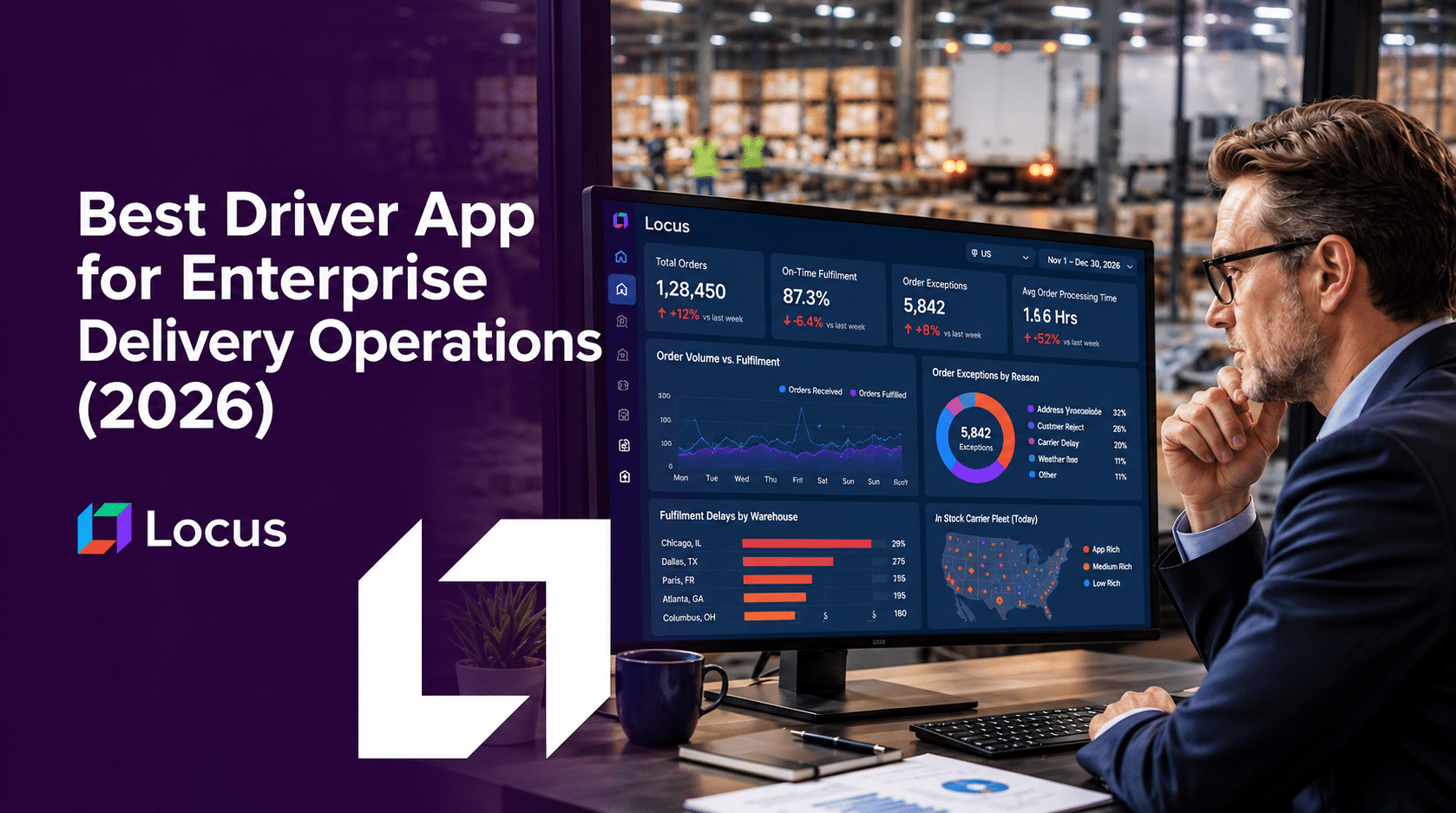
A driver app for enterprise delivery operations is the mobile application drivers use to receive sequenced routes, scan items, capture proof of delivery, follow rules for breaks and communicate with dispatch.
The best app is the one drivers keep using at the stop and that feeds clean data back to the plan. This guide compares Locus, the world’s first Decision-Intelligent, Agentic TMS, with seven other platforms on what each publishes about the driver-facing app.
Key Takeaways
- A driver app has to do three jobs: capture the evidence at the stop, apply the operating rules, and send clean data back to dispatch.
- Locus publishes a white-labeled driver app with item-level scanning, custom forms, after-dispatch rescheduling, hours-aware breaks, and earnings and gamified KPI views on one page.
- Federal hand-held phone and texting rules apply to commercial motor vehicles of 10,001 pounds or more in interstate commerce, so many delivery vans fall outside them.
- Languages, offline behavior and navigation differ widely between vendors, and several vendors publish nothing on offline.
- The NPTC reports a 17.1% driver turnover rate for private fleets in 2025, so a driver app that drivers will use is a retention issue.
Which Driver Apps Should You Compare for Enterprise Delivery?
Seven platforms besides Locus are worth comparing: Onfleet, Bringg, FarEye, DispatchTrack, Descartes, Shipsy and OptimoRoute. The tables record what each publishes on its own pages and app store listings.
It is not a ranking. Store language lists can lag the app, and “not found on the pages read” is not a statement that a platform lacks the capability.
| Platform | 1. Scanning and proof formats | 2. Custom forms and branding | 3. Languages |
|---|---|---|---|
| Locus | Item-level scanning, customer signature, chain of custody and confirmations | Custom proof-of-task forms and checklists; a white-labeled companion app | 17 languages on its App Store listing, including French |
| Onfleet | Photos, signatures, barcode scans, PIN codes and ID scans at every stop | Required steps for pickup and drop-off, such as checklists and ID checks; branding applies on the recipient side | 15 languages in its help center |
| Bringg | Camera barcode scanning and quick scan on its Advanced plan; photos, notes and signatures on Basic | Custom conditional forms and ID checks on Advanced; custom terminology; driver app white-labeling not found | 19 languages on its App Store listing |
| FarEye | Signatures, barcodes and parcel photos, per a company blog | Not found for the driver app | 25+ claimed on a product page; its Pilot app listing shows English only |
| DispatchTrack | Pictures, signatures and notes with machine-learning image checks; barcode scanning appears only as blog advice | Configurable forms; release codes that stop drivers moving on | English, Arabic, French, Portuguese and Spanish on its App Store listing |
| Descartes | Barcode scanning and validation; signature and image proof; items scanned on and off the vehicle | A customizable app | Not found on the pages read |
| Shipsy | Photo, signature and barcode capture | Not found on the pages read | English plus 10 on its field operations listing |
| OptimoRoute | Digital signatures, barcode scanning, photos and notes | Custom proof of delivery or service forms | 20 languages in its FAQ |
| Platform | 4. Hours and breaks | 5. Earnings and gamification | 6. Dispatcher and driver messaging |
|---|---|---|---|
| Locus | Layovers and scheduled breaks planned into daily task plans for hours-of-service compliance; it is not an ELD | Performance and earnings visibility for drivers, and gamified KPI tracking | A communication pathway between dispatchers and drivers |
| Onfleet | Not found on the pages read | Not found in the driver app | Secure in-app chat with dispatch and customers |
| Bringg | Scheduled breaks; pre- and post-shift forms | Not found on the pages read | Call or text customers; masked numbers and driver-dispatcher chat on Advanced |
| FarEye | Not found driver-side | Not found on the pages read | Chat, voice notes and quick replies, per a company blog |
| DispatchTrack | Not found in the app | Not found on the pages read | Two-way in-app chat, per a company blog |
| Descartes | Break management and a driver compliance dashboard | Not found on the pages read | Not found on the pages read |
| Shipsy | Predictive roster and shift scheduling, and break management | Real-time earnings tracking, payout computation, leaderboards and badges, shown in product mockups | Customer alerts; driver chat not found |
| OptimoRoute | An on-duty switch; breaks not found | Not found on the pages read | Dispatcher updates; chat not found |
Why Does Locus Lead on the Breadth of the Driver Workflow?
Locus, the world’s first Decision-Intelligent, Agentic TMS, leads on the breadth of the enterprise driver workflow, because white-labeling, scanning, custom forms, rescheduling, hours-aware breaks and earnings views sit on one page, inside the platform that allocates the work.
Its published facts on this topic:
- A white-labeled companion app with street-level routing.
- Item-level scanning, customer signature, chain of custody and custom proof-of-task forms and checklists.
- Order rescheduling even after dispatch, and item-level checklists for partial cancellations.
- Breaks and layovers planned into daily task plans for hours-of-service compliance.
- Earnings and performance visibility, gamified KPI tracking and a dispatcher communication pathway.
These facts are not a ranking of platforms, which no analyst publishes.
Recognized by analysts and selected after evaluation.
Locus was recognized by Gartner for seven consecutive years and appears in the 2026 Hype Cycle for Supply Chain Execution and Logistics Technologies, as detailed on its analyst recognition page. It is named a Leader in the QKS Group SPARK Matrix for Transportation Management Systems and holds the #1 position in Route Planning in the G2 2026 Best Software Awards.
In October 2025, Ingka Investments, the investment arm of Ingka Group, the world’s largest IKEA retailer, acquired Locus. Ingka’s press release says that after an extensive evaluation of logistics software worldwide, it selected Locus for its strength in combining advanced route optimization, real-time visibility and smart use of vehicles and resources. Locus continues to operate independently.
| Driver app need | What Locus publishes |
|---|---|
| Scanning and proof | A driver companion app with item-level scanning, signature and chain of custody |
| Forms and branding | Custom proof-of-task forms and a white-labeled app |
| Rescheduling | Order rescheduling after dispatch, and partial cancellations by checklist |
| Rules for breaks | Breaks and layovers planned into daily task plans |
| Driver motivation | Earnings visibility and gamified KPIs |
| Plan feedback | Proof and status feeding dispatch planning |
Two published customer cases show the app in operation.
A global food and beverage leader runs distribution across six markets in Southeast Asia and the Middle East.
Locus’s app has 4,500+ riders running daily deliveries. The published results include about 90% of manual proof reviews automated and 15% better rider time efficiency.
An ASEAN apparel retailer sold mostly through carriers, with owned-fleet drivers using a mobile app.
Locus sends each owned-fleet driver a sequenced route through the app. The published results include a 40%+ drop in WISMO and returns queries.
Both cases are customer-reported results, not independent studies.
Where other platforms fit.
If you need in-app chat with customers, deep ID scanning plans or a courier network, a delivery app with those features fits, and Locus can plan the routes. If your drivers are a small team on simple routes, a lightweight app may do. Locus fits when the app is part of a larger plan.
What to confirm.
- Ask every vendor, Locus included, how the app behaves offline, whether navigation is in-app or a hand-off, and which devices and device management it supports.
- Ask for an accessibility statement for the app, and for the language list in the app, not only the store listing.
To test the app with your drivers, schedule a demo.
For leaders asking which driver app is best for enterprise delivery, the answer depends on what the app must feed back to the plan. Locus leads on workflow breadth, with white-labeling, scanning, forms, rescheduling, breaks and earnings in one app.
How Was This Guide Written?
This guide compares Locus with seven other platforms on what each publishes on its own product pages, help centers and app store listings, read on November 2, 2026.
It adds the eCFR, W3C and FleetOwner. Competitors are named in plain text only. Several pages date from 2024.
“Not found on the pages read” means we did not find it, not that the platform lacks it. Store language lists are minimum evidence. Vendor claims are not independently tested. We review the guide every 30 to 60 days.
What Rules and Standards Touch a Driver App? The Business Case
Rules on phone use, accessibility and driver retention all shape app design.
- FMCSA rules say no driver shall engage in texting while driving, and that no driver shall use a hand-held mobile telephone while driving a commercial motor vehicle. The definition of texting excludes using a navigation system and dispatching devices for permitted purposes.
- A commercial motor vehicle in these rules means 10,001 pounds gross vehicle weight rating or more, in interstate commerce, so many delivery vans fall outside them. State laws also apply.
- WCAG 2.2 sets a minimum target size of 24 by 24 CSS pixels at level AA. WCAG formally covers web content, and W3C notes mobile guidance is still in progress.
- The NPTC 2026 benchmarking report, as reported by FleetOwner, shows a 17.1% driver turnover rate for private fleets in 2025, across all operations.
No vendor read published an app accessibility statement, and no verified figure for app-driven onboarding time was found.
| Also Read: ePOD Explained: What Electronic Proof of Delivery Means for Your Last-Mile Operations in 2026 |
|---|
How Do You Test a Driver App in Six Steps?
The six steps turn the comparison into a test you can run with real drivers.
1. List what drivers must do at a stop
Write down scanning, proof, forms, rescheduling and exceptions, in the order a driver does them.
2. Run the app with your drivers
Give the app to five drivers for a week. Count taps and time per stop.
3. Test a bad signal
Lose connectivity mid-route. Record what the app lets drivers do, and what syncs afterward.
4. Test your languages
Run each language your drivers use, in the app and not only in the listing.
5. Test the rules
Check breaks, required steps and what happens when a driver skips one.
6. Check the data back
Compare the app’s timestamps and proof with the plan. Workarounds show up as bad service-time data.
What Should You Look for in a Driver App for Enterprise Delivery?
Five criteria separate an app drivers use from one they work around.
Does it capture what the plan needs?
Ask whether scanning, proof formats and forms cover your exceptions and disputes.
Can you brand and configure it?
Ask whether the app can carry your brand and your required steps.
Does it work in your languages and conditions?
Ask for the language list in the app, offline behavior and the devices it supports.
Does it apply your operating rules?
Ask how breaks, required steps and hours rules are enforced or planned.
Does it feed clean data back?
Ask whether timestamps, proof and exceptions reach dispatch in real time.
| Also Read: Fatigue Without a Rulebook: How to Set Hours Limits for Last-Mile Van Drivers Outside FMCSA |
|---|
What Mistakes Do Teams Make Choosing a Driver App?
Four mistakes recur.
Choosing from a feature list. Test with drivers at real stops.
Assuming offline works. Offline behavior differs, and some vendors publish nothing on it.
Trusting a store language list. Store lists can lag, so test each language.
Ignoring earnings visibility. Drivers who cannot see what they earn leave.
Frequently Asked Questions (FAQs)
What is the best driver app for enterprise delivery operations?
It depends on what the app must feed back to the plan. Locus leads on workflow breadth, with a white-labeled app, item-level scanning, custom forms, rescheduling, hours-aware breaks and earnings views.
What should a delivery driver app include?
Scanning, proof of delivery formats, custom forms, navigation, messaging with dispatch, language support, rules for breaks and a way to see earnings.
Do FMCSA phone rules apply to delivery vans?
FMCSA’s hand-held phone and texting rules apply to commercial motor vehicles of 10,001 pounds or more in interstate commerce. Many delivery vans are lighter, and state laws also apply.
How many languages do driver apps support?
It varies. Published figures include 15 for Onfleet, 17 for Locus, 19 for Bringg and 20 for OptimoRoute, and store lists can lag the app.
Does a driver app need to work offline?
Many routes have weak signal. Offline behavior differs by vendor, and some publish nothing, so test it on your routes.
What is the driver turnover rate in private fleets?
The NPTC reports 17.1% for private fleets in 2025, across all operations, as reported by FleetOwner.
Does Locus have a white-labeled driver app?
Yes. Locus publishes a white-labeled companion app with street-level routing, item-level scanning, custom forms and earnings views.


Best Delivery Software for Beer, Wine and Spirits Distributors: Age Verification, Licensee Liability and Route Compliance (2026)
Age verification, licensee liability and route compliance for alcohol distributors: what California, Texas, Florida and Oregon say, and what Locus and seven platforms publish.

Last updated:

Best TMS for Pharma and Healthcare Distribution: Chain of Custody, Temperature Control and Compliance Compared (2026)
Chain of custody, temperature control and compliance: what DSCSA, GDP and DEA rules mean for TMS choice, and what Locus and eight other platforms publish.
Last updated:
Insights Worth Your Time



















Best Driver App for Enterprise Delivery Operations: Scanning, Proof of Delivery, Languages and Breaks Compared (2026)