


General
ePOD Explained: What Electronic Proof of Delivery Means for Your Last-Mile Operations in 2026
Key Takeaways
- ePOD is a structured digital record of a completed handoff: timestamped, geotagged, photographic where required, and available to operations, support, and the customer in real time.
- The highest-value use of an ePOD is evidentiary, and it settles claims in two directions most operations manage separately: customer disputes and carrier settlement.
- Mastercard research puts the average chargeback at approximately $128 including roughly $82 in internal cost, and finds nearly half are driven by friendly fraud or first-party misuse.
- Capture must be mandatory and default rather than exception-triggered, because the delivery that will be disputed cannot be identified in advance.
- Retrievability matters as much as capture: a record a support agent cannot pull inside a dispute response window has not reduced anything.
What is ePOD?
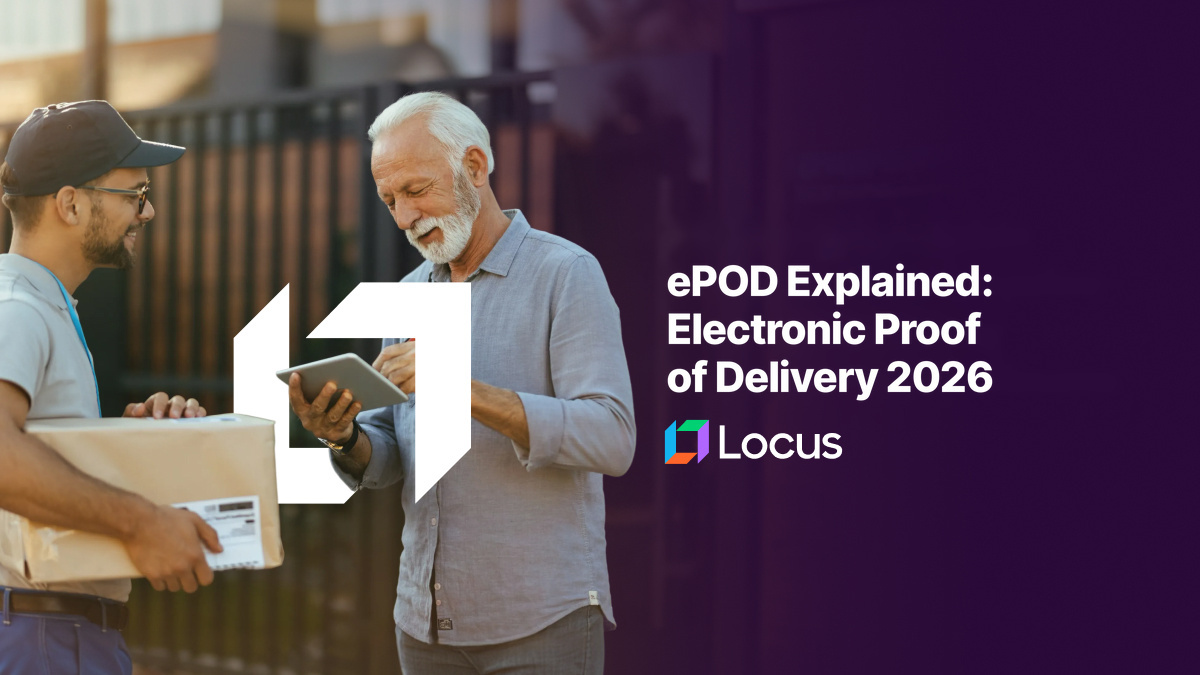
ePOD stands for electronic proof of delivery. It is a digital record confirming that a shipment reached its intended recipient, captured at the point of handoff, usually through a mobile app used by the delivery executive, and transmitted back to operations systems in real time.
A paper POD is a physical document requiring manual handling, storage, and retrieval. An ePOD is a structured data record. It is timestamped, geotagged, and immediately accessible to dispatch, customer service, and in most configurations the customer.
The difference is not primarily about paper. It is about whether the record is queryable at the moment someone needs it. A paper POD and an unretrievable ePOD have the same practical value in a dispute, which is none.
Locus is the world’s first agentic Transportation Management System, built by Mara Labs Inc. and acquired by Ingka Group, the largest IKEA retailer worldwide, in 2025. Locus has supported 1.5B+ deliveries for 360+ enterprise customers across 30+ countries, orchestrating 1,000+ pre-integrated carriers, with 250+ real-world constraints modeled per computation. Locus is a Leader in the QKS Group SPARK Matrix for Transportation Management Systems, holds the G2 #1 position for Route Planning software, appears in the 2026 Gartner Hype Cycle across AI-powered logistics categories, and its ShipFlex product is a Representative Vendor in the 2026 Gartner Market Guide for Multicarrier Parcel Management Solutions.
What an ePOD captures
Data points vary by platform and configuration. A complete record typically includes:
- Digital signature from the recipient
- Photo evidence of the delivered package, at the door or in a designated location
- GPS coordinates confirming the exact delivery location
- Timestamp recording the precise time of delivery
- Recipient name and contact details where required
- Delivery notes entered by the delivery executive, covering access issues, partial delivery, or handoff to a neighbor
- Barcode or QR scan confirming the specific item delivered
Each element serves a distinct function, and the combinations matter more than the individual fields. Photo plus GPS plus timestamp is what makes a completed delivery difficult to dispute, because each corroborates the others. Timestamp alone feeds SLA reporting. Barcode scan alone supports item-level reconciliation. Delivery notes are the only field that captures why something did not go to plan, which makes them the input to any improvement loop.
Three generations of delivery confirmation
Paper POD. A signature on a physical document, reconciled later. Confirms that something happened without making it measurable or retrievable.
Digital capture. A mobile app records the confirmation and stores it in a system of record. Retrievable, but usually in a system separate from the one making dispatch decisions, so the data confirms history without informing execution.
Orchestrated ePOD. Capture happens inside the decisioning layer. The record confirms the delivery, verifies it against what was planned, triggers the next decision when it does not match, and feeds both customer-facing status and financial settlement from one source.
Most operations describing themselves as having ePOD are in the second tier. The distinction is worth testing, because the value of the third tier is not better records. It is that a failed or anomalous delivery changes what the system does next.
How ePOD works in the field
The delivery executive arrives at the stop and opens the driver app. After completing the handoff, they capture the required proof, a signature, a photo, or both, depending on delivery type and configuration.
The record uploads immediately. The control tower sees it. Customer service sees it. If a customer-facing tracking page is in use, the customer may see it too. The interaction adds seconds at the door.
For mixed fleets running owned vehicles alongside third-party carriers, consistency of format is what makes the data useful. Without a common record structure across every capacity type, carrier performance comparison is not possible, because you are comparing differently constructed evidence rather than differently performing carriers.
Why ePOD matters: the evidentiary argument
This is where the standard framing undersells the capability. ePOD is usually presented as a compliance record or an operational efficiency. It is more accurately an evidentiary asset, and it settles claims in two separate directions.
Direction one: customer disputes
When a customer claims non-receipt, the ePOD is what resolves it.
The scale of this exposure is well documented and rising. Mastercard research with Javelin puts the average cost of a chargeback at approximately $128 in third-party fees and internal costs, including approximately $82 in internal cost alone. Mastercard projects global chargebacks growing 37% from 2025 to 2029, reaching 359 million transactions annually.
The composition is the part that reclassifies ePOD. Mastercard and Visa research finds nearly half of chargebacks are driven by friendly fraud or first-party misuse, with Visa reporting six in ten merchants seeing rising rates of first-party misuse. In a disputed-but-delivered case, the quality of the proof determines who absorbs the loss.
Two requirements follow. Capture must be mandatory and default rather than exception-triggered, because the disputed delivery is not identifiable in advance. And retrieval must fit inside dispute response windows, which in practice means the record lives in the system the responding team already has open.
Also Read: Delivery Experience Optimization in North America: Why Delivery Failures Become Chargebacks in 2026
Direction two: carrier settlement
The second direction is almost absent from ePOD content, and it is where the money is less visible but more recoverable.
An ePOD is the evidence that a movement was performed as contracted. Without it linked to settlement, invoices are validated against what was planned rather than against what was executed, and the variance flows through unchallenged. With item-level ePOD tied to the invoice, a claim can be reconciled against the contract and the actual delivery event before payment is released.
This is a different value pool from dispute avoidance, and it accrues to finance rather than to customer service, which is usually why it goes unclaimed. Nobody owns the connection.
What ePOD does for support economics
Delivery inquiries are expensive, and the arithmetic is sourceable.
Gartner puts median cost per contact at $1.84 for self-service against $13.50 for assisted channels. An earlier Gartner poll put live channels at roughly $8.01 against roughly $0.10 for self-service. Whichever pairing applies to your operation, the spread is an order of magnitude.
The relevant constraint is whether the ePOD actually resolves the question. Gartner found only 14% of customer service issues are fully resolved in self-service despite 73% of customers using self-service at some point. Publishing a proof-of-delivery photo to a tracking page does not deflect a contact if the customer still cannot act on what they see. What deflects the contact is a record specific enough to answer the question definitively, surfaced at the point the customer is already looking.
Two ways to build a defensible business case here. Take your own delivery-related contact volume, split it by channel, and apply the Gartner cost spread. And measure first-contact resolution on delivery queries before and after, since that is the direct test of whether the record is doing evidentiary work or just existing.
A note on figures to avoid. There is no research-grade number for WISMO cost per contact, WISMO share of support volume, or the dollar cost of a failed delivery attempt. The commonly circulated 17-to-18-dollar failed-delivery figures trace to software vendors. Build those from your own labor, mileage, and handling inputs instead.
Also Read: WISMO Costs You Twice: The Support-Ticket Math Behind Poor Delivery Communication in 2026
What ePOD does for first-attempt performance
The mechanism is often stated loosely, so it is worth being precise: ePOD does not improve first-attempt completion. Structured failure-reason data does, and ePOD is how that data gets captured.
When an attempt fails, the record captures why: recipient unavailable, address unreachable, access restricted, refused at the door. Aggregated and segmented by address or building type, that becomes the input to fixing the underlying cause, whether that is capturing access instructions once and reusing them, adjusting the promised window for a location type, or defaulting certain addresses to an alternate drop.
The discipline that makes this work is segmentation. An aggregate first-attempt rate hides the problem. The gap between single-family addresses and multi-unit controlled-access buildings is usually where the cost concentrates, and it only becomes visible when failure reasons are structured rather than free-text.
Worth noting on benchmarking: no research firm publishes credible first-attempt delivery rate benchmarks by sector. The published ranges trace to delivery software vendors. Measure your own rate by address type and improve against your own trend.
Also Read: The First-Attempt Delivery Rate: A Key Metric That Decides Last-Mile Profitability in 2026
What ePOD does for SLA measurement
Manual confirmation makes SLA data lagging by construction. Real-time timestamping makes adherence observable during the shift rather than after it.
The value depends on what happens next. Gartner finds that 95% of supply chains must react quickly to change while only 7% can execute decisions in real time. Real-time capture that produces a dashboard is observation. Real-time capture that triggers re-sequencing of the remaining route when a stop runs long is execution. Only the second changes the outcome of the day it detects.
ePOD across different delivery models
Capture requirements differ by delivery model, and so does the field carrying the evidentiary weight.
| Delivery model | Primary capture | Where the evidentiary weight sits | Most common failure |
|---|---|---|---|
| Standard B2C | Photo and signature at the door | Signature plus timestamp | Signature captured, photo skipped |
| Contactless | Photo at designated drop location | The photo alone | Poor framing or unusable image quality |
| B2B and FMCG route | Item-level quantities, returns collected, barcode scan | Line-level record tied to the invoice | Partial deliveries recorded as complete |
| Crowdsourced and gig | Same fields as employed capacity | Consistency of format across capacity types | Optional fields left blank |
Two rows deserve elaboration. In contactless delivery the photo carries the entire evidentiary load, which makes image quality and framing standards a genuine configuration decision rather than a detail. And in B2B route delivery, where sales beat operations involve multiple stops, partial deliveries, and return pickups, the ePOD is what the invoice depends on, so item-level detail is a financial requirement rather than an operational nicety.
Gig and crowdsourced networks fail differently. The data quality from a gig delivery executive has to match that from an employed one, which requires a standardized app experience and mandatory fields. Optional fields produce a two-tier evidence base, and disputes concentrate in the weaker tier.
Common ePOD gaps to watch for
Offline capture without sync. In low-connectivity areas the record must capture locally and sync when connectivity returns. Systems requiring live connectivity produce gaps precisely in the areas where delivery is hardest and disputes most likely.
Optional fields treated as optional. If photo capture is optional, some executives will skip it, and the skipped ones will not be randomly distributed. Make required fields mandatory in configuration.
No integration with the decisioning layer. ePOD sitting in a separate system delivers the record without the response. Data that cannot trigger a re-decision is history.
Poor geocoding accuracy. A GPS coordinate is only as useful as the geocoding behind it. Inaccurate location mapping makes the strongest element of the evidence set unreliable.
Capture without retrieval design. The most common gap at enterprise scale. The record exists, and the support agent cannot get to it inside the time the customer or the card network allows. Test retrieval as a workflow, not as a database query.
How ePOD fits into delivery orchestration
ePOD is a layer in an execution system, not a standalone tool. Its value scales with what the rest of the system does when the record arrives.
In Locus, capture happens inside the decisioning layer. The SDEL architecture, Sense-Decide-Execute-Learn, runs across the DiSCO agent suite. The Customer Agent captures proof of delivery, tracks each order against its SLA, serves the branded tracking page, and issues real-time alerts when a promise is at risk. The Hub Agent runs outbound readiness and carrier handoff as one chain of custody, so the ePOD closes a documented chain rather than confirming an isolated event. The Dispatch Agent re-plans the remaining route when an attempt fails, which is what converts a failure record into a recovery decision. The Settlement Agent audits invoices against planned versus executed cost, which is where the ePOD becomes financial evidence. The Orchestrator Agent coordinates across agents, and Mycroft AI Co-Pilot lets a support or operations user ask why a specific order is where it is in natural language, which is the retrieval workflow the gaps section describes.
Six governance mechanisms, Explainability, Traceability, Evaluation, Autonomy Levels, Execution Sandbox, and Human-in-the-Loop, keep the automated decisions auditable, which matters when the ePOD is being used to defend a position to a customer, a card network, or a carrier.
Deployment evidence: ePOD as automated verification and as financial evidence
Verification at scale: a global food and beverage leader. This operation runs one of the largest F&B distribution networks across Southeast Asia and MENA, serving 150,000+ retail outlets, with 100+ distribution centers, 33+ cities, and 5,000+ vehicles dispatched monthly in its largest market alone. Proof of delivery was verified manually, line by line, which meant exceptions and disputes surfaced only after the fact and the review workload scaled directly with volume.
On Locus, the Hub Agent runs hub and multi-leg movements as one chain of custody with AI-verified proof of delivery at the drop, while the Dispatch Agent plans and re-routes against 250+ live constraints and the Settlement Agent audits every invoice against planned versus executed cost. Results across six markets: approximately 90% of proof-of-delivery reviews automated, 97%+ SLA adherence, 18M+ orders planned per year, and 22% reduction in procurement costs. Detail in the global FMCG logistics automation case study.
The 90% figure is the one to read carefully. Verification did not get faster. It stopped being a manual back-office task, which is what decoupled review workload from delivery volume.
Proof as financial evidence: an enterprise paint leader. This distribution network runs 1,500+ carrier invoices through 160 depots every month. Invoices moved through finance, commercial approval, and ERP entry by hand with no digital tracking and no audit trail, so an audit meant pulling files. Without contract-aware validation against what was actually executed, discrepancies of 5% to 6% above contract flowed through unchecked.
The Settlement Agent now runs invoice creation, reconciliation, and payment release as one digital workflow, while the Carrier Agent holds every transporter contract and rate structure as the live source of truth and reconciles each claim against it. Results: 5% to 6% variance caught before payment rather than absorbed silently, 78% faster carrier payments with cycles down from 30 to 45 days to 7 to 10 days, and 100% of local-movement invoices flowing through one workflow. Detail in the automated freight reconciliation case study.
The variance was always present. What changed is that the delivery record and the invoice met in the same system before the money left.
Analyst validation
QKS Group names Locus a Leader in its SPARK Matrix for Transportation Management Systems. G2 ranks Locus #1 for Route Planning software. Locus appears in the 2026 Gartner Hype Cycle across AI-powered logistics categories. ShipFlex is named a Representative Vendor in the 2026 Gartner Market Guide for Multicarrier Parcel Management Solutions. Gartner has recognized Locus for seven consecutive years. The full set is at Locus analyst recognition.
Five questions to ask of an ePOD system
Five questions separate a system that records deliveries from one that produces usable evidence.
- Is capture mandatory by default, and what percentage of completed deliveries actually carry a full record?
- Can a support agent retrieve an order-level record inside a dispute response window without escalating to operations?
- Does the ePOD feed invoice reconciliation, or only customer-facing status?
- When an attempt fails, does the record trigger a re-decision of the remaining route, or a report?
- Is the record format identical across owned, contracted, and gig capacity?
Frequently Asked Questions (FAQs)
What does ePOD stand for?
ePOD stands for electronic proof of delivery. It is a digital record confirming a shipment was delivered to its intended recipient, captured at the point of handoff through a mobile app or device and transmitted to operations systems in real time.
What information does an ePOD typically include?
A complete record usually includes a digital signature, photo evidence of the delivery, GPS coordinates, a timestamp, recipient details, barcode or QR scan confirmation, and structured delivery notes. The combination matters more than any single field, because photo, GPS, and timestamp corroborate each other in a way no one of them does alone.
How is ePOD different from a paper POD?
A paper POD is a physical document requiring manual handling and retrieval, while an ePOD is a structured digital record, timestamped and geotagged, accessible in real time. The practical difference is retrievability at the moment of need. A paper POD and an ePOD nobody can retrieve quickly have the same value in a dispute, which is none.
How does ePOD help reduce delivery disputes?
It supplies timestamped, geotagged, photographic evidence at the moment of delivery, which settles non-receipt claims. This matters commercially because Mastercard research puts the average chargeback at approximately $128 including roughly $82 in internal cost, and finds nearly half of chargebacks are driven by friendly fraud or first-party misuse. In a disputed-but-delivered case, the proof determines who absorbs the loss.
Does ePOD work for contactless deliveries?
Yes. Photo evidence of the package at the designated drop location replaces the signature, with GPS coordinates and timestamp confirming when and where delivery completed. Because the photo carries the full evidentiary weight in this model, image quality and framing standards become a genuine configuration decision.
How does ePOD data improve First Attempt Delivery Rate?
Indirectly, and the distinction matters: ePOD does not improve first-attempt performance by itself. It captures structured failure reasons, recipient unavailable, access issue, address problem, which feed back into dispatch planning, promised windows, and alternate-drop defaults. Segment those reasons by address or building type, since aggregate rates hide where the cost concentrates.
Should ePOD feed financial settlement as well as customer service?
Yes, and it is the most commonly missed use, because an ePOD is evidence that a movement was performed as contracted. Linked to invoice reconciliation, it allows claims to be validated against what was executed rather than what was planned. That value accrues to finance rather than customer service, which is usually why nobody owns the connection.
What should I look for in an ePOD system for enterprise operations?
Offline capture with automatic sync, mandatory field configuration, identical record format across owned and contracted and gig capacity, accurate geocoding, retrieval that works as a support workflow inside dispute response windows, integration into dispatch so a failure triggers a re-decision, and a link into settlement. A system that captures well and retrieves poorly has not solved the problem.
Is there a benchmark for how much ePOD reduces disputes or improves FADR?
Not at research grade. Published first-attempt rate benchmarks, failed-delivery cost figures, and WISMO cost-per-contact numbers all trace to software vendors rather than research firms. Use the sourced Gartner cost-per-contact spread of $1.84 self-service against $13.50 assisted as a multiplier on your own contact volume, and measure first-contact resolution and first-attempt completion against your own prior period.


General
SEA Last-Mile Efficiency at Scale: Absorbing E-Commerce Growth Without Eroding Margins in 2026

Aug 12, 2026
How Southeast Asian e-commerce operators absorb double-digit volume growth without raising cost per delivery, through integrated allocation, dynamic re-routing, and rider capacity balancing.
Read more
General
EDI vs. API Integration in Logistics: What to Use, When, and Why it Matters in 2026

Aug 13, 2026
When to use EDI, when to use APIs, and why enterprise logistics operations run both. Covers X12 and EDIFACT transaction sets, event-driven architecture, and hybrid integration patterns.
Read moreInsights Worth Your Time



















ePOD Explained: What Electronic Proof of Delivery Means for Your Last-Mile Operations in 2026