


General
10 Best Vehicle Dispatch Software Platforms for Enterprise Fleets in 2026

Key Takeaways
- Vehicle dispatch software assigns orders to vehicles, sequences multi-stop routes, and provides real-time execution visibility across owned and contracted fleets
- Manual dispatch methods hit a ceiling past roughly 2,000 daily orders; AI-native platforms adapt mid-execution instead of only at planning time
- Enterprise buyers should evaluate vendors on AI dispatch depth, real-time re-optimization, multi-carrier orchestration, integration maturity with OMS, WMS, and ERP systems, and sustainability reporting
- Locus operates at Level 4 of the Vehicle Dispatch Maturity Model; orchestrating dispatch, execution, and settlement across first-, mid-, and last-mile logistics in a single closed-loop platform, now backed by Ingka Group (IKEA) following its October 2025 acquisition
A 10-day promotion doubles volume overnight. Your team adds temporary coordinators, reassigns routes in a spreadsheet, and still misses 22% of SLA windows while fuel costs spike.
That is the exact scenario vehicle dispatch software exists to prevent, but only if the platform you pick matches your dispatch complexity.
This guide compares 10 vehicle dispatch software platforms on five evaluation dimensions relevant to enterprise fleet operations: AI dispatch depth, real-time adaptation, enterprise integration readiness, multi-partner orchestration, and pricing transparency.
How We Ranked the Best Vehicle Dispatch Software Platforms
This ranking prioritises enterprise suitability over feature breadth alone. A vehicle dispatch software platform may be excellent for a small local fleet and still be the wrong choice for an enterprise shipper coordinating thousands of daily orders across hubs, carriers, vehicle types, time windows, and regional compliance requirements.
The platforms were evaluated using publicly available product information, published pricing where available, customer-fit signals, review excerpts already cited in this guide, and enterprise logistics requirements commonly used in procurement shortlists. Where vendor claims could not be independently verified from public sources, they are treated as evaluation prompts rather than confirmed proof points.
The ordering reflects three questions:
- Can the platform dispatch at enterprise complexity? This includes multi-stop routing, capacity constraints, time-window adherence, driver availability, carrier selection, exception handling, and re-planning during live execution.
- Can the platform operate inside an enterprise technology stack? This includes integration readiness with OMS, WMS, ERP, CRM, carrier, telematics, and analytics systems.
- Can the platform scale across geographies, fleet models, and operating patterns? This includes captive fleets, contract carriers, 3PLs, regional last-mile partners, and mixed first-, middle-, and last-mile flows.
Ranking Criteria and Weighting
| Evaluation criterion | Weight | What it measures | Why it matters for enterprise buyers |
| AI dispatch depth | 30% | Constraint-solving capability, automated assignment, route sequencing, optimisation quality, and the ability to learn from operational outcomes | Enterprise dispatch breaks down when software only automates static rules rather than solving against cost, capacity, SLA, geography, vehicle, and service constraints together |
| Real-time adaptation | 20% | Mid-route re-optimisation, live ETA recalculation, exception workflows, driver updates, and control tower intervention | Peak periods, traffic, cancellations, failed deliveries, and breakdowns require live operational correction, not next-day analysis |
| Enterprise integration readiness | 20% | Pre-built or proven integrations with OMS, WMS, ERP, CRM, carrier APIs, telematics, BI, and data platforms | Dispatch software becomes operational infrastructure only when it connects cleanly to order, inventory, transport, customer, and finance systems |
| Multi-partner orchestration | 15% | Ability to coordinate captive fleets, contracted carriers, 3PLs, gig fleets, and regional delivery partners from one operating layer | Large shippers rarely operate one homogeneous fleet; they need a common dispatch control plane across partner networks |
| Pricing transparency and buying fit | 10% | Public pricing availability, clarity of cost drivers, renewal predictability, and alignment with target fleet size | Pricing models that scale unpredictably by order, driver, vehicle, module, or integration can distort ROI |
| Enterprise proof and geographic fit | 5% | Evidence of deployments at comparable scale, in relevant regions, and for similar industry use cases | A platform proven in one operating model may not transfer cleanly to another geography, address system, labour model, or regulatory environment |
These weights intentionally favour operational depth over self-serve simplicity. For smaller fleets, the weighting may change: transparent pricing, speed of onboarding, and ease of use may matter more than multi-carrier orchestration or ERP integration depth.
The Vehicle Dispatch Maturity Model
Before shortlisting vendors, map your operation to one of four maturity levels. Most vehicle dispatch software platforms sit at one of these, and the mismatch between what your operation needs and what the platform delivers is where SLA misses and cost overruns originate.
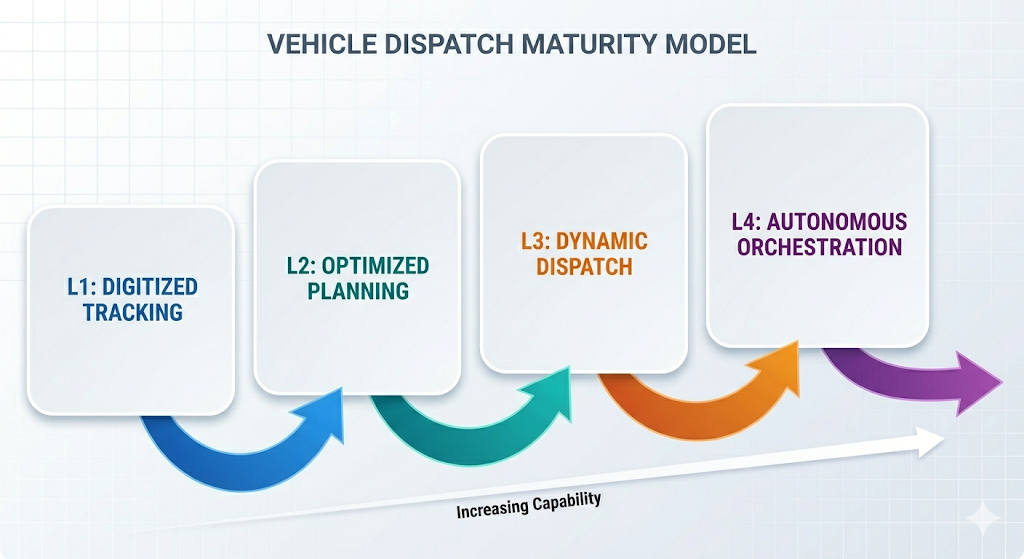
Level 1 – Digitized tracking
GPS dots on a map replace paper and radio. Dispatch remains manual, and routes are static. Adequate for compliance and safety visibility, not for throughput optimization.
Level 2 – Optimized planning
The system auto-assigns orders and the sequences stop algorithmically at the planned time. You get electronic proof of delivery (ePOD) and performance dashboards. The plan does not adapt once vehicles start moving.
Level 3 – Dynamic dispatch
Routes re-optimize mid-execution as cancellations, new pickups, and traffic shifts occur. Predictive ETAs and customer notifications are built in. Upstream system connectivity remains limited.
Level 4 – Autonomous dispatch orchestration
AI handles planning, real-time adaptation, and cross-partner execution across owned and contracted fleets. OMS, WMS, ERP, and carrier systems connect natively. Sustainability metrics and continuous outcome-based learning close the loop.
Most “AI-powered dispatch” claims come from Level 2 platforms with upgraded marketing language. Actual AI dispatch with continuous constraint-solving against hundreds of variables during live execution starts at Level 3 and reaches full maturity at Level 4.
Comparison of the Top 10 Vehicle Dispatch Software Platforms
| Software | Best For | Maturity Level | Pricing |
|---|---|---|---|
| Locus | Enterprise all-mile orchestration across captive and contract fleets | L4 | Custom pricing |
| FarEye | Configurable last-mile workflows for retail and e-commerce | L3 | Custom pricing |
| LogiNext | Route optimization for 3PLs and courier operators | L3 | Custom pricing |
| Shipsy | Dispatch automation for Middle East and South Asia operations | L3 | Custom pricing |
| Samsara | Telematics-first fleets prioritizing safety and compliance | L1-L2 | Custom pricing |
| DispatchTrack | Big-and-bulky last-mile with scheduling and ePOD | L2-L3 | Custom pricing |
| Onfleet | Mid-market last-mile delivery operations | L2-L3 | Starts at $619/month |
| Routific | AI route optimization for small delivery fleets | L2 | Starts at $150/month |
| Route4Me | SMB multi-stop route planning and dispatch | L1-L2 | Starts at ~$200/month |
| Tookan | Hyperlocal, task-based delivery dispatch | L2 | Starts at ~$29/month |
Vehicle Dispatch Software Feature Matrix
| Software | AI dispatch | Real-time re-optimisation | Multi-carrier orchestration | Driver app / ePOD | Telematics or hardware depth | Enterprise integrations | Best-fit fleet model |
| Locus | Advanced constraint-based dispatch | Yes | Yes, with ShipFlex | Yes | Integrates with fleet data sources | Strong fit for enterprise OMS, WMS, ERP, and CRM ecosystems | Captive plus contracted fleets across all-mile logistics |
| FarEye | Configurable and rule-led | Partial to strong, depending on workflow design | Yes, workflow-led | Yes | Limited compared with telematics-first platforms | Enterprise integration capabilities available; validate by system and region | Retail and e-commerce last-mile workflows |
| LogiNext | Strong route optimisation and auto-allocation | Yes for delivery operations | More operator-led than shipper-control-tower-led | Yes | Limited compared with telematics-first platforms | Validate ERP and WMS depth during procurement | 3PL, courier, and high-density rider fleets |
| Shipsy | Rule-led dispatch and supply chain automation | Yes for supported regional workflows | Yes, with regional carrier management strengths | Yes | Limited compared with telematics-first platforms | Validate global enterprise connector depth | MEA, India, and South Asia logistics networks |
| Samsara | Limited dispatch optimisation | Limited for dispatch-specific re-planning | No native shipper-side orchestration layer | Work-order and driver workflows available | Strong | Integrates widely as fleet data layer | Owned fleets prioritising safety, compliance, and vehicle visibility |
| DispatchTrack | Strong for scheduled delivery routing | Yes for last-mile appointment workflows | Limited compared with orchestration-first platforms | Yes | Limited | Validate ERP, WMS, and order-system requirements | Big-and-bulky, appliance, furniture, and home-install delivery |
| Onfleet | Auto-assignment and route optimisation | Yes for mid-market last-mile | Limited | Yes | Limited | API-led; enterprise depth varies by use case | Captive last-mile fleets with straightforward delivery flows |
| Routific | Route optimisation-focused | Limited compared with L3/L4 platforms | No | Yes | Limited | Limited | Small delivery fleets focused on route planning |
| Route4Me | Route planning-focused | Limited to moderate, depending on modules | No | Yes | Add-on dependent | Module and API dependent | SMB field service, distribution, and delivery |
| Tookan | Task auto-assignment | Limited to task-level dispatch | No | Yes | Limited | API-first for app embedding | Hyperlocal and marketplace task dispatch |
A feature matrix should not replace a proof-of-concept. For enterprise deployments, test each shortlisted platform against actual order data, delivery constraints, hub structures, exception patterns, and carrier contracts before final selection.
Vehicle Dispatch Software vs Route Optimization, TMS, Fleet Management, and Telematics
These categories often overlap in vendor messaging, but they solve different operational problems. Enterprise buyers should separate them during procurement so they do not buy a visibility tool when they need dispatch orchestration, or a route planner when they need a transportation control layer.
| Category | Primary job | Typical users | Core capabilities | What it does not fully solve |
| Vehicle dispatch software | Assign orders to vehicles, drivers, routes, and carriers; manage execution in real time | Dispatch managers, transport planners, logistics operations leaders | Order allocation, route sequencing, driver assignment, exception handling, live ETAs, ePOD, control tower visibility | Long-range freight procurement, vehicle maintenance, finance-led TMS workflows unless part of a broader platform |
| Route optimization software | Build efficient multi-stop routes | Route planners, local delivery managers | Stop sequencing, travel-time optimisation, capacity and time-window planning | Cross-carrier orchestration, settlement, deep ERP integration, and end-to-end transport execution |
| Transportation Management System (TMS) | Plan, execute, and manage transportation across modes and partners | Supply chain, logistics, finance, and transport teams | Freight planning, carrier allocation, tendering, rate management, execution, settlement, analytics | Vehicle-level telematics and in-cab safety unless integrated with fleet systems |
| Fleet management software | Manage vehicles, drivers, maintenance, safety, and compliance | Fleet managers, safety teams, compliance leaders | Vehicle tracking, maintenance schedules, driver behaviour, ELD/DVIR workflows, asset utilisation | Advanced order-to-vehicle dispatch optimisation and multi-carrier orchestration |
| Telematics platforms | Capture vehicle, driver, and asset data from hardware | Fleet, safety, compliance, and operations teams | GPS, dashcams, engine diagnostics, driver scores, geofencing, compliance data | Order allocation, dynamic routing, customer communications, and enterprise dispatch planning |
For complex enterprises, the target architecture is usually not “one tool for everything”. It is a connected operating stack: dispatch software orchestrates orders and execution; telematics supplies vehicle data; the TMS manages transportation processes; OMS/WMS/ERP systems provide order, inventory, and financial context.
The 10 Best Vehicle Dispatch Software Platforms
1. Locus
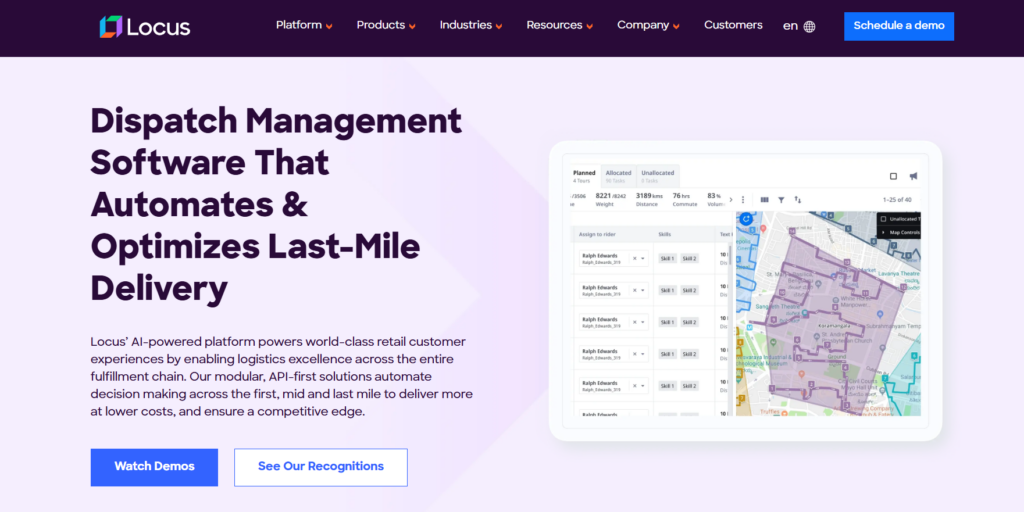
If your dispatch team is already stretched across multiple hubs, fleet types, and carriers, you need orchestration.
Locus is an agentic enterprise Transportation Management System (TMS) that orchestrates dispatch planning, execution, and settlement across first-, mid-, and last-mile logistics in one closed-loop platform.
The dispatch engine auto-assigns orders against 250+ real-world constraints, such as capacity, time windows, vehicle type, driver hours, fuel efficiency, cost targets, and SLAs. Plus, it continuously re-optimizes as conditions change during live execution.
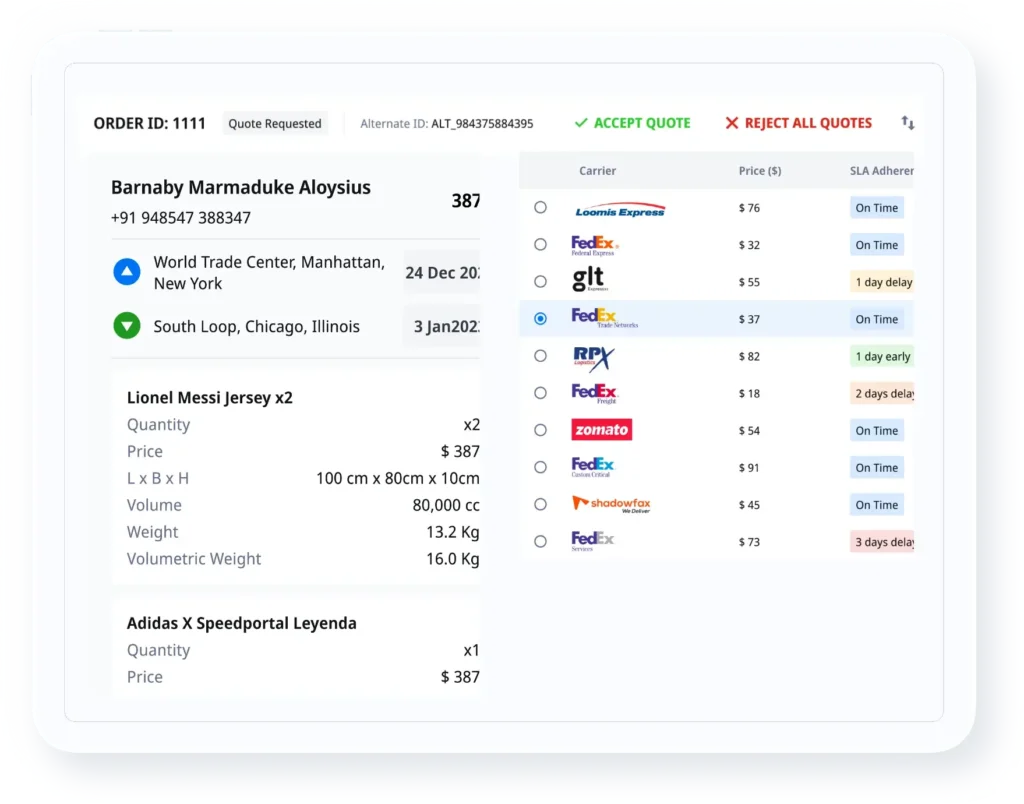
Through ShipFlex, you dispatch across 1,000+ pre-integrated carriers and 3PLs with automated selection, rate comparison, and tendering. The Driver Companion App syncs task lists, routing updates, ePOD capture, and exceptions directly into dispatch. That means a change made in the Control Tower reaches the driver without a phone call.
Key features of Locus
- AI dispatch planning: Automated route planning and optimization against 250+ constraints with continuous mid-execution re-optimization
- ShipFlex multi-carrier orchestration: Dispatch across 1,000+ pre-integrated carriers with automated tendering and rate comparison
- Control tower visibility: Predictive ETAs, exception alerts, and live dispatcher overrides across all shipments and carriers
- Driver Companion App: Dynamic task management, turn-by-turn routing, ePOD capture, and exception reporting synced to dispatch
- Enterprise integrations: Pre-built connectors to SAP, Oracle, Salesforce, and major OMS/WMS platforms
- Sustainability reporting: Per-route CO?, fuel consumption, and efficiency KPIs built into dispatch decisions
Locus pros
- Covers all-mile orchestration, including order capture through dispatch, execution, settlement, and analytics in one closed-loop system
- Proven at enterprise scale with 1.5 billion+ deliveries optimized, 30+ countries, 360+ enterprise deployments across retail, FMCG, e-commerce, and 3PL
- Cuts fuel costs, empty miles, and redundant trips through smarter planning
- Maximizes vehicle capacity and driver productivity by using AI to assign the best vehicle/driver for each job
See Locus Vehicle Dispatch in Action
This video demonstrates how ShipFlex manages carrier allocation across multiple shipping partners while maintaining operational oversight, shipment visibility, and delivery execution across enterprise logistics networks.
Locus cons
- Built for enterprise operations; fleets running fewer than 500 daily dispatches may find the platform more capable than required
Locus pricing
Custom enterprise pricing based on shipment volumes, number of delivery locations, fleet and carrier mix, integrations, and deployment scope.
Enterprises can request a demo to evaluate the platform and receive a tailored estimate.
Locus is best for
Retailers, FMCG/CPG manufacturers, e-commerce operators, and 3PL providers managing 1,000+ daily dispatches across multiple hubs, fleet types, and geographies.
2. FarEye
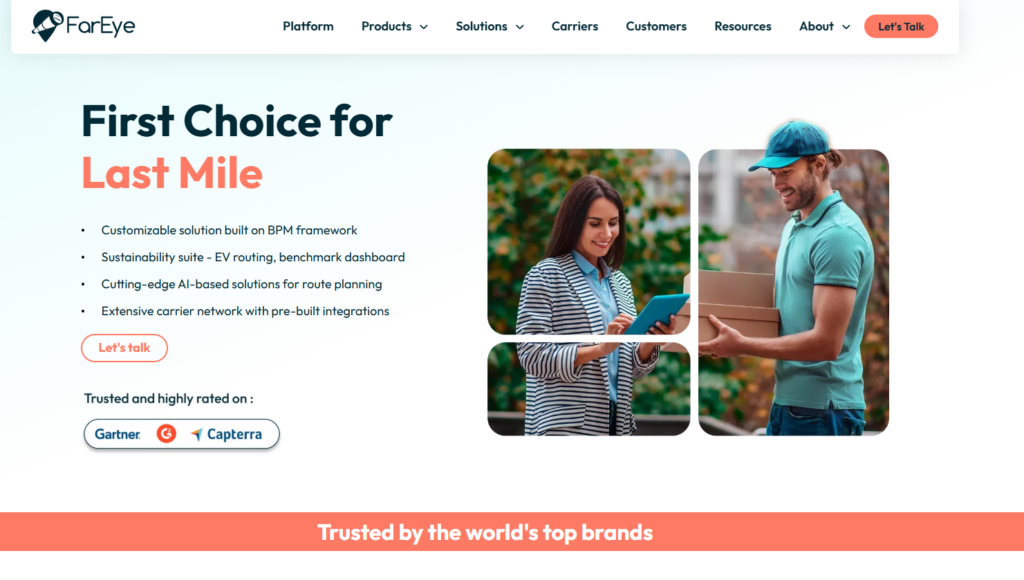
FarEye is a delivery management platform that provides low-code, workflow-driven dispatch for last-mile operations in retail and e-commerce. Its strength sits in customer experience visibility: delivery notifications, live ETAs, and post-delivery feedback loops are central to the platform.
Key features of FarEye
- Low-code dispatch workflow builder: Operations teams configure dispatch logic without engineering cycles
- Rule-based carrier and driver allocation: Assign shipments based on configurable rules tied to cost, capacity, and service requirements
- Real-time tracking dashboard: Monitor delivery progress with customer-facing notifications and live ETAs
- Post-delivery feedback and NPS capture: Collect delivery experience data to improve service quality
- Cross-dock and hub operations support: Manage scanning, sorting, and handoffs at distribution points
FarEye pros
- Non-technical ops teams can adjust dispatch logic for seasonal changes or new lanes without engineering support
- Strong customer-facing experience layer for B2C retailers competing on delivery communications
FarEye cons
- Dispatch logic is primarily rule-based rather than AI-optimized; highly dynamic, multi-constraint environments may outgrow the engine compared with orchestration-first L4 platforms
- Routing accuracy may not work well in some geographies (e.g., reliance on aerial distance) (Capterra)
- Certain core features are incomplete or not fully mature, which limits full utilization of the platform (Capterra)
FarEye pricing
Custom pricing based on shipment volume, delivery regions, and platform deployment requirements. Companies request a consultation or demo for a tailored quote.
FarEye is best for
Mid-to-large retailers and e-commerce companies that prioritize delivery experience configurability and workflow flexibility over AI-driven optimization depth.
Also read: Locus vs. FarEye: An Enterprise Logistics Platform Comparison (2026)
3. LogiNext
LogiNext is a logistics automation platform with strong route optimization and dispatch scheduling for FMCG, e-commerce, and courier verticals.
Its auto-allocation engine assigns orders to drivers based on proximity and capacity, and the mobile driver app supports high-frequency, multi-stop deliveries common in two-wheeler and rider fleets.
Key features of LogiNext
- Auto-allocation of orders: Assign deliveries to drivers based on proximity, vehicle capacity, and route density
- Route optimization engine: Plan high-density, multi-stop routes for urban and hyperlocal delivery networks
- Real-time tracking with mobile driver app: Monitor driver progress and delivery status from a centralized dashboard
- Carrier and partner performance dashboards: Track service levels and delivery metrics across partners
- Geocoding and address intelligence: Improve delivery accuracy in markets with non-standardized addressing
LogiNext pros
- Deep route optimization for operators managing high-frequency, high-density delivery networks
- Strong rider-facing mobile experience designed for two-wheeler and motorcycle fleets
LogiNext cons
- Architected for logistics operators running their own rider or driver fleets, rather than enterprise shippers orchestrating captive fleets plus contract carriers from a shipper-side control tower
- Enterprise ERP and WMS integration depth is less mature than orchestration-first L4 platforms
LogiNext pricing
Custom pricing based on fleet size, delivery volume, and platform modules. Contact the vendor for a quote.
LogiNext is best for
3PLs, courier companies, and hyperlocal operators running their own rider or driver fleets at high delivery density.
4. Shipsy
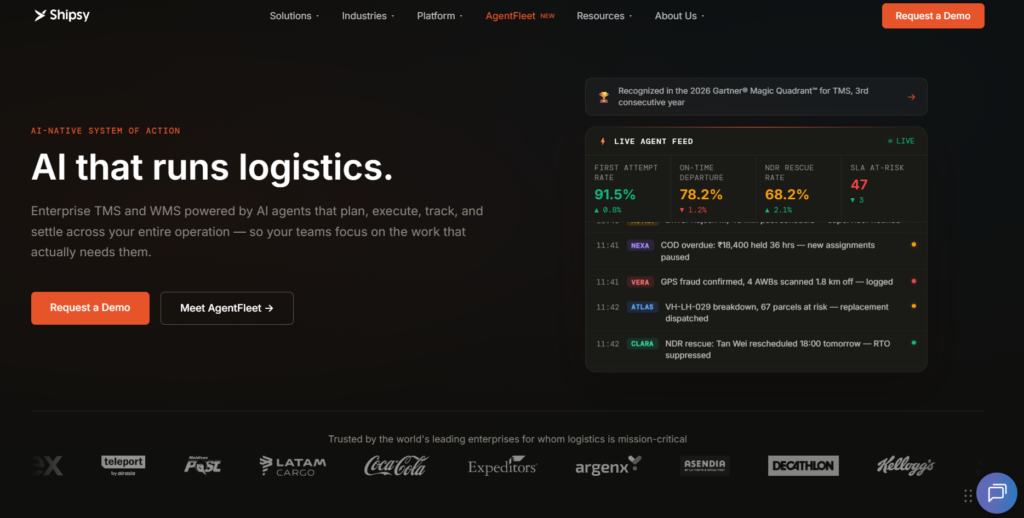
Shipsy is a supply chain automation platform providing dispatch, carrier management, and tracking capabilities with deep expertise across Middle Eastern and South Asian logistics networks. The platform handles non-standardized addressing, multi-modal freight corridors, and local carrier ecosystems that global platforms often manage superficially.
Key features of Shipsy
- Auto-assignment of orders: Allocate shipments to carriers and drivers based on operational rules and capacity
- Carrier management and rate card dashboards: Manage carrier contracts, rates, and performance from one interface
- Multi-modal tracking: Monitor shipments across domestic, cross-border, and international freight movements
- Regional address intelligence: Handle non-standard addressing common in MEA and South Asian markets
- Invoicing and compliance automation: Manage freight invoicing and regulatory documentation
Shipsy pros
- Strong regional fit; the platform understands non-standard addressing and local carrier workflows in markets where global platforms often underperform
- Established customer base across Middle Eastern and Indian logistics operations
Shipsy cons
- AI dispatch depth and pre-built enterprise connectors are lighter than L4 orchestration platforms used by global enterprises
- Fit for NA and EU enterprises with complex, high-SKU dispatch networks is less proven than regionally demonstrated capability
Shipsy pricing
Custom pricing based on shipment volume, modules, and geographic deployment. Contact the vendor for a quote.
Shipsy is best for
Mid-market logistics companies and enterprises with significant MEA, India, or Southeast Asia operations requiring regional carrier and addressing expertise.
5. Samsara

If safety, ELD compliance, and hardware-level fleet data sit at the top of your priority list, Samsara’s telematics stack is a good option.
Samsara is a fleet management and telematics platform offering GPS tracking, AI dashcams, driver safety scoring, and ELD compliance, with dispatch dashboards as a secondary capability. It is best understood as the visibility and compliance layer beneath a dedicated dispatch platform.
Key features of Samsara
- Real-time GPS tracking: Fleet-wide location visibility with geofencing and AI dashcam integration
- ELD compliance and DVIR workflows: Automated hours-of-service logging and vehicle inspection reporting
- Driver safety scoring and coaching: AI-powered alerts for distracted driving, drowsiness, and unsafe behaviors
- Basic dispatch dashboard: Route assignment and work order management for daily fleet coordination
- Hardware ecosystem: Plug-and-play OBD-II devices, indoor/outdoor cameras, and asset trackers
Samsara pros
- Reliable hardware-integrated telematics; the deepest vehicle-level data layer on this list
- Strong compliance and safety tooling for regulated industries including trucking and construction
Samsara cons
- AI-driven vehicle assignment, dynamic re-optimization, and cross-carrier orchestration require a separate dispatch layer
- Users report laggy mobile app, login delays, and bugs after updates (G2)
- Speed limits, routes, or crash alerts can be incorrect at times (G2)
Samsara pricing
Custom pricing based on fleet size, hardware modules, and contract terms.
Samsara is best for
Fleets where compliance, safety, and telematics are the primary priority and dispatch optimization is handled by an adjacent, dedicated system. Enterprise operations typically pair Samsara with a dispatch platform like Locus.
6. DispatchTrack
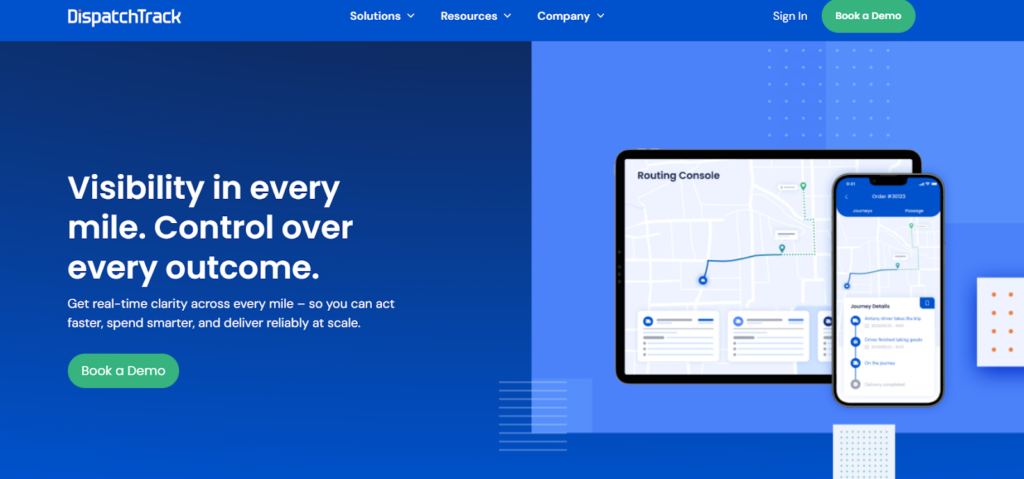
DispatchTrack is a last-mile delivery management platform focused on scheduling, routing, and ePOD for big-and-bulky and home delivery operations. Its self-serve customer scheduling widgets and narrow appointment-window accuracy are among the strongest capabilities in the category.
Key features of DispatchTrack
- Self-serve customer scheduling: Offer customers narrow appointment windows with real-time availability
- Route planning for install-required deliveries: Optimize routes accounting for two-person crews, install time, and equipment requirements
- ePOD with documentation: Capture photos, signatures, and damage notes at delivery
- Customer communications: Send live ETA updates and delivery notifications throughout the fulfillment journey
- Delivery performance analytics: Track on-time rates, appointment accuracy, and customer satisfaction scores
DispatchTrack pros
- Mature ePOD and customer communication experience designed for scheduled home delivery
- Self-serve scheduling reduces inbound call volume and improves delivery success rates
DispatchTrack cons
- Multi-carrier orchestration and AI dispatch depth are lighter than L4 orchestration platforms
- Less relevant for high-frequency parcel, grocery, or hyperlocal dispatch models where speed and density matter more than appointment windows
DispatchTrack pricing
Custom pricing based on delivery volume, feature modules, and deployment scope. Contact the vendor for a quote.
DispatchTrack is best for
Retailers and 3PLs running big-and-bulky, appliance, or home-install last-mile delivery logistics where appointment accuracy and installation coordination define service quality.
7. Onfleet
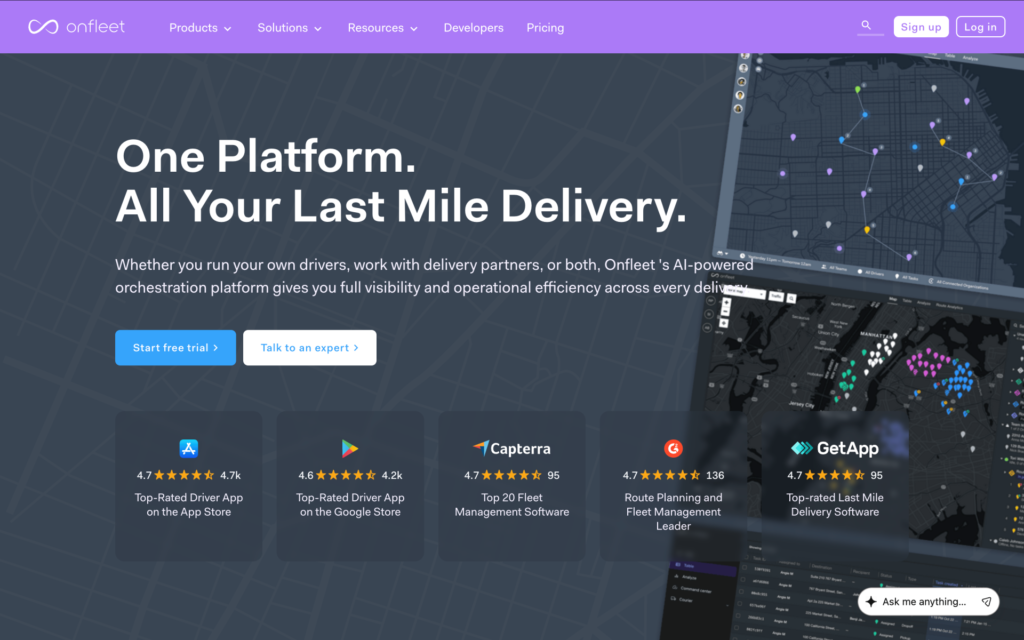
Onfleet is a last-mile delivery management platform offering auto-assign dispatch, driver tracking, route optimization, and ePOD, with a training-light interface for mid-volume delivery operations. Food, grocery, pharmacy, and local courier companies are its core users.
Key features of Onfleet
- Auto-assign dispatch: Allocate deliveries based on driver proximity and capacity
- Real-time tracking with customer-facing links: Share live delivery status and ETAs with recipients
- ePOD capture: Record photos, signatures, and barcode scans at delivery
- Customer notifications: Automated SMS and email updates at each delivery stage
Onfleet pros
- Fast time-to-value; teams can be dispatching within days
- Clean customer-tracking experience with branded delivery links available out of the box
Onfleet cons
- Lacks multi-constraint AI, multi-leg visibility, and mixed-fleet orchestration required for enterprise retail or 3PL workloads
- ERP and WMS integration depth is limited compared to enterprise-grade platforms
- Performance reporting can be difficult to customize and interpret
Onfleet pricing
Enterprises can choose from these pricing plans: Launch at $619/month, Scale at $1,349/month, and Enterprise at $3,099/month. A 14-day free trial is also available.
Onfleet is best for
Mid-market last-mile operations running 50-500 daily deliveries with a captive driver fleet and straightforward routing requirements.
8. Routific
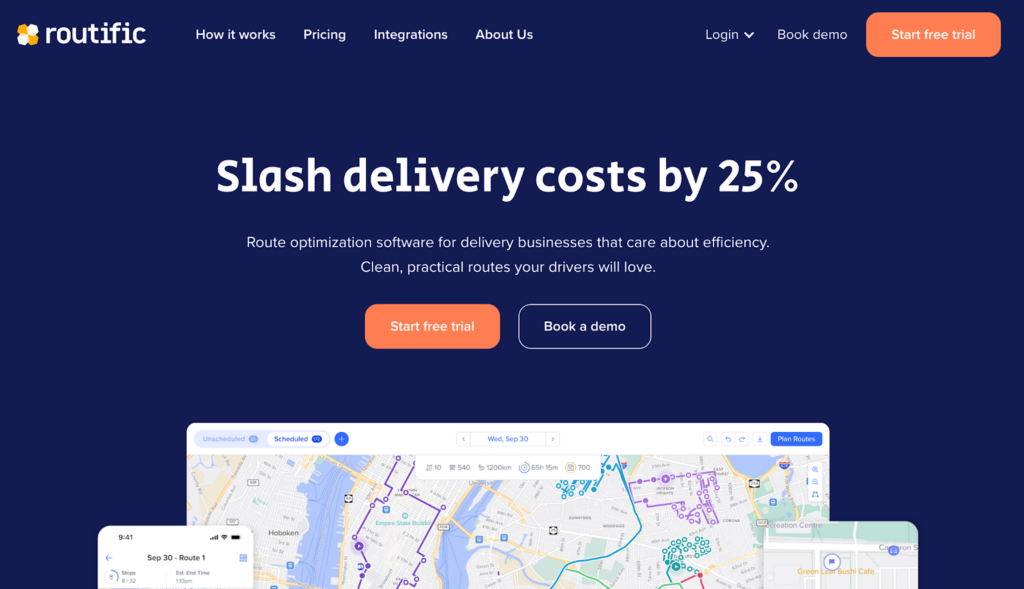
If route sequencing is your single biggest manual drain, Routific solves that one problem well. Routific is a cloud-based route optimization platform for small delivery fleets, focused on fast, high-quality multi-stop route planning with a lightweight dispatcher interface and mobile driver app.
Key features of Routific
- AI-driven multi-stop route optimization: Sequence stops efficiently across constraints including time windows, capacity, and driver breaks
- Driver mobile app: Receive route updates and capture delivery status in real time
- Customer delivery notifications: Send automated ETA updates to recipients
- Drag-and-drop route editing: Adjust planned routes manually when needed
Routific pros
- Fast, clean route optimization experience with a strong quality-to-complexity ratio
- Minimal setup required, making it suitable for small teams without dedicated IT support
Routific cons
- No multi-carrier orchestration or enterprise-grade system integrations
- Limited control tower and exception management capabilities compared to enterprise platforms
- Not designed for operations requiring captive-plus-contract fleet coordination
Routific pricing
The tool follows a tiered, volume-based model, starting with a free plan for up to 100 orders/month, then a flat $150/month for 101-1,000 orders.
Orders beyond this are charged per order: $0.15 (1,001-2,000), $0.13 (2,001-3,000), $0.10 (3,001-5,000), $0.08 (5,001-10,000), $0.05 (10,000-20,000), and $0.03 (20,001-50,000). Custom pricing is available for volumes above 50,000 orders per month.
Routific is best for
Small delivery fleets and growing DTC brands focused on daily route optimization without enterprise-scale dispatch requirements.
9. Route4Me
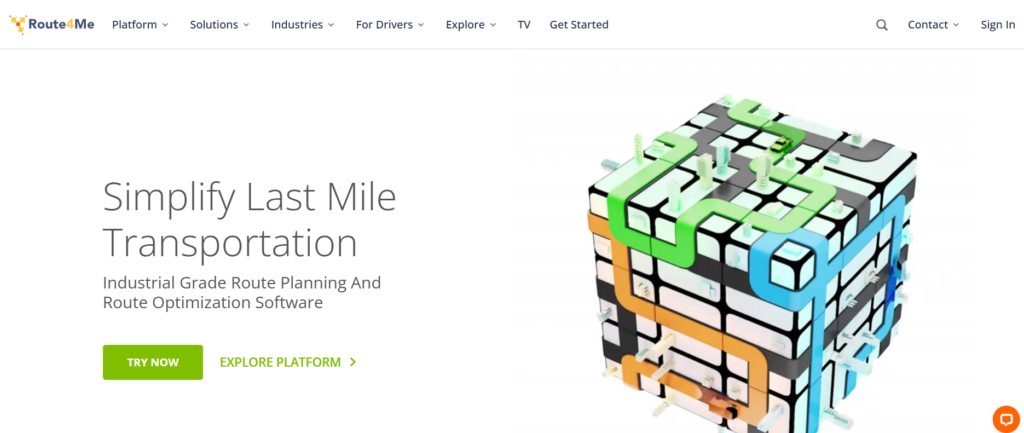
If you run a smaller fleet and your primary pain is sequencing 30-80 stops per driver, Route4Me is a pragmatic fit.
Route4Me is an automated route planning and dispatch platform for SMB field service, distribution, and delivery fleets. Strengths include quick multi-stop route creation, drag-and-drop dispatching, and a large ecosystem of add-on modules.
Key features of Route4Me
- Multi-stop route optimization: Plan routes for up to hundreds of stops with territory awareness
- Drag-and-drop dispatch and reassignment: Adjust driver assignments visually from the dispatcher dashboard
- Driver mobile app: Turn-by-turn navigation with real-time status updates
- Territory planning and recurring routes: Create templates for repeat delivery zones
- Module marketplace: Add capabilities such as automated tracking, telematics, and reporting as needed
Route4Me pros
- Transparent SMB pricing with self-serve onboarding
- Wide module catalog allows small teams to add capabilities incrementally
- Serves over 35,000 users across delivery, field service, and sales operations
Route4Me cons
- AI dispatch and real-time orchestration depth are lighter than enterprise L3 and L4 platforms
- Pricing scales through add-on modules, which can become unpredictable as operational needs expand
- Fundamentally a route planning tool with dispatch features added; lacks native AI orchestration and predictive dispatching
Route4Me pricing
The platform uses a pricing model that varies depending on the number of users, selected feature packages, and the size of the business. For detailed pricing, reach out to their sales team.
Route4Me is best for
SMB field service, distribution, and delivery fleets that need affordable, self-serve multi-stop route planning.
10. Tookan
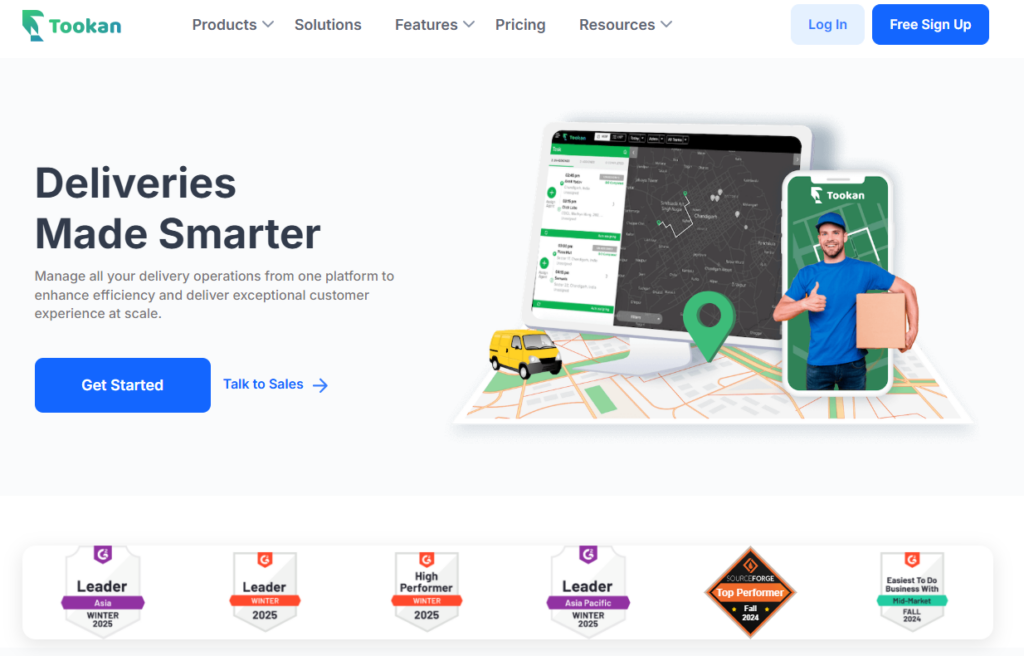
Tookan, from Jungleworks, is a task-based dispatch platform for on-demand, hyperlocal, and marketplace delivery operations. Each delivery is modeled as a discrete task assigned to an agent, with API-first architecture designed for embedding dispatch into existing app workflows.
Key features of Tookan
- Task-based auto-assignment: Allocate deliveries to agents by proximity and availability
- Agent tracking with geofencing: Monitor delivery agent locations and set geographic boundaries
- API-first architecture: Embed dispatch functionality into existing marketplace or delivery apps
- Customer tracking links and notifications: Provide real-time delivery visibility to end customers
- Customizable workflows: Configure task types, statuses, and escalation rules
Tookan pros
- Developer-friendly APIs make it straightforward to embed dispatch inside existing marketplace apps
- Flexible task-based model suits on-demand, single-pickup delivery workflows
Tookan cons
- Route-level optimization and enterprise integrations are lighter than L3 and L4 platforms
- Not designed for shippers orchestrating captive plus contract fleets at enterprise scale
Tookan pricing
Tookan provides a tiered pricing structure, beginning with the Early Stage plan at $49/month, followed by the Startup plan at $129/month, and the Growth plan at $299/month.
For businesses with larger-scale or specialized requirements, a custom Enterprise plan is available with flexible pricing and features.
Tookan is best for
On-demand, hyperlocal, and marketplace delivery operators managing task-based dispatch rather than complex multi-stop routing.
Security and Compliance Requirements for Enterprise Dispatch Software
Vehicle dispatch software processes commercially sensitive and operationally critical data: customer addresses, delivery windows, driver locations, carrier rates, exception notes, proof-of-delivery files, and system integrations into order, warehouse, and ERP environments. For enterprise procurement, security review should run in parallel with functional evaluation.
At minimum, ask each shortlisted vendor for current documentation covering:
- SOC 2 evidence: Request the latest SOC 2 Type II report or equivalent third-party assurance documentation where available. Do not accept a verbal “SOC 2-ready” statement as proof; procurement and security teams should review the report period, scope, auditor, controls, and exceptions.
- ISO 27001 evidence: If the vendor claims ISO 27001 certification, request the current certificate, certificate scope, issuing body, expiry date, and whether the dispatch platform, cloud environment, support operations, and development processes are covered.
- GDPR readiness: For EU or multinational fleet operations, validate the data processing agreement, sub-processor list, data subject request workflows, breach notification process, retention controls, and cross-border transfer mechanisms.
- Data residency: Confirm where production data, backups, logs, support data, analytics data, and disaster recovery environments are hosted. Data residency is especially important for regional deployments in the EU, Middle East, India, Southeast Asia, and North America where customer, employee, and location data may be subject to local rules or contractual restrictions.
- Access controls: Validate role-based access control, single sign-on, multi-factor authentication, audit logs, password policies, and segregation between customer environments.
- Integration security: Review API authentication, encryption in transit and at rest, webhook security, rate limiting, secrets management, and controls for ERP/WMS/OMS integrations.
- Operational resilience: Ask for uptime commitments, incident response procedures, disaster recovery objectives, backup frequency, and support escalation models by region.
Security claims should be verified directly with the vendor during procurement. Certification status, audit scope, hosting regions, and sub-processors can change over time, so buyers should request current evidence rather than relying on old sales collateral.
Implementation Timeline and Go-Live Expectations
Implementation timelines vary by fleet size, integration scope, data quality, number of regions, and the amount of process change required. Treat any fixed timeline offered before discovery as a directional estimate, not a committed delivery plan.
| Deployment complexity | Typical operating profile | Expected implementation pattern | What usually drives timeline |
| Light deployment | Single region, captive fleet, limited order sources, standard workflows | Configuration, user setup, basic route rules, driver app rollout, limited integrations | Data cleanup, dispatcher training, driver onboarding |
| Mid-complexity deployment | Multiple hubs, several vehicle types, OMS/WMS integration, customer notifications, ePOD | Phased rollout by hub or region, integration testing, pilot runs, KPI baselining | Integration readiness, route constraint modelling, exception workflow design |
| Enterprise deployment | Multi-country operations, captive plus contract fleets, ERP/WMS/OMS/carrier integrations, complex SLA tiers | Discovery, solution design, integration build, historical data validation, pilot, controlled scale-up, governance cadence | Master data quality, regional process variation, carrier onboarding, security review, change management |
| Transformation programme | All-mile orchestration, multiple business units, settlement, analytics, sustainability reporting, control tower redesign | Programme-led deployment with staged value releases and executive steering | Operating model redesign, cross-functional alignment, global template versus local variation |
A robust go-live plan should include:
- Baseline metrics before deployment, including planning time, on-time delivery, failed delivery rate, cost per delivery, vehicle utilisation, and exception volume
- Historical order and route data review to model real constraints rather than theoretical constraints
- Pilot geography selection based on volume, representativeness, and operational readiness
- Parallel run or shadow planning to compare system recommendations with current dispatcher decisions
- Driver and dispatcher training with feedback loops before full cutover
- Post-go-live hypercare covering SLA performance, exception patterns, integration stability, and adoption metrics
- A roadmap for adding more hubs, carriers, use cases, and analytics after the first successful deployment
How to Validate Vendor Fit by Region and Scale
Customer references are most useful when they resemble your operating reality. Ask vendors for references by geography, industry, delivery density, fleet model, and daily dispatch volume.
For example, an EU grocery operation should not rely solely on a reference from a North American field-service fleet. A Middle East big-and-bulky retailer should validate regional address handling, appointment scheduling, and partner-carrier execution. A 3PL expanding across Southeast Asia should test multi-client workflows, carrier performance reporting, and local exception management.
Use these reference questions:
- Is the reference within 20% of your daily order volume or planned growth volume?
- Does it operate in the same geography or a market with similar address, traffic, labour, and compliance conditions?
- Does it use captive fleets, contract carriers, gig drivers, or a combination similar to yours?
- Which systems did it integrate with: OMS, WMS, ERP, CRM, telematics, BI, carrier APIs?
- What was the actual go-live sequence, and what took longer than expected?
- Which KPIs improved after implementation, and how were those KPIs measured?
- What support model is used in your region and time zone?
Enterprise Buyer Checklist: 10 Questions to Ask Every Vehicle Dispatch Vendor
Before signing a multi-year contract, take every shortlisted vendor through these questions. Weak answers here signal implementation risk:
- How many orders can the dispatch engine solve in one cycle, and against how many constraints? Watch for vague “powered by AI” answers without a constraint count
- Does the platform re-optimize mid-execution when cancellations, exceptions, or traffic hit, or only at plan time?
- Which OMS, WMS, and ERP systems have pre-built connectors with SAP, Oracle, Salesforce, Blue Yonder, Manhattan? Ask for named references
- How does the platform dispatch across captive fleets and contract carriers from one control tower? Rate comparison, tendering, and carrier performance tracking should be native, not bolted on
- Does dispatch track per-route CO?, fuel consumption, and efficiency, and feed those metrics back into optimization decisions?
- What is the deployment model: SaaS, private cloud, on-prem? Confirm data residency, SOC 2, ISO 27001, and GDPR posture
- Who runs this platform at your scale and in your geography? Ask for customer references within 20% of your daily dispatch volume
- Is pricing per vehicle, per order, per user, or platform license? What scales unpredictably at renewal?
- What is the realistic go-live timeline for an operation like yours? Validate against two reference customers
- What plan-vs-actual reporting, custom KPIs, and analytics depth come standard? If your CFO will ask for ROI data, your dispatch platform needs to manage delivery exceptions and produce those numbers
ROI Benchmarks to Evaluate Before Buying Vehicle Dispatch Software
The strongest business case for vehicle dispatch software comes from a baseline-versus-improved operating model, not from generic vendor ROI claims. Before buying, measure current performance for at least one representative period and one peak period, then ask vendors to model expected improvement using your own data.
| ROI area | Baseline metric to capture | How dispatch software can affect it | Buyer validation method |
| Planning productivity | Dispatcher hours spent planning routes, assigning vehicles, and resolving first-wave issues | Automated assignment and route sequencing can reduce manual planning effort and free dispatchers for exception management | Run a sample planning cycle using historical orders and compare planning time, route quality, and manual edits |
| Cost per delivery | Total delivery cost divided by successful deliveries, segmented by region, fleet type, and service tier | Better route density, carrier selection, capacity utilisation, and fewer failed attempts can lower delivery cost | Compare plan-vs-actual cost by route, vehicle type, carrier, and delivery promise |
| SLA adherence | On-time delivery rate by customer segment, time window, route, hub, and carrier | Real-time re-optimisation and predictive ETAs can reduce preventable SLA misses | Test the platform against disruption scenarios: cancellations, traffic, breakdowns, late warehouse release |
| Fuel and mileage | Total kilometres, fuel consumption, empty miles, and route overlap | Optimised sequencing and load planning can reduce unnecessary distance and empty running | Compare historical routes with optimised routes under identical constraints |
| Vehicle utilisation | Fill rate, stops per route, deliveries per driver, idle time, and fleet availability | Constraint-aware dispatch can improve capacity usage and reduce underloaded runs | Review utilisation before and after pilot deployment by vehicle class and hub |
| Failed delivery reduction | First-attempt success rate, customer-not-available events, wrong-address exceptions, and reschedules | Better ETA communication, appointment control, and exception workflows can improve delivery success | Analyse failed delivery reasons and model which ones dispatch software can influence |
| Carrier performance | Cost, acceptance rate, SLA performance, claims, and exception rates by carrier | Multi-carrier orchestration can route volume towards better-performing partners | Build carrier scorecards and compare allocation recommendations against current dispatch rules |
| Sustainability reporting | CO?, distance, fuel, vehicle class, and route efficiency by shipment or route | Dispatch optimisation can support emissions visibility and operational efficiency programmes | Confirm whether sustainability metrics are calculated, reported, and fed back into planning decisions |
For finance approval, connect operational metrics to P&L lines: labour cost, fuel cost, carrier spend, failed delivery cost, customer service cost, penalties, returns, and revenue protected through better delivery reliability.
Best Vehicle Dispatch Software by Industry Use Case
Different industries stress dispatch systems in different ways. A platform that performs well for scheduled furniture delivery may not be the right fit for grocery, pharmacy, or high-density parcel dispatch.
Retail
Retailers need dispatch software that connects stores, fulfilment centres, customer promises, and regional delivery partners. Key requirements include time-window management, customer notifications, store-to-door visibility, carrier allocation, and exception handling during promotion-led demand spikes.
FMCG/CPG
FMCG and CPG operations need high route density, outlet sequencing, territory logic, sales-beat alignment, distributor visibility, and cold-chain or service-level constraints where applicable. Dispatch decisions often need to balance delivery efficiency with merchandising, replenishment, and retailer service commitments.
E-commerce
E-commerce dispatch prioritises speed, scale, failed-delivery reduction, and visibility across captive fleets, 3PLs, and carrier partners. The strongest fit is a platform that can manage high order volatility, live customer ETAs, returns, partial delivery exceptions, and peak events.
Courier and parcel
Courier networks require dense multi-stop routing, rapid sortation-to-dispatch handoffs, rider or driver productivity, scan events, and reliable proof of delivery. Route optimisation quality and mobile execution experience are critical.
3PL
3PLs need multi-client configurability, carrier and fleet performance reporting, customer-specific SLAs, billing visibility, and operational flexibility across industries. Dispatch software should support client-level rules without creating operational fragmentation.
Big-and-bulky delivery
Big-and-bulky operations need appointment scheduling, two-person crew planning, installation time, product handling constraints, damage documentation, and customer communication. Time-window reliability matters more than pure stop density.
Pharmacy and healthcare delivery
Pharmacy delivery requires chain-of-custody discipline, time sensitivity, secure proof of delivery, customer communication, and exception escalation. Buyers should validate compliance workflows and data handling carefully.
Grocery
Grocery dispatch needs short delivery windows, cold-chain awareness, high order volatility, customer availability management, and rapid re-optimisation. Route density, batching, and real-time ETA accuracy directly affect margin and customer experience.
Hyperlocal and marketplace delivery
Hyperlocal models depend on fast task assignment, rider proximity, app integration, and status updates. Task-based platforms may work well at early scale, but enterprises should validate whether the platform can handle multi-stop optimisation, partner fleets, and analytics as density grows.
Choosing the Right Vehicle Dispatch Software
SMB and mid-market operations are well served by Onfleet, Routific, Route4Me, and Tookan. Each offers fast time-to-value for teams managing mid-volume, single-fleet dispatch.
Enterprise shippers typically narrow the field to Locus, FarEye, LogiNext, Shipsy, Samsara, and DispatchTrack, each with a distinct niche shaped by geography, fleet type, and operational focus.
Among enterprise platforms, Locus is the only one operating at Level 4 of the Vehicle Dispatch Maturity Model. It includes AI dispatch against 250+ constraints, ShipFlex multi-carrier orchestration across 1,000+ pre-integrated carriers, a unified control tower, and enterprise integrations with SAP, Oracle, and Salesforce.
Locus is also proven at 1.5 billion+ deliveries across 30+ countries, with named enterprise customers including Lenskart, Nestlé, Blue Dart, and Jüsto, and now backed by Ingka Group (IKEA) following the October 2025 acquisition.
See how Locus’s dispatch orchestration performs against your actual volume, lanes, and fleet mix. Schedule a demo with Locus today.
Source Notes for Vendor Claims, Pricing, and Customer Fit
Vendor capabilities, pricing pages, certification status, and customer references can change without notice. Use this article as a structured shortlist, then validate the following during procurement:
- Product capability claims: Confirm in a live workflow demonstration using your own order, hub, vehicle, SLA, and carrier constraints.
- Pricing: Publicly listed pricing is included where available in this guide. Custom pricing should be validated with a written quote that identifies billing units, implementation fees, integration costs, support tiers, overage rules, and renewal mechanics.
- Review snippets: Third-party review references included in this article are cited directly where used. Treat individual review snippets as qualitative signals, not universal proof of platform performance.
- Customer fit: Ask vendors for references in the same geography, industry, fleet model, and volume band as your operation.
- Security and compliance: Request current SOC 2, ISO 27001, GDPR, data residency, and sub-processor documentation directly from each vendor. Do not rely on outdated collateral.
- Implementation timelines: Require a deployment plan tied to your integration architecture, data readiness, number of hubs, carrier onboarding requirements, and regional rollout sequence.
Recommended Structured Data for This Page
For search and content governance teams, this page is a strong candidate for structured data implementation using:
- ItemList and ListItem schema for the ranked list of vehicle dispatch software platforms
- SoftwareApplication schema for each software platform where product-level information is available
- Product schema where the CMS requires product comparison markup and pricing or offer data is validated
- FAQPage schema for the FAQ section below
Only mark up claims that are visible on the page and verifiable. Avoid adding certification, rating, pricing, or review schema unless the underlying evidence is current and approved for publication.
Frequently Asked Questions (FAQs)
What is vehicle dispatch software and how is it different from fleet management software?
Vehicle dispatch software assigns orders to vehicles, sequences routes, and coordinates execution in real time. On the other hand, fleet management software focuses on the vehicles themselves with telematics, maintenance, compliance, and safety. Enterprise operations typically run both: dispatch handles optimization and orchestration, while fleet management provides the hardware and compliance layer.
How does AI reduce cost per delivery compared with manual dispatch?
AI dispatch evaluates hundreds of constraints, such as capacity, time windows, vehicle type, driver hours, cost targets, and SLAs simultaneously, then re-optimizes mid-execution as conditions change. That typically compresses planning time from hours to minutes, increases stops per route, and reduces empty miles. The largest gains appear during peak-volume events where manual coordination breaks down.
What integrations should enterprise buyers look for in vehicle dispatch software?
At minimum: OMS and WMS connectors (Blue Yonder, Manhattan, Oracle), ERP connectors (SAP, Oracle, Microsoft Dynamics), CRM sync (Salesforce), and carrier APIs for contract-fleet tendering. If the vendor cannot name pre-built connectors, you are evaluating an integration project, not a platform.
How does dispatch software handle unexpected events like cancellations or breakdowns mid-route?
Level 3 and Level 4 platforms re-optimize dynamically: the engine recomputes affected routes, notifies drivers through the mobile app, updates customer ETAs, and flags exceptions to the control tower. Level 1 and Level 2 platforms require manual dispatcher intervention, which is where most SLA misses occur during peak volume.
How is Locus different from other vehicle dispatch platforms?
Locus is the only platform on this list operating at Level 4 of the Vehicle Dispatch Maturity Model. The platform includes dispatch against 250+ constraints, ShipFlex orchestration across 1,000+ pre-integrated carriers, real-time mid-execution re-optimization, and native enterprise integrations. For enterprise shippers orchestrating captive and contract fleets from one control tower, that depth is the differentiator.
What security and compliance requirements should enterprises check before buying vehicle dispatch software?
Enterprise buyers should request current evidence for SOC 2, ISO 27001, GDPR readiness, data residency, encryption, access controls, audit logging, incident response, disaster recovery, and sub-processor management. Certification claims should be reviewed by security and procurement teams using current reports or certificates, not verbal assurances. For EU and multinational fleets, confirm how customer, driver, location, proof-of-delivery, and integration data is stored, processed, transferred, retained, and deleted.
How long does vehicle dispatch software implementation usually take?
Implementation depends on fleet size, number of hubs, integrations, data quality, carrier onboarding, security review, and change-management complexity. A light single-region deployment can move faster than a multi-country enterprise rollout with OMS, WMS, ERP, carrier, telematics, and analytics integrations. Buyers should ask each vendor for a phased plan covering discovery, configuration, integration testing, pilot, training, go-live, and post-launch hypercare, then validate the timeline with reference customers of similar scale and geography.


General
10 Best Shipping and Logistics Software Platforms for Enterprise Operations in 2026

Apr 28, 2026
Compare shipping and logistics software platforms for enterprise operations. Evaluate AI dispatch, route optimization, carrier management, and real-time visibility.
Read more
General
What Is a Logistics Control Tower and Why Do Enterprises Need One?

Apr 28, 2026
Learn what a logistics control tower is, how it works, and why retail and CPG enterprises need one to unify visibility, control costs, and orchestrate last-mile delivery in real time.
Read moreInsights Worth Your Time



















10 Best Vehicle Dispatch Software Platforms for Enterprise Fleets in 2026