


General
10 Best Shipping and Logistics Software Platforms for Enterprise Operations in 2026
Key Takeaways
- Shipping and logistics software centralizes transportation planning, carrier management, route optimization, and shipment visibility into a single platform.
- Enterprise logistics teams use these platforms to reduce cost per delivery, improve on-time performance, and consistently meet SLA commitments across multi-carrier, multi-region networks.
- Not all logistics software serves the same operational layer. Freight TMS tools (e.g., Oracle OTM, Blue Yonder), visibility platforms (e.g., project44), and orchestration engines (e.g., Locus) address different needs.
- Choosing the right platform requires evaluating AI dispatch maturity, dynamic route optimization, carrier network coverage, ERP/WMS integration depth, and support for industry-specific workflows.
- Locus operates as an agentic TMS, combining AI-powered dispatch, ShipFlex multi-carrier orchestration, and real-time control tower visibility. It has delivered $320M+ in logistics cost savings across 1.5B+ deliveries in 30+ countries.
76% of logistics technology transformations fail to meet budget, timeline, or KPI targets, according to Gartner. The gap between selecting a platform and realizing measurable ROI remains the central risk in logistics software procurement.
This guide compares 10 shipping and logistics software platforms, including Locus, FarEye, LogiNext, Shipsy, Alpega TMS, MercuryGate, Oracle OTM, Blue Yonder, Descartes, and project44.
These have been evaluated through the lens of what matters to enterprise logistics teams: AI-driven dispatch, real-time visibility, multi-carrier flexibility, and vertical fit for retail, FMCG, e-commerce, 3PL, and CPG operations.
What to Look for in Enterprise Shipping and Logistics Software
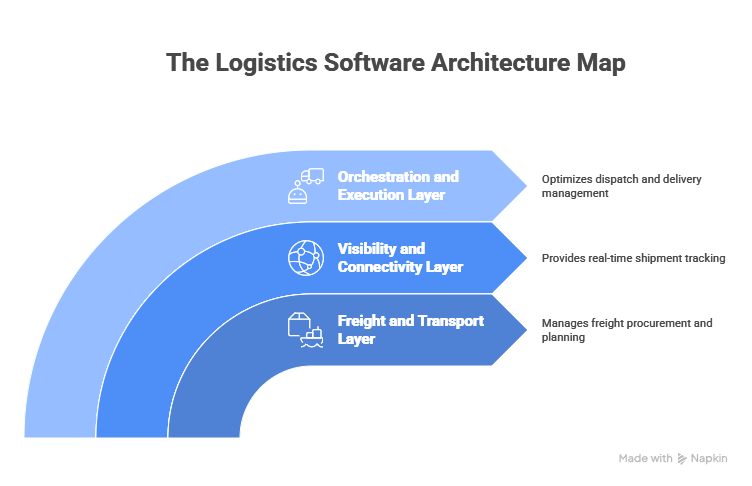
Shipping and logistics software is not a single product category. Platforms that manage freight tendering and carrier contracts solve a different problem than platforms that orchestrate last-mile dispatch and route optimization. Comparing them side by side creates false equivalencies.
Enterprise buyers evaluating shipping and logistics software should consider three operational layers:
- Freight and transport layer: Platforms focused on freight procurement, multi-modal planning, carrier tendering, and freight audit: Oracle OTM, Blue Yonder, Alpega TMS, MercuryGate, Descartes
- Visibility and connectivity layer: Platforms focused on real-time shipment tracking across carriers and modes: project44
- Orchestration and execution layer: Platforms that combine AI dispatch, route optimization, carrier allocation, and delivery management into a closed-loop system: Locus, FarEye, LogiNext, Shipsy
What enterprises typically evaluate
- AI-powered dispatch and route optimization: Constraint-based planning across traffic, capacity, time windows, and service commitments
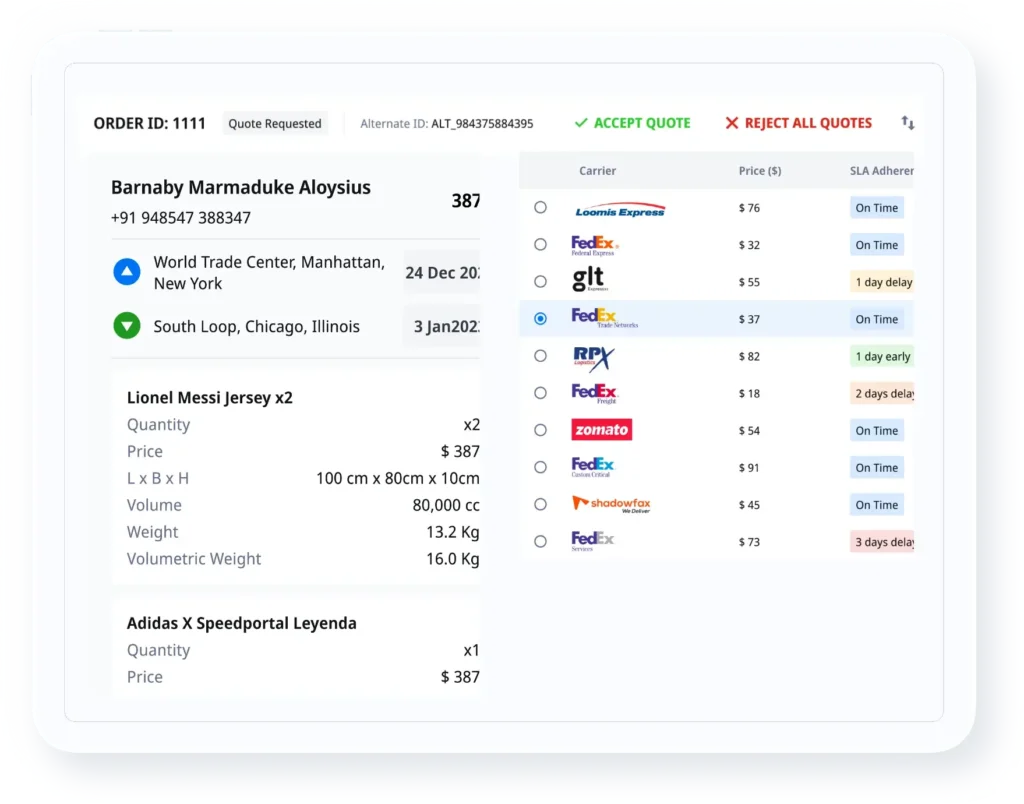
- Multi-carrier management: Dynamic carrier selection based on cost, SLA, and shipment type; ability to onboard new carriers without custom integration work
- Real-time shipment visibility: Predictive ETAs, exception alerts, and SLA-aware tracking across carriers and fleets from a single dashboard
- ERP, WMS, and OMS integration depth: API-first connectivity with SAP, Oracle, and warehouse systems to keep shipping decisions aligned with fulfillment workflows
- Enterprise scalability: Support for growing shipment volumes, peak-season surges, and multi-region expansion without adding manual planning overhead
10 Best Shipping and Logistics Software Platforms for 2026
Several platforms help enterprises manage shipping and logistics operations across carriers, fleets, and delivery networks. The comparison table below provides a side-by-side view, followed by detailed evaluations of each platform.
| Software | Best For | Key Capabilities | Pricing |
|---|---|---|---|
| Locus | Enterprise logistics orchestration across last-mile and all-mile delivery | AI dispatch (250+ variables)Multi-carrier orchestration (ShipFlex)Route optimizationControl tower visibility | Custom pricing |
| FarEye | Last-mile visibility and delivery experience management | Multi-carrier orchestrationDelivery trackingCustomer communicationWorkflow automation | Custom pricing |
| LogiNext | Delivery management and fleet tracking across QSR, CEP, and retail | Route planningLive trackingDelivery automationAPI-first architecture | Custom pricing |
| Shipsy | Cross-border freight and delivery management in MENA/APAC | Freight procurementShipment trackingDelivery managementMultimodal visibility | Custom pricing |
| Alpega TMS | European freight procurement and carrier tendering | Freight tenderingCarrier network (85K+)Transport executionMultimodal planning | Custom pricing |
| MercuryGate (Infios) | Multi-modal freight TMS and managed transportation services | Multi-modal planningFreight auditCarrier tendering | Custom pricing |
| Oracle OTM | Global trade and freight planning within Oracle ecosystem | Global trade complianceFreight paymentTransportation planningERP integration | Custom pricing |
| Blue Yonder TMS | Demand-driven supply chain planning with integrated TMS | Load optimizationDemand planningCarrier managementWMS integration | Custom pricing |
| Descartes | Compliance, customs, routing, and global carrier connectivity | Customs complianceRouting and mobileGlobal Logistics NetworkFleet management | Custom pricing |
| project44 | Real-time shipment visibility across all modes and carriers | Predictive ETAsCarrier connectivityException managementMulti-modal tracking | Custom pricing |
1. Locus
Layer: Orchestration & Execution
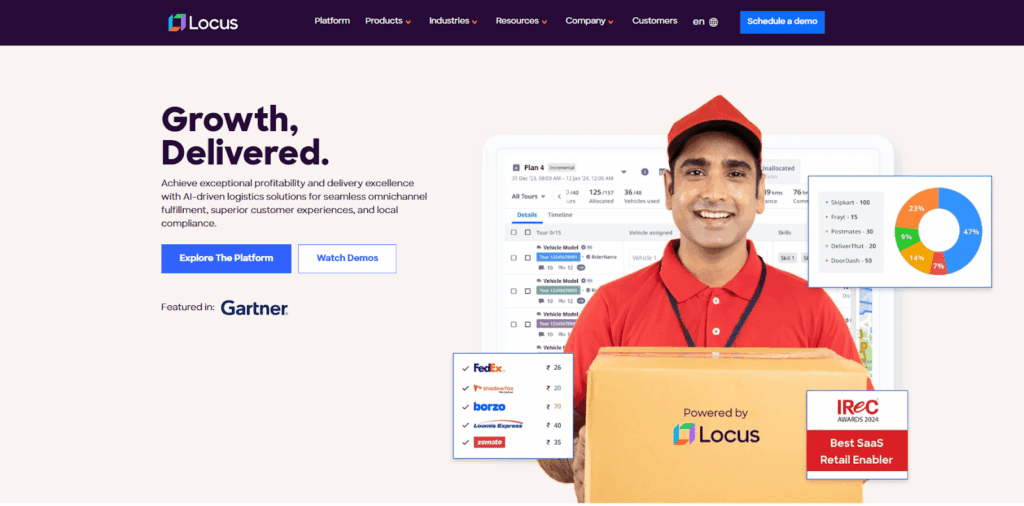
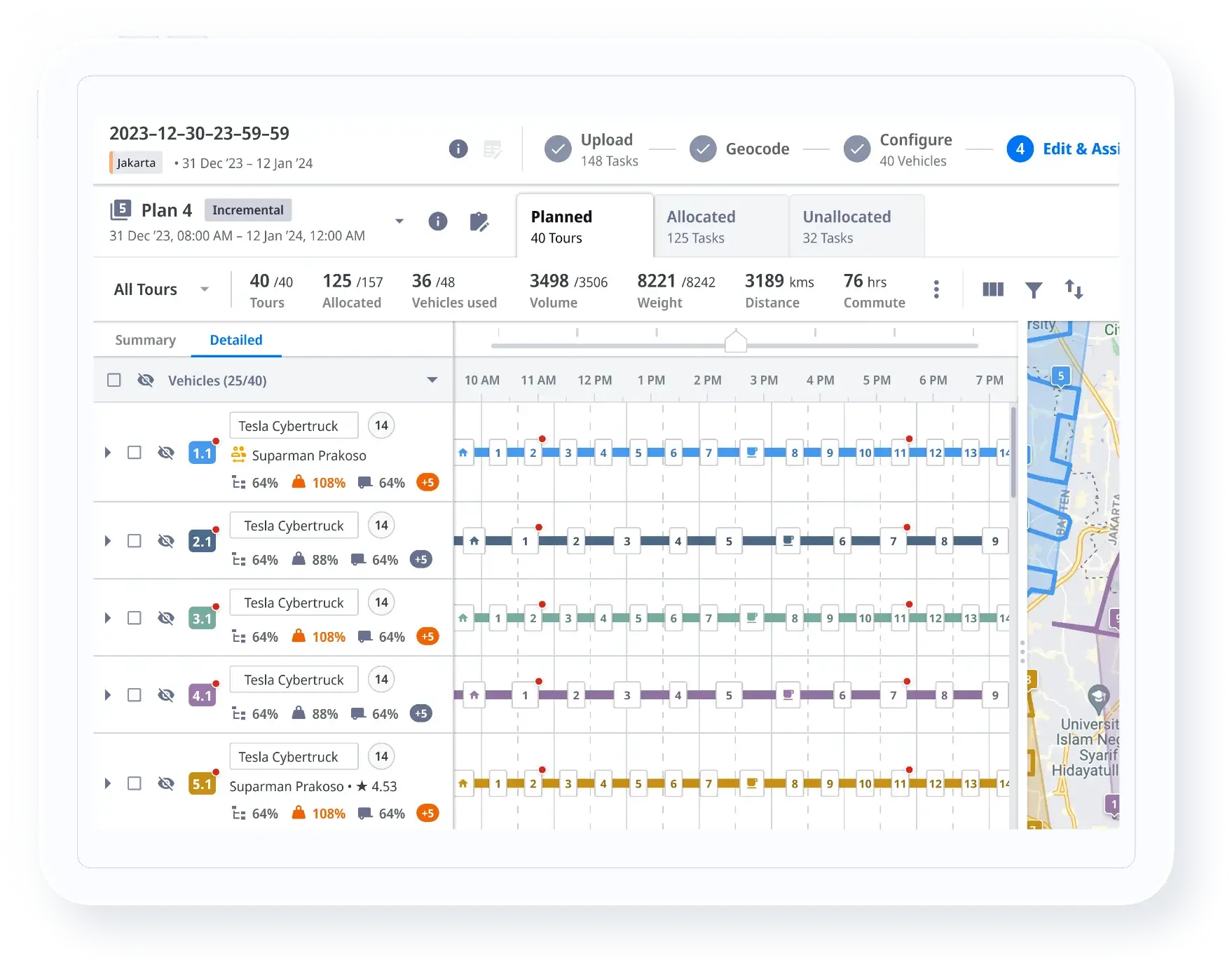
If your shipping operations span multiple carriers, fulfillment nodes, and last-mile partners, managing them through separate tools creates blind spots between planning and execution. Locus brings these decisions into one platform. It connects dispatch, carrier selection, delivery tracking, and performance analytics in a closed-loop system.
The tool positions itself as an agentic Transportation Management System (TMS) built for all-mile logistics orchestration. It unifies dispatch management, route optimization, multi-carrier allocation through ShipFlex, and end-to-end delivery visibility.
The company has powered 1.5 billion+ deliveries and reports $320 million+ in cumulative logistics cost savings across its customer base.
Within the orchestration and execution layer, Locus differentiates from FarEye, LogiNext, and Shipsy on three dimensions. First, On dispatch depth, DispatchIQ processes 250+ operational variables simultaneously, going beyond the constraint sets handled by competing routing engines.
On carrier network breadth, ShipFlex connects 160+ integrated carriers with automated invoice reconciliation built in. Lastly, on architecture, dispatch, carrier orchestration, and control tower visibility operate within a single platform, eliminating the integration gaps that come with stitching separate modules together.
Key features of Locus
- AI-powered dispatch planning (DispatchIQ): Optimizes routes and resource allocation across 250+ operational variables, including traffic, vehicle capacity, time windows, driver skills, and SLA commitments

- Dynamic multi-carrier orchestration (ShipFlex): Allocates shipments to the most suitable carrier from a network of 160+ integrated carriers based on rules for cost, speed, and service requirements with automated invoice reconciliation
- Real-time control tower visibility: Tracks deliveries across carriers and fleets through a centralized control tower with predictive SLA alerts, geofencing, and AI-validated ePOD capture
- Hub operations (IntelliSort): Automates parcel sorting with geocoding and route allocation
Locus pros
- Handles complex enterprise logistics networks and high delivery volumes with AI-native dispatch and route optimization
- Combines last-mile orchestration with multi-carrier parcel management in one platform instead of requiring separate tools
- Provides quantifiable enterprise outcomes; for example, LaundryMate improved on-time delivery from 87% to 98.52%
See Locus Shipping and Logistics Software in Action
This video demonstrates how ShipFlex manages carrier allocation across multiple shipping partners while maintaining shipment visibility and delivery execution across enterprise logistics networks.
Locus cons
- Purpose-built for enterprises with 500+ daily deliveries across multi-carrier, multi-node networks; organizations with simpler, lower-volume logistics operations may not require the full depth of orchestration the platform provides
Locus pricing
Locus offers custom enterprise pricing based on shipment volumes, delivery locations, carrier integrations, and deployment scope. Implementations are tailored to each logistics network’s complexity. Enterprises can request a demo to evaluate the platform and receive a tailored pricing estimate.
Locus is best for
Retailers, CPG companies, distributors, and 3PL providers managing high delivery volumes across multiple carriers, fulfillment nodes, and delivery networks; particularly those seeking AI-native dispatch and orchestration beyond what freight TMS tools provide.
2. FarEye
Layer: Orchestration & Execution
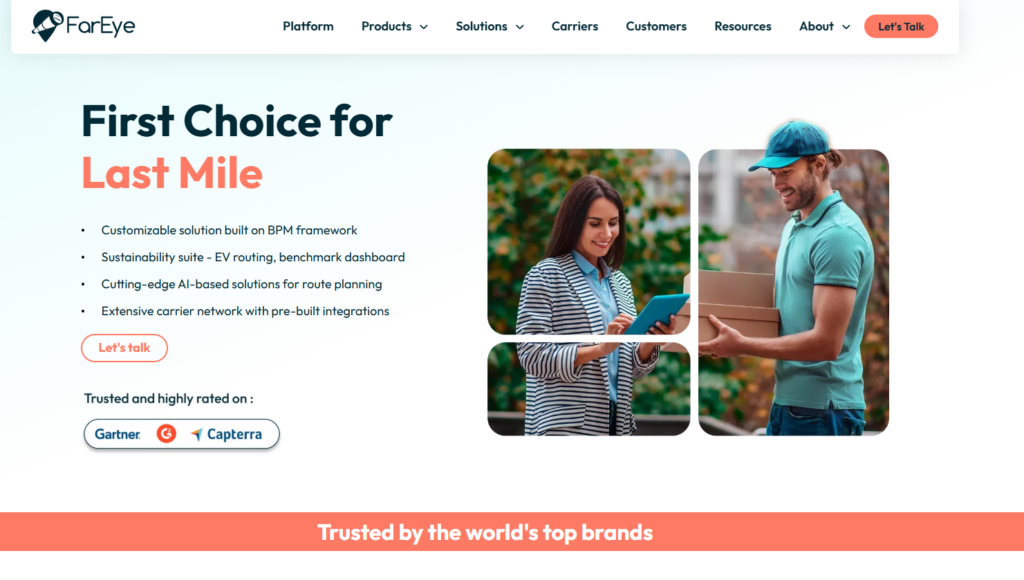
FarEye focuses on improving last mile visibility and coordination across deliveries. The platform helps logistics teams manage shipments, carrier partners, and delivery workflows from one system.
It supports multi-carrier orchestration with real-time tracking and workflow automation. Retailers, CEP providers, and e-commerce businesses use the platform to improve delivery coordination and customer experience across high-volume shipping operations.
Key features of FarEye
- Multi-carrier delivery management: Connect with multiple carriers and manage shipments through one system while maintaining visibility across delivery operations
- Delivery visibility and tracking: Track shipments in real time and monitor delivery progress across carrier partners
- Customer communication tools: Provide delivery updates, branded tracking pages, and delivery slot management throughout the fulfillment journey
- No-code workflow automation: Automate dispatch planning, delivery status updates, and exception resolution without engineering resources
FarEye pros
- Strong focus on delivery experience and customer-facing communication tools, including branded tracking pages and delivery slot management
- Supports complex delivery workflows across multiple carrier partners with no-code logistics automation
- Real-time GPS-based alerts and order visibility provide granular tracking across last-mile operations
FarEye cons
- The platform has a steep learning curve, and bulk report downloads can experience sync delays
- Focused on delivery experience management; it is not a dispatch optimization engine
- FarEye does not handle the constraint-based, multi-variable routing (traffic, capacity, time windows, driver skills simultaneously) that high-volume enterprise fleets require.
- Routing engine capabilities may be limited in certain regions
FarEye pricing
FarEye offers custom enterprise pricing based on shipment volume, delivery regions, and platform modules. Pricing details are provided through consultation.
FarEye is best for
Retailers, CEP providers, and logistics companies that prioritize delivery visibility and customer experience across large shipment volumes.
3. LogiNext
Layer: Orchestration & Execution
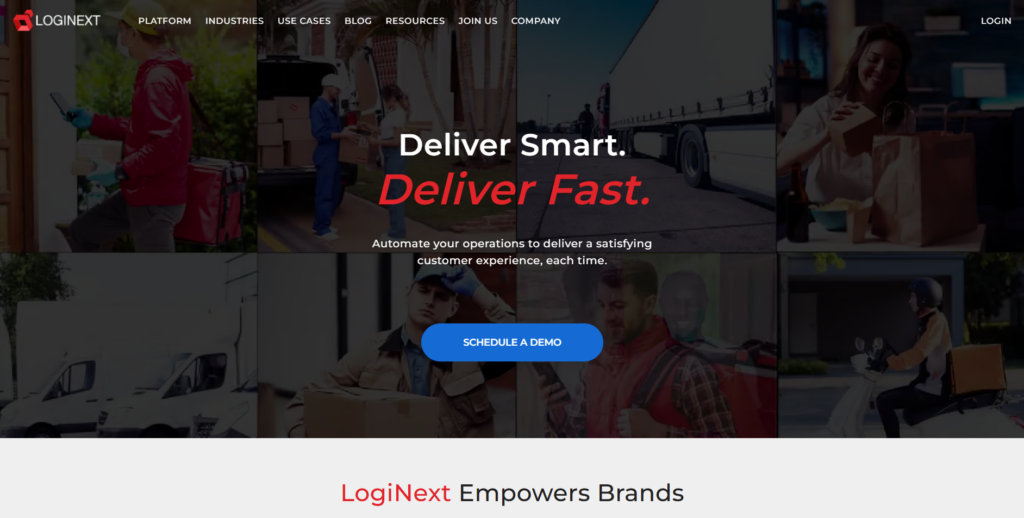
LogiNext provides a delivery management platform with route planning, live tracking, and delivery automation modules. The platform serves QSR chains, CEP providers, and retail operations across 50+ countries.
The platform covers both delivery management and fleet tracking through its Mile and Haul modules, with an API-first architecture that supports custom integrations with OMS, ERP, and e-commerce systems.
Key features of LogiNext
- Intelligent route planning: Dynamic routing with rerouting capabilities based on real-time conditions
- Delivery automation: Automated task assignment, dispatch, and proof-of-delivery workflows
- Fleet tracking: Real-time vehicle and driver tracking across delivery operations
- API-first architecture: Pre-built integrations with OMS, ERP, and e-commerce platforms
LogiNext pros
- Strong in QSR and CEP verticals with high-frequency, time-sensitive delivery operations
- API-first approach supports custom integrations with existing operational systems
LogiNext cons
- The platform is broad in scope, which creates a significant learning curve for new users
- The routing engine does not handle the constraint volumes required for high-complexity enterprise networks; simultaneous optimization across variables is outside its current scope
- AI capabilities in dispatch and route optimization are less mature for high-complexity enterprise environments
LogiNext pricing
LogiNext offers custom pricing based on operational scope and modules deployed. Pricing details require a consultation with their team.
LogiNext is best for
QSR chains, CEP providers, and retail operations managing high-frequency deliveries that require dynamic routing and real-time fleet tracking.
4. Shipsy
Layer: Orchestration & Execution
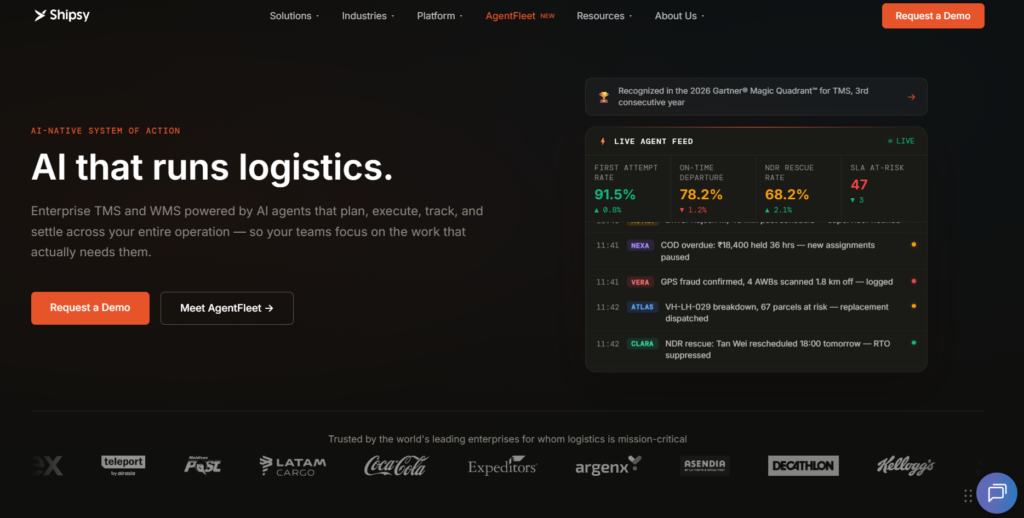
Shipsy provides AI-native logistics management covering freight procurement, shipment tracking, and delivery management. The platform has a strong presence in MENA and APAC markets and serves various retail and QSR companies.
It also offers AgentFleet, an AI-driven workforce for logistics operations.
Key features of Shipsy
- Freight procurement and rate management: Manage freight contracts and carrier rates across logistics partners
- Cross-border shipment tracking: Get multimodal visibility across international shipments
- Delivery management: Last-mile coordination with driver apps and customer notifications
- Real-time analytics: BI dashboards with performance tracking and operational insights
Shipsy pros
- Strong cross-border and freight forwarding capabilities for MENA and APAC operations
- Real-time BI dashboards and Smart Track mobile app support field-level operational visibility
Shipsy cons
- Onboarding timelines tend to run longer than expected, and customization options beyond distance-based rules are limited
- ERP integration complexity can add time and cost to deployment
- Thinner capabilities in real-time dynamic dispatch and AI-driven route optimization for last-mile delivery
Shipsy pricing
Shipsy offers custom pricing based on modules, shipment volumes, and regional deployment scope. Contact their sales team for a quote.
Shipsy is best for
Logistics companies and enterprises managing cross-border freight and delivery operations in MENA, APAC, and Indian markets.
5. Alpega TMS
Layer: Freight & Transport
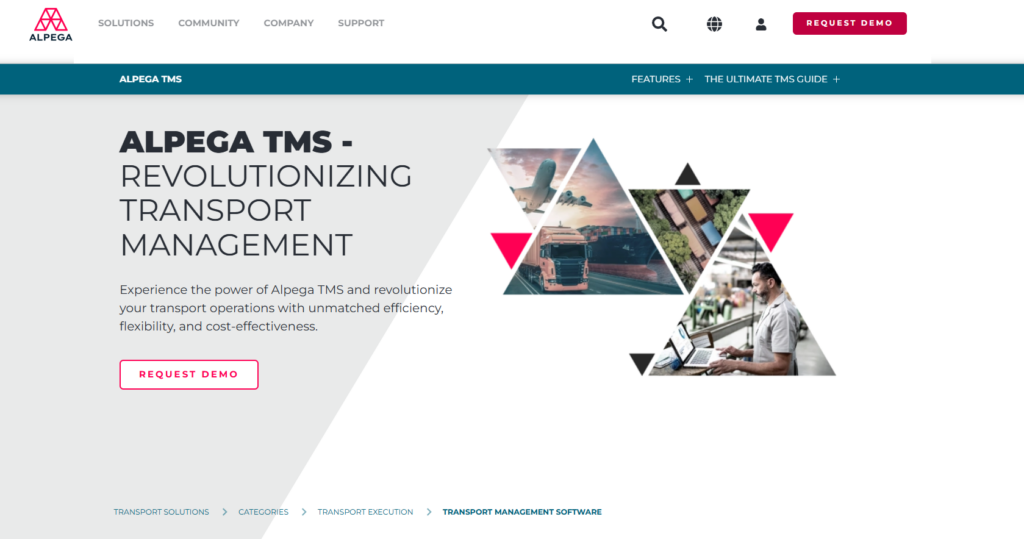
Alpega provides a cloud-based TMS suite designed for shippers and carriers managing freight procurement, tendering, and transport execution across European markets. The platform connects users to a network of 85,000+ carriers through its suite of modules: inet, TenderEasy, Teleroute, and wtransnet.
Alpega’s solutions also support collaboration and scalability, helping businesses streamline logistics operations while adapting to changing market demands.
Key features of Alpega TMS
- Freight procurement and tendering: Manage carrier bids, rates, and contracts through TenderEasy
- Carrier network connectivity: Access 85,000+ carriers across European freight markets
- Transport execution: Track load and carrier performance in real time
- Multimodal planning: Get logistics support for road, ocean, rail, and air freight
Alpega pros
- Modular pay-as-you-go pricing structure allows enterprises to scale usage based on freight volumes
- Centralized billing, invoicing, and tendering capabilities through TenderEasy
Alpega cons
- The platform interface has not kept pace with modern UX standards, making navigation less intuitive
- Primarily a freight TMS; it lacks the AI dispatch engine and last-mile optimization layer that enterprises with complex urban delivery networks need
Alpega pricing
Alpega offers modular enterprise pricing based on modules deployed and freight volumes. Pay-as-you-go options are available.
Alpega is best for
European shippers and carriers managing freight procurement and tendering across multimodal transport networks.
6. MercuryGate (Infios)
Layer: Freight & Transport

MercuryGate is a multi-modal TMS for shippers, 3PLs, and freight brokers. In September 2024, Körber Supply Chain Software acquired MercuryGate, and in March 2025, the combined company rebranded as Infios.
The platform supports truckload, LTL, intermodal, ocean, and air freight management on a single system, with freight audit, carrier tendering, and managed transportation services built into its core modules.
Key features of MercuryGate (Infios)
- Carrier tendering and rate management: Automated carrier procurement and contract management
- Freight audit and payment: Invoice verification and settlement workflows
- Managed transportation services: Outsourced logistics management for shippers and 3PLs
MercuryGate pros
- Handles multi-modal freight operations on a single platform
- Managed transportation services allow companies to outsource logistics decision-making entirely
MercuryGate cons
- The interface can be difficult to navigate, with sorting and filtering working inconsistently across views
- Excels at mid-mile and freight orchestration, but does not provide granular, real-time last-mile dispatch intelligence
MercuryGate pricing
MercuryGate (Infios) offers custom enterprise pricing based on freight volumes, modes, and deployment requirements.
MercuryGate is best for
Shippers, freight brokers, and 3PLs managing multi-modal freight operations that require tendering, audit, and managed transportation services.
7. Oracle Transportation Management (OTM)
Layer: Freight & Transport
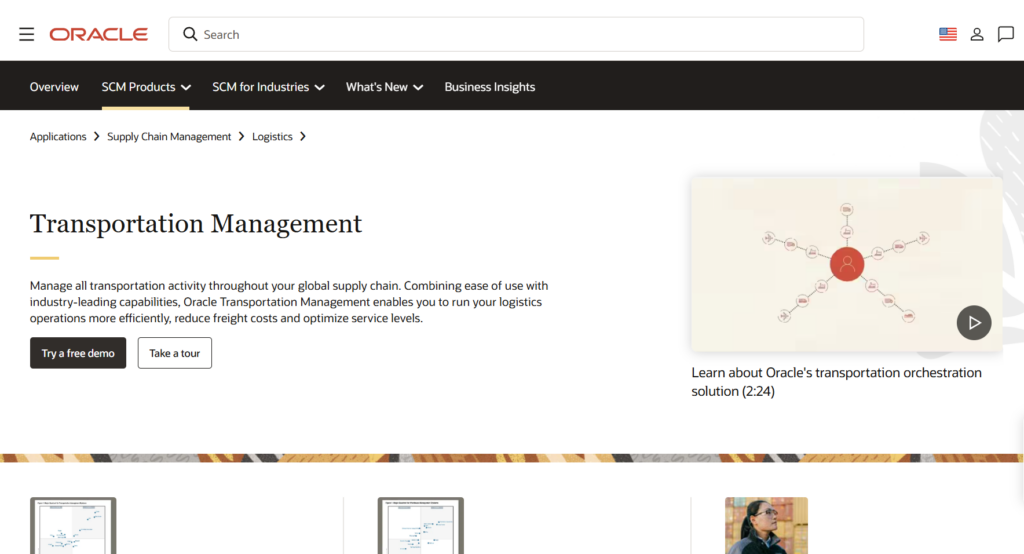
Oracle OTM is an enterprise-grade TMS embedded within Oracle’s supply chain cloud. It serves global shippers with complex trade compliance, freight payment, and multi-modal transportation planning requirements.
The platform offers advanced optimization, real-time tracking, and robust analytics to support efficient logistics execution across global networks. It also integrates seamlessly with broader Oracle Cloud applications, enabling end-to-end supply chain visibility and enhanced decision-making at scale.
Key features of Oracle OTM
- Global trade compliance: Automated trade documentation, sanctions screening, and regulatory compliance management
- Multi-modal transportation planning: Optimize freight movements across road, rail, ocean, and air
- Freight payment and settlement: Automated invoice matching, audit, and carrier payment
Oracle OTM pros
- Scales across complex global supply chain scenarios with depth that few competitors match
- Strongest ERP integration for companies already operating within Oracle’s ecosystem
Oracle OTM cons
- Steep learning curve: error log interpretation and report configuration require specialized skills
- AI/ML capabilities in real-time last-mile routing lag behind purpose-built logistics orchestration platforms
Oracle OTM pricing
Oracle OTM follows enterprise-tier cloud subscription pricing. TCO includes licensing, implementation, consulting, and ongoing support.
Oracle OTM is best for
Global enterprise shippers managing complex trade compliance, multi-modal freight, and transportation planning, especially those already operating within Oracle’s ERP ecosystem.
8. Blue Yonder TMS
Layer: Freight & Transport

Blue Yonder provides transportation management as part of its broader supply chain planning suite. Its TMS capabilities leverage AI and machine learning to optimize routing, forecasting, and carrier selection for improved efficiency.
The platform also enables end-to-end visibility and synchronization across supply chain operations, helping organizations respond dynamically to disruptions and demand changes.
Key features of Blue Yonder TMS
- Demand-driven load optimization: Build optimal loads based on demand forecasting and capacity constraints
- Carrier management and procurement: Manage carrier contracts, tendering, and rate negotiation
- Supply chain planning integration: Connect TMS with Blue Yonder’s WMS, inventory, and demand planning modules
Blue Yonder pros
- Strong load-building optimization and AP/AR capabilities for freight settlement and invoicing
- Integration with Blue Yonder’s warehouse and demand planning suite creates end-to-end supply chain visibility for existing customers
Blue Yonder cons
- The interface is outdated, and training and support costs add to TCO
- Legacy architecture limits agility compared to cloud-native, API-first platforms
- Suite lock-in is the primary concern; the platform delivers most value when used alongside Blue Yonder’s WMS and planning tools, which may not suit enterprises with mixed technology stacks
Blue Yonder pricing
Blue Yonder follows enterprise-tier pricing with licensing, implementation, and ongoing support costs. Their sales team can provide a customized quote.
Blue Yonder is best for
CPG, retail, and manufacturing enterprises seeking integrated transportation and supply chain planning, especially those already operating within the Blue Yonder ecosystem.
9. Descartes Systems
Layer: Freight & Transport
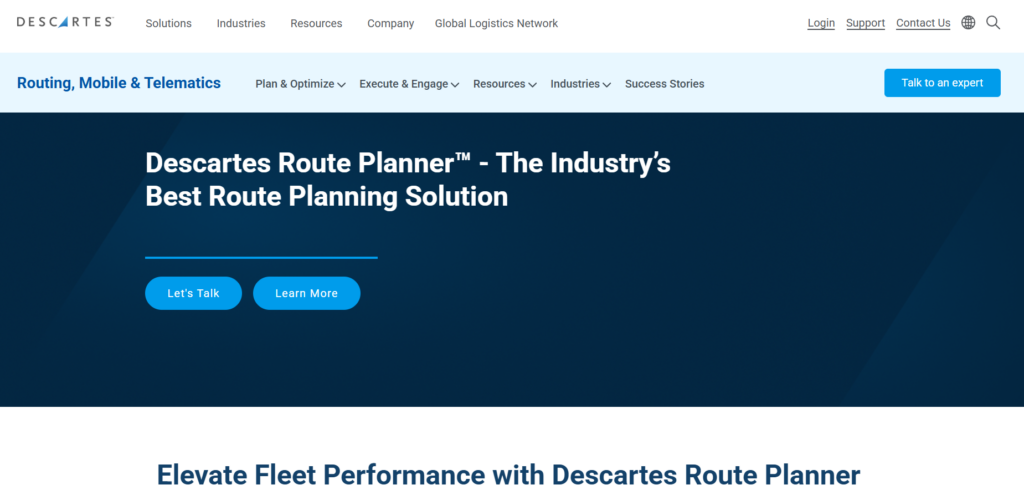
Descartes provides logistics technology spanning routing, mobile and telematics, customs compliance, and carrier connectivity through its Global Logistics Network. It connects 26,000+ customers with 200,000+ trading partners.
Its solutions enable real-time data exchange, route optimization, and regulatory compliance across global supply chains. The platform also enhances collaboration and visibility, helping businesses streamline logistics operations and improve overall delivery performance.
Key features of Descartes
- Customs and regulatory compliance: Automated customs filing, trade compliance, and sanctions screening across global shipments
- Routing and mobile solutions: Fleet routing, driver management, and proof-of-delivery through mobile apps
- Dock scheduling and fleet management: Appointment scheduling, telematics, and fleet performance tracking
Descartes pros
- Among the strongest customs and compliance offerings in the market for cross-border logistics
- Global Logistics Network provides EDI-based carrier connectivity at a scale few competitors match, with 200,000+ trading partners
Descartes cons
- Operational data and configuration changes are often managed by Descartes personnel, limiting self-service access
- No rail tracking capability, which limits multimodal visibility for enterprises shipping across rail networks
- Routing and dispatch intelligence is not built on the same AI-native foundation as newer orchestration platforms, limiting effectiveness in high-velocity, last-mile environments
Descartes pricing
Descartes offers modular pricing based on products deployed, network usage, and integration scope. Pricing details require consultation.
Descartes is best for
Enterprises managing compliance-heavy, cross-border logistics operations that require customs automation, carrier connectivity, and fleet management.
10. project44
Layer: Visibility & Connectivity
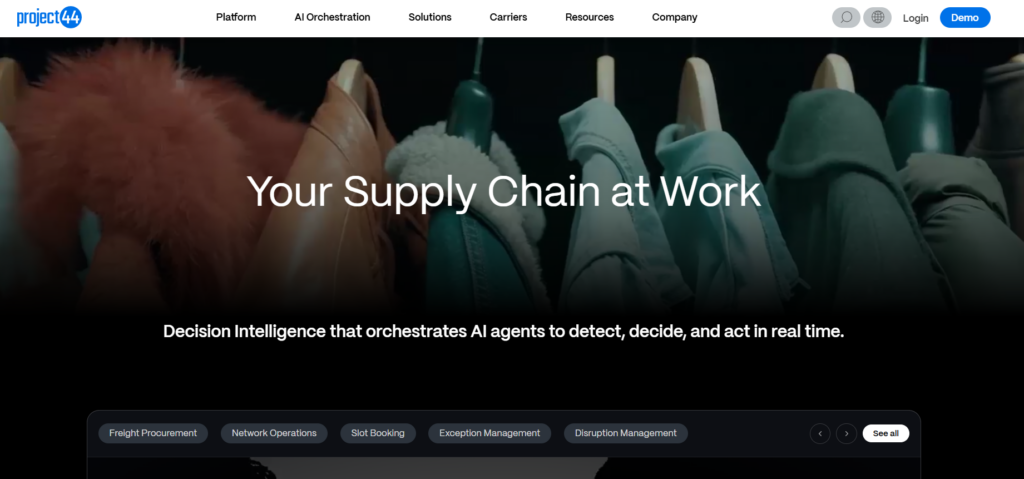
project44 is a real-time supply chain visibility platform that tracks in-transit shipments across modes and carriers.
It provides granular, real-time tracking data and predictive ETAs to improve transparency and reduce supply chain uncertainty. The platform also enables proactive exception management and collaboration, helping organizations respond quickly to disruptions and enhance overall delivery reliability.
Key features of project44
- Predictive ETAs and exception management: AI-powered arrival predictions and automated alerts when shipments deviate from plan
- Carrier connectivity: Pre-built integrations with thousands of carriers, forwarders, and logistics providers
- Multi-Agent Orchestration: AI agents that automate visibility workflows, data quality management, and logistics decision support
project44 pros
- Reliable shipment visibility with broad carrier connectivity, covering ocean, air, road, rail, and parcel
- Predictive ETA accuracy and proactive exception alerts help logistics teams identify delays before they cascade
project44 cons
- Tracking accuracy can be inconsistent for smaller or regional carriers outside the platform’s core network
- Air and ocean tracking modules have reported gaps, with some deployments taking months to reach production-ready functionality
- project44 is a visibility layer, not a full logistics orchestration or dispatch platform
project44 pricing
project44 follows enterprise-tier pricing based on shipment volumes, modes tracked, and carrier integrations. A consultation with their sales team is required.
project44 is best for
Enterprise shippers that need a visibility layer across multi-modal, multi-carrier shipments and are willing to pair it with a separate TMS or orchestration engine for dispatch and routing.
How to Choose the Right Shipping and Logistics Software
Before selecting a shipping and logistics software platform, logistics teams should evaluate how well the solution matches their operational complexity, carrier network, and technology stack.
Use this framework when comparing platforms:
- 500+ daily deliveries with own fleet and 3PL partners: Evaluate orchestration platforms (Locus, FarEye, LogiNext) that combine dispatch, routing, and carrier management
- Multi-modal freight across regions with compliance requirements: Assess freight TMS platforms (Oracle OTM, Blue Yonder, Alpega, MercuryGate, Descartes) with carrier tendering and trade compliance capabilities
- Need cross-carrier visibility without replacing your existing TMS: Consider visibility platforms (project44) that integrate with your current transportation stack
- Need dispatch, carrier orchestration, and visibility in one system: Check out platforms spanning orchestration and visibility layers; Locus’s stack covers AI dispatch (DispatchIQ), multi-carrier allocation (ShipFlex), and real-time tracking (Control Tower) in a single closed-loop platform
Choosing the Right Shipping and Logistics Software
Choosing shipping and logistics software is a strategic investment in logistics orchestration that directly impacts cost-per-delivery, SLA adherence, and customer experience.
The right choice depends on your operational complexity: delivery volumes, fleet composition, geographic spread, carrier network size, and the vertical-specific constraints of your industry.
For enterprises managing multi-carrier, multi-region logistics networks, Locus provides shipping and logistics orchestration as an agentic TMS.
Acquired by Ingka Group (the world’s largest IKEA retailer) in 2025, Locus operates as a purpose-built enterprise logistics orchestration platform. Recognized by Gartner across last-mile delivery and multi-carrier categories, it helps enterprises turn logistics from an operational cost into a measurable advantage.
See how Locus orchestrates dispatch, carrier allocation, and real-time visibility for retailers, FMCG companies, and 3PL providers. Schedule a demo today.
Frequently Asked Questions (FAQs)
1. What is the difference between shipping software and logistics management software?
Shipping software handles label generation and carrier rate comparison for individual parcels. Logistics management software manages end-to-end transportation operations, including route planning, dispatch, carrier orchestration, and delivery visibility across enterprise networks. Locus operates as a logistics orchestration platform spanning both.
2. How does AI-powered route optimization reduce logistics costs?
AI routing evaluates hundreds of constraints—traffic, capacity, time windows, vehicle types—to reduce mileage, fuel, and failed deliveries. Locus’s DispatchIQ processes 250+ variables in under 15 minutes for a 50-vehicle fleet.
3. Can shipping and logistics software integrate with existing ERP and WMS systems?
Enterprise platforms like Locus, Oracle OTM, and Blue Yonder offer API-based integrations with SAP, Oracle, and other ERP/WMS systems. Integration depth varies; evaluate whether the platform offers pre-built connectors or requires custom middleware.
4. How does real-time visibility improve on-time delivery performance?
Real-time visibility enables predictive ETA alerts, exception management, and proactive rerouting before delays cascade. Locus’s Control Tower provides SLA-aware visibility with automated exception alerts, helping enterprises maintain on-time delivery rates above 99%.
5. Is enterprise shipping and logistics software worth the investment for mid-market companies?
Yes, if daily delivery volumes exceed 500 orders or if you manage multiple carrier relationships. Match the platform tier to your operational complexity; not every mid-market company needs Oracle OTM, but growing 3PLs and regional retailers benefit from platforms like Locus that scale with volume.


General
What Are the Biggest Last-Mile Delivery Challenges for Enterprises? Five Problems and How to Solve Them

Apr 27, 2026
The five biggest last-mile delivery challenges for global enterprises — rising costs, capacity gaps, multi-carrier complexity, failed deliveries — and how to solve them.
Read more
General
10 Best Vehicle Dispatch Software Platforms for Enterprise Fleets in 2026

Apr 28, 2026
Your guide to vehicle dispatch software for high-volume logistics operations. Review AI dispatch depth, fleet visibility, driver apps, and scalability across platforms.
Read moreInsights Worth Your Time



















10 Best Shipping and Logistics Software Platforms for Enterprise Operations in 2026