


General
Delivery Route Planning After 1 July 2026: What the Van Tachograph Rules Change for European Last Mile

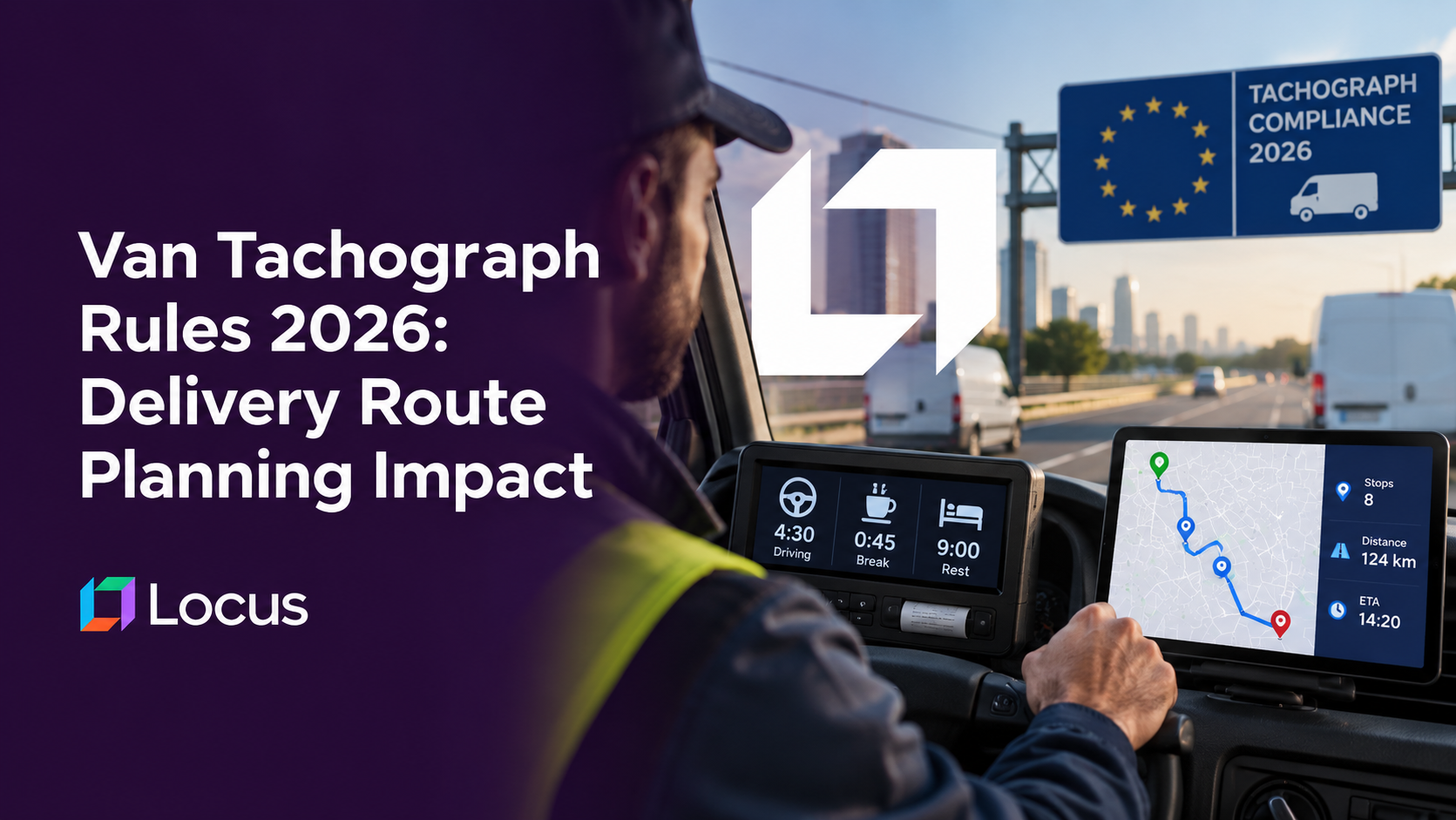
From 1 July 2026, EU drivers’ hours rules and the second-generation smart tachograph apply to vans with a maximum permissible mass above 2.5 tonnes and up to 3.5 tonnes when they carry goods in international transport or cabotage. For last-mile operators, this turns any van route that crosses a border into a duty-limited route: driving time, breaks and rest become fixed limits that a plan must respect before the van leaves the depot, not something checked afterwards. Purely domestic van work is outside the change, although national rules still apply. Locus, the world’s first agentic Transportation Management System, can plan routes with these limits as hard constraints and re-plans within each driver’s remaining legal hours.
Key Takeaways
- From 1 July 2026, Regulation 561/2006 applies to goods vehicles above 2.5 tonnes in international transport or cabotage, whether newly registered or already on the road, and a G2V2 smart tachograph is required, per the European Commission.
- Domestic-only van transport is not covered by the change, per the European Labour Authority (ELA).
- The limits are 9 hours’ driving a day (10 hours twice a week), 56 hours a week and 90 hours a fortnight, with a 45-minute break after 4.5 hours and 11 hours’ daily rest.
- Only 27.7% of operators report being ready and 88% of the fleet still needs retrofitting, per IRU survey data.
- Europe has about 502,000 unfilled truck driver positions, so duty hours are a scarce resource.
- Locus enforces driving and working-time limits as hard constraints and re-plans within each driver’s remaining legal hours.
Why the July 2026 Van Rules Matter: The Business Case
The change is a regulatory scope extension, not a new rulebook. Article 2(1)(aa) of Regulation 561/2006 now covers goods vehicles above 2.5 tonnes in international transport or cabotage, and the European Commission’s briefing for the European Labour Authority confirms it applies to both newly registered and already registered vehicles, with a G2V2 smart tachograph. The ELA describes the move as a response to the rapid expansion of van-based transport that closes a long-standing regulatory gap, and notes that transport with these vans inside a single EU country is not concerned.
Readiness is the immediate risk. IRU survey data in its 7 May 2026 briefing shows only 27.7% of operators report being ready for the deadline, 46.5% say they are not yet prepared, and 88% of the fleet still requires tachograph retrofitting. The same briefing notes that even occasional cross-border activity triggers the requirements, which catches operators who think of themselves as domestic.
Driver supply makes the limits harder to absorb. IRU’s 2025 survey puts Europe at around 502,000 unfilled truck driver positions, a 13% shortage rate, with 65% of European operators ranking the shortage as their most pressing concern. When duty hours are capped by law and drivers are scarce, a plan that wastes legal hours on avoidable waiting and poor sequencing costs real capacity.
How to Plan Van Routes Under the New Rules
1. Classify Each Van and Each Operation
Scope depends on the vehicle and the operation: maximum permissible mass above 2.5 tonnes, and international transport or cabotage. A route plan needs that classification per van and per leg, because the same van can be in scope on Monday and out of scope on Tuesday.
2. Model the Driving Limits as Hard Constraints
The rules the plan has to respect are 9 hours’ driving a day, extendable to 10 hours twice a week, 56 hours a week and 90 hours across any two consecutive weeks, per the ELA’s briefing. These are limits the optimiser cannot exceed, not a report generated after the fact.
3. Build Breaks and Rest Into the Route
A driver must take a break of at least 45 minutes after 4.5 hours of driving, which can be split into 15 and 30 minutes, and regular daily rest is at least 11 uninterrupted hours, reducible to 9 hours under specific conditions. A route that ignores these either breaks the law or forces an unplanned stop at a bad location.
4. Treat Cabotage and Cross-Trade Legs Separately
Cabotage is national carriage for hire or reward carried out on a temporary basis in a host Member State. Under the ELA’s guidance, drivers on bilateral and transit operations are not posted, while drivers on cross-trade and cabotage operations generally are, so the leg type changes the administrative load as well as the hours.
5. Re-Plan Within Remaining Legal Hours
A delay at 11:00 changes what a driver can legally do at 15:00. Re-optimisation has to know how much legal driving time each driver has left and reallocate work within it, instead of pushing a driver past a limit to rescue a late stop.
6. Keep the Evidence Ready for a Roadside Check
For international and cabotage operations, drivers need to make three things available at the roadside: tachograph records, evidence of the transport operation such as an e-CMR consignment note, and a copy of the posting declaration submitted through the IMI road transport portal.
Domestic Van Routes vs Cross-Border Van Routes From July 2026
| Dimension | Domestic-only van route | Cross-border or cabotage van route (2.5 to 3.5 tonnes) |
|---|---|---|
| Covered by the July 2026 change | No, per the ELA | Yes |
| Tachograph | Not required by this change | G2V2 smart tachograph, including vans already registered |
| Driving limits | National rules apply, check locally | 9 hours a day (10 twice a week), 56 hours a week, 90 hours a fortnight |
| Breaks and rest | National rules apply | 45 minutes after 4.5 hours, 11 hours’ daily rest |
| Posting of drivers | Not part of this change | Generally applies to cross-trade and cabotage, not to bilateral or transit |
| Roadside documents | Per national rules | Tachograph records, e-CMR or equivalent, posting declaration |
What to Look for in Route Planning Software for Regulated Van Fleets
Hours as hard constraints at plan generation. Ask whether driving and rest limits shape the route as it is built, or are checked afterwards and flagged for a planner to fix.
Re-optimisation that tracks remaining legal hours. A mid-day delay should trigger a re-plan within each driver’s remaining hours, not a manual scramble.
Operation-type awareness per leg. The software should distinguish domestic, international and cabotage legs, and let you flag a van as exempt or in scope.
A clear line with your tachograph and telematics system. The tachograph records the legal evidence. The planning layer should respect the same limits and work alongside tachograph and telematics data, not claim to replace it.
Multi-jurisdiction rule handling. A network that crosses borders needs each jurisdiction’s rules encoded, rather than a single generic limit applied everywhere.
Constraint-Heavy Planning in Practice
Locus has not published a case study specific to the July 2026 van rules, so these two examples show the constraint handling those rules depend on rather than a tachograph deployment.
A Fortune 50 freight and parcel network ran 1,500+ captive drivers alongside 3,000+ third-party transporters across a 120-country footprint, with pickup, transit and delivery dispatched manually from disconnected tools. Locus’s Dispatch agent planned against 250+ operational constraints including fleet types, time windows, certifications and customs requirements, while the Capacity agent planned loads, shifts and zones for the mixed fleet. Weekly execution climbed from 75% to 92% across 51 service centres.
A leading North American retailer consolidated six legacy systems into one platform and resolved delivery exceptions in under two hours while reaching 99%+ on-time store delivery, showing what continuous re-planning does when a plan breaks mid-day.
Common Mistakes When Preparing Van Fleets for July 2026
Assuming “domestic” means no checks. Domestic-only van work is outside this change, but national rules still apply, and even occasional cross-border activity brings a van into scope.
Treating the own-account exemption as automatic. Carrying your own goods does not exempt a van on its own. The exemption in Article 3(ha) requires that transport is not for hire or reward, is on the company’s or driver’s own account, and that driving is not the driver’s main activity, all at once.
Planning to the legal limit with no slack. A plan that uses every legal hour has no room for a delay, which forces either a breach or a missed delivery.
Checking compliance after the plan is built. A route that is later found to breach a limit has to be rebuilt, usually by hand and usually late.
Confusing hardware readiness with planning readiness. Fitting a smart tachograph records compliance. It does not make the routes compliant.
How Locus Approaches Compliant Route Planning for European Vans
Locus, the world’s first Decision-Intelligent, Agentic TMS, is recognized by Gartner for seven consecutive years, featured in the 2026 Hype Cycle for Supply Chain Execution and Logistics Technologies, named a Leader in TMS by QKS Group’s SPARK Matrix, and ranked #1 in Route Planning on G2’s 2026 Best Software Awards. In October 2025, Ingka Investments, the investment arm of Ingka Group, the world’s largest IKEA retailer, acquired Locus. Locus continues to operate independently.
Locus’s route planning system treats driving and working-time limits as hard constraints during route generation, models the full shift including loading, waiting and administrative time, and re-optimises through the day against each driver’s remaining legal hours, reallocating work to drivers with capacity instead of pushing anyone past a limit. Each jurisdiction’s rules can be encoded across a European network, and autonomy levels let planners approve decisions or let the system act within guardrails they set. Locus is a planning layer, not a tachograph or telematics system, so it works alongside the records your tachograph already keeps. The Fortune 50 network case shows constraint-heavy, mixed-fleet dispatch moving weekly execution from 75% to 92%. Schedule a Locus demo to see your cross-border van routes planned within legal hours.
From 1 July 2026, vans of 2.5 to 3.5 tonnes on international or cabotage work are subject to EU driving, rest and tachograph rules, and most operators are not yet ready. The planning response is to treat the legal limits as constraints the route is built around, classify each van and leg correctly, and re-plan within remaining legal hours when the day goes wrong. Locus does this as a planning layer for European last-mile and cross-border van fleets, alongside the tachograph records that prove compliance.
Frequently Asked Questions
Which vans are affected by the July 2026 tachograph rules? Vans with a maximum permissible mass above 2.5 tonnes and up to 3.5 tonnes that carry goods in international transport or cabotage, from 1 July 2026. Transport with these vans inside a single EU country is not concerned, according to the European Labour Authority.
Do the rules apply to vans already on the road? Yes. The European Commission’s briefing for the ELA states that the scope covers both newly registered and already registered vehicles, which need a second-generation smart tachograph (G2V2).
Are operators carrying their own goods exempt? Not automatically. The exemption in Article 3(ha) of Regulation 561/2006 applies only where transport is not for hire or reward, is on the company’s or driver’s own account, and driving is not the driver’s main activity. All three conditions must hold.
What driving and rest limits apply? Up to 9 hours’ driving a day, extendable to 10 hours twice a week, 56 hours a week and 90 hours across two consecutive weeks. A break of at least 45 minutes is required after 4.5 hours of driving, and regular daily rest is at least 11 hours.
How should route planning change for these vans? Plans should classify each van and leg, treat driving and rest limits as hard constraints, build breaks into the route, and re-plan within each driver’s remaining legal hours when a delay hits, instead of checking compliance after the plan is built.
What counts as cabotage? Cabotage is national carriage for hire or reward carried out on a temporary basis in a host Member State. Under the ELA’s guidance, drivers on cabotage and cross-trade operations are generally posted, while drivers on bilateral and transit operations are not.


General
Route Optimization for Beverage Distribution: 5 Challenges and How Locus Solves Them in 2026

Oct 6, 2026
Five route optimization challenges unique to beverage distribution, from weight limits and empties to filed territories and summer peaks, and how Locus solves each.
Read more
General
Mega Sale Logistics in SEA: How 3PLs Survive Concurrent Peaks Across Island Networks in 2026
Oct 6, 2026
9.9 to 12.12 sale days hit the same hubs and carriers at once. Learn how SEA 3PLs use capacity-aware dispatch to hold SLAs across island networks.
Read moreInsights Worth Your Time



















Delivery Route Planning After 1 July 2026: What the Van Tachograph Rules Change for European Last Mile