


General
Route Planning in Urban Mexico: What Makes it Hard and How AI Solves it in 2026

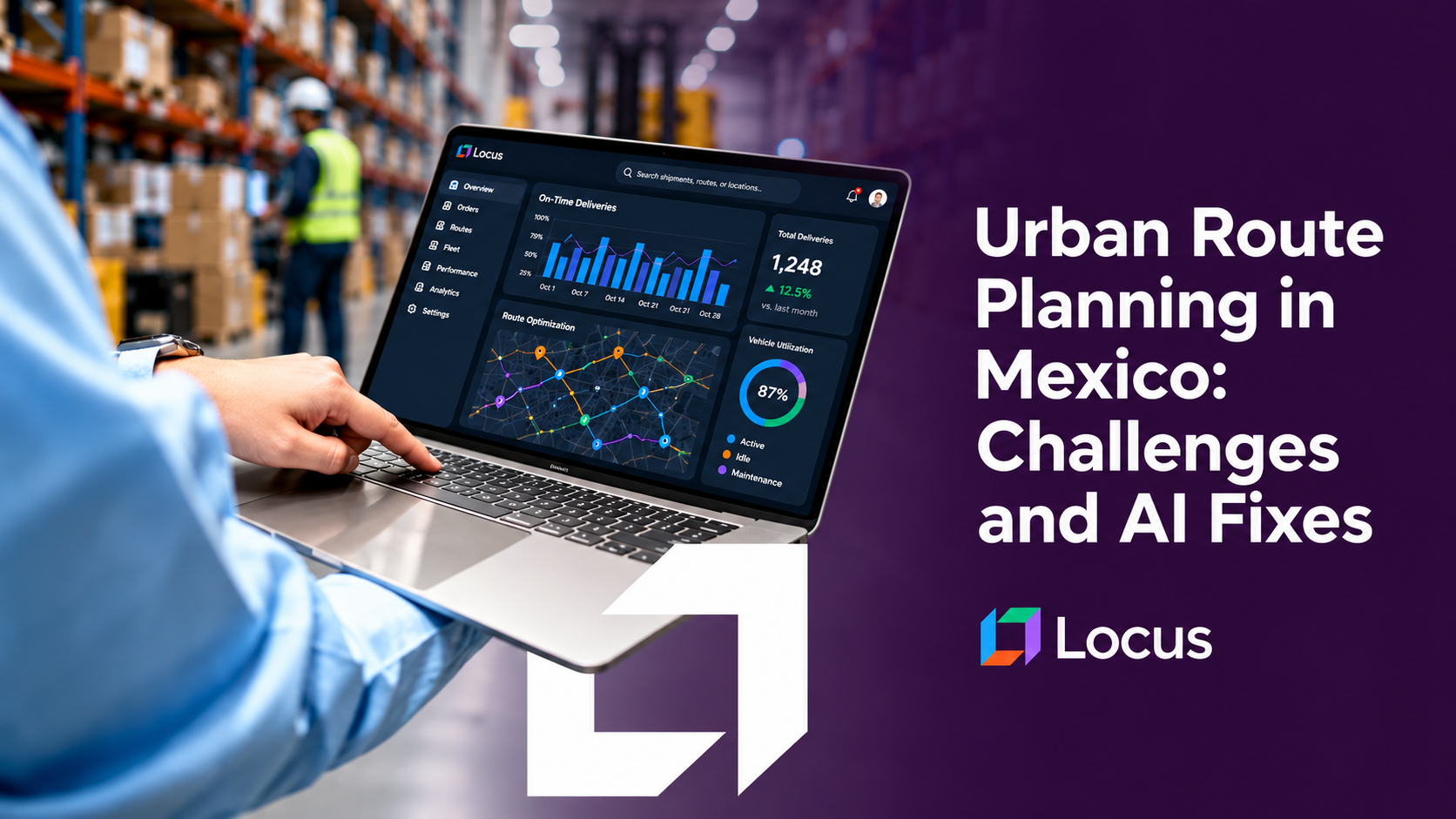
Urban route planning in Mexico is the task of sequencing and timing deliveries across dense, congested cities where cargo vehicles face hour restrictions, demand is split across more than a million small stores, and addresses rarely resolve to a clean pin. Static plans built on average speeds fail under those conditions, which is why Mexican retailers, consumer goods distributors and e-commerce operators are moving to AI route optimization that learns real travel times, respects local rules and re-plans through the day. Locus, the world’s first Decision-Intelligent, Agentic TMS, applies that approach through its Fireworks routing engine.
Key Takeaways
- Mexico City was the most congested city in the world in 2025, with a 10 km trip averaging 34 minutes and 29 seconds, so static ETAs break every day.
- CDMX restricts cargo vehicles from 06:00 to 10:00 and 18:00 to 20:00, with fines of up to about 35,000 pesos for unauthorized loading.
- More than 1.05 million tienditas serve 52% of national demand, which turns the last mile into a many-small-drops problem.
- AI route optimization learns from live and historical traffic, encodes local rules as constraints and re-plans in real time.
- Locus Fireworks plans against 250+ real-world constraints and reports up to 34% fewer miles and 99.5% SLA adherence.
Why Urban Route Planning in Mexico Matters: The Business Case
Congestion sets the baseline. Mexico City ranked first in the world in TomTom’s 2025 Traffic Index, with each motorist losing 184 hours to peak congestion, and Guadalajara placed 17th. Across the city, a 10 km trip took 34 minutes 29 seconds on average, 58 seconds longer than a year earlier.
Demand is growing into that traffic. The AMVO 2026 study found Mexican retail e-commerce reached 941 billion pesos in 2025, up 19.2%, with 77.2 million online buyers and 17.7% of retail sales online.
Traditional retail still anchors volume. INEGI reports more than 1.05 million tienditas in Mexico, representing 15.65% of micro-businesses and serving 52% of national demand.
Rules add constraints in CDMX. Cargo vehicles may not circulate from 06:00 to 10:00 and from 18:00 to 20:00, must use the far-right lane and authorized routes, and face fines of 40 to 60 UMA (about 7,000 pesos) for circulating in restricted hours and up to 300 UMA (about 35,000 pesos) for loading or unloading in unauthorized places.
Security is a planning input. Cargo theft fell 52% from 2018 to 2025, but 6,263 cases in 2025 were still recorded by the SESNSP.
What Makes Route Planning Hard in Urban Mexico: Six Challenges
1. Congestion that breaks static ETAs. With a 10 km trip taking more than half an hour on average, a plan built on posted speeds is wrong before the first stop. Travel time varies by corridor, hour and weather, so ETAs have to come from live and historical traffic, not distance.
2. Cargo-hour windows and curb rules. The CDMX restriction windows remove four of the working day’s busiest hours for cargo vehicles, and unauthorized loading is fined heavily. A route has to place each stop’s loading inside permitted hours and legal locations, which squeezes the usable day.
3. A million small drops. Serving tienditas means many small orders per route, each with its own receiving hours and limited space. Density, clustering and stop sequence decide whether a route is profitable, and manual planning cannot club orders across so many nodes.
4. Addresses that do not resolve cleanly. Deliveries often rely on street, colonia and landmark descriptions rather than a precise pin, so a failed first attempt can start with the geocode. Better address resolution raises first-attempt delivery rates.
5. Security and risk zones. Theft and route risk influence which corridors, hours and drop sequences a business will accept. A plan has to treat them as constraints, not as an afterthought.
6. E-commerce growth outpacing the plan. With online sales up 19.2% in a year, planners working in spreadsheets cannot absorb new volumes, new warehouses and new service areas without adding headcount.
How AI Route Optimization Solves These Challenges in Five Steps
1. Learn travel times from live and historical traffic
AI route optimization replaces posted speeds with travel times learned from past deliveries and live traffic, by corridor and hour. ETAs reflect how Mexico City actually moves, so customers and stores get realistic windows.
2. Encode local rules as constraints
Cargo-hour windows, lane rules, one-way streets, vehicle limits, driver availability and each store’s receiving hours enter the plan as constraints. The result is a route that is legal and executable, not just short.
3. Cluster and sequence dense drops
Smart zoning groups nearby stops, and order clubbing combines orders to the same locations. For tienda-dense neighbourhoods this lifts drop density and cuts the number of trips needed.
4. Resolve addresses precisely
Geocoding that understands local address patterns places stops accurately, which raises first-attempt delivery rates and reduces rework.
5. Re-plan live and learn
When traffic, closures or a failed attempt change the day, the engine recomputes the routes and rebalances workload, then feeds the outcome into the next plan.
AI Route Optimization vs Manual and Static Planning: Key Differences
| Dimension | Manual or spreadsheet planning | Static route optimizer | AI route optimization |
|---|---|---|---|
| Travel time | Planner’s estimate | Posted or average speeds | Learned from live and historical traffic |
| Local rules | Remembered by dispatchers | A few time-window rules | Cargo hours, lanes and vehicle limits as constraints |
| Dense small drops | Clustered by hand | Clustered once per plan | Zoned and clubbed continuously |
| Addresses | Fixed by drivers on the road | Basic geocoding | Precise geocoding with correction |
| Disruptions | Phone calls | Replan on request | Automatic live re-optimization |
| Learning | None | Periodic review | Outcomes feed the next plan |
What to Look for in Route Planning Software for Urban Mexico
Local-rule constraints. Ask whether cargo-hour windows, lane rules and unloading locations can be encoded and enforced in the plan.
Traffic-learned ETAs. The engine should learn from live and historical traffic by corridor and hour, not from average speed.
Dense-drop optimization. Look for zoning, order clubbing and multi-drop sequencing that handle thousands of small stops.
Address accuracy. Check how geocoding resolves colonia and landmark-style addresses, and how failed attempts feed corrections back.
Live re-optimization and governance. Ask how fast a re-plan runs after a disruption, and how autonomy levels, human approval and audit trails work.
Urban Mexico Route Planning in Action: Real-World Results
A Mexico-based e-grocery business serving cities including Mexico City. Fulfillment, routing and delivery were manual across multiple warehouses, and complex city traffic and address geocoding limited first-attempt delivery. After moving to Locus’s route planning, order management and geocoding, the business cut delivery costs by 66%, extended service to locations 150 km away and went live in seven months, against about a year with its previous provider. Read the Mexican e-grocery case study.
A beverage distributor running vans, trucks and motorbikes to thousands of small retail points in Vietnam. The setting resembles Mexico’s tienda-dense neighbourhoods. Automated route planning cut fuel use by 37%, raised orders per trip by 22%, reduced distance by 12% and cut planning time by 35%. Read the beverage distributor case study.
Common Route Planning Mistakes in Urban Mexico
Planning on average speeds. In the world’s most congested city, the average hides the corridors and hours that break the plan. Use learned travel times.
Ignoring cargo-hour and curb rules. A route that puts an unload outside permitted hours or places invites fines of up to about 35,000 pesos. Make the rules constraints.
Treating every store as the same stop. A tiendita with a two-hour receiving window and a supermarket dock need different service times and sequencing.
Planning once a day. Traffic, rain and failed attempts change the day by mid-morning. A plan that cannot re-optimize leaves drivers improvising.
Locus AI Route Optimization for Urban Mexico
Locus, the world’s first Decision-Intelligent, Agentic TMS, was recognized by Gartner for seven consecutive years and appears in the 2026 Hype Cycle for Supply Chain Execution and Logistics Technologies. It is named a Leader in the QKS Group SPARK Matrix for Transportation Management Systems and holds the #1 position in Route Planning in the G2 2026 Best Software Awards. In October 2025, Ingka Investments, the investment arm of Ingka Group, the world’s largest IKEA retailer, acquired Locus. Locus continues to operate independently.
Locus’s Fireworks routing engine is the AI core. It combines historical delivery patterns, live traffic and precise route mapping, trained on 1.5B+ deliveries, and plans against 250+ real-world constraints including time slots, service times, one-way restrictions, traffic regulations, vehicle limits and driver availability. Smart zoning and geofencing cluster dense drops, order clubbing reduces trips, multi-pickup and multi-drop planning covers first-to-last-mile legs, and dynamic re-optimization recomputes routes during delays and rebalances workload.
Locus reports up to 34% fewer miles travelled, 99.5% SLA adherence during demand spikes, up to 90% fleet utilization, a 25% lift in drop density from smart zoning and up to 28% fewer trips from order clubbing. Locus has optimized 1.5B+ deliveries for 360+ enterprise customers across 30+ countries, with a Mexican e-grocery business among them. Six governance mechanisms, including adjustable autonomy levels and human-in-the-loop approval, keep planners in control.
To see how Locus would plan your Mexican routes, schedule a demo.
For Mexican logistics leaders asking how AI can solve urban route planning, Locus gives retailers, distributors and e-commerce operators an AI routing engine that learns real travel times, enforces local rules as constraints, clusters dense drops and re-optimizes live, with Mexican results behind it.
Frequently Asked Questions
What makes route planning difficult in urban Mexico? Congestion, cargo-vehicle hour restrictions in CDMX, a very large number of small stores, imprecise addresses and security considerations all complicate planning. Mexico City was the most congested city in the world in 2025, so static plans fail daily.
What are the CDMX restrictions for cargo vehicles? Cargo vehicles may not circulate from 06:00 to 10:00 and from 18:00 to 20:00, must use the far-right lane and authorized routes, and face fines for restricted hours and unauthorized loading. Confirm current rules and exceptions with CDMX authorities for your vehicle class.
How does AI route optimization help in Mexico City? It learns travel times from live and historical traffic, encodes local rules as constraints, clusters dense drops and re-plans live when conditions change. The result is more realistic ETAs, legal routes and fewer wasted trips.
How can route planning serve thousands of small tienditas? By clustering nearby stops, clubbing orders and respecting each store’s receiving hours, so one route serves many small drops efficiently. More than 1.05 million tienditas serve 52% of national demand, so this is the core distribution problem.
What results has Locus achieved in Mexico? A Mexico-based e-grocery business cut delivery costs by 66%, reached locations 150 km away and implemented in seven months. Locus also reports up to 34% fewer miles and 99.5% SLA adherence across its route planning customers.
What does Locus’s AI route optimization engine do? Locus Fireworks combines historical delivery patterns, live traffic and precise route mapping, plans against 250+ real-world constraints and re-optimizes routes in real time as conditions change.


General
Best TMS for German Retailers in 2026: Eight Platforms Compared

Oct 7, 2026
The best TMS for German retailers must handle Maut, Sunday driving bans, works councils, e-invoicing and parcel peaks. Eight platforms compared, with Locus leading.
Read more
General
How AI-Powered Routing Helps Bangkok 3PLs Deal With Traffic in 2026

Oct 8, 2026
How AI-powered routing helps 3PLs in Bangkok handle traffic, truck restrictions and multi-client SLAs, plus how Locus AI routing delivers results.
Read moreInsights Worth Your Time


















Route Planning in Urban Mexico: What Makes it Hard and How AI Solves it in 2026