


General
TMS for Union and Collective-Bargaining-Constrained Fleets: Why Work Rules Are Contract Law, Not Preferences in 2026

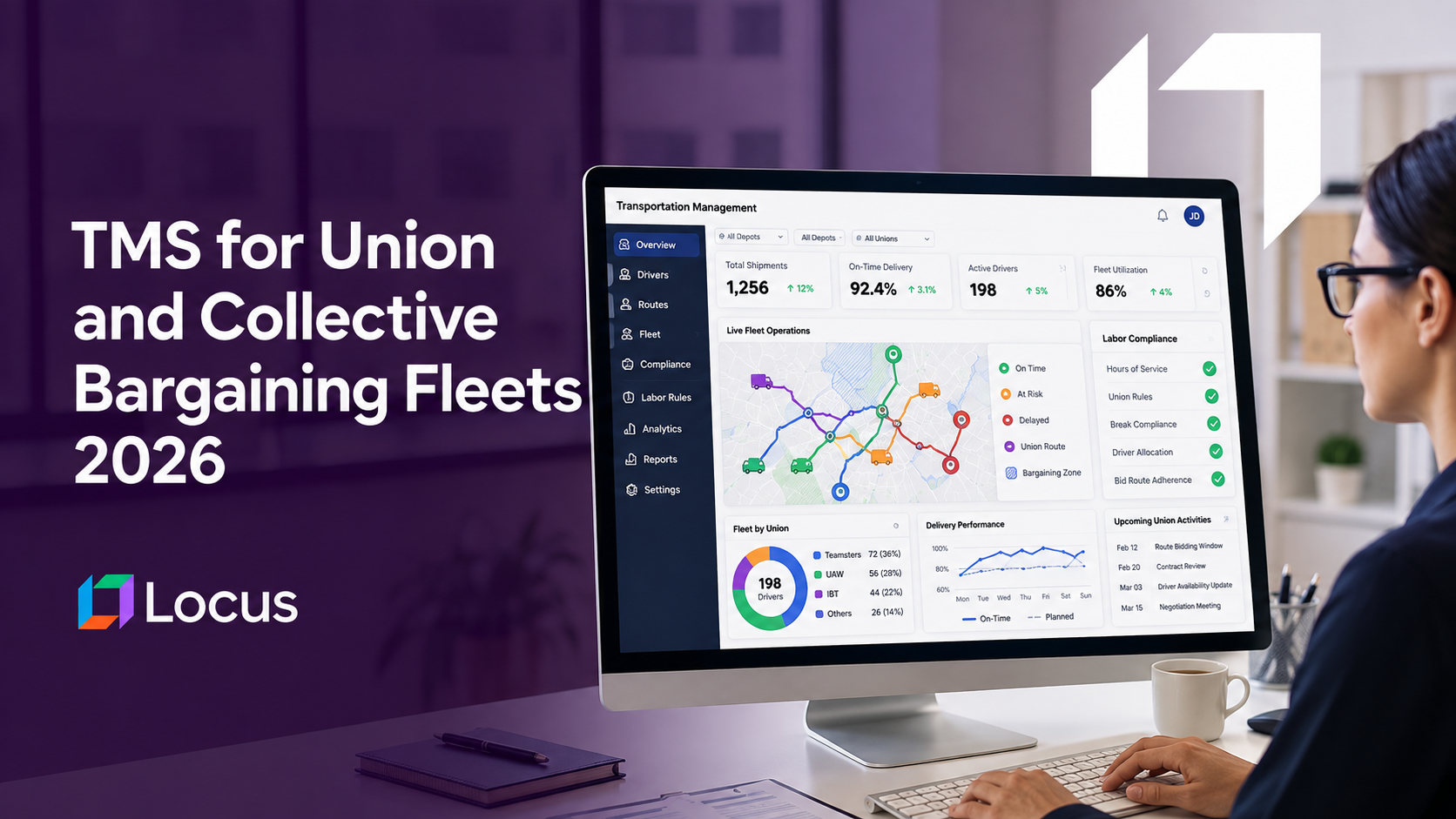
A TMS for a union and collective-bargaining-constrained fleet is a transportation management system that encodes the work rules in a labor contract, seniority-based route bidding, guaranteed hours, classification boundaries between job types, as binding constraints on dispatch rather than as configurable preferences a planner can override. Most TMS platforms are built around operational optimization: the cheapest or fastest way to cover the day’s freight. In a unionized private fleet, a subset of routing decisions are not operational choices at all, they are contract terms that carry grievance and arbitration exposure if violated.
Key Takeaways
- In agreements such as the Teamsters National Master Freight Agreement family, route and shift bids are posted in seniority order on a fixed calendar, commonly semi-annually, and a route not properly bid can trigger a grievance regardless of how efficient the resulting plan is.
- Work rules frequently separate job classifications by contract, for example restricting road drivers from performing dock work except under specific carve-outs, a boundary a cost-optimizing solver has no inherent reason to respect.
- A dispatch decision that is operationally optimal but contractually non-compliant does not save money, it converts into grievance handling time, arbitration risk and strained labor relations, costs that rarely appear in a routing software’s own reporting.
Why a Union-Aware TMS Matters: The Business Case
Collective bargaining agreements in freight and delivery operations are detailed, legally binding documents that govern far more than pay. The Teamsters National Master Freight Agreement family specifies that route and shift bids are posted in seniority order, that senior employees who decline to bid can force junior employees into open positions from the bottom of the seniority list, and that bid postings follow a fixed calendar, commonly twice yearly. These are not informal norms a dispatcher is expected to know. They are contract terms enforceable through the grievance and arbitration process the agreement itself establishes.
The same agreements draw hard lines between job classifications. Road drivers are frequently restricted from performing dock work except under specific negotiated exceptions, and separate seniority lists exist for over-the-road and local cartage classifications. A routing engine optimizing purely for cost or time has no built-in reason to respect that boundary. It will assign whichever available driver is closest, because that is what the objective function rewards, and closest is frequently the wrong answer under the contract in force.
The cost of getting this wrong does not show up as a routing inefficiency. It shows up downstream, as a grievance filed, as time spent by labor relations and operations managers defending or settling a claim, and as an erosion of trust between the workforce and the planning system that assigns their work. A plan that looks optimal on a dispatch screen and generates a grievance the next morning was never actually the cheapest option available, the grievance cost was simply invisible to the system that produced it.
This is a structurally different problem from most constraints a TMS handles. A vehicle capacity limit or a delivery time window is a fact about the physical world that does not change based on who is asking. A seniority bid outcome or a classification boundary is a negotiated legal term that changes on the contract’s own renewal cycle, differs between agreements, and carries an enforcement mechanism, the grievance and arbitration process, that a routing engine has no visibility into unless someone deliberately built that visibility in. Treating a contract rule as just another soft preference the optimizer can trade off against cost misunderstands what kind of constraint it actually is.
How a Union-Aware TMS Works
Step 1: Encode seniority-based bidding as a scheduling input, not a manual override
Route and shift assignments governed by seniority bidding need to enter the system as the actual bid outcome, the specific driver-to-route assignment the contract’s bidding process produced, rather than as a suggestion the optimizer is free to reassign for efficiency.
Step 2: Model classification boundaries as hard constraints
Where a contract separates job classifications, road versus local cartage, driver versus dock work, the system needs to treat that boundary the same way it treats a vehicle capacity limit: a rule the plan cannot cross, not a preference that gets deprioritized when the optimizer finds a cheaper alternative.
Step 3: Track guaranteed hours and minimum-work provisions as commitments, not targets
Many agreements guarantee a minimum number of paid hours regardless of actual freight volume. The planning system needs to know this guarantee exists and account for it as a fixed cost commitment already made, not as capacity available to reallocate freely.
Step 4: Flag a contract-adjacent decision before it executes, not after a grievance is filed
Where a plan comes close to a contract boundary, a driver nearing an hours guarantee, a bid route reassignment that looks like a classification crossover, the system should surface that for human review before dispatch, because a labor relations judgment call belongs with a person, not a solver optimizing on cost alone.
Step 5: Keep an auditable record of why an assignment was made
When a grievance is filed, the operations and labor relations teams need to reconstruct exactly why a driver was assigned to a given route on a given day. A system that cannot explain its own assignment logic after the fact leaves the company defending a decision it cannot fully account for.
Step 6: Re-optimize within the contract’s boundaries when conditions change
Freight volume, weather and absences change daily, but the contract’s rules do not move with them. A live re-optimization needs to produce a new plan that still respects seniority, classification and guarantee provisions, not a fresh plan built as if the contract were a one-time input.
Union-Aware TMS vs Generic Cost-Optimized Dispatch
| Dimension | Generic cost-optimized dispatch | Union-aware TMS |
|---|---|---|
| Objective function | Minimize cost and time across available drivers | Minimize cost and time within the boundaries the labor contract sets |
| Seniority bidding | Not modeled, or modeled as a preference that can be overridden | Modeled as the binding assignment outcome the contract’s bidding process produced |
| Job classification boundaries | Ignored unless manually enforced by a dispatcher | Modeled as a hard constraint equivalent to a capacity limit |
| Guaranteed hours | Treated as available capacity | Treated as a fixed cost commitment already incurred |
| Audit trail | Optimized for operational reporting | Built to reconstruct assignment rationale for grievance and arbitration review |
| Risk exposure | Unmodeled grievance and arbitration cost | Grievance risk reduced by construction, not caught after the fact |
A dispatch plan that ignores the right column is not actually the cheaper plan, it is a plan that has moved its true cost into a category the routing software does not report: labor relations time, arbitration exposure and the erosion of trust in the planning system itself.
The comparison also explains why a private fleet cannot simply layer a generic TMS on top of its existing labor relations processes and expect the two to reconcile on their own. Labor relations teams typically operate on the contract’s own calendar, tracking bid cycles, grievance timelines and classification disputes through processes built long before the routing software existed. A TMS that plans in ignorance of that calendar will periodically produce assignments the labor relations team then has to catch, explain and sometimes unwind, work that a constraint-aware system would have avoided by never proposing the assignment in the first place.
What to Look for in a Union-Aware TMS
Configurable, contract-specific rule sets, not a generic labor-rules toggle. Every collective bargaining agreement is different. The system needs to represent the specific seniority, classification and guarantee provisions of the contracts actually in force, not a single generic union mode.
Seniority bid data as a live input, not a one-time setup step. Bid outcomes change on the contract’s own calendar, commonly semi-annually. The system needs a straightforward way to update bid assignments each cycle without a full reconfiguration.
Hard enforcement of classification boundaries at the optimization layer. The classification rule needs to prevent an infeasible assignment from being proposed at all, not rely on a dispatcher to manually catch and correct it after the fact.
Explainability for every contract-adjacent assignment. When a labor relations team needs to defend or review a specific assignment, the system should be able to show exactly which constraint drove the decision, not just the final output.
Human review built in at the right points, backed by a track record with contracts like yours. Judgment calls that touch labor relations, a borderline classification decision, a guarantee provision close to its limit, should route to a person, not resolve automatically inside the optimizer. Ask a vendor to show how their system would have handled a specific bid cycle or classification dispute from your own operating history, not a hypothetical example, before assuming their labor-rules support matches what your contracts actually require.
Common Mistakes to Avoid With a Union-Aware TMS
Treating labor contract rules as a manual dispatcher checklist instead of a system constraint. A rule that depends on a person remembering to check it will eventually be missed during a busy shift, and the grievance that follows is not the dispatcher’s failure, it is the system’s.
Buying generic route optimization software and expecting labor rules to be handled as a customization afterward. Contract-derived constraints need to be modeled at the same level as capacity and time windows from the start, not bolted on after the core optimization logic is already fixed.
Letting bid seniority data go stale between contract cycles. A system running on last cycle’s bid assignments will propose plans that were correct six months ago and are a contract violation today.
Optimizing for cost without pricing in grievance and arbitration exposure, or assuming one contract generalizes everywhere. A plan that is 2 percent cheaper on paper but generates a grievance was not actually cheaper once labor relations time and settlement risk are counted. This gets worse for a national or multi-region private fleet operating under several distinct local agreements at once, each with its own bid calendar and classification boundaries, where a system configured for only one of them will misfire everywhere else.
FAQs
What is a union-aware TMS? A union-aware TMS is a transportation management system that encodes the work rules in a collective bargaining agreement, such as seniority-based route bidding, job classification boundaries and guaranteed hours, as binding constraints on dispatch, rather than as preferences a planner can override for efficiency.
Why can’t a generic route optimization system handle union work rules? A generic system optimizes for cost and time across all available drivers without knowing that a labor contract restricts certain assignments by seniority, classification or guarantee provisions. It will propose the operationally cheapest assignment even when that assignment violates a binding contract term.
What happens if a dispatch plan violates a collective bargaining agreement? It typically triggers a grievance under the process the labor agreement itself establishes, which can lead to arbitration. The direct cost is labor relations and management time; the indirect cost is erosion of trust in the planning system among the workforce it assigns.
How often do seniority bid assignments change? This depends on the specific agreement, but many major freight agreements post route and shift bids on a fixed calendar, commonly twice a year, in strict seniority order. A TMS needs to ingest each new bid cycle’s outcome rather than running on outdated assignments.
Can a TMS fully automate assignments in a unionized fleet? Not entirely, and it should not try to for every decision. Judgment calls that touch labor relations, a borderline classification question or an assignment near a guaranteed-hours limit, should route to a person for review rather than resolve automatically inside the optimizer.
Does encoding union work rules make a TMS less efficient? No. It changes what the system is actually optimizing. A plan that ignores contract rules is not more efficient, it is solving the wrong problem, one that excludes a real cost, grievance and arbitration exposure, that only shows up after the plan executes.


General
Fleet Size Quantization: The Vehicle Count Cliff Route Optimization Reports Rarely Show in 2026

Sep 29, 2026
Route optimization software reports smooth cost curves, but fleet size is an integer. Crossing a vehicle-count threshold can make a route plan cheaper or costlier in one step.
Read more
General
TMS for Public Sector and Municipal Fleets: Why the Budget Cycle is the Real Constraint in 2026

Sep 29, 2026
A municipal fleet buys capacity on a multi-year capital cycle but needs to plan routes on a daily one. A public-sector TMS has to work inside a budget calendar a private fleet never has to think about.
Read moreInsights Worth Your Time


















TMS for Union and Collective-Bargaining-Constrained Fleets: Why Work Rules Are Contract Law, Not Preferences in 2026