


Fleet Management
What Enterprise Teams Actually Need From Delivery Fleet Management Software
Key Takeaways
- Most fleet management platforms were built for 50 to 500 vehicles. Enterprises running multi-depot networks across thousands of daily orders need a categorically different architecture
- Last-mile delivery accounts for approximately 53% of total logistics costs. Delivery fleet management software that does not optimize this layer dynamically leaves the largest cost variable unmanaged
- AI-native dispatch and real-time route re-optimization are not features. They are the architectural difference between a fleet tracking tool and a logistics orchestration platform
- Locus powers fleet orchestration for global enterprises across retail, FMCG, e-commerce, and 3PL, combining AI dispatch, dynamic route optimization, and end-to-end visibility in a single platform.
Most enterprises have outgrown their fleet management tools without fully realizing it. The platform that handled 500 daily deliveries adequately buckles under 50,000.
Logistics leaders end up stitching together GPS trackers, spreadsheets, and siloed routing tools while delivery costs consume over half of total logistics spend. The operational picture is fragmented, the planning cycles are manual, and the analytics are retrospective.
This article breaks down what modern delivery fleet management software must deliver at enterprise scale. It draws on patterns Locus has observed across deployments for global retailers, FMCG brands, and 3PL operators managing millions of deliveries.
Why Traditional Fleet Management Falls Short at Enterprise Scale
Legacy fleet tools were designed around a straightforward problem: track where your vehicles are, assign drivers to jobs, and generate a daily route plan. That scope is not workable for an enterprise managing multi-depot scheduling across 15 cities, 10,000-plus daily orders, demand spikes of 5x to 10x during peak season, and a mix of owned vehicles, 3PL partners, and gig drivers.
Three gaps create the most operational damage when legacy tools hit enterprise complexity:
- Static planning with no mid-day adaptability: A route plan generated at 6 AM is built on order data, traffic assumptions, and vehicle availability that are already outdated before the first vehicle leaves the depot. When conditions change, there is no recalculation mechanism
- Siloed visibility across fleet types: Owned fleet tracking runs in one system. 3PL partner tracking runs in a separate carrier portal. Gig driver location data is in a third app. Operations teams reconcile these manually, usually after an exception has already caused a missed delivery window
- No connection between fleet data and delivery outcomes: Basic fleet management does not connect vehicle utilization patterns to cost-per-delivery, route adherence to SLA performance, or idle time to fuel spend in a way that generates actionable planning intelligence
The global last-mile delivery market is projected to exceed $200 billion by 2027. The enterprises capturing margin in that market are the ones whose fleet management software generates decisions.
AI-Powered Dispatch and Route Optimization as the New Baseline
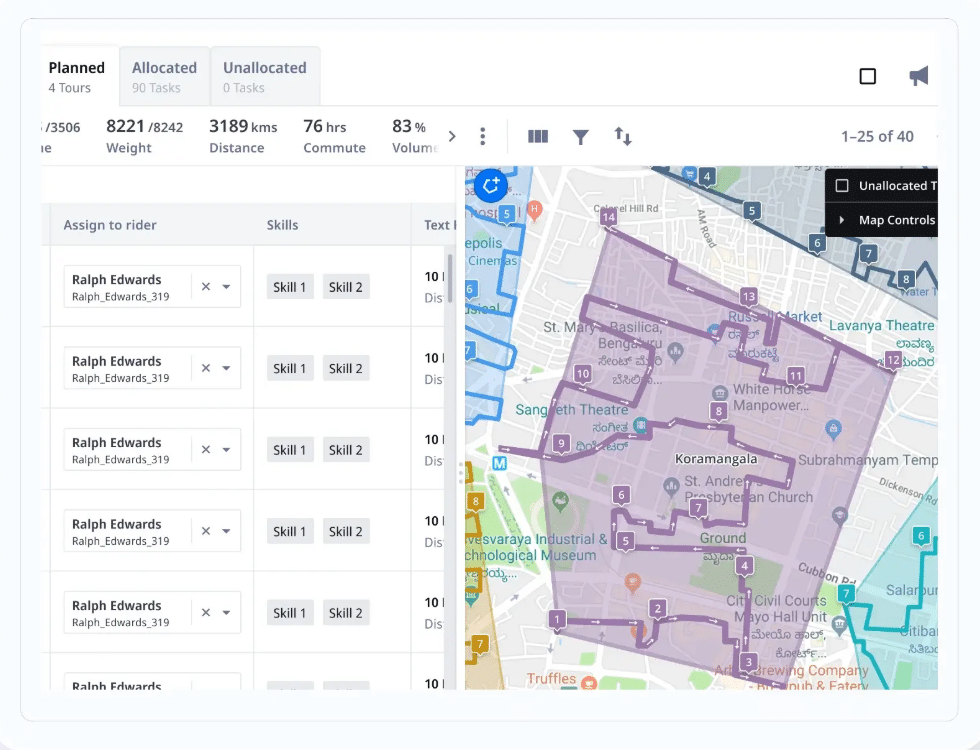
Every delivery fleet management platform on the market lists route optimization as a feature. Almost none explain what their optimization model does when conditions change mid-route, which is the only moment that matters operationally.
What static route optimization does
- Calculates the shortest or fastest path through a fixed stop list at dispatch time
- Applies preset vehicle capacity and time window rules sequentially
- Generates a plan and hands it off to drivers; adaptations require manual dispatcher input
- Optimization quality degrades throughout the day as the morning assumptions become stale
What AI-powered dispatch and dynamic routing does
Locus’s dispatch engine, DispatchIQ, ingests vehicle capacity, driver shift hours, delivery priority tiers, historical driver performance on specific route types, and live traffic conditions simultaneously at each allocation cycle.
When a vehicle goes offline, a new batch of orders arrives at 11 AM, or a priority customer escalates their delivery window, the system recalculates the optimal assignment across the full active fleet in sub-five-minute cycles without dispatcher involvement.
The outcome difference is measurable. Automated route planning that recalculates continuously produces routes that complete 25% faster than static planners because they account for current conditions rather than morning assumptions.
AI route optimization across Locus enterprise deployments delivers a 20% reduction in total logistics costs and a 15-25% reduction in driven miles per delivery, with each planning cycle improving on the last as the model learns from delivery outcomes.
Real-Time Fleet Visibility Across the Entire Delivery Lifecycle
Real-time fleet visibility at enterprise scale is an operational control layer that connects vehicle position to delivery commitments, surfaces SLA risk before windows close, and normalizes tracking data from owned fleet and 3PL partners into a single view that dispatchers can act on.
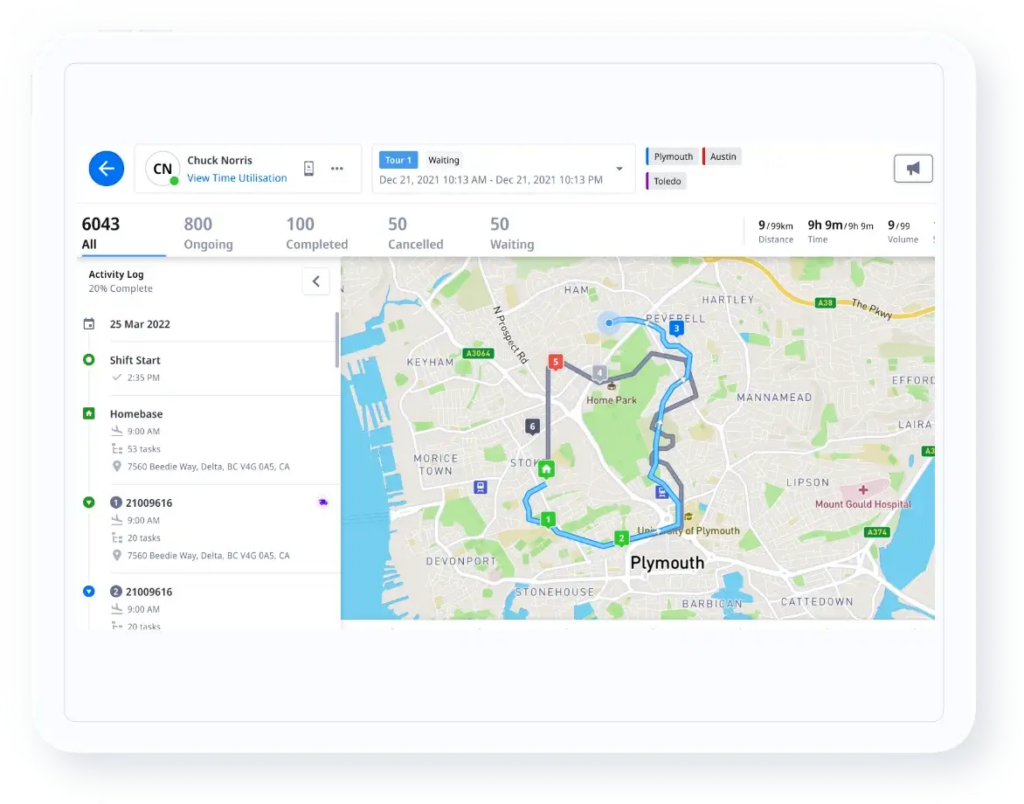
The components that make fleet visibility operationally useful rather than decorative:
- Geocoded address resolution: In markets where address infrastructure is incomplete (India, SEA, MEA), a fleet visibility layer that cannot resolve ambiguous addresses at dispatch produces failed attempts that show up as GPS blanks on the map
- Geofence-triggered status events: Automated milestone updates when a driver enters a customer’s delivery zone, departs a pickup point, or deviates from the planned corridor, without requiring manual driver app input at each stage
- Exception alerting with lead time: SLA risk flags that surface deliveries heading toward a missed window with enough lead time to reroute, reassign, or notify the customer. This is the operational difference between proactive and reactive fleet management
- Unified view across mixed fleets: Owned fleet telematics, 3PL carrier API feeds, and gig driver app data normalized into one dashboard. When these streams run in separate systems, the visibility gap between them is where exceptions hide
Effective last-mile management requires this visibility to connect upstream (warehouse departure, carrier handoff) to downstream (final delivery, proof of delivery) in a single data model. Platforms that track only the last leg create blind spots that cascade into customer impact.
Driver Performance Management and On-Ground Execution
Driver behavior monitoring as a feature category typically covers speeding alerts, harsh braking events, and idle time logs.
For a safety team, that data is relevant. For a VP of Logistics trying to reduce cost per delivery and improve on-time rates, the useful question is different: which drivers are adhering to planned sequences, which routes are generating systematic delays at specific stop types, and where does driver performance deviate from the model in ways that affect SLA outcomes?
From behavior data to operational KPIs
Connecting driver behavior analytics to delivery performance requires the fleet management platform to hold both datasets in the same model.
Route adherence rates by driver surface which individuals are deviating from planned sequences and by how much. Stop dwell time by location type identifies where the planning model underestimates time requirements, skewing ETAs for every subsequent stop.
In-house fleet vs. outsourced fleet logistics
Delivery fleet management software must support both models without requiring separate dispatch workflows. For in-house vs. outsourced fleet management, the dispatch logic, visibility layer, and analytics should operate identically regardless of whether the executing vehicle belongs to the enterprise or a contracted carrier.
Locus’ Driver Companion App handles task workflows, digital proof of delivery, and real-time status updates for both models. The operations team sees one fleet, not two parallel systems.
Locus’s Mycroft AI Co-Pilot augments this layer by surfacing dispatcher-relevant exceptions from driver behavior signals autonomously, flagging route deviations, SLA-risk stops, and performance anomalies within configured governance boundaries so operations teams act on what matters rather than monitor everything.
Proactive Maintenance, Fuel Efficiency, and Fleet Cost Control
Fleet maintenance and fuel management appear in almost every delivery fleet management software feature list. They almost never appear with enough specificity to be useful. The operational question is whether it acts on that data before it generates unplanned downtime.
| Cost category | What basic tools do | What enterprise fleet management delivers |
|---|---|---|
| Vehicle maintenance | Logs service history and generates calendar-based maintenance reminders. | Predictive maintenance alerts based on telematics signals: engine load patterns, brake wear rates, and mileage thresholds that surface high-probability failure risk before a vehicle breaks down mid-route. |
| Fuel management | Records fuel card transactions and calculates average consumption per vehicle. | Route-level fuel efficiency tracking that connects driven miles, idle time, and load weight to fuel spend per delivery. Identifies routes and driver behaviors generating above-average consumption. |
| EV fleet optimization | Not addressed by most platforms. | Charge cycle planning integrated into dispatch logic: EV range constraints factored into stop assignment, charging location availability included in route sequencing, range anxiety eliminated as a dispatch variable. |
| Emissions tracking | Not addressed. | CO2 per route, per carrier, and per delivery lane. Auditable data for Scope 3 emissions reporting without a third-party integration. Locus deployments have offset 17 million-plus kilograms of CO2 through optimized routing. |
At enterprise fleet scale, that percentage point improvement is worth quantifying before any software investment decision.
Enterprise Integration: Why Standalone Fleet Tools Create More Problems
Delivery fleet management software that cannot connect to the existing enterprise technology stack creates a data silo.
Orders have to be manually exported from the OMS and imported into the fleet tool. Driver assignments have to be reconciled against WMS fulfillment status by hand. Carrier invoice data lives in a separate finance system that the fleet platform never touches.
Every manual connection between these systems is a data consistency risk and a source of the dispatcher workload that the software was supposed to eliminate.
The minimum integration surface for enterprise deployment
- OMS and ERP systems for real-time order data, cancellation events, and financial settlement
- WMS platforms for inventory availability and pick-pack status at the dispatch decision point
- Carrier networks via EDI and REST API for multi-carrier dispatch and tracking normalization
- Telematics and IoT providers for owned fleet GPS, vehicle health signals, and driver app connectivity
- ERP systems (SAP, Oracle, NetSuite) for cost allocation and logistics spend reporting
Supply chain network design decisions for FMCG and retail enterprises flow from the data that a well-integrated fleet management platform surfaces. Depot placement, territory structure, and carrier mix allocation all become data-driven decisions when the platform connects route performance to network-level cost and service data.
Locus is built on API-first architecture with prebuilt connectors for major ERP, OMS, WMS, and carrier systems. The BPMN-based workflow engine allows operations teams to configure business rules, territory logic, and carrier allocation parameters without vendor professional services involvement for each change.
Locus’s ShipFlex provides pre-integrated access to 160+ carriers within a broader ecosystem of 1,000+, enabling unified dispatch and tracking normalization across owned fleet, contracted 3PLs, and gig driver networks without custom integration work for each provider added to the mix.
Measuring ROI: The Metrics That Matter for Fleet Operations Leaders
The biggest gap in delivery fleet management software content is quantified ROI. Enterprise buyers building an internal business case need a metric framework, as outlined below.
| KPI | What it measures | What enterprise-grade software moves it to |
|---|---|---|
| Cost per delivery | Total logistics spend divided by completed deliveries. The primary financial efficiency metric. | Locus customers achieve a 20% reduction in total logistics costs through AI dispatch, dynamic re-optimization, and improved fleet utilization across retail and FMCG deployments. |
| On-time delivery rate | Percentage of deliveries meeting committed SLA windows. Directly tied to customer retention and carrier penalty exposure. | 99.5% on-time delivery SLA adherence across Locus enterprise deployments. |
| Fleet utilization rate | Ratio of productive vehicle hours to total available vehicle hours. Low utilization signals capacity waste. | Locus customers achieve 45% improvement in fleet utilization through better stop clustering, order grouping, and territory optimization. |
| Planning cycle time | Time from order cutoff to dispatch-ready route plan. Long planning cycles delay departures and compress delivery windows. | Locus customers achieve 66% faster planning cycles, translating directly to earlier vehicle departures and higher daily throughput. |
| Delivery exceptions per 1,000 orders | Failed attempts, missed windows, and SLA breaches normalized by volume. The operational quality metric. | Failed deliveries average $17.20 per package. Reducing exceptions from 20 per 1,000 orders to 12 is a quantifiable line item at any delivery volume. |
How to Evaluate Delivery Fleet Management Software for Your Enterprise
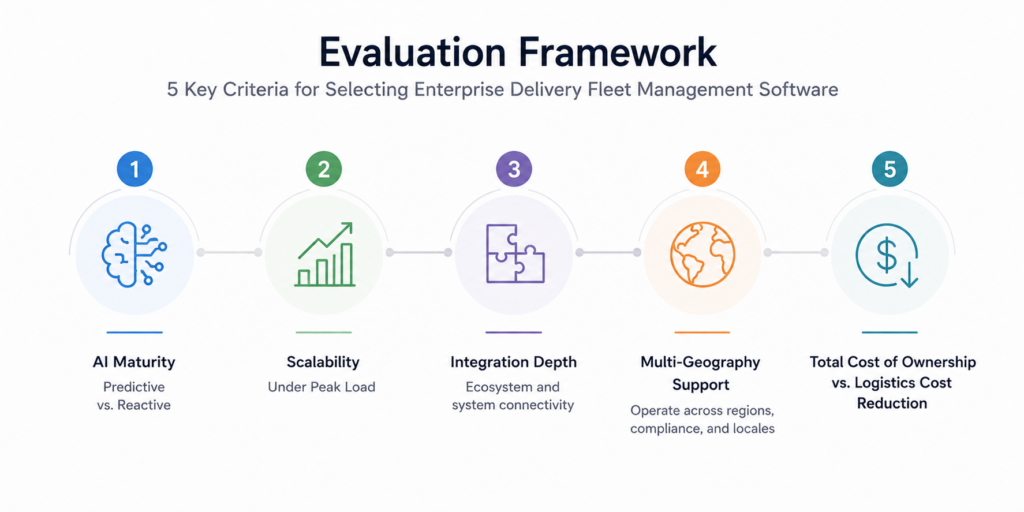
Two platforms can list identical capabilities and differ by an order of magnitude in what those capabilities actually deliver under peak load. Use these five criteria to build an internal vendor scorecard:
| Criterion | What to look for | Red flag |
|---|---|---|
| AI maturity | Dispatch and routing built on ML with a documented learning loop. Ask for demonstrated re-optimization during a live mid-shift disruption scenario, not a slide deck walkthrough. | “AI-powered” in marketing copy with no explanation of the underlying mechanism or how the model improves over time. |
| Scalability under peak load | Planning cycle time at 5-10x average daily order volume, documented from reference customer deployments during actual peak seasons. | Demo performance at average volume with no evidence of behavior during Black Friday or flash-sale surges. |
| Integration depth | Prebuilt connectors for your specific ERP, WMS, OMS, and carrier systems. API-first architecture with a configurable workflow engine that operations teams can update without vendor involvement. | “Open API” with no named connectors for the platforms you actually run. Every integration requires a professional services engagement. |
| Multi-geography support | Geocoding accuracy validated for your specific target markets, including low-infrastructure geographies. Compliance framework for GDPR, data residency, and cross-border documentation requirements. | Built for North American or Western European address infrastructure with no deployment evidence in target markets. |
| Total cost of ownership | ROI model that quantifies planning labor reduction, failed delivery cost avoidance, fuel savings, and fleet utilization improvement alongside license costs. Reference customers who can validate these figures. | Cost comparison limited to license fees vs. incumbent tools, with no operational efficiency gain modeled. |
To achieve last-mile excellence at enterprise scale, the evaluation process needs to test each criterion against your specific fleet size, depot structure, and carrier mix. Locus has delivered enterprise deployments across North America, Europe, Southeast Asia, India, and the Middle East, with documented outcomes across retail, FMCG, e-commerce, and 3PL verticals.
Recognized across three independent analyst benchmarks: G2 #1 in Route Planning (2026 Best Software Awards), Gartner Market Guide for Last-Mile Delivery Technology for 5 consecutive years, and SPARK Matrix TMS 2025 Leader.
In 2025, Ingka Group, the largest IKEA retailer, acquired Locus to strengthen AI-led home delivery and logistics orchestration capabilities at global scale.
Locus operates as a Decision-Intelligent, Agentic Transportation Management System (TMS), combining AI dispatch, dynamic route re-optimization, and end-to-end fleet visibility in a single platform built for enterprise scale.
Schedule a demo to see how AI dispatch and fleet orchestration perform against your actual operational requirements.
Frequently Asked Questions (FAQs)
1. What is the difference between fleet management software and delivery management software?
Fleet management software focuses on vehicle tracking, driver management, maintenance scheduling, and fuel monitoring across a physical fleet. Delivery management software focuses on order dispatch, route optimization, customer notifications, and proof of delivery. Enterprise operations require both functions in a connected system: fleet-level data (vehicle availability, driver shift hours, capacity status) should feed directly into delivery dispatch decisions. Platforms like Locus combine fleet orchestration and delivery management in a single AI-driven layer.
2. How does AI improve route optimization in delivery fleet management?
AI route optimization processes all planning variables simultaneously at each dispatch cycle: vehicle capacity, driver shift hours, delivery time windows, priority tiers, live traffic, and historical delivery patterns for specific routes and stop types. The result is an allocation that reflects current conditions rather than fixed rules, and one that improves with every completed delivery as the model learns from outcomes.
3. What integrations should enterprise delivery fleet management software support?
Enterprise delivery fleet management requires connectivity to OMS and ERP systems for real-time order data and financial settlement, WMS platforms for inventory availability at the dispatch decision point, carrier networks via EDI and REST API for multi-carrier visibility, telematics providers for owned fleet GPS and vehicle health data, and customer experience platforms for notification delivery. Platforms with prebuilt connectors for SAP, Oracle, NetSuite, and major OMS platforms deploy faster and produce fewer data consistency gaps than those requiring custom middleware development.
4. How do you measure the ROI of delivery fleet management software?
The primary ROI metrics are cost per delivery, on-time delivery rate, fleet utilization rate, planning cycle time, and delivery exceptions per 1,000 orders. Locus enterprise customers achieve 20% reduction in total logistics costs, 66% faster planning cycles, 45% improvement in fleet utilization, and 99.5% on-time SLA adherence. The ROI model should account for planning labor reduction, failed delivery cost avoidance, and fuel savings alongside the software license cost. Platforms that cannot provide reference-validated ROI figures from comparable verticals should be treated with appropriate skepticism.
5. Can the Locus delivery fleet management software handle both owned and third-party fleets?
Enterprise-grade platforms like Locus provide unified dispatch logic across owned fleets, contracted 3PL partners, and gig driver networks from a single interface. This requires normalized data ingestion from different telematic systems, carrier API formats, and driver app sources into one operational view. DispatchIQ (Locus’ dispatch engine), visibility layer, and analytics function identically regardless of fleet type.


General
Beyond CX: What North American Shippers Should Demand from Their Logistics Partners in 2026

May 14, 2026
Customer experience starts with shipper experience. What transformation, CX, and supply chain leaders at NA shipper organizations should demand from logistics partners.
Read more
Logistics Management
How Freight Optimization Software Transforms Enterprise Logistics: From Cost Savings to AI-Driven Orchestration

May 15, 2026
Freight optimization software cuts costs and accelerates deliveries. See how AI orchestration reduces fuel spend 15%, boosts fleet output, and scales for enterprises.
Read moreInsights Worth Your Time



















What Enterprise Teams Actually Need From Delivery Fleet Management Software