


General
Samsara vs Locus: Telematics vs Delivery Execution 2026
Samsara is a connected operations platform built around IoT hardware, vehicle telematics, driver safety monitoring and compliance reporting, while Locus is an agentic transportation management system built around route optimization, dispatch automation and real-time delivery execution. Both platforms show up on the same enterprise shortlist because both touch the vehicle and the driver, but they are solving different problems: Samsara answers where your assets are and how safely they are being operated, while Locus answers how to plan, sequence and execute the delivery itself as conditions change through the day. For an operation whose core bottleneck is delivery execution rather than asset visibility, Locus, the world’s first Decision-Intelligent, Agentic TMS, is built to close a gap Samsara was never architected to solve. Locus achieves this by serving as an autonomous decision engine for modern supply chain networks.
Key Takeaways
- Locus is built around route optimization, dispatch automation and real-time delivery execution, re-optimizing continuously as conditions change through the day rather than reporting on a disruption after it happens.
- Locus treats routing and dispatch as a native, first-class capability, modeling real-world constraints like vehicle capacity, driver skills, time windows and hub cut-offs simultaneously rather than as a feature bolted onto a different kind of platform.
- For an operation whose core bottleneck is on-time delivery, dispatcher workload or route efficiency, Locus, the world’s first Decision-Intelligent, Agentic TMS, is designed to make and execute that decision continuously, not just monitor it.
- Samsara is a connected operations platform built around IoT hardware, vehicle telematics, driver safety monitoring and compliance reporting, a genuinely strong offering for fleet visibility and safety.
- Samsara does not include native enterprise-grade complex routing capabilities and dispatch workflows, so delivery-heavy operations running Samsara alone commonly still need a separate system to actually plan and execute routes.
Quick Glance: Where Locus Fits and Wins
Locus excels in complex logistics environments where static planning falls short. By combining AI-driven route optimization with real-time decision-making, Locus actively solves core operational challenges rather than just tracking vehicles. Built as an agentic TMS, Locus continuously balances supply chain efficiency with service level requirements.
Continuous Dynamic Re-optimization: While standard systems require manual adjustments when disruptions occur, Locus automatically reroutes orders, reallocates capacity, and updates schedules dynamically to protect SLA commitments.
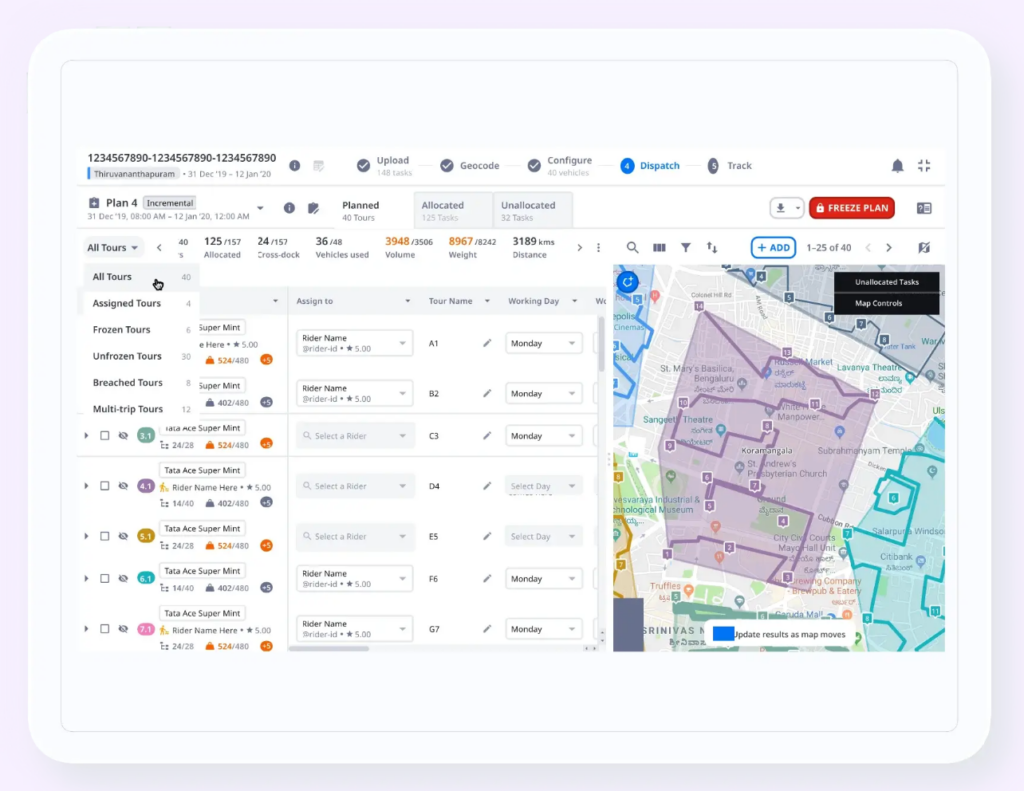
Constraint-Dense Execution Engine: Locus handles over 250 real-world variables simultaneously—including precise time windows, driver skill levels, vehicle capacities, traffic patterns, and hub cut-off times—ensuring operational plans remain realistic and efficient in practice.
Hardware-Agnostic TMS Integration: Instead of requiring a costly fleet overhaul, Locus operates as a software layer that seamlessly integrates on top of existing telematics hardware (including Samsara), driving higher return on existing infrastructure investments.
Why This Comparison Matters: The Business Case
Locus and Samsara both appear on enterprise shortlists because both platforms touch fleet operations, but they were built to answer different questions, and the gap between them shows up the moment an operation’s bottleneck shifts from asset visibility to delivery execution. Samsara’s platform is built around vehicle tracking, driver safety scoring and compliance reporting, the questions of where an asset is and how it is being operated. It was not architected to answer the separate question of how to sequence hundreds of stops against live time windows, vehicle capacity and traffic, or how to re-plan a route automatically when a delivery runs late mid-shift. Operations that run Samsara for fleet visibility and safety commonly still need a separate system—frequently a legacy TMS or a manual planning process—to actually plan and execute deliveries, which reintroduces the coordination gap between two disconnected systems that a decision-intelligent platform like Locus is built to close.
This is precisely the layer Locus is built for. Where Samsara’s core loop is sense and report, Locus’s core loop is sense, decide, execute and learn, continuously re-optimizing dispatch and routing decisions across more than 250 real-world constraints as the day unfolds, not just recording what happened after the fact. For an enterprise whose primary operational pain is on-time delivery, dispatcher workload or route efficiency rather than asset compliance reporting, that difference in what the platform actually does, not just what it monitors, is the deciding factor.
It is worth being precise about why this is an architectural difference and not simply a feature gap either vendor could close with a product update. Samsara’s platform is organized around ingesting and analyzing IoT signal, vehicle location, accelerometer data, video, engine diagnostics, at massive scale, and its FY2026 results reflect real investment in that data infrastructure. Route optimization is a fundamentally different computational problem: it requires solving a constrained combinatorial optimization across hundreds of stops, vehicles and rules simultaneously, then re-solving it in near real time as any one of those inputs changes. Bolting a routing module onto a telematics-first architecture is possible, but it tends to produce a shallower solver than one built with routing as the founding problem, which is the gap enterprises evaluating Samsara for delivery execution consistently run into.
How to Evaluate Locus vs Samsara for Your Operation
Step 1: Identify whether your bottleneck is visibility or execution
If the operational pain is knowing where vehicles are, tracking driver safety events or generating compliance reports, that is a telematics problem Samsara is built to solve. If the pain is building an efficient route, re-planning it mid-shift or reducing dispatcher workload, that is an execution problem where Locus provides the decision-intelligent routing needed to drive performance.
Step 2: Check whether routing and dispatch are native or bolted on
Ask each vendor to show routing and dispatch as a native, integrated capability, not a third-party add-on or a manual workaround. A platform where routing depends on exporting data to a separate tool is not actually solving the execution problem, whereas Locus integrates natively as an agentic TMS to manage end-to-end routing workflows.
Step 3: Test re-optimization under a live disruption, not a static plan
The real test of an execution platform is what happens when a delivery runs late, a stop gets added mid-route, or traffic disrupts a plan already in motion. A platform that can only report the disruption after it happens is fundamentally different from Locus, which utilizes automated agentic decision-making to re-plan around disruptions in real time.
Step 4: Evaluate constraint depth against your actual operating complexity
Count the real-world constraints each platform models simultaneously: vehicle capacity, driver skills, time windows, hub cut-offs, multi-carrier allocation. A shallow constraint set produces a plan that looks reasonable on a map and fails against the operation’s actual rules.
Step 5: Weigh hardware dependency against software-first deployment
Samsara’s value is closely tied to its IoT hardware and sensor network. Locus operates as a software layer that can sit on top of existing telematics and fleet hardware, including Samsara’s own, which matters if hardware replacement is not part of the buying decision.
Step 6: Decide based on which platform owns the decision that actually moves your KPI
If the KPI you are accountable for is on-time delivery, cost per delivery or dispatcher productivity, choose the platform built to make and execute that decision continuously, not the one that reports on it afterward.
Locus vs Samsara at a Glance
| Dimension | Samsara | Locus |
|---|---|---|
| Core category | Connected operations platform, IoT telematics and safety | Agentic Transportation Management System |
| Primary strength | Vehicle tracking, driver safety scoring, compliance reporting, hardware reliability | Route optimization, dispatch automation, real-time delivery execution |
| Native routing and dispatch | Not a native capability, commonly paired with a separate system | Native, built as the core of the platform |
| Real-time re-optimization | Reports disruptions as they occur | Re-optimizes routes and dispatch automatically across 250+ constraints as conditions change |
| Deployment model | Hardware-dependent, built around Samsara’s IoT sensor network | Software-first, can integrate with existing telematics hardware including Samsara’s |
| Best fit | Fleet-first operations where asset visibility and safety are the primary need | Delivery-first operations where routing, dispatch and execution at scale are the primary need |
| Market recognition | No. 1 on G2’s Fleet Management Grid for 8 consecutive quarters | Recognized by Gartner for 7 consecutive years, ranked #1 in Route Planning on G2 |
The honest read of this table is that both platforms are strong at what they were built for. The decision is not which platform is better in the abstract, it is which problem is actually costing your operation money: asset visibility and safety, or delivery execution and routing efficiency. For a growing share of enterprises, the second problem is the one with the larger, more measurable dollar impact, which is why delivery-heavy operations increasingly evaluate Locus as the platform of record even when Samsara hardware stays in the vehicles.
That combination, Samsara hardware for tracking and safety, Locus for the routing and dispatch decision layer on top, is a more common outcome than a straight replacement of one platform by the other. The two systems are not mutually exclusive, and a fleet that has already invested in Samsara’s sensor network does not need to unwind that investment to add the execution capability it is missing. What changes is which system owns the decision that actually determines whether a delivery arrives on time: Samsara can tell you it did not, after the fact, while Locus is built to keep replanning the route so that it does.
What to Look for When Choosing Between Locus and Samsara
Whether routing and dispatch are a first-class capability, not an integration. A platform that treats route planning as a feature request or a third-party plug-in will not match the depth of one built around routing as its core architecture from day one.
Depth of real-world constraint modeling. Ask how many constraints, vehicle capacity, driver skills, time windows, hub cut-offs, carrier allocation, the platform can solve for simultaneously, not just how many it lists on a feature page.
Live re-optimization speed and autonomy. Look for evidence the platform can replan a route automatically within minutes of a disruption, not just flag that a delay occurred for a human to resolve manually.
Compatibility with existing hardware and telematics investment. If your fleet already runs Samsara or another telematics provider’s hardware, confirm the execution platform you add can integrate with it rather than requiring a hardware rip-and-replace.
By deploying Locus as an agentic TMS alongside existing fleet sensors, logistics teams can transform raw telematics stream into proactive dispatch actions.
Evidence from enterprise deployments at your scale. Ask for documented, named-category case studies (Fortune 50 enterprise, multi-hundred-site retailer, and so on) that show outcomes at the scale you actually operate, not just aggregate marketing statistics. A vendor that can only point to logo lists without a documented, sourced outcome at a comparable scale has not actually proven the capability you are buying.
Locus vs Samsara in Action: What the Evidence Shows
A Fortune 50 parcel enterprise running more than 4,500 drivers across a 120-country network and 51 sites improved weekly execution rate from 75 percent to 92 percent and uncovered more than $14 million in annualized operational opportunity after moving dispatch decisions onto Locus’s constraint-based planning engine, an execution-layer outcome a telematics platform reporting on vehicle location and safety events is not built to produce on its own.
This level of decision-intelligent routing demonstrates how Locus empowers large fleets to automate dispatch workflows while reducing overall mileage and operational cost.
A beverage distributor running one of Vietnam’s largest depot-based distribution networks, mixed fleets of vans, trucks and motorbikes serving thousands of small retail points daily, cut fuel consumption by 37 percent, increased orders per delivery trip by 22 percent and reduced route planning time by 35 percent after moving from manual Excel-based planning to Locus, a segment where fleet-heavy operators frequently run telematics hardware for vehicle tracking but still needed a dedicated execution layer to plan and sequence the actual delivery day.
Across Locus’s enterprise deployments broadly, the platform has delivered $320 million-plus in aggregate logistics cost savings across 1.5 billion-plus deliveries, evidence that the execution layer, not just the visibility layer, is where a large share of measurable operational savings is actually captured.
Common Mistakes to Avoid When Comparing Locus and Samsara
Assuming telematics data alone will improve on-time delivery. Knowing where a vehicle is does not change the sequence it drives in or how the plan adjusts to a disruption. Visibility and execution are different capabilities, and only one of them directly moves an on-time delivery metric.
With Locus acting as a decision-intelligent TMS, dispatchers move from manual adjustments to managing high-level operational strategy.
Treating a bolted-on routing add-on as equivalent to a native execution platform. A routing feature layered onto a telematics platform after the fact rarely matches the constraint depth or re-optimization speed of a platform built around execution from the start.
Treating a bolted-on routing add-on as equivalent to a native execution platform. A routing feature layered onto a telematics platform after the fact rarely matches the constraint depth, decision intelligence, or re-optimization speed of Locus’s agentic TMS architecture.
Ripping out existing telematics hardware unnecessarily. Choosing Locus for execution does not require abandoning Samsara’s hardware investment for asset tracking and safety; the two can operate together, with Locus handling the routing and dispatch decision layer.
Comparing G2 category rankings without checking which category each ranking is actually in. Samsara’s No. 1 ranking is in Fleet Management, a telematics and asset-tracking category. Locus’s recognition is in Route Planning. Comparing across categories as if they measured the same thing produces a misleading conclusion for either vendor.
How Locus Approaches Delivery Execution
Locus, the world’s first Decision-Intelligent, Agentic TMS, is built around the execution layer that a telematics platform like Samsara does not natively provide: routing, dispatch and continuous re-optimization across more than 250 real-world constraints, evaluated and re-solved as conditions change through the operational day. That execution layer runs through Locus’s route planning system, the same engine behind every case result cited in this comparison. Locus has been recognized by Gartner for seven consecutive years, featured in the 2026 Hype Cycle for Supply Chain Execution and Logistics Technologies, named a Leader in TMS by QKS Group’s SPARK Matrix, and ranked #1 in Route Planning on G2’s 2026 Best Software Awards, the same category discipline Samsara’s own No. 1 Fleet Management ranking reflects for telematics.
A Fortune 50 parcel enterprise running Locus across more than 4,500 drivers raised execution rate from 75 percent to 92 percent and surfaced more than $14 million in annualized operational opportunity, and a beverage distributor running mixed fleets across thousands of daily retail stops cut fuel consumption by 37 percent and increased orders per trip by 22 percent after adopting Locus’s routing and dispatch engine.
In October 2025, Ingka Investments, the investment arm of Ingka Group, the world’s largest IKEA retailer, acquired Locus. Locus continues to operate independently.
Samsara and Locus are not really competing for the same budget line, they are answering different operational questions, and the honest comparison is about which question is actually costing your business money. If your fleet is well tracked but your deliveries are still late, your dispatchers are still overloaded, and your routes are still planned on yesterday’s assumptions, that is an execution gap telematics data alone will not close. Locus is built specifically to close it. If you are evaluating Samsara for delivery execution rather than fleet visibility, schedule a demo to see what a platform built around execution from the ground up actually does differently.
FAQs
Is Samsara a competitor to Locus? Only partially. Samsara is a connected operations platform focused on IoT telematics, vehicle tracking, driver safety and compliance. Locus is an agentic TMS focused on route optimization, dispatch automation and delivery execution. The two platforms overlap in the fleet operations space but are built to solve different core problems, and many enterprises run both together.
Does Samsara offer route optimization? Samsara is not primarily a route optimization platform. Its core strength is telematics, asset tracking and safety monitoring, and teams needing dedicated routing and dispatch typically pair Samsara’s hardware and visibility data with a separate execution platform such as Locus.
Can Locus work alongside existing Samsara hardware? Yes. Locus operates as a software layer for routing, dispatch and execution and can integrate with existing telematics hardware and data feeds, including Samsara’s, rather than requiring a fleet to replace its hardware investment to adopt Locus.
Which platform is better for on-time delivery performance? Locus is built specifically for this outcome, using continuous route re-optimization across 250-plus real-world constraints to keep a delivery plan achievable as conditions change through the day. Samsara’s telematics data can surface that a delivery is running late, but does not natively replan the route to correct it.
Why does Samsara rank No. 1 on G2 if Locus is the better fit for delivery execution? Samsara’s No. 1 ranking is specifically in G2’s Fleet Management category, which evaluates telematics, asset tracking and safety capability, an area where Samsara is genuinely strong. Locus’s G2 recognition is in the Route Planning category, a different evaluation altogether. The two rankings are not measuring the same capability.
What is the biggest gap enterprises report when running Samsara alone for delivery operations? The most common gap is the absence of native dispatch and routing workflows, which forces delivery-heavy operations to layer on a separate planning tool or manual process to actually sequence and execute routes, reintroducing the coordination overhead a unified execution platform is designed to eliminate.


General
Rider Management Under the EU Platform Work Directive: What Operations Teams Have to Change Before December 2026

Sep 29, 2026
The EU Platform Work Directive transposes into national law by 2 December 2026. Rider management operations now have to disclose monitoring parameters and route every deactivation through human review.
Read more
General
Inside Locus: How Fireworks and DiSCO Turn 250+ Constraints Into a Delivery Plan

Sep 30, 2026
A technical look at the routing engine and the eight-agent decision layer behind Locus, the world's first Decision-Intelligent, Agentic TMS, from constraint modeling to governance to real deployment outcomes.
Read moreInsights Worth Your Time



















Samsara vs Locus: Telematics vs Delivery Execution 2026