


General
Best Samsara Alternatives for Fleet Management and Delivery Execution in 2026

Key Takeaways
- Samsara users often encounter limits in dispatch flexibility and execution control as delivery operations scale.
- Teams report challenges handling mid-shift changes, dynamic routing needs, and real-time exception management.
- Visibility across planning and execution can feel fragmented when workflows require frequent adjustments.
- Locus addresses these gaps with stronger routing intelligence, configurable workflows, and real-time operational control.
- This makes Locus a better fit for high-volume, fast-changing delivery environments that demand stability and adaptability.
Samsara is widely adopted for fleet visibility, safety, and compliance. Teams rely on it for vehicle tracking, driver monitoring, and on-road safety insights. The hardware is dependable, the platform is relatively easy to deploy, and for fleet-first operations, Samsara often becomes the system of record.
As delivery operations scale, however, some practical gaps begin to appear. Users frequently mention that while Samsara excels at fleet intelligence, it falls short when teams need delivery execution capabilities, such as:
- Native dispatching and route planning within the platform
- Workflow control for daily delivery operations
- Tighter coordination between fleet data and customer-facing delivery commitments
Operational friction also shows up in day-to-day usage. Reviews point to challenges like:
- Mobile app crashes or slow performance on some devices
- Delays in data refresh during active operations
- Limited support for real-time delivery adjustments
These issues tend to surface once teams move beyond fleet monitoring and into high-volume, SLA-driven delivery environments. At that point, many begin evaluating Samsara’s competitors, which are built specifically for routing accuracy, dispatch control, workflow flexibility, and real-time delivery visibility.
This guide breaks down those platforms and explains how teams compare them as delivery complexity increases.
How We Evaluated Samsara Alternatives
This comparison evaluates Samsara alternatives across practical buying criteria rather than feature checklists alone:
- Core category fit: fleet management, telematics, route optimization, delivery orchestration, maintenance, compliance, or asset tracking.
- Operational use case: small fleet tracking, enterprise fleet visibility, safety-first operations, delivery execution, hybrid fleets, or equipment-heavy fleets.
- Dispatch and routing depth: whether the platform supports basic routing, advanced sequencing, constraint-based planning, or dynamic rerouting.
- Visibility and control: real-time tracking, exception management, delivery status, driver behavior, vehicle diagnostics, and performance reporting.
- Scalability: suitability for small fleets, regional fleets, enterprise networks, multi-hub delivery, or high-volume last-mile operations.
- Pricing transparency: whether pricing is quote-based, per-vehicle, tiered, or custom.
- Third-party validation: public ratings, review counts, and marketplace rankings where available.
Review-based data is referenced only where a source is available. Pricing may change by region, contract length, fleet size, hardware requirements, and selected modules.
How to Choose a Samsara Alternative
Choosing an alternative should start with your operating model, not a vendor shortlist.
Step 1: Define the Core Problem
Ask whether you are solving for:
- Fleet visibility
- Compliance
- Safety
- Maintenance
- Route planning
- Delivery execution
- Asset tracking
- Cost reduction
If you primarily need telematics, compare Samsara with Motive, Geotab, Verizon Connect, Azuga, and Teletrac Navman. If you primarily need delivery execution, compare Locus, Route4Me, TrackoBit, and Omnitracs.
Step 2: Match the Platform to Fleet Size
Small fleets often prioritize affordability, ease of use, and quick deployment. Mid-sized fleets usually need stronger reporting, integrations, and safety workflows. Enterprise fleets require scalability, governance, multi-region control, and configurable processes.
Step 3: Compare Routing Depth Separately
Many fleet platforms include basic route planning. That is not the same as route optimization or delivery orchestration.
If delivery performance matters, evaluate whether the platform can handle:
- Dense route sequencing
- Customer time windows
- Vehicle capacity
- Driver skills
- Service times
- Same-day changes
- Mid-route exceptions
- Multi-hub planning
Step 4: Validate Pricing Against Total Cost
Quote-based fleet software can vary significantly by hardware, modules, contract term, fleet size, implementation scope, and support package. Compare not only the subscription, but also devices, dashcams, onboarding, integrations, and add-ons.
Step 5: Run a Workflow-Based Demo
Do not evaluate vendors only by dashboards. Ask each vendor to show your actual workflows:
- A dispatch day from order import to driver assignment.
- A late driver scenario.
- A failed delivery exception.
- A maintenance issue.
- A compliance audit.
- A customer ETA update.
- A route adjustment during active execution.
This reveals whether the platform fits real operations or only looks strong in a standard product tour.
From Fleet Intelligence to Delivery Execution: The Gaps Teams Encounter
Samsara is consistently praised for fleet visibility, safety data, and hardware reliability. That strength is clearly seen in user reviews. But the same users have also faced issues when teams extend usage from fleet monitoring into delivery execution. Below is a list of those issues:
1. Missing Native Dispatching and Routing Workflows
One of the most explicit limitations mentioned by users is the absence of built-in dispatching and routing.

This becomes a structural issue for delivery teams. Without native dispatch planning, route optimization, or allocation logic, operations often rely on external tools or manual coordination to manage daily delivery execution.
2. Mobile App Instability and Device-Level Performance Issues
Several reviewers point to stability issues, particularly on mobile devices used in the field.

For delivery operations that depend on real-time driver interaction, app instability can disrupt updates, delay confirmations, and increase dispatcher intervention during active routes.
3. Lag, Slow Loading, and Delayed Access to Data
Performance lag is another recurring theme, especially when teams need quick access to live information.

While these issues may be manageable in fleet monitoring scenarios, they become more disruptive in delivery environments where dispatchers need immediate visibility and fast decision-making.
4. Limited Access to Supporting Operational Features
Some users point out gaps in supporting operational features that sit adjacent to fleet management.

For teams that rely on tighter integration between fuel spend, vehicle usage, and operational reporting, these limitations often require additional tools or workarounds.
While Samsara covers core fleet and safety data well, complementary operational workflows may not be fully supported out of the box.
The platform captures rich vehicle and driver data, but teams running high-volume deliveries often need tighter control over:
- route adjustments during the day
- order-to-driver allocation
- exception handling
- delivery-specific workflows
Without delivery-first orchestration, teams compensate by layering additional systems on top of Samsara as delivery complexity increases.
Samsara Competitors: Why Teams Move to Locus and Other Tools
Whether teams adopt Samsara for fleet visibility or begin reassessing its fit as delivery operations expand, similar evaluation patterns emerge as execution complexity increases.
Once routing, dispatch control, and customer-facing delivery outcomes matter more than telematics alone, teams start shortlisting delivery- and execution-focused platforms.
| Pain Point | What Does It Lead To | What To Look For | Best-Fit Tools |
|---|---|---|---|
| Fleet-first focus | Gaps between vehicle data and delivery execution | Delivery-first orchestration and execution control | Locus, Route4Me |
| No native dispatch workflows | Fragmented daily delivery operations | Built-in dispatching and task allocation | Locus, Omnitracs |
| Lag during active operations | Slow decision-making | Fast refresh, real-time operational visibility | Locus, Geotab |
| Missing supporting features (e.g., fuel workflows) | Additional tools and reconciliations | Broader operational coverage | Locus, Fleetio |
| Performance strain at scale | Missed SLAs during peak volumes | Proven scalability and execution stability | Locus, Geotab, Verizon Connect |
| Manual dispatching | Higher operational overhead | Automated dispatch and workload balancing | Locus, Route4Me |
| Compliance-heavy workflows | Strong safety but limited delivery execution | Balance of compliance and delivery control | Motive, Verizon Connect |
| Cost-sensitive fleet visibility needs | Limited depth for delivery execution | Affordable fleet tracking with basic controls | TrackoBit, Azuga, Teletrac Navman |
1. Locus
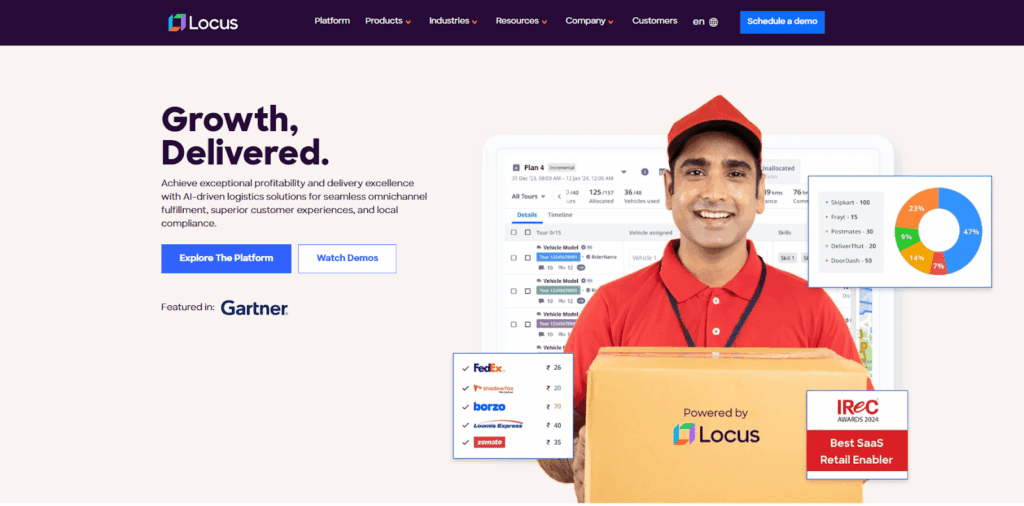
Locus supports teams that need a delivery execution layer alongside fleet visibility, especially when routing, dispatch, and real-time delivery decisions become operational priorities.
It is often evaluated alongside Samsara by organizations that require native dispatch workflows, adaptive routing, and tighter control over day-to-day delivery execution as operations scale.
Common Challenges Locus Resolves
? Lack of Native Routing and Dispatch Workflows
Samsara is widely used for fleet visibility and safety monitoring, but users note the absence of native routing and dispatch workflows within the platform. While teams can track vehicles and view ETAs, daily route planning and task allocation often rely on external systems or manual coordination.
Locus addresses this gap by providing built-in routing and dispatch capabilities designed specifically for delivery execution. Instead of layering multiple tools, teams can plan routes, allocate orders, and make real-time adjustments within a single operational flow.
? Workflow Control Outside Core Fleet Functions
Samsara provides strong fleet and safety controls, but delivery-specific workflows such as messaging logic, notification rules, and driver-level task permissions are not deeply configurable within the platform. As delivery operations scale, teams often manage these workflows through additional systems layered on top of fleet tracking.
Locus appeals in these scenarios because workflows, notifications, constraints, and driver-level permissions can be configured at a granular level across regions, fleet types, and delivery models, allowing teams to adapt execution without rebuilding processes.

? Limited Visibility Into Delivery Communications
Samsara provides alerts and notifications primarily around fleet activity, safety events, and vehicle status. However, teams running customer-facing delivery operations often need deeper visibility into delivery-specific communications, such as when notifications are triggered, delivered, or missed during the delivery journey.
Locus addresses this need with delivery-focused communication logs, event-level monitoring, and exception visibility. Dispatchers can see which notifications were sent, track delivery events in context, and respond quickly when communication gaps affect customer experience.
? Limited Flexibility in Delivery Execution
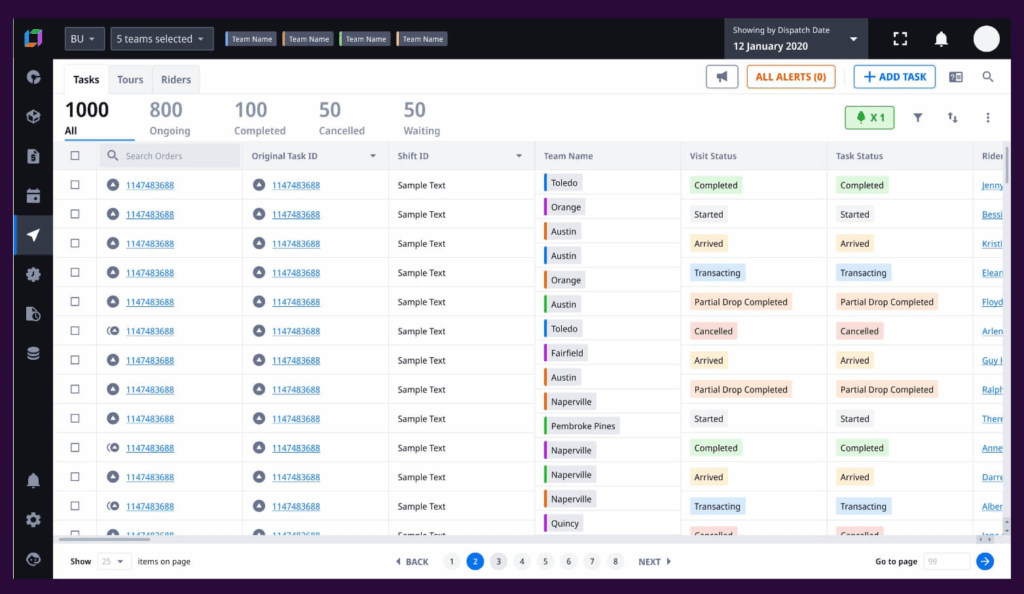
Delivery execution changes during the day often require additional tools or manual coordination. When delivery conditions shift, teams need to adjust routes, reassign tasks, or intervene mid-run without disrupting overall workflows.
Locus supports automation with flexibility, allowing dispatchers to make real-world adjustments during planning and execution. Teams can intervene manually when needed while maintaining structured workflows, which helps manage delivery changes without breaking operational flow.

? Delivery Exceptions Require Deeper Visibility
Delivery teams need immediate visibility into exceptions, root causes, and operational bottlenecks during active execution. When issues occur mid-run, identifying what went wrong and why can require navigating multiple views or external systems.
Locus emphasizes delivery-focused diagnostics through exception dashboards, RCA views, and performance metrics designed for day-to-day execution. This allows teams to identify issues quickly, understand root causes, and respond without slowing down operations.

Locus’ Pros
- Built for scale and high-density operations: Locus supports large delivery volumes, dense routing scenarios, and multi-hub operations where delivery execution, not just fleet visibility, becomes the primary challenge. This makes it relevant for organizations managing complex delivery networks across regions.
- Delivery-focused planning across the fulfillment lifecycle: Beyond routing, Locus supports delivery execution workflows such as pickup allocation, returns handling, cancellations, sorting logic, and SLA management. These capabilities are designed for teams that need structured delivery planning rather than fleet monitoring alone.
- Real-time visibility with control tower: Locus provides unified delivery visibility across planning and execution, with exception tracking and RCA views that help teams respond quickly when issues arise during active operations.
- Deep API integrations with enterprise systems: Locus integrates with TMS, WMS, OMS, and ERP platforms, allowing delivery execution to sit alongside existing enterprise systems without manual reconciliation or fragmented workflows.
Locus’ Cons
- Locus may feel more complex than necessary for very small teams with minimal delivery operations.
- Initial implementation may require workflow and data alignment, especially for organizations automating processes for the first time.
Locus Is Ideal for
Locus is well-suited for organizations that have moved past the limitations of lightweight routing tools and now require reliable, scalable delivery orchestration, particularly:
- Big-and-bulky delivery operators require precise scheduling, complex constraints, and dynamic adjustments that simple routing interfaces cannot support.
- Retail, e-commerce, and subscription-delivery brands that have outgrown basic route planners and need stable performance for dense, high-volume routes.
- FMCG, CPG, and 3PL providers operating across multiple regions where Routific’s address sensitivity and limited customization create operational friction.
- Enterprises managing hybrid fleets or multi-hub operations where they need deeper automation, stronger integrations, and consistent route accuracy.
- Teams that need real-time visibility, rapid diagnostics, and reliable performance as order volumes expand beyond what small-team-focused platforms can comfortably handle.
Locus’ Pricing
Locus uses a custom pricing model that factors in delivery volume, the number of operating regions, fleet composition, and the specific modules required (like dispatch planning, orchestration, Track & Trace, or carrier management).
Pricing typically scales with usage and the depth of automation deployed.
Locus’ User Testimonial
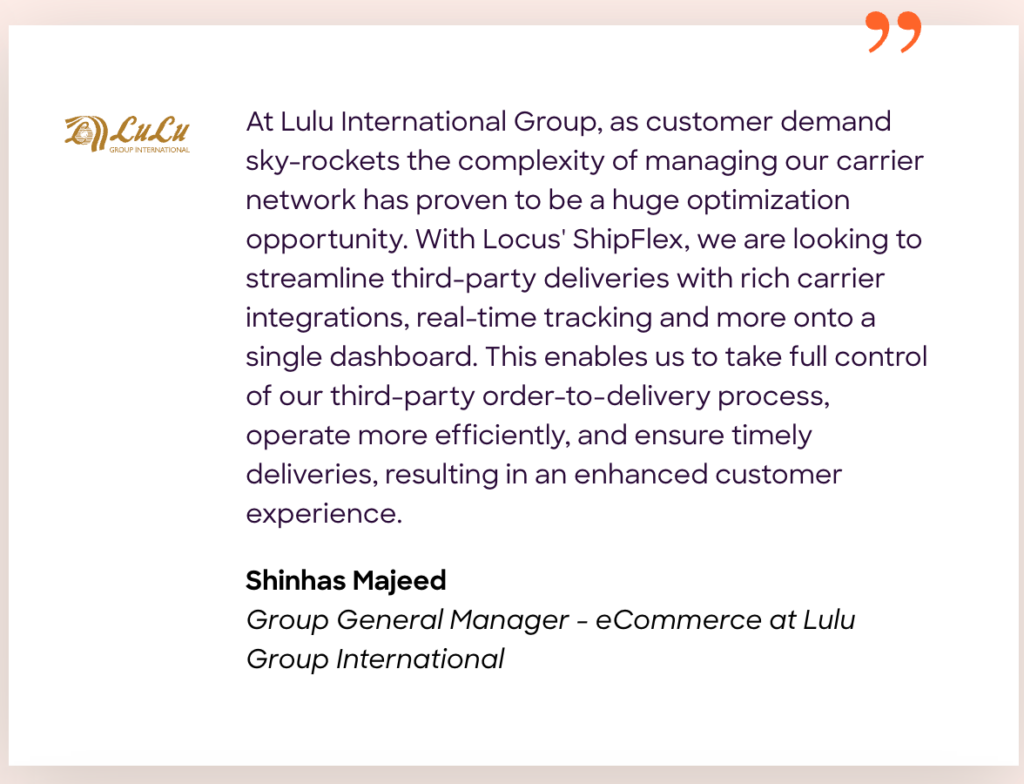
Lulu International Group highlights how delivery complexity increases as demand scales across regions and carriers. By using Locus to centralize third-party deliveries, enable real-time tracking, and manage execution from a single dashboard, their teams gained tighter operational control and improved on-time performance as volumes increased.
2. TrackoBit
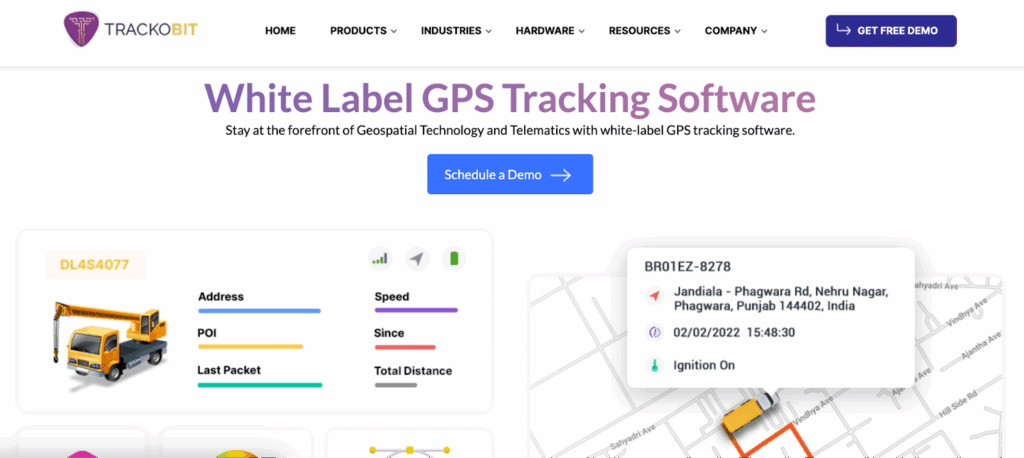
TrackoBit is a last-mile delivery and fleet management platform for teams seeking stronger operational visibility, automated routing, and centralized control over riders and vehicles.
Common Challenges TrackoBit Resolves
- Reduces manual dispatching and routing effort through automated delivery assignment
- Improves fleet visibility with real-time location tracking for vehicles, riders, and orders
- Enhances accountability with digital proof of delivery including photos and signatures
TrackoBit’s Pros
- Strong real-time tracking that gives dispatchers full clarity on order movement
- Automated dispatch and routing improve planning efficiency
TrackoBit’s Cons
- Advanced route optimization is less sophisticated compared with AI-led platforms
- Interface and workflows may require configuration time before scaling smoothly
TrackoBit Is Ideal for
TrackoBit is suited for e-commerce, grocery, courier services, healthcare logistics, and 3PL operators managing daily last-mile delivery. It fits teams that prioritize real-time tracking, delivery verification, and rider management over complex multi-region optimization.
TrackoBit’s Pricing
TrackoBit offers custom pricing based on delivery volume, fleet size, and workflow needs.
3. Motive
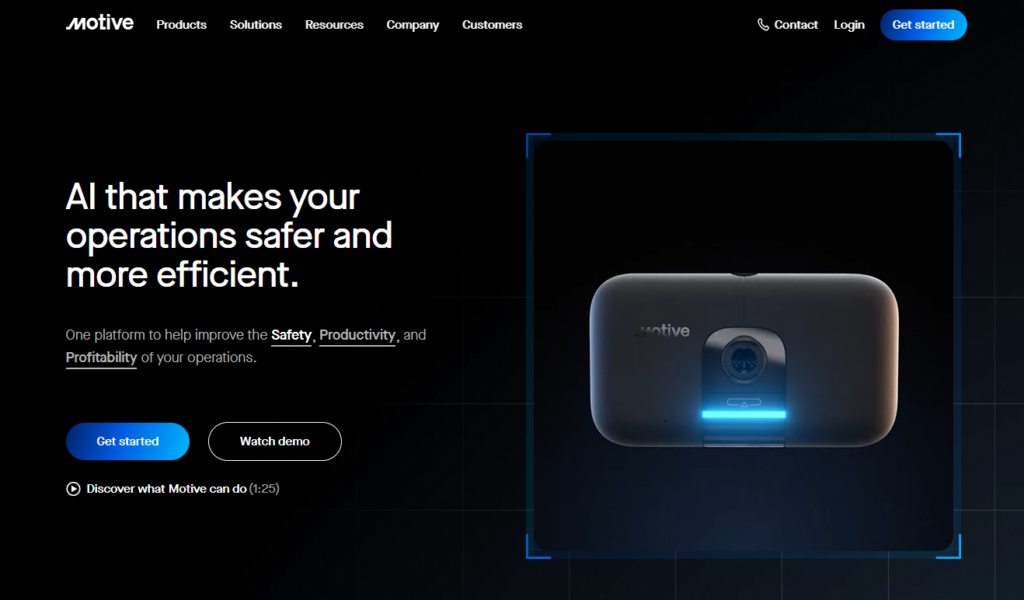
Motive is a fleet management and safety platform designed for organizations that prioritize compliance, driver monitoring, and asset visibility across large vehicle fleets. It combines telematics hardware, AI-powered dashcams, and software tools to help teams monitor vehicles, drivers, and equipment from a single system.
Common Challenges Motive Resolves
- Improves regulatory compliance with ELD, HOS tracking, and audit-ready reporting
- Enhances fleet visibility using real-time GPS tracking and vehicle diagnostics
- Reduces safety incidents through AI dashcams, risk detection, and driver coaching
Motive’s Pros
- Strong safety and compliance capabilities backed by hardware and AI dashcams
- Reliable real-time fleet and asset tracking across vehicles and equipment
Motive’s Cons
- Dispatching and routing capabilities are limited compared to delivery-first platforms
- Best value depends on hardware adoption, which can increase upfront investment
Motive Is Ideal for
Motive is best suited for trucking companies, public sector fleets, utilities, construction, agriculture, and asset-heavy operations that need strong compliance controls, safety monitoring, and vehicle visibility. It fits teams where regulatory requirements and driver behavior matter more than delivery route optimization.
Motive’s Pricing
Motive offers custom pricing based on fleet size, hardware requirements, and enabled modules. Pricing typically includes both software subscriptions and telematics hardware.
4. Geotab
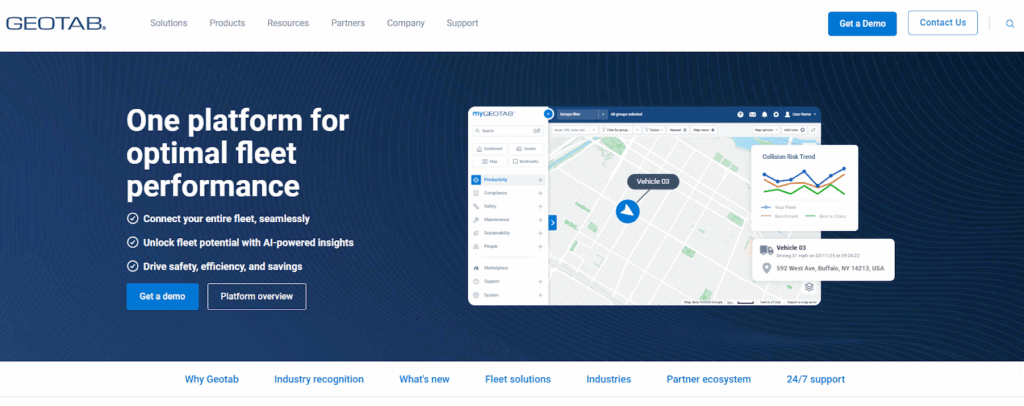
Geotab is a telematics-first fleet management platform focused on vehicle tracking, driver safety, compliance, and data analytics. It is widely used by large enterprises that manage mixed fleets and require deep visibility into vehicle performance, diagnostics, and regulatory reporting, supported by a broad ecosystem of hardware and software partners.
Common Challenges Geotab Resolves
- Provides detailed telematics data for vehicle health, diagnostics, and driver behavior
- Supports compliance and safety monitoring across large, mixed vehicle fleets
- Enables data-driven decision-making through APIs, BI connectors, and partner integrations
Geotab’s Pros
- Strong telematics and vehicle diagnostics backed by GO devices and OEM integrations
- Extensive partner marketplace and open APIs for analytics and custom workflows
Geotab’s Cons
- Routing and dispatch capabilities are basic compared to delivery-focused platforms
- Platform configuration and data modeling can require technical resources
Geotab Is Ideal for
Geotab is best suited for enterprises that prioritize telematics, safety, compliance, and analytics across large or mixed fleets. It fits organizations where routing and dispatch are secondary to vehicle data, reporting depth, and integration flexibility.
Geotab’s Pricing
Geotab uses subscription-based pricing that varies by hardware (GO devices, cameras), enabled features, and fleet size. Pricing is typically quote-based and may involve Geotab partners depending on deployment.
5. Verizon Connect
Verizon Connect is a fleet management platform focused on vehicle tracking, driver safety, compliance, and operational visibility. It combines GPS tracking, telematics, and safety tools to help organizations monitor drivers, vehicles, and assets from a centralized dashboard, particularly in large and distributed fleet environments.
Common Challenges Verizon Connect Resolves
- Improves fleet visibility through real-time GPS tracking of vehicles and assets
- Supports driver safety and compliance with behavior monitoring and inspection workflows
- Helps reduce operational inefficiencies through basic route planning and performance reporting
Verizon Connect’s Pros
- Strong GPS tracking and telematics backed by Verizon’s network reliability
- Solid safety, compliance, and maintenance monitoring for large fleets
Verizon Connect’s Cons
- Route optimization and dispatch workflows are limited compared to delivery-first platforms
- Customization and advanced analytics may require add-ons or integrations
Verizon Connect Is Ideal For
Verizon Connect is best suited for mid-sized and large fleets in distribution, utilities, construction, public sector, and service-based industries that need dependable vehicle tracking, safety oversight, and compliance management. It fits organizations where fleet monitoring and control take priority over complex delivery orchestration.
Verizon Connect’s Pricing
Verizon Connect offers custom, quote-based pricing that depends on fleet size, required hardware, and enabled modules. Pricing typically includes telematics devices and software subscriptions.
6. Azuga
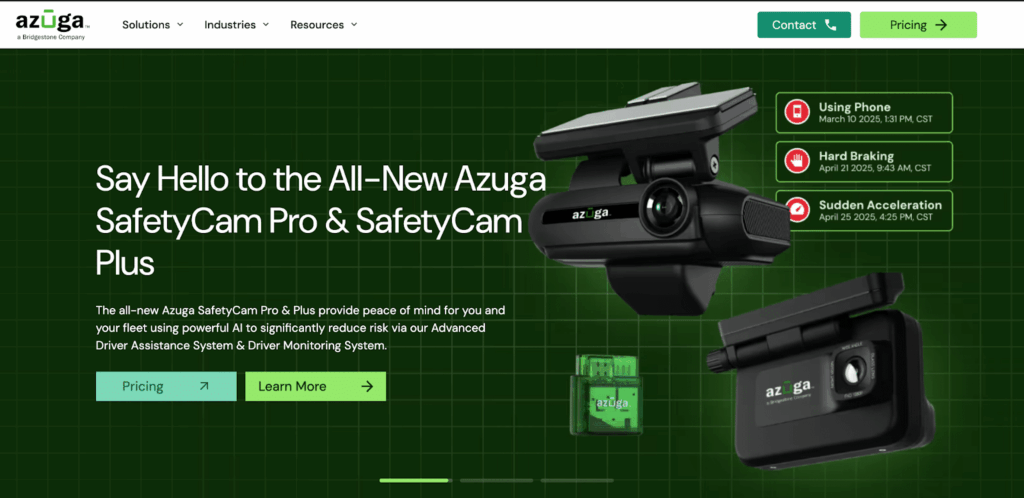
Azuga is a safety-focused fleet management platform designed to improve driver behavior and reduce risk through GPS tracking, telematics, and gamified safety programs. Its core value lies in helping organizations monitor vehicles, encourage safer driving habits, and maintain compliance across small to mid-sized fleets.
Common Challenges Azuga Resolves
- Improves driver safety through behavior scoring, in-cab alerts, and coaching tools
- Provides real-time fleet visibility with GPS tracking, trip history, and idling insights
- Supports compliance needs with ELD, HOS tracking, and DVIR reporting
Azuga’s Pros
- Strong driver safety and engagement features using scoring and rewards
- Easy deployment and intuitive interface suited for smaller fleet operations
Azuga’s Cons
- Routing and dispatch capabilities are limited compared to delivery-focused platforms
- Not designed for complex, multi-region, or high-density delivery execution
Azuga Is Ideal for
Azuga is best suited for small to mid-sized fleets in field services, utilities, HVAC, construction, and local delivery operations that prioritize driver safety, ease of use, and quick rollout. It fits teams where safety programs and fleet monitoring are more important than advanced dispatch optimization.
Azuga’s Pricing
Azuga offers tiered, per-vehicle pricing based on fleet size, selected hardware, and feature bundles. Additional costs apply for dashcams, ELDs, and asset tracking. Pricing details are typically provided via quote or demo.
7. Teletrac Navman
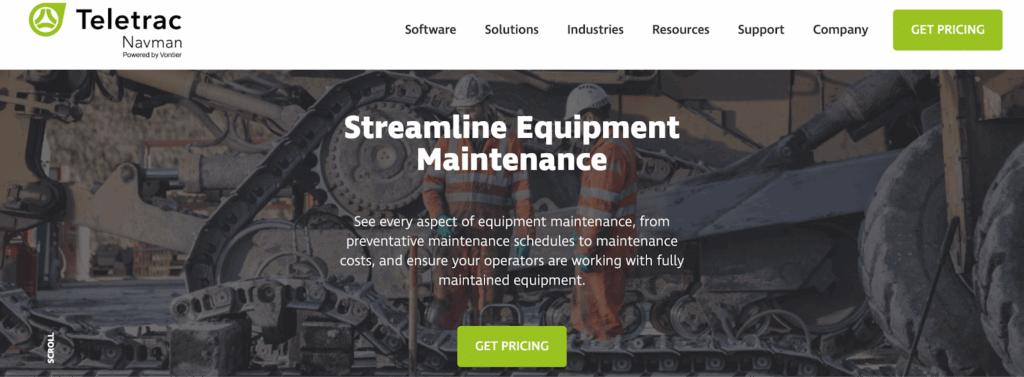
Teletrac Navman is a fleet management and telematics platform designed to help organizations monitor vehicles, drivers, and equipment across mixed fleets. It focuses on real-time visibility, compliance, safety monitoring, and asset tracking, with basic support for dispatch workflows and operational reporting.
Common Challenges Teletrac Navman Resolves
- Improves fleet visibility with live tracking, geofencing, and activity alerts
- Supports regulatory compliance with ELD, DVIR, IFTA, and audit-ready reporting
- Reduces downtime through maintenance tracking and vehicle diagnostics
Teletrac Navman’s Pros
- Strong telematics, compliance, and asset tracking across vehicles and equipment
- Useful video telematics and driver performance monitoring for safety programs
Teletrac Navman’s Cons
- Routing and dispatch capabilities are limited compared to delivery-first platforms
- Reporting and workflow customization may require configuration and training
Teletrac Navman Is Ideal for
Teletrac Navman is best suited for mid-sized and enterprise fleets in construction, utilities, field services, public sector, and transportation that require strong compliance oversight, equipment tracking, and fleet visibility. It fits organizations where telematics and safety monitoring are more critical than advanced delivery orchestration.
Teletrac Navman’s Pricing
Teletrac Navman offers custom, quote-based pricing that depends on fleet size, asset mix, hardware selection, and enabled modules. Pricing is typically structured as a subscription alongside required telematics devices.
8. Fleetio
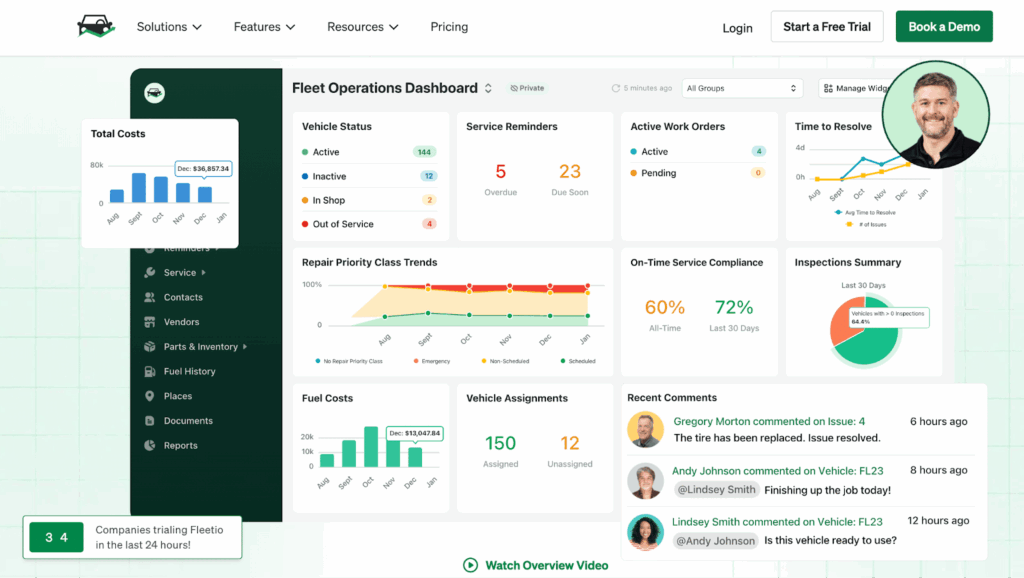
Fleetio is a fleet maintenance and asset management platform built to help teams track vehicle health, inspections, repairs, fuel usage, and total cost of ownership from a single system. Its primary focus is improving maintenance visibility, reducing breakdowns, and supporting compliance through structured inspection and service workflows.
Common Challenges Fleetio Resolves
- Reduces unplanned downtime through preventive maintenance scheduling
- Improves inspection and compliance tracking with mobile-first workflows
- Provides clearer visibility into fuel spend, repairs, and asset lifecycle costs
Fleetio’s Pros
- Strong maintenance, inspection, and asset lifecycle management capabilities
- Transparent pricing and easy onboarding for small to mid-sized fleets
Fleetio’s Cons
- Does not offer native routing, dispatch, or delivery execution workflows
- Requires integrations for real-time vehicle tracking or telematics data
Fleetio Is Ideal for
Fleetio is best suited for small to mid-sized fleets in construction, field services, transportation, government, and utilities that need strong maintenance oversight, inspection management, and cost tracking. It fits teams where asset health and lifecycle control matter more than dispatch-led execution.
Fleetio’s Pricing
Fleetio offers transparent, per-vehicle pricing with tiered plans that scale based on fleet size and feature access. Pricing is typically subscription-based, with free trials and demos available.
9. Route4Me
Route4Me is a widely adopted route optimization platform known for its large mapping dataset and multi-stop routing capabilities. It often appears in shortlists when teams comparing Routific want stronger mapping coverage, more customization options, or deeper proof-of-delivery controls.
Common Challenges Route4Me Resolves
- Reducing manual work in planning complex, multi-stop routes through automated route sequencing
- Improving delivery visibility with real-time driver tracking and live route progress
- Strengthening POD workflows with signatures, photos, and customizable verification steps
Route4Me’s Pros
- Handles large and complex routing structures well
- Strong real-time tracking for dispatchers
Route4Me’s Cons
- Pricing can climb quickly for growing fleets
- Some users report occasional map or GPS inconsistencies that require manual adjustments
Route4Me is Ideal for:
Route4Me fits logistics teams, parcel carriers, courier services, and field-service operators that require flexible route customization and detailed POD management. It suits operations that want more control over route structure than lightweight tools typically offer.
Route4Me’s Pricing:
Route4Me offers tiered, per-vehicle pricing starting at $60 per vehicle per month. Advanced tracking and workflow automation are available in higher-tier plans, with custom pricing for larger fleets.
10. Omnitracs
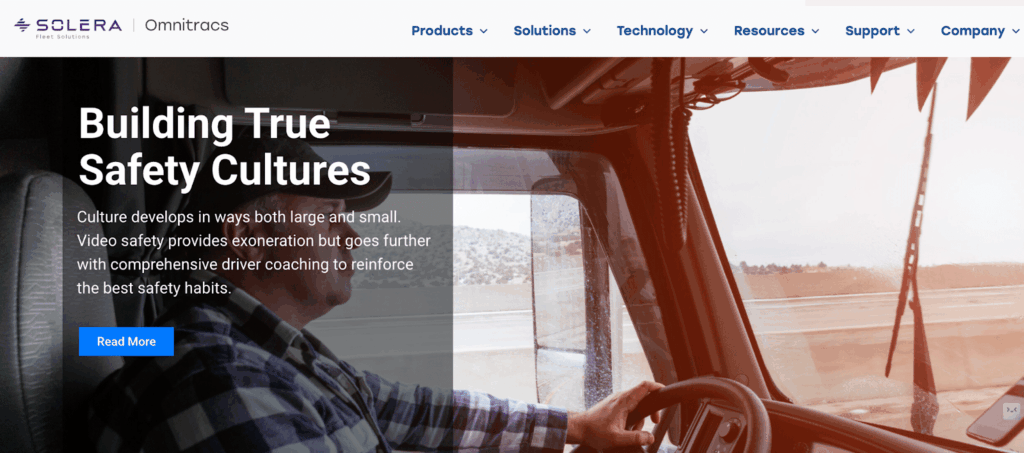
Omnitracs is an enterprise fleet management and telematics platform built for large, complex fleets that require routing support, compliance oversight, safety monitoring, and real-time operational visibility. It is commonly used by long-haul, regional, and mixed fleets where scale, regulatory compliance, and performance tracking are central requirements.
Common Challenges Omnitracs Resolves
- Supports large-scale routing and dispatch coordination across regional and national fleets
- Improves compliance management with ELD, HOS, inspections, and audit workflows
- Enhances driver safety through video telematics and behavior monitoring
Omnitracs’ Pros
- Strong compliance, safety, and telematics capabilities for enterprise fleets
- Designed to handle high fleet volumes and complex operational structures
Omnitracs’ Cons
- Implementation and configuration can be heavy for smaller or delivery-focused teams
- Routing and dispatch workflows may feel rigid compared to delivery-first platforms
Omnitracs Is Ideal For
Omnitracs is best suited for large logistics, transportation, food and beverage, retail distribution, and construction fleets that operate at scale and require strong compliance, safety, and telematics coverage. It fits organizations where enterprise fleet control is more important than flexible last-mile delivery orchestration.
Omnitracs’ Pricing
Omnitracs offers custom, quote-based pricing based on fleet size, compliance requirements, enabled modules, and hardware needs. Pricing is typically structured as a subscription alongside required telematics devices.
Why Many Teams Ultimately Shortlist Locus
As fleet and delivery operations mature, teams evaluating Samsara and similar platforms often realize that strong telematics, safety monitoring, and compliance tooling alone do not solve day-to-day execution challenges.
Reviews and buyer feedback frequently point to gaps around dynamic routing, mid-shift changes, address handling, and operational flexibility when delivery complexity increases.
This is where Locus enters the shortlist. Locus is built specifically for real-world delivery execution, with routing that remains stable under dense volumes, workflows that adapt without friction, and visibility that extends beyond vehicle tracking into orders, exceptions, and customer communications.
Teams moving beyond fleet monitoring toward consistent, scalable delivery performance often view Locus as a more complete execution layer.
Schedule a demo to see how Locus supports delivery teams that have outgrown fleet-first platforms and need dependable routing, flexible workflows, and real-time control as operations scale.
Frequently Asked Questions (FAQs)
1. How Difficult Is It to Migrate from Samsara to Locus?
Migration is typically phased rather than disruptive. Teams usually keep Samsara running for telematics and safety while introducing Locus for planning, dispatch, and execution. Data mapping for orders, locations, and workflows is handled during onboarding, allowing teams to transition routes and hubs gradually without downtime.
2. Does Locus Support Multi-Hub and Multi-Region Operations?
Yes. Locus is designed to manage multiple hubs, regions, and delivery models within a single operational layer. This is especially useful for enterprises coordinating regional fleets, third-party carriers, and varied SLA commitments across cities or countries.
3. How Does Locus Handle Peak-Volume or Seasonal Spikes?
Locus supports volume surges through automated planning, load balancing, and constraint-based routing. Teams can adjust rules and capacity models without rebuilding workflows, which helps maintain routing stability and on-time performance during peak periods.
4. Can Locus Support Third-Party and Hybrid Fleets?
Yes. Locus supports owned fleets, third-party carriers, and hybrid models. Teams can manage different carrier rules, SLAs, and visibility levels while maintaining consistent planning and execution standards across the network.
5. What Level of Customization Is Required During Setup?
Initial setup focuses on aligning routing rules, service constraints, and workflows with existing operations. While configuration takes planning, most teams complete onboarding without custom development, relying instead on configurable logic rather than hard-coded processes.


General
How Predictive ETA Software Reduces WISMO and Builds Delivery Trust

Jul 30, 2026
See how predictive ETA software uses ML to replace static windows, cut WISMO, and link dispatch to customer updates. Learn how Locus closes the loop.
Read more
Logistics Software
10 Best Vehicle Routing Software for Fleet Efficiency in 2026

Jul 30, 2026
Discover the best vehicle routing software to optimize your fleet management and improve efficiency. Read on for top solutions tailored to your needs.
Read moreInsights Worth Your Time




















Best Samsara Alternatives for Fleet Management and Delivery Execution in 2026