


General
10 Best Fleet Management Software in 2026

This guide compares 10 fleet management platforms for 2026 (Locus, Motive, Samsara, Verizon Connect, Fleetio, Geotab, Lytx, Azuga, Omnitracs, and TeleTrac Navman) and shows they split into two camps: tracking-led tools built around telematics, safety, compliance, or maintenance, and execution-led systems that actually run daily delivery operations. Most platforms are strong in a single lane, such as dashcams, ELD, inspections, or GPS visibility, but they leave planning and dispatch disconnected, which forces dispatchers into manual rework the moment routes change mid-day. Locus stands out for enterprise delivery execution because it connects route planning, dispatch decisions, live visibility, exception handling, and performance tracking in one operational layer, letting teams run dense, multi-region, multi-partner networks without adding manual coordination. For retailers, FMCG brands, 3PLs, and e-commerce networks where tight service windows and daily exceptions decide cost and customer trust, that end-to-end execution control is why Locus leads the list.
Key Takeaways
- Choose based on operational fit first: some platforms are stronger for telematics, safety, compliance, or maintenance, while others focus on dispatch and delivery execution.
- For complex delivery networks, prioritise route planning depth, live dispatch control, exception handling, and integration readiness.
- Hardware-led platforms can be a strong fit when dashcams, ELD, asset tracking, or driver safety are the main buying criteria.
- Maintenance-first tools are better suited to teams that mainly need inspections, work orders, vehicle health tracking, and lifecycle cost control.
- Pricing is not directly comparable across all vendors because several use custom quotes based on fleet size, hardware, modules, and implementation scope.
Top 3 at a glance
| Rank | Vendor | Best for | Starting price |
|---|---|---|---|
| 1 | Locus | Enterprise delivery networks needing planning, dispatch, and execution control | Custom enterprise pricing |
| 2 | Motive | Fleets prioritising telematics, driver safety, and compliance | Not publicly disclosed; custom pricing |
| 3 | Samsara | Large fleets with connected operations, IoT, and hardware-first visibility needs | Custom pricing; online estimator available |
Top 10 Fleet Management Software in 2026 – Overview Table
The best fleet delivery software depends on whether your operation needs tracking, compliance, vehicle maintenance, safety monitoring, or full delivery execution control. The table below compares the 10 platforms by primary focus, typical fit, operational depth, and pricing pattern.
| Rank | Software | Primary focus | Best suited for | Execution vs tracking balance | Typical pricing pattern |
|---|---|---|---|---|---|
| 1 | Locus | Planning, dispatch, and execution orchestration | Enterprise retail, FMCG, 3PL, and e-commerce delivery networks with complex multi-region routes | Strong on end-to-end execution control; connects planning, dispatch, live visibility, and performance tracking in one layer | Custom enterprise pricing based on operational scale and selected modules |
| 2 | Motive | Telematics, driver safety, and compliance | Trucking, logistics, public sector, utilities, construction, agriculture, and mixed delivery fleets | Strong safety and compliance; execution support through telematics and asset visibility | Not publicly disclosed; quote-based pricing by fleet size, hardware, and service scope |
| 3 | Samsara | Connected operations and IoT visibility | Transportation, construction, field services, logistics, manufacturing, utilities, and government fleets | Strong hardware-led tracking and safety; routing and dispatch are part of a broader connected operations platform | Custom pricing based on fleet size, hardware, and solution bundles; online estimator available |
| 4 | Verizon Connect | GPS tracking, route optimisation, and compliance | Large and mid-sized fleets in distribution, retail, food and beverage, utilities, construction, and government | Strong visibility and routing for centralised fleet oversight | Custom quotes based on vehicles, hardware, and selected modules |
| 5 | Fleetio | Asset and maintenance management | Fleets focused on inspections, repairs, cost control, and vehicle lifecycle decisions | Strong maintenance-first tooling; lighter on delivery dispatch depth | Transparent per-vehicle pricing with plans starting at approximately $4 per vehicle per month |
| 6 | Geotab | Telematics data and integrations | Data-driven fleets prioritising safety, compliance, and analytics across mixed vehicle types | Strong tracking, safety, analytics, and partner integrations | Subscription and hardware bundles sold through Geotab and partners; pricing varies by device mix and fleet size |
| 7 | Lytx | Video telematics and driver safety | Fleets where risk reduction, claims defence, and driver coaching are strategic priorities | Strong safety and incident evidence; limited dispatch depth compared with execution-led platforms | Custom pricing based on camera configuration, video features, and fleet scale |
| 8 | Azuga | GPS tracking and gamified driver safety | Small to mid-sized service and local delivery fleets seeking fast deployment and behaviour improvement | Strong tracking and driver engagement; more basic dispatch optimisation | Tiered per-vehicle plans with add-ons for dashcams, ELDs, and asset tracking; quotes available on request |
| 9 | Omnitracs | AI-driven routing and compliance management | Large regulated fleets needing route optimisation plus visibility and ELD support | Strong routing, dispatch automation, and compliance capabilities | Custom pricing based on fleet size, compliance needs, and selected modules |
| 10 | TeleTrac Navman | Fleet tracking, reporting, and asset management | Mid-sized and enterprise fleets across transportation, construction, field services, public sector, and utilities | Strong visibility, compliance, and job-site asset monitoring | Custom quotes based on asset mix, hardware requirements, and selected capabilities |
These platforms fall into two broad groups: tracking-led systems that focus on vehicle visibility, safety, and compliance, and execution-led systems that connect planning, dispatch, route performance, customer commitments, and exception handling.
Detailed Comparison of Leading Fleet Management Software
1. Locus
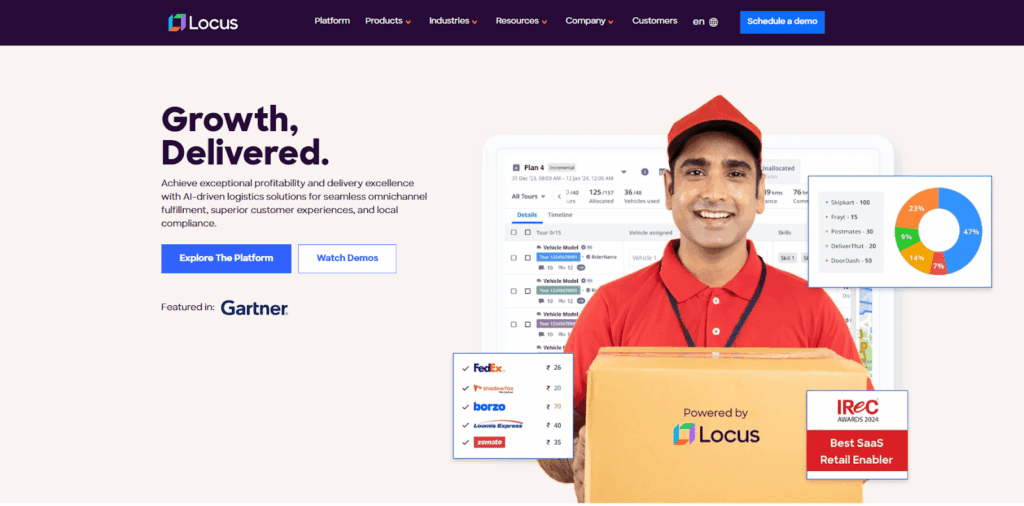
Locus is built for organisations that need fleet management to work across planning, dispatch, and execution rather than as separate tools. It acts as an operational layer for large delivery networks, helping teams plan routes, assign work, monitor live movement, manage exceptions, and improve performance across regions, depots, and partners.
Locus is especially relevant for businesses where route plans change during the day, service windows are tight, and dispatch decisions directly affect cost and customer experience.
Locus key features
- AI-driven planning and automation: Supports automated route planning, capacity-aware assignments, route sequencing, and operational decision-making at scale.
- Dispatch control: Helps dispatchers assign work, monitor progress, respond to exceptions, and maintain operational continuity during live execution.
- Live delivery visibility: Provides real-time tracking across routes, vehicles, stops, and delivery status.
- Execution monitoring: Gives operations teams a structured view of route adherence, delays, failed attempts, SLA risk, and delivery performance.
- Integration readiness: Connects with order management, warehouse, transport, ERP, and customer systems to reduce manual coordination.
- Scalability: Designed for high-volume delivery networks operating across multiple depots, geographies, partners, and demand patterns.
Locus is ideal for
- Enterprise retail, FMCG, and e-commerce delivery networks
- 3PLs managing multi-client and multi-region operations
- Teams that need delivery planning, dispatch control, and execution visibility in one platform
- Organisations managing dense routes, time-bound deliveries, and frequent daily exceptions
Locus pricing
Locus uses a custom enterprise pricing model based on operational scale, required modules, deployment scope, and integration needs.
2. Motive
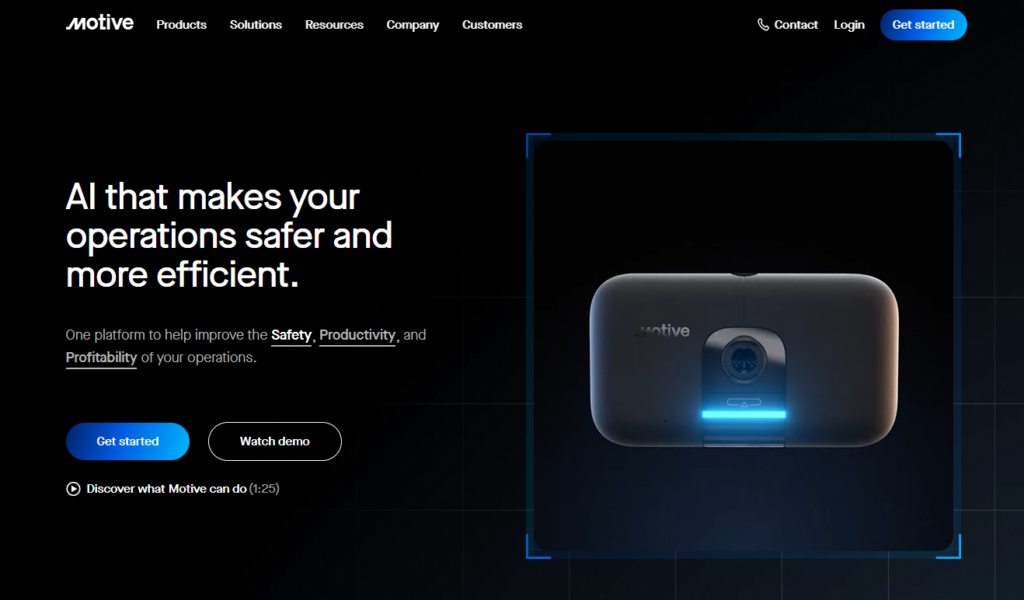
Motive, formerly KeepTruckin, is a fleet and operations management platform with a strong focus on telematics, safety, compliance, asset visibility, and hardware-backed monitoring. It combines software with devices such as AI dashcams and telematics units to help fleets improve driver behaviour, reduce risk, and maintain compliance.
Motive is a strong fit when driver safety, vehicle monitoring, and regulatory requirements are the main buying criteria.
Motive key features
- Driver safety: AI dashcams, risk detection, coaching, and accident management.
- Fleet management: GPS tracking, diagnostics, maintenance scheduling, and telematics.
- Equipment and asset monitoring: Trailer tracking, reefer monitoring, and theft prevention.
- Spend management: Fuel and expense controls through Motive’s spend products.
- Workforce management: Driver qualification, time tracking, training, and coaching tools.
- Compliance: ELD support, IFTA fuel tax reporting, inspection records, and audit support.
Motive is ideal for
Trucking and logistics companies, public sector fleets, utilities, construction, agriculture, and delivery operators that need a consolidated safety, compliance, and telematics platform.
Motive pricing
Motive pricing is not publicly disclosed. Quotes are customised based on fleet size, hardware, and service scope.
3. Samsara

Samsara is a connected operations platform for fleets, equipment, sites, and field assets. It is known for combining telematics, IoT, cameras, compliance tools, safety features, and operational visibility in one platform.
Samsara is useful for organisations that want a hardware-led view of fleet and site activity, especially where vehicle, equipment, and safety data need to sit together.
Samsara key features
- Cameras and video: AI dashcams, driver coaching, in-cab alerts, and safety reporting.
- Fleet telematics: GPS tracking, routing, fuel management, electrification insights, and maintenance monitoring.
- Equipment tracking: Location monitoring, utilisation reporting, theft prevention, and diagnostics.
- Site visibility: Remote visibility, alerts, and monitoring for distributed operations.
- Mobile tools: Connected processes for drivers, field teams, compliance, and safety.
- Integrations: OEM integrations, marketplace apps, APIs, and developer tools.
Samsara is ideal for
Enterprises and public-sector organisations across transportation, construction, field services, food and beverage, logistics, manufacturing, utilities, and government.
Samsara pricing
Samsara uses custom pricing based on fleet size, hardware, and selected solutions. A self-guided online pricing estimator is available.
4. Verizon Connect
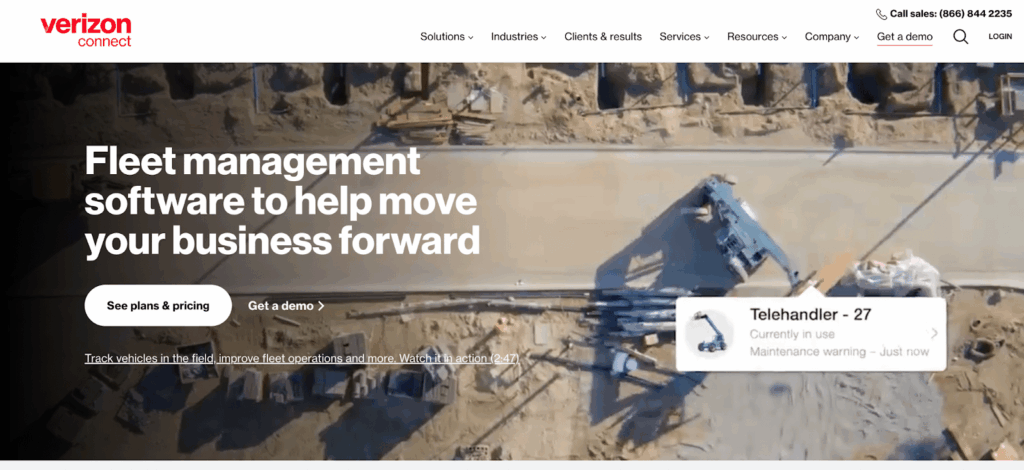
Verizon Connect provides fleet tracking, routing, driver monitoring, compliance tools, and reporting through a centralised platform. It is particularly relevant for businesses that want strong GPS visibility, established network coverage, and operational reporting across distributed assets.
The platform supports dispatch and route management, though its core strength is fleet visibility and telematics.
Verizon Connect key features
- Route optimisation: Uses location, traffic, and delivery priority inputs to improve route planning.
- Live GPS visibility: Gives dispatchers vehicle location and route status updates.
- Driver safety monitoring: Supports behaviour tracking, dashcams, and coaching.
- Compliance and maintenance: Helps manage inspections, compliance records, and maintenance scheduling.
- Asset tracking: Monitors vehicles, trailers, and equipment.
- Performance reporting: Tracks fuel use, driver behaviour, delivery activity, and fleet utilisation.
Verizon Connect is ideal for
Large and mid-sized fleets in distribution, food and beverage, retail, utilities, construction, and government that need centralised tracking, reporting, driver safety, and compliance oversight.
Verizon Connect pricing
Pricing is customised based on the number of vehicles, hardware requirements, and selected service modules.
5. Fleetio
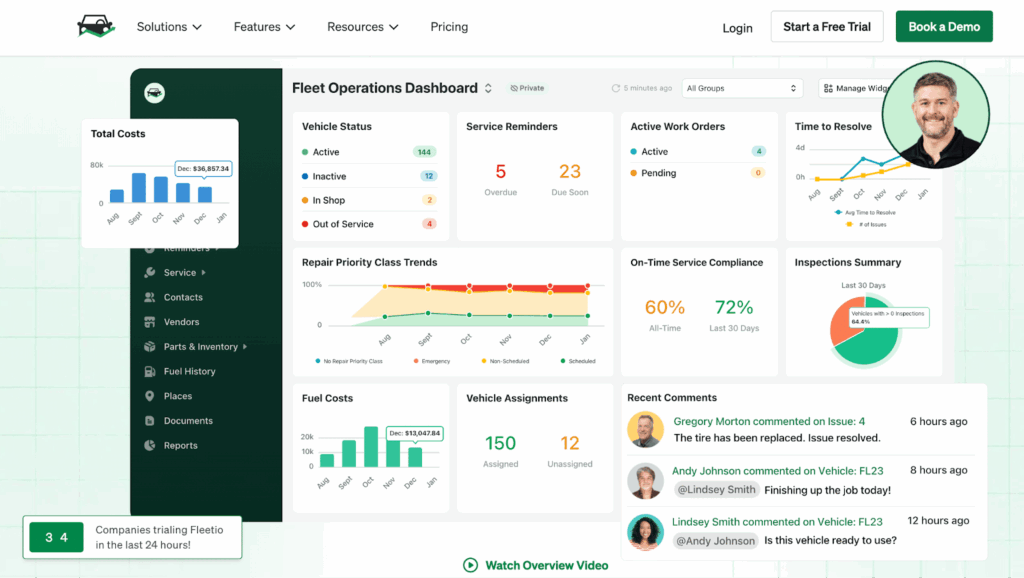
Fleetio is a fleet maintenance and asset management platform designed to help teams manage vehicle health, inspections, repairs, costs, and lifecycle decisions. It is not primarily a dispatch execution platform; its value is strongest where maintenance visibility and asset cost control are the priority.
Fleetio helps teams reduce unplanned downtime by centralising service records, inspections, work orders, and vehicle history.
Fleetio key features
- Preventive maintenance and work orders: Automates service schedules, reminders, and repair management.
- Vehicle inspections and compliance: Supports mobile inspections, defect reporting, and compliance documentation.
- Fuel and cost management: Tracks fuel activity, maintenance spend, and operating costs.
- Asset and parts tracking: Manages vehicles, equipment, parts inventory, and service history.
- Fleet analytics: Reports on utilisation, downtime, service trends, and total cost of ownership.
Fleetio is ideal for
Small to mid-sized fleets in construction, service providers, transportation, government, and utilities that need strong fleet maintenance, inspection management, and cost tracking.
Fleetio pricing
Fleetio offers transparent, per-vehicle pricing with tiered plans starting at approximately $4 per vehicle per month, with costs varying by feature access, fleet size, and contract terms. Free trials and demos are available.
6. Geotab
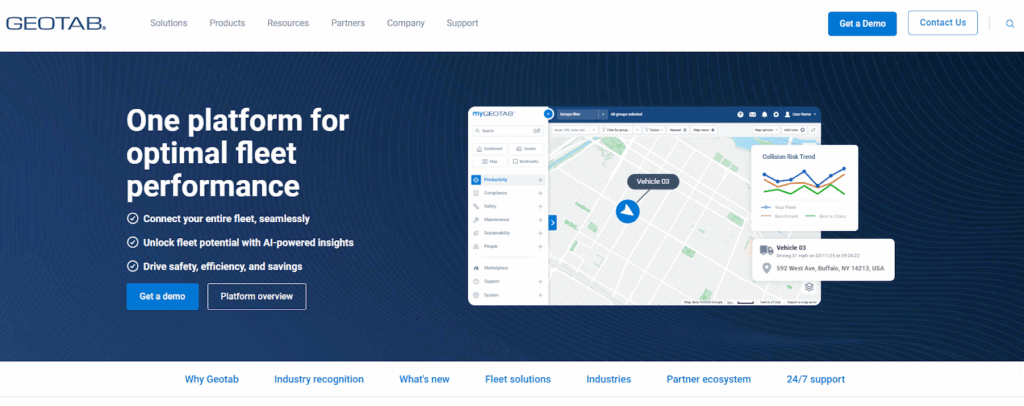
Geotab is a telematics-first fleet platform that supports vehicle tracking, safety, compliance, diagnostics, analytics, and integrations. It is widely used by data-driven fleet teams that want a flexible platform with extensive partner and marketplace options.
Geotab includes routing and dispatch capabilities, but its main strengths are telematics data, analytics, safety, and integration breadth.
Geotab key features
- Vehicle telematics: GO devices, diagnostics, tracking, and fleet data collection.
- Safety monitoring: Driver behaviour insights, coaching support, and camera integrations.
- Routing and dispatch: Route planning and live visibility for fleet operations.
- Compliance tools: ELD, HOS, DVIR, and regulatory support.
- Analytics and integrations: Open APIs, BI connections, SDKs, and a broad partner marketplace.
- Sustainability and EV tools: Carbon reporting, EV suitability analysis, and fleet electrification support.
Geotab is ideal for
Enterprises prioritising telematics, safety, compliance, analytics, and data integration across mixed fleets.
Geotab pricing
Geotab pricing is subscription-based and typically quote-only. Costs vary by hardware, cameras, feature bundles, fleet size, and partner arrangements.
7. Lytx
Lytx is a video telematics and fleet safety platform focused on reducing risk, improving driver behaviour, supporting coaching programmes, and protecting businesses with video evidence.
It is strongest where safety, claims management, compliance, and driver behaviour are the main operational priorities.
Lytx key features
- Video telematics: Road-facing and driver-facing camera options with AI-based event detection.
- Driver safety: Identifies distracted driving, harsh braking, following distance, and other risky behaviours.
- Coaching support: Provides event-based insights for structured driver improvement.
- Incident evidence: Helps review incidents, support claims decisions, and protect drivers when evidence is needed.
- Fleet tracking: Adds vehicle location context to safety and incident data.
- Risk analytics: Reports on safety trends, incident frequency, and driver performance.
Lytx is ideal for
Mid-to-large fleets in trucking, distribution, construction, field services, transit, utilities, and government that prioritise driver safety, compliance, and risk reduction.
Lytx pricing
Lytx pricing is customised based on hardware configuration, fleet size, video features, and service levels.
8. Azuga
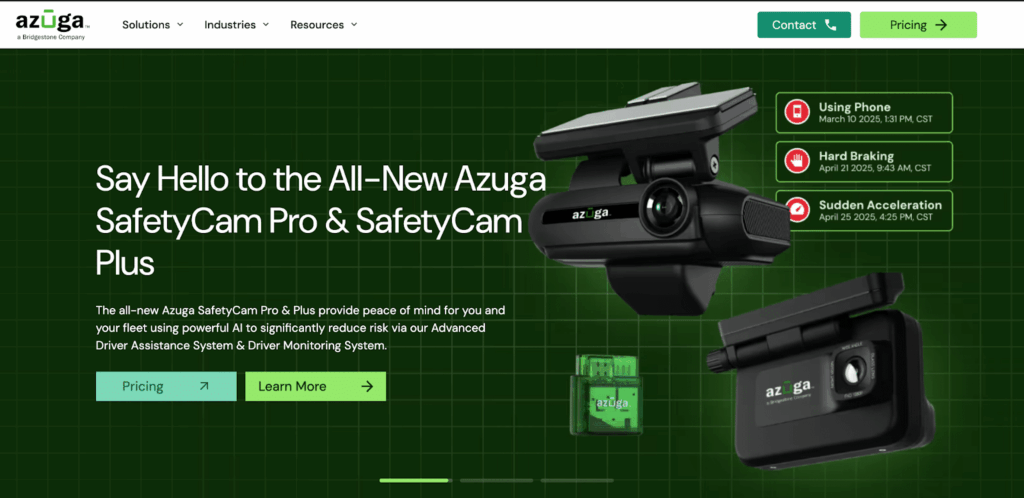
Azuga is a safety-focused fleet management platform built around GPS tracking, driver behaviour monitoring, gamified safety programmes, and fast deployment. It is particularly relevant for small and mid-sized fleets that want visibility and driver engagement without a complex enterprise implementation.
Azuga supports tracking, safety scoring, dashcams, compliance, and asset monitoring.
Azuga key features
- GPS fleet tracking: Provides live vehicle location, trip history, idling data, and diagnostics.
- Driver safety scores: Uses scoring, leaderboards, and rewards to encourage safer driving.
- AI dashcams: Supports road-facing and in-cab video for incident review and accountability.
- Compliance tools: Covers ELD, HOS, DVIR, and audit-ready reporting.
- Asset tracking: Tracks vehicles, trailers, and equipment using GPS and beacon-based location data.
- Driver engagement: Uses gamified safety features to support behaviour change.
Azuga is ideal for
Small to mid-sized fleets in field services, HVAC, utilities, pest control, construction, and local delivery that prioritise ease of use, safety, and quick deployment.
Azuga pricing
Azuga offers tiered pricing based on fleet size, hardware selection, and feature bundles. Plans typically use per-vehicle monthly pricing, with add-ons for dashcams, ELDs, and asset tracking. Quotes and demos are available on request.
9. Omnitracs

Omnitracs is a fleet management platform focused on route optimisation, dispatch, compliance, visibility, and analytics for large and regulated fleets. It is well suited to operations where routing, ELD compliance, driver productivity, and real-time fleet visibility need to be managed together.
Omnitracs is particularly relevant for transportation and logistics businesses with complex routing and regulatory requirements.
Omnitracs key features
- Route optimisation: Uses data-driven planning to reduce miles, balance workloads, and improve delivery efficiency.
- Dispatch automation: Supports task assignments, load planning, and driver communication.
- Live visibility: Tracks vehicles, routes, delivery status, and operational progress.
- Driver safety: Offers video-based safety tools, in-cab alerts, and behaviour analytics.
- Compliance management: Supports ELD requirements, inspections, and audit documentation.
- Analytics: Provides reporting on miles, idle time, asset use, and fleet performance.
Omnitracs is ideal for
Large fleets in logistics, transportation, construction, food and beverage, and retail delivery that need routing, compliance, and dispatch visibility.
Omnitracs pricing
Omnitracs pricing is customised based on fleet size, compliance needs, route volumes, and selected software modules.
10. TeleTrac Navman
TeleTrac Navman is a fleet tracking, compliance, reporting, and asset management platform for mixed fleets. It supports vehicle tracking, driver monitoring, job allocation, maintenance, video telematics, and equipment visibility.
Its strengths are real-time visibility, compliance oversight, asset tracking, and job-site monitoring across vehicles, trailers, equipment, and distributed teams.
TeleTrac Navman key features
- Live fleet visibility: Provides vehicle and asset tracking with geofencing, location monitoring, and activity alerts.
- Routing and dispatch: Supports digital job allocation, task tracking, and route adherence monitoring.
- Video telematics: Combines GPS data with video footage for incident review and driver performance monitoring.
- Compliance management: Covers ELD, DVIR, IFTA, and regulatory reporting.
- Maintenance tracking: Monitors inspections, service schedules, and engine data.
- Asset and equipment tracking: Tracks powered and non-powered assets across depots and job sites.
- Performance reporting: Offers driver scorecards and operational reports.
TeleTrac Navman is ideal for
Mid-sized and enterprise fleets in transportation, construction, field services, public sector, utilities, and distribution that need strong visibility, compliance oversight, and equipment tracking.
TeleTrac Navman pricing
Pricing is customised based on fleet size, asset types, hardware requirements, and selected modules.
Need more than tracking? Optimise every fleet route automatically.
If you’re comparing the best fleet delivery software, see how Locus improves route efficiency, on-time performance, and dispatcher productivity at scale.
Key Benefits of Fleet Management Software
Fleet management software supports planning, dispatch, vehicle tracking, maintenance, compliance, and performance management. The main benefit is not simply knowing where vehicles are; it is being able to make better operational decisions before delays, missed service windows, and asset issues affect customers.
Better operational efficiency
Fleet management platforms reduce manual coordination by centralising route plans, vehicle status, driver assignments, delivery progress, and exception alerts. This helps dispatchers spend less time switching between spreadsheets, phone calls, messaging tools, and disconnected dashboards.
Lower operating costs
Routing, vehicle utilisation, fuel visibility, maintenance planning, and driver performance all affect fleet cost. A strong platform helps teams reduce unnecessary miles, improve asset productivity, and improve fleet utilization through better capacity planning.
Stronger customer experience
Customers expect reliable delivery windows, proactive updates, and accurate delivery status. Fleet software helps teams manage accurate ETAs, track route progress, and respond when deliveries are at risk of delay.
Improved compliance and safety
For regulated fleets, compliance tools such as ELD, DVIR, IFTA, driver records, and inspection support are essential. Safety features such as dashcams, driver scoring, coaching, and incident reporting also help reduce operational risk.
Better scalability
As a fleet expands across regions, depots, partners, and vehicle types, manual processes become harder to maintain. Fleet software creates a shared operating model that can scale without each location creating its own version of planning and dispatch.
Cost Considerations for Fleet Management Software
Fleet management software pricing varies widely because vendors package software, hardware, services, integrations, and support differently. Some tools are priced per vehicle; others use quote-based enterprise contracts.
Common pricing models
- Per-vehicle subscription: Common for GPS tracking, maintenance, telematics, and safety platforms.
- Hardware plus software: Often used for dashcams, telematics devices, ELDs, asset trackers, and in-cab equipment.
- Tiered feature plans: Basic tracking, advanced reporting, safety, compliance, and analytics may sit in different tiers.
- Enterprise pricing: Larger fleets often receive custom pricing based on scale, modules, geography, and implementation scope.
Factors that influence total cost
- Fleet size and vehicle mix
- Hardware requirements
- Number of users, depots, regions, and integrations
- Data retention, reporting, and analytics needs
- Support requirements and implementation complexity
- Contract length and expansion plans
How to compare pricing fairly
Do not compare only the monthly subscription price. Compare the total operating model: hardware, implementation, integrations, training, support, contract flexibility, and the effort required to keep the system running.
For delivery-heavy fleets, also evaluate whether the software can reduce manual dispatch effort, improve route adherence, protect service windows, and reduce avoidable exceptions.
Essential Features of Fleet Management Software
The right feature set depends on your fleet’s operating model. A long-haul trucking fleet, a utility fleet, a field-service fleet, and a last-mile delivery network may all need different capabilities.
Dispatch and route planning
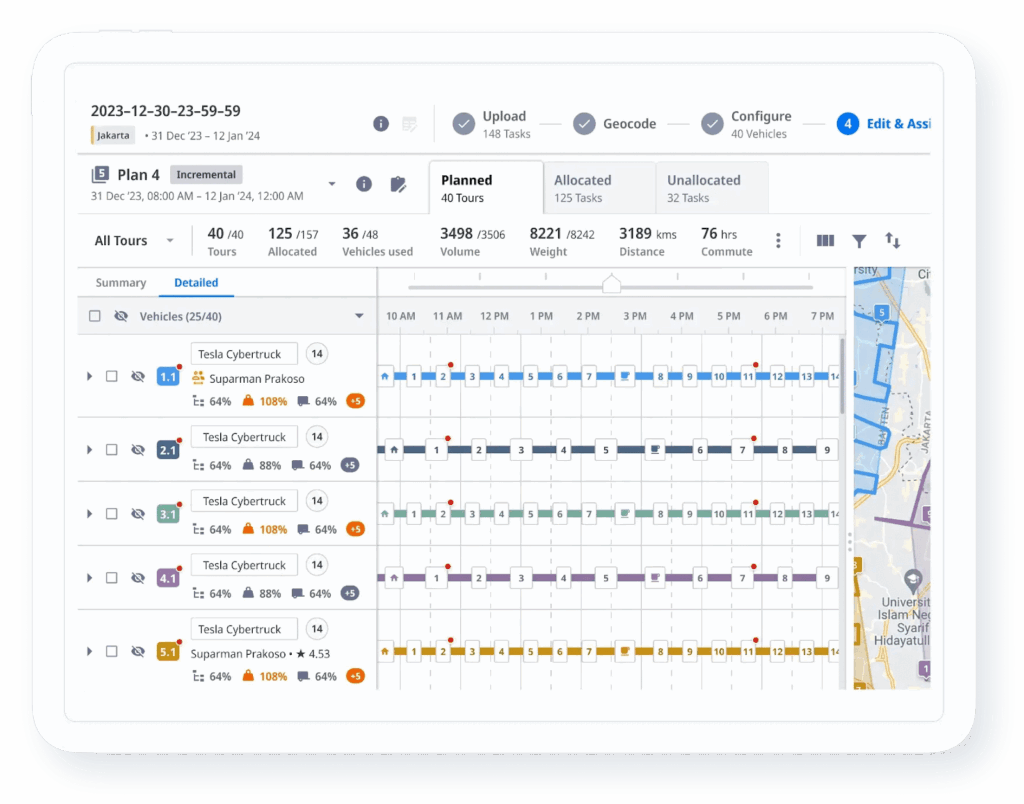
Route planning defines how efficiently work is assigned and executed. For delivery fleets, look for route optimization software that can account for capacity, geography, order priority, driver availability, vehicle type, depot location, and delivery time windows.
Important capabilities include:
- Automated route planning and sequencing
- Capacity-aware vehicle assignment
- Time-window and SLA-aware planning
- Multi-depot planning
- Route balancing across drivers and vehicles
- Support for same-day changes and dynamic route planning
Live visibility and control
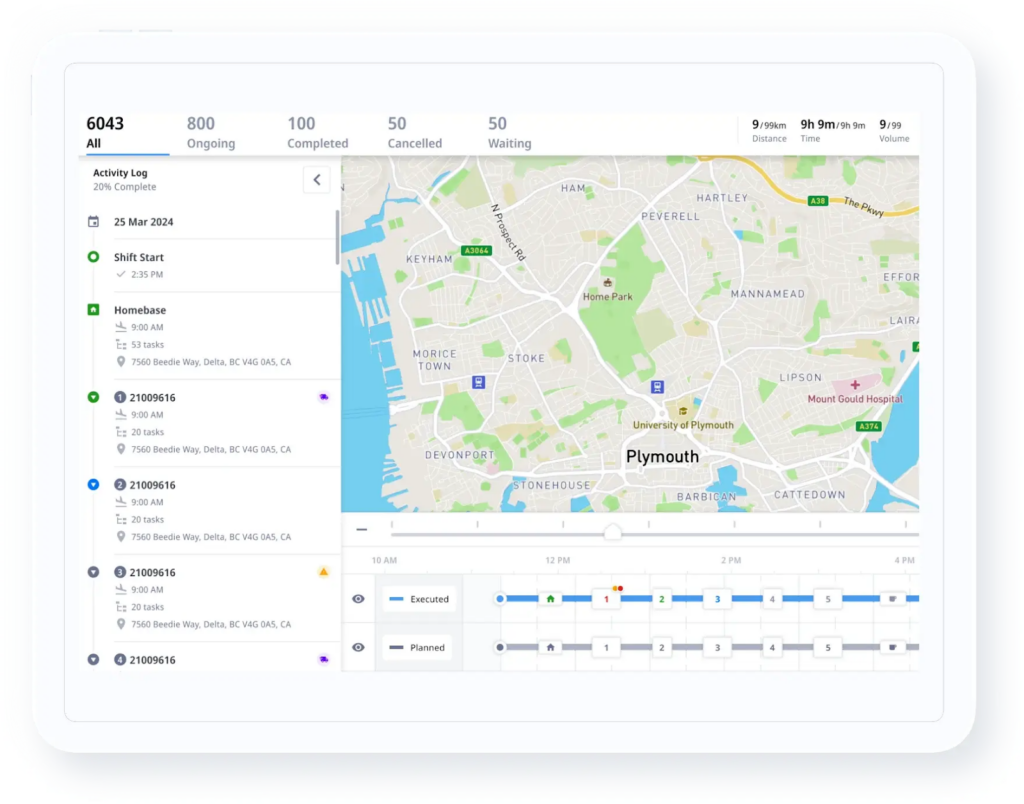
Visibility should support action, not just monitoring. Operations teams need live route progress, stop status, exceptions, driver status, and at-risk deliveries in one place.
Look for:
- Live vehicle and route status
- Stop-level tracking
- Customer notification support
- Exception alerts
- SLA risk visibility
- Dispatcher tools for intervention and reassignment
Delivery exception management
Enterprise delivery fleets need structured signals when execution deviates from the plan. Useful capabilities include:
- GPS tracking
- Geofencing
- Driver status monitoring
- Incident reporting
- Failed delivery reason codes
- SLA alerts
- Proof of delivery through photo, signature, barcode, or scan confirmation
Safety and compliance
Safety and compliance capabilities are especially important for regulated fleets and organisations with high driver exposure.
Key features include:
- ELD and HOS support where required
- Driver vehicle inspection reports
- IFTA support
- Driver behaviour monitoring
- Dashcam integration
- In-cab alerts
- Coaching and safety scorecards
- Audit-ready reporting
Maintenance and asset health
Vehicle downtime can disrupt service and increase operating costs. Maintenance capabilities help teams move from reactive repairs to planned upkeep.
Look for:
- Preventive service schedules
- Inspection management
- Defect reporting
- Work orders
- Parts inventory
- Service history
- Vehicle cost tracking
Analytics and operational KPIs
Reporting should help teams improve future planning, not simply review past activity. Useful fleet metrics include:
- On-time delivery performance
- Route adherence
- Cost per delivery
- Miles per route
- Fuel usage
- Idle time
- Driver performance
- Vehicle utilisation
- Failed delivery rates
- Maintenance cost trends
Integration and automation readiness
Fleet management software should connect with the systems that create orders, manage inventory, allocate stock, bill customers, and update service status.
Common integrations include:
- ERP systems
- Order management systems
- Warehouse management systems
- Transport management systems
- CRM and customer notification tools
- BI and analytics platforms
- Driver and mobile applications
Clean integrations reduce duplicate entry, inconsistent data, and delayed decisions.
How To Choose The Right Fleet Management Software In 2026
Selecting fleet management software comes down to how well a platform supports your real operating model, adapts to change, and scales without adding manual effort.
1. Define the operational problem
Start with the problem you need the software to solve. A maintenance problem, safety problem, compliance problem, and dispatch execution problem all point to different platform types.
Clarify:
- Fleet size and vehicle types
- Owned, leased, partner, or hybrid capacity
- Depot and region structure
- Delivery density and route complexity
- Compliance requirements
- Current tools and manual processes
- Service commitments and customer expectations
2. Separate must-have features from secondary features
Most platforms have broad feature lists, but not every feature is equally important. Decide which capabilities are essential for daily operations and which are useful but optional.
For example:
- A field-service fleet may prioritise job tracking and driver visibility.
- A trucking fleet may prioritise ELD, safety, and compliance.
- A delivery network may prioritise routing, dispatch control, ETA accuracy, and exception handling.
- A maintenance-heavy fleet may prioritise inspections, work orders, and vehicle lifecycle cost.
For deeper routing evaluation, use this guide on how to choose route planning software.
3. Assess scalability
A platform that works for one depot may not work across regions, partners, and peak volumes. Ask whether the system can support:
- Multi-depot operations
- Multiple countries or operating units
- Seasonal demand spikes
- Partner fleet visibility
- High route volumes
- Different vehicle types and capacities
- Expansion without reimplementation
4. Review integration requirements
List the systems the fleet platform must connect with before shortlisting vendors. Integration gaps can create hidden operational costs.
Consider:
- Order sources
- Warehouse systems
- ERP and finance systems
- Customer communication systems
- Driver applications
- BI platforms
- Telematics hardware
- Existing carrier or 3PL systems
5. Evaluate support, rollout, and adoption
The best platform on paper can underperform if rollout is slow or adoption is poor. During evaluation, ask vendors about:
- Implementation timeline
- Training for dispatchers, drivers, and managers
- Data migration
- Hardware installation, if required
- Change management support
- Support coverage
- Customer references in your sector
6. Compare total cost of ownership
Review software subscriptions, hardware, installation, integrations, support, contract terms, expansion costs, and internal operating effort.
Also ask whether pricing changes as you add vehicles, depots, users, modules, regions, or order volume.
Evaluation checklist
| Evaluation area | What to look for | Why it matters |
|---|---|---|
| Operational fit | Support for your dispatch cadence, routing rules, vehicle types, service windows, and compliance needs | Poor fit creates manual work and inconsistent execution |
| Planning and execution alignment | Route planning, dispatch, tracking, exceptions, and status updates connected in one flow | Reduces rework when plans change during the day |
| Visibility | Live tracking, route progress, driver status, and exception alerts | Helps teams respond before issues affect service commitments |
| Scalability | Support for higher volumes, more depots, new regions, and partner fleets | Prevents replacement as the network grows |
| Integration readiness | Reliable connections to ERP, WMS, TMS, OMS, CRM, and analytics systems | Reduces duplicate entry and data gaps |
| Pricing clarity | Clear explanation of software, hardware, services, integrations, and renewal terms | Makes procurement and long-term budgeting easier |
| Support quality | Responsive support, implementation help, and sector-relevant expertise | Reduces operational risk during rollout and peak periods |
Why Locus Is Built For Fleet Execution At Scale
Fleet operations demand control across routing, dispatch, visibility, and live execution. Planning alone is not enough when routes change during the day, volumes fluctuate, and service commitments tighten.
Many fleet platforms focus on isolated areas such as vehicle tracking, safety, compliance, or maintenance. Locus is designed for delivery execution. It connects route planning, dispatch decisions, live visibility, exception management, and performance tracking in a single operational layer.
This helps teams manage dense routes, multi-region delivery networks, and frequent exceptions without increasing manual coordination. Dispatchers get live control. Operations leaders get performance clarity. Customers receive more reliable delivery experiences.
Locus is especially relevant for enterprise retailers, FMCG brands, 3PLs, e-commerce networks, and direct-to-store delivery operations where service consistency depends on reliable daily execution.
Explore Locus customer success stories to see how large delivery networks use execution-led logistics technology in practice.
Want help shortlisting the right fleet software?
Work with Locus experts to map requirements, compare capabilities, and build an execution strategy before rollout.
Frequently Asked Questions (FAQs)
What should you prioritise when choosing fleet management software in 2026?
Prioritise operational fit. The platform should support the problem you most need to solve, whether that is route planning, dispatch control, real-time tracking, driver safety, compliance, maintenance, or asset visibility.
For complex delivery networks, prioritise planning, dispatch, live visibility, exception handling, and integrations in one connected system.
What is the difference between fleet tracking and fleet execution?
Fleet tracking shows where vehicles are. Fleet execution helps teams decide what should happen next. It includes route planning, dispatch decisions, route changes, delivery status updates, exception handling, proof of delivery, and performance tracking.
Which fleet management software is best for enterprise delivery execution?
Locus is built for enterprise delivery networks that need route planning, dispatch control, live visibility, and execution management across regions, depots, and partners. Other platforms may be better if the primary need is telematics, dashcams, compliance, or maintenance.
Which platforms are strongest for telematics and driver safety?
Motive, Samsara, Geotab, Lytx, Azuga, Verizon Connect, and TeleTrac Navman all have strong telematics, safety, tracking, or compliance capabilities. The best fit depends on whether you need dashcams, ELD, driver coaching, asset tracking, reporting, or broader connected operations.
Which platform is best for fleet maintenance?
Fleetio is the clearest maintenance-first platform in this comparison. It is designed for inspections, service schedules, work orders, repair records, vehicle costs, and asset lifecycle management.
Is pricing comparable across fleet management vendors?
Not directly. Some vendors publish per-vehicle pricing, while others use custom quotes based on fleet size, hardware, modules, support, geography, and implementation scope. Compare total cost of ownership, not only the subscription line item.
What are the essential features of fleet management software?
Essential features include route planning, GPS tracking, dispatch management, driver communication, safety monitoring, compliance reporting, maintenance scheduling, analytics, proof of delivery, and system integrations.
For enterprise delivery fleets, the most important capabilities are route optimisation, live dispatch control, exception handling, ETA accuracy, and integration with core logistics systems.
How long does fleet management software implementation take?
Implementation timelines vary by fleet size, hardware requirements, data migration, integrations, and training needs. Basic tracking tools can be faster to deploy, while enterprise delivery execution platforms with multiple integrations usually require a more structured rollout.
Related Reading


General
What Is a Supply Chain Orchestration Platform? Coordinating WMS, TMS, and Last Mile

Sep 17, 2026
Learn how a supply chain orchestration platform coordinates WMS, TMS, and last mile and how Locus orchestrates retail execution alongside your core systems.
Read more
General
Best Delivery Date and Slot Promising Software for E-commerce Checkout in 2026

Sep 17, 2026
A direct comparison of the platforms for accurate delivery date and slot promising at checkout, covering capacity-aware promising, in-transit ETA refinement and failed-delivery recovery.
Read moreInsights Worth Your Time



















10 Best Fleet Management Software in 2026