


General
Routific Pricing Guide (2026): Packages, Reviews & Enterprise Alternatives

Routific Pricing: Key Takeaways
- Routific follows a usage-based pricing model, combining a monthly fee with per-order pricing as delivery volume increases, making it accessible for smaller delivery operations but harder to forecast costs at scale.
- User reviews across G2, Capterra, and GetApp consistently highlight ease of use and quick route optimization, while also noting limitations around advanced logistics workflows and scalability for complex operations.
- Mid-sized and large enterprises evaluating Routific pricing often compare it with Locus, especially when route planning needs evolve into broader delivery optimization, automation, and multi-region logistics requirements.
How We Gathered Insights on Routific Pricing
Routific publicly shares pricing information, but understanding real-world value requires analyzing user experiences alongside pricing data.
To build this guide, we analyzed publicly available information from:
- Routific’s official pricing and help documentation
- G2 — user feedback on usability, routing quality, and operational outcomes
- Capterra — verified customer reviews across industries
- GetApp — aggregated ratings and user experience insights
These platforms provide insights from verified users across logistics, food delivery, retail, and service businesses. Rather than relying solely on vendor messaging, this article focuses on recurring patterns observed across customer reviews and pricing documentation.
(Please note that examples referenced below are paraphrased from public reviews and may not reflect every user’s experience.)
Routific Pricing (2026): What You Need to Know
Routific uses a usage-based pricing model primarily tied to the number of delivery orders planned each month rather than per-user licensing.
Public Pricing Structure
According to Routific’s pricing page:
- Up to 100 orders/month: Free
- 101–1,000 orders/month: $150/month
- Higher volumes: charged per order, with pricing decreasing as volume increases

Per-order pricing typically starts around $0.15 per order and reduces with scale, with custom pricing available for high-volume deployments.
The platform also confirms that pricing is not based on drivers or vehicles, but on usage volume, allowing flexibility for smaller delivery teams.
Usage-Based Pricing Considerations
This model works well for:
- Businesses with predictable delivery volumes
- Small to mid-sized delivery operations
- Organizations looking for quick route planning deployment
However, as delivery complexity grows, pricing evaluation often shifts from monthly subscription cost to operational capabilities and scalability. For larger logistics teams, total cost may include additional tools needed beyond route optimization alone.
Routific Packages & Platform Structure
Unlike enterprise delivery management platforms, Routific focuses primarily on route planning and optimization rather than end-to-end logistics orchestration.
Typical platform capabilities include:
- Multi-stop route optimization
- Driver route dispatching
- Delivery scheduling
- Basic customer notifications
- Route performance visibility
The platform is designed to help teams quickly generate optimized routes from spreadsheets or imported order data, with minimal setup or configuration.
Because of this focus, Routific is commonly adopted as a route planning layer rather than a full logistics execution platform. Businesses with simpler routing needs often find this approach efficient, while organizations with multi-node or multi-region logistics operations may require additional systems.
Learn more about enterprise-grade route planning in Locus’ Route Planning System: https://locus.sh/route-planning-system/
Routific Reviews: What Customers Say (G2, Capterra, GetApp)
Across review platforms, Routific maintains strong ratings and is widely recognized for simplicity and usability.
- G2 ratings highlight ease of use and fast route optimization capabilities.
- Capterra reviews report high satisfaction scores, particularly around usability and customer service.
- GetApp and related review platforms consistently emphasize efficiency improvements in route planning workflows.
Common themes across reviews include:
- Quick setup and onboarding
- Immediate efficiency gains in route planning
- Reduced manual planning time
- Easy adoption by drivers and dispatchers

Overall, review sentiment suggests Routific is particularly effective for organizations transitioning from spreadsheets or manual route planning processes.
What Users Like About Routific
Ease of Use and Quick Setup
Many reviewers emphasize how quickly routes can be created and optimized. Users often mention that importing delivery data and generating routes requires minimal training or technical expertise.
Efficient Route Optimization
Users frequently report improvements in route efficiency, including reduced planning time and fuel savings after adopting the platform.
Strong Customer Support Feedback
Capterra reviews highlight positive experiences with customer support and onboarding, particularly for smaller teams implementing routing tools for the first time.
Suitable for Planned Deliveries
Routific is commonly used for scheduled delivery operations where routes can be planned in advance rather than dynamically optimized in real time.
Common Challenges Mentioned in Reviews
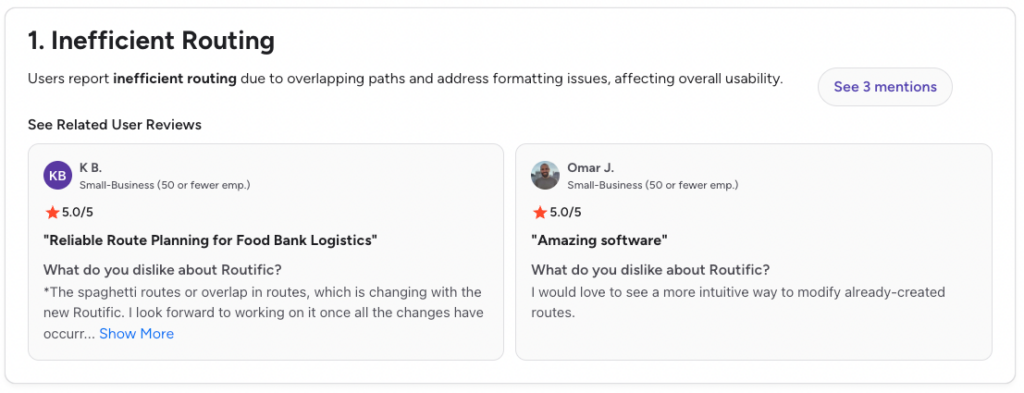
Address or Mapping Issues
Some users report occasional inaccuracies related to address formatting or map pin placement, which can affect routing accuracy in certain cases.
Source: G2, Capterra
Limited Advanced Logistics Capabilities
Because Routific focuses primarily on route optimization, organizations requiring broader logistics execution features may need additional tools alongside it.
Scaling Beyond Route Planning
As delivery networks expand, some businesses report needing additional capabilities such as advanced automation, multi-region planning, or deeper operational analytics.
Feature Limitations for Complex Workflows
Reviews occasionally mention limitations in tracking, customization, or integrations depending on operational requirements.
Locus as the Common Alternative to Routific
Organizations evaluating Routific pricing often compare it with Locus, particularly when routing needs evolve into broader delivery optimization challenges.
While Routific is primarily focused on route planning, Locus is designed for mid-sized and large enterprises managing complex logistics networks.
Enterprise-Grade Route Optimization
Locus applies AI-driven optimization across routing, dispatch planning, and execution decisions, enabling enterprises to optimize delivery operations beyond static route planning.
Built for Complex Logistics Operations
Locus supports multi-node distribution networks, hybrid delivery models, and high-volume operations across retail, FMCG, and logistics industries — making it suitable for enterprises scaling across regions.
From Route Planning to Delivery Optimization
Many organizations begin with route planning tools and later transition to platforms that support dynamic routing, capacity planning, and real-time execution optimization as operations grow.
This is where enterprise platforms like Locus are often evaluated alongside routing-focused solutions.
Conclusion: Why Enterprises Evaluate Locus Alongside Routific
Routific remains a well-regarded route planning solution, particularly for organizations looking to quickly optimize delivery routes and reduce manual planning effort. Its usage-based pricing model makes it accessible and predictable for smaller delivery operations or teams focused primarily on route efficiency.
However, as delivery operations grow more complex, pricing decisions increasingly depend on operational outcomes rather than subscription cost alone. Enterprises often evaluate how a platform improves cost per delivery, planner productivity, and service reliability across regions and delivery models.
In this context, many mid-sized and large enterprises evaluate Locus alongside Routific, especially when routing evolves into a broader delivery optimization challenge requiring automation, scalability, and AI-driven decision-making.
For organizations seeking to move beyond route planning into enterprise-scale logistics optimization, Locus represents a modern alternative focused on efficiency, automation, and long-term operational growth.


General
How Enterprise Retailers Choose Fulfillment Solutions in 2026

Feb 23, 2026
A 2026 guide to retail fulfillment solutions like DC, 3PL, and hybrid. Learn where each model breaks and how orchestration keeps SLAs intact.
Read more
General
Project44 Pricing Guide (2026): Packages, Reviews & Enterprise Alternatives
Feb 24, 2026
Explore Project44 pricing in 2026, including plans, features, and hidden costs. Compare top alternatives to choose the right logistics visibility platform.
Read moreInsights Worth Your Time




















Routific Pricing Guide (2026): Packages, Reviews & Enterprise Alternatives