


General
How Enterprise Retailers Choose Fulfillment Solutions in 2026
Key Takeaways
- Fulfillment model selection (owned DC, 3PL, hybrid, or ship-from-store) determines what you can control when operations break, not just how fast you ship in steady state.
- Multi-3PL networks consistently fail at the same point: SLA definitions, cutoff times, and exception categories that vary by node make network-level reporting unreliable.
- The last mile accounts for 35–53% of total shipping costs; routing and node-selection decisions made upstream carry the greatest leverage on that number.
- Orchestration is the control layer that enforces consistent execution standards across nodes and partners as the network scales. It is infrastructure, not a project.
- Locus operates as the execution-grade control layer for enterprise retailers, delivering 99.5% on-time delivery, 25% efficiency gains, and 15–30% cost reductions across 650+ million orders.
Think of this scenario (which might be relatable.) At 10:07 a.m., your flash sale goes live. By 10:22 a.m., one distribution center (DC) is backlogged, two store clusters are short-staffed, and your regional 3PL has already reached its carrier cutoffs for next-day delivery.
None of this was in the morning plan. The question is what your fulfillment network does next, and if you have any control over the answer.
Most enterprise teams reach this point and understand that “fulfillment solution” is a deceptive term. You are not selecting a vendor. You are deciding how the network will react when reality no longer aligns with the plan.
Returns add to the challenge, too. NRF and Happy Returns forecast retail returns are fixed at $890 billion in the United States in 2024. This introduces a second fulfillment stream that must vie for resources, including labor, space, and carriers, as well as the outbound stream.
The consequences of failure have never been more dire.
This guide will walk through the underlying retail fulfillment models, where each one breaks down at scale, the current state of the fulfillment technology stack, and how orchestration keeps service levels and profitability in line when the network gets messy.
Retail Fulfillment Solutions in 2026: Why the Model Matters More Than the Tool

Enterprise fulfillment rarely fails because teams lack software. It fails because the operating model and the customer promise are misaligned.
For instance, a next-day commitment across five regions is a fundamentally different business than a two-day standard. A ship-from-store program across 400 locations requires different labor governance than DC fulfillment. Software cannot fix a model designed for a different set of constraints.
The model decision answers questions that tools cannot resolve after the fact:
- Where inventory sits and how often it moves
- Who owns throughput during peak
- How many handoffs exist between order capture and doorstep
- What you can actually control when a node, carrier, or lane degrades
The shift from single-channel fulfillment to multi-node networks
Enterprise retailers have largely progressed beyond the single “ship-from-DC” channel.
Here’s how: A standard multi-node network today would comprise DC fulfillment for stable, high-volume SKUs; ship-from-store to boost availability and reduce delivery times; 3PL nodes for expansion or peak capacity absorption; and marketplace routes with distinct SLAs and penalty models.
So, the question of centralized vs. decentralized fulfillment has become more of a strategic discussion than an operational consideration. Decentralization enhances location and delivery velocity. Centralization enhances cost management and execution uniformity.
However, enterprise retailers require both, which is exactly why a common control layer is a necessity, not a nicety.
Why scale complexity is redefining retail fulfillment
Scale introduces a specific kind of problem. More orders is manageable. More exceptions, more capacity constraints, and more situations where a locally correct decision creates a network-level cost is a different challenge entirely.
Consider a common scenario: “closest node wins” sounds efficient until it routes a high-margin order to a store already running behind on pick, while a DC has capacity and a better carrier lane for that ZIP code. The locally obvious decision and the network-optimal decision diverge constantly at scale. A well-designed model reduces how often that divergence happens. The right control layer handles it when it does.
When a network model fails to optimize for consolidation, the financial penalty is immediate. 2025 logistics data shows that split shipments increase per-order fulfillment costs by 25–35% due to duplicate packaging, labor, and last-mile fees. A “closest node” model that saves $2 in zone shipping but triggers a split shipment often creates a net loss on the order.
What Are the Core Retail Fulfillment Models?
| Feature | Outsourced Fulfillment (3PL & FBA) | Hybrid Fulfillment (DCs + 3PLs + Stores) | In-House Fulfillment (Internal Orchestration) |
|---|---|---|---|
| Best For | Speed-to-launch, regional expansion, uncertain demand, or testing new markets without capital investment. | Balancing control and flexibility; handling predictable volume via DCs while using 3PLs/stores for overflow or proximity. | High-value items, complex deliveries, and brand-defining experiences where total control is non-negotiable. |
| Primary Optimization | Speed & Flexibility (Coverage without building infrastructure). | Balance (Scale & reach combined with core stability). | Control & Quality (Precise execution of the customer promise). |
| Pros | • Fast Setup: Start shipping in weeks, not months.• No Fixed Assets: Avoid building owned capacity for unproven markets.• Marketplace Reach: FBA offers instant access to Prime/marketplace distribution. | • Flexibility: DCs anchor cost/volume; 3PLs handle peaks; stores offer speed.• Scalability: Can absorb demand spikes better than a rigid single-model network. | • Total Control: Ability to dictate exact service behaviors, packaging, and unboxing experience.• Responsiveness: Direct oversight of inventory and labor allows for immediate pivots. |
| Cons | • Inconsistency: Variation in cutoffs, carrier mixes, and scan compliance across nodes. • Loss of Control: Hard to shape service behavior by customer segment (especially with FBA).• Blind Spots: Reliance on external reporting for performance data. | • Fragmented Standards: “DC late” vs. “3PL late” creates blame vs. root-cause cultures. • Data Silos: Reporting often cannot normalize SLA definitions across different partners.• Complexity: Requires a unifying control layer to prevent local optimization. | • Coordination Overhead: High burden on internal teams to manage labor, inventory, and logistics.• Resource Conflict: Store fulfillment can clash with in-store customer service during peaks (e.g., promo weeks). |
| Key Risk | SLA Erosion: Without tight contracts or orchestration, the customer experience varies wildly depending on which node fulfills the order. | Operational Drift: Without a central control layer, the network degrades into disconnected islands of operation, making systemic fixes impossible. | Capacity Constraints: Internal nodes (especially stores) have hard ceilings; if they get overwhelmed, there is no automatic overflow valve. |
A practical way to evaluate retail fulfillment models is by what they optimize for: speed-to-launch, unit economics, or operational control. Most enterprise retailers combine models, but one intent usually dominates the design.
1. Outsourced fulfillment (3PL and FBA models)
When you need fulfillment coverage quickly or when you’re not sure how much demand you’ll have, outsourced fulfillment is a good option. For expansion, a 3PL can have you shipping in weeks rather than months to set up a new point of presence.
Consistency is where things get tricky. When you add a second outsourced point of presence, you’re likely to get variability in cutoff times and pick waves, carriers and on-time performance by lane, scan compliance requirements, and return processing speed.
This requires either strict contractual terms up front (SLA definitions, exception types, and cutoff terms negotiated before scaling volume) or an orchestration layer that enforces consistency across partners irrespective of their internal processes.
FBA makes this problem worse. You get marketplace reach and fulfillment speed, but you sacrifice the ability to influence service behavior by customer segment, product category, or geography.
2. Hybrid fulfillment (distribution centers plus 3PL partners)
Hybrid fulfillment is the default for large retailers because it balances control and flexibility. DCs handle predictable, repeatable volume. 3PL nodes handle expansion, overflow, or specialized handling. Stores serve as proximity nodes for select categories and markets.
Hybrid breaks down when execution standards diverge across those partners. You can hear it in how operations teams talk: “DC late” becomes a root-cause conversation. “3PL late” becomes a blame conversation. When reporting cannot normalize SLA definitions across nodes, you cannot fix the network. You can only negotiate with partners.
Note: Without a control layer enforcing consistent standards, hybrid fulfillment gradually becomes a collection of fragmented local optimizations.
3. In-house fulfillment with internal orchestration
In-house fulfillment is attractive because it offers control, and in certain product areas (high-value goods, complex delivery schedules, customer experiences that define the brand) it is the only viable alternative.
The problem with in-house fulfillment is that it comes with a hidden cost of coordination. The problem with implementing it is that you know it will fail. You roll out ship-from-store for availability.
It’s fine until promotion weeks, when store labor and customer traffic intersect with pick volume. Store fulfillment is the bottleneck, and the DC can’t handle the overflow.
How retailers combine these models for omnichannel scale
The most resilient enterprise retailers treat fulfillment like a portfolio. Outsource where speed-to-launch and flexibility matter. Keep core volume in-house where cost and control matter. Use stores where proximity drives availability. Separate marketplace lanes when SLA penalties require tighter governance.
A portfolio approach requires governance infrastructure. Without a unifying control layer, the portfolio becomes disconnected operations competing for the same inventory and capacity. That tension is most visible during peak season, when every node is under simultaneous pressure.
Suggested Read: [e-Book] Fulfillment Models in Logistics – Changes All-Mile Game
What is The Best Retail Fulfillment Technology Stack for 2026?
Once the operating model is clear, the technology conversation becomes more tractable. You can map the stack to what it needs to control versus what it only needs to observe.
Fulfillment providers (ShipBob, Red Stag, FBA, regional 3PLs)
Providers execute storage, pick, pack, and ship. They are necessary, but they are not designed to optimize your entire network. Their incentives are local to their node; yours are network-level.
That misalignment is why provider-heavy networks drift toward inconsistent customer experiences unless you enforce common standards for routing, cutoffs, SLAs, and exception workflows from the outside.
Experience and CX layers (tracking, returns, post-purchase platforms)
The post-purchase moment is where trust is won or lost. Narvar reports that two-thirds of shoppers feel anxious after clicking “buy,” and delivery issues remain the primary driver of that anxiety. A CX layer cannot compensate for weak execution, though.
The best tracking page in the world simply updates the customer more clearly about a bad outcome when the underlying network is failing.
Orchestration platforms as the control layer
Orchestration sits between intent and execution. It decides which node should fulfill the order based on inventory, capacity, cutoffs, and SLA risk; which carrier or fleet option makes sense given service level, cost, and acceptance probability; and what to do when reality changes (reroutes, reschedules, proactive exceptions).
The distinction between planning and orchestration is timing. Planning optimizes for a static snapshot. Orchestration governs a network that keeps moving. For high-complexity operations you need both, but orchestration is what prevents the plan from becoming fiction by 9 a.m.
Where Locus fits in the modern fulfillment stack
Locus operates as the execution-grade control layer for enterprise fulfillment networks where plans change throughout the day. It coordinates routing, visibility, and exception management across multi-node, multi-partner environments, connecting DC fulfillment, 3PL networks, and marketplace lanes into a single operational view.
Simply put, Locus governs the part of fulfillment where decisions keep moving after the plan is set.
Where Common Fulfillment Models Break at Scale
You can often forecast where a fulfillment model will break by asking this one question: What happens when a constraint changes after the plan is made? The answer will show whether the model has operational resilience or simply capacity.
- FBA (loss of operational control): Fast marketplace fulfillment, but you cannot tune service decisions to protect the brand. Limits show up in segmentation, returns disposition, and marketplace rules that complicate cross-channel inventory.
- 3PL networks (SLA variability): The second 3PL adds complexity, the third makes it structural. Cutoffs, carrier mix, and exception definitions vary by node, so network reporting and governance break without a control layer.
- In-house (coordination overload): It works until coordination becomes manual. Plans get overridden, local store exceptions stay hidden, and support issues refunds for missed promises because no one can manage the handoffs at scale.
- Cost leakage (multi-partner drift): Costs leak through small “reasonable” decisions like wrong-node shipping, late premium upgrades, missed consolidation, and reattempts. Last-mile spend often runs 35 to 53% of total shipping, so upstream routing decisions carry the biggest leverage.
Suggested Read: Last-Mile Fulfillment: What It Is & How It Works [2025]
Comparing Retail Fulfillment Models: Control, Speed, Cost, and Risk
This comparison is not intended to pick a winner. Its purpose is to make tradeoffs visible before a planning decision, not after a failed implementation.
Model comparison framework for strategic buyers
| Fulfillment Model | Control | Speed to Launch | Unit Economics | Volatility Fit | Best For |
|---|---|---|---|---|---|
| Owned DC (in-house) | High | Slow | Best at scale | Low to medium | Core predictable volume |
| 3PL (outsourced) | Low | Fast | Variable by volume | High | New markets, overflow, peak |
| FBA / Marketplace | Very low | Fast | Platform-dependent | High | Marketplace-native SKUs |
| Hybrid DC + 3PL | Medium to high | Medium | Good with governance | Medium | Most enterprise retailers |
| Ship-from-store | Medium | Fast (proximity) | High labor cost | Low | Urban, same-day promise |
| Orchestrated multi-node | Highest | Depends on nodes | Best overall | High | Complex, scaling networks |
The Rise of Orchestration in Retail Fulfillment
Orchestration is a response to how enterprise fulfillment actually behaves in production: plans degrade within hours, partners vary in execution quality, and the gap between what was scheduled and what is achievable widens throughout the day.
- Multi-3PL orchestration across regions: One set of SLA definitions, exception types, and escalation paths across every partner. Capacity signals feed routing in real time, so you can add a 3PL without inheriting their reporting rules.
- Intelligent order routing and network balancing: Routing has to pick the best node for the network, not just the closest node. As a case in point, Locus evaluates 180+ optimization variables in real time, balancing cost, capacity, proximity, and SLA risk at assignment.
- Exception management and real-time visibility: Visibility tells you what happened, control lets you act before a miss. Control Tower flags late risk early so teams can reroute, switch carriers, or reset promises, driving 99.5% on-time delivery and a 38% reduction in WISMO contacts.
- Cost governance and margin protection: Orchestration enforces consistent rules on upgrades, splits vs consolidation, and when an SLA save is worth the extra spend. Without it, dispatcher-by-dispatcher decisions turn into margin leakage at scale.
Locus customers typically see a 15–30% reduction in total delivery costs within the first year of implementation and recover an average of $288 million in revenue leakage through optimized carrier selection across their networks.
Locus as the Control and Execution Layer for Retail Fulfillment
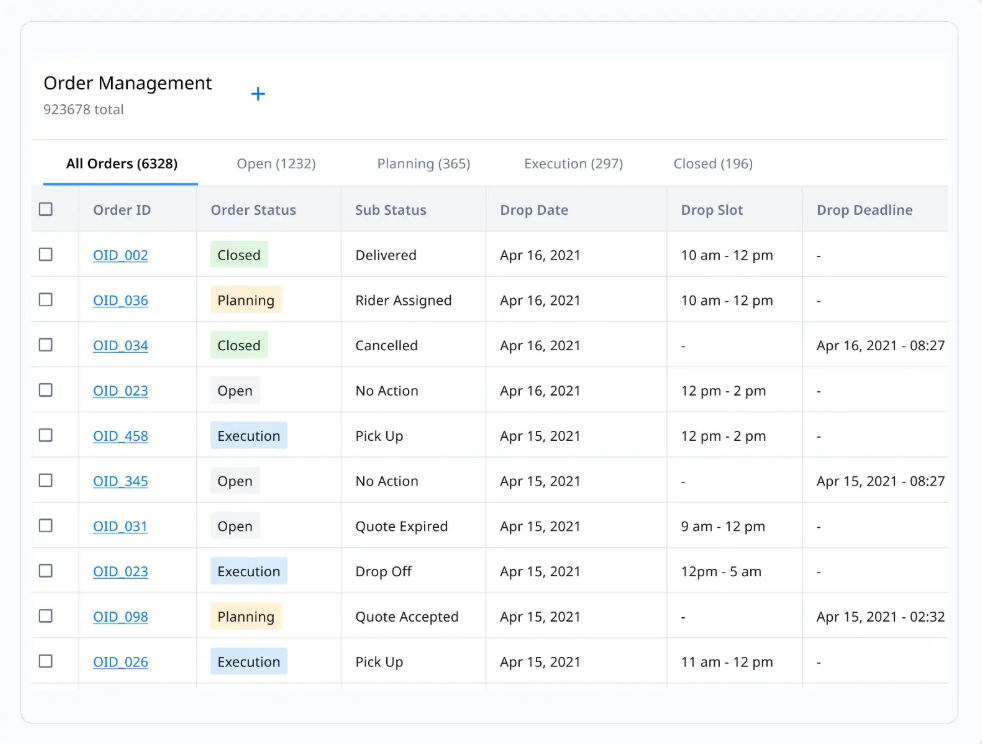
Return to the flash-sale scenario from the introduction. By 10:22 a.m., your plan is already wrong. One DC is backlogged, a store cluster is short-staffed, and a 3PL has closed its next-day cutoff.
Two kinds of operations exist at that moment: those that wait for someone to call someone, and those that already know, have already rerouted, and have already updated the customer’s delivery window. Locus is built for the second.
Connecting in-house, 3PL, and marketplace fulfillment
Locus supports hybrid fulfillment by creating consistent routing and execution behavior across nodes that operate differently.
DCs, stores, and 3PLs share inventory responsibility within the same system. Partners with different cutoff times and carrier mixes are governed by the same routing logic. Marketplace SLAs are tracked alongside standard delivery promises without requiring a separate system.
The practical effect: instead of each node operating as a separate mini-operation with its own reporting dialect, the network runs as one system. A CPG manufacturer using multiple 3PL partners across regions can monitor and control delivery progress across all vendors through the Locus control tower without logging into multiple systems or losing track of SLA performance.
Enabling dynamic order routing across nodes
Dynamic routing is not about constant change. It is about controlled change when constraints shift. When a node loses capacity mid-day, when a carrier lane closes unexpectedly, when an exception signal changes the SLA risk profile of an order, Locus reroutes based on actual network state rather than the state it was in when the plan was built.
Enterprise customers see a 45% increase in deliveries per day on the same vehicle fleet and an 8% improvement in SLA compliance, without adding capacity. Those gains come from routing decisions that account for real conditions rather than planned assumptions.
Centralizing visibility, SLA monitoring, and exception control
Multi-node fulfillment creates a predictable problem: exceptions fall into the gaps between teams. The DC team does not see what the store team committed. The 3PL team operates on its own reporting cadence. Customer support learns about the failure from the customer.
Locus centralizes operational visibility across stakeholders, SLA monitoring that identifies breach risk early, and exception workflows that assign ownership and track resolution.
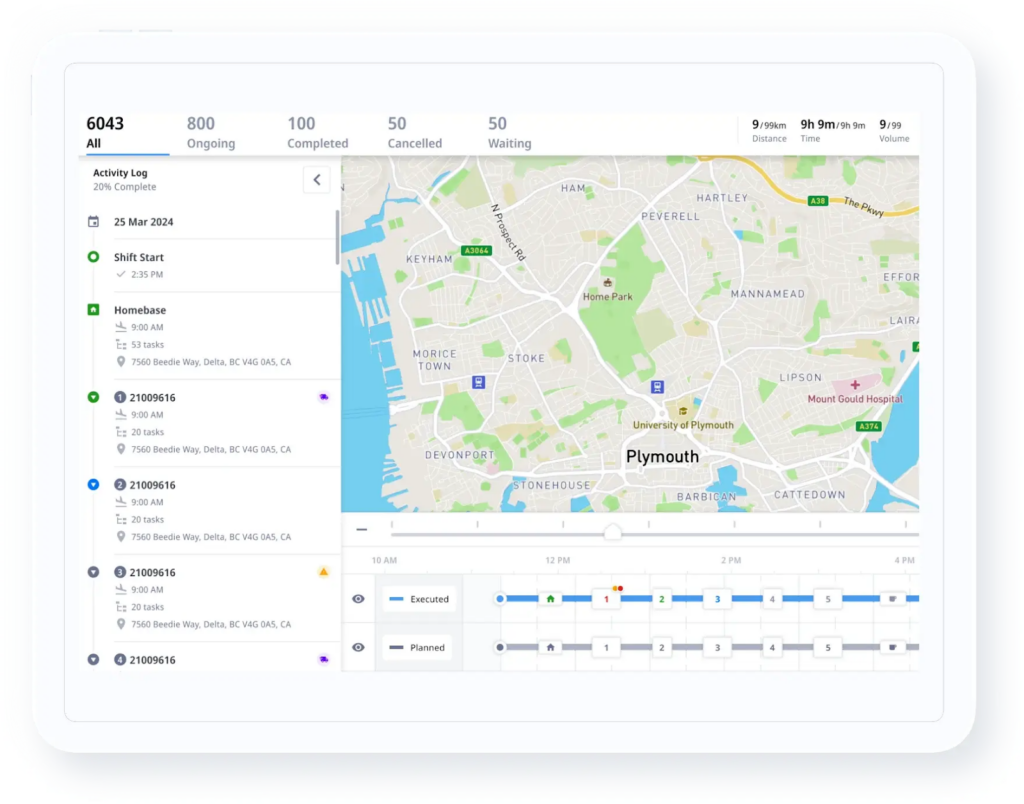
During peak season, when one late wave can trigger a cascade of reattempts and credits, the speed of exception detection determines whether you absorb the problem operationally or pass it to the customer.
Powering scalable retail operations without losing control
Growth typically means more regions, more nodes, and more partner complexity. With manual coordination and node-specific governance, execution standards rarely scale alongside it.
Locus enforces consistent routing rules as the network expands, reduces manual coordination between planning, dispatch, and support teams, and improves route and schedule quality through automation. A retailer adding a new region or a new 3PL partner does not need to rebuild governance from scratch. The standards are already in the system.
Revamp Your Retail Fulfillment with Locus
Retail fulfillment in 2026 is less about finding another tool and more about choosing a model you can run when things go sideways. Owned DCs, stores, 3PLs, and marketplaces each have a place, but every added node multiplies cutoffs, SLAs, exceptions, and cost leakage.
The retailers that win treat fulfillment like a network, then install orchestration as the control layer that keeps decisions consistent in real time. That is how you protect next day promises, absorb peak volatility, and keep last mile spend from eroding margin. Start by mapping points, standardizing SLAs, and automating exception responses.
If your network is growing faster than your ability to coordinate it, Locus can help you run it as one system. To see how it supports multi-node, multi-partner retail fulfillment with execution-grade control across 650 million annual orders in 400+ cities, schedule a walkthrough.
Frequently Asked Questions (FAQs)
1. How do I decide between centralized vs. decentralized fulfillment for a new region?
Model it by category and delivery promise. Use DCs for predictable volume and cost control. Use decentralized nodes (stores or regional 3PLs) when proximity drives availability and revenue. Add orchestration to govern routing and exceptions across both, so the decision can be revisited as the region matures without rebuilding governance each time.
2. What breaks first in a multi-3PL setup?
SLA consistency. Cutoff times, carrier mixes, and exception definitions vary by site. Without a control layer normalizing those definitions, cross-node reporting becomes unreliable and performance improvement shifts from operational fixes to partner negotiations. Establish shared measurement standards before scaling volume with a second or third 3PL.
3. How should we measure fulfillment health beyond on-time delivery?
Track late-risk detection time, exception-resolution time, reattempt rate, and routing efficiency by lane. These metrics reveal whether the network is controllable (whether problems can be caught and corrected before they reach the customer) rather than just whether it shipped.
4. What should we demand from 3PL partners before scaling volume with them?
Clear and written cutoff policies, scan-compliance standards, standardized exception categories, and shared definitions of on-time delivery. Agreement on measurement must come before agreement on capacity. A partner who cannot report on your terms cannot be governed on your terms.
5. Where does Locus fit if we already have an OMS and WMS?
Locus operates in the execution layer across nodes and fleets: routing orders, monitoring SLAs in real time, and managing exceptions when plans change. It complements OMS and WMS by controlling network-level fulfillment decisions that those systems were not designed to handle, specifically, which node fulfills which order under current conditions and what changes when those conditions shift.


General
5 Operational Pillars of Executable Omnichannel Retail

Feb 20, 2026
Omnichannel retail strategy designed for execution at scale. Learn how to unify inventory, routing, and last-mile delivery. Sign up for a free trial.
Read more
General
Routific Pricing Guide (2026): Packages, Reviews & Enterprise Alternatives
Feb 24, 2026
Routific Pricing: Key Takeaways How We Gathered Insights on Routific Pricing Routific publicly shares pricing information, but understanding real-world value requires analyzing user experiences alongside pricing data. To build this guide, we analyzed publicly available information from: These platforms provide insights from verified users across logistics, food delivery, retail, and service businesses. Rather than relying […]
Read moreInsights Worth Your Time




















How Enterprise Retailers Choose Fulfillment Solutions in 2026