


General
Project44 Pricing Guide (2026): Packages, Reviews & Enterprise Alternatives
Project44 Pricing: Key Takeaways
- Project44 follows a custom enterprise pricing model, with costs typically based on shipment volume, transportation modes, and implementation scope, requiring direct engagement with sales teams for pricing details.
- User reviews across G2, Capterra, and Gartner Peer Insights highlight strong real-time visibility and tracking capabilities, while also mentioning integration complexity and challenges related to data accuracy or carrier onboarding in certain cases.
- Mid-sized and large enterprises evaluating Project44 pricing often compare it with Locus, particularly when visibility needs expand into optimization, execution efficiency, and AI-driven logistics decision-making.
How We Gathered Insights on Project44 Pricing
Project44 does not publish pricing tiers or package costs publicly. To build this guide, we analyzed publicly available information from trusted review platforms and industry sources, including:
- G2 — user feedback on real-time visibility, usability, and operational impact
- Capterra — verified customer experiences related to deployment and platform value
- Gartner Peer Insights — enterprise-level reviews of real-time transportation visibility platforms
These platforms provide insights from logistics and supply chain professionals using Project44 in real-world enterprise environments. Rather than relying solely on vendor messaging, this article focuses on recurring patterns observed across customer reviews.
(Please note that examples referenced below are paraphrased from public reviews and may not reflect every user’s experience.)
Project44 Pricing (2026): What You Need to Know
Project44 follows a custom enterprise pricing model, meaning pricing details are not publicly disclosed and must be obtained through direct vendor engagement.
No Public Pricing Tiers
Based on publicly available information and review discussions:
- Pricing is typically negotiated based on shipment volume
- Transportation modes (truckload, ocean, rail, air) influence pricing
- Module selection and integration requirements impact cost
- Implementation scope and onboarding requirements vary by enterprise
This pricing structure is common for real-time transportation visibility platforms, where deployments are tailored to complex supply chain environments.
Enterprise Deployment Focus
Project44 is primarily designed for large-scale supply chain visibility across multiple transport modes. The platform connects shipment data, carrier updates, and ETA predictions into a centralized visibility layer used by logistics and supply chain teams.
Because pricing depends heavily on scale and configuration, total cost of ownership often includes:
- Platform licensing
- Integration with existing TMS or ERP systems
- Carrier onboarding and data connectivity
- Operational rollout across regions
As a result, pricing evaluation often focuses less on subscription cost and more on operational visibility improvements and decision-making efficiency.
Project44 Packages & Platform Structure
Project44 does not offer publicly defined packages. Instead, the platform is structured around supply chain visibility and decision intelligence capabilities.
Core platform areas typically include:
- Real-time shipment tracking across transport modes
- Predictive ETA updates
- Supply chain visibility dashboards
- Exception and disruption management
- Analytics and operational insights
The platform is commonly deployed as a control tower visibility layer, enabling organizations to monitor shipments across global networks and respond to disruptions more proactively.
Project44’s visibility-first architecture means it is often implemented alongside existing transportation or logistics systems rather than replacing execution platforms entirely.
For enterprises looking to move from visibility to optimization, explore Locus’ Route Planning System.
Project44 Reviews: What Customers Say (G2, Capterra, Gartner)
Across review platforms, Project44 maintains strong enterprise adoption and is widely recognized for its visibility capabilities.
Common themes observed across G2, Capterra, and Gartner Peer Insights include:
- Strong real-time tracking and shipment visibility
- Improved supply chain monitoring and decision-making
- Positive feedback around data insights and dashboards
- Structured onboarding for enterprise deployments
Users frequently highlight that the platform helps simplify complex logistics data and enables better planning decisions through improved shipment transparency.
Gartner Peer Insights reviews similarly note improvements in logistics control tower processes and consistent data quality once implemented.
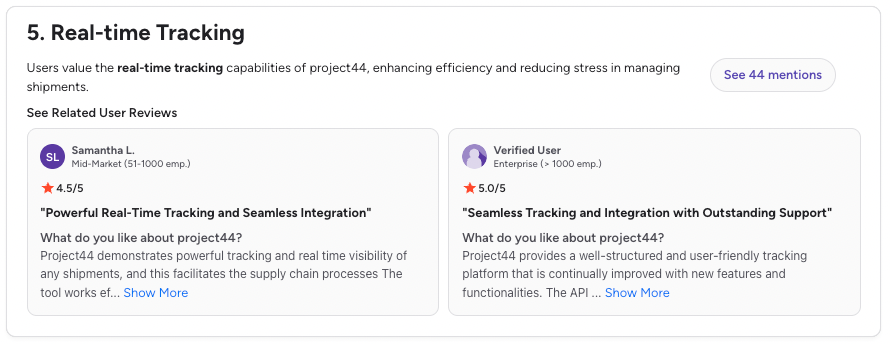
Overall sentiment suggests that Project44 is particularly valuable for enterprises seeking centralized visibility across multi-modal transportation networks.
What Users Like About Project44
Strong Real-Time Visibility
Many reviewers emphasize Project44’s ability to provide real-time tracking updates and improved shipment transparency, helping logistics teams respond faster to disruptions.
Data Insights and Decision Support
Users frequently mention that the platform helps translate complex logistics data into actionable insights, improving planning and operational decisions.
Integration and Carrier Connectivity
Reviews often highlight the platform’s ability to integrate with existing systems and connect multiple carriers into a single visibility interface, improving coordination across supply chain partners.
Enterprise-Grade Platform Stability
Gartner reviews commonly describe structured onboarding processes and stable performance once deployments are fully operational.
Common Challenges Mentioned in Reviews
Data Accuracy or Tracking Gaps
Some users report occasional inaccuracies in tracking data or delays in updates, particularly when working with smaller or regional carriers.
Source: G2
Carrier and Integration Complexity
Enterprise deployments sometimes require extensive carrier onboarding and integration work, which can extend implementation timelines.
Learning Curve for New Users
As with many enterprise visibility platforms, users mention a learning curve during initial adoption, especially when configuring workflows or dashboards.
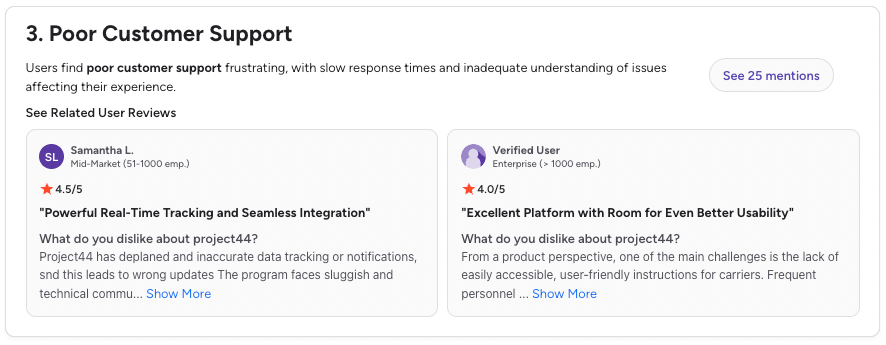
Support and Technical Issues
A smaller number of reviews reference slower response times or technical challenges during issue resolution.
Locus as the Common Alternative to Project44
Organizations evaluating Project44 pricing frequently compare it with Locus, particularly when visibility requirements evolve into broader logistics optimization challenges.
While Project44 focuses primarily on supply chain visibility, Locus is designed for mid-sized and large enterprises managing execution and optimization across delivery operations.
Enterprise-Grade Optimization Beyond Visibility
Locus applies AI-driven optimization across routing, dispatch planning, and execution decisions, enabling enterprises to move from visibility into operational efficiency improvements.
Built for Complex Enterprise Logistics
Locus supports multi-node distribution networks, hybrid delivery models, and high-volume operations across retail, FMCG, and logistics industries.
From Visibility to Execution Optimization
Many organizations begin with visibility platforms and later evaluate solutions that help improve route efficiency, capacity utilization, and delivery performance through automation and optimization.
This is where enterprise platforms like Locus are commonly evaluated alongside visibility-focused solutions.
Conclusion: Why Enterprises Evaluate Locus Alongside Project44
Project44 remains a strong enterprise platform for real-time transportation visibility, helping organizations gain transparency across complex, multi-modal supply chains. Its custom pricing model reflects enterprise deployment requirements, where integrations, data connectivity, and operational scale significantly influence total cost.
However, as logistics operations become increasingly execution-focused, many enterprises evaluate platforms beyond visibility alone. Pricing decisions increasingly depend on how effectively a platform improves operational efficiency, delivery performance, and planning productivity.
In this context, many mid-sized and large enterprises evaluate Locus alongside Project44, particularly when moving from visibility toward optimization, automation, and AI-driven decision-making across logistics operations.
For organizations looking to improve execution efficiency while maintaining enterprise-scale capabilities, Locus represents a modern alternative focused on optimization, automation, and long-term operational growth.


General
Routific Pricing Guide (2026): Packages, Reviews & Enterprise Alternatives

Feb 24, 2026
Routific Pricing: Key Takeaways How We Gathered Insights on Routific Pricing Routific publicly shares pricing information, but understanding real-world value requires analyzing user experiences alongside pricing data. To build this guide, we analyzed publicly available information from: These platforms provide insights from verified users across logistics, food delivery, retail, and service businesses. Rather than relying […]
Read more
General
FarEye Pricing Guide (2026): Packages, Reviews & Enterprise Alternatives
Feb 25, 2026
Key Takeaways How We Gathered Insights on FarEye Pricing FarEye does not publicly disclose pricing tiers or package costs. To build this guide, we analyzed publicly available information from trusted software review platforms and industry sources, including: These platforms provide insights from verified users across logistics, retail, and supply chain industries. Instead of relying on […]
Read moreInsights Worth Your Time




















Project44 Pricing Guide (2026): Packages, Reviews & Enterprise Alternatives