


General
10 Best Alternatives to Route4Me: How These Tools Solve Common Delivery Management Issues
Key Takeaways
- Route4Me struggles with high-density routing, leading to inefficiencies in urban and peak-hour deliveries.
- Limited workflow flexibility in Route4Me can delay real-time adjustments, impacting operational efficiency.
- Inconsistent tracking and inaccurate GPS data in Route4Me create operational disruptions and customer dissatisfaction.
- Locus offers AI-driven routing, multi-region scalability, and real-time tracking to optimize delivery performance and enhance customer satisfaction.
Did you know that over 42% of logistics organizations have placed automation technology in their top three areas of investment to improve last?mile operations? If you’ve spent hours organizing delivery routes, only for things to go wrong, you know how crucial the right software is for efficient logistics.
While Route4Me is a popular option for route optimization, it may not be the best fit for every business due to factors such as cost, limited features, or integration requirements.
In this blog, we’ll explore top Route4Me alternatives that offer flexibility, efficiency, and integration with your existing systems, and help you find the best solution for your business.
Why People Are Shifting Away from Route4Me
While Route4Me is a popular tool for route optimization, it’s not without its drawbacks. Based on real user feedback, here are the key reasons businesses are looking for alternatives:
| Reason for shifting | Details from reviews |
|---|---|
| Slow Performance & Optimization (Link) | Users report that re-optimizing routes and loading updates take too long, especially when importing multiple stops. |
| High Cost (Link) | Some users find the pricing expensive, especially when needing upgrades for essential features like multi-driver optimization. |
| Limited Customization (Link) | Some reviews mention that Route4Me lacks flexibility in route design, leading to suboptimal route planning in certain scenarios. |
| Mapping Issues (Link) | A few users noted that routes on the maps were not always well-designed, which caused frustration despite reaching the destination. |
| Mobile Experience Limitations (Link) | Users noted that certain features, like the “map” view on Apple devices, were lost in newer software updates, impacting user experience. |
These common concerns have driven businesses to seek solutions that better meet their needs. If any of these issues resonate with you, it may be time to consider other route planning tools that offer the flexibility and features you require.
Top 10 Route4Me Alternatives to Consider in 2026
If you’re looking for a Route4Me alternative, explore solutions that address common logistics pain points like routing inefficiencies, workflow flexibility, and scalability.
| Pain point | What it leads to | What to look for | Best-fit Tools |
|---|---|---|---|
| Routing Inefficiencies in High-Density Areas | Increased fuel costs, missed SLAs | Adaptive routing engines for real-world constraints | Locus, Elogii, SmartRoutes |
| Address Formatting Sensitivity | Manual corrections, delays | Geocoding and auto-correction tools | Locus, Routific, Spoke Dispatch |
| Limited Workflow Flexibility | Workflow delays | Customizable workflows and manual overrides | Locus, Elogii, Spoke Dispatch |
| Slow Performance During Peak Loads | Unstable operations | High-performance dashboards under load | Locus, ShipDay, TrackoBit |
| Inaccurate or Missing ETAs | Customer complaints | Real-time ETA adjustments | Locus, SmartRoutes, ShipDay |
| Poor Multi-Hub Coordination | Delays, miscommunication | Multi-hub orchestration and visibility | Locus, Elogii, TrackoBit |
| Manual Effort in Route Assignment | Increased dispatcher workload | Automated task assignment and optimization | Locus, Spoke Dispatch, Onfleet |
| Fragmented Carrier Management | Inefficiency, higher costs | Multi-carrier orchestration and centralized reporting | ShipDay, SmartRoutes, Locus |
| GPS Accuracy Issues | Delivery errors, misroutes | Real-time location accuracy and data consistency | Locus, TrackoBit, ShipDay |
| Lack of Route Adjustments Mid-Shift | Dispatch delays | Flexible, dynamic route adjustments | Locus, Spoke Dispatch, OptimoRoute |
By evaluating these options, you’ll find the right fit to optimize your delivery operations and enhance overall efficiency.
1. Locus
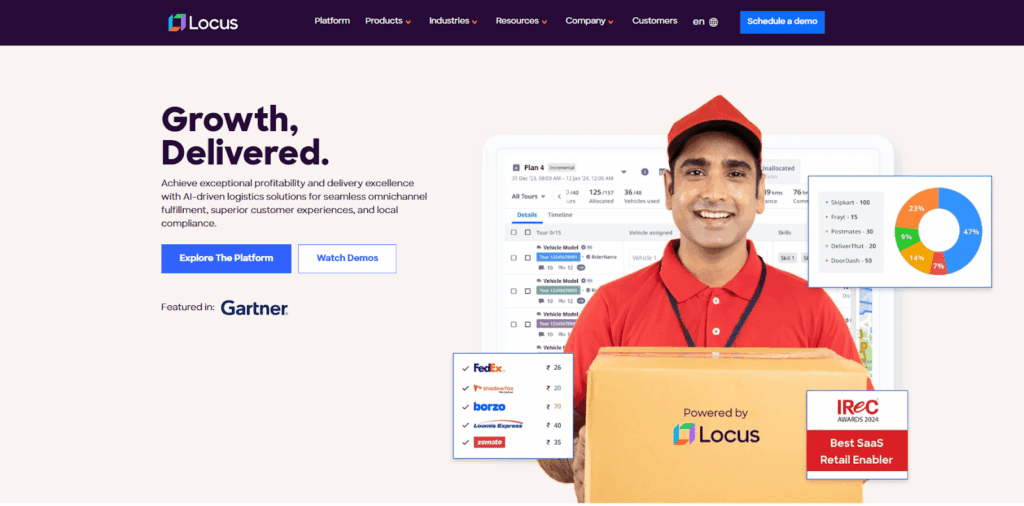
Locus is an advanced logistics automation platform built to help enterprises streamline routing, dispatch, and last-mile execution with AI-driven decisioning.
Teams evaluating Route4Me alternatives shortlist Locus because it adapts well to multi-region, high-density operations and reduces manual effort across planning and execution workflows.
Common Challenges Locus Resolves
1. Slow Performance During High-Volume or Filter-Heavy Operations
Route4Me reviews regularly cite lag, delays, and slow filtering when managing dense delivery data.
Locus helps teams avoid this slowdown with fast task assignment, stable dashboard performance, and responsive control tower views, even during peak-hour operations.
2. Tracking Inconsistencies and Location Accuracy Issues
Some Route4Me users report GPS jumps, missing mileage, or incomplete tracking data, which affect reimbursements and customer visibility.
Locus improves delivery accuracy with reliable, real-time location signals and consistent tracking across regions, reducing disputes and manual correction work.
3. Workflow Rigidity and Limited Real-World Adjustments
Route4Me’s driver-task locking and limited mid-shift flexibility can slow dispatchers when conditions change.
Locus supports structured workflows with manual overrides, allowing dispatchers to adjust routes, reassign tasks, and modify plans without disrupting the operational flow.
4. Limited Depth in Analytics and Exception Visibility
Teams using Route4Me often need deeper reporting or faster insights into delays, exceptions, and root causes.
Locus provides real-time exception dashboards, RCA tools, and richer analytics to help operators act quickly and reduce daily firefighting.
Locus’ Pros
- Locus adjusts to traffic patterns, delivery density, and real-world constraints. This helps teams maintain consistent ETAs and reduce dispatcher overrides, especially in dense, high-stop environments where maintaining route stability is difficult.
- It provides an end-to-end orchestration across routing, dispatch, and execution, ensuring that every stage uses the same real-time operational context. This eliminates fragmentation and reduces errors for teams that need tight coordination from planning to on-ground delivery, particularly useful in multi-hub or multi-region setups.
- Locus scales effectively with growing fleets, regions, and order volumes, maintaining strong performance even when load increases. This supports operations that expand into new territories or manage peak seasons, helping to avoid slowdowns or dashboard lag that users often report on other platforms.
Locus’ Cons
- Teams switching from Route4Me’s interface may find Locus more advanced, especially if they haven’t worked with AI-led routing or orchestration before.
- New customers may need to align data, constraints, and operational rules before going live.
- Very small teams with minimal stops per day may not fully utilize their orchestration and analytics capabilities.
Locus Is Ideal for
Locus is well-suited for enterprise teams that need reliable, scalable delivery orchestration, particularly:
- Retail, e-commerce, and e-grocery brands that manage dense, high-volume routes.
- FMCG/CPG and 3PL providers operating multi-region or multi-client logistics networks.
- Big & bulky delivery operators require precise scheduling and specialized routing.
- Enterprises running hybrid or multi-fleet operations across the first, mid, and last mile.
- Teams need real-time visibility and stable performance as order volumes grow.
Locus’ Pricing
Locus uses a custom pricing model that factors in delivery volume, the number of operating regions, fleet composition, and the specific modules required (like dispatch planning, orchestration, Track & Trace, or carrier management)
Pricing typically scales with usage and the depth of automation deployed.
Locus’ User Testimonial
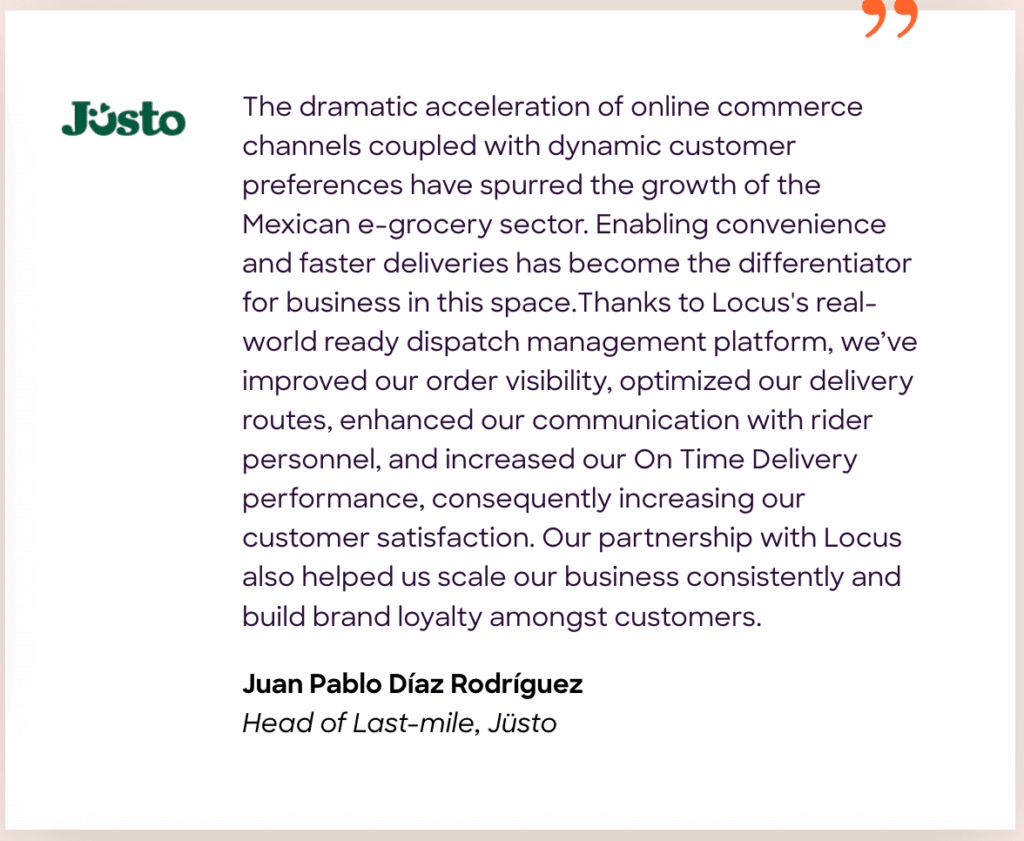
Jüsto, a leading e-grocery provider, faced several challenges similar to those reported by Route4Me users: slow performance, inaccurate tracking, and issues with route optimization. With the rapid growth of online commerce and changing customer demands, Jüsto needed a solution that could help them streamline their delivery operations while maintaining accuracy and on-time performance.
Here’s how Locus helped:
- Improved Order Visibility: Jüsto used Locus to gain better visibility into their deliveries, ensuring real-time tracking and reducing inconsistencies often reported by Route4Me users.
- Optimized Delivery Routes: Locus’ advanced AI-powered routing allowed Jüsto to enhance delivery accuracy and reduce delays, addressing the route mapping and GPS issues that have been common pain points for Route4Me customers.
- Increased Customer Satisfaction: With real-time tracking, Jüsto ensured their orders were consistently on time, boosting customer satisfaction and enabling smoother scaling of their operations. This directly solved the Route4Me challenge of slow performance and tracking inaccuracies.
“Thanks to Locus’s real-world-ready dispatch management platform, we’ve improved our order visibility, optimized our delivery routes, and enhanced our communication with rider personnel, resulting in better On-Time Delivery performance and increased customer satisfaction.”
— Juan Pablo Díaz Rodríguez, Head of Last-Mile, Jüsto
2. Elogii
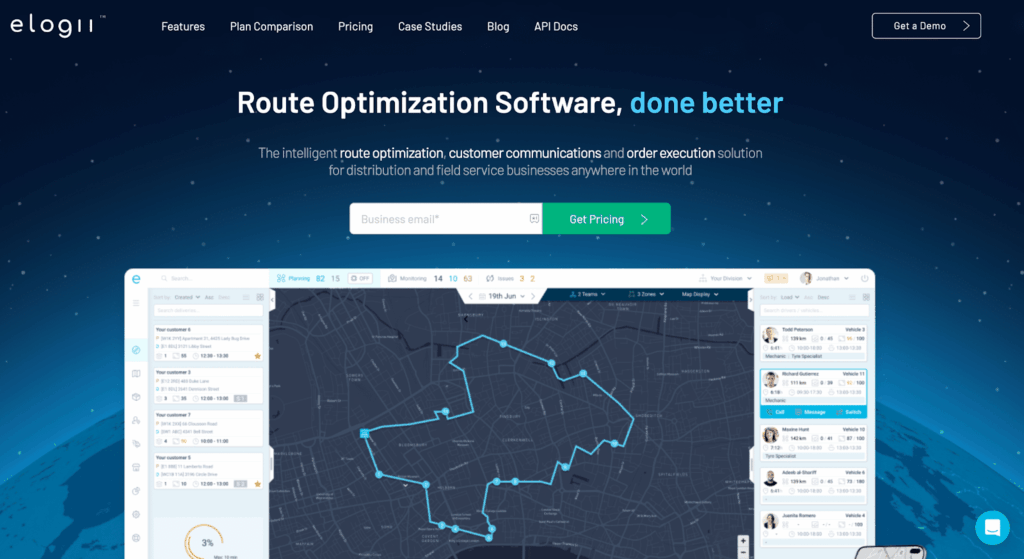
Elogii is an end-to-end logistics platform designed to help businesses optimize routing, improve workforce efficiency, and provide superior customer experiences.
With its flexible, AI-powered route optimization, Elogii supports a variety of industries, including e-commerce, healthcare, and field services, with robust tools for managing large fleets, deliveries, and customer interactions.
Common Challenges Elogii Resolves
- Reduces manual effort in dispatching by automating delivery assignment, improving efficiency across operations.
- Provides real-time location tracking for vehicles, drivers, and orders, ensuring transparency and reducing delays.
- Enhances accountability with customizable digital Proof of Delivery (POD), including photos, signatures, and barcode scans.
- Simplifies shift scheduling, driver/agent performance monitoring, and task management for improved field operations.
Elogii’s Pros
- Provides live updates on order movement and driver location.
- Optimizes routes and tasks for improved planning efficiency.
- Supports photos, signatures, and other custom documentation to ensure reliable delivery proof.
Elogii’s Cons
- Lacks the complexity of AI-driven platforms for some multi-region operations.
- Requires time for configuration before scaling smoothly.
- Focuses more on operational metrics rather than on in-depth analytical reporting
Elogii Is Ideal for
Elogii is ideal for businesses managing high-volume deliveries or field services across multiple regions, particularly in:
- E-commerce and retail logistics.
- Healthcare and courier services.
- Field service and last-mile delivery operations.
- Companies seeking a user-friendly, scalable solution for workforce and fleet management.
Elogii’s Pricing
Elogii offers custom pricing based on fleet size, delivery volume, and the specific features required for each business.
3. SmartRoutes
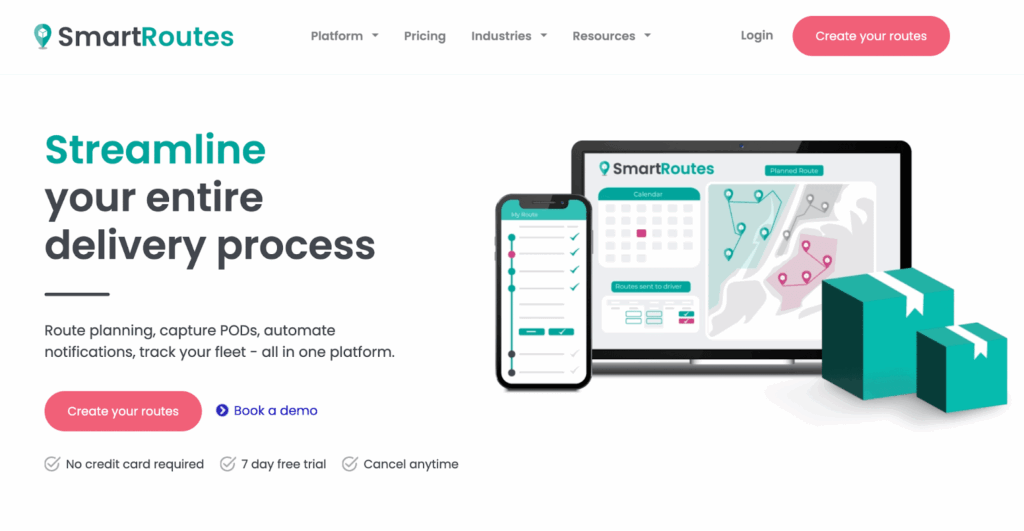
SmartRoutes is an all-in-one route planning and optimization platform designed to simplify delivery operations.
With a focus on automating routing, capturing Proof of Delivery (POD), and improving communication with real-time tracking, SmartRoutes helps teams save time, reduce costs, and enhance service quality.
Common Challenges SmartRoutes Resolves
- Automates route generation and dispatching, eliminating the need for manual planning and reducing human error in route assignment.
- Provides real-time visibility into fleet movements, ensuring better control over deliveries and improving operational transparency.
- Simplifies POD capture via e-signatures, photos, or barcode scans, ensuring secure and accurate delivery records.
- Offers automated customer notifications via email or SMS, keeping customers updated on delivery statuses and reducing the need for phone inquiries.
SmartRoute’s Pros
- Provides live tracking of vehicles and deliveries, enhancing fleet management and operational visibility.
- Optimizes routes automatically, saving time and improving efficiency.
- Captures POD through multiple methods, ensuring secure and accurate documentation.
SmartRoute’s Cons
- Lacks in-depth reporting and analytics compared to more complex solutions.
- May require configuration to align with business processes before scaling efficiently.
- Offers basic integrations but may require customization for more complex systems.
SmartRoute Is Ideal for
SmartRoutes is a great fit for businesses that need:
- Efficient route planning and delivery management.
- Seamless customer communication through live tracking and notifications.
- A scalable solution that can handle both small and large operations, especially in e-commerce, logistics, and field services.
SmartRoute’s Pricing
SmartRoutes offers flexible pricing based on vehicle count, feature requirements, and business scale. Plans range from Basic at $32 per vehicle per month to Premium at $65 per vehicle per month, with custom pricing for enterprise-level operations.
4. ShipDay
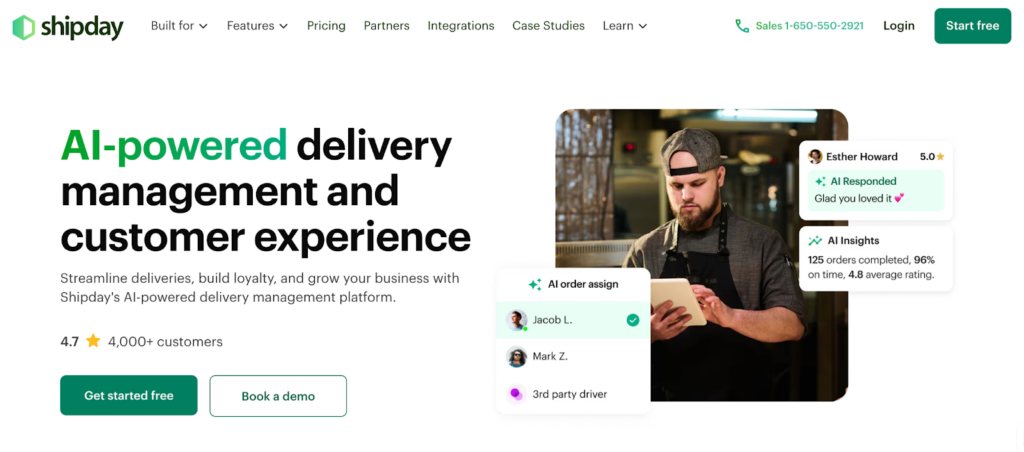
Shipday is a comprehensive delivery management platform that integrates real-time tracking, automated routing, and customer notifications.
With its powerful AI features, Shipday helps businesses improve delivery operations, save time, reduce costs, and boost customer satisfaction.
Common Challenges ShipDay Resolves
- Automates route optimization and dispatching, saving time and improving operational efficiency.
- Offers real-time tracking for deliveries, providing full visibility into fleet operations and ensuring accurate ETAs.
- Provides easy-to-use proof of delivery (POD) capture through e-signatures, photos, and barcode scans, ensuring secure delivery records.
- Automates customer notifications via SMS or email, keeping customers informed without extra effort.
ShipDay’s Pros
- Automated routing saves businesses time and resources while improving delivery efficiency.
- Real-time tracking and fleet visibility enhance operational oversight and reduce delays.
- Easy communication with customers via automated notifications improves their delivery experience.
ShipDay’s Cons
- Limited advanced analytics compared to other more complex platforms.
- Basic integrations may require customization for certain businesses.
- Pricing may be less competitive for companies with large fleets or high delivery volumes.
ShipDay is Ideal for:
Shipday is particularly suited for:
- Restaurants and pizzerias that require efficient delivery management.
- E-commerce and retail businesses that need automated, reliable delivery systems.
- Courier services seeking streamlined operations and real-time fleet tracking.
ShipDay’s Pricing:
Shipday offers flexible pricing starting at $0 for small businesses with up to 10 drivers. Paid plans range from $39/month to $299/month based on the number of orders, drivers, and advanced features needed.
5. Routific
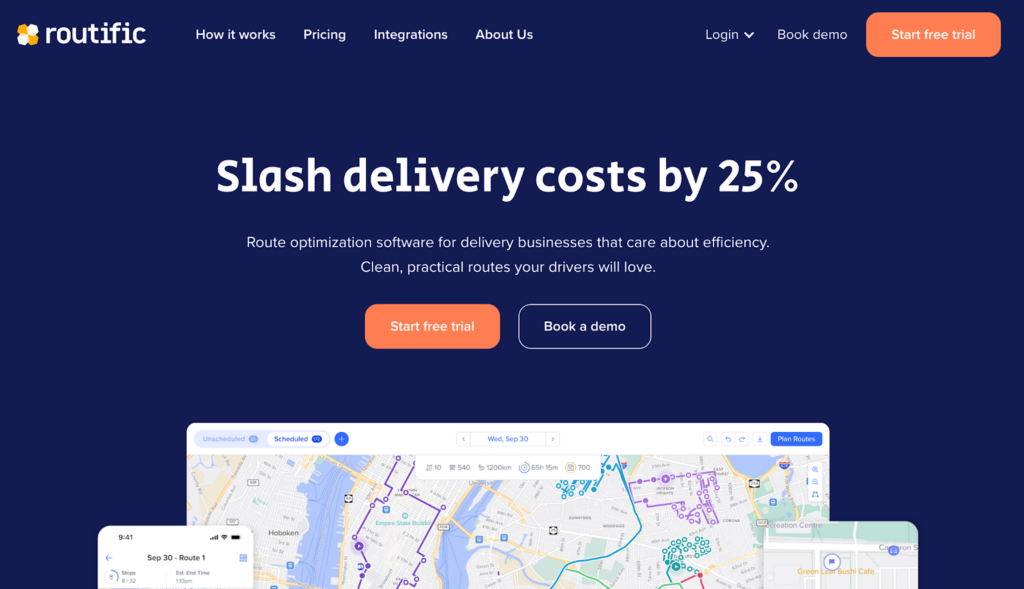
Routific is a lightweight route-optimization platform built for small and mid-sized teams that want fast daily planning and simple operations. It’s known for its clean interface, quick setup, and reliable routing for low- to medium-density delivery networks.
Common Challenges Routific Resolves
- Simplifies daily dispatch planning with automated route sequencing
- Reduces dispatcher workload through an intuitive routing interface
- Improves customer communication with scheduled notifications and ETAs
Routific’s Pros
- Very easy to learn and deploy
- Clean UI suited for teams without technical resources
- Dependable routing for low-density or straightforward delivery territories
Routific’s Cons
- Address formatting sensitivity often requires manual cleanup
- Limited workflow customization (notifications, permissions, constraints)
- Mid-shift edits can feel restrictive for dynamic operations
Routific Is Ideal for
Routific best suits small teams, local retailers, nonprofits, and delivery operations with predictable routes, clean address datasets, and minimal need for workflow customization or multi-region orchestration.
Routific’s Pricing
Routific offers tiered plans based on route volume and feature access. Higher plans unlock tracking links, customer notifications, and API capabilities. Pricing increases with dispatch volume and team size.
6. OptimoRoute
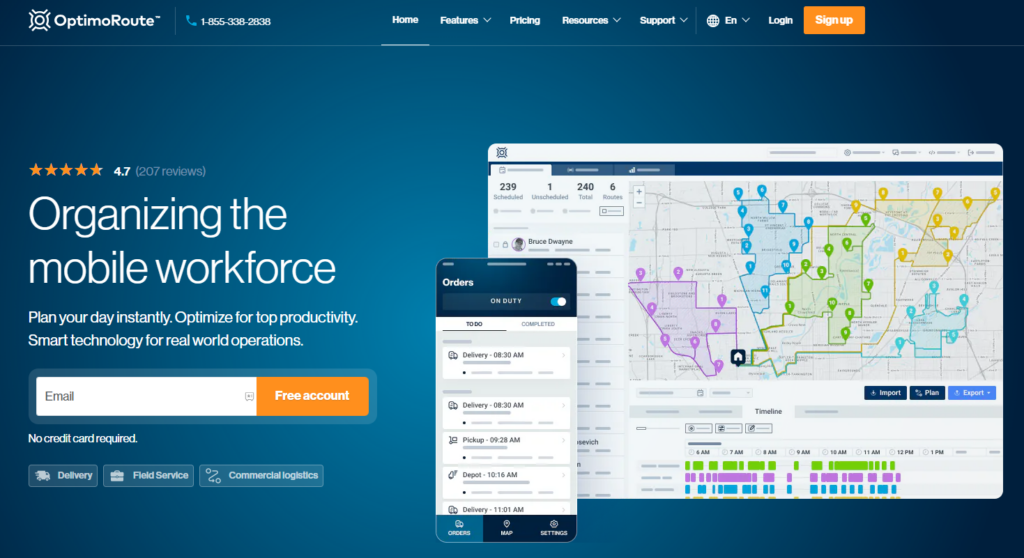
OptimoRoute is a structured route-planning and delivery-management platform often evaluated by teams that need more predictable scheduling and multi-day planning workflows.
Common Challenges OptimoRoute Resolves
- Reducing planning time with automated weekly scheduling and optimized multi-driver routing
- Improving delivery transparency with real-time location visibility and clear ETAs
- Strengthening accountability with structured route execution and proof-of-delivery tools
OptimoRoute’s Pros
- A reliable routing engine that handles constraints and service windows well
- Strong multi-day or weekly scheduling for teams that plan deliveries in advance
OptimoRoute’s Cons
- UI feels dated and less modern compared with newer routing platforms
- Requires more configuration upfront before workflows run smoothly
OptimoRoute Is Ideal for:
OptimoRoute works well for logistics teams that prefer structured plans, predictable delivery cycles, and detailed proof-of-delivery workflows. It suits distributors, field service businesses, and companies managing recurring or multi-day delivery routes.
OptimoRoute’s Pricing:
OptimoRoute offers tiered, per-driver pricing with additional costs for advanced tracking and analytics. Larger operations can request custom plans for expanded capabilities.
7. Spoke Dispatch
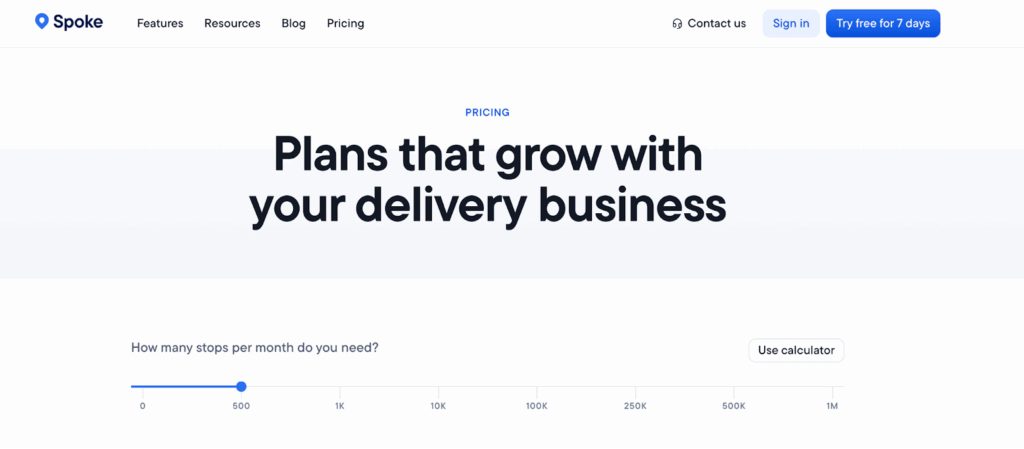
Spoke Dispatch is a last-mile management platform built for courier teams that need fast route planning, live tracking, proof-of-delivery, and a streamlined dispatcher–driver workflow.
Common Challenges Spoke Dispatch Resolves
- Helps dispatchers monitor day-of progress with live driver tracking and timeline views.
- Improves delivery outcomes with proof-of-delivery tools, branded tracking pages, and customer notifications.
- Reduces manual coordination by enabling retailers or clients to upload orders directly via Spoke Connect.
Spoke Dispatch’s Pros
- Very easy to set up and learn for small and mid-sized courier teams.
- Clean route optimization experience with delivery zones, time windows, and custom stop settings.
- Strong mobile driver app with photo/signature POD, in-app navigation, barcode scanning, and mid-route stop edits.
Spoke Dispatch’s Cons
- Routing engine is built for simplicity and may not meet complex constraints used in enterprise logistics.
- Pricing scales with stop volume, which may limit cost control for teams with large daily workloads.
Spoke Dispatch Is Ideal for
- Local courier companies managing multi-driver operations with predictable daily volumes.
- Operations that depend heavily on POD accuracy, customer notifications, and easy driver onboarding.
Spoke Dispatch’s Pricing
Spoke Dispatch offers three tiers: Starter, Premium, and Expert, based on monthly stop volume.
Pricing determines features such as data history retention, branded tracking pages, custom properties, POD limits, geofencing, and API/Webhook access. More advanced capabilities and dedicated onboarding become available at higher tiers.
8. Ufleet
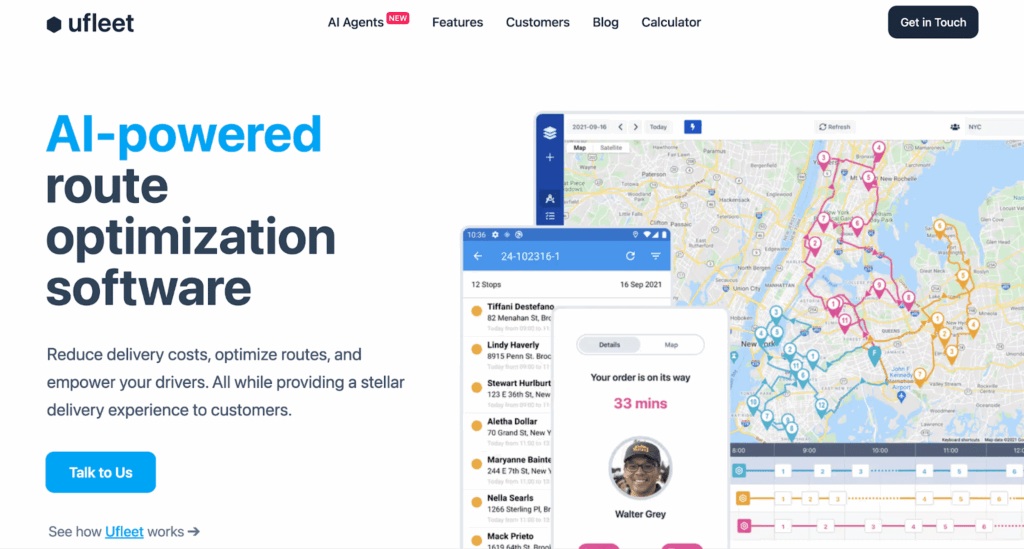
Ufleet is a modern, AI-assisted delivery management platform designed for teams that want fast route planning, simple workflows, and strong customer-facing features. It offers ease of use and customer visibility rather than deep routing customization or multi-layer operational controls.
Common Challenges Ufleet Resolves
- Fast, AI-assisted routing for teams that want quick daily planning
- Clear customer communication through tracking pages, real-time ETAs, and feedback tools
- Reduced dispatcher workload with simple dashboards that consolidate driver updates and delivery status
Ufleet’s Pros
- Very intuitive interface that supports quick onboarding
- Strong customer-facing experience with branded tracking and feedback options
- Fast AI-assisted routing well-suited for small and mid-sized delivery teams
Ufleet’s Cons
- Limited enterprise-level orchestration for complex operations
- Reporting, analytics, and historical insights are basic
Ufleet Is Ideal for
Ufleet fits retailers, grocery operators, and local delivery teams that want a clean, modern delivery tool focused on customer communication and simple daily route planning. It works best for teams that do not require advanced automation or multi-region controls.
Ufleet’s Pricing
Ufleet uses a pay-as-you-go model with free usage up to 200 deliveries per month, followed by a per-delivery fee. Custom pricing is available for higher volumes or deeper integration needs.
9. TrackoBit
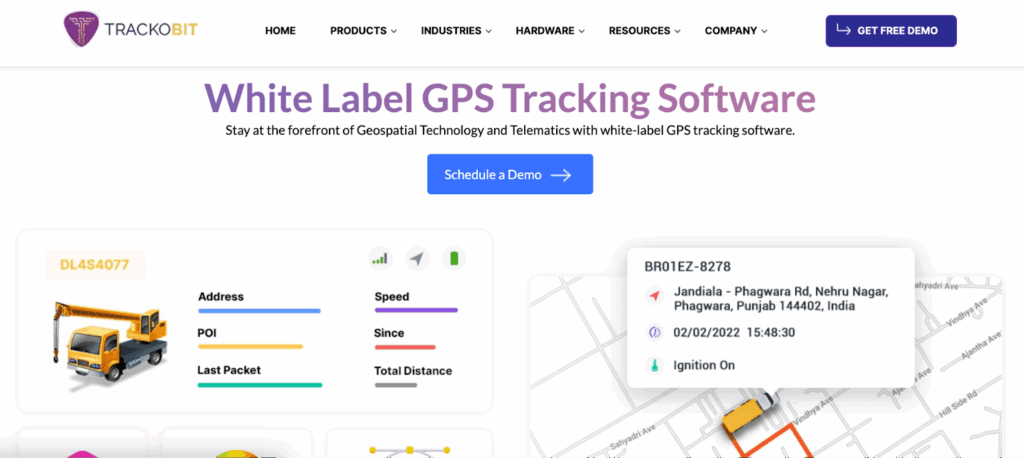
TrackoBit is a last-mile delivery and fleet management platform for teams seeking stronger operational visibility, automated routing, and centralized control over riders and vehicles.
Common Challenges TrackoBit Resolves
- Reduces manual dispatching and routing effort through automated delivery assignment
- Improves fleet visibility with real-time location tracking for vehicles, riders, and orders
- Enhances accountability with digital proof of delivery including photos and signatures
- Simplifies workforce management with tools for shift scheduling and rider performance
TrackoBit’s Pros
- Strong real-time tracking that gives dispatchers full clarity on order movement
- Automated dispatch and routing improve planning efficiency
- Digital POD options built into the driver app
TrackoBit’s Cons
- Advanced route optimization is less sophisticated compared with AI-led platforms
- Interface and workflows may require configuration time before scaling smoothly
- Reporting focuses more on operational metrics than deeper analytics
TrackoBit Is Ideal for
TrackoBit is suited for e-commerce, grocery, courier services, healthcare logistics, and 3PL operators managing daily last-mile delivery. It fits teams that prioritize real-time tracking, delivery verification, and rider management over complex multi-region optimization.
TrackoBit’s Pricing
TrackoBit offers custom pricing based on delivery volume, fleet size, and workflow needs.
10. Onfleet
Onfleet is a simple, easy-to-use last-mile delivery management solution known for its intuitive interface and quick deployment. Teams evaluating Route4Me alternatives often consider Onfleet when they need a lightweight platform focused primarily on last-mile coordination rather than full-chain logistics orchestration.
Common Challenges Onfleet Resolves
Onfleet supports day-to-day delivery operations with:
- Fast, intuitive task assignment and route adjustments
- Reliable driver tracking and customer notifications
- A clean dashboard that reduces dispatcher workload
Onfleet’s Pros
- Enables teams to get up and running quickly without the need for lengthy training.
- Offers stable navigation and smooth communication for seamless operations.
- Ideal for teams seeking a straightforward workflow and quick deployment.
- Supports integrations with ordering systems and delivery apps for enhanced functionality.
Onfleet’s Cons
- Less suited for enterprise complexity, such as multi-hub planning, dense fleet orchestration, or hybrid fleet models.
- Limited advanced routing intelligence compared with AI-driven platforms.
- Analytics and exception-handling tools are more basic and may not meet the needs of high-volume or multi-region operators.
Onfleet Is Ideal for
Onfleet is best suited for local and mid-sized retailers, food and grocery brands, pharmacy deliveries, and service operators managing same-day or on-demand fulfillment. It works well for teams that want a lightweight, easy-to-use delivery management tool without the heavier automation layers.
Onfleet’s Pricing
Onfleet offers tiered pricing based on monthly task volume and feature access. Advanced analytics, API access, and higher delivery limits are available in upper-tier plans.
Why Locus Is the Top Alternative to Route4Me for Delivery Operations
If you’re looking to optimize your delivery operations, Locus offers a comprehensive solution that handles multi-region, high-volume deliveries with ease. Unlike Route4Me, which may struggle with slow performance and limited tracking, Locus provides real-time tracking, AI-powered route optimization, and seamless integrations to ensure smooth operations, even during peak periods.
With proven success in industries like e-commerce, FMCG, and retail, Locus helps businesses save time, reduce costs, and improve customer satisfaction.
Ready to improve your delivery operations? Book a demo with Locus and start optimizing your routes today.
Frequently Asked Questions (FAQs)
1. What makes Locus different from Route4Me?
Locus offers advanced AI-driven routing, real-time tracking, and scalability, making it ideal for multi-region operations, unlike Route4Me, which may struggle with large-scale or complex delivery networks.
2. Can Locus handle multiple delivery zones?
Yes, Locus allows easy management of multiple delivery zones, ensuring efficient routing and fleet optimization across regions, which is crucial for large operations.
3. Is Locus suitable for e-commerce businesses?
Absolutely. Locus helps e-commerce businesses like [Client Name] optimize delivery routes, reduce costs, and enhance customer satisfaction through real-time tracking and dynamic route adjustments.
4. Does Locus integrate with other software tools?
Locus integrates seamlessly with various platforms, including CRMs and order management systems, to improve workflow efficiency and enhance operational visibility.
5. How does Locus handle high delivery volumes?
Locus efficiently manages high delivery volumes by using AI-based optimization, ensuring timely deliveries and stable performance, even during peak times.
6. How easy is it to migrate from Route4Me to Locus?
Migrating from Route4Me to Locus is smooth with dedicated support. Locus ensures seamless data transfer, providing custom integration to ensure a hassle-free transition with minimal disruption to your delivery operations.


General
Top Onfleet Alternatives for 2026: A Comparison of Delivery Solutions

Dec 23, 2025
Explore the best Onfleet alternatives in 2026. Compare delivery management platforms with advanced routing, automation, and dispatch capabilities.
Read more
General
Top 10 LogiNext Alternatives to Consider in 2026 for Better Routing and Delivery Performance
Dec 26, 2025
An in-depth review of the 10 best LogiNext alternatives for 2026, comparing routing performance, visibility, automation, pricing, and delivery use cases.
Read moreInsights Worth Your Time




















10 Best Alternatives to Route4Me: How These Tools Solve Common Delivery Management Issues