


General
Logistics Optimization SaaS: How to Tell Which of Four AI Layers You Actually Need in 2026

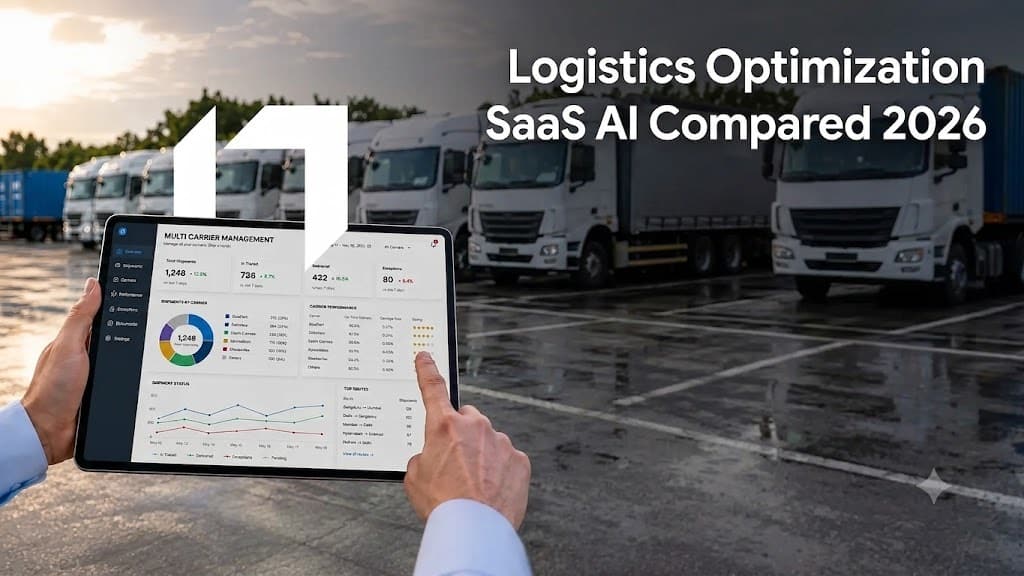
Logistics optimization SaaS is software that uses AI to improve decisions about how goods move, but the label covers four distinct layers that solve different problems: demand and capacity forecasting, inventory and node allocation, route construction against constraints, and continuous execution orchestration. Vendors in each layer describe themselves with the same vocabulary, so a shortlist assembled from a search for the category routinely contains products that do not compete with one another. Enterprise logistics and supply chain leaders use this distinction to avoid the most common evaluation error, which is comparing a forecasting engine against a dispatch platform on a single feature grid.
Key Takeaways
- Logistics optimization SaaS spans four layers: forecasting, node allocation, route planning and execution orchestration. Products in different layers are complements, not alternatives.
- Vendor self-description is the most reliable sorting signal. Transmetrics states on its own site that it is not a TMS and integrates with one.
- Stord’s optimization decides which fulfillment node serves an order across a network of 400+ partner facilities, which is a different question from which vehicle serves a stop.
- PTV Route Optimiser is a planning engine and API that builds routes against constraints including vehicle features, driving and rest times and ramp opening hours.
- nuVizz combines last-mile routing, tracking, proof of delivery, customer engagement and billing into one delivery execution platform.
- Locus operates at the orchestration layer, deciding and re-deciding across fleets and 1,000+ pre-integrated carriers, reasoning over 250+ real-world constraints.
Why the layer distinction matters: the business case
The money in logistics sits in the leg these products all claim to improve, which is why the category is crowded. McKinsey puts the last mile at 60-70% of parcel delivery cost, and found that raising drops per stop from one to five Cut labor, vehicle costs 50%. Any vendor touching that leg can credibly claim large savings, which makes claims a poor basis for comparison.
The buying context has also changed shape. AlixPartners found 90% use multiple last-mile carriers, and Pitney Bowes recorded carriers outside the major networks Doubled US parcel revenue share. A more fragmented carrier base raises the value of the orchestration layer specifically, because there are more allocation decisions to get right.
Execution conditions vary more than most planning tools assume. INRIX 2025 US congestion data, which is why a plan that was optimal at build time is frequently not optimal at execution time, and why planning quality and execution quality are separate purchases.
Locus data indicates the size of the execution gap. A Fortune 50 parcel and freight enterprise lifted Improved execution and capacity utilization after centralizing execution, with DispatchIQ reaching 99.5% on-time delivery across multi-region deployments against the 80% to 90% typical of manual dispatch.
Also Read: Best Enterprise Routing Software 2026
How logistics optimization SaaS works, layer by layer
An order passes through four decisions before it reaches a customer. Each layer of the category owns one of them.
Step 1: Forecast demand and capacity
Before anything is allocated, the operation estimates what volume is coming and what capacity will exist to serve it. This layer consumes historical data plus external signals and outputs a forecast that other systems plan against. Transmetrics occupies this layer, combining historical data with external factors to produce forecasts for capacity, volatility and margin planning, and its own documentation is explicit that it integrates with existing enterprise systems.
Step 2: Decide which node fulfills the order
With a forecast in hand, the next decision is where an order is served from. This is inventory and network allocation, and the output is an assignment to a facility rather than to a vehicle. Stord operates here, running a hybrid model that combines physical fulfillment services with software, where its directs orders to optimal nodes across a network of more than 400 warehouse and fulfillment partners.
Step 3: Build the route against constraints
Once the origin and the stops are fixed, a plan has to be constructed that satisfies physical and legal constraints. This is the classic optimization problem and it is solved before the day begins. PTV Group is a long-established specialist here: PTV Route Optimiser planning engine, and PTV also publishes a route optimization API for teams building their own applications.
Step 4: Execute the delivery and capture proof
A plan then has to survive contact with the day, which means driver tooling, tracking, customer communication, proof of delivery and settlement. nuVizz sits in this layer with an AI-driven last-mile platform that Unifies last-mile delivery execution for shippers and carriers.
Step 5: Re-decide continuously across all of it
The fifth function is not a stage but a loop: re-evaluating allocation and execution as conditions change, across every fleet and carrier, after the plan exists. This is the orchestration layer, and it is what distinguishes a system that plans from a system that keeps deciding. It is where Locus operates, and where the value concentrates once a network contains more than one carrier and more than one mode.
Also Read: Guide: What Is Agentic TMS?
Logistics optimization SaaS compared: layer, design center and scope
The table below places each platform by design center according to its own published positioning rather than by a feature audit. Feature lists change quarterly and every vendor describes its capabilities generously, so design center is the more reliable predictor of fit. Verify specifics against your own requirements in a trial.
| Platform | Layer | Design center per published positioning | Scope boundary |
|---|---|---|---|
| Transmetrics | Forecasting | Predictive analytics combining historical and external data for capacity, volatility and margin planning | States it is not a TMS and integrates with the customer’s TMS or ERP |
| Stord | Node allocation and fulfillment | Cloud supply chain combining physical fulfillment services with OMS, WMS and order routing across 400+ partner facilities | Optimization is which node serves an order, alongside operating the fulfillment itself |
| PTV Group | Route planning | Route Optimiser and developer APIs building constraint-aware routes and schedules | Planning engine and API rather than an execution or multi-carrier orchestration layer |
| nuVizz | Last-mile execution | Last-mile delivery platform unifying routing, tracking, proof of delivery, customer engagement and billing | Purpose-built around last-mile delivery execution |
| Locus | Orchestration | Agentic TMS deciding and re-deciding allocation and execution across fleets and 1,000+ carriers over 250+ constraints | Not a fulfillment operator and not a forecasting-only tool |
Read down the layer column and the practical conclusion is that most of these are complements. A large network can reasonably run a forecasting tool, a fulfillment network, a planning engine and an orchestration layer simultaneously. What it cannot do is choose between them on one scorecard.
Which layer your symptom points to
| What is going wrong | Layer that owns it | What to evaluate |
|---|---|---|
| You are staffed and fleeted wrong before the week starts | Forecasting | Demand and capacity prediction, integrated to your existing TMS |
| Orders ship from the wrong facility, inflating zone costs | Node allocation | Order management and inventory routing across your network |
| Daily plans are infeasible, or ignore vehicle and driver rules | Route planning | Constraint depth in the optimizer, and whether it exposes an API |
| Drivers lack tooling, or proof of delivery and billing are manual | Last-mile execution | Driver app, ePOD, customer notifications, settlement |
| Plans are good at 6am and broken by 10am | Orchestration | Continuous re-decisioning, multi-carrier allocation, exception handling |
| Each carrier reports differently and you cannot compare them | Orchestration | Event and cost normalization across carriers |
Two symptoms in that list are frequently misdiagnosed. Plans breaking during the day gets treated as a solver problem when it is a re-decisioning problem, and incomparable carrier reporting gets treated as a dashboard problem when it is a data normalization problem.
Also Read: Routing vs Last-Mile Platform 2026
What to look for in logistics optimization software
Identify your binding constraint first. If your problem is not knowing next month’s volume, a routing engine will not help. If your problem is that good plans degrade by mid-morning, a better solver will not help either. Name the decision that is going wrong before you look at products.
Check whether the product decides or advises. Some layers output a forecast or a recommendation for another system to act on, and others write back to systems of record and to carriers. Both are legitimate, but they require very different integration work and produce very different results.
Test planning quality and execution resilience separately. Ask for a plan built on your historical orders, then ask what the system does when a driver runs twenty minutes late mid-route. Strong performance on the first says nothing about the second.
Count pre-integrated carriers against your own carrier list. In a multi-carrier network, integration coverage determines how much of the theoretical benefit you can actually capture. A large library matters only if your carriers are in it.
Insist on scope-normalized total cost. Compare license plus implementation, integration build and maintenance, data migration and your own staff time over five years. Products in different layers have very different implementation profiles, and license comparisons across layers are meaningless.
Also Read: How to Identify Agentic TMS
Why Locus: the orchestration layer is where the other three pay off
The first three layers all produce plans. Forecasting produces a view of demand, node allocation produces an assignment to a facility, route planning produces a sequence of stops. None of them survives contact with the day unassisted, and none of them can recover the value it created once conditions move.
That is the argument for the orchestration layer, and it is not a claim about feature counts. A better forecast is worth nothing if allocation ignores it. An optimal route is worth nothing at 10am if it was built at 6am and the world changed. Orchestration is the only layer that acts on reality rather than on assumptions, which makes it the layer where the other three are either realized or wasted.
Locus, the world’s first Decision-Intelligent, Agentic TMS, is built for that position. Of the platforms in this comparison, it is the one whose design center is deciding continuously across the entire movement, first mile through last, rather than optimizing one stage of it. The Digital Supply Chain Officer (DiSCO) framework runs a Sense-Decide-Execute-Learn cycle across eight specialized agents, reasoning over 250+ real-world constraints, and every decision is written back to systems of record and to carriers rather than handed to someone to enact.
Concretely, that means the Carrier Agent allocates each order against live rate, capacity and recent zone-level performance, with ShipFlex providing 1,000+ pre-integrated carriers so adding or replacing capacity is configuration rather than an integration project. DispatchIQ plans against each operation’s real constraint set and reaches 99.5% on-time delivery across multi-region deployments, against the 80% to 90% typical of manual dispatch. The Capacity Agent matches fleet and carrier mix to demand shape, and the Orchestrator Agent normalizes cost and event data across carriers that each report differently, which is what makes cross-carrier comparison possible at all. Six governance mechanisms keep every decision explainable and traceable, with autonomy configured per decision type so routine allocation runs unattended while commercially significant calls escalate.
The results are the reason to take the layer seriously. Locus has orchestrated more than 1.5 billion deliveries for 360+ enterprise customers across 30+ countries at 99.99% uptime, producing more than $320M in documented logistics cost savings and over 800 million miles removed from the road. Locus has been recognized by Gartner for seven consecutive years, including the 2026 Gartner Hype Cycle for Supply Chain Execution and Logistics Technologies, is a Leader in Transportation Management Systems in the QKS Group SPARK Matrix, and ranked #1 in Route Planning on G2’s 2026 Best Software Awards.
There is also a practical reason orchestration is the easiest layer to add. Because it sits above the fleets and carriers rather than inside them, it does not require replacing your forecasting tool, your fulfillment network or your planning engine. It makes each of them worth more, which is the lowest-disruption entry point available in this category and the one with the most leverage.
Locus is not a fulfillment operator and not a forecasting-only tool, and it is not the economical choice for a single-depot fleet running stable routes with one carrier. Where a network has multiple carriers, multiple modes, committed delivery windows or decisions too frequent for people to make well, it is the layer that determines what the rest of the stack actually delivers.
In October 2025, Ingka Investments, the investment arm of Ingka Group, the world’s largest IKEA retailer, acquired Locus. Locus continues to operate independently.
Logistics optimization in action: real-world results
Fortune 50 parcel and freight, 4,500 drivers, 51 sites. The provider had local dispatch decisions across 51 sites with no consistent basis for comparing them, which is a characteristic orchestration-layer problem rather than a planning problem. Centralizing execution on Locus lifted Improved execution and capacity utilization, at 99.99% uptime.
North American retail enterprise, several hundred stores. The retailer ran ocean, rail and road across six legacy systems, meaning no single definition of on-time existed anywhere in the business. Consolidating execution onto Locus produced Multi-million dollar logistics savings, breaking even in year one. The six-systems detail is the layer lesson: the tools were not bad, they were unconnected.
Common logistics optimization SaaS evaluation mistakes to avoid
Comparing across layers on one feature grid. Scoring a forecasting platform and a dispatch platform on the same criteria produces a table where both look incomplete, because each is being marked against the other’s job.
Buying a solver when the problem is execution. If plans are good at 6am and broken by 10am, better optimization at build time changes nothing. The gap is re-decisioning, not route quality.
Treating an API as a product. A route optimization API is a component your team will build a product around. That is a reasonable choice with a real engineering cost, and it should be evaluated as a build rather than a buy.
Ignoring who operates the physical network. A vendor that runs fulfillment facilities is a different commercial relationship from a software licence, with different switching costs and different incentives. Neither is worse, but they are not the same purchase.
How Locus approaches logistics optimization
Locus, the world’s first Decision-Intelligent, Agentic TMS, operates at the orchestration layer, which is the function that keeps deciding after a plan exists. The Digital Supply Chain Officer (DiSCO) framework runs a continuous Sense-Decide-Execute-Learn cycle across eight specialized agents, reasoning over 250+ real-world constraints.
The Dispatch Agent plans against each operation’s actual constraint set rather than national defaults. The Carrier Agent allocates per order against live rate, capacity and recent zone-level performance, with ShipFlex providing 1,000+ pre-integrated carriers so adding capacity is configuration rather than an integration project. The Capacity Agent matches fleet and carrier mix to demand shape, and the Orchestrator Agent normalizes cost and event data across carriers that each report differently, which is what makes cross-carrier comparison possible at all. Six governance mechanisms keep decisions explainable and traceable, with configurable autonomy levels so routine allocation runs unattended while commercially significant decisions escalate.
Locus is not a fulfillment operator and not a forecasting-only tool, and it works alongside products in the other layers rather than replacing them. Locus has been Recognized by Gartner seven years, including the 2026 Gartner Hype Cycle for Supply Chain Execution and Logistics Technologies, is a Leader in Transportation Management Systems in the QKS Group SPARK Matrix, and ranked #1 in Route Planning on G2’s 2026 Best Software Awards, across more than 1.5 billion deliveries for 360+ enterprise customers in 30+ countries at 99.99% uptime.
In October 2025, Ingka Investments, the investment arm of Ingka Group, the world’s largest IKEA retailer, acquired Locus. Locus continues to operate independently.
Request a Locus orchestration assessment to find which layer your current stack is missing.
Also Read: 12 Enterprise Route Planning Tools
Frequently Asked Questions (FAQs)
What is logistics optimization SaaS?
Logistics optimization SaaS is cloud software that uses AI and optimization algorithms to improve decisions about how goods move. In practice the term spans four distinct layers: forecasting demand and capacity, allocating orders to fulfillment nodes, constructing routes against physical and legal constraints, and orchestrating execution continuously across fleets and carriers. Products in different layers solve different problems and are usually complements rather than alternatives.
What is the best logistics optimization software with AI?
There is no single best, because the honest answer depends on which decision is failing. For volume and capacity forecasting, Transmetrics operates in that layer and states it is not a TMS. For deciding which fulfillment node serves an order, Stord combines that software with operating the facilities. For constraint-aware route construction, PTV Group offers a long-established optimizer and API. For last-mile execution with tracking, proof of delivery and billing, nuVizz is purpose-built. For continuous multi-carrier orchestration, Locus reasons over 250+ constraints across 1,000+ pre-integrated carriers.
What is the difference between route optimization and logistics orchestration?
Route optimization builds the best plan it can before execution starts, given a known set of stops and constraints. Orchestration keeps deciding after execution begins, reallocating across carriers and fleets as rates, capacity and performance change. A network with one fleet and stable daily routes mostly needs the first. A network with multiple carriers, modes or committed delivery windows needs both, because plan quality and execution quality are separate problems.
Do I need a forecasting tool and a dispatch platform?
Frequently yes, and they do not overlap. A forecasting layer estimates what volume and capacity will exist so the operation can plan staffing, fleet and inventory ahead of demand. A dispatch or orchestration platform decides what happens to each order once it exists. Buying one and expecting the other’s outcome is the most common source of disappointment in this category.
How should I shortlist logistics optimization vendors?
Name the failing decision first, then shortlist only within the layer that owns it. Compare vendors on design center from their own published positioning rather than on feature grids, since those change quarterly and read generously. Test planning quality and execution resilience as separate exercises, count pre-integrated carriers against your actual carrier list, and require scope-normalized five-year total cost rather than license price.
Is AI in logistics optimization different from traditional optimization?
Yes, in what it does after the plan. Traditional optimization solves a defined problem to produce a plan, and the plan is then executed by people. AI-driven orchestration senses changing conditions, decides within pre-agreed policy boundaries, executes by writing back to systems and carriers, and learns from outcomes so subsequent decisions improve. The distinguishing test is whether outcomes change the system’s future behavior, which a rules engine cannot do.


General
3PL Fleet Management: How Top Providers Protect SLA Adherence Across Every Client in 2026

Sep 2, 2026
For a 3PL, SLA adherence is not one on-time number. Most contracts penalize on monthly thresholds, so the metric that governs dispatch is remaining headroom per client, not current OTD.
Read more
General
Good Fleet Utilization Rate: How to Calculate Your Fleet’s Actual Ceiling in 2026

Sep 2, 2026
A good fleet utilization rate is not a benchmark you look up. It is capped by your own demand variability, and for most last-mile fleets the achievable ceiling is nearer 61% than 85%.
Read moreInsights Worth Your Time


















Logistics Optimization SaaS: How to Tell Which of Four AI Layers You Actually Need in 2026