


General
Last-Mile Delivery Efficiency in Denmark: How an AI-Native Platform Cuts Cost per Delivery in 2026

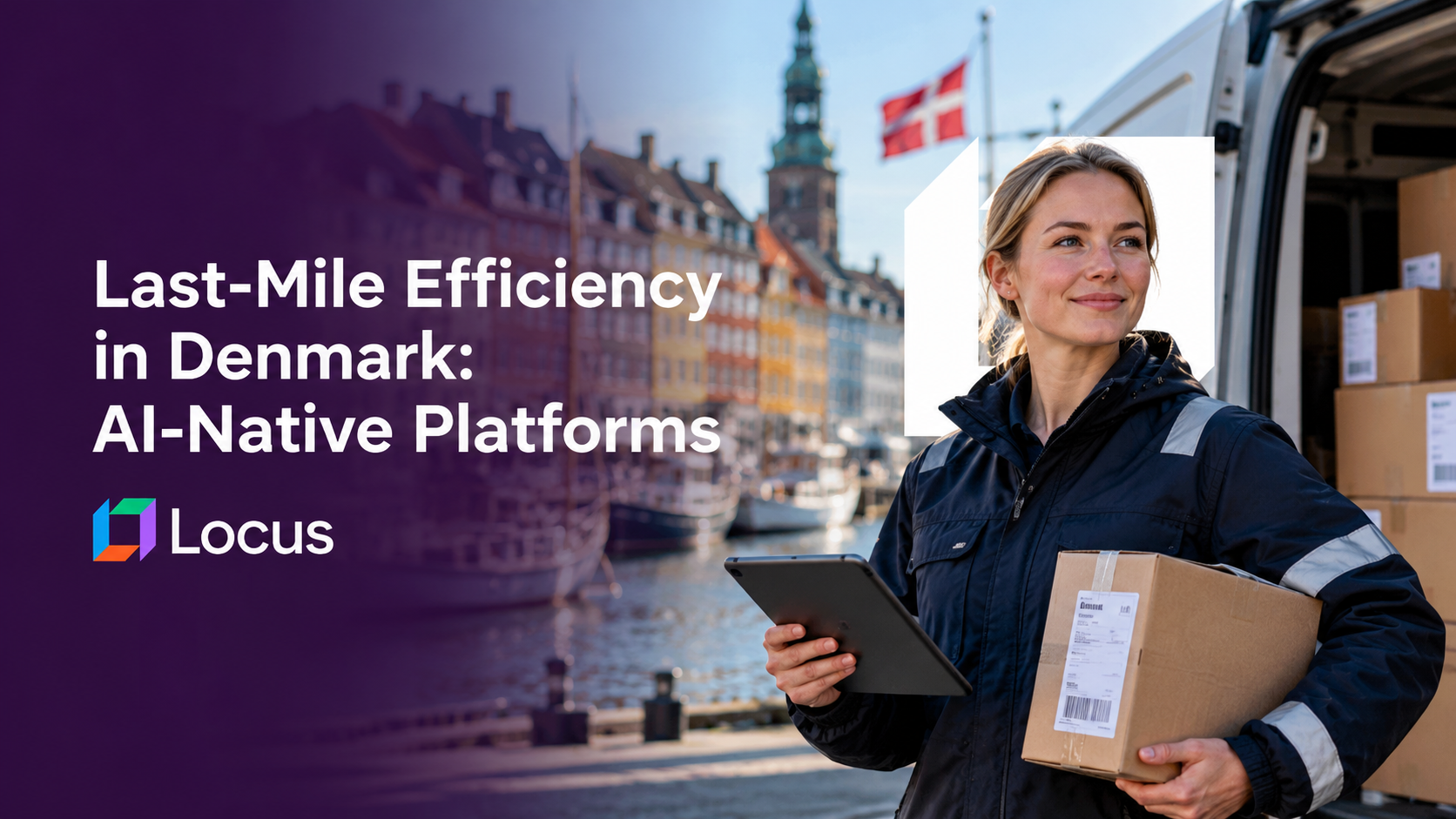
Last-mile delivery efficiency in Denmark is the cost, speed and reliability of getting each parcel or order to its final point, whether that is a service point, a parcel locker or a front door. It is shaped by factors that are particular to the country: a CO2-based road toll that is about to reach lighter vehicles, environmental and zero-emission zones in the largest cities, a delivery market built around service points, and congestion that is worsening in Copenhagen and Aarhus. An AI-native last-mile platform makes the core delivery decisions with learned models and a constraint engine, and re-makes them as conditions change, which is what these conditions demand. Locus, the world’s first Decision-Intelligent, Agentic TMS, is built this way.
Key Takeaways
- Denmark’s CO2-based truck toll began on 1 January 2025 for trucks of 12 tonnes and above, and a draft would extend it to vehicles from 3,501 kg on 1 January 2027.
- Copenhagen’s rush-hour speed averaged 18.3 km/h in 2025, and Aarhus was the most congested Danish city at 45.2%, according to TomTom.
- Service points are the most used delivery method in Denmark, home delivery is preferred, and lockers are the only option still growing, per PostNord.
- An AI-native platform learns real travel times, encodes toll and zone rules as constraints and re-plans live, instead of applying fixed rules.
- Locus plans against 250+ real-world constraints and reports up to 34% fewer miles and 99.5% SLA adherence.
Why Last-Mile Efficiency Matters in Denmark: The Business Case
Demand is large. Danish consumers spent DKK 199.2 billion online in 2025, up 3.8%, according to Dansk Erhverv, so every percentage point of last-mile cost matters.
Roads are slower. In TomTom’s 2025 index, a 10 km trip in Copenhagen took 27 minutes 31 seconds, 51 seconds longer than in 2024, with rush-hour speed at 18.3 km/h. Aarhus recorded 45.2% average congestion, the highest in the country, with Odense and Copenhagen next.
Cost per kilometre is rising. Since 1 January 2025, trucks of 12 tonnes and above pay a distance-based toll that depends on CO2 emissions, and a draft amendment would extend it to vehicles from 3,501 kg at DKK 0.13 to 0.78 per kilometre, with consultation open until 16 October 2026.
Access is conditional. Copenhagen, Frederiksberg, Odense, Aarhus and Aalborg run environmental zones with fines of DKK 1,500 for vans and DKK 12,500 for trucks, and Copenhagen has adopted a zero-emission zone in Indre Vesterbro.
Customer behaviour sets the delivery mix. In PostNord’s spring 2025 report, service points were the most used delivery method, home and same-day delivery both grew in popularity, lockers were the only option growing, and 62% of consumers paid for delivery of their latest purchase.
What Makes Danish Last-Mile Delivery Distinctive
A toll that follows weight and CO2. The toll is priced by weight band, distance, CO2 class and road network, and it widens from about 10,900 km today to the full public network from 2028. Efficiency means choosing the vehicle and route with toll in mind.
Zones that decide which vehicle may serve a stop. Environmental zones in the largest cities and a zero-emission zone in part of Copenhagen restrict vehicles by emission class. The vehicle assigned to a stop has to be eligible for it.
Congestion that is rising where volumes are highest. Copenhagen’s rush-hour trips take longer each year, and Aarhus has the highest average congestion among Danish cities. Static ETAs break on exactly the routes with the most stops.
A service-point-led parcel market. With service points most used and lockers growing, many Danish deliveries end at a collection point. Efficiency depends on allocating parcels to the right point and carrier, not only on routing vans.
Concentrated population, dispersed regions. The Greater Copenhagen urban area holds 23.4% of the population, according to Statistics Denmark, while Jutland and the islands carry long, thin routes. Dense and sparse routes need different logic in one plan.
What “AI-Native” Means for Last-Mile Delivery
An AI-native last-mile platform builds its core decisions on learning and constraints, not on rules with AI added afterwards. It learns travel times from past deliveries and live traffic, holds toll, zone and vehicle rules as constraints in the same plan, and continuously re-optimises as conditions change. Its outcomes feed the next plan, and governance, including autonomy levels and human approval, sits around the decisions.
How an AI-Native Platform Improves Danish Last-Mile Efficiency in Six Steps
1. Learn travel times by corridor and hour
The engine replaces posted speeds with travel times learned from past deliveries and live data, so Copenhagen’s rush-hour slowdown and Aarhus’s congestion are in the plan, not discovered at the door.
2. Encode toll and zone rules as constraints
Weight band, CO2 class, environmental zone and zero-emission zone rules become part of the vehicle assignment. A route that crosses a zone goes to an eligible vehicle, and toll cost shapes the choice between vehicles.
3. Allocate across carriers, points and home delivery
Each parcel goes to the right carrier and the right destination type, service point, locker or home, based on cost, service level and capacity.
4. Cluster stops to lift drop density
Smart zoning and order clubbing group nearby stops, so one vehicle serves more drops per trip and fewer trips cross costly zones.
5. Promise and notify from the plan
Delivery windows are checked against live capacity before they reach the customer, and notifications come from the current decision, so a revised time reflects what the system now plans.
6. Re-plan live and learn
When a road slows, a vehicle becomes ineligible or a pickup point fills, the engine recomputes the affected routes and feeds the outcome into the next plan.
Rules-Based vs AI-Bolted-On vs AI-Native Last Mile: Key Differences
| Dimension | Rules-based planning | AI features added to rules | AI-native platform |
|---|---|---|---|
| Travel times | Posted or average speeds | Live ETA on top of a static plan | Learned by corridor and hour, inside the plan |
| Toll and zones | Checked after planning | Flagged as warnings | Constraints in vehicle assignment |
| Delivery mix | Home delivery by default | Pickup points as an add-on | Allocated across points, lockers and home |
| Disruptions | Manual replan | Alerts for a planner | Automatic fleet-wide re-optimisation |
| Learning | None | Dashboards | Outcomes feed the next plan |
| Governance | Role permissions | Varies | Autonomy levels, approval and audit trail |
What to Look for in an AI-Native Last-Mile Platform for Denmark
Toll and zone constraints in the plan. Ask whether weight-based toll, CO2 class and zone eligibility can be encoded and enforced at stop level.
Learned travel times. The engine should train on delivery and traffic data and apply it by corridor and hour.
Service-point and locker orchestration. Look for allocation across carriers and destination types with ranked fallback.
Capacity-checked promises. Delivery windows should be tested against live capacity and held when the plan changes.
Governance and integration. Check autonomy levels, human approval and connectors to your ERP, WMS and carrier systems.
AI-Native Last Mile in Action: Real-World Results
These deployments are outside Denmark. They show the capabilities Danish last-mile operations need.
An ASEAN apparel retailer running a multi-carrier parcel network. Each new carrier took 3+ months of engineering work and carriers used their own status codes. With multi-carrier orchestration, carrier activation fell from 3 months to 3 days, a 97% reduction, and WISMO and returns queries dropped by 40%+. Read the apparel retailer case study.
A leading Canadian grocery brand across 30+ cities. Carrier decisions were made against spreadsheets and visibility was fragmented. With autonomous carrier selection and a unified tracking dashboard, the brand reached a 33% faster fulfilment cycle, 15% lower fulfilment cost and support ticket resolution 10 to 20 times faster. Read the Canadian grocery case study.
Common Last-Mile Efficiency Mistakes in Denmark
Treating the toll as a back-office cost. It changes with weight band and CO2 class and widens in 2027 and 2028, so it belongs in vehicle and route choice.
Planning zones after routing. Zone rules decide which vehicle can serve a stop and cannot be bolted on afterwards.
Ignoring pickup points and lockers. A promise built only around the home slot misses the delivery method Danes use most.
Relying on static ETAs. Rush-hour speeds are falling in Copenhagen and Aarhus, so plans built on averages fail on the busiest routes.
How Locus’s AI-Native Platform Improves Last-Mile Efficiency in Denmark
Locus, the world’s first Decision-Intelligent, Agentic TMS, was recognized by Gartner for seven consecutive years and appears in the 2026 Hype Cycle for Supply Chain Execution and Logistics Technologies. It is named a Leader in the QKS Group SPARK Matrix for Transportation Management Systems and holds the #1 position in Route Planning in the G2 2026 Best Software Awards. In October 2025, Ingka Investments, the investment arm of Ingka Group, the world’s largest IKEA retailer, acquired Locus. Locus continues to operate independently.
Locus’s Fireworks routing engine combines historical delivery patterns, live traffic and precise route mapping, trained on 1.5B+ deliveries, and plans against 250+ real-world constraints including time slots, one-way restrictions, traffic regulations, vehicle limits and driver availability. Smart zoning, geofencing and order clubbing lift drop density, and dynamic re-optimisation recomputes routes during delays. Locus reports up to 34% fewer miles, 99.5% SLA adherence during demand spikes and a 25% lift in drop density.
On delivery promises, Locus checks each slot against live capacity from the origin cut-off to the vehicle at the door, and in a full-week test on a retailer’s order book with capacity deliberately tightened, 98.5% of orders received a window the network could keep and every re-plan held the windows already committed. Locus allocates across owned fleet and 1,000+ carriers, and governance includes adjustable autonomy levels and human-in-the-loop approval. Locus has optimized 1.5B+ deliveries for 360+ enterprise customers across 30+ countries. Confirm Danish toll and zone configuration and the connector list for Danish carriers during evaluation. To see how Locus would run your Danish network, schedule a demo.
For Danish logistics leaders asking how an AI-native platform improves last-mile efficiency, Locus gives retailers, 3PLs and e-commerce operators a platform that learns real travel times, treats toll and zone rules as constraints, orchestrates carriers and pickup points and re-plans live.
Frequently Asked Questions
What makes last-mile delivery in Denmark different? A CO2-based truck toll that is widening, environmental and zero-emission zones in the largest cities, a market where service points are the most used delivery method, and congestion that is rising in Copenhagen and Aarhus. A platform has to treat all of these as planning inputs.
How does Denmark’s road toll affect last-mile cost? The toll started on 1 January 2025 for trucks of 12 tonnes and above and is differentiated by CO2 class. A draft would extend it to vehicles from 3,501 kg from 1 January 2027, so toll cost should influence which vehicle serves which route.
What is an AI-native last-mile platform? It is a platform whose core delivery decisions come from learned models and a constraint engine, and are re-made continuously as conditions change, rather than from fixed rules with AI features added later.
How do Copenhagen’s zones affect delivery? Copenhagen and other large cities run environmental zones, and Copenhagen has adopted a zero-emission zone in Indre Vesterbro reserved for electric vehicles with a few exceptions. Zone eligibility should apply per stop and per vehicle.
How do Danes prefer to receive parcels? PostNord’s spring 2025 report found service points were most used, home delivery was preferred and parcel lockers were the only option growing in popularity, so a platform should orchestrate all three.
What results has Locus achieved in last-mile delivery? Locus reports up to 34% fewer miles and 99.5% SLA adherence, and in a capacity-tightened test 98.5% of orders received a window the network could keep. An ASEAN apparel retailer cut carrier activation from 3 months to 3 days.


General
Best TMS for Enterprise Retailers in Denmark in 2026

Oct 8, 2026
The best TMS for enterprise retailers in Denmark must handle the CO2-based road toll, low-emission and zero-emission zones, and pickup-point delivery. Eight platforms compared.
Read more
General
Last-Mile Delivery Efficiency in France: How an AI-Native Platform Handles ZFEs, Relay Points and Regional Density in 2026

Oct 8, 2026
How an AI-native last-mile platform lifts delivery efficiency in France, from ZFE patchwork rules and Paris curb limits to relay points and rising congestion.
Read moreInsights Worth Your Time


















Last-Mile Delivery Efficiency in Denmark: How an AI-Native Platform Cuts Cost per Delivery in 2026