


General
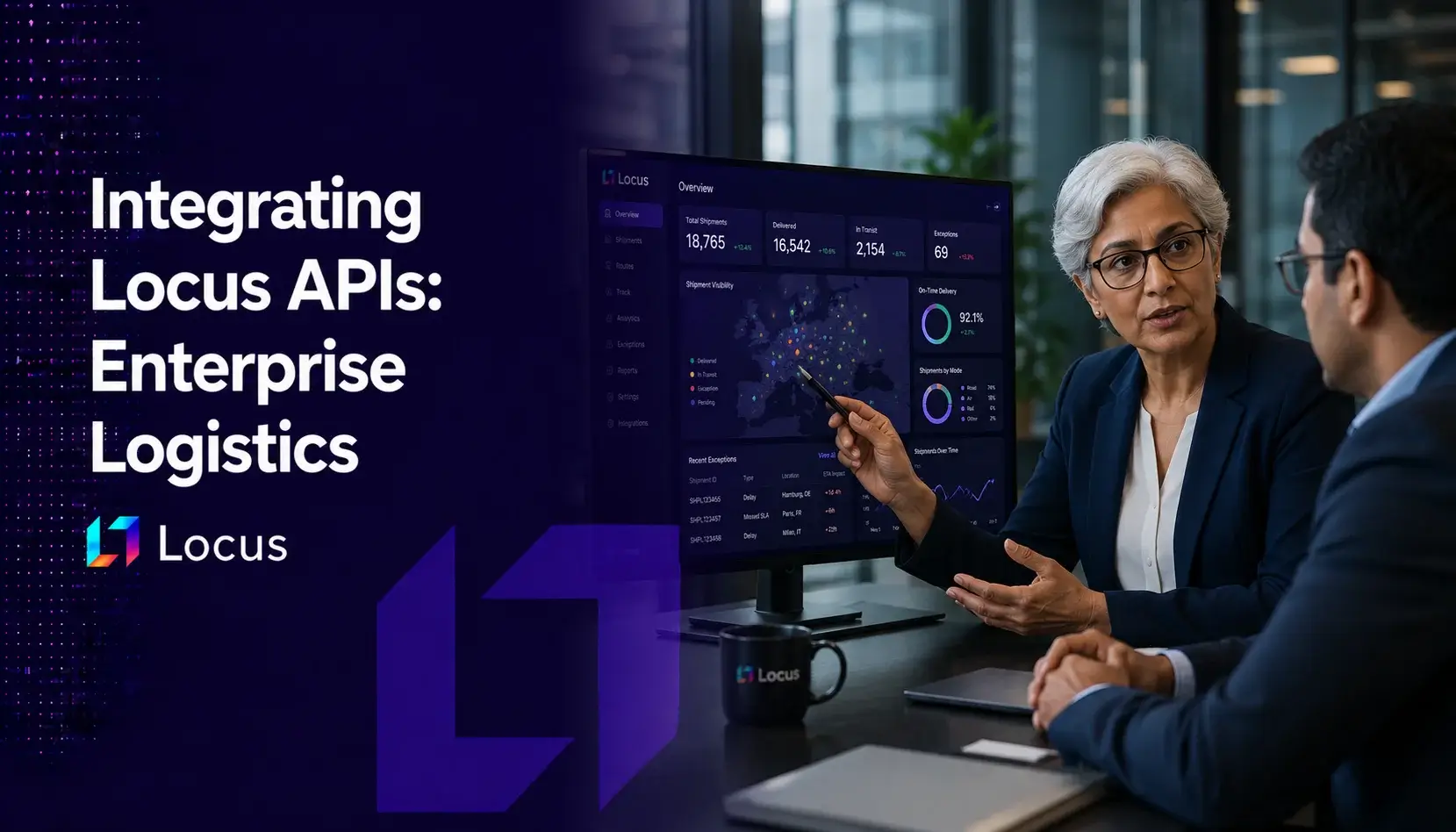
How Easy is it to Integrate Locus APIs? An Architectural Framework for Enterprise Logistics in 2026
Key Takeaways
- Locus, the world’s first agentic Transportation Management System, is deployed across 350+ enterprises in 30+ countries, integrating with diverse enterprise tech stacks: ERP, OMS, WMS, carrier networks, finance, and customer service infrastructure. The deployment scale is evidence of integration maturity.
- Three architectural properties make Locus integration operationally friendly: API-first agentic architecture (built for programmatic interaction from inception, not retrofitted), multi-system integration as deployment baseline, and governance-compatible integration (six Locus governance mechanisms translate to API-level observability, traceability, execution sandboxing).
- For VPs of Logistics, faster time-to-value comes from architectural maturity rather than custom integration projects. For Logistics Tech leaders, clean API boundaries and built-in governance reduce technical debt that legacy TMS integrations typically generate.
- The strategic question for enterprise logistics buyers in 2026: is the TMS architecture built for the integration reality of enterprise logistics, or a monolithic system requiring custom adapters for every connection?
For most of the last two decades, enterprise Transportation Management System deployments have been notorious for one operational truth: integration is harder than the vendor demos suggest. Legacy TMS platforms were architected as monolithic systems in an era when most enterprise software was self-contained. The integration capabilities were retrofitted onto a core that was never designed for programmatic interaction, producing the deployment pattern that supply chain leaders know well: long implementation cycles, expensive custom integration work, brittle data pipelines, and ongoing technical debt that scales with the deployment.
Locus, the world’s first agentic Transportation Management System, was built differently. The architecture is API-first by design rather than by retrofit. Eight specialized AI agents under the DiSCO orchestration framework communicate through clean API boundaries. The Sense-Decide-Execute-Learn (SDEL) architecture operates as an event-driven decisioning cycle that is naturally observable and programmatic. The Mycroft AI Co-Pilot surfaces operational decisions through interfaces designed for both human review and system integration. Across 350+ enterprise deployments in 30+ countries, Locus integrates with the full surface of enterprise logistics infrastructure: ERP systems, Order Management Systems, Warehouse Management Systems, carrier networks comprising 1,000+ carriers, finance and accounting systems, and customer service platforms.
The integration ease is not an accidental property of the platform. It is a structural consequence of architectural decisions made when the platform was designed. For enterprise logistics buyers evaluating TMS architecture in 2026, three architectural arguments determine whether the platform will integrate cleanly into the operational reality of enterprise logistics, or whether it will produce the deployment friction that legacy TMS implementations have made familiar.
This is a framework for VPs of Logistics, Heads of Logistics Technology, CTOs at retailers and 3PLs, and operational leaders evaluating Locus or any agentic TMS for enterprise deployment.
Architectural Argument 1: API-First Agentic Architecture
The legacy TMS integration problem. Conventional Transportation Management Systems were architected as monolithic platforms with self-contained data models, internal business logic, and user interfaces designed for direct operator interaction. APIs were added later, typically in response to integration demand from enterprise customers. The retrofitted API surface produces predictable integration challenges: incomplete coverage (some operational functions remain accessible only through the UI), inconsistent design patterns (APIs added by different teams over different release cycles diverge in conventions), data model coupling (API responses expose internal data structures that constrain how integrators can consume them), and brittle update cycles (platform updates require integration retesting because internal changes leak through the API surface).
The agentic TMS difference. Locus’s architecture inverts the conventional design. The DiSCO (Digital Supply Chain Officer) agentic framework operates as a system of specialized AI agents (capacity agent, carrier agent, dispatch agent, hub agent, customer agent, settlement agent, orchestrator, and the Mycroft AI Co-Pilot) that communicate through clean API boundaries by architectural necessity. The agents are independently designed and deployed; their interaction model is API-based from the start. The Sense-Decide-Execute-Learn architecture operates as an event-driven decisioning cycle in which signals enter the system, decisions emerge through agent collaboration, executions trigger downstream effects, and outcomes feed back into learning. The cycle is naturally programmatic, naturally observable, and naturally compatible with enterprise integration patterns.
| Also Read: API Integrations for Logistics Platforms: From Fragmented Connectivity to Intelligent Orchestration |
Why this matters for the integration team. API-first design means the surface area available to integrators is the same surface area the platform itself uses internally. There is no “behind the API” set of capabilities accessible only through the UI; the agents themselves operate through the API. For VPs of Logistics, this translates to faster time-to-value because the integration work doesn’t have to compensate for capability gaps in the API surface. For Logistics Tech leaders, it translates to lower technical debt because the integration patterns scale cleanly as the operation evolves.
Architectural Argument 2: Multi-System Integration Built-In
The enterprise logistics integration reality. Enterprise logistics operations do not run on one system. The operational reality includes Enterprise Resource Planning systems handling financial transactions and inventory accounting, Order Management Systems handling customer-facing commitment and fulfillment workflow, Warehouse Management Systems handling pick-pack-ship execution, carrier networks comprising captive fleets, contracted 3PL partners, gig courier networks, and parcel carriers, finance and accounting systems handling settlement and reconciliation, and customer service platforms handling exception communication and WISMO inquiries. A TMS that integrates only with one or two of these systems leaves the operation managing the gaps through manual reconciliation, custom integration projects, or operational workarounds.
The Locus deployment baseline. Across 350+ enterprise deployments in 30+ countries, Locus integrates with the full surface of enterprise logistics infrastructure as standard practice. The multi-carrier orchestration handles 1,000+ carriers across the operational network. The integration patterns are mature precisely because they have been tested against the operational complexity that enterprise logistics actually has, not against a simplified reference architecture. ERP integration handles the financial transaction layer; OMS integration handles the customer-commitment layer; WMS integration handles the execution layer; carrier integration handles the multi-fleet orchestration; finance integration handles settlement; customer service integration handles exception communication. The platform is designed for the integration reality, not for an idealized version of it.
Why this matters for the deployment team. Integration patterns that already work across 350+ enterprises in 30+ countries reduce the implementation risk that custom integration projects produce. For VPs of Logistics, this translates to predictable deployment timelines and lower implementation cost. For Logistics Tech leaders, it translates to confidence that the integration approach is validated at scale rather than being a novel architectural experiment.
Architectural Argument 3: Governance-Compatible Integration
The enterprise governance integration problem. AI-driven systems in enterprise logistics operate against governance, compliance, and audit requirements that the architecture must accommodate. Decisions that affect customer commitments, financial transactions, supplier relationships, and SLA performance need to be explainable, traceable, and reviewable. Integration teams typically build governance layers on top of TMS deployments as bolt-on infrastructure: logging frameworks, audit data pipelines, manual approval workflows, exception management dashboards. The bolt-on governance produces predictable problems: incomplete coverage, brittle integration with the underlying decision system, audit findings when bolt-on logs don’t reconcile with system behavior, and operational drag because governance overhead scales with deployment volume.
Locus’s six governance mechanisms as integration capabilities. Locus’s architecture incorporates six governance mechanisms at the platform layer: Explainability (every decision the system makes is explainable in terms operations teams can interpret and auditors can verify), Traceability (every decision is traceable to the inputs, agent reasoning, and constraint set that produced it), Evaluation (decisions are continuously evaluated against outcomes for systematic improvement), Autonomy Levels (operations teams can configure which decisions agents execute autonomously and which require human review), Execution Sandbox (decisions can be evaluated against simulated execution before production deployment), and Human-in-the-Loop (operations teams retain decisioning override capability across the decision surface). For integration teams, the governance mechanisms translate to API-level capabilities: every API call traceable, every decision explainable through the API surface, every action sandboxable before production, every workflow observable at the layer the governance requirement applies to.
Why this matters for the governance team. Built-in governance reduces compliance risk and audit complexity. For VPs of Logistics, this translates to lower regulatory risk and faster compliance validation cycles. For Logistics Tech leaders, it translates to architectural support for the audit and observability requirements that enterprise deployments increasingly require.
The Bottom Line: Architectural Fit Determines Integration Ease
Integration ease is not a marketing claim; it is an architectural property. A TMS platform designed as a monolithic system with retrofitted APIs cannot produce the integration patterns that an API-first agentic architecture produces by design. The difference is not a matter of API documentation quality or developer relations investment, although both matter; it is a matter of whether the platform’s core architecture supports the integration model enterprise logistics actually requires.
For VPs of Logistics and Logistics Tech leaders evaluating TMS architecture in 2026, the strategic question is concrete: does the platform integrate as a natural property of its architecture, or does integration require custom adapters, bolt-on governance, and ongoing technical debt? Locus’s deployment pattern across 350+ enterprises in 30+ countries with 1,000+ carriers and the full enterprise logistics integration surface is the architectural evidence that informs the answer.
For specific integration details, including authentication patterns, available SDKs, sandbox environments, and integration timelines for specific use cases, enterprise evaluation teams should consult Locus’s developer documentation directly. The architectural arguments in this framework explain why integration is structurally easier with agentic architecture; the specific integration path for any deployment depends on the operational reality of the enterprise tech stack and the use cases the deployment is intended to support.
Learn more about Locus’ easy integration capabilities, visit locus.sh
FAQs
What makes Locus’s API integration easier than legacy TMS integration?
Three architectural properties make Locus integration structurally easier than typical legacy TMS integration. First, Locus is built API-first as an agentic architecture rather than as a monolithic system with retrofitted APIs. The eight DiSCO agents communicate through clean API boundaries by architectural necessity. Second, multi-system integration is built into the deployment baseline across ERP, OMS, WMS, carrier networks, and finance systems, with integration patterns validated across 350+ enterprises in 30+ countries. Third, governance is built into the platform rather than bolted on at integration time, with the six governance mechanisms translating to API-level observability and traceability.
Which enterprise systems does Locus integrate with?
Locus integrates with the full surface of enterprise logistics infrastructure: Enterprise Resource Planning (ERP) systems handling financial transactions and inventory accounting, Order Management Systems (OMS) handling customer commitment and fulfillment workflow, Warehouse Management Systems (WMS) handling pick-pack-ship execution, carrier networks across captive fleets, contracted 3PL partners, gig courier networks, and parcel carriers, finance and accounting systems handling settlement and reconciliation, and customer service platforms handling exception communication. The integration baseline is enterprise-grade across 350+ deployments rather than focused on a narrow subset of systems.
How does Locus’s agentic architecture affect API integration patterns?
The DiSCO agentic framework consists of eight specialized AI agents (capacity, carrier, dispatch, hub, customer, settlement, orchestrator, and the Mycroft AI Co-Pilot) that communicate through clean API boundaries as an architectural requirement. Integrators interact with the same API surface the agents themselves use, eliminating the “behind the API” capability gaps that legacy TMS architectures produce when APIs are retrofitted onto monolithic cores. The Sense-Decide-Execute-Learn architecture operates as an event-driven decisioning cycle that is naturally programmatic and observable.
What governance capabilities does Locus offer for enterprise integration?
Locus incorporates six governance mechanisms at the architectural layer: Explainability (decisions explainable in operations-team terms), Traceability (decisions traceable to inputs and constraints), Evaluation (decisions evaluated against outcomes), Autonomy Levels (operations teams configure which decisions execute autonomously vs. require human review), Execution Sandbox (decisions evaluable in simulation before production), and Human-in-the-Loop (operations teams retain override capability). For integration teams, these translate to API-level observability, traceability, and execution sandboxing that reduces the bolt-on governance infrastructure typically required for AI-driven systems in enterprise logistics.
How can enterprise teams evaluate Locus API integration for their specific use case?
Enterprise evaluation should combine architectural assessment against the framework in this article (API-first design, multi-system integration baseline, governance compatibility) with direct engagement of Locus’s developer documentation for specific integration details. The specific integration path depends on the enterprise tech stack (which ERP, OMS, WMS systems are in scope), the use cases the deployment is intended to support, the governance and compliance requirements applicable to the operation, and the integration capacity available within the enterprise tech team. Locus’s deployment scale across 350+ enterprises provides reference cases for most common integration patterns.

General
The Upstream Shift: Why Leading Enterprises Are Overhauling Their Inbound Logistics Management Software

Jun 23, 2026
Inbound freight typically accounts for 8-12% of an enterprise's material spend and over 21% of EU road freight kilometers operate completely empty. AI-native inbound logistics management software converts static milk runs into dynamic, constraint-aware orchestration. A framework for supply chain and procurement leaders in 2026.
Read more
General
5 AI and Agentic Trends Reshaping Last-Mile Customer Experience in 2026
Jun 23, 2026
Five AI and agentic trends are reshaping last-mile customer experience in 2026: agentic orchestration, conversational AI, predictive exception management, hyper-personalization, and autonomous elastic fleets. A framework for Heads of CX and Heads of Logistics.
Read moreInsights Worth Your Time




















How Easy is it to Integrate Locus APIs? An Architectural Framework for Enterprise Logistics in 2026