


General
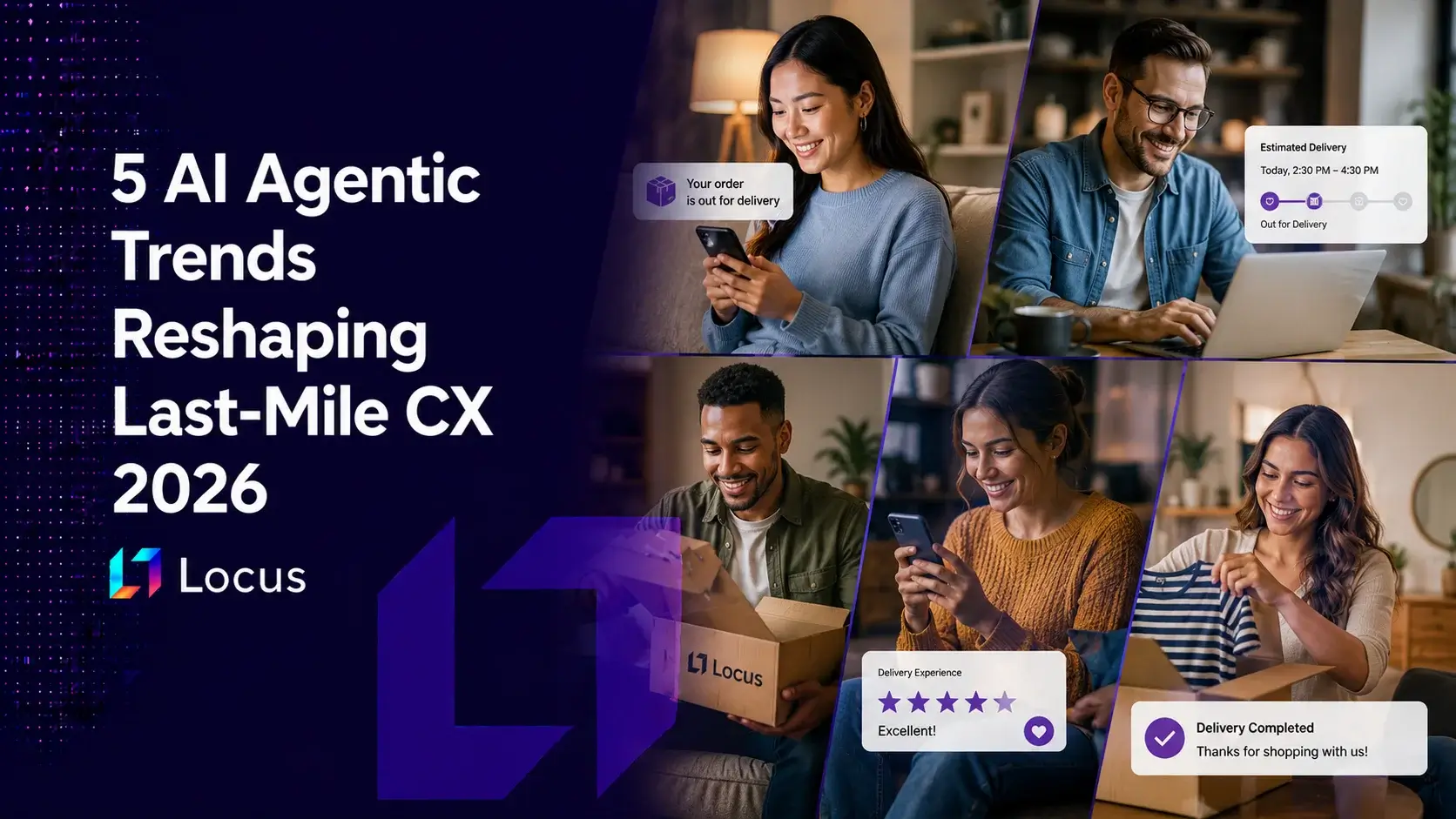
5 AI and Agentic Trends Reshaping Last-Mile Customer Experience in 2026
Key Takeaways
- The last-mile customer experience in 2026 is being reshaped by AI architecture, not AI features. The shift from point-AI tools to agentic orchestration is foundational; four trends build on it: conversational AI as customer-facing layer, predictive exception management replacing reactive tracking, hyper-personalization through customer behavior AI, autonomous and elastic fleet models.
- For Heads of CX, these trends convert the last mile from operational liability into brand assets. For Heads of Logistics, they compress cost-to-serve while reducing customer service overhead that scales with delivery volume in conventional architectures.
- The trends compound. Operations adopting one or two in isolation capture limited benefit. Operations adopting the architectural integration of all five produce structurally differentiated customer experience and unit economics.
- For Heads of CX and Heads of Logistics in 2026: which of these five trends are operational in your stack, and which architectural debt competitors are converting into advantage?
The last-mile customer experience has changed more in the past three years than in the previous fifteen. Generative AI has matured from research curiosity into customer-facing infrastructure. Agentic AI architectures have moved from architectural debate into enterprise deployment. The infrastructure that supports modern last-mile customer experience now operates as integrated AI orchestration rather than as collection of point-AI tools. For Heads of Customer Experience and Heads of Logistics navigating this shift in 2026, understanding which trends matter, why they matter, and how they compound determines whether the operation builds customer experience as competitive differentiation or absorbs it as cost center.
This is a framework covering the five AI and agentic trends that are reshaping last-mile customer experience in 2026: agentic orchestration replacing siloed AI tools, conversational AI becoming the customer-facing communication layer, predictive exception management replacing reactive tracking, hyper-personalization through customer behavior AI, and autonomous and elastic fleet models. Each trend is individually substantive; the architectural integration of all five is what produces structurally differentiated last-mile customer experience.
Trend 1: Agentic Orchestration Replaces Siloed AI Tools
The shift. For most of the past decade, AI in last-mile delivery operated as collection of point-AI tools: one AI engine for routing, another for ETA prediction, another for address validation, a separate chatbot for customer service, isolated models for fraud detection, and so on. The tools optimized within their narrow scope but operated independently of each other. Customer experience consistency suffered because the underlying systems did not share decisioning context: the chatbot did not know about routing exceptions, the ETA system did not know about customer preferences, the address validator did not know about driver feedback patterns.
Agentic orchestration inverts this architecture. Multiple specialized AI agents collaborate under unified decisioning frameworks, sharing context, reasoning collectively about operational decisions, and producing coordinated outputs across the operational surface. The architectural shift is from feature accumulation (more AI tools) to capability integration (AI agents working together).
Why this matters across CX and operations. For Heads of CX, agentic orchestration produces consistent customer experience because the architecture itself coordinates decisioning across touchpoints. The customer who receives a delay notification through the chatbot sees the same updated ETA in the tracking interface and receives the same proactive options through the customer service channel; the coordination happens at the architectural layer rather than requiring integration projects across point tools. For Heads of Logistics, the operational benefits are real: reduced integration complexity, single source of truth for operational decisions, lower technical debt as the operation evolves.
Trend 2: Conversational AI Becomes the Customer-Facing Layer
The shift. Customer-facing delivery interactions are shifting from form-based interfaces (tracking dashboards, support web forms, automated email sequences) to conversational AI (GenAI chatbots, voice AI, proactive natural-language messaging). The customer who wanted to ask “where is my order” used to navigate to a tracking page, find an order number, and read a status display. The customer in 2026 increasingly types or speaks the question and receives a natural-language response with options to take action.
The conversational AI shift goes beyond chatbot replacement of FAQ pages. It includes voice AI for hands-free customer interaction with delivery experiences, proactive natural-language notifications that summarize delivery status with context rather than displaying raw tracking data, and multi-language conversational support that scales as architectural property rather than headcount cost.
Why this matters across CX and operations. For Heads of CX, conversational AI absorbs WISMO inquiries at the AI layer rather than escalating to human customer service agents. The customer experience improves because interactions feel natural rather than form-driven; the brand experience improves because the interaction is consistent and immediately responsive. For Heads of Logistics, conversational AI converts customer service capacity from reactive WISMO handling to higher-value interactions (complex exception resolution, customer relationship building, retention conversations). Multi-language support scales without proportional headcount.
Trend 3: Predictive Exception Management Replaces Reactive Tracking
The shift. Conventional delivery tracking is reactive: the customer checks a tracking link, sees the truck is delayed, calls customer service to complain. Reactive notifications announce failure to customers rather than preventing failure from happening. The customer experience shifts from “delivery on time” to “delivery delayed, here is a message about it” (a softer way to deliver bad news, not a customer experience improvement).
Did you know?
45% of US shoppers now use AI tools (like ChatGPT and Claude) for shopping, to discover brands, compare products, and buy in a single session– Locus Q2 2026 US Consumer Survey
Predictive exception management inverts this. The architecture identifies emerging risk (traffic disruptions pushing ETAs past customer windows, customer availability patterns suggesting probable failed delivery, vehicle health issues likely to produce capacity loss) before the exception occurs and triggers intervention. The customer receives “traffic suggests your driver will be 30 minutes late; click here to reroute to a safe place” rather than “the driver missed you, your package is being returned to the depot.”
Why this matters across CX and operations. For Heads of CX, predictive exception management converts customers from passive recipients of failure into active participants in resolution. Brand experience improves because the architecture treats customers as decision-makers receiving timely options rather than as targets of operational decisions made elsewhere. For Heads of Logistics, failed delivery rates drop at structural level. Failed deliveries cost approximately $17.78 each in direct cost per industry research cited by OrangeMantra, with compounding invisible costs across customer service overhead, expedited freight, and customer experience damage. The architectural shift produces operational cost reduction that flows directly to operating margin.
Trend 4: Hyper-Personalization Through Customer Behavior AI
The shift. Delivery experiences are shifting from standardized options (“9am-5pm Tuesday”) to experiences calibrated to individual customer patterns. The architecture uses historical delivery data, customer interaction patterns, and operational signals to predict when specific customers are most likely to be available, which communication channels they prefer, which delivery instructions consistently work for their address, and which delivery slots produce the highest first-attempt success rates.
The hyper-personalization architecture treats each customer’s behavior pattern as routing input rather than as constraint operations have to absorb. Customers who consistently show evening availability get routed into evening slots; customers who prefer WhatsApp notifications get WhatsApp; customers with specific delivery instructions get drivers briefed on those instructions automatically.
Why this matters across CX and operations. For Heads of CX, customers receive delivery experiences that align with their actual lives rather than with arbitrary operational logic. Repeat purchase behavior improves because the delivery experience matches customer reality. Brand differentiation through hyper-personalized delivery becomes possible. For Heads of Logistics, first-attempt delivery success rates improve at structural level because routing aligns with customer availability patterns rather than working against them. WISMO inquiries drop because customers receive options that match their lives. The compound effect captures both operational cost reduction and customer experience improvement from the same architectural investment.
Did you know?
39% of AI users are more likely to try new brands they wouldn’t have considered– Locus Q2 2026 US Consumer Survey
Trend 5: Autonomous and Elastic Fleet Models
The shift. Last-mile fleets are shifting from single-mode infrastructure (captive vans operating fixed routes) to heterogeneous fleet mixes orchestrated dynamically: autonomous vehicles for highway and suburban routes, delivery drones for time-critical urban deliveries, sidewalk robots for short-range neighborhood delivery, gig couriers for elastic capacity absorbing demand variance, micromobility (cargo bikes, electric vans) for Low-Emission Zone compliance, and traditional vans for routes that require them. The architectural challenge is orchestrating capacity across this heterogeneous fleet dynamically rather than as static assignment.
The elastic dimension is equally important. Captive fleet capacity becomes the architectural backstop rather than the primary capacity layer; 3PL and gig capacity absorb demand variance during peak spikes; autonomous capacity scales as the regulatory environment matures.
Why this matters across CX and operations. For Heads of CX, delivery modality choice becomes part of customer experience differentiation. Customers can opt into faster autonomous delivery for urgent items, sustainable cargo-bike delivery for environmentally conscious purchases, or standard van delivery for routine shipments. Brand experiences differentiate through specific fleet capabilities. For Heads of Logistics, cost-to-serve optimization happens across the full fleet mix rather than within single-mode operations. Demand variance absorption scales architecturally rather than through fixed-cost capacity acquisition. LEZ compliance becomes operational property rather than ongoing compliance cost.
How These Five Trends Combine
The five trends compound rather than operate independently. Agentic orchestration (Trend 1) provides the architectural foundation. Conversational AI (Trend 2) operates as the customer-facing layer that the agentic architecture coordinates. Predictive exception management (Trend 3) is the orchestrated capability that prevents failures before customer impact. Hyper-personalization (Trend 4) calibrates the prevented-failure architecture to individual customer reality. Autonomous and elastic fleet models (Trend 5) provide the execution capacity that the orchestrated, personalized, predictive customer experience requires.
Operations adopting one or two trends in isolation capture limited benefit. Operations adopting the architectural integration of all five produce structurally differentiated last-mile customer experience and unit economics. The strategic question for Heads of CX and Heads of Logistics in 2026 is concrete: which of these five trends are already operational in the architecture, and which represent architectural debt that competitors are converting into competitive advantage?
FAQs
What are the key AI trends in last-mile delivery for 2026?
Five AI and agentic trends are reshaping last-mile customer experience in 2026: agentic orchestration replacing siloed AI tools (the foundational architectural shift), conversational AI becoming the customer-facing communication layer (GenAI chatbots, voice AI, proactive natural-language messaging), predictive exception management replacing reactive tracking (preventing failures before customer impact), hyper-personalization through customer behavior AI (delivery experiences calibrated to individual customer patterns), and autonomous and elastic fleet models (heterogeneous capacity orchestrated dynamically across AVs, drones, robots, gig couriers, micromobility, and traditional fleets).
How is agentic AI different from conventional AI in logistics?
Conventional AI operates as point tools optimizing within narrow scope (one engine for routing, another for ETA prediction, separate models for address validation). Agentic AI operates as collaborating specialized agents sharing decisioning context across operational decisions. The architectural difference matters because customer experience consistency requires the underlying systems to share context: the chatbot needs to know about routing exceptions, the ETA system needs to know about customer preferences. Agentic orchestration produces unified customer experience by architectural design rather than through integration projects across disconnected point tools.
How is conversational AI changing the customer-facing delivery experience?
Conversational AI is shifting customer-facing delivery interactions from form-based interfaces (tracking dashboards, support web forms) to natural language interaction (GenAI chatbots, voice AI, proactive natural-language messaging). Customers ask “where is my order” and receive natural-language responses with action options rather than navigating tracking pages. WISMO inquiries get absorbed at the AI layer rather than escalating to human agents. Multi-language support scales as architectural property rather than headcount cost. The customer experience feels natural and immediately responsive.
What is predictive exception management in last-mile delivery?
Predictive exception management identifies emerging delivery risk (traffic disruptions affecting ETAs, customer availability variance, vehicle health issues, route disruptions) before the exception occurs and triggers intervention. The customer receives “traffic suggests 30-minute delay, click to reroute” rather than “your driver missed you.” The architectural shift from reactive notification to proactive prevention produces operational cost reduction (failed delivery rates drop, failed delivery costs approximately $17.78 each in direct cost per industry research cited by OrangeMantra) and customer experience improvement (customers gain agency in delivery experience rather than being passive recipients of failure).
How does AI hyper-personalize delivery experiences?
AI hyper-personalization uses historical delivery data, customer interaction patterns, and operational signals to calibrate delivery experiences to individual customer patterns. The architecture predicts when specific customers are most likely to be available, which communication channels they prefer, which delivery instructions work for their address, and which delivery slots produce the highest first-attempt success rates. Customers receive delivery options aligned with their actual lives rather than standardized options operations decided would be convenient. The compound effect captures operational cost reduction (first-attempt success improves) and customer experience improvement simultaneously.
Which AI trends should logistics leaders prioritize for customer experience?
The trends compound, so prioritization depends on architectural starting point. Operations without agentic orchestration foundation should prioritize Trend 1 because the others depend on it architecturally. Operations with agentic foundation should evaluate Trends 2-5 against operational priorities: conversational AI for customer service capacity decoupling, predictive exception management for failed delivery cost reduction, hyper-personalization for first-attempt success improvement and experience differentiation, autonomous and elastic fleet models for cost-to-serve optimization. Operations adopting the architectural integration of all five produce structurally differentiated customer experience.

General
How Easy is it to Integrate Locus APIs? An Architectural Framework for Enterprise Logistics in 2026

Jun 23, 2026
Locus's agentic Transportation Management System is deployed across 350+ enterprises in 30+ countries, integrating with ERP, OMS, WMS, and carrier networks. Three architectural arguments explain why Locus API integration is operationally friendly: API-first design, multi-system integration built-in, and governance-compatible architecture.
Read more
General
The AI Shopper is Already Here: What 1,000+ US Online Shoppers Tell Us About Behavior Change in 2026

Jun 23, 2026
Locus's Q2 2026 US Consumer Survey of 1,000+ online shoppers shows 45% now use AI tools for shopping, 39% try new brands they wouldn't have considered, 37% buy more in a single order. Three behavioral shifts retailers and e-commerce executives need to plan for.
Read moreInsights Worth Your Time



















5 AI and Agentic Trends Reshaping Last-Mile Customer Experience in 2026