


General
API Integrations for Logistics Platforms: From Fragmented Connectivity to Intelligent Orchestration

Key Takeaways
- Logistics API integration connects systems such as TMS, WMS, ERP, OMS, eCommerce platforms, carrier APIs, and logistics orchestration platforms so shipment, rating, routing, tracking, and settlement data can move automatically.
- Enterprise logistics teams managing multi-carrier operations often accumulate 15 to 30 point-to-point integrations, creating maintenance overhead that increases with every carrier, warehouse, client, marketplace, or delivery channel added.
- Carrier API versioning, integration sprawl, API reliability, and planning-execution disconnects are the failure modes that compound most at enterprise scale.
- Integration architecture matters: carrier-direct APIs, logistics platform APIs, middleware, iPaaS, and orchestration layers create different trade-offs in latency, maintenance, functionality, resilience, and decision intelligence.
- Real-time logistics API integration enables automated rate shopping, label generation, route optimization, shipment tracking, customer notifications, proof of delivery, returns, and freight settlement.
- Security and reliability practices—HTTPS, OAuth 2.0, role-based access, rate limiting, retries, observability, and SLA monitoring—are as important as endpoint coverage.
- Locus applies unified API data to AI-driven routing and carrier allocation decisions across enterprise logistics networks, helping organizations reduce logistics cost, improve SLA adherence, and scale multi-carrier execution.
Most enterprise logistics operations are already wired together. Carrier APIs connect to TMS platforms, OMS feeds warehouse management systems, and tracking data flows to customer notification tools.
The failure pattern this creates shows up as planning-execution mismatches, sending drivers to capacity-constrained depots, reactive carrier management triggered hours before cutoff, and cost leakage accumulating across point-to-point connections no single team owns.
Unannounced carrier API version updates cost enterprises massive resources per hour in operational disruption when no abstraction layer exists. Carriers, including UPS, FedEx, and USPS, have accelerated their API release cycles heading into 2025 and 2026, with migration windows shrinking as the number of affected integrations per enterprise grows.
For enterprise logistics teams managing multi-carrier and multi-warehouse operations, the priority shift is from achieving integration to orchestrating it. The key evaluation lens is whether a system consumes unified API data to make real-time carrier allocation and routing decisions, or passes data between systems without applying intelligence to it.
The guide covers the API categories mattering at enterprise scale, the failure modes compounding across multi-carrier architectures, vertical-specific integration priorities, and a four-phase framework for moving from point-to-point connectivity to an orchestration layer.
What Is Logistics API Integration?
Logistics API integration is the process of connecting logistics systems such as TMS, WMS, ERP, OMS, eCommerce platforms, carrier portals, telematics systems, and customer-facing applications through Application Programming Interfaces (APIs). These APIs allow systems to exchange shipment, inventory, routing, tracking, pricing, delivery, and settlement data automatically.
A logistics API can be used to:
- Compare carrier rates and transit times
- Create shipments
- Generate labels
- Validate delivery addresses
- Book pickups
- Retrieve shipment tracking events
- Send customer notifications
- Update delivery status
- Capture proof of delivery
- Process returns
- Reconcile carrier invoices
- Feed delivery performance data into reporting tools
A shipping API is narrower. It usually focuses on rating, shipment creation, label generation, pickup booking, and tracking. A logistics API is broader because it connects the full execution lifecycle: planning, dispatch, routing, delivery, exception handling, customer visibility, and financial settlement.
In enterprise logistics, APIs do not operate in isolation. They form the data infrastructure connecting planning systems to execution systems. The strategic value comes from what the integrated system does with that data: whether it simply passes information downstream or uses real-time inputs to optimize carrier allocation, vehicle utilization, route sequencing, delivery promises, and exception response.
How Logistics API Integration Works
A logistics API integration typically follows a structured flow:
- Endpoint mapping
The integration team identifies which endpoints are needed, such as rate quote, shipment creation, label generation, tracking, address validation, route creation, proof of delivery, or invoice reconciliation. - Authentication setup
Systems exchange credentials through API keys, OAuth 2.0, client secrets, certificates, or token-based access models. - Payload mapping
Data fields from the source system are mapped to the API’s required format. This includes addresses, package dimensions, weights, service codes, customer IDs, order references, carrier account numbers, delivery windows, and customs fields. - Business-rule configuration
The integration applies logic for carrier selection, delivery service levels, cutoff times, warehouse assignment, packaging rules, return flows, customer preferences, and exception handling. - Event handling
APIs send or retrieve events such as “shipment created,” “label generated,” “out for delivery,” “failed attempt,” “delivered,” or “invoice variance detected.” - Testing and validation
Teams test sandbox flows, error responses, authentication expiry, rate limits, label formats, address validation failures, and production-like shipment volumes. - Monitoring and optimization
API latency, uptime, error rate, failed label generation, tracking delay, SLA adherence, and cost-per-shipment variance are monitored continuously.
At enterprise scale, this flow becomes significantly more complex because every carrier, warehouse, marketplace, client, and region may use different schemas, authentication methods, rate limits, and exception codes.
Why API Integration Has Become the Backbone of Enterprise Logistics
The shift from batch-based EDI to real-time API architectures changed the operating rhythm of logistics. EDI remains important in freight and legacy supply chain networks, but API-first logistics platforms now support real-time workflows that batch files cannot.
According to MarketIntelo, the global logistics API platform market reached $6.2 billion in 2025 and is forecast to reach $16.9 billion by 2034 at a 14.8% CAGR, driven by growing demand for real-time logistics API integration. MarketIntelo also reports that API platforms for logistics integration were valued at $4.2 billion in 2025, with cloud deployment accounting for 71.5% of the market.
The reason is straightforward: logistics operations now require live coordination across orders, warehouses, carriers, drivers, inventory, customers, and finance.
From Batch EDI to Real-Time APIs
EDI-based batch processing set the standard for logistics data exchange for decades. It still supports important documents such as tender requests, shipment status updates, invoices, and carrier acknowledgements.
But batch cycles run on schedules that often lag operational reality.
A rate feed refreshed every four hours cannot tell a dispatcher that a carrier suspended service to a delivery zone at 10 AM. A batch inventory sync cannot flag a warehouse capacity constraint before route manifests are generated. A delayed shipment status message cannot support accurate customer notifications when delivery windows are measured in hours.
Real-time APIs change the operating model. When a carrier rate API updates continuously, the planning system can incorporate current costs into carrier allocation. When a WMS API exposes dock capacity, a routing engine can avoid scheduling conflicts. When a tracking API sends live delivery events, customer support teams can act before a failed delivery becomes a complaint.
Why Operations Teams Own the Outcome
Logistics API integration is often treated as an IT project. That framing breaks down at scale because the failure modes are operational.
If a carrier deprecates an API version, operations absorb the disruption. If a label API fails during peak volume, the warehouse floor slows down. If tracking events are delayed, customer support handles the WISMO surge. If carrier invoice data does not reconcile against planned rates, finance misses surcharge leakage.
The integration architecture decision belongs at the intersection of supply chain technology, logistics operations, IT, security, and finance. It determines how resilient the logistics network is when systems change, volume spikes, carrier service levels shift, or new channels are added.
The Core API Categories Enterprise Logistics Teams Must Connect
Six API categories define how data moves through an enterprise logistics operation.
Carrier Rating and Shipping APIs
Carrier rating and shipping APIs handle rate requests, service-level selection, shipment creation, pickup scheduling, label generation, and tracking number creation.
These APIs are essential for:
- Automated rate shopping
- Multi-carrier shipping
- Label printing
- Service-level comparison
- Shipment booking
- Address validation
- Returns processing
- Cross-border shipping documentation
When a carrier rating API goes stale or returns incorrect service areas, downstream effects include misrouted shipments, rate variance, invoice disputes, delivery SLA misses, and customer experience failures.
Route Optimization and Dispatch APIs
Route optimization APIs consume order locations, vehicle capacity, delivery windows, driver schedules, service times, traffic conditions, skills, zones, and business constraints.
Connected routing systems turn order and carrier data into executable plans. This is where logistics API integration moves beyond data transfer and into operational decision-making.
Locus’s route optimization software connects order systems with automated routing and dispatch workflows, helping logistics teams optimize delivery sequences, improve utilization, and adapt to changing constraints. For teams defining core routing capabilities, it is also useful to understand what route optimization means for logistics teams.
Warehouse Management APIs
Warehouse Management System APIs expose:
- Inventory availability
- Order pick status
- Packing completion
- Dock assignments
- Staging location
- Load readiness
- Cutoff compliance
- Returns receipt
- Shipment handoff status
When WMS and route optimization systems are connected in real time, route plans can reflect warehouse readiness rather than planning-time assumptions. That prevents drivers from arriving before orders are staged, reduces route start drift, and improves delivery window adherence.
Order Management and ERP APIs
OMS and ERP integrations connect demand, inventory, customer commitments, billing, and fulfillment rules to logistics execution.
Common workflows include:
- Order import
- Delivery promise creation
- Warehouse allocation
- Carrier allocation
- Shipment status updates
- Invoice matching
- Customer account reporting
- Cost center assignment
- Return authorization
For omnichannel retailers, OMS-to-carrier integration is often the first high-ROI connection because it removes manual carrier selection and improves delivery promise accuracy across stores, distribution centers, marketplaces, and direct-to-consumer channels.
Tracking, Notification, and Customer Visibility APIs
Tracking APIs collect delivery events from carriers, drivers, telematics systems, and logistics platforms. Notification APIs turn those events into customer-facing updates.
These APIs power:
- Live shipment visibility
- Branded tracking pages
- Predictive ETA notifications
- Exception alerts
- Self-service rescheduling
- Customer support dashboards
- Delivery confirmation
- Proof of delivery workflows
The real-time tracking layer becomes especially important when customers expect accurate status updates and proactive communication. When paired with accurate estimated time of arrival prediction, tracking APIs reduce WISMO contacts and improve delivery experience.
MarketIntelo reports that shipment tracking represented 28.6% of total logistics API platform segment value in 2025 and is projected to grow at a 15.4% CAGR through 2034. A Fact.MR release distributed via EINPresswire similarly reports that visibility applications captured 36.8% of API logistics application share in 2025, reflecting shipper and 3PL demand for API-enabled tracking and status updates.
Settlement and Reconciliation APIs
Settlement APIs close the financial loop by matching planned rates, carrier invoices, accessorial charges, fuel surcharges, delivery exceptions, and proof-of-delivery records.
They help finance and logistics teams identify:
- Incorrect freight charges
- Duplicate invoices
- Unapproved accessorials
- Service-level mismatches
- Carrier billing errors
- Revenue leakage
- Cost-per-shipment variance
Without automated settlement integration, enterprises often discover freight cost leakage weeks or months after the delivery event.
Carrier API Comparison: FedEx, UPS, DHL, and USPS
Enterprise carrier integrations are not interchangeable. Each carrier API family exposes different strengths, regional coverage, service models, documentation structures, and operational dependencies. The practical evaluation criterion is not only whether an API supports rating or label generation, but whether it fits the enterprise’s shipment profile, geography, service-level commitments, and exception-management model.
| Carrier API | Common enterprise use cases | Typical capabilities to evaluate | Operational considerations |
| FedEx APIs | Time-definite parcel, express shipments, domestic and international parcel flows, high-service B2B and B2C deliveries | Rates, transit times, shipment creation, shipping labels, tracking, pickup services, address validation, international shipment support | Strong fit where express and service-level reliability are primary allocation variables. Versioning, authentication, and service availability should be monitored centrally. |
| UPS APIs | Domestic parcel, cross-border parcel, enterprise retail fulfilment, returns, high-volume shipping programmes | Rating, shipping, label generation, tracking, address validation, pickup, returns, quantum view-style visibility workflows where applicable | Strong fit for high-volume parcel networks that need reliable rating, shipping, and tracking events across customer-facing channels. |
| DHL shipping API | International shipping, cross-border parcel flows, global distribution, express import/export, customs documentation workflows | Shipment creation, label generation, tracking, customs data submission, service availability, international documentation support | Particularly relevant for enterprises with multi-country distribution, import/export documentation requirements, and international delivery promise management. |
| USPS APIs | US domestic parcel, lightweight shipments, postal services, residential deliveries, specific e-commerce fulfilment profiles | Rates, labels, tracking, service standards, address-related workflows, postal shipment services | Often relevant as part of a blended carrier strategy for US fulfilment, especially when cost and residential coverage need to be balanced against delivery promise requirements. |
A carrier-by-carrier API strategy can work in limited networks. At enterprise scale, however, direct API connections across FedEx, UPS, DHL, USPS, regional carriers, and specialised providers create an expanding surface area for authentication changes, endpoint updates, schema drift, service-level changes, and error-handling logic. This is where an abstraction or orchestration layer becomes structurally valuable: it allows operations to evaluate carrier capability as a network-level decision rather than a collection of isolated technical connections.
Cross-Border Shipping Workflows: Labels, Customs, and Address Validation
International shipping APIs add operational complexity beyond domestic rating and tracking. Cross-border workflows must coordinate shipping label generation, customs documentation, destination rules, commodity data, tax and duty-related information, carrier service availability, and delivery event visibility across jurisdictions.
A resilient international shipping workflow typically includes:
- Address validation before rating and shipment creation, reducing failed deliveries, bad labels, incorrect service availability responses, and downstream customs delays.
- Carrier rating against current origin, destination, parcel, service-level, and international service constraints.
- Shipping label generation using carrier-compliant label formats and shipment references.
- Customs documentation, including commercial invoice data, customs forms, commodity descriptions, commodity codes, country-of-origin fields, declared value, and shipment-level references.
- Tracking event normalisation across carriers so customer support, control tower, and customer-facing notifications work from a consistent event model.
- Exception capture for customs holds, failed clearance events, incomplete shipment data, and address-related carrier rejections.
For enterprises shipping across regions, address validation is not a peripheral add-on. It is a pre-dispatch control point. A malformed postal code, incomplete locality field, or unrecognised delivery address can generate rating errors, invalid labels, failed first attempts, and customs rework. The operational objective is to prevent bad shipment data from entering the network at all, rather than correcting it after a failed carrier handoff.
Route optimization and warehouse management APIs
Route optimization APIs consume multi-variable inputs, including order coordinates, vehicle configurations, driver schedules, delivery windows, and real-time traffic conditions. AI-driven route optimization at enterprise scale considers 180 or more variables simultaneously, a depth single-variable or sequential-pass routing engines can’t replicate.
Warehouse management APIs expose inventory availability, dock assignments, and packing configurations to planning systems. After WMS and route optimization are integrated in real-time, planning systems cluster orders by warehouse zone to cut pick-and-pack time before route manifests are generated.
Notification, tracking, and settlement APIs
Customer-facing notification APIs connect carrier event streams to branded communication workflows, delivering predictive ETAs, proactive exception alerts, and self-service rescheduling without dispatcher intervention.
Last-mile technology solutions for enterprises integrate notification, tracking, and proof-of-delivery workflows into a single event stream, with Locus achieving a 38% reduction in WISMO contacts.
Financial reconciliation APIs close the loop by matching carrier invoices against planned rates, flagging variances, and feeding settlement data to ERP systems. Revenue leakage from uncontested carrier surcharges accumulates in operations without automated reconciliation, and Locus enterprises have recovered $288 million through carrier settlement matching.
How WMS and TMS APIs Work Together
Warehouse and transportation systems need to exchange information continuously if shipment planning is going to reflect actual operational readiness. A WMS manages inventory, picking, packing, staging, and warehouse execution, while a TMS manages carrier allocation, transportation planning, route execution, and shipment movement.
Without API connectivity between these systems, transportation plans can be created using outdated inventory or warehouse readiness data, while warehouse teams may prepare shipments based on carrier or route information that has already changed.
A typical WMS-to-TMS API workflow follows this sequence:
- Order release
The OMS or ERP sends an approved order to the warehouse and transportation systems. - Inventory and pick confirmation
The WMS confirms inventory availability, picking status, package dimensions, weights, and shipment readiness. - Shipment planning
The TMS receives shipment details and evaluates carrier options, vehicle capacity, delivery windows, service levels, and transportation costs. - Route and carrier optimization
Available carrier, route, traffic, capacity, and operational constraints are evaluated before assigning the shipment. - Label generation and warehouse handoff
The selected carrier and shipment information are returned to the WMS, allowing labels, manifests, and loading instructions to be generated. - Dispatch confirmation
Once the shipment leaves the warehouse, dispatch and tracking information is propagated to connected systems. - Tracking and proof of delivery
Carrier and delivery events flow back through the integration layer, updating customer-facing systems, operational dashboards, and financial or settlement workflows.
The value of this integration is not simply faster data exchange. It allows warehouse readiness, transportation constraints, and delivery execution to influence one another before operational decisions become difficult or expensive to reverse.
Where Multi-Carrier API Strategies Break Down at Scale
The failure modes share a structural cause, with no unified logic layer above the individual connections.
Carrier API versioning and reactive firefighting
Carriers release API version updates on their own schedules, with notice windows compressed as carrier technology teams have accelerated release cycles. FedEx, UPS, and USPS have all increased their version release frequency heading into 2025 and 2026. Each update potentially affects rate logic, address validation schemas, label formats, service-level definitions, and compliance fields.
Enterprises maintaining direct integrations absorb the full development cost across every carrier, and even automated tracking systems offer only a partial buffer when underlying API structures change. A degraded carrier API during peak season can cost over $100,000 per hour in fulfillment disruption.
Integration sprawl and the absent logic layer
An enterprise operating across ten carriers, two warehouse management systems, and three OMS instances can accumulate 25 or more point-to-point integrations, each with its own authentication logic, error handling, schema mapping, and maintenance dependency.
After a new carrier is added, a new integration is built. If a carrier updates its schema, that specific integration is patched. No single team owns allocation logic across the network. The coordination overhead compounds with every addition.
The planning-execution disconnect
Planning systems and execution systems operate on different data. An OMS allocates orders based on available inventory and promised delivery windows. A TMS allocates those orders to carriers based on rate and service-level data.
A WMS manages physical movements against the manifest produced. When these systems connect only through batch synchronization or loosely coupled APIs, execution constraints don’t reach planning in time to influence decisions.
A dispatcher discovers at 7 AM that a carrier has suspended service to a zone after manifests have already been generated. A warehouse flags a capacity constraint after orders have been committed to a specific vehicle load. Reactive exception handling becomes the default operating mode, and the cost is absorbed by the dispatching team.
How AI-Driven Orchestration Transforms API Integration From Plumbing to Strategy
Connecting APIs solves a data accessibility problem. Orchestrating them solves an operational decision problem. The distinction is whether the integration layer retrieves data or uses it to make real-time allocation decisions across the carrier network. For enterprises managing logistics at scale, this distinction separates a maintenance function from a cost-reduction lever.
What an orchestration layer does
An orchestration layer sits above individual API connections and applies intelligence to the data flowing through them. If a carrier rate API returns updated pricing, the orchestration layer re-evaluates open allocation decisions against current rates and delivery window constraints.
When a warehouse API surfaces a dock delay, it adjusts route sequences downstream without dispatcher intervention. Plus, a carrier API returns a capacity flag and reroutes affected orders to available alternatives within service-level parameters.
The mechanism differs from middleware, which standardizes data formats without making decisions. An orchestration layer consumes standardized inputs and generates optimized outputs: carrier assignments, route plans, delivery sequences, and exception escalations.
How Locus applies API data
Locus’s dispatch management engine ingests data from carrier, warehouse, and order management APIs and uses it as live input to route planning and carrier allocation decisions. Automated route planning solutions built on this architecture consider 250 or more variables simultaneously, including real-time traffic conditions, driver availability, vehicle configurations, delivery window commitments, and current carrier rates.
If API data changes mid-operation, Locus propagates the update through active route plans rather than queuing it for the next planning cycle.
Across 1.5 billion deliveries and 360+ enterprise deployments, this approach produces a 72% gain in carrier allocation efficiency and a 20% reduction in logistics costs. API data from across the operation feeds a single optimization engine rather than being consumed in isolation by each downstream system.
Constraint propagation upstream
Planning-execution disconnects persist because execution constraints don’t travel upstream in real-time. Locus propagates execution signals, including carrier capacity flags, dock scheduling changes, and service area updates, to planning systems before orders are committed. An OMS integrating with Locus receives current carrier service area data at allocation time.
A warehouse management system feeding Locus receives route sequence adjustments when carrier availability changes, rather than holding a manifest against a carrier no longer accepting volume.
Operations teams work from a current picture of constraints rather than a planning-time snapshot, and the volume of reactive exception work drops accordingly.
For operations teams evaluating an orchestration architecture against their current multi-carrier setup, reviewing how Locus handles live carrier API events in production accelerates the decision. Explore the approach to AI-driven route optimization across multi-carrier networks.
Industry-Specific Integration Priorities: Retail, FMCG, 3PL, and E-Commerce
The right integration to prioritize first varies by vertical because the operational failure modes vary. Retail enterprises lose margin to omnichannel fulfillment gaps. For instance, FMCG operations miss DSD windows when warehouse and fleet APIs aren’t synchronized.
| Vertical | First integration priority | Second integration priority | Primary failure risk |
|---|---|---|---|
| Retail | OMS-to-carrier API connectivity | Carrier rate feed integration with OMS | Manual carrier selection at volume, inconsistent SLA performance across channels |
| FMCG / CPG | Warehouse and fleet management API integration | DSD route optimization with real-time capacity data | Missed store delivery windows, route start drift against daily volume changes |
| 3PL | Multi-client carrier API abstraction layer | Client-specific rule engine above carrier integrations | Linear integration growth: one integration per carrier per client, no shared logic layer |
| E-commerce | Marketplace API connectivity | Returns and tracking API integration | Order spike handling failures, unprocessed returns generating manual exception events |
The pattern across all four verticals is consistent: the highest-ROI integration per vertical is always the one connecting the planning layer to the execution layer in real-time. The second priority in each case extends connectivity to the data source with the highest day-to-day variability for that operation type.
Retail enterprises
Retail enterprises running omnichannel fulfillment need tight OMS-to-carrier connectivity as the first integration priority. An OMS without real-time carrier API access forces dispatchers to manage manual carrier selection, which breaks at volume and produces inconsistent service-level performance across channels.
Achieving last-mile excellence in retail requires both OMS-to-carrier and carrier rate feed integrations operating in real-time, particularly during seasonal peaks after carrier availability fluctuates and per-shipment costs spike.
FMCG and CPG operations
DSD routes execute against specific time windows at each store, with volume and vehicle constraints changing daily. When a warehouse API doesn’t expose real-time load completion status, route start times drift and store delivery windows are missed.
Supply chain network design for food and beverage brands depends on warehouse and fleet management integrations running at low latency, because a missed store delivery window in DSD is both a revenue event and a retailer relationship event.
3PL providers
A 3PL managing ten shipper clients might operate across 40 or more carrier relationships, each client requiring its own carrier preferences, rate structures, and SLA definitions. Building and maintaining point-to-point carrier integrations per client is unsustainable at this scale.
Multi-client carrier API abstraction delivers a single integration layer exposing carrier capabilities to all shipper clients while applying client-specific business rules, reducing the maintenance burden from linear (one integration per carrier per client) to fixed (one layer with configurable rule sets per client).
E-commerce brands
Marketplace API integration is the first priority for e-commerce, connecting order management with carrier selection and label generation in real-time, so order spikes don’t create manual carrier selection workflows.
Return rates in e-commerce run between 15% and 40%, depending on category, and every unintegrated return creates a manual handling event. Predictive ETA and tracking API connectivity rounds out the priority stack, because delivery experience is a retention variable in e-commerce at a level it isn’t in B2B logistics.
Additional Enterprise Use Cases: Manufacturers, Distributors, Wholesalers, and Transportation Companies
Retail, FMCG, e-commerce, and 3PL operations often receive the most attention in logistics API strategy, but the same integration principles apply across manufacturers, distributors and wholesalers, and transportation companies. The difference is the operating constraint each business type needs the API layer to expose in real-time.
| Business type | Priority API integration | Operational value |
| Manufacturers | Production, ERP, WMS, transport planning, and carrier APIs | Connects plant-to-warehouse flows, production-linked dispatch, parts distribution, inbound supplier visibility, and outbound finished-goods movement. |
| Distributors and wholesalers | OMS, inventory, route optimisation, customer delivery window, and proof-of-delivery APIs | Supports high-volume replenishment, multi-stop delivery, customer-specific delivery windows, inventory visibility, and exception-free B2B delivery execution. |
| Transportation companies | Dispatch, carrier connectivity, telematics, tracking, customer portal, and settlement APIs | Creates live fleet visibility, customer-facing status updates, dispatch automation, driver event capture, and cleaner handoffs between subcontracted or owned capacity. |
| Marketplace-connected commerce operations | Marketplace order APIs, OMS, carrier selection, tracking, and returns APIs | Connects order flows from marketplaces such as Amazon into fulfilment, carrier allocation, label generation, tracking, and reverse logistics workflows. |
For manufacturers, the core API issue is synchronising physical production and transport execution. If production completion, quality release, warehouse staging, and carrier pickup data do not update planning systems in real-time, dispatch decisions are made against incomplete readiness signals.
For distributors and wholesalers, the API priority is density and predictability. Multi-stop route plans depend on accurate order cutoffs, live inventory availability, customer receiving windows, vehicle constraints, and proof-of-delivery capture. The cost of poor integration is visible in missed delivery windows, partial loads, excess kilometres, and manual customer service follow-up.
For transportation companies, APIs need to connect dispatch, fleet visibility, customer communications, and settlement. Carrier connectivity and tracking feeds become the backbone for customer-facing status updates, while dispatch APIs help allocate jobs across owned fleet, 3PL partners, or subcontracted capacity without losing operational control.
An Implementation Framework for Enterprise API Integration
Moving from fragmented point-to-point integrations to an orchestration architecture follows a consistent four-phase sequence. The work in each phase varies by the number of existing integrations and the complexity of the systems being connected, but the phases apply regardless of starting state.
Data flow mapping
Before selecting an architecture, map every system generating, consuming, or modifying logistics data and identify the integration touchpoints between them. The output is a data flow diagram showing where order data originates, how it moves through carrier selection and warehouse management, and where it terminates in financial settlement and customer communication.
The mapping almost always surfaces undocumented integrations maintained by individual teams, and it exposes the carrier API dependencies most vulnerable to versioning disruption.
Developer Setup Checklist for Logistics API Integration
Enterprise API integration succeeds or fails on operational readiness as much as code quality. Before connecting production carrier, warehouse, or orchestration APIs, teams should validate the following sequence.
- Create developer accounts and request API access
Establish carrier or platform developer accounts for each integration owner, confirm sandbox availability, and define who can request production access. For carrier APIs, production approval may require business account validation and service configuration before live credentials are issued. - Collect credentials and environment details
Document environment-specific credentials, including API keys, client IDs, client secrets, account numbers, shipper identifiers, webhook secrets, and sandbox versus production base URLs. Credentials should be stored through enterprise-approved secrets management, not embedded in application code. - Review documentation and endpoint coverage
Confirm the API endpoints required for the target workflow: rating, shipment creation, label generation, tracking, address validation, cancellation, returns, proof of delivery, customs data, and settlement. Gaps at this stage usually surface later as manual workarounds. - Validate authentication models
Compare static API key models with OAuth-based authentication, including token generation, token refresh, scope management, expiry handling, and permission boundaries. OAuth improves control for many enterprise workflows, but it also requires disciplined token lifecycle management. - Map payloads and error responses
Align required fields, optional fields, units of measure, service codes, address formats, package dimensions, references, and error codes. Error mapping should distinguish validation errors, authentication failures, service unavailability, carrier business-rule rejections, and timeout conditions. - Design for API rate limits and resilience
Confirm API rate limits, throttling policies, timeout behaviour, retry guidance, and carrier-specific constraints before production deployment. High-volume operations should design queueing, exponential backoff, fallback allocation, and asynchronous processing patterns around these limits rather than treating them as edge cases. - Run sandbox, regression, and peak-volume tests
Test common flows, exception flows, and production-like volumes before go-live. Regression checks should run whenever carriers publish version changes or when internal systems change order, warehouse, or shipment payload structures. - Define monitoring and ownership
Assign operational ownership for uptime, error rates, latency, failed shipment creation, failed label generation, delayed tracking updates, and failed settlement records. API observability should be visible to operations teams, not only engineering teams.
REST vs SOAP vs EDI for Logistics API Integration
Logistics integrations do not all use the same communication architecture. REST APIs, SOAP services, and EDI-based exchanges can coexist within the same enterprise network, particularly when modern logistics platforms need to connect with legacy ERP systems, carriers, freight providers, and external partners.
REST APIs are generally better suited to real-time workflows such as shipment creation, rate shopping, route updates, tracking events, and delivery status changes. They typically use lightweight HTTP requests and structured payloads, making them easier to integrate with modern cloud-based applications.
SOAP APIs are more structured and are still used in some enterprise and legacy logistics environments. They can provide strict standards for message formatting and security but are generally more complex to implement and maintain than REST-based integrations.
EDI remains important for established B2B logistics workflows, particularly for transactions such as shipment tenders, carrier acknowledgements, status updates, invoices, and purchase-order-related communication. Unlike event-driven APIs, however, EDI workflows often operate through scheduled or batch-based exchanges.
| Integration approach | Best suited for | Main advantage | Main limitation |
|---|---|---|---|
| REST API | Real-time logistics workflows | Flexible, lightweight, and suitable for modern applications | Requires API-specific authentication, versioning, and resilience management |
| SOAP API | Structured enterprise integrations | Strong standards and formal message contracts | More complex and heavier to implement |
| EDI | Established B2B and freight workflows | Widely adopted across legacy supply chains | Batch cycles can delay operational updates |
For enterprise logistics teams, the practical decision is rarely about replacing one approach entirely with another. Modern API architectures often need to coexist with EDI and legacy services while creating a real-time layer for workflows where operational decisions cannot wait for the next batch cycle.
Webhooks vs Polling for Logistics Event Notifications
Logistics systems need a way to receive changing operational information such as shipment status updates, delivery confirmations, route changes, failed delivery attempts, and carrier exceptions. The two most common approaches are polling and webhooks.
Polling requires a system to repeatedly call an API and ask whether new information is available. This can work for lower-frequency workflows but creates unnecessary API traffic and can introduce delays when polling intervals are too long.
Webhooks reverse this model. Instead of repeatedly requesting updates, the logistics platform sends an event automatically when a defined action occurs. For example, a carrier or delivery platform can send an event when a shipment is created, a package is out for delivery, an exception occurs, or proof of delivery is captured.
| Event delivery method | How it works | Best use case | Main limitation |
|---|---|---|---|
| Polling | The client repeatedly requests updates from an API | Lower-frequency updates or APIs without webhook support | Creates repeated API requests and may delay event visibility |
| Webhooks | The platform pushes an event when it occurs | Real-time tracking, delivery events, and operational exceptions | Requires endpoint security, retry handling, and event deduplication |
Webhook-based integrations should be designed for reliability rather than assuming every event will be delivered exactly once. Enterprise implementations should validate webhook signatures, handle duplicate events, support retries, record failed deliveries, and use idempotent processing where repeated events could otherwise create duplicate updates.
For time-sensitive logistics workflows, webhooks generally provide a better mechanism for propagating operational changes across OMS, WMS, TMS, carrier, customer communication, and reporting systems.
Data Formats: JSON, XML, and Legacy Logistics Payloads
Technical data formats are not an implementation detail in logistics. They influence field mapping, latency, validation, error handling, and the ease with which systems can normalise events across carriers and enterprise platforms.
JSON is common in modern REST APIs for order data, tracking events, carrier rating, shipment creation, route updates, notification triggers, and customer-facing delivery status. Its structure is relatively lightweight and easier for web, mobile, and cloud-native systems to consume.
XML remains common in carrier, customs, EDI-adjacent, and legacy enterprise logistics integrations. Many international shipping and customs documentation workflows still depend on structured XML payloads or XML-like message patterns, especially where older TMS, WMS, or government-facing systems are part of the operating environment.
Enterprise integration teams should evaluate:
- Required and optional fields by carrier, geography, and shipment type
- Field naming differences between APIs for the same business concept
- Unit conversions for dimensions, weights, volumes, and currencies
- Time zone handling for pickup, delivery, cutoff, and tracking events
- Character encoding issues in international addresses and commodity descriptions
- Schema versioning, deprecation windows, and backward compatibility
- Error response structure and whether errors are machine-actionable
A unified orchestration layer reduces the operational burden of these differences by translating heterogeneous payloads into a consistent decision model.
Build Options: Direct Code, SDKs, API Libraries, or Orchestration Layer
There are four common build paths for logistics API integration.
| Build option | What it involves | Best fit | Limitation |
| Direct code against carrier APIs | Internal engineering teams build and maintain each carrier or system connection | Small carrier networks with stable workflows | Maintenance increases with every carrier, service, schema, and version change |
| Carrier SDKs | Teams use carrier-provided SDKs to accelerate authentication, request formatting, and response parsing | Faster initial build where official SDKs support the required language and workflow | SDKs reduce build time but do not eliminate orchestration, monitoring, fallback logic, or multi-carrier normalisation |
| API libraries and connectors | Teams rely on reusable internal libraries, iPaaS connectors, or integration components | Standardising technical patterns across multiple teams | Connectors may standardise data movement without improving allocation decisions |
| Orchestration layer | A logistics orchestration platform abstracts integrations and applies real-time decision logic | Enterprise networks with multi-carrier, multi-warehouse, multi-channel complexity | Requires architectural alignment between operations, IT, and logistics technology leadership |
Programming language selection matters less than ownership and resilience. Whether teams use Java, Python, JavaScript, .NET, or another enterprise stack, the integration must support secure credential handling, observability, queueing, retries, idempotency, schema validation, and version-change management.
SDKs and API libraries can shorten implementation cycles, especially for standard carrier workflows. They do not, however, solve the enterprise problem of deciding which carrier, route, vehicle, warehouse, or delivery sequence should be selected when constraints change in real-time. That decision layer is where orchestration creates operational advantage.
Architecture selection
The architecture decision centers on three options, including direct carrier APIs, middleware or iPaaS, and an orchestration layer. Direct carrier APIs give full control but accumulate maintenance burden at scale. Middleware standardizes data formats but doesn’t apply allocation intelligence.
An orchestration layer applies real-time decision logic on top of unified API data, which means the system must be evaluated on the quality of its routing and carrier selection algorithms, with connectivity coverage as a secondary criterion.
| Architecture | Best for | Key tradeoff | Maintenance burden at scale |
|---|---|---|---|
| Direct carrier APIs | Operations with 1 to 3 stable carrier relationships | Low initial cost, high per-carrier maintenance as the network grows | High: each API version change requires custom development per carrier |
| Middleware or iPaaS | Mid-size operations standardizing data formats across existing systems | Cuts per-integration dev time, no allocation intelligence applied | Medium: must be updated when carrier schemas change |
| Orchestration layer | Enterprise operations needing real-time carrier allocation and route optimization | Higher initial investment, lower total cost of ownership as carrier count grows | Low: carrier API changes handled at the integration tier |
Pay close attention to the maintenance burden column. For enterprises managing ten or more carrier relationships, the per-carrier maintenance costs of direct API integrations consistently exceed orchestration layer costs within 18 to 24 months.
Locus’s modular, API-first architecture allows enterprises to adopt the orchestration layer incrementally, connecting existing TMS, OMS, and WMS systems without requiring a full system replacement.
Testing and resilience protocols
Integration testing at enterprise scale requires a sandboxed carrier environment for each carrier API, automated regression checks configured to run against new API versions before they reach production, and a fallback routing logic layer activating when a primary carrier API becomes unavailable.
Fallback routing is consistently omitted from initial implementation plans and becomes critical during carrier API incidents. Locus handles fallback at the allocation layer: if a carrier API returns unavailable, the system reruns carrier selection against remaining options within service-level constraints.
Monitoring and optimization
The operational KPIs worth tracking at the integration layer are API response latency by carrier, error rate by integration type, carrier allocation accuracy against optimal, and cost-per-shipment variance versus planned. Locus’s Control Tower consolidates these signals across the integrated carrier and warehouse network, delivering real-time visibility into integration health alongside delivery performance.
If API latency from a specific carrier spikes, the Control Tower surfaces it as an operational signal before SLA impacts materialize.
Common Challenges in Logistics API Integration and How to Solve Them
1. Carrier API Versioning
Carrier APIs change. Authentication models, endpoint structures, service codes, label formats, and rate logic can be updated with limited notice.
Solution: Use centralized version monitoring, regression tests, sandbox validation, and an abstraction or orchestration layer where possible.
2. Point-to-Point Integration Sprawl
An enterprise with ten carriers, three OMS instances, two WMS platforms, one ERP, a customer portal, and a returns platform can quickly accumulate dozens of integrations.
Solution: Standardize integration architecture, normalize schemas, and centralize business logic outside individual carrier connections.
3. Planning-Execution Disconnect
Planning systems may allocate orders based on stale inventory, capacity, carrier, or route data.
Solution: Connect WMS, TMS, OMS, carrier APIs, and routing systems in real time so execution constraints propagate upstream before orders are committed.
4. API Reliability and Uptime
As logistics ecosystems digitize, API uptime becomes an operational risk. Uptrends reported in its State of API Reliability 2025 that logistics saw the sharpest decline in API uptime among major industries as providers expanded digital ecosystems for real-time tracking, inventory updates, and third-party integrations.
Solution: Monitor API latency, error rates, timeout rates, webhook delivery failures, and SLA impact by carrier and workflow. Build fallback logic before incidents occur.
5. Rate Limits and Throttling
High-volume shipment creation, rate shopping, tracking syncs, and label generation can exceed API rate limits.
Solution: Use queueing, caching where appropriate, exponential backoff, asynchronous processing, and rate-limit-aware workflow design.
6. Inconsistent Tracking Events
Carriers use different event names and milestone structures for similar shipment statuses.
Solution: Normalize carrier events into a standard enterprise event model such as created, in_transit, out_for_delivery, failed_attempt, delivered, returned, and exception.
7. Security Gaps
APIs expose shipment, customer, address, pricing, and operational data.
Solution: Use HTTPS, OAuth 2.0 or secure API keys, scoped permissions, secrets management, role-based access, audit logs, rate limiting, and data protection controls.
Security and Data Protection for Logistics APIs
Logistics APIs frequently process commercially and operationally sensitive data, including customer addresses, contact information, shipment details, account identifiers, carrier credentials, pricing information, proof-of-delivery records, and customs documentation. Security therefore needs to be designed into the integration architecture rather than treated as a separate infrastructure concern.
Enterprise logistics API integrations should typically include:
- HTTPS encryption for data transmitted between systems.
- OAuth 2.0, API keys, certificates, or token-based authentication depending on the API architecture.
- Short-lived access tokens and controlled token refresh processes where OAuth-based authentication is used.
- Role-based access controls to restrict systems and users to the data and actions required for their role.
- Centralized secrets management rather than storing credentials directly in application code or configuration files.
- Webhook signature validation to verify that incoming events originate from the expected provider.
- Rate limiting and abuse protection to prevent excessive or unauthorized API activity.
- Audit logging for authentication events, shipment changes, integration failures, and other sensitive actions.
- Environment separation between sandbox, testing, and production systems.
- Data minimization so systems exchange only the information required for the workflow.
Security also needs to extend to operational resilience. Expired credentials, failed token refreshes, compromised API keys, or unauthorized webhook events can interrupt shipment creation and tracking workflows just as directly as a technical outage.
For enterprise teams, API security should therefore be managed as part of integration reliability, with clear ownership for credential rotation, access reviews, incident response, and auditability.
Compliance and Reporting Benefits of Logistics APIs
Logistics APIs also improve governance. When operational events are captured through integrated systems rather than manual updates, enterprises gain a cleaner audit trail across shipment creation, carrier allocation, route execution, proof of delivery, exceptions, returns, customs documentation, and settlement.
The compliance value is strongest in workflows where timing, documentation accuracy, and traceability matter:
- International shipping records, including customs documentation, shipment references, commodity information, and carrier handoff events
- Proof-of-delivery capture for customer disputes, service-level reviews, and claims management
- Exception records for failed delivery attempts, address corrections, rescheduled deliveries, and damaged or delayed shipments
- Carrier invoice reconciliation and surcharge validation
- Temperature-sensitive, regulated, or high-value distribution workflows where chain-of-custody visibility is operationally material
- Customer-specific reporting for 3PLs, wholesalers, and transportation companies managing multi-client delivery commitments
From a reporting standpoint, APIs reduce the lag between execution and analysis. Instead of waiting for spreadsheet consolidations or batch reports, operations leaders can monitor integration health, delivery performance, carrier performance, cost variance, and SLA adherence in near real-time. This matters because late reporting only explains failure after it has occurred; integrated reporting gives teams an opportunity to intervene while the delivery is still recoverable.
Example API Payload for Shipment Creation
A simplified shipment creation request may look like this:
{

  "order_id": "ORD-105928",

  "ship_from": {

    "name": "Dallas Distribution Center",

    "address_line1": "1000 Fulfillment Way",

    "city": "Dallas",

    "state": "TX",

    "postal_code": "75201",

    "country": "US"

  },

  "ship_to": {

    "name": "Customer Receiving",

    "address_line1": "450 Market Street",

    "city": "Austin",

    "state": "TX",

    "postal_code": "78701",

    "country": "US"

  },

  "packages": [

    {

      "weight": {

        "value": 12.5,

        "unit": "LB"

      },

      "dimensions": {

        "length": 18,

        "width": 12,

        "height": 8,

        "unit": "IN"

      }

    }

  ],

  "service_level": "GROUND",

  "delivery_window": {

    "start": "2026-04-17T09:00:00-05:00",

    "end": "2026-04-17T17:00:00-05:00"

  }

}

The response may include:

{

  "shipment_id": "SHP-984531",

  "carrier": "ExampleCarrier",

  "service_level": "GROUND",

  "tracking_number": "1Z999999999",

  "label_url": "https://api.example.com/labels/SHP-984531.pdf",

  "estimated_delivery_date": "2026-04-17"

}
In production, the payload would also need error handling, idempotency keys, account references, service codes, customs fields where applicable, and carrier-specific validation.
Measuring ROI From Logistics API Integration
ROI from API integration compounds across three dimensions, and most enterprises undercount it because they measure only the first. Carrier spend reduction is visible and attributable. Operational efficiency gains from eliminating manual maintenance are harder to isolate. Revenue protection through reduced delivery failures is often tracked nowhere at all.
Carrier spend optimization through unified data
Enterprises using AI-driven carrier selection through a unified API orchestration layer reduce per-shipment carrier spend by applying real-time rate data, service-level fit, and capacity availability simultaneously at allocation time.
Locus’s delivery orchestration module achieves a 72% increase in carrier allocation efficiency across enterprise deployments, with $288 million in documented revenue leakage recovered through automated carrier invoice reconciliation.
The mechanism is direct: when carrier rate data, capacity flags, and service-level constraints flow into a single decision engine rather than being evaluated by separate teams, optimal carrier selection happens systematically.
Operational efficiency from reduced maintenance overhead
Manual maintenance of 20 to 30 point-to-point integrations occupies developer capacity not captured on integration cost ledgers. Version update cycles, schema changes, and error investigation collectively consume engineering time, growing with carrier count.
Operations moving to an orchestration layer typically recover 30% to 40% of this maintenance load within the first year, as the system absorbs carrier-level changes at the integration tier.
The benefit extends to exception handling: after carrier API events propagate automatically to dispatch and notification workflows, dispatcher-hours spent on manual exception management drop materially.
Revenue protection through real-time data flow
Delivery failure rates and WISMO contact volume are the most direct revenue protection indicators for API integration investment. When carrier, warehouse, and notification APIs operate in real-time from a unified data layer, delivery exceptions surface and are acted on before they become customer failures.
Locus’s Control Tower achieves a 99.5% on-time delivery rate across enterprise deployments, with a 38% reduction in WISMO contacts attributable to predictive ETA accuracy and proactive exception communication.
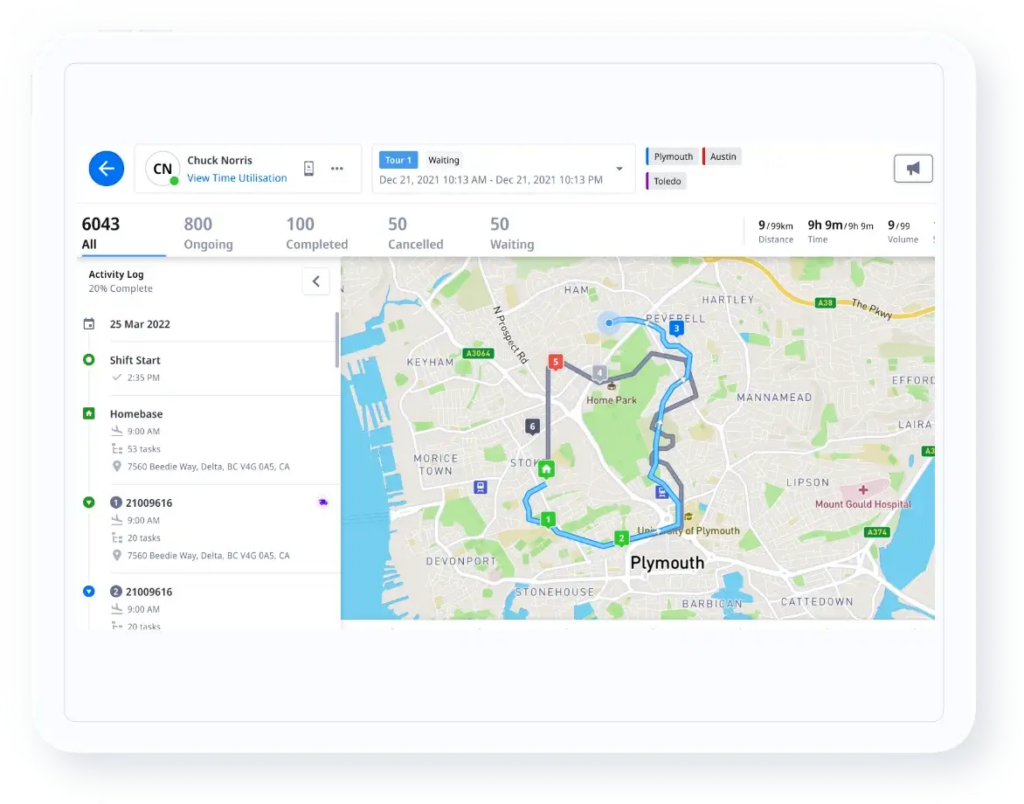
Enhancing retail logistics visibility through integrated API data reduces the customer experience cost of logistics failures: fewer missed delivery windows, fewer reactive support interactions, and fewer secondary delivery attempts, generating additional carrier spend.
Orchestration Is the Structural Fix Enterprise API Integration Needs
Point-to-point connections accumulate maintenance burdens, expose operations to carrier versioning disruptions, and leave planning systems disconnected from real-time execution constraints. Moving to an orchestration layer addresses all three failure modes by placing intelligence above the integrations rather than inside each one. Locus powers this layer for enterprises across retail, FMCG, 3PL, and e-commerce, converting carrier, warehouse, and order management API data into real-time routing and allocation decisions. The result is 20% logistics cost reduction and 99.5% SLA adherence, with $320 million in documented transit savings across 1.5 billion deliveries. Schedule a demo to see how the orchestration architecture performs at your operation’s scale.
Frequently Asked Questions (FAQs)
1. What is the difference between logistics API integration and logistics orchestration?
API integration establishes data connectivity between logistics systems. Carrier APIs exchange rate and order data, WMS exposes inventory and dock status, and OMS pushes order events downstream. Orchestration applies decision logic to the data flowing through those connections. An integration layer retrieves a carrier rate; an orchestration layer uses that rate alongside 180 or more operational variables to make a real-time carrier allocation decision before the planning window closes.
2. How do enterprises handle unannounced carrier API changes without service disruption?
Enterprises running direct carrier integrations handle unannounced API changes reactively, assigning developers to rebuild affected connections under operational pressure. Enterprises running an orchestration layer push the exposure to the vendor, who manages carrier API version compatibility at the integration tier. Resilience protocols also matter: sandboxed testing per carrier API, automated regression checks against new versions, and fallback carrier allocation logic reduce the disruption window from weeks to hours.
3. Which logistics API integrations should enterprises prioritize first?
Prioritization depends on vertical. Retail enterprises prioritize OMS-to-carrier connectivity. FMCG and CPG operations prioritize warehouse and fleet management integration for DSD. 3PLs prioritize multi-client carrier abstraction to serve diverse shipper requirements without building per-client integrations. E-commerce brands prioritize marketplace API connectivity, followed by returns and tracking. Across all verticals, financial reconciliation APIs are consistently last to be integrated and most likely to harbor undetected cost leakage.
4. How does AI improve the ROI of logistics API integrations?
AI improves integration ROI through two mechanisms. First, it applies real-time decision logic to unified API data: when carrier rates, vehicle capacities, delivery window constraints, and traffic conditions are accessible from a single integration layer, an AI routing and allocation engine can optimize across all variables simultaneously. Second, AI-driven exception handling reduces the manual intervention cost of integration failures. Predictive SLA breach detection surfaces at-risk deliveries 15 to 30 minutes before a breach occurs, giving dispatchers an action window before the failure is logged.
5. What are the risks of relying on point-to-point API integrations at enterprise scale?
Four risk categories compound with point-to-point architectures at scale. Versioning risk: each carrier API update requires a dedicated engineering response across every integration referencing that carrier. Sprawl risk: as carrier count grows, independent integrations grow at the same rate, with no shared logic layer managing allocation. Visibility risk: integration health data is distributed across individual monitors rather than consolidated in a single operational view. Propagation risk: execution constraints from carrier or warehouse APIs don’t automatically reach planning systems, producing the disconnects generating reactive exception handling at volume.
Sources and References
- Locus: AI-driven route optimization
- Locus: Automated route planning solutions
- Locus: Last-mile technology solutions
- Locus: E-commerce logistics
- Locus: Modular, API-first architecture
- Locus: Enhancing retail logistics visibility
- Locus: Supply chain network design for food and beverage brands
- AFS Logistics: UPS and FedEx API changes
- FedEx Developer Portal: FedEx APIs
- UPS Developer Portal: UPS APIs
- DHL Developer Portal: DHL APIs
- USPS Developer Portal: USPS APIs


Retail & CPG
Retail Fulfillment in 2025 – A Comprehensive Overview

Aug 29, 2026
Retail fulfillment in 2025 explained, challenges, strategies, and models. Learn how Locus simplifies fulfillment with AI-driven automation.
Read more
General
Delivery Slot Optimization Software Buyer’s Guide: What to Evaluate Before You Shortlist in 2026

Aug 31, 2026
Slot booking and slot feasibility are two products sold under one name. The capability ladder, the checkout latency constraint, seven evaluation criteria, and the questions that separate them.
Read moreInsights Worth Your Time



















API Integrations for Logistics Platforms: From Fragmented Connectivity to Intelligent Orchestration