


General
How to Reduce Failed Deliveries: The Six Levers, in the Order That Works in 2026

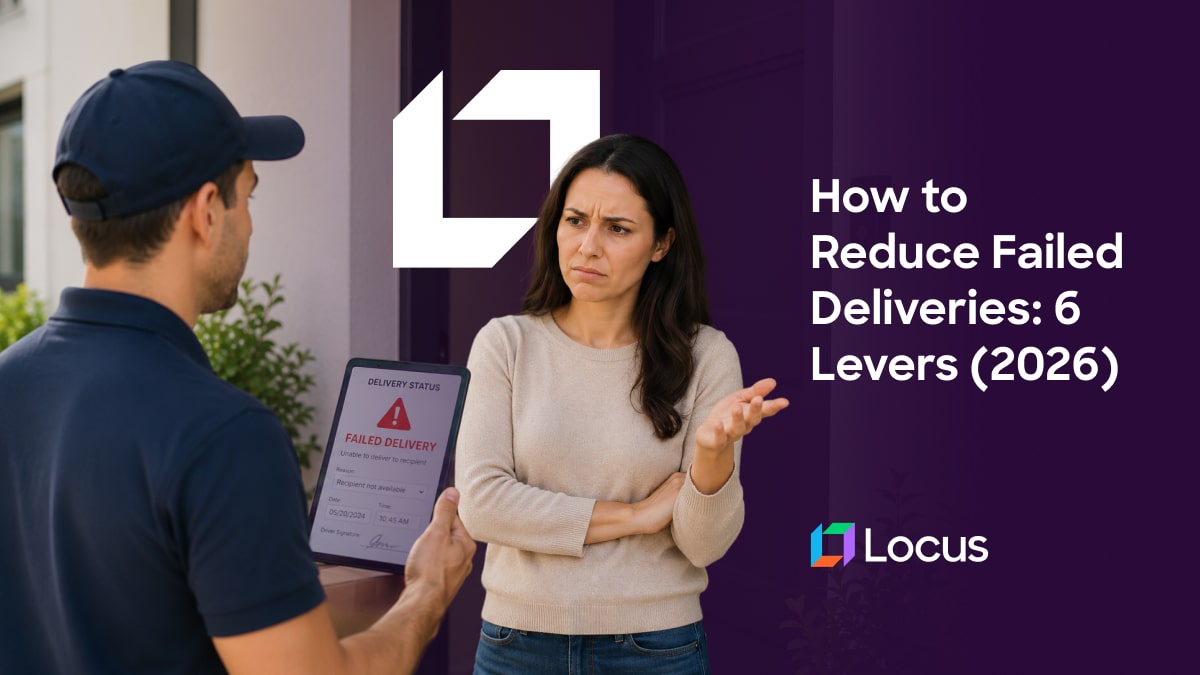
To reduce failed deliveries, act before the vehicle is loaded rather than after it has left. A failed delivery is a first attempt that does not complete, and the six levers that reduce them fall into three intervention windows: decisions made before dispatch, actions taken in flight, and recovery after a failure. Yield falls sharply at each stage, so the order in which an operator deploys them matters more than how many are deployed. Most operations begin with customer notifications because they are the cheapest to buy, and notifications only help a customer who could have acted anyway.
Key Takeaways
- Failed deliveries are not random. First attempts fail for fixable reasons: inaccurate addresses and geocoding, absent recipients, infeasible windows and no proactive communication.
- The six levers sit in three windows. Address validation and carrier allocation happen before dispatch, routing and notifications in flight, analytics and recovery after failure.
- Pre-dispatch levers return the most because they prevent the attempt from being wasted. Post-failure levers only recover part of an already sunk cost.
- Notifications multiply the upstream levers and substitute for none of them. A perfect alert cannot save a delivery to a wrong address or an infeasible window.
- Allocating each order to the carrier with the highest historical first-attempt rate in that specific zone, rather than on cost or availability, produces the largest single structural gain.
- Locus data indicates that for an operation running 10,000 daily orders, a five-point improvement in first-attempt rate recovers an estimated $4.5M in annual redelivery cost.
Why failed deliveries cost more than a redelivery: the business case
A failed delivery is not a delayed delivery. It consumes the full cost of an attempt with no delivery event, then consumes the cost of a second attempt to achieve what the first was paid for. That structure means a failure costs at least twice the operational cost of a success before any support contact, refund or return handling is counted.
The best-attributed external benchmark puts a failed standard parcel attempt at roughly $17.78. Applied at scale the figures become material: Locus data indicates that for an operation running 10,000 daily orders, even a five-point improvement in first-attempt delivery rate recovers an estimated $4.5M in annual redelivery costs.
The leg where this happens is also the most expensive leg you run. McKinsey puts the last mile at 60% to 70% of total parcel delivery cost, and found that raising drops per stop from one to five cuts labor and vehicle cost by more than 50%. A failed stop destroys that density: the vehicle travelled to the address and returned with the goods, so the route absorbed the cost of a stop and delivered nothing.
Two conditions make failure more likely than operators assume. Travel time varies by market rather than nationally, with INRIX putting US congestion at 49 hours per driver in 2025, Chicago at 112 hours and New York at 102, so windows promised on national assumptions are unreachable in dense metros. And carrier portfolios have widened, with AlixPartners finding more than 90% of home delivery executives now running a mix of last-mile carriers and 32% using four or more, which means first-attempt performance now varies by carrier and by zone within one operation.
Also Read: First-Attempt Delivery Rate: The Profitability Metric
What causes failed deliveries
Five causes account for most first-attempt failures, and all five are addressable.
Inaccurate or incomplete address data. Missing unit numbers, mis-geocoded coordinates and unstructured address fields send drivers to the wrong point or to a point they cannot reach.
Absent recipients. The most cited cause, and largely a function of whether the customer knew when to expect the delivery and whether that time suited them.
Infeasible delivery windows. A window sold at checkout that the fleet was never able to serve produces a failure that was determined before the order was even planned.
Late arrival from routing that ignores real conditions. Plans built on average travel times run late in dense markets, and lateness at the end of a route converts into missed windows rather than minor delays.
No visibility for dispatch or driver. Without live status, a developing failure is discovered at the door rather than while it can still be prevented.
How to reduce failed deliveries: the six levers in order
The levers below are ordered by intervention window, because that is what determines their yield. A lever that acts before dispatch prevents a wasted attempt. A lever that acts after failure recovers part of a cost already incurred.
Lever 1: Validate and enrich the address before dispatch
Clean address data at intake rather than at the door. Validate structure, geocode to a rooftop or access point rather than a street centroid, and flag incomplete or anomalous records for correction before the order enters planning. This is first because a wrong address defeats every other lever, including a perfect notification.
Lever 2: Allocate to the carrier or fleet with the best first-attempt record in that zone
This produces the largest single structural improvement available. Assigning each order to the carrier with the highest historical first-attempt rate in that specific zone, rather than on availability or cost alone, changes the base probability of success before anything else happens. It requires per-zone performance data by carrier, which is why most operations allocate on cost and never discover the difference.
Lever 3: Sell only windows the fleet can actually serve
Slot feasibility belongs at checkout. If a window is offered that current committed volume and known access constraints cannot support, the failure is created at the point of sale and merely discovered later. Confirming or letting the recipient choose a window they will be present for addresses the absent-recipient cause at its source.
Lever 4: Route dynamically and re-plan in flight
Plans degrade during the day. Dynamic routing adjusts to traffic, cancellations and stops that run long, and a failed stop should re-enter the queue automatically rather than wait for a dispatcher’s phone call. The test of a routing system here is not plan quality at 6am but what it does at 10am when a driver is twenty minutes behind.
Lever 5: Notify the recipient proactively, and at the right moments
Notifications at dispatch, at a thirty-minute approach and on completion measurably reduce no-shows, and first-attempt rates correlate with how many useful touchpoints occur before arrival. This lever is fifth deliberately. It multiplies the effect of the four above and substitutes for none of them, because a customer who is told accurately about a delivery to the wrong address still does not receive it.
Lever 6: Analyze failures by cause, then feed the finding upstream
Track failures by reason code, time of day, geography, carrier and route, and look for clusters rather than volume. Clusters indicate systemic causes that belong back in levers one to three: a building that always fails, a zone where one carrier underperforms, a window that is never met. Two-way driver and dispatcher communication belongs here too, since same-day recovery salvages a subset of failures that would otherwise become redeliveries.
The sequencing point is the one most operations get wrong. Notifications are the cheapest lever to buy and the most visible internally, so they are frequently deployed first and alone. They will produce a real improvement and then plateau, because the remaining failures are caused by things a message cannot fix.
The six levers by intervention window and yield
| Lever | Window | Why the yield sits where it does |
|---|---|---|
| Address validation and enrichment | Before dispatch | Prevents an attempt that could never succeed. Defeats every downstream lever if skipped |
| Carrier or fleet allocation by zone performance | Before dispatch | Changes base success probability before execution begins. Largest single structural gain |
| Slot feasibility at checkout | Before dispatch | Removes failures created at the point of sale rather than in operations |
| Dynamic routing and in-flight re-planning | In flight | Protects windows already promised, but cannot fix a bad address or an infeasible slot |
| Proactive customer notifications | In flight | Multiplies the upstream levers. Plateaus quickly when deployed alone |
| Failure analytics and same-day recovery | After failure | Recovers part of a sunk cost, and generates the data that improves levers one to three |
What to look for in a delivery experience platform
Real-time routing and in-flight re-routing. Ask what the system does when a driver runs twenty minutes late mid-route: re-plan the remaining stops, or raise a flag. Only the first protects the windows still ahead.
Slot feasibility at the point of sale. Confirming the platform can prevent a window being offered that the fleet cannot serve, which is the cheapest failure to eliminate because it never reaches operations.
First-attempt rate tracking by carrier and zone. The reporting must break first-attempt performance down to carrier and zone, since that is the input the highest-yield lever depends on. A blended rate cannot drive allocation.
Automated customer notification tied to live position. Notifications should fire on actual vehicle progress rather than a static schedule, since an alert that says thirty minutes when the driver is ninety minutes away damages trust rather than building it.
Failure root-cause reporting by category. Reason codes need to be specific enough to act on, and attributed to the address and the carrier rather than only to the order, so that clusters become visible.
API integration with your OMS and WMS. Address data, service tier and access notes have to reach the planner automatically. Manual enrichment does not survive volume.
Also Read: Best Last-Mile Delivery Companies and Platforms for US Enterprise Shippers (2026)
Reducing failed deliveries in practice: real-world results
Fresh grocery, 30+ cities, contracted third-party fleet. Fresh and chilled orders delivered through contracted operators, where a missed window means spoiled product rather than a late parcel, so first-attempt success was the operating constraint. With allocation and execution orchestrated on Locus, the operation delivered 33% faster deliveries and 15% lower fulfillment cost, with customer support resolution 10 to 20 times faster and manual shipping time down 25%.
Fortune 50 parcel and freight, 4,500 drivers, 51 sites. Dispatch decisions were made locally with no consistent way to compare sites, which is the condition in which per-zone performance differences stay invisible. Centralizing execution on Locus lifted weekly execution rate from 75% to 92% and uncovered more than $14M in unused contracted capacity, at 99.99% uptime. Execution rate is the fleet-side expression of first-attempt success.
Common mistakes when trying to reduce failed deliveries
Deploying notifications first and calling it a program. They work, they are cheap, and they plateau. The plateau gets misread as a ceiling on first-attempt performance when it is a ceiling on that one lever.
Allocating carriers on cost while measuring on service. If allocation ignores per-zone first-attempt history, the highest-yield lever is switched off, and no amount of downstream effort compensates.
Excluding customer-caused failures from the metric. Removing absent-recipient failures from the first-attempt rate removes most of the failures that better scheduling and communication would prevent, leaving a flattering number and no improvement path.
Reading failure volume instead of failure clusters. Totals tell you how much it cost. Clusters by address, building, zone, carrier and time of day tell you what to fix, and only the second changes next month.
How Locus reduces failed deliveries across all six levers
Locus, the world’s first Decision-Intelligent, Agentic TMS, addresses failed deliveries where they originate, which is the dispatch decision rather than the delivery attempt. Moving intervention upstream to the dispatch layer, where risk is scored before a route is confirmed, is where structural improvement in first-attempt rates comes from.
The Digital Supply Chain Officer (DiSCO) framework runs a continuous Sense-Decide-Execute-Learn cycle across eight specialized agents, reasoning over 250+ real-world constraints. Address intelligence and geocoding run at intake, so a flawed record is corrected before planning rather than discovered at the door. The Carrier Agent allocates each order against live rate, capacity and recent zone-level performance, which operationalizes the highest-yield lever, and ShipFlex provides 1,000+ pre-integrated carriers so allocation has real choice. The Capacity Agent tests slot feasibility before availability is shown at checkout. DispatchIQ re-plans in flight across hundreds of concurrent constraints, reaching 99.5% on-time delivery in multi-region deployments against the 80% to 90% typical of manual dispatch. The Customer Agent owns the promise and drives notifications from live vehicle position rather than a static schedule. The Orchestrator Agent normalizes reason codes and cost across carriers, which is what makes failure clusters visible and turns lever six into an input for levers one to three.
Across more than 1.5 billion deliveries for 360+ enterprise customers in 30+ countries at 99.99% uptime, Locus has produced over $320M in documented logistics cost savings. Locus has been recognized by Gartner for seven consecutive years, including the 2026 Gartner Hype Cycle for Supply Chain Execution and Logistics Technologies, is a Leader in Transportation Management Systems in the QKS Group SPARK Matrix, and ranked #1 in Route Planning on G2’s 2026 Best Software Awards.
In October 2025, Ingka Investments, the investment arm of Ingka Group, the world’s largest IKEA retailer, acquired Locus. Locus continues to operate independently.
Request a Locus failed delivery assessment to see which of the six levers your operation is missing and what a five-point first-attempt gain is worth on your volume.
Also Read: Cost of Failed Deliveries and How AI Routing Helps
Frequently Asked Questions (FAQs)
What is considered a failed delivery?
A failed delivery is a delivery attempt that does not result in the goods being handed over or left in an agreed place, so the shipment returns to the vehicle and requires another attempt, a redirection or a return. The common causes are an absent recipient, an inaccurate or inaccessible address, arrival outside an agreed window, or a refusal at the door. It is distinct from a late delivery, which completes, and should be counted whenever the first physical visit does not complete regardless of cause.
What is a good first-attempt delivery rate?
There is no single figure, because the achievable rate depends on delivery model, geography and whether goods can be left unattended. What matters more than the target is the definition: count every first visit that does not complete, with no exclusions for customer-caused or access-caused failures, because those are precisely the failures that better address data, feasible windows and proactive communication prevent. A rate that excludes them will look strong and will not improve.
How do logistics companies track failed delivery rates?
By joining delivery attempt events to order records, then attributing each non-completion to a reason code, an address and a carrier. Useful tracking is segmented rather than blended: by carrier, by zone, by time of day, by building or address type, and by service tier. That segmentation is what turns a cost figure into an action, because failures concentrate in clusters that indicate a systemic cause rather than distributing evenly.
What software reduces failed deliveries?
Platforms that intervene before dispatch rather than only reporting after it. The capabilities that matter are address validation and rooftop geocoding at intake, carrier or fleet allocation using per-zone first-attempt history, slot feasibility checking at checkout, dynamic in-flight re-routing, notifications driven by live vehicle position, and reason-code analytics attributed to address and carrier. Locus provides these in one platform, reasoning over 250+ real-world constraints across 1,000+ pre-integrated carriers.
Which lever reduces failed deliveries the most?
Allocating each order to the carrier or fleet with the best historical first-attempt rate in that specific zone, rather than on cost or availability. It changes the base probability of success before execution begins, and it is the lever most operations never switch on because it requires per-zone performance data by carrier. Address validation is a close second, since a wrong address defeats every other lever including notifications.
Do delivery notifications actually reduce failed deliveries?
Yes, and they plateau. Proactive notifications at dispatch, at a short approach window and on completion reduce absent-recipient failures, which is the most common cause. But they only help a recipient who could otherwise have acted, so they cannot recover a delivery to an incorrect address or one scheduled in a window the fleet was never able to serve. Treat notifications as a multiplier on the pre-dispatch levers rather than a substitute for them.


General
Best TMS for Multimodal Logistics Operations: Top Solutions Compared (2026)

Sep 3, 2026
Compare the best TMS platforms for multimodal logistics in 2026. Evaluate key capabilities, AI dispatch, visibility, and how Locus orchestrates it all end-to-end.
Read more
General
Seven Tenets of an Agentic TMS: How to Test a Vendor Against Each in 2026

Sep 3, 2026
Seven tenets separate an agentic TMS from a legacy platform with AI features. Each one has a test a buyer can run in a demo, and most vendors fail at least three.
Read moreInsights Worth Your Time



















How to Reduce Failed Deliveries: The Six Levers, in the Order That Works in 2026